
Species, Physical Form, and Sensory Traits
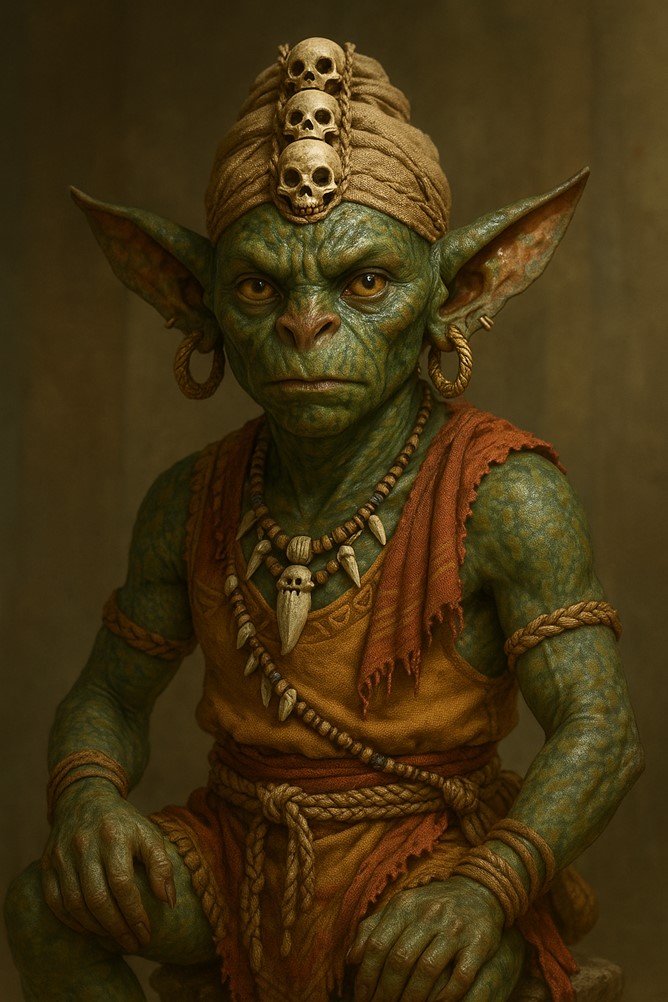
The Ka’thirn are a compact, sinewy people with elongated limbs, lean torsos, and angular facial features that give them a perpetually watchful look. Skin tones range from kelp-green to weathered bronze, often mottled with tide-mark patterns or speckled with flecks of darker pigmentation—patterns that intensify during emotional surges. Large, bat-like ears flare outward, giving exceptional sound triangulation, while wide-set amber or sea-gray eyes are adapted for sharp low-light vision and rapid movement detection. Their sense of smell is keen enough to detect subtle changes in wind-borne scents, useful both for hunting and in courtly intrigue. The Ka’thirn’s voices are naturally resonant and carry well across open air or water, giving them an orator’s edge in both governance and rallying troops.
General Size
Adults average 4½ to 5 feet in height, with a wiry build ranging from 85 to 115 pounds. Despite their slight frames, dense muscle fiber grants them surprising strength for their size, particularly in short bursts.
Body Pattern
Skin markings mimic the coastal terrain of Stillbay—streaks like wave foam, mottled patches like tidal stone, or stripes reminiscent of wet sandbars. These patterns shift subtly over years, often deepening with age and status, and in some rare individuals, can produce faint bioluminescence during high-magic ebbs.
Life Cycle
Ka’thirn reach physical maturity at around 14 years, though cultural adulthood is marked at 16, after a rite called The Tide’s Binding, in which the youth proves their ability to survive a full lunar cycle along Stillbay’s unpredictable shoreline. Average lifespan is 65 to 80 years, though members of the ruling family often live longer due to access to rare restorative gear. Family lines are matrilineal, with property and titles passing through the female bloodline.
Potential Positives Due to Physical Form
• High agility and reflex speed, especially in shifting terrain.
• Excellent night vision and auditory acuity.
• Strong short-burst climbing and leaping ability.
• Naturally efficient swimmers, able to hold breath longer than most land races.
Potential Negatives Due to Physical Form
• Slighter bone structure means reduced raw lifting capacity compared to heavier-built races.
• Sensitive ears can be overwhelmed by sudden loud noises or disruptive magic.
• Saltwater dehydration can cause joint stiffness if they remain inland for long periods without coastal remedies.
Tags: Stillbay, Vhallic, Goblin-kin, Maritime, Tier-1+, Coastal-Adapted, Regal, Monarchy, Gear-Focused, Magic-User, Seafaring, Nocturnal-Adapted, Sharp-Toothed, Coral-Craft, Clan-Loyal, Trade-Oriented, Island-Nation
Specialized Item Slots Available
Due to their lean frames and joint flexibility, Ka’thirn can wear up to two additional lightweight strapped items along the ribcage without penalty, often used for throwing pouches, scroll tubes, or aquatic breather masks. Their ears can hold dual sets of ornamental or magical ear cuffs without interfering with headgear.
Environmental Adaptability
The Ka’thirn are most at home along coastal, tidal, and estuarine environments. They adapt well to urban life but retain instinctive comfort in cliffside and lagoon settlements. Prolonged stays in arid or high-altitude environments require them to maintain special hydration rituals and carry sea-salt infusions to prevent inner ear imbalance.
Other Information Important to This Race
• The ruling family claims descent from a mythical sea-hunter said to have harpooned the moon’s reflection to draw the tides in their favor.
• They maintain an unbroken tradition of ornate ear markings that denote lineage and political standing; higher nobility often bears piercings set with carved shell or coral inlays.
• Ka’thirn are adept at working intricate ropecraft and netting, skills that are as valued in warfare as they are in trade and fishing.
• Their cultural emphasis on oral history means memory-anchoring magic in their language is woven into everyday speech.
Tide-Wrought Crown and Stone of Many Echoes
It is told, in words passed from the mouths of wave-singers to the ears of shell-carvers, that in the First Dawns of Stillbay, before the coral palaces had roots and before the pearl vaults were closed, there was a Prince-Without-Hull. He was not yet crowned, for the Crown slept in the deep silt, and no one in the bloodline dared disturb it lest the ocean rise in anger. His name was given as Kalru, though in the older shell-scratches it is written with runes now broken, and some say the name meant “One-Who-Waits-for-the-Tide” or “He-Who-Holds-a-Net-with-No-Hands.”
The tale begins with the sky dropping cold rain for thirty-and-two tides without end. Fish swam far from the harbors, ships rotted at their moorings, and the people of the coast ate only bitter root and the black meat of sand crabs. Kalru, who was yet young and without the gear of a warrior, sat among the rain and asked the elders why the fish would not return. They told him the sea had turned her face away, for the Stone of Many Echoes had been stolen from her floor by hands not of the bloodline. Without the Stone, the sea could not hear the songs of the fisherfolk, and so she gave nothing back.
It is said that Kalru took up no sword, no spear, no bow, but wrapped himself in a cloak woven of sailcloth and sharkskin, so that the water would not taste his skin. He carried only a shell-horn to speak beneath the waves. For three nights and four days he dove in secret, traveling where the pressure bruises bone and the light is only memory. In the silted hall of the Deep Shell Giants, he found the Stone upon an altar of ribs and basalt. The Giants told him that they had taken it to hear the voices of the stars through the water, for without it, their dreams were silent.
Kalru did not draw blade against them, for he had none. Instead, he told them of the people above, whose nets were empty and whose bellies sank hollow. He offered them a bargain: if they would return the Stone to the sea’s own cradle, he would come each year to tell them the new songs of the world above, carved into whale bone and sung through the horn. The Giants listened, and though their teeth were sharp as anchor-flukes, they knew the worth of stories. They gave him the Stone, warning that it must never again be held by one who does not hear both the tide’s voice and the land’s heartbeat.
Kalru swam with the Stone clutched to his chest. The fish followed him, first a few, then many, until the water boiled with silver and blue. When he placed the Stone back into its cradle—a hollow of living coral said to be older than the moon—the rain ceased, the sun shone, and the people cheered as ships left the harbor heavy with sail.
But the story does not end there. The elders say that when Kalru returned, the tide itself rose up in the shape of a woman crowned with foam, and in her hand was the Crown that had slept in the silt. She placed it upon his head, saying in words like breaking waves, “He who wears this must carry both hunger and plenty, both storm and calm.” And so Kalru became the first Tide-King, and the bloodline has never since been broken.
In the carvings, his face is always shown half in shadow, half in sun, for he was neither wholly of the land nor wholly of the sea after that day. The shell-horn, the sharkskin cloak, and the Stone’s resting place are still guarded, and each monarch of Stillbay must dive alone to touch the coral cradle, so the sea remembers who wears the Crown.
Moral: The one who would rule must hear the needs of both the seen and the unseen, for a kingdom is as much what it hides as what it shows.