
Physical Form and Sensory Traits:
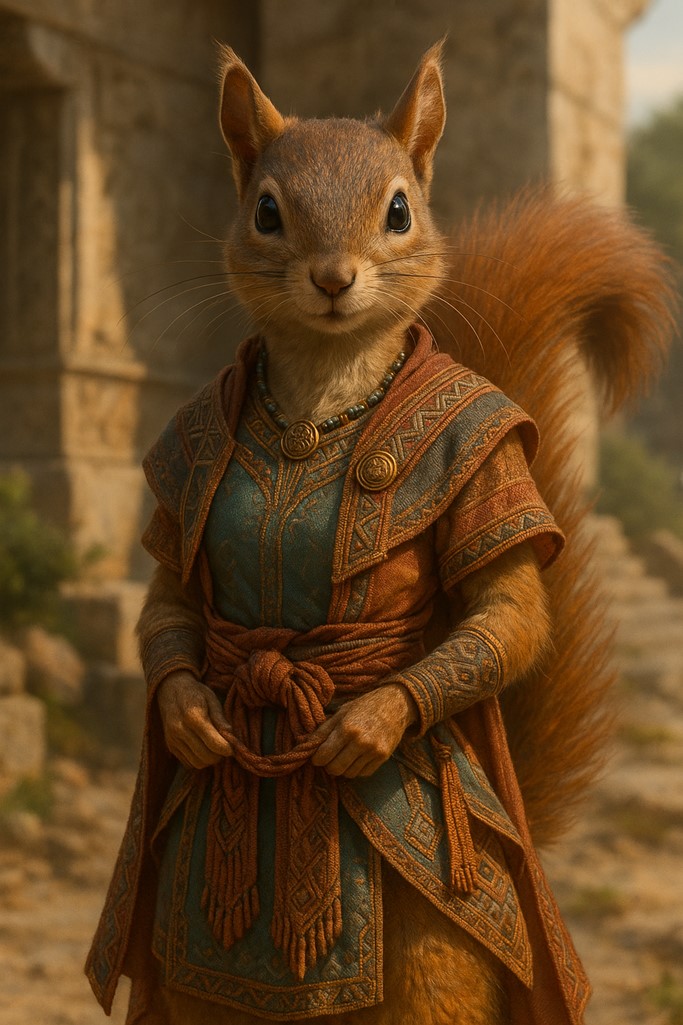
The Kaerunai are lithe, quick-bodied avatars whose build blends delicate precision with muscular agility. They are covered in fine, weather-resistant fur that naturally repels saltwater and coastal mists, maintaining insulating warmth without becoming waterlogged. Their tails are long, plume-like, and highly expressive, used for counterbalance in leaping, mid-air turning, or stabilizing on narrow perches. Hands and feet have dexterous, claw-tipped digits with a semi-prehensile quality, allowing them to scale rigging, cliff faces, and architectural beams with ease.
Their faces are angular yet soft-featured, with bright, forward-set eyes adapted for rapid focus changes—switching from wide peripheral awareness to detailed close inspection in a fraction of a heartbeat. Their ears are long, tufted, and capable of independent rotation, able to detect high-frequency sounds and gauge wind direction changes through subtle shifts in air pressure. Whisker-like vibrissae sprout subtly from cheekbones and forearms, sensitive to vibration through air and surface contact. Their sense of smell is tuned not to distant odors, but to the fine distinctions in freshness, fermentation, and mineral content—critical for coastal foraging and quality control of stored goods.
General Size:
Average height ranges from 4’10” to 5’4” for adults, with a lean, wiry musculature. Weight rarely exceeds 120 lbs, even for the most heavily built. Tails add an additional 1.5 to 2 feet in length.
Body Pattern:
Coastal Kaerunai display muted silver-grays, cream-whites, and driftwood-browns in their fur, often broken by darker dorsal streaks that fade toward the flanks. Inland variants tend toward warmer browns, russets, and tawny golds, with speckled or barred patterns across the shoulders and hips. Seasonal shedding produces thicker, fluffier coats in the cooler months and sleeker, shorter fur in hotter seasons. Distinct facial markings—such as a contrasting eye mask or light muzzle—are common and culturally prized as identifiers of lineage.
Life Cycle:
Kaerunai mature quickly compared to other sentient races, reaching young adulthood by age 10–12. Physical prime is reached by age 18, with most individuals living into their mid-70s if not lost to hazard. The ruling families keep meticulous genealogies, with political alliances often sealed through inter-house unions in their early adulthood years. Fertility rates are moderate, with litters usually of two offspring, and gestation lasting roughly four months. Child-rearing is communal in extended households, with older siblings and cousins trained early in both craft and court etiquette.
Potential Positives Due to Physical Form:
• Exceptional balance and agility, allowing feats of climbing, leaping, and rapid maneuvering even in confined or unstable environments.
• Keen hearing and rapid visual refocusing, enabling both scouting and fine-detail work in shipbuilding, weaving, or precision mechanics.
• Tactile whisker-sensing makes them adept at detecting subtle structural weaknesses or hidden compartments.
• Salt-repellent fur provides natural insulation for maritime travel.
Potential Negatives Due to Physical Form:
• Light frame and low body mass make them more vulnerable to blunt force trauma or high-impact falls compared to heavier-bodied avatars.
• Sensitive ears can be overwhelmed by explosive or resonant noises, impairing focus temporarily.
• High metabolism requires frequent caloric intake, making starvation and food scarcity harder on them than on more robust species.
• Tails, while useful, are also a grasp point for predators or opponents in close quarters.
Tags: Fur-Covered, Arboreal, Agile, Magic-Woven, Island-Dwelling, Sangoan-Heritage, Royal-Lineage, Herbivorous-Omnivore, Prehensile-Tail, Sharp-Clawed, Keen-Eyed, Whisker-Sensitive, Gear-Dependent, Tier-Adaptive, Culturally-Adorned, Environment-Attuned, Long-Lived
Specialized Item Slots Available:
• Tail Adornments Slot – Decorative or functional gear designed to attach to the base or length of the tail, often weighted or fitted with counterbalance charms.
• Ear Band Slot – Small circlets, comms-charms, or wind-gauging ornaments mounted over the ear tufts without impairing rotation.
• Climbing Grip Slot – Claw caps, gripping bands, or hook gloves for improved vertical travel.
• Standard humanoid item slots apply, though tail and ear slots provide unique tactical and aesthetic opportunities.
Environmental Adaptability:
Kaerunai thrive in maritime climates, cliffside settlements, and dense port cities. Their fur and physiology tolerate both wet coastal winds and inland tropical heat. They adapt less readily to extreme cold unless supplemented by layered gear. In urban architecture—particularly the Sangoan capital’s tiered wooden-and-stone terraces—they navigate multi-level structures with ease, treating walls, ropes, and rafters as natural extensions of the ground.
Other Information Important to This Race:
The Kaerunai are the marginally predominant race in the Sangoan Island Nation, representing just over half the population. Their influence is especially felt in trade fleets, shipbuilding guilds, and governance. The ruling family, descended from the earliest unifiers of the archipelago, holds authority both as political leaders and symbolic navigators of the nation’s fate.
Culturally, Kaerunai aesthetics emphasize fluid motion, layered fabrics that mirror tidal flow, and intricate knotwork patterns in ornamentation. Their architecture and clothing designs are shaped for agility—loose enough for freedom of movement but reinforced at points of wear for climbing and maneuvering.
They are natural traders, diplomats, and seafarers, guided by the belief that a leader must be able to traverse any height or hazard their people face. A Kaerunai diplomat might scale a mast to address a crowd just as readily as they might stand at a council table.
Crowned Tail in Wind of Many Days
And in the days before the counting of coins, when the lands of the red trees were still without walls, there was born to the nest of the Upper Branch a child with tail brighter than the dawnfruit skin. The people saw and said, “This is the Tail that will know the wind’s path before the wind does.” And the elders nodded, for the whiskers upon the child’s cheeks twitched when no storm was near, and the eyes were lit with the fire that had not yet been given by the sun.
The child grew fast in the learning of leaps, climbing the high bark to speak with the cloud-birds, and in the running of branches could chase shadow without fear of falling. Yet the child did not seek the golden acorn of kingship, for in those days crowns were heavy stones and brought no rest to the brow.
But the winds came one season as no season before, carrying with them the voices of strangers who sailed from the horizon’s edge. These strangers bore teeth of metal and eyes like wet stone, and their feet broke the roots without care. The people of the red trees scattered, for their tails were quick but their hands were few.
The child of the Upper Branch climbed to the Sky Fork, where the three oldest trees grew from one root, and there called to the wind by name. The wind came, coiling as a serpent, wrapping round the child’s tail, lifting it until the hairs shone like small spears. “Tell me, little branchling,” the wind whispered, “what will you trade for my swiftness and my unseen path?”
The child thought and did not speak for a full turn of the moon, for in silence one hears the shape of truth. Then said, “I will trade the ground beneath my paws, if only my people may have the sky in their eyes again.” The wind laughed without sound, and its breath scattered the leaves in a thousand spirals.
The strangers awoke to find the forest no longer where it had been. The roots had moved while they slept, carrying the people deep into the hills, and the red trees closed behind them like gates of green flame. And it was told that the child’s tail had grown long enough to touch the clouds, so that every gust from the north or the south carried word to the people before any danger could step near.
When age came, the child—now crowned not with stone but with woven air—taught the young to read the shift of leaves and the song of bark in the rain. Thus, the people lived many generations without the stranger’s shadow returning, and the ruling line bore always a tail that bent with the wind but broke not in the storm.
Moral: The one who listens longest to the silence will hear the wind’s true promise.