
Physical Form and Sensory Traits:
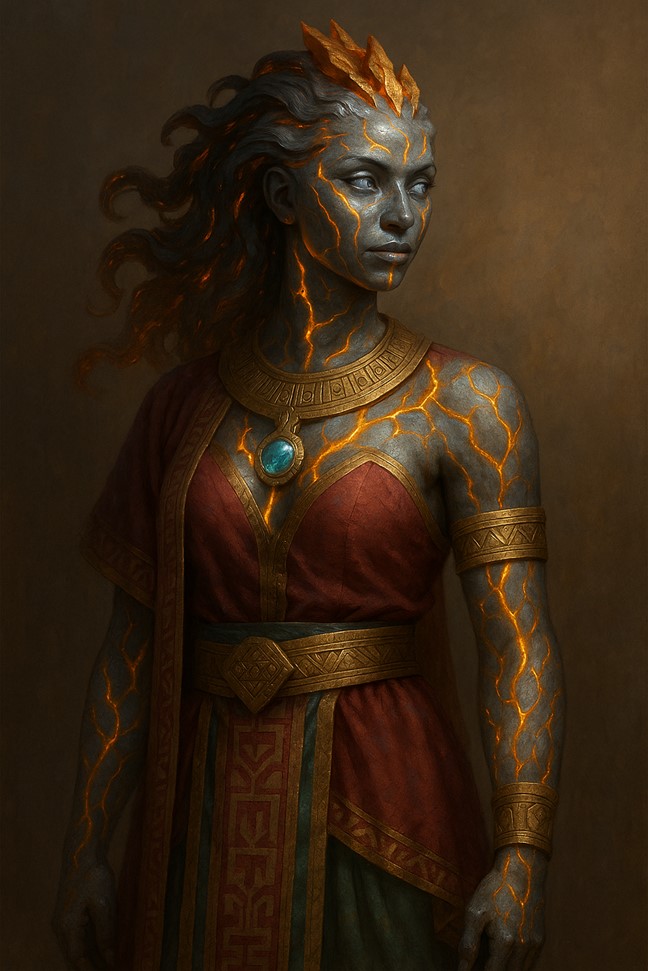
Qasvallorin appear largely humanoid in structure but with a striking elemental resonance that is both visible and tactile. Their skin is a composite texture of smooth, polished stone-like patches and faintly luminous, flowing seams resembling veins of molten ore or bioluminescent river channels. These seams shift subtly in hue depending on the individual’s attunement and the ambient mana flow—cool blues and greens during calm states, golds and crimsons in heightened emotion, and stark white or deep violet when preparing for conflict. Hair ranges from thick mineral-like strands to flowing locks that move as if in an unseen current, with color tones reflecting the elemental balance of their lineage.
Their eyes are entirely irised, with crystalline or glassy surfaces and depths that refract light, giving the impression of constantly shifting stormscapes, flowing lava, rushing water, or drifting clouds. Qasvallorin possess heightened sensitivity to atmospheric changes; their inner ear and skin seams can sense shifts in air pressure, humidity, temperature, and mana saturation. Hearing is slightly sharper than most avatars in the mid and high frequencies, but they rely heavily on a sense akin to barometric instinct to predict storms or mana surges.
General Size:
Adult height averages 1.75 – 1.95 m, with strong, balanced musculature suited for endurance rather than raw explosive strength. Weight varies between 70 – 105 kg depending on mineral density in their dermal plates.
Body Pattern:
Skin patterns are unique to each individual, a natural “sigil map” formed of the glowing seams and stony patches. These markings are culturally regarded as life-maps and are read by ritualists for omens. The patterning deepens in color and complexity with age, with elders often displaying intricate branching networks that appear almost like topographic maps of rivers and mountains.
Life Cycle:
- Birth: Qasvallorin are born as soft-skinned infants with faint seam traces; mineral patches form in the first five years as the body’s elemental resonance stabilizes.
- Adolescence: From age 13 – 18, seam colors become more pronounced, and sensory acuity sharpens. At this stage, elemental attunement can shift slightly due to environment and training.
- Adulthood: From 20 – 90 years, form and abilities remain stable; aging manifests as gradual dulling of seam glow unless actively replenished by high-magic exposure.
- Elderhood: Past 100 years, stone plates thicken and seams slow in color shift; elders often develop low-level mana leakage, which can be harnessed in rituals. Lifespan averages 130 – 150 years.
Potential Positives Due to Physical Form:
- Natural resistance to extremes of heat and cold due to insulating dermal plates and mana seams that regulate body temperature.
- Enhanced durability against blunt and cutting attacks (natural armor equivalent to a reinforced leather harness).
- Atmospheric awareness allows for early warning of environmental hazards or ambushes during sudden mana surges.
- Innate resonance with mana circuits allows slightly reduced attunement time when bonding to gear with elemental traits.
Potential Negatives Due to Physical Form:
- Mineralized dermal plates make swimming slower and more laborious without specific technique or buoyancy gear.
- Seam glow can make stealth more difficult in low-light conditions unless masked with special clothing or suppressive ointments.
- Sudden mana fluctuations in the environment can cause disorientation, seam spasms, or temporary numbness in extremities.
Tags: Elemental-Blooded, Mana-Veined, Recuayan-Heritage, Tier-Bound, Island-Ruler, Stone-Patterned, Heat-Resistant, Water-Linked, Wind-Attuned, Earth-Shaped, Mana-Breather, Gear-Empowered, Volcanic-Adapted, Coastal-Dweller, Magically-Sustained, Sensory-Acute, Ancient-Lineage
Specialized Item Slots Available:
- Seam Inlays: Unique to Qasvallorin; small socket-like depressions along seam lines can hold conductive inlays, gemstrips, or engraved mana-plates, granting them one extra magical accessory slot separate from the standard worn item count.
- Crest Mount: A head-slot adaptation that allows both ornamental and functional crests or headpieces to integrate with the mineral hairline for secure mounting, granting better conductivity for head-slot magical items.
Environmental Adaptability:
Qasvallorin adapt best to highland terraces, river valleys, and volcanic slopes, thriving in mana-rich regions with fluctuating elemental activity. While they can survive in deserts or arctic zones, prolonged exposure without mana replenishment dulls their seam glow and can cause lethargy. Underwater adaptation is limited but not impossible; their stone plating can endure deep-water pressure, though buoyancy remains a challenge.
Other Information Important to This Race:
- Qasvallorin culture places deep value on personal seam patterns, seeing them as living genealogies and mana signatures. Any attempt to artificially alter or carve these patterns is taboo, except in rare funerary preparation for rulers.
- They possess a long oral tradition of weather prophecy, seam reading, and geomantic navigation, which allows them to traverse their island’s diverse landscapes without reliance on maps.
- The ruling lineage’s seam glow is said to shift into a rare “dawn-spectrum” blend—an omen of legitimacy and prosperity. This trait is monitored closely in succession disputes.
- While they lack innate spellcasting, their gear-based magic often incorporates conductive alloys or inscribed stone compatible with their seam inlays, making their combat and craft styles distinct from neighboring peoples.
Song of Ash and Tide
It was said, before the mountain cracked the sky, before the waves forgot the shore, before the blood of stone and breath of clouds found one body, there was none like them. In the elder days, the island was restless—mountains moving in the night, sea bending in anger, and the air turning to knives. The people hid in low caves, listening to the old fires rumble, and none dared walk the high ridges where the horizon’s teeth cut the sun.
Then came the One-Who-Was-Many, whose skin bore maps of earth and whose hair flowed as wind over the black sands. In their veins ran the slow heat of the mountain’s heart and the salt weight of the sea. They spoke, though their voice was a chorus of storm, ember, wave, and stone. “This place is too wild for one soul alone to tame,” they told the frightened dwellers, “but I will not tame it—I will speak its names until it knows itself.”
They walked the ridges where no feet went, and the mountain’s fire rose to greet them. They cupped the molten stream in their hands and drank. The heat did not burn; instead, it traced glowing lines along their body like the rivers of the world’s first dawn. They waded into the deep water, where the tide’s pull had stolen many. The sea coiled around their waist, tasted the salt in their heart, and let them pass. In the clouded high air, where breath grows thin, they danced with the wind until they could leap from peak to peak without falling.
The dwellers followed, one by one, learning the old shapes: how to hold fire without fear, how to walk the deep without sinking, how to move as the wind without breaking. The One-Who-Was-Many carved stones with their breath, each mark a reminder that the island was not enemy nor master, but kin. From these stones grew the first city, where roofs curved like waves and towers rose like cooled spires of lava.
Yet in the third year of calm, a shadow from far across the water came—a great shell-backed beast whose claws could scoop valleys from the hills. It devoured the wind, drank the rain before it touched the ground, and cracked the hardened roads. The people fled to their caves again, but the One-Who-Was-Many stood upon the shore and called to the four in their blood. The fire in their chest roared into the beast’s face, the water in their limbs churned the sea into walls, the wind in their hair lashed the monster’s eyes, and the stone in their bones rooted them where the waves broke.
For three days and three nights, they fought—fire against shell, tide against claw, wind against roar, stone against strike—until the beast sank into the deep, leaving only bubbles like moons upon the water. But the One-Who-Was-Many had spent all their strength. Their body cracked into bright shards, each piece still glowing with the mountain’s memory, and scattered across the island.
The people gathered these pieces and set them into their walls, their gates, their harbor stones. They swore that their rulers would be of that same blood, so the island would never forget the shapes of fire, water, wind, and earth living in one body. And they teach their children to speak to the island, for it is still kin, still restless, still listening.
Moral: That which holds many natures can guard against many storms, but must give all to keep the balance.