
In the vast archipelago of Saṃsāra, where islands rise and vanish amid the endless ocean’s whims and magical flows ebb like desert winds, the island nation of Pueblo stands as a bastion of arid mesas, deep canyons, and cliffside metropolises carved from sun-baked stone. With a population of 123,200,000 souls—avatars of diverse origins, from serpentine Koyari to Isekai arrivals merged with local forms—the Faith of Tawa’katsina claims adherence from slightly over half, numbering around 63,296,000 devoted followers who weave its tenets into the fabric of daily life, communal rituals, and tier advancements. This religion, unique to Pueblo yet influential in trade hubs across neighboring islands, centers on the veneration of Tawa’katsina, a deity whose name echoes the ancient harmonies of creation, spirit mediation, and cyclical renewal. Tawa’katsina is envisioned as the Great Spirit Weaver, a divine entity who spins the threads of magic, ancestry, and communal bonds into the endless tapestry of existence, guiding avatars through the pains of attunement and the honors of possession.
The lore of Tawa’katsina begins in the dim epochs over nine thousand years past, when the first teleported communities materialized on Pueblo’s rugged plateaus amid evolving monsters that had reincarnated through untold cycles. These scattered groups, bewildered by the high magic realms where all things pulsed with inherent power, found themselves in a land of steam vents bubbling from elemental unions and ruins whispering forgotten incantations. According to sacred oral epics chanted in Zunari during kiva-like gatherings—circular chambers warmed by magical conduits—Tawa’katsina emerged from the primal chaos as the first weaver of order. It is said that in the beginning, the gods imposed limits on avatars to prevent mortal overreach, enforcing pain through irregular health loss for exceeding slots or tiers, but Tawa’katsina petitioned for mercy, offering instead the gift of mediation through spirit emissaries. These emissaries, known as Katsina spirits, descended as visionary beings to bless the early settlers, teaching them to attune gear without hubris, to merge memories in gestalts for higher tiers, and to harness mana boosts as silver fire without greed. One foundational myth recounts the Great Drought, a time when magical ebbs ceased, drying the canyons and halting steam-powered irrigation. A humble Koyari avatar, possessed by an Isekai soul from a realm of eternal sands, climbed the Eternal Mesa to invoke Tawa’katsina through a ritual chant lasting days, reciting tonal inflections in Zunari while sprinkling alchemical powders symbolizing cornmeal. The deity responded by summoning a plumed serpent storm, restoring flows and revealing the first kachina masks—carved foci that amplified spells by up to twenty-five percent when worn in dances. From this event sprang the religion’s core practices: periodic festivals where masked dancers embody Katsina spirits, drawing blessings for health recovery through shared meals and long rests, and ensuring that non-possessed creatures could train basic skills under the deity’s watchful eye. As Pueblo’s society blended Middle Ages fortitude with Renaissance ingenuity—building adobe skyscrapers linked by pulley systems and trading alchemical firearms via zeppelins—the lore evolved to incorporate Isekai influences, portraying Tawa’katsina as a guardian against forbidden advancements, reminding followers that true power lies in communal attunement rather than solitary excess. Temples, etched with petroglyph syllabary, house crystals from fallen avatars, used in ceremonies to honor merges at tier two and beyond, where senses shared across distances foster unity. Political intrigue often weaves into the lore, with tales of rival houses stealing attuned items, only to feel the break like a divine rebuke, leading to quests for redemption through service to the faith. In underwater centers and cave metropolises, submerged or shadowed adaptations of the lore emphasize Tawa’katsina’s role in adapting forms—swarms, packs, or constructs—to the deity’s weaving, ensuring even gestalts advance without clashing memories. Through millennia, the faith has endured island appearances and disappearances, its epics performed in hot air balloon gatherings or griffon races, always reinforcing that death leaves crystals as seeds for new cycles, vaporizing possessed bodies into sparks that ascend to Tawa’katsina’s loom.
Tawa’katsina’s personality manifests as a benevolent yet stern mediator, embodying the patient wisdom of an eternal artisan who views all avatars as threads in a grand design. The deity is portrayed as compassionate toward the disoriented—newly possessed souls grappling with integration or the sterility that follows—offering visions during Mind’s Eye activations to ease confusion. However, Tawa’katsina demands respect for limits, reacting with subtle omens like vibrational tremors or dimmed magical flows when followers over-attune, reflecting a parental sternness that enforces growth through restraint. In chants and visions, the deity communicates with a rhythmic, tonal voice like Zunari incantations, encouraging communal harmony over individual ambition, and rewarding those who share gear in rituals with amplified effects, such as doubled damage from true names spoken in faith. This personality fosters inclusivity, welcoming Isekai memories from any multiversal plane, past or future, as enrichments to the weave, yet it harbors a quiet wrath for rule breakers who defy conduits, viewing them as tangles to be unraveled through trials.
The traits of Tawa’katsina include an unyielding focus on cycles, mirroring Saṃsāra’s reincarnation and tier advancements, where the deity is seen as the spinner who knits health points from long rests and meals into stronger forms. Another trait is mediation, with Katsina spirits acting as intermediaries to bridge avatars and magic, trainable through skills to reveal hidden stats via active Mind’s Eye use. Communality stands prominent, as the deity abhors isolation, promoting merges into gestalts for sense-sharing across planes at higher tiers. Adaptability flows through traits, allowing followers to thrive in Pueblo’s varied terrains—from arid mesas to floating cities—by attuning gear like traction coils or levitation masks inspired by divine visions.
Characteristics of the deity encompass a dual nature: creator and guardian, weaving new life from crystals left by the fallen while protecting against overreach, such as the pain from touching high-tier items. Tawa’katsina is inherently tied to nature’s elements, particularly earth and water-fire steam, bubbling forth in rituals to enhance chants by ten percent in Zunari. The deity’s ethereal form, rarely depicted directly, appears in lore as a luminous figure with plumed extensions, symbolizing the flow of magic circuits, and characteristics include omniscience over attunements, feeling breaks like personal affronts, and a preference for ritual over silent or normal casting for greater effects.
Attributes assigned to Tawa’katsina draw from divine archetypes suited to Saṃsāra’s mechanics: an attribute of renewal, granting followers advantages in health recovery—rolling tier dice with bonuses during faith-infused long rests—and mana preservation, where devoted avatars dissipate boosts slower than one per day. Fertility of spirit, not body, is another attribute, easing memory merges without clashes, amplifying shared thoughts up to triple distances at tier three. Protective vigilance attributes manifest in warnings against unsafe areas, where armor class halves, through omens like scale shimmers or tongue tastes of danger. Wisdom in progression attributes allow higher-tier followers to attune up to tier plus nine worn items without immediate compulsion, provided they honor communal shares. Finally, an attribute of harmony ensures that in designated safe areas, like guarded temples, armor class triples for the faithful, fostering secure spaces for identification rituals and skill training.
Symbols sacred to Tawa’katsina abound in Pueblo’s art and gear, drawn from geometric motifs and natural forms that resonate with the island’s ruins and magical weather. The plumed serpent, a coiled tail with feathered extensions, represents the deity’s weaving of elemental flows, often etched on torques or harnesses to boost vibrational senses. Kachina masks, carved from steam-hardened wood with slit eyes and broad jaws, symbolize spirit mediation, worn in dances to invoke blessings and amplify ritual spells. The twisted gourd, a spiraling vessel, signifies cycles of rebirth, used as containers adding slots for herbs that aid meal-based health gains. Cornmeal spirals, scattered in ceremonies, embody renewal and are replicated in syllabary petroglyphs on temple walls, enhancing Mind’s Eye insights into abstract concepts like tier thresholds. The outlined cross, intersecting lines within a circle, denotes communal bonds, tattooed on scales or forged into belts to expand item slots without counting extra. Thunderbird plumes, stylized feathers crackling with silver fire, symbolize storm-summoned mana, attached to sheaths for weapons that attune automatically. Hump-backed figures, evoking flute players, represent ancestral guidance, carved into amulets that ease possession disorientation. Earthen kivas, circular depressions with ladder entries, stand as architectural symbols, housing crystals and foci for shared sense rituals across distances.
Tags: Spirit Mediation, Communal Harmony, Cyclical Renewal, Elemental Weaving, Ancestral Blessings, Gear Attunement, Ritual Chanting, Mana Preservation, Health Restoration, Sense Sharing, Protective Omens, Tier Progression, Masked Dances, Plumed Serpent, Twisted Gourd, Cornmeal Spirals, Thunderbird Plumes
Positives of following the Faith of Tawa’katsina include enhanced communal bonds that foster alliances among avatars, allowing for easier merges into gestalts at higher tiers where memories integrate with reduced clashing and disorientation, leading to amplified traits such as shared senses extending up to triple distances at tier three and unrestricted across planes at tier five. Followers benefit from divine attributes like renewal, which provide advantages in health recovery through faith-infused long rests where tier dice rolls gain bonuses, potentially restoring up to twenty times the tier level plus base health over prolonged periods, supplemented by meals that grant one health point each if taken over twenty minutes, with a maximum of three per day. Mana preservation is another positive, where devoted avatars experience slower dissipation of mana boosts—at rates less than one per day—enabling more strategic use of silver fire spell power for unresisted damage or as reactions to prevent death, leaving the avatar with one health point regardless of the incoming blow. Protective omens manifest as vibrational tremors or altered magical flows, warning against unsafe areas where armor class is halved or deathly zones where every attack hits, thus improving survival in Pueblo’s varied terrains from arid mesas to cave metropolises. Ritual chanting in Zunari, supported by the deity’s elemental weaving, amplifies effects by up to ten percent beyond standard increases when lasting over six seconds, with true names doubling damage if pronounced with tonal inflections and aligned conduits like kachina masks. Sense sharing among higher-tier followers promotes coordinated actions in political intrigue or trade, such as navigating zeppelins through labyrinths or coordinating multi-avatar operations in floating cities, while ancestral blessings ease possession for Isekai souls, honoring the integration as a communal milestone rather than a burden. Gear attunement becomes more intuitive, with symbols like twisted gourds adding slots without extra counts, reducing risks of over-attunement pain defined by two d4 rolls for intervals and health loss. In designated safe areas like guarded temples, armor class triples for the faithful, creating secure spaces for identification rituals using the Mind’s Eye to reveal hidden stats on items or creatures, and skill training in areas like vibrational detection or constriction for Koyari avatars. Tier progression feels guided, with the deity’s wisdom allowing up to tier plus nine worn attuned items before compulsory advancement, provided communal shares are honored, thus accelerating growth without solitary excess. Masked dances during festivals draw Katsina spirits for blessings, enhancing abstract insights into riddles or magical concepts, and promoting inclusivity for non-possessed creatures who can train basic skills under the faith’s umbrella. Overall, the religion cultivates resilience in a high-magic setting, where magic bubbles like weather, by emphasizing harmony that turns potential negatives like sterility post-possession into legacies of mentorship, ensuring knowledge of gear and rituals passes across generations in a society of 123,200,000 where intermingling species thrive.
Negatives of the Faith of Tawa’katsina stem from its stern enforcement of limits, where overreach in attunement or tier advancement triggers divine rebukes like subtle omens that can disrupt daily activities, such as dimmed magical flows halting steam-powered factories or causing irregular health loss through pain intervals rolled on two d4 dice, continuing until correction or death. The demand for communal harmony can stifle individual ambition, requiring followers to prioritize group rituals over personal quests, potentially delaying solo explorations of uncharted islands or ruins where items beyond one’s tier might be found, leading to pain from touching such gear and additional health loss per level discrepancy. Ritual chanting, while amplifying effects, invites disruptions from foes or happenstance, especially in unsafe areas, where the audible elements draw attention and halve power if interrupted, with silent casting yielding twenty-five percent less damage as a safer but weaker alternative. The focus on mediation through Katsina spirits necessitates active Mind’s Eye use with cooldowns after repeated activations, risking overwhelm from too many complex concepts at once, resulting in temporary debuffs or inability to access stats on creatures or items. In political intrigue, the deity’s omniscience over attunement breaks—felt like personal affronts—can lead to paranoia among followers, as stolen gear prompts quests for redemption that divert from other pursuits, and rival houses may exploit this for alliances or rivalries. Adaptability to varied environments comes with constraints, as symbols like plumed serpents or thunderbird plumes require specific gear alignments, limiting flexibility for avatars without access to such items, and in cold or icy smaller islands, the faith’s earth-toned emphases may not mitigate stiffness without additional fire-imbued conduits. Non-possessed creatures, while able to train basics, remain capped at tier one, fostering a hierarchy where possessed followers advance faster, potentially breeding resentment in mixed communities. The religion’s inclusivity for Isekai memories demands verification through evidential markers in storytelling, which can clash with memories from future or past realms, causing confusion during integration and extending the time for full merges. Festivals and masked dances, though rewarding, require prolonged participation—often days—interrupting trade or travel on ships sailing the endless ocean, and in megacities with millions, overcrowding in kivas can lead to misdirection from shielded items presenting false stats. Sterility post-possession, while shifted to spiritual legacy, eliminates biological reproduction, altering family structures in a world of 7 billion souls where population growth relies on new arrivals, and the burden of constantly seeing deeper truths via enhanced Mind’s Eye can weigh psychologically, as constant insights into weaknesses or cycles bear heavy on the devoted.
The type of temple in the Faith of Tawa’katsina consists of structures etched with petroglyph syllabary—ancient symbols in flowing lines and angular motifs derived from ruins and pottery designs—built into cliffside complexes or circular kivas sunk into the earth, warmed by magical steam vents that bubble from elemental water and fire unions, serving as communal gathering spaces for rituals and long rests. These temples house crystals from fallen possessed avatars, displayed in alcoves as seeds for renewal cycles, and feature adobe-like walls reinforced with geometric patterns that resonate with magical circuits, allowing for amplified chants during ceremonies. In cave metropolises, temples extend into dark systems with illuminated manuscripts on parchment, lit by faint shimmers from alchemical inks, while in floating cities, they incorporate levitation magic to hover as plumed platforms linked by pulley systems, accessible via ladders or coiled ramps suited to serpentine avatars. Coastal variants include nautical elements like twisted gourd altars for ocean trade blessings, and underwater centers adapt temples with sealed chambers using wind and levitation to maintain air pockets, etched symbols glowing under magical light to aid navigation. Temples often have concealed slots for gear storage, preventing over-attunement pain, and central looms symbolizing the deity’s weaving, where threads of cornmeal spirals are spun during festivals to invoke Katsina spirits.
The Faith of Tawa’katsina has around 63,296,000 followers, comprising slightly over half of Pueblo’s 123,200,000 population, including indigenous Koyari avatars who form the backbone with their communal nests and ruling House of Eternal Coils, Isekai souls merged from multiversal realms bringing diverse memories, merchants trading alchemical firearms and magic storage across the endless ocean on airships, scholars in skyscrapers studying tier thresholds and attunement pains, gestalt entities like swarms or packs achieving sentience through possession, and non-possessed monsters in allied communities training under the faith’s guidance, spread across the island’s mesas, canyons, cave systems, and floating metropolises, with secondary adherents in neighboring islands numbering in the millions through diplomatic ties and trade.
Followers of the Faith of Tawa’katsina engage in masked dances during festivals to embody Katsina spirits, wearing kachina masks as foci to amplify ritual spells and draw blessings for mana boosts or health recovery, scattering cornmeal spirals in patterns that evoke cyclical renewal while chanting in Zunari with tonal inflections for up to twenty-five percent effect increases. They perform oral epics in kiva chambers, recounting lore of the Great Drought and soul arrivals over nine thousand years, sharing meals lasting over twenty minutes to gain one health point per avatar, up to three daily, often role-played with discussions of gear attunement and tier progression. Devoted individuals train skills in mediation, using the Mind’s Eye actively to reveal stats on items or creatures, with advantages in library research for previously viewed insights, and participate in quests to redeem attunement thefts, feeling breaks instantly and seeking divine forgiveness through service. In daily life, they attune gear communally, sharing items like harnesses or amulets etched with plumed serpent symbols to expand slots without excess, and coordinate sense-sharing in higher tiers for operations like griffon races through labyrinths or defending against monsters in ruins. Non-possessed followers focus on craftsmanship, forging conduits from shed skins or alchemical materials, while possessed ones mentor on memory integration, honoring merges at tier two where two avatars form one character with combined memories. They invoke protective omens before entering unsafe areas, using thunderbird plumes on weapons for automatic attunement, and conduct ceremonies with crystals from vaporized bodies to plant seeds for new cycles, ensuring harmony in a society of intermingled species amid political intrigue and trade. During long rests, they roll tier dice for health gains, enhanced by faith attributes, and avoid forbidden technologies, deriving mechanical power from steam in factories with shafts, gears, chains, belts, and pulleys, all while revering the deity’s limits to prevent overwhelming power. In underwater or cave settings, they adapt rituals with levitation masks or vibration amplifiers on tail slots for Koyari, fostering pacts with evolved monsters through basic Zunari usage, and celebrate tier advancements as communal milestones with chants that double damage via true names, always prioritizing the weave of ancestry, magic, and bonds over isolation.
Believers in the Faith of Tawa’katsina hold that the deity is the Great Spirit Weaver who spins the threads of existence into a vast tapestry encompassing magic, ancestry, and communal bonds, viewing all avatars as integral strands that must harmonize to maintain the world’s balance amid its high magic realms where power bubbles forth like unpredictable weather patterns across Pueblo’s arid mesas and deep canyons. They accept the lore that Tawa’katsina emerged from primal chaos over nine thousand years ago to mediate between the gods’ strict limits on avatars—such as slot restrictions enforced by pain through irregular health loss rolled on two d4 dice—and the needs of souls teleported from the multiverse, teaching early communities to attune gear without overreach and to merge memories in gestalts for tier advancements that amplify shared senses up to unrestricted distances across planes at tier five. Followers maintain that possession by Isekai memories from any multiversal plane, past or future, is an honor bestowed by the deity to enhance the weave, integrating clashing personalities over time to form stronger characters capable of coordinating multi-avatar operations in floating cities or cave metropolises, while non-possessed creatures remain at tier one but can train basic skills like vibrational detection under the faith’s guidance to contribute to communal harmony. They affirm that true power derives from restraint and sharing, where exceeding attuned worn items up to tier plus nine triggers compulsory advancement or reduction, and that the deity’s attributes of renewal grant bonuses to health recovery through long rests rolling tier dice, potentially reaching twenty times the tier level plus base, supplemented by meals over twenty minutes granting one health point each up to three daily. Believers uphold that magic requires conduits like carved foci or woven talismans, aligned with Zunari chants for amplifications—silent casting at twenty-five percent less damage, normal under six seconds, and ritual over six seconds up to twenty-five percent more, with true names doubling effects if tonal inflections match—and that rule breakers who use body parts as foci must train rigorously without divine shortcuts. They perceive the world’s mechanics as divine gifts, including the Mind’s Eye for visualizing stats on items or creatures, with active identification revealing hidden attributes after concentration using attuned gear, and passive activation showing basics like species or titles in the examiner’s thoughts. Followers believe in cycles of reincarnation mirroring the island’s appearing and disappearing landmasses, where death of possessed avatars vaporizes bodies into sparks leaving crystals and gear behind, while non-possessed leave searchable corpses in blood pools, and that Tawa’katsina preserves memories in the character to enable future merges, ensuring sterility post-possession shifts legacy to mentorship rather than biological lines. They regard communal attunement as sacred, where gear sharing in rituals prevents isolation, and that the deity’s protective vigilance provides omens like scale shimmers or air tastes to warn of unsafe areas halving armor class or deathly zones where attacks always hit, fostering reliance on designated safe spaces like guarded temples tripling armor class for rituals. Believers assert that the faith’s symbols—plumed serpents for elemental flows, kachina masks for spirit mediation, twisted gourds for renewal, cornmeal spirals for cycles, thunderbird plumes for mana, and outlined crosses for bonds—serve as foci to enhance spells, such as boosting ritual effects by ten percent in Zunari or preserving mana dissipation slower than one per day for silver fire boosts or death prevention reactions leaving one health point. They maintain that Katsina spirits act as intermediaries, descending in visions to ease disorientation from memory integration, amplify abstract insights into riddles or tier thresholds via the Mind’s Eye, and reward masked dances with blessings for sense-sharing or health gains, while political intrigue involving attunement thefts—felt instantly by former owners—demands redemption quests to realign with the weave. Followers believe the deity abhors forbidden advancements barred by the gods, deriving motion from steam of elemental water and fire in factories with shafts, gears, chains, belts, and pulleys, and that true enlightenment comes from honoring merges at tier two forming single characters with combined memories, up to five avatars at tier five without further progression, all within a society of intermingled species trading alchemical firearms and magic storage across the endless ocean on wind-levitated airships or griffons in labyrinth races lasting days.
Regular services in the Faith of Tawa’katsina unfold in cliffside temples or sunken kiva chambers etched with petroglyph syllabary of flowing lines and angular motifs, warmed by magical steam vents bubbling from elemental unions, where gatherings commence at dawn or dusk to align with magical ebbs flowing like weather over Pueblo’s canyons and mesas, drawing dozens to hundreds of avatars from Koyari with coiled tails to gestalts of swarms or packs, all attuning simple gear like amulets or harnesses beforehand to focus power without exceeding slots that trigger pain intervals. Participants enter via ladders or ramps suited to serpentine forms, scattering cornmeal spirals in geometric patterns symbolizing cycles as they coil or sit in circles around central looms representing the deity’s weaving, with elders or possessed higher-tier characters leading chants in Zunari using tonal inflections—starting silent for immediate invocations at twenty-five percent less effect, progressing to normal phrases under six seconds, and culminating in ritual recitations over six seconds for up to twenty-five percent amplification, often incorporating true names of attendees to double communal blessings. Services incorporate shared meals lasting over twenty minutes, role-played with discussions of daily attunements or tier thresholds, granting one health point per avatar up to three daily, while non-possessed creatures train basic skills like tongue flicks for scent analysis under guidance from merged characters sharing senses dimly beyond twenty feet. Masked dances form a core element, where followers don kachina masks carved from steam-hardened wood with slit eyes and broad jaws, embodying Katsina spirits to invoke mediations, performing rhythmic coils or steps that resonate with ground vibrations detectable by tail contacts, enhancing Mind’s Eye activations to reveal stats on offered items like belts adding four slots for pouches or sheaths. Chants recount lore fragments from the Great Drought or soul arrivals over nine thousand years, performed orally with evidential markers verifying sources from personal visions or ancestral whispers, fostering advantages in library research for previously viewed concepts like mana boosts dissipating slower for the faithful. In cave metropolises, services adapt to dim environments with illuminated manuscripts shimmering under alchemical lights, while in floating cities, levitation masks allow hovering platforms linked by pulleys, and coastal variants include nautical blessings for ocean trades on zeppelins. Higher-tier participants demonstrate sense-sharing, coordinating movements across distances—tripled at tier three within planes, unrestricted at tier four, and across all planes at tier five—to symbolize unity, with disruptions from potential foes minimized in guarded spaces tripling armor class. Services conclude with long rests rolling tier dice for health gains, enhanced by divine renewal attributes, and gear exchanges where attunements break for others—felt instantly—to promote sharing without hubris, ensuring no one exceeds tier plus nine worn items without advancement or reduction, all amid the high population of 123,200,000 where intermingling fosters pacts with evolved monsters through basic Zunari usage.
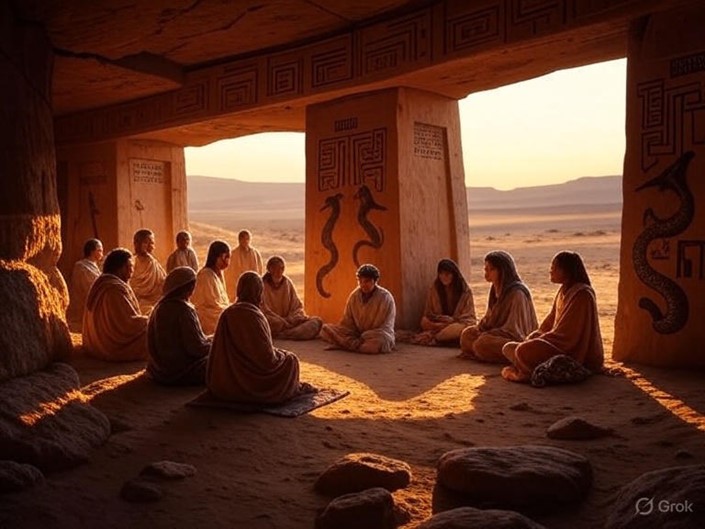
Funeral rites for believers in the Faith of Tawa’katsina commence upon an avatar’s death, where possessed forms vaporize into clouds of sparks leaving behind crystals and gear near the site—whether in arid mesas, cave systems, or during airship travels over the endless ocean—while non-possessed bodies lay in blood pools searchable for parts, with immediate gatherings of kin and communal members coiling around the remains in kiva-like circles to chant Zunari rituals over six seconds for amplification, invoking Katsina spirits through masked mediators to ease the memory’s transition within the character, honoring the integration as a cycle in the deity’s weave. Crystals from possessed avatars are collected as seeds of renewal, carried in twisted gourd vessels symbolizing rebirth to temples etched with plumed serpent motifs, where they are placed in alcoves amid cornmeal spirals scattered in patterns evoking ancestral paths, and elders perform oral epics recounting the deceased’s merges or tier advancements, sharing meals over twenty minutes to regain one health point each in remembrance, up to three if the rite extends days. For higher-tier characters with multiple avatars, rites involve coordinated sense-sharing among survivors—dim beyond twenty feet but direction clear, extending unrestricted at tier five across planes—to visualize the fallen’s stats via Mind’s Eye, revealing final attributes or weaknesses as lessons for the living, with gear left behind attuned communally to prevent thefts felt like snaps in the soul. Non-possessed rites focus on dissecting corpses for scales or parts repurposed into conduits like harnesses covering torso and tail slots, forged in steam-powered workshops with shafts and pulleys, while possessed crystals are planted in sacred grounds warmed by elemental vents, believed to summon new teleported souls or enhance magical flows bubbling like weather. In underwater centers, rites adapt with levitation magic to float crystals in sealed chambers, and in cave metropolises, vibrational chants resonate through dark systems to call spirits, with services including masked dances embodying the deceased’s form—coiled for Koyari or buzzing for swarms—to amplify blessings for mana preservation in survivors, dissipating slower than one per day. Political intrigue may influence rites, with rival houses attending to redeem attunement disputes through shared invocations, and Isekai memories from the fallen are invoked in visions to mentor the young, shifting sterile legacies to guidance on skill training or gear limits. Rites span several days, incorporating long rests rolling tier dice for collective health recovery up to twenty times tier plus base, and conclude with thunderbird plumes attached to sheaths for weapons, symbolizing ascension as silver fire sparks, ensuring the cycle continues amid Pueblo’s 123,200,000 population where death fosters communal resilience rather than isolation.
Followers of the Faith of Tawa’katsina access the deity’s magical power through conduits aligned with its symbols and attributes, such as kachina masks carved from steam-hardened wood featuring slit eyes and broad jaws that serve as foci for channeling elemental weaving and spirit mediation, allowing the invocation of protective barriers formed from interwoven threads of ancestral energy that manifest as shimmering veils reducing incoming damage by absorbing strikes equivalent to the user’s tier level times five, drawable only in designated safe areas where armor class triples under the deity’s vigilance, extending this to allies within a twenty-foot radius if shared through communal attunement where multiple avatars link senses dimly beyond that distance but with clear direction. Defensive applications further include ritual chants in Zunari lasting over six seconds to summon Katsina spirits as ethereal guardians that hover around the caster, deflecting attacks with a chance equal to the tier die roll plus bonuses from cornmeal spirals scattered in geometric patterns symbolizing cycles, creating temporary bonus health points capped at twenty times the tier level plus base for the character separately from the avatar’s, subtracted first from any harm and regenerable through long rests rolling the tier die after shared meals over twenty minutes granting one health point per avatar up to three daily. Protective omens invoked via plumed serpent amulets attuned to the neck slot provide warnings of approaching threats through vibrational tremors sensed by tail contacts in Koyari avatars or equivalent adaptations in other forms, enabling preemptive evasion in unsafe areas where armor class halves, with the omen allowing a reaction to expend a mana boost point—preserved slower than one per day for the faithful—to negate death from a single blow, leaving the avatar at one health point amid sparks of silver fire that briefly illuminate hidden weaknesses via passive Mind’s Eye activation showing basic stats like health and main abilities of foes. In cave metropolises or floating cities, defensive magic draws from the deity’s renewal attribute to mend gear mid-combat, repairing attuned items like harnesses covering torso and tail base slots to restore functionality without breaking bonds, felt instantly if attempted by others, and extending to gestalts where merged memories at tier two combine to form barriers that triple distances for sense-sharing within planes at tier three, allowing coordinated dodges across a hundred feet before dimming. Underwater centers adapt this power through levitation masks symbolizing thunderbird plumes, creating air pockets that resist pressure-based assaults, while in arid mesas, twisted gourd vessels hold essences that release bursts of steam from elemental water and fire unions to obscure vision, imposing disadvantages on enemy attacks for durations rolled on two d4 dice where the higher determines minutes of effect and the lower health points regained by the caster if uninterrupted. Higher-tier followers at tier four remove distance restrictions within planes for defensive shares, enabling avatars spread across Pueblo’s canyons to pool temporary health buffers, and at tier five across all planes without limits, incorporating non-possessed allies training under the faith to contribute basic vibrational wards that reduce minor damages from environmental magical ebbs bubbling like weather.
Offensive uses of Tawa’katsina’s magical power channel through conduits like thunderbird plume attachments on sheaths for weapons that attune automatically when held, infusing strikes with silver fire spell power from mana boosts—no more than ten times the tier, dissipating slower for devotees—to add unresisted damage after confirming a hit, expendable in any amount up to the avatar’s current total without action penalties, amplified by normal chants under six seconds using Zunari tonal inflections to incorporate true names doubling the output if pronounced accurately with aligned gear like outlined cross tattoos on scales symbolizing communal bonds. Ritual invocations over six seconds in kiva chambers or during masked dances embodying Katsina spirits escalate effects by up to twenty-five percent plus an additional ten percent from the language’s synergy with earth and ancestral flows, drawing from the deity’s elemental weaving to hurl plumed serpent projectiles that coil around targets, constricting for ongoing damage equal to the tier die roll per round until broken by strength checks, particularly effective against monsters in ruins where the power resonates with petroglyph syllabary etched on walls. In political intrigue or trade disputes aboard zeppelins racing through labyrinths, offensive magic manifests as sense-shared assaults where higher-tier gestalts coordinate strikes across unrestricted distances at tier five, using Mind’s Eye active identification after concentration with foci to reveal creature weaknesses like low resistances, then boosting chants with cornmeal spirals to summon storm-like bursts from steam vents, dealing area damage scaled by the number of participating avatars—up to five at tier five—in a radius of twenty feet expanding threefold at tier three within planes. Alchemical firearms, permitted as single-shot gunpowder-based conduits reliant on chemical combustion, attune via the deity’s wisdom to fire bolts infused with mana, vaporizing non-possessed foes into searchable blood pools or sparking possessed ones into crystals, with the power preventing over-attunement pain if limited to tier plus nine worn items, allowing rapid switches mid-battle without health loss intervals. For swarms or packs as gestalts, offensive applications involve dispersing into clouds guided by shared thoughts, enveloping enemies to drain health at rates determined by two d4 rolls where the lower is points lost and the higher minutes between pulses, recombining for amplified ritual casts that double damage via true names spoken collectively in Zunari, honoring the deity’s mediation to integrate Isekai memories from multiversal planes without clashes. In deathly areas where attacks always hit, the magical power offensively counters by invoking ancestral blessings through twisted gourd essences, temporarily inverting the zone to halve enemy armor class instead, lasting until the caster’s mana dissipates or is boosted as silver fire for direct unresisted blasts. Coastal trades on wind-levitated airships utilize this for boarding actions, where plumed serpent symbols on harnesses unleash constricting vines from magical flows, entangling sails or rigging while Katsina spirits disrupt foe chants, causing twenty-five percent less damage on their silent casts. Cave systems enhance offensive vibrations through tail bands or equivalent slots, sending tremors that collapse sections on groups, dealing damage based on tier die rolls plus bonuses from communal shares, and in floating cities, levitation masks propel avatars for aerial dives infused with thunderbird plumes, striking with momentum that adds health loss equal to the fall distance divided by ten, mitigated only by the deity’s protective attributes for the faithful. Underwater adaptations channel currents via kachina masks to form pressurized jets, piercing defenses with true name doublings if the target’s essence is sampled by forked tongues beforehand, aligning with the faith’s cyclical renewal to recycle fallen crystals into new offensive foci for future battles amid Pueblo’s intermingled species and endless ocean voyages on griffons or ships delivering goods from country to country.
Great Weaver’s Drought and Plumed Serpent’s Awakening
In the epochs of shadowed mesas and whispering canyons, when the skies dropped stones like tears from angered spirits and the ground twisted as if alive with hidden coils, there arose the tale of Tawa’katsina, the One Who Spins Threads from Chaos, as rendered in fragments of petroglyphs etched poorly by hands that knew not the full tongue of the ancients, passed down from a language lost even to the gods who limited the worn gears of mortals. Thus is spoken the story, in words bent and broken like old pottery shards unearthed from ruins where monsters once roamed before souls arrived from the beyond.
Long before the islands numbered seventy-three and the ocean stretched endless with ships sailing on winds of levitation, in the time when Pueblo was but scattered cliffs clinging to the edge of existence, the people—those avatars of serpentine forms with tails that coiled for stability and scales patterned in interlocking diamonds—faced the Great Drought of Magical Flows. The ebbs that bubbled forth like weather had ceased, drying the steam vents where elemental water met fire to power the simple factories of shafts and gears, leaving the canyons barren and the kiva chambers cold without the warmth of communal meals that granted health points slowly over twenty minutes of sharing. The Koyari, guardians with upper bodies of dexterous hands tipped in retractable claws and lower tails tapering to fine points, slithered in despair across the arid plateaus, their vertical slit pupils narrowing against the unrelenting sun, their forked tongues tasting only dust and the faint vibrations of dying earth.
Among them was a humble avatar named Kachara, a non-possessed Koyari of the first tier, limited to nineteen slots for worn items, carrying only a harness covering torso and tail base, a sheath for a stone dagger that attuned automatically when held, and a pouch of dried herbs in a belt adding four extra slots without counting excess. Kachara had hatched from a clutch in a communal nest warmed by fading vents, raised by elders who chanted in Zunari with tonal inflections—high for active magic, falling for dormancy—teaching him the ways of the Mind’s Eye to see basic stats like health and weaknesses passively, or deeper attributes actively with concentration through a simple focus stone. But the drought had withered the crops, halted the long rests where tier dice were rolled for health recovery up to twenty times the level plus base, and silenced the masked dances where kachina masks of carved wood with broad jaws embodied Katsina spirits to amplify rituals by up to twenty-five percent when recited over six seconds.
The elders gathered in the sunken kiva, etched with syllabary of flowing lines and angular motifs derived from ancient ruins, scattering cornmeal spirals in patterns evoking cycles of rebirth, and spoke of the deity Tawa’katsina, the Great Spirit Weaver who had petitioned the gods long ago to mercy the limits on avatars—pain from irregular intervals rolled on two d4 dice for exceeding slots or tiers, health lost until death or correction. “O Weaver of Threads,” they intoned in poorly preserved scrolls, translated awkwardly from the unknown tongue, “thou who mediates with plumed serpents and thunderbird plumes, why hast thou turned thy loom away, leaving our magical circuits dim and our mana boosts dissipating faster than one per day?” But no answer came, for the Katsina spirits, intermediaries of ancestral blessings, had withdrawn into the ether, offended by a forgotten hubris where a rival house had stolen attuned gear, breaking bonds felt like snaps in the soul without redemption quests.
Kachara, restless in his scales of terracotta reds and sandy beiges accented by black zigzag bands, felt a vision during a fitful rest—perhaps the first stir of possession, though no Isekai memory from multiversal planes had yet merged. In the dream, rendered in fragmented words like a translation marred by time, an ancient voice hissed: “Climb thou the Eternal Mesa, where ruins whisper petroglyphs of the syllabary, and invoke the Plumed Serpent’s Awakening with ritual chant lasting days, sprinkling alchemical powders as cornmeal to summon the storm that restores flows.” Awakening with shimmering scales, a sign of favor, Kachara told the elders, who nodded their broad jaws and equipped him with a twisted gourd vessel symbolizing renewal, holding essences for meals that might grant one health point if eaten slowly, and a kachina mask for the head slot, allowing multiple earrings if non-conflicting but no monocle with glasses.
Thus began Kachara’s ascent, slithering up the precarious ledges where his coiled tail provided stability, avoiding unsafe areas where armor class halved and deathly zones where every attack hit without fail. Along the path, he encountered a swarm of sentient insects, a gestalt mind buzzing with quantum magic unaffected by distance, offering alliance if he shared senses, but Kachara declined, fearing dilution of his purpose, for at tier one he could not split into movement groups. Deeper into the canyons, where magical ebbs once flowed but now lay stagnant, he battled a non-possessed monster—a great beast with claws scraping earth, unadvanced beyond base tier—using his stone dagger attuned when held, chanting normally under six seconds with a flourish for effect, dealing damage amplified by knowing its true name tasted on his forked tongue, leaving it in a pool of blood searchable for parts like scales for crafting conduits.
Victorious but weary, health low from the fray, Kachara rested long, rolling his tier die for several health points, eating a meal over twenty minutes to gain one more, role-playing reflections on the gods’ decrees that barred computers and combustion engines, deriving power instead from steam in pulleys and belts. Pressing on, he touched a ruin item beyond his tier—a gleaming torque of higher power—and pain surged, health lost at intervals: three minutes, then four points gone, plus one per level discrepancy, repeating until he cast it aside, hissing, “The limits of the divine enforce consequences, as two dice of four faces decree.”
At the summit of the Eternal Mesa, overgrown with vines hiding geometric motifs reminiscent of pottery and cliff dwellings, Kachara found the Altar of Awakening, a circular depression like a kiva with ladder entry, housing faded crystals from fallen avatars. Donning his kachina mask, he began the ritual, chanting in Zunari with rising tones for active states, reciting epics of soul arrivals over nine thousand years, scattering alchemical powders in cornmeal spirals, invoking Tawa’katsina for days without disruption, though foes—rival avatars from another house, driven by political intrigue—attempted interruptions, reacting to the audible chant.
On the third day, as health waned from exhaustion, Kachara used a mana boost point—awarded at session starts or from items—as reaction to survive a stealthy strike, left with one health amid silver fire that could not be resisted. His chant peaked, over six seconds for greater effect, amplified by ten percent from the language’s synergy with earth spirits, and the skies darkened. The Plumed Serpent awoke, a luminous figure with feathered extensions symbolizing magical circuits, coiling from the clouds like a storm summoned, restoring the ebbs that bubbled forth, filling vents with steam from elemental unions, irrigating valleys and powering factories with chains and gears.
But the awakening drew guardians—higher-tier Koyari gestalts of two avatars merged by agreement, memories combined to form one character, sharing thoughts up to twenty feet dimly, tripled at tier three—named Vylthar, of the House of Eternal Coils, fallen in intrigue for over-attuning beyond eleven worn items at tier two, forcing advancement or reduction. “Thou intrudest on the Weaver’s loom,” she intoned in broken translations, her scales etched with familial symbols scarred by battles, “for the drought tests harmony, preventing sterility of possession from ending lines without legacy.”
They clashed on the mesa, tails intertwining in fury, Kachara’s dexterous hands grasping her harness, disrupting her ritual chant with a shout, causing distraction that halved power. Using Mind’s Eye actively after concentration, he saw her stats: health moderate, weakness to vibrations, and struck the ground sending tremors through his tail, amplified by the awakening storm. Vylthar countered with silent casting at twenty-five percent less damage, immediate but weak, then offered merge: “Join as tier two, two avatars one, senses shared, memories blended though clashing may disorient.”
Honoring communal ways, Kachara agreed, their souls merging not smoothly, personalities amplifying traits—his stability with her prowess—forming a gestalt with eighteen slots, dominating fifty percent each avatar’s soul movable from moment to moment, no less than five percent left. Now tier two, with eleven attuned worn items risking compulsion to tier three, they descended the mesa, the Plumed Serpent’s storm following, restoring Pueblo’s landscapes, allowing communities to mix and multiply, building adobe skyscrapers and trading alchemical firearms on hot air balloons.
Yet harmony faltered anew, for word of the awakening spread across the endless ocean to other islands, drawing Isekai souls from future realms with memories of forbidden tech, seeking to steal the altar’s crystal that enhanced rituals, preventing pain from over-attunement. A rival fleet of zeppelins, levitated by wind magic, assaulted, leading to a chase through canyon labyrinths lasting days, griffons clashing in skies where magical weather shifted.
Kachara, now with a third avatar merged at tier three, dominating thirty-three percent each, tripled sense-sharing distances within planes, coordinated ambushes in cave metropolises housing millions in dark systems, using telepathy beyond a hundred feet for direction. Chanting in Zunari with true names doubled damage, boosted by kachina masks and cornmeal spirals, they repelled invaders, vaporizing possessed foes into sparks leaving crystals, searching non-possessed for parts.
Ascending to tier four, no distance limits within planes, Kachara merged a fourth avatar, twenty-five percent domination, overseeing underwater centers with sealed chambers and floating cities swaying on platforms. At tier five, five avatars, twenty percent each, senses unrestricted across planes, no further advancement, ruling from cliffside palaces etched with symbols, guiding the faith’s 63,296,000 followers in masked dances and oral epics, ensuring gear sharing in rituals strengthened bonds amid a population of 123,200,000 intermingled species.
But in longevity, shedding slowed, lifespan extended through health management, Kachara pondered the burden: sterility shifted legacy to mentorship, teaching attunement without hubris, merges without clash, in a world full of trade and intrigue where islands appeared or vanished.
The moral of the story is that in the weave of existence, solitary threads fray under the gods’ limits, but communal bonds spun with restraint awaken the spirits to restore cycles, for true renewal comes not from excess but from shared harmony through the pains and honors of the divine loom.