
This is the most influential and widely practiced religion within the Phoenician island nation. The Adonian Compact is not a faith of fervent prayer or divine intervention, but a pragmatic spiritual philosophy that codifies the principles of commerce, craft, and contract. It is the guiding force behind the nation’s mercantile empire, with approximately 34 million adherents from Phoenicia’s total population of 62,574,102.
The Deity: Adon, The Balancer
The central figure of the faith is Adon. Adon is not a creator god who forged the world, nor a celestial king ruling from a distant throne. He is revered as the Great First, the primordial avatar who first brought order to the chaos of mortal interaction. He is the patron of merchants, sailors, artisans, and scribes—all who seek to create value and navigate the risks of the world. He is seen as the ultimate arbiter of contracts and the silent observer of all transactions.
Lore
The sacred texts of the Compact, known as the “Ledgers of the First Voyage,” do not speak of a war in the heavens or the creation of the stars. They tell a more practical story. The lore states that in the beginning of civilization, the world was governed by brute strength and fleeting whims. A promise was only as good as the force that backed it, and trade was little more than piracy.
Adon, then a mortal Kothari of unparalleled genius, saw that this chaos was the true enemy of prosperity. He dedicated his long life to establishing the three pillars of civilization. First, he became the First Artisan, mastering the secrets of metallurgy and craft, proving that true value came not from what one could take, but from what one could make. Second, he became the First Navigator, meticulously charting the currents, winds, and safe harbors of the endless ocean, proving that the unknown could be conquered with knowledge and courage, not just magic.
His final and greatest act was becoming the First Scribe. He took the Byblian script and created the First Contract, a magically binding agreement for the delivery of one hundred perfect bronze ingots in exchange for safe passage through a pirate lord’s waters. When the pirate lord sought to betray the deal, the contract itself enforced the terms, causing the pirate’s ships to rust and his wealth to turn to dust. Adon had proven that a written, binding word was the most powerful force in the world. Having established these foundations, his spirit is said to have ascended, not to a higher plane, but to have diffused into the very concept of commerce itself. He doesn’t watch over the world; he is the balance of the world’s ledger.
Personality and Attributes
Adon is defined by a profound and impartial duality. He is a god of pure logic and balance, devoid of passion, anger, or capricious mercy. To Adon, all things are a transaction, and his only concern is that the ledger is balanced.
- Personality: Meticulous, patient, calculating, and utterly impartial. He does not offer comfort or inspiration. He offers principles. A follower does not pray for success; they pray for the clarity to make a sound decision and the integrity to honor it. Breaking a contract or cheating a partner is not a “sin” to be forgiven; it is a mathematical debt that the universe, guided by Adon’s principles, will eventually collect, often with ruinous interest.
- The Two Aspects: Adon is always depicted through his two balanced halves:
- The Voyager (The Aspect of Risk): This is Adon’s face of the unknown. He is the god of the open sea, the uncharted territory, the speculative venture. This aspect represents courage, exploration, and the understanding that great reward requires great risk. Sailors embarking on long voyages and merchants funding risky expeditions make offerings to this aspect.
- The Artisan (The Aspect of Value): This is Adon’s face of the known. He is the god of the forge, the workshop, the vault, and the perfectly written contract. This aspect represents skill, precision, security, and the creation of tangible, measurable value. Artisans seeking a flawless creation and scribes drafting a binding contract meditate on the principles of this aspect.
A successful life, according to the Compact, is one that skillfully balances the Voyager and the Artisan—taking calculated risks while relying on proven skill and unwavering integrity.
Symbols
- Primary Symbol: A set of perfectly balanced scales. On one pan rests a stylized ship, representing the Voyager and the risk of the journey. On the other pan rests a cog or gear, representing the Artisan and the value of the created good.
- Secondary Symbols: A ship’s rudder, symbolizing guidance and careful navigation. A crossed hammer and stylus, representing the union of craft and contract. The number 22, for the letters of the Byblian abjad, the sacred tools for binding reality to a promise.
- Colors: Deep Tyrian Purple, the color of the rare dye that represents the ultimate luxury and wealth. Burnished Bronze, for the color of reliable tools and early currency. Parchment White, for the purity of a new contract waiting to be written.
Tags: Dualistic, Pragmatic, Mercantile, Lawful, Patron Deity, Guild Religion, Contractual, Seafaring, Artisan Worship, Wealth, Risk vs. Reward, Phoenician, Impartial, Balance, Civilization God, Record-Keeping, Navigation, Innovation, Inevitable Debt, Principle-Based
The Adonian Compact is a practical faith with roughly 34 million followers, whose temples are part guildhall, part bank. Its practices focus on tangible acts of craft and commerce, which brings both great prosperity and a certain ruthless materialism to Phoenician society.
Followers and Their Actions
The Adonian Compact is the guiding philosophy for approximately 34 million citizens in Phoenicia. Its followers, known as Compactors, don’t practice worship in the traditional sense; for them, work is worship.
- The Clergy (“Arbiters”): The faith’s leaders aren’t priests but Arbiters. They are a blend of notary, banker, guild master, and judge. Their role isn’t to provide spiritual comfort but to be the unwavering fulcrum of commerce. They witness and magically seal major contracts, manage the secure vaults within the temples, and arbitrate disputes based on the black-and-white terms of written agreements.
- The Laity: A Compactor’s daily devotion is their profession. An artisan honors Adon by creating a flawless product with no defects. A merchant honors Adon by undertaking a risky but profitable voyage and returning with their ledger perfectly balanced. Their most common ritual is the “Sanctification of the Contract,” where they bring significant business or personal agreements to an Arbiter to be witnessed and magically bound.
Temples and Services
The temples of Adon, known as Covenants or Factorums, are grand, functional buildings that serve as the economic and legal heart of a city. They are constructed with intimidating security and precision, often featuring massive vault doors and intricate stonework.
Inside, a Covenant is a bustling hub of activity. It contains secure vaults for storing wealth, archives for filing contracts and ledgers, tribunals for arbitrating disputes, and guild chambers for artisans to display their masterwork creations. The central chamber doesn’t have a traditional altar. Instead, it features a massive, perfectly balanced set of bronze scales.
The closest thing to a regular “service” is the “Weighing of the Tithe.” At this weekly gathering, individuals and guilds present a tenth of their finest work or profits. The offering is weighed on the great scales, not as a sacrifice, but as a public demonstration of their success and contribution to the community’s shared prosperity.
Positives of the Faith
- Economic Prosperity: The faith’s core tenets—hard work, innovation, and the sanctity of the deal—create an engine for immense economic growth. This results in a very high standard of living, incredible public works, and widespread wealth.
- High-Trust Society: Because contracts are magically binding and breaking them brings ruin, business is conducted with unparalleled security and speed. This fosters a society where one’s word, once written, is an absolute guarantee.
- Meritocratic Advancement: While guilds can be insular, the faith fundamentally respects results. An individual who consistently produces high-quality work or demonstrates shrewd business acumen, regardless of their background, can achieve great wealth and status.
Negatives of the Faith
- Ruthless Pragmatism: The Compact has no principles for charity, mercy, or forgiveness. A failed business, a bad investment, or a crippling debt is seen as a personal failure to balance one’s own ledger. Society views foreclosure and bankruptcy not as tragedies, but as the natural and just consequence of poor calculation.
- Stifling Materialism: The culture is intensely materialistic. Value is measured in concrete terms: currency, property, and profitable goods. Art for art’s sake is often considered frivolous, and pursuits that don’t generate tangible wealth or a practical advantage are looked down upon.
- Predatory Contracts: While the enforcement of a contract is impartial, the writing of one is not. A clever merchant or Arbiter can draft a legally and magically sound contract that is deeply exploitative of the desperate or poorly educated. The system sanctifies the deal as written, offering no protection for those who agree to bad terms. It’s a faith that protects the shrewd, not the needy.
Core Beliefs of the Adonian Compact
Followers of the Adonian Compact, known as Compactors, adhere to a spiritual philosophy centered on pragmatism, transaction, and the creation of tangible value. Their core beliefs are less about faith and more about proven principles for navigating the world.
- The Sanctity of the Transaction: Believers hold that the universe itself operates like a great, impartial ledger. Life is a series of transactions: time is exchanged for skill, resources for goods, risk for reward. The highest virtue is to conduct these transactions with integrity and precision, ensuring the ledger always balances. Chaos and ruin are the natural results of an unbalanced account.
- The Ascended Ideal: Adon is not a god who demands worship, but an ideal to be emulated. He was the first and most perfect artisan, navigator, and merchant. To be a follower of Adon is to strive for perfection in one’s own craft, to navigate life’s risks with shrewd calculation, and to honor every contract as if it were a sacred text written by Adon himself.
- The Duality of Ventures: Life requires a constant balance between the religion’s two core aspects. The Voyager represents calculated risk—the bold venture, the long sea voyage, the speculative investment necessary for growth. The Artisan represents proven value—the mastery of a craft, the security of a fortified vault, the certainty of a well-written contract. To lean too heavily on risk is to invite ruin; to lean too heavily on security is to embrace stagnation.
- The Inevitable Audit: While the soul reincarnates, the legacy of a life—its net worth, its creations, its reputation, and its fulfilled contracts—is permanently inscribed in the world’s cosmic ledger. A life that ends in debt, with broken promises and shoddy work, leaves a negative balance that can bring tangible misfortune to the person’s guild and matrilineal line. Conversely, a life of profit, integrity, and masterful creation builds a legacy of prosperity that benefits future generations.
- The Written Word as Law: A spoken promise is fleeting and worthless. A thought has no value until it is made manifest. A promise only becomes real when it is written down in the Byblian script and bound by the sympathetic magic of a formal contract. Therefore, the acts of scribing and notarizing an agreement are considered among the most sacred rites of the faith.
Regular Services
The most common public gathering for the Adonian Compact is the Weekly Weighing, a ceremony that is part town hall meeting, part financial review. It is held in the grand central chamber of the local Covenant temple, before the massive bronze scales of Adon.
The service begins when an Arbiter, the faith’s administrative clergy, formally unveils the scales. The Arbiter then recites a passage from a sacred text, such as the “Ledgers of the First Voyage,” that illustrates a key principle of commerce or craft. Following this, the Weighing begins. Representatives from the city’s guilds, as well as prominent individuals, approach the scales with their weekly tithe—a tenth of their profits in currency or an example of their finest work. The Arbiter weighs the contribution, announces the name of the contributor and the value of their tithe to the assembly, and has the amount recorded in the Covenant’s public ledger. This public display of success and contribution is a primary source of social status. After the Weighing, the forum is opened to the community to discuss business, propose new ventures, and announce major trade expeditions.
Funeral Rites
The funeral rite of a Compactor is a solemn, practical, and public affair known as The Final Accounting. The ceremony is not focused on mourning the soul, which is believed to move on, but on auditing and closing the ledger of the deceased’s life.
Upon a person’s death, their family and guild are given a set period, typically seven days, to gather all of the deceased’s worldly records: their business ledgers, all contracts they were party to, deeds of ownership, and a representative collection of their life’s work. The body is simply preserved, seen now as a vessel whose function has ceased.
The Final Accounting takes place at the Covenant, presided over by an Arbiter. The deceased’s heir presents the gathered life-story. The Arbiter then recites a formal summary that functions as a final report, detailing the avatar’s major accomplishments, profitable ventures, and assets acquired. Crucially, the Arbiter must also declare any outstanding debts or unfulfilled contracts. The heir is then expected to publicly settle these debts from the deceased’s estate. Once all accounts are reconciled, the Arbiter strikes a heavy bronze chime and declares, “The ledger of [Name] is closed and balanced.” This act brings great honor and closure to the family and guild. If the debts cannot be paid, the ledger is declared unbalanced, a deep shame that can affect the family’s credit and standing for generations.
After the ceremony, the body, now a non-asset, is disposed of with pragmatic efficiency. It is often cremated, with the ashes being “reinvested” into the community—perhaps mixed into the mortar of a new public building or used in the crucible of a forge, returning its base material value to the society it helped build.
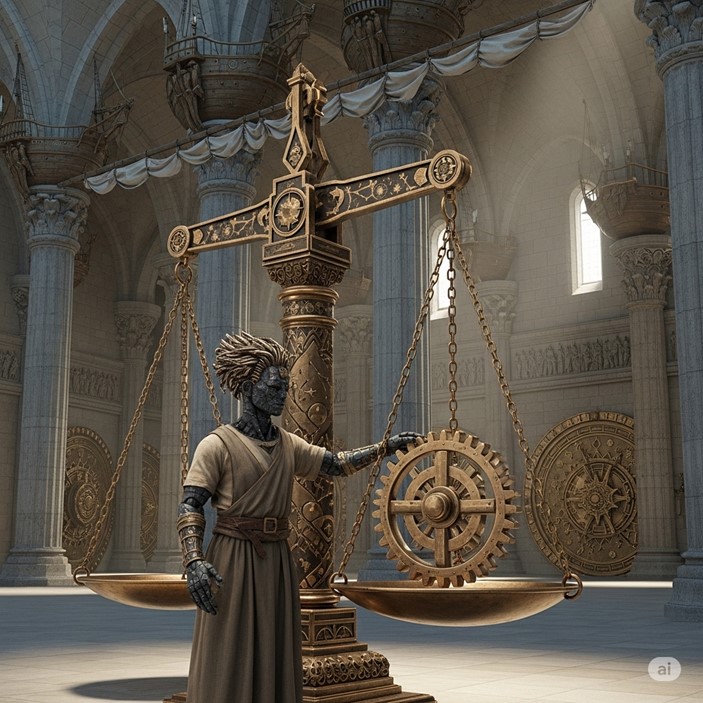
Followers of the Adonian Compact do not receive direct boons from a deity. Adon is a system of principles, not an interventionist god. The magical power wielded by his followers is an application of these principles—of balance, contract, risk, and value—channeled through their specially crafted gear. Their magic is not an act of faith, but of cosmic and arcane accounting.
Defense: The Way of the Artisan
Defensive magic is an expression of the Artisan aspect of Adon. It is about creating security through meticulous preparation, flawless design, and the reinforcement of known value. A defensive spell is a pre-calculated “fortification” of reality, an attempt to make the cost of an attack so high that it becomes an unprofitable venture for the aggressor. The follower’s focus is on achieving a state of perfect, balanced integrity, making them too “expensive” a target to damage.
Practical Applications:
- The Sanctified Barrier: By channeling magic through a focus inscribed with legal or mathematical symbols (such as a guild signet or a perfectly crafted gear), a follower can erect a shimmering barrier of faint, glowing Byblian script. This is not a mere wall of force. It is a “contractual field” that audits incoming energy. A magical bolt that strikes it may be partially diminished, as the barrier exacts a “tax” on its power. A physical blow might land with less force, as its kinetic energy is “balanced” against the barrier’s integrity.
- The Perfect Ingot: This is a powerful self-buff applied to armor. The user enters a state of deep focus, contemplating the ideal of a flawless creation with no cracks, no weaknesses, and perfect material integrity. By channeling this concept through their armor, they magically and temporarily negate its flaws. For a short time, the armor becomes impossibly resilient, not because it is physically harder, but because for that moment, it exists in a state of theoretical perfection, leaving no purchase for a damaging blow.
- Null Transaction: This is the Adonian form of counter-magic. It requires a prepared focus, such as a specially scribed ceramic shard bearing a “null contract.” When targeted by a hostile spell, the user presents the focus and channels their own magic into it, effectively proposing a cosmic transaction where the attacker’s magical effort results in zero gain. If the user’s power is sufficient, the incoming spell is perfectly canceled out, its energy balanced to nothingness. The result is not a violent explosion, but a quiet fizzle, as if a line item on a ledger has been zeroed out.
Offense: The Way of the Voyager
Offensive magic is the domain of the Voyager aspect of Adon. It is about calculated risk, the exploitation of imbalance, and the aggressive imposition of “costs” upon an enemy. An offensive caster is not just dealing damage; they are issuing a magical “invoice” for services rendered in pain and misfortune. Each attack is designed to create a “debt” in the target’s physical or magical being, a debt which will inevitably be collected.
Practical Applications:
- The Inevitable Debt: This is a unique damage-over-time effect. The initial attack places a glowing, purple rune, reminiscent of the Byblian script for “debt,” on the target. This rune creates a magical imbalance. Every few moments, the rune flares as the “interest” on the debt comes due, inflicting a small but consistent amount of damage. The target is being systematically ruined by a magical liability they cannot discharge.
- The Speculative Strike: A high-risk, high-reward attack channeled through a weapon. The user invests a significant amount of magical energy into a single, decisive blow. This “investment” is speculative; the attack is harder to land accurately and may do minimal damage if it only grazes the target (a failed venture). However, if the strike lands true, the invested energy pays out with massive dividends, resulting in devastating damage far beyond a normal strike (a successful venture).
- Hostile Takeover: A subtle and potent spell used against enchanted opponents. The caster does not try to shatter an enemy’s magical ward or dispel their flaming sword. Instead, they magically “audit” the enchantment, looking for a loophole or flaw in its construction. If they succeed, they can seize control of the “contract” of the enemy’s magic for a moment. This could cause a defensive shield to trap its owner, a flaming sword to suddenly become harmlessly cold, or a haste spell to falter at a critical moment. It is the ultimate expression of exploiting the fine print of an opponent’s power.
Hiram’s Hammer and Abel’s Rudder
It is told that in the dawn of the Kothari people, before the first Gilded Contract was fired, the world was understood in two halves. There were two brothers, great in their own right, who personified these halves. One was Hiram, whose hands knew the secrets of stone and metal. The other was Abel, whose eyes knew the language of the stars and the sea.
Hiram was the Artisan. His home was the forge, his music was the ring of the hammer, his wealth was in the things he had made. He could build a gear so fine it would turn for a hundred years with a single push. He could cut a gem so that it held the light of a thousand suns. He looked upon the Endless Water and saw only chaos, a force that broke and corroded all perfect things. He said, “True value is here, in the workshop, in what can be held and measured. The sea is a lie that promises all and delivers only salt and ruin.” His vaults were full of his creations, but his ledgers were empty, for he traded with no one.
Abel was the Voyager. His home was the deck of his swift ship, his music was the cry of the wind, his wealth was in the tales he told of far-off lands. He could read the currents as a scribe reads a scroll. He could navigate by the faintest star in a clouded sky. He looked upon the workshop and saw only dust and stagnation. He said, “True value is out there, in the Uncharted, in what has not yet been found. The forge is a cage that promises safety and delivers only boredom.” His mind was full of wonders, but his holds were empty, for he brought back nothing that lasted.
And so their people were divided and stagnant. They had many fine things but no new materials. They had many fine sailors but no cargo to carry. The two halves of the world were at war.
To end this strife, the brothers made a great wager, a promise before the matriarchs. Hiram declared, “I will build a vault so perfect, so secure, that no force in this world can breach it.” And Abel declared, “And I will find a treasure so vast, so magnificent, that no vault in this world can contain its value.” They were given a year and a day to fulfill their vow.
Hiram went to his forge. He did not build a box; he built a denial. He forged great plates of bronze and layered them with steel, quenching them not in water but in the oil of stubborn belief. He built a great door, and within it, he crafted a lock of a thousand moving parts, a puzzle of gears and tumblers that shifted its own solution with every passing hour. He finished his work on the last day. It was a masterpiece of security, a perfect, unbreachable vault. And it was utterly empty. It held the promise of value, but no value itself.
Abel, meanwhile, took to his ship. He sailed past the known islands into the Uncharted Sea. He faced storms that sang with the world’s rage and great beasts that rose from the depths. He did not fight them with brute force, but with calculation. He made a contract with the wind, offering the skill of his rudder in exchange for passage. He survived not by strength, but by shrewd risk. At the edge of the known world, he found it: the Isle of Liquid Light. It was an island where the trees wept a sap of pure, liquid silver, and the sands of the beaches were fine-ground gemstones. He had found a treasure beyond all accounting. He filled the hold of his ship until it sat low in the water and turned for home.
On the final day of the wager, a great storm, a typhoon of legend, rose from the sea and fell upon Abel’s ship. It had followed him from the Uncharted Sea, the price of his great reward. The waves, like angry gods, battered his vessel, and its timbers, which were built for speed but not for such divine violence, began to groan and split. At the same time, a band of Reaver captains, having heard whispers of Abel’s treasure, descended upon the coast to attack the Kothari settlement.
The people saw it all. They saw Abel’s ship, heavy with a treasure that could make them all kings, breaking apart just beyond the harbor. And they saw the Reavers’ ships, full of warriors, about to make them all slaves.
In that moment, the two brothers, watching from the shore and the sea, had the same revelation. Hiram looked at his perfect, empty vault and knew its worth was nothing without the treasure to protect. Abel looked at his sinking treasure and knew its worth was nothing if it could not be brought to a safe harbor. Their separate truths were lies.
With a cry, Hiram, the Artisan, led his guild-mates not to their swords, but to their workshops. They brought forth great cranes, chains of flawless steel, and gears of immense power. Using their perfect craft, they reached into the raging harbor and pulled Abel’s foundering ship to the safety of the shore just as its keel was about to break.
And Abel, the Voyager, once his feet were on solid ground, commanded his crew of master sailors. They used their knowledge of knots and rigging to create great traps. They used their understanding of wind and currents to misdirect the Reaver fleet into the treacherous rocks. They saved the town not with the sword, but with the tools of their journey.
The treasure was secured within the vault. The Reavers were defeated. And the two brothers stood before the people and their empty wagers. They took Hiram’s greatest hammer and the rudder from Abel’s ship, and in the heat of the forge, they melted them down and recast them as a single object: a great, perfect set of balanced scales. They declared that their spirits would forever reside within it, not as two warring ideas, but as two halves of one truth: the Artisan and the Voyager. This was the foundation of the Adonian Compact.
Moral: For the artisan who builds a perfect vault with nothing to put inside has only crafted a tomb. And the voyager who finds a perfect treasure with no vault to keep it in has only discovered a prettier kind of dust. True wealth is a ship that brings the treasure home.