
The dominant spiritual practice in the nation of Nachikufan is known as the Great Kinship, and it does not center on a single, personified god. Instead, it venerates a vast, interconnected consciousness called Umoja, a name that in their language, Kufani, translates to “Oneness” or “Unity.” Umoja is not a being that sits on a throne; it is the collective spirit of the land, the beasts, and the people of Nachikufan, all woven together into a single, living entity.
Lore
The core belief of the Great Kinship is that when the first Atavists arrived on Saṃsāra, they were lost and disconnected. They were individuals without a pride, a pack, or a herd. The wild beasts of the island, ancient and powerful, saw them as invaders. It was only through the sacrifice of their first ancestor, who offered her spirit not to a god but to the land itself, that a pact was formed. In that moment, the spirits of the beasts intertwined with the spirits of the people, creating the first Atavist bloodlines.
Umoja was born from this pact. It is the spiritual web that connects every Atavist to their animal aspect, to their ancestors, and to the living world around them. Adherents believe that every thought, action, and emotion ripples through Umoja, affecting the entire community. A single act of selfishness can weaken the Kinship, while an act of communal support strengthens it. The Queen of Nachikufan is not seen as a ruler by divine right, but as the Heart of the Kinship, the individual whose connection to Umoja is so strong that she can feel the joys and pains of the entire nation.
Deity Personality and Traits
Umoja is not a personality in the conventional sense. It is a vast, primal consciousness that is both nurturing and savage, like nature itself. It is the fierce protectiveness of a lioness for her cubs, the cunning of a serpent, and the unyielding strength of an old baobab tree. Umoja does not speak in words but in instincts, gut feelings, and shared emotions that ripple through the Atavist people. It is a silent, ever-present force that feels pride in the strength of its community and sorrow in their division. It values cooperation, courage, and respect for the natural cycle of life and death above all else.
Characteristics of the Faith
Followers of the Great Kinship practice their faith through community action and personal reflection.
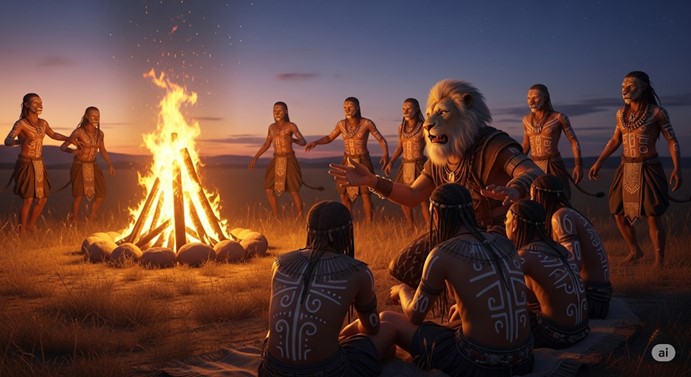
- Worship: Worship is not conducted in temples. It is performed through storytelling, dance, and song around a communal fire. These gatherings, called Convergences, are held to celebrate hunts, births, and initiations. During a Convergence, the community shares stories and sings in the melodic Kufani language, believing their unified voices strengthen the consciousness of Umoja.
- Clergy: There is no formal clergy. The spiritual leaders are the Elders, men and women who have lived long lives and whose deep connection to their animal aspect has granted them great wisdom. They are the keepers of the oral traditions and the guides who help young Atavists understand the instincts and responsibilities that come with their inner beast.
- Society: The faith promotes a deeply communal society. The concept of individual property is secondary to the needs of the community. Success is measured not by wealth, but by the strength of one’s bonds with their kin and their contributions to the pride.
Attributes
Umoja’s divine influence covers all aspects of the natural and social world of the Atavists.
- Primary Attributes: Community, Instinct, The Wild, Ancestors, The Hunt.
- Secondary Attributes: Harmony, Strength, Family, Oral Tradition, Life Cycles.
Symbols
- Primary Symbol: The most sacred symbol is the Intertwined Knot. It is a complex, unending knot made from three strands, representing the unbreakable bond between the People, the Beasts, and the Land. This symbol is carved into Heart-Totems and ceremonial gear.
- Secondary Symbols: Specific animal symbols are used to represent lineages (e.g., the Lion for the royal line, the Elephant for a line of great builders). Another common symbol is the circular ring of a village fire, representing community and shared stories.
Tags: The Great Kinship, Umoja, Spirit of Unity, Primal Consciousness, Animistic, Communal Worship, Ancestor Veneration, The Hunt, Natural Order, Nachikufan, Elder Guidance, Storytelling, Intertwined Knot, Totemic, No Temples, Matrilineal, Heart of the Kinship
Positives of the Faith
Followers of the Great Kinship are part of a deeply interconnected and supportive society. This provides several key benefits:
- Unbreakable Community: The core belief in Umoja (Oneness) fosters an incredible sense of social cohesion. Individuals instinctively prioritize the well-being of the group, creating resilient communities where no one is left behind.
- Intuitive Teamwork: Because they believe their instincts are linked through Umoja, they can coordinate with an uncanny, unspoken understanding. In a group hunt or a battle, they move as one, anticipating each other’s actions without needing verbal commands.
- Environmental Harmony: The belief that the land, beasts, and people are all part of the same entity ensures a deep respect for nature. They are expert conservationists, never taking more than they need and maintaining a sustainable balance with their environment.
- Sense of Belonging: Every individual feels they are a vital and necessary part of a greater whole. This provides a profound sense of purpose, identity, and psychological security.
Negatives of the Faith
The same interconnectedness that provides their strength also creates significant cultural drawbacks:
- Suppression of Individuality: The overwhelming focus on the group can stifle personal ambition. An individual who wishes to pursue a solitary path or a goal that doesn’t immediately benefit the community is often seen as selfish, strange, or spiritually unwell.
- Deep-Seated Tribalism: While incredibly unified internally, their society can be intensely xenophobic and suspicious of outsiders. Those not part of the Kinship are often treated with distrust, making diplomacy and integration with other cultures difficult.
- Emotional Contagion: Their shared consciousness makes them vulnerable to mass hysteria. A potent emotion, especially fear or anger, can ripple through a community uncontrollably, leading to poor group decisions or collective panic based on the feelings of a few.
- Resistance to Change: A powerful reverence for ancestral ways and oral traditions can make the culture resistant to new ideas, technologies, and social structures from outside sources, sometimes leading to stagnation.
Type of Temple
The Great Kinship has no built temples or constructed shrines. Adherents believe that Umoja is the world itself, so creating an artificial place of worship is seen as pointless and insulting to the natural order. Their sacred spaces are instead communal and natural.
The heart of every village is the Convergence Fire, a large, centrally located fire pit that is kept burning continuously. This is the community’s social and spiritual hub, where stories are told, dances are performed, and decisions are made. Other sacred sites include natural landmarks believed to have a strong connection to Umoja, such as ancient, towering trees, secluded watering holes where legendary beasts drink, or the peaks of mountains where ancestors performed great deeds.
Number of Followers
The Great Kinship is the dominant spiritual tradition of the Nachikufan nation. Out of a total population of 118,304,000, it is practiced by approximately 62 million people. For the Atavists, the nation’s predominant race, adherence isn’t a choice so much as a fact of their existence, as their very being is tied to the spiritual web of Umoja. The faith is also adopted by many non-Atavist residents who wish to fully integrate into Nachikufan society.
What Followers Do
The “doing” of the faith is living in harmony with one’s community and inner nature.
- Daily Practices: There are no formal daily prayers. A follower’s daily worship consists of contributing to the community—participating in hunts, preparing food, teaching the young, or protecting the village. Personal reverence is often shown through quiet moments of reflection, listening to the instincts of their animal aspect and the subtle emotional currents of the Kinship.
- Rituals: Their most important rituals are communal and tied to life events. A youth’s first successful solo hunt, which provides food for the elders, marks their passage into adulthood. The most sacred gathering is the Convergence of Elders, where the storytellers of various communities meet to share and recount the oral histories of their people, ensuring the tales—and therefore the wisdom of Umoja—are never lost.
- Goals: The ultimate goal of the community is to live in balance and ensure its continuity and strength. For an individual, the goal is to live up to the virtues of their animal aspect—to be as brave as their lion ancestor or as wise as their serpent foremother—and in doing so, become a worthy ancestor themselves.
What the Believers Believe
The faith of the Great Kinship is defined by a set of deeply held truths about the nature of the world and their place within it.
- The Spirit is One: Their most fundamental belief is that all life within their lands—the Atavist people, the beasts of the savanna and jungle, and the very trees and rivers—are threads in a single, vast spiritual web called Umoja. They don’t believe in a separation between themselves and the natural world; to harm the land is to harm oneself.
- Ancestors as Anchors: When a person dies, their individual consciousness dissolves back into the great Oneness of Umoja. However, the strength, wisdom, and courage of their life remain as a distinct “memory” or “knot” in the spiritual web. A living Atavist, through their Heart-Totem, can feel and draw upon the virtues of their direct matrilineal ancestors, asking for the lion’s courage from their grandmother or the serpent’s cunning from a great-grandmother.
- Instinct is Divine Will: They do not believe in holy texts or commandments from a distant god. For them, the “voice” of Umoja is felt through primal instinct, gut feelings, and the emotional currents that flow through the community. To trust one’s inner beast and act in accordance with its nature (bravery, cunning, patience) is to be in harmony with the divine.
- The Community is the True Body: The individual is seen as a single cell in the larger body of the community or “pride.” The health and survival of the group is the highest possible virtue. Actions are judged first and foremost on how they affect the Kinship. An act of selfishness is a spiritual sickness that harms the entire collective.
- Life as an Unbroken Cycle: They see life and death not as a beginning and an end, but as a continuous cycle of energy. A hunt provides death to an animal, which in turn brings the energy of life to the village. A person’s death is not a departure, but a transformation where their physical and spiritual energy is returned to Umoja to fuel the next generation and the land itself.
Regular Services
Followers of the Great Kinship do not have weekly, scheduled services. Their spiritual gatherings, known as Convergences, are organic events held around a central village fire whenever the community has a reason to gather. This could be to celebrate a successful hunt, the birth of a child, a seasonal change, or to mediate a dispute.
A typical Convergence has three parts:
- The Sharing: The event begins with the sharing of food. The bounty of a recent hunt or harvest is cooked on the central fire and distributed among all members of the community. They believe that eating from the same source physically and spiritually reinforces their bond.
- The Telling: After the meal, one of the community Elders will rise to recount one of the great oral histories of their people. They tell the stories of their ancestors, the deeds of legendary beasts, and the founding of their Kinship. The community participates, providing rhythmic chants and responses in the melodic Kufani language.
- The Dance: The storytelling seamlessly transitions into song and percussive dance. The dances are often imitations of their lineage’s aspect animals—a powerful, stomping elephant dance or a swift, leaping gazelle dance. They believe the unified rhythm, song, and movement of the community actively strengthens the spiritual web of Umoja.
Funeral Rites
The funeral rite is a solemn but accepting ceremony called The Return. Its purpose is to guide the deceased’s spirit back into the whole of Umoja and celebrate the contributions of their life.
- The Vigil: The body of the deceased is washed and painted with clay symbols representing their animal aspect and the great deeds of their life. It is then laid beside the central Convergence Fire for one night. The community gathers around, but not to mourn with tears. Instead, they spend the night telling stories about the person, recounting their bravery, their wisdom, and their acts of service to the Kinship. This act is believed to permanently “weave” the memory of their spirit into Umoja for their descendants to draw upon.
- The Heart-Totem: The person’s most sacred possession, their Heart-Totem, is removed. It is either passed down to their eldest daughter to carry on the matrilineal line’s strength, or it is given to the community’s Elders for safekeeping.
- The Return to the Land: At sunrise, the body is carried to a sacred, natural place—an open savanna, a quiet jungle clearing, or a high cliff. It is laid upon a simple wooden platform and left exposed to the elements and to the animals of the wild. To have one’s body be consumed by scavengers is considered the greatest honor, as it represents the final, perfect act of giving one’s energy back to the Great Kinship, completing the cycle of life.
The magical power of Umoja isn’t a force that’s called down from the heavens; it’s a power that’s drawn up from within the community and the land itself. For the Atavist people, this power is channeled through their specialized gear, particularly their Heart-Totems, to manifest in potent defensive and offensive ways that emphasize their core belief in the Great Kinship.
Defensive Applications: The Unbroken Pride
The defensive capabilities of the Kinship are based on communal support, shared resilience, and a preternatural, instinctual awareness.
- Shared Vigor: A group of Atavists can wear gear, such as Kin-Bracers, that attunes them to each other through Umoja. When one member takes a severe blow, another attuned member can activate their bracer to willingly take a portion of that pain and injury upon themselves. They aren’t casting a spell; their gear is opening a channel through their shared spirit, allowing them to distribute a single, lethal blow across the whole group, ensuring the survival of the individual for the good of the community.
- Primal Warning: Their connection to the great spirit gives all Atavists a “gut feeling” when danger is near. This can be honed by gear like a Sentinel’s Charm or a fetish woven from a hawk’s feathers. When worn, this gear sharpens that instinct to a fine point, feeding warnings from the wearer directly into the Kinship. This makes it nearly impossible to ambush a prepared group of Atavists, as the unease of one becomes an instinctive alarm for all.
- The Land’s Stability: Atavists are spiritually connected to their native land. By wearing specially carved Roots-of-the-World Greaves, an Atavist in their attuned state can plant their feet and become incredibly difficult to move. Their gear channels their connection to the earth, allowing them to brace against charges, shoves, and knockback effects as if they were a great tree, drawing stability from the very ground they protect.
Offensive Applications: The Coordinated Hunt
Offensive power is not about individual might, but about the flawless, instinctual coordination of a pack of hunters moving as one.
- The Pack Hunter’s Focus: A party’s scout or leader might wear a Seer’s Eye-Totem that allows them to “mark” a target with their focus. This mark isn’t visible to outsiders, but through the web of Umoja, every member of the Kinship intuitively knows which target is marked. Their own gear, like Hunter’s Gauntlets, will then guide their attacks toward this single foe, allowing the group to focus their fire with terrifying, unspoken efficiency.
- Aspect Manifestation: The Heart-Totem allows an Atavist’s gear to take on the qualities of their animal aspect. An Atavist with a Lion Totem can activate a Gorget of the Roar to unleash a concussive shout that staggers foes. A Serpent Atavist could activate Fangs of Slumber gauntlets, causing their strikes to deliver a non-lethal magical energy that drains an opponent’s stamina and slows their movements.
- Ancestral Strike: By wearing a relic passed down through their matrilineal line, like an Ancestor’s Fang worn as a necklace, an Atavist can call upon the memory of a legendary warrior. For a brief moment, their gear will channel that ancestor’s skill. This might allow a single, perfectly aimed arrow that bypasses cover, or a sword strike that lands with the accumulated weight of a dozen generations, a guaranteed and devastating blow to protect the future of the Kinship.
Tale of the Lone Hunter
It is told, in the time after Anya’s Pact but before the great cities, of a hunter named Kaelen of the Eagle-Eye. His aspect was the great eagle, and his sight was so keen it was said he could count the spots on a leopard from a mountain away. He was the greatest hunter of his generation, and his skill brought much bounty to his people. But his heart was filled with pride, a dangerous thing for one of the Kinship.
Kaelen grew weary of the Convergences. He tired of sharing the meat of his kills with the whole village. He grew angry that the glory of his hunts was not his alone, but belonged to the community. He thought to himself, “It is my eye that sees the prey. It is my arm that guides the spear. Why then is the honor not mine? The Great Kinship makes the strong share their strength with the weak. It is a chain upon my greatness.”
This thought was a poison. It began to close his heart to the hum of Umoja. He started to hunt alone, not for the village, but for himself. The Elders warned him. They said, “Kaelen, no lion hunts without its pride. No wolf hunts without its pack. You are one, and the world is many. The Kinship is your strength, not your cage.”
Kaelen did not listen. To prove his singular greatness, he vowed to hunt the Whispering Beast, a creature of legend said to live in the deepest, most tangled part of the jungle where the air itself was a maze of illusions. No one had ever seen this beast and returned with a clear mind.
He crafted his gear alone. He did not ask the wisdom of the wood-carver for his Heart-Totem, nor the guidance of the fletcher for his arrows. He trusted only in his own sharp eyes. He entered the jungle, and as he did, he felt the familiar, warm presence of Umoja fade, a connection he had willingly severed. For the first time in his life, he was truly alone.
The jungle was a strange place. The paths shifted when he was not looking. The sounds of birds came from empty branches. He saw shimmering pools of water that were only dry leaves. His eyes, the sharpest in the nation, were being lied to. He felt a prickle of unease, an instinct to turn back, but he silenced it. That feeling, he thought, was the weakness of the Kinship calling to him. He pushed on.
After three days, he found his prey. It was a creature of shadow and light, a thing that seemed to be made of mist and fear. It had no true form. He drew his bow, his aim true, but the arrow passed through it like smoke. The beast laughed, and the sound was like the scraping of bones in his own mind.
For days, the beast toyed with him. It showed him visions of his village feasting without him. It showed him illusions of great trophies that turned to dust in his hands. It whispered his own prideful thoughts back to him from the rustling leaves. Kaelen, the great hunter, was now the one being hunted. He grew tired. He grew hungry. His keen eyes were useless, for they could not be trusted. His strength was useless, for he could not strike a foe made of shadow.
Lost and starving, huddled in the roots of a great tree, Kaelen finally understood his folly. His keen eyesight could see a leaf fall from a hundred paces, but it could not see the truth of a lie. He realized that if his pride had been with him, the lion-hearted would have smelled the deceit. If the serpent-souled had been there, their instincts would have sensed the trap. The thousand eyes of the Kinship, working as one, would have seen the one truth through the thousand illusions. His single pair of eyes, however sharp, saw only what the beast wanted him to see. He was not strong because of his eyes; he was strong because his eyes were one part of a greater whole.
Humbled and broken, Kaelen did not pray for victory. He simply opened his heart one last time, reaching out into the silence for the warmth he had rejected. He did not ask for strength, only for clarity. He whispered, “I am one, and I am lost. Let me be one-of-many again.”
No voice answered him. No great spirit appeared. But a feeling arose in his gut—a simple, animal instinct. A pull in a certain direction. A sense that home was that way. Trusting this feeling over his own deceptive eyes for the first time, he began to walk. The illusions did not vanish, but he ignored them. He followed only the thread of instinct, the faintest hum of the Umoja he had abandoned.
After another day, he stumbled out of the jungle, thin and haunted, with no trophy and no pride. He returned to his village and stood before the Convergence Fire. He did not boast. He did not make excuses. He told his story. He told them of his pride and his failure. He became the greatest teacher of the Great Kinship, for he had learned its most important lesson not in the company of his kin, but in the terrifying silence of being alone.
The Moral of the Story: A single eye, no matter how sharp, can be deceived. A single heart, no matter how brave, can be filled with fear. But the thousand eyes of the Kinship see all truths, and the great heart of the community knows no fear.