
The primary religion within the nation of Mycenaean is The Wanaxian Foundation. It is centered on the worship of a single, powerful deity known as Wanax, a name that translates from an ancient dialect to “The King Below” or “The Sovereign of the Depths.”
Lore
The Wanaxian Foundation isn’t a religion of overt miracles or divine intervention in the traditional sense. It’s a faith built on the principles of order, knowledge, and strength drawn from the world itself. According to its central scripture, the Lay of Lycomedes, the god Wanax does not solve mortals’ problems. Instead, Wanax is the embodiment of the deep, orderly, and powerful patterns that exist within the world, particularly the sea. It’s believed that the ocean of Saṃsāra possesses a deep, resonant “song” of power, and Wanax is that song.
The lore states that when the Kymian hero Lycomedes sought to defeat the Abyssal Maw, he didn’t pray for a miracle. He meditated in the crushing depths until he could “hear” the song of Wanax. This divine resonance guided him and his people, granting them the insight to forge the specialized gear, like the Resonant Trident, that was needed to establish order over chaos. Followers believe Wanax doesn’t give power; he presents the blueprint for mortals to forge it themselves. This makes the act of creation—smithing, building, writing laws—the highest form of worship.
The faith is practiced by slightly over half of Mycenaean’s 116,000,000 citizens, making it the dominant cultural and spiritual force in the nation, with approximately 60 million adherents.
Deity Personality and Traits
Wanax is depicted not as a humanoid figure, but as an immense and impersonal force with a will. The god’s personality is said to be like the deep ocean itself: patient, inexorable, and possessing incomprehensible power held in reserve. Wanax is a stern and silent deity, whose voice is not heard in words but felt in the hum of resonant metals, the groan of shifting tectonic plates, and the unyielding pressure of the abyss.
He is not a god of compassion but of order. He is not a god of mercy but of balance. Wanax is utterly dispassionate, valuing endurance, intricate design, and the successful application of knowledge above all else. He is said to despise chaos, randomness, and weakness, viewing them as dissonant notes in the world’s song.
Attributes
Wanax’s divine domains are seen as fundamental concepts that govern the world, which mortals can learn to harness.
- Primary Attributes: The Sea, The Abyss, Order, Foundations, Pressure, Gravity.
- Secondary Attributes: Smithing, Metallurgy, Secret Knowledge, Navigation, Endurance, Law.
Characteristics of the Faith
Followers of the Wanaxian Foundation are known for their stoicism, pragmatism, and reverence for craftsmanship.
- Worship: Adherents worship through action. Building a perfectly balanced wall is a prayer. Forging a flawless piece of gear is a hymn. Successfully navigating a treacherous strait is a testament of faith. The grandest temples, called Foundries, are always functional structures—part forge, part fortress, and part archive—built in places of great pressure, like the deep seabed or within the stone of high coastal cliffs.
- Clergy: The priests of Wanax are called Keepers of the Depth. They are not miracle workers but masters of engineering, metallurgy, history, and law. They wear ceremonial gear, including heavy bronze masks and resonant pauldrons, which they believe helps them attune to the “song of Wanax” to find insight and guidance.
- Society: The faith promotes a highly ordered, hierarchical society where worth is determined by skill, duty, and one’s contribution to the strength and stability of the nation.
Symbols
- Primary Symbol: A heavy, downward-pointing bronze trident laid over a perfectly balanced, two-pan scale. This represents the mastery of the sea’s power (the trident) used to create and maintain perfect order and justice (the scales).
- Secondary Symbols: The octopus, representing the far-reaching and complex influence of the deep; the geometric spiral, representing the eternal, cycling currents of both the ocean and fate; and the heavy anvil, representing the sacred act of forging.
Tags: Wanaxian Foundation, Wanax, God of the Deep, God of Order, Patron of Smiths, The Sovereign Below, Deep Knowledge, Forge Worship, Law and Foundation, The Song of the Deep, Mycenaean, Order Over Chaos, Pressure and Endurance, Balance, Sacred Engineering, Keeper of the Depth, Trident and Scales
Positives of the Faith
Followers of the Wanaxian Foundation benefit from a culture of profound stability and purpose. Their shared faith fosters:
- Societal Order: A deep, cultural respect for law, duty, and hierarchy creates a remarkably stable and crime-free society. Everyone understands their role and the importance of contributing to the greater structure.
- Technological Excellence: Because the act of crafting and engineering is considered the highest form of worship, the nation is a leader in metallurgy, architecture, and the forging of magical gear. Their infrastructure, weapons, and ships are second to none.
- Psychological Resilience: The belief that all challenges can be overcome with sufficient knowledge and effort creates a population of determined, self-reliant individuals. They do not despair in the face of adversity but instead begin drafting plans to overcome it.
- Clarity of Purpose: The faith provides a clear framework for life. By mastering a craft and performing one’s duties, a follower earns respect and contributes to the divine “foundation” of their civilization, giving their life a tangible sense of meaning.
Negatives of the Faith
The same rigidity that provides strength also creates significant drawbacks:
- Lack of Compassion: The relentless focus on function and order can lead to a society that is deeply unforgiving. Failure is seen not just as a mistake but as a moral and spiritual flaw. The weak, the infirm, or those who cannot contribute to a craft are often marginalized.
- Stifled Innovation: While engineering is perfected, true innovation can be slow. The reverence for ancient foundations and proven designs can cause followers to be deeply suspicious of radical new ideas, social change, or foreign concepts that threaten the established order.
- Emotional Suppression: Stoicism is held as the ideal state of being. The open expression of strong emotions—grief, passionate joy, anger—is often viewed as a sign of personal chaos and spiritual imbalance. This can lead to a populace that is emotionally distant and struggles with personal connection.
- Authoritarianism: The belief in a divinely inspired hierarchy, where leaders are those best at maintaining order, can justify authoritarian rule and suppress dissent in the name of preserving the sacred foundation.
Type of Temple
The temples of Wanax are known as Foundries. They are not quiet places of prayer but loud, industrious centers of sacred work.
- Architecture: Foundries are masterpieces of cyclopean engineering, built with massive, irregular stone blocks that are perfectly fitted without mortar. They are often built into coastal cliffs or partially submerged in deep-sea chasms to utilize geothermal heat or the immense pressure of the abyss in their forges. They are stark, imposing, and built to withstand ages of elemental abuse.
- Layout: A Foundry has no central prayer hall. Its heart is a massive, open-air or high-ceilinged forge, where master smiths craft the most important gear and tools for the nation. Surrounding this sacred forge are wings that serve as archives for historical records and engineering schematics, workshops for artisans, and solemn halls where laws are written and justice is administered.
Number of Followers
The Wanaxian Foundation claims the allegiance of the vast majority of the Mycenaean nation. Out of a total population of 116,000,000, it is estimated that approximately 60 million souls are active followers. Adherence to the Foundation is a practical necessity for anyone wishing to hold a position of power, from a ship’s captain to a member of the ruling family. While other beliefs exist, they are practiced by small, often isolated communities.
What Followers Do
The daily life of a follower is one of purpose-driven work and the pursuit of perfection in their chosen craft.
- Professions: Adherents are guided into professions that support the “foundation” of society. They become the nation’s premier engineers, smiths, architects, navigators, judges, and military officers. Even a simple mason considers their work a sacred duty.
- Daily Practices: A follower’s day often begins not with prayer, but with the meticulous cleaning and maintenance of their tools, an act seen as honoring the principle of order. Before beginning a complex project, a smith might trace the symbol of the trident and scales in the dust of the forge floor.
- Rituals: Religious ceremonies are public, practical, and tied to acts of creation. The completion of a new aqueduct, the quenching of a masterwork piece of gear, or the launching of a new naval vessel are all major religious festivals, presided over by the Keepers of the Depth. The most sacred personal ritual is the “Master’s Test,” where an apprentice presents a masterwork creation to be judged, marking their transition to full standing within their craft and the faith.
What the Believers Believe
The core tenets of the Wanaxian Foundation are built upon a pragmatic and orderly worldview. Believers hold these truths to be self-evident:
- The Divinity of Order: They believe the universe exists in a natural state of mindless, destructive chaos, embodied by tales of the Abyssal Maw. Wanax is the divine principle of Order, Pattern, and Structure that counteracts this chaos. The world is not a finished creation to be enjoyed, but raw material that must be given purpose and form.
- Creation as the Highest Form of Worship: Mortals are the instruments through which Wanax imposes order on the world. As such, the most sacred act a person can perform is the act of creation. Forging a flawless gear, building an unbreachable wall, or drafting a perfectly balanced law are all acts of profound worship. A well-made object is a more honest prayer than any spoken word because it brings tangible order into the world.
- The Impersonal Nature of God: Wanax is not a comforting parent figure who answers prayers or intervenes with miracles. The god is a fundamental force, like gravity or pressure. To know Wanax is to understand the laws of physics, mathematics, and metallurgy. The guidance of Wanax is found not in visions, but in the precise measurements of a blueprint and the resonant frequency of tempered metal.
- Worth is Forged, Not Granted: Followers believe that concepts like innate talent or inherent worth are illusions. A person’s value is measured entirely by their contributions and the quality of their work. The soul is seen as a tool, and it is a believer’s duty to sharpen it through discipline, training, and tireless effort. A person is what they do.
- The Primacy of the Foundation: The individual is temporary and insignificant compared to the enduring structures they help to build—their guild, their city, the nation of Mycenaean itself. The ultimate spiritual goal of every believer is to contribute a permanent, flawless piece to this great societal machine, ensuring it stands for ages as a testament to the victory of Order.
Regular Services
The Wanaxian Foundation does not have “services” in the sense of passive worship. Their gatherings are active, communal, and productive, taking place at the local Foundry on a designated “Day of Measure.”
A typical service involves three phases:
- The Presentation: Artisans and workers present their most significant work from the previous period. A Keeper of the Depth serves as arbiter, inspecting the works not for their beauty, but for their structural integrity, precision, and functionality. Public praise for exceptional craftsmanship is a high honor, while a declaration of a flaw is a source of profound public shame, motivating all to strive for perfection.
- The Communal Work: The great central forge is brought to a roaring heat. The assembled followers work together on a civic or sacred project, such as forging a massive bronze component for a new temple, laying the keel for a naval warship, or collectively enchanting a defensive obelisk. The rhythmic clang of hammers on anvils is their sacred music, a symphony of unified labor.
- The Recitation of Knowledge: The service concludes not with a sermon on morality, but with a Keeper’s formal recitation of new knowledge that benefits the Foundation. This may include new engineering principles, updated navigational charts, amendments to the legal code, or reports on the structural integrity of public works. This sharing of practical wisdom is how the congregation “communes” with the divine order of Wanax.
Funeral Rites
The funeral rites of the Foundation are stoic, practical, and focus entirely on the legacy of the deceased’s work.
- The Final Measure: The ceremony is known as the “Final Measure.” The body, seen as a tool that has served its purpose, is simply washed and wrapped in an unadorned shroud. A Keeper of the Depth presides over the gathering, and their eulogy is a factual accounting of the deceased’s contributions. They do not speak of the person’s kindness or humor, but rather state: “Her name was Callista. She served as a naval architect for fifty-three years. She designed the hulls for thirty-seven vessels of the line. Her work endures. Her measure is taken.”
- The Masterwork and the Tools: During the rite, the single finest creation of the deceased’s life—their “masterwork”—is displayed for all to see. After the ceremony, their common tools are given to apprentices in their guild to continue the work. The masterwork, however, is taken to be placed in the Foundry’s permanent archive, a testament to a life of productive worship.
- The Return to the Depths: A believer’s body is always returned to the sea. It is weighted down with a heavy, unadorned stone tablet inscribed only with their name and their greatest professional achievement (e.g., “Phorcys, Master Mason of the Western Seawall”). The body is then committed to the deep, either from a ship or by being carried into a deep-sea trench. They believe the body is simply raw material being returned to the great crucible of the world, while their true legacy remains in the enduring Foundation they helped to build.
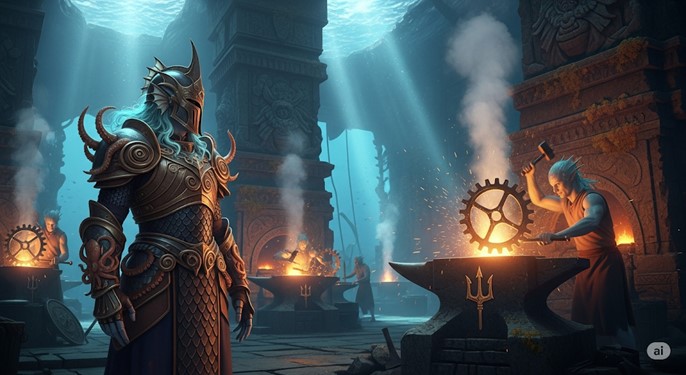
The magical power of Wanax is not invoked through prayer or supplication; it is harnessed through the application of divine principles—Order, Pressure, Gravity, and Resonance—channeled through masterfully crafted and attuned gear. Believers do not cast spells; they operate sacred machinery.
Defensive Applications: The Unbreakable Foundation
Defense in the Wanaxian faith is about creating an unbreachable state of perfect order, reinforcing a position or a person until they are as immutable as the deep sea floor.
- Gravitic Plating: Defensive gear, particularly heavy armor and tower shields, is forged with internal circuits of dense, resonant metals. When activated by the wearer’s focused intent, these circuits can generate localized fields of intense gravity around the armor’s surface. This doesn’t make the armor heavier for the wearer, but it can drastically slow or even deflect incoming physical projectiles. Arrows or bolts seem to curve away at the last second, and a striking sword blade feels as if it has suddenly been plunged into thick tar.
- Pressure Nullification: By attuning their gear to the surrounding environment, Wanaxian champions can create a “pressure shell” around their body. In the sea, this allows them to survive the crushing depths. In combat, this shell can be used to repel energetic or gaseous attacks. A gout of flame might be smothered and dispersed before it reaches the armor, and a poison gas cloud would be unable to penetrate the wall of sheer force.
- Resonant Reinforcement: Just as a pure resonant note can shatter a chaotic structure, it can also reinforce an ordered one. The defensive walls of a Mycenaean fortress are built with resonant crystals embedded at key structural points. When a siege engine strikes, Keepers of the Depth can activate these crystals, causing the entire wall to hum at a single, perfect frequency that dissipates the impact, rendering it far more durable than mere stone should be. The same principle applies to personal armor, making it incredibly resistant to shattering blows.
Offensive Applications: The Weight of the Abyss
Offense is the focused application of the sea’s crushing, inexorable power onto a single point of chaos, forcing it to break.
- Concussive Pressure Blasts: Specialized gauntlets or trident-like weapons can be designed to rapidly compress and then explosively decompress the surrounding water or even air. This unleashes a devastating, invisible blast of concussive force. This is not a jet of water, but a shockwave that can stagger heavily armored foes, shatter wooden shields, and pulverize brittle structures.
- Gravity Well Generation: Offensive champions can use specialized resonant foci to project a short-lived, localized ‘gravity well’ onto an enemy. This makes the target’s armor feel impossibly heavy, their movements slow and laborious, and their footing unstable. A charging enemy might suddenly find themselves struggling to lift their feet, becoming an easy target. Groups of enemies can be pinned down, their formation broken as they are crushed under their own weight.
- Armor Shattering Resonance: The most feared offensive technique is a direct application of the principle Lycomedes used against the Abyssal Maw. By striking an enemy’s armor with a specially attuned weapon (like a Resonant Hammer), a warrior can send a specific, disruptive frequency into their defenses. If the attacker can find the dissonant frequency of the target’s gear, a single, well-placed strike can cause armor plates to shatter and shields to splinter from the inside out, bypassing their conventional durability entirely. This is a difficult and precise art, requiring a deep understanding of metallurgy and harmonic principles.
Lay of the Unmoving Anvil
It is known that after the time of Lycomedes, he of the Resonant Trident, the Kymian people had victory. They had the isles of Mycenaean and the Sunken Crown was upon the head of their king. But victory is a memory, and memories fade like dye in the great salt water. The people remembered the glory of the deed, but they forgot the truth of the principle. They became a people of great pride. Pride was their mason, and haste was their smith.
The smiths would forge gear of great beauty. The armor was like the setting sun, and the blades sang a high note when swung. But the beauty was a skin upon a body of weakness. The song was a pleasing lie. The deep resonance, the true song of the world that Lycomedes had commanded, was forgotten. It was a murmur beneath the loud shouts of their pride. And so it was that their foundations were laid upon sand, and the sand was upon a floor of cracking stone.
Then the world groaned. It groaned from its very bones. The great island of Mycenaean shuddered, and the earth gave a great fracture. The city of Akoros, a city of high towers and boastful walls, was broken. The walls, which were built to be looked upon, not to stand against the true pressure, they fell. The sea, which was their home, became their enemy that day. It rushed into the ruins. It claimed the work of prideful hands. Many were lost. The works of generations were lost. All was chaos.
In the ruin, there was a man named Phorcys. He was not a king nor a great warrior. He was a master of stone and a knower of metals. His hands knew the faults in a rock and the stresses in a beam. He had warned the lords of Akoros. He had said, “Your walls are a skin. They have no bones. They do not hear the deep song.” But they had not listened, for his words were not pleasing and his hands were dusty with his work.
When the dust of the fall settled, Phorcys stood among the broken stones. He saw the failure not as a punishment from a god, but as a result. A result of a flawed equation. A foundation of pride gives a result of ruin. This he knew.
And so Phorcys spoke to the survivors, who wept and despaired. He said, “You weep for the stone, but the stone did not fail you. You failed the stone. You asked it to stand without giving it a true foundation. The victory of Lycomedes was not the end of our work. It was the beginning of the lesson. We have forgotten the lesson. The song of Wanax is not a tale for children. It is the law of pressure and the truth of weight. It is the measure of all things. I will not rebuild this city upon its own rubble. I will find a new foundation. A foundation that cannot be moved.”
The people asked him, “Where is this foundation?”
Phorcys pointed not to the sea, nor to the sky, but to the ground. He said, “It is in the deep earth. In the place where the pressure is greatest. There is a stone there, the heart of the mountain. From this stone, I will make an anvil. And upon this anvil, we will measure the world anew. Around this anvil, we will build a house of work, a Foundry. And its walls will not fall.”
And so began the quest of Phorcys and those who believed his words. They were not warriors. They were engineers, smiths, and masons. Their quest was not one of battle, but of endurance and calculation. They built gear not for slaying, but for surviving. They forged great suits of bronze, with circuits of lead to shield them from the deep earth’s heat. They made drills that sang the note that softens stone.
They went down. Down into the great fracture, into the root of the island. The pressure was a solid thing. It was a sea made of stone. Many times their gear failed. Many times they had to retreat and rebuild, learning the lesson of pressure with each failure. Phorcys did not despair. Each failure was a new line in his blueprint. Each groan of stressed metal was a new word in the language of the deep.
At last, they came to a great cavern. The air hummed. It was not a sound but a feeling, a vibration in the bones. Here, the song of Wanax was clear. It was the hum of gravity itself, the immense, orderly weight of the world. In the center of the cavern was a stone of impossible density. It was star-fallen iron, cooled into a monolith of pure, unyielding order. It was the Heart of the Mountain.
Phorcys approached it. In the presence of that pure, orderly resonance, his mind was opened. He did not see visions. He saw the truths of the world as a master builder sees a blueprint. He saw the geometry of strength, the mathematics of balance, the harmonics of enduring structures. He understood that Lycomedes did not just wield a trident; he had solved an equation.
Upon the Heart of the Mountain, Phorcys and his followers set to work. They did not move it. They carved it where it lay. They shaped its top into a great, flat anvil. This was The Measure of All Things. And as they worked, Phorcys dictated the laws that he now understood. He spoke of the divinity of order. He spoke of work as worship. He spoke of the worth of a soul being measured only by the quality of its creations. His followers carved these laws, the first tenets of the Foundation, into the sides of the great anvil.
Their work was done. The journey back was long, but their knowledge was true. They could not bring the whole anvil, for its weight was the weight of a mountain’s soul. They brought back a great slab of it, still humming with the deep song, and it was enough.
They returned to the ruins of Akoros. They did not rebuild the fallen towers. They cleared the rubble to the bedrock. Upon the bedrock, they placed the slab of the star-fallen anvil. And around this anvil, they built the first Foundry. They used the principles of resonant architecture that Phorcys had learned. Every stone was cut to a precise measure, placed in harmony with the stones around it, so the entire structure shared the load as one. The walls were not beautiful, but they were true. They were strong. Strong were the walls.
Phorcys became the first Keeper of the Depth. The Foundry became the heart of the city and the soul of the people. They came not to pray with words, but to work with their hands, to learn the sacred laws of measure, and to build a foundation that would last for all time.
The Moral of this account is: A great victory can inspire a people, but only a true principle can sustain them. Memory is a monument to the past, but knowledge is the foundation of the future.