
The primary faith of Mousterian is known as the Discipline of Form. It is less a religion of worship and more a spiritual and intellectual philosophy practiced by slightly more than half the nation’s population, numbering over 70 million adherents. Its most devout followers are the ruling Kaltos, whose entire psychology resonates with the Discipline’s core tenets. The faith is not concerned with morality, divine judgment, or an afterlife, but with a single, all-consuming goal: achieving perfect alignment with the fundamental structure of reality.
Deity: Khor-An-Tak, “The Pattern”
The Discipline of Form does not have a deity in the traditional sense—there is no sentient, personal god to be worshipped or appeased. The object of their devotion is an impersonal, universal principle they call Khor-An-Tak, which translates from the Ghoran language as “The Pattern of All Things” or simply “The Pattern.” Khor-An-Tak is not a being; it is the underlying blueprint of the cosmos, an intricate, perfect, and logical structure that dictates the optimal state of all things, from the orbit of a star to the crystalline lattice of a mineral to the function of a society.
Lore
The lore of the Discipline is not a creation myth but a story of discovery. It posits that the world of Saṃsāra and the greater multiverse have always existed, growing and changing according to the intricate, mathematical blueprint of The Pattern. For eons, the creatures of the world acted randomly, their lives filled with chaos, waste, and inefficiency—a state known as “The Flaw.”
When the first Kaltos avatars appeared, their uniquely logical minds and the conceptual clarity of their Ghoran language allowed them to do what no others had: perceive the faint outlines of Khor-An-Tak. They came to understand that success, stability, and strength were not random, but were the direct result of actions, objects, and thoughts that were in harmony with The Pattern. Conversely, failure, decay, and suffering were the results of being out of alignment. The purpose of life, therefore, became clear: to study The Pattern and to methodically eliminate “The Flaw” by shaping oneself, one’s tools, and one’s world to perfectly resonate with its design.
Personality, Traits, and Characteristics
The Pattern’s “Personality”: Khor-An-Tak is impassive, silent, and has no personality, consciousness, or will. It is a fundamental law of reality, as unavoidable and impartial as mathematics. It cannot be prayed to, and it does not perform miracles. Its only interaction with the world is through the natural consequences of cause and effect. An action aligned with its principles will succeed. An action that defies them will fail. It is the ultimate expression of cosmic logic.
Characteristics of the Faith:
- Worship Through Craft: The highest form of religious practice is the act of perfect creation. A Kaltos engineer designing a flawless magi-steam engine is in a state of deep communion with The Pattern. An artisan carving a perfectly symmetrical stone is performing a sacred rite. The workshop and the forge are their cathedrals.
- The Rejection of Emotion: Adherents to the Discipline view strong emotion as a form of psychic noise that corrupts logic and obscures one’s perception of The Pattern. The Kaltos’s naturally unemotional state is therefore considered a spiritual advantage, allowing for the pure, unfiltered reasoning necessary to achieve attunement.
- Logical Absolutism: The faith is entirely pragmatic. If a course of action is proven through observation and repetition to be the most efficient and effective, it is adopted as being “aligned.” If a tradition is found to be inefficient, it is ruthlessly discarded as “flawed.”
- Meditative Observation: The priests of the Discipline are not preachers but scholar-monks. They spend their lives in quiet observation of the natural world, using their Mind’s Eye to perceive the echoes of The Pattern in the flocking of birds, the erosion of a riverbank, or the growth of a crystal. Their role is to discover the principles of The Pattern and teach them to the crafters and rulers.
Symbols
- Primary Symbol: The Seed of Form: The most sacred symbol is a perfect hexagon, often depicted as a flawless crystal. The hexagon represents the fundamental, efficient geometry found throughout nature, from honeycombs to basalt columns. It symbolizes the core unit of The Pattern from which all greater complexity is built. Often, it is shown being carved or emerging from a rough, unworked stone, symbolizing the act of bringing order from chaos.
- Secondary Symbols: The tools of a master artisan—a compass and square, a perfectly balanced hammer, or a plumb bob—are all sacred icons. A still, undisturbed pool of water is also used as a symbol for a calm, clear mind capable of perfectly reflecting the truth of The Pattern.
Tags: The Discipline of Form, Khor-An-Tak, Mousterian Religion, Logic-Based, A-theistic Philosophy, Artisan-Faith, Perfectionism, Meditative, Impersonal Deity, Pragmatic, Order and Chaos, Anti-Emotion
Number of Followers
The Discipline of Form is the guiding philosophy and state religion of Mousterian. It is practiced by approximately 70 million individuals, constituting a slight majority (around 52%) of the nation’s total population. Its core adherents are the ruling Kaltos, but its demonstrable results in engineering, craft, and societal stability have led many other avatars within the nation to adopt its principles. This leaves a significant minority population that follows other, often more traditional or emotional, belief systems, creating a society that is outwardly a monument to logic but inwardly contains a complex diversity of thought.
Positives of the Religion
- Unparalleled Innovation and Quality: The cultural and spiritual imperative to create flawless objects results in legendary craftsmanship. Mousterian magi-steam engines are the most efficient and durable in the world, their weapons are perfectly balanced, and their architecture is built with impossible precision. This drive for perfection fuels constant technological and logistical advancement.
- Extreme Social Stability: A society run on the principles of pure logic is orderly and predictable. The law is applied without emotion or prejudice, government functions are ruthlessly efficient, and every citizen has a clearly defined role and purpose. This creates an environment of immense stability and security for those who adhere to its structure.
- Intellectual and Mental Clarity: For its followers, the Discipline offers a path to a serene state of focus. By teaching them to view emotion as “chaotic data,” it allows them to approach problems with a clear, untroubled mind. This leads to profound insights in mathematics, engineering, and strategy.
- Pragmatic Governance: The ruling Kaltos Matriarchy governs not by divine right or popular appeal, but by a commitment to the most logical and efficient path forward. This leads to decisions that, while often cold, are almost always effective at ensuring the long-term survival and prosperity of the nation.
Negatives of the Religion
- Ruthless Utilitarianism: The Discipline’s greatest strength is also its most terrifying weakness. It is a philosophy devoid of compassion. Individuals, communities, or traditions deemed “inefficient” or “flawed” can be systematically dismantled or “purged” for the good of the whole system. There is no moral consideration for sentiment, only a cold calculus of function.
- Suppression of Creativity and Individuality: The focus is on achieving a known, perfect form, not on inventing something new and untested. True, chaotic artistic expression, passionate inspiration, and radical new ideas are seen as dangerous deviations from The Pattern. Individuality is often suppressed in favor of conforming to one’s most efficient societal role.
- Brittleness Against Chaos: A system built on pure logic is vulnerable to that which defies logic. Adherents can be paralyzed by indecision when faced with a truly chaotic opponent, a paradoxical magical effect, or an act of pure, irrational kindness. They are ill-equipped to process or react to events that do not fit their predictive models.
- Lack of Empathy: The society can be incredibly isolating and harsh. There is no concept of charity for its own sake. The weak, the disabled, or those who cannot fulfill their function are not cared for; they are seen as flawed components to be discarded or repurposed, creating a deeply unforgiving social environment.
Type of Temple
The “temples” of the Discipline are not places of worship but are instead called Axioms. They are stark, geometrically perfect structures built from massive, seamlessly interlocking stones, often in the shape of perfect cubes, spheres, or complex polyhedra. There is no ornamentation, no stained glass, no frivolous decoration—only pure, mathematical form. An Axiom is typically divided into three main sections:
- The Great Workshop: The heart of the Axiom. This is a massive, immaculate forge and workshop containing the most precise tools imaginable. Here, master artisans perform their work as a form of high ritual, attempting to create objects of flawless design.
- The Chamber of Observation: A silent, empty room, often spherical, with a perfectly still, circular pool of water in the center. Scholar-priests use this chamber for deep meditation, clearing their minds to better perceive the echoes of The Pattern in the universe.
- The Archive of Forms: A library that contains no books. Instead, it holds a vast collection of physically perfect objects—a gear that will never wear, a flawless crystal, a spear with a mathematically perfect center of balance. These objects are their sacred texts.
What Followers Do
Adherents of the Discipline practice their faith through their actions, striving for perfection in their given role.
- Daily Practice: The most common religious practice is simply performing one’s job with absolute precision and focus. An engineer calibrating a magi-steam piston is engaging in a prayer of action. Upon waking, many followers perform a “Calibration,” a short, silent meditation to clear their minds of the chaotic “flaws” of dreams and align their thoughts with logic for the coming day.
- The Presentation of Form: When a master artisan completes a “Great Work”—an object believed to be flawless—they bring it to an Axiom. It is presented to the scholar-priests not for a blessing, but for verification. They use magical and mundane means to measure it for any imperfection. If it is deemed truly flawless, it is accepted into the Archive of Forms, becoming a new piece of “scripture” for others to study. This is one of the highest honors a Mousterian can achieve.
- The Purging of the Flaw: This is the most severe rite. When a system, a tradition, or a great work is identified as being irredeemably flawed and inefficient, a “Purging” is held. This is the calm, systematic, and complete dismantling and destruction of the flawed element. It is performed without anger or malice, but with the cold, detached precision of a surgeon removing a diseased organ.
What Believers Believe
The followers of the Discipline of Form adhere to a creed built on observable reality and pure logic, which shapes their entire worldview.
- The Pattern as The Only Truth: They believe the universe is not the creation of a sentient god, but is itself a vast, intricate machine or growing crystal. The fundamental laws that govern its perfect, efficient function are known as Khor-An-Tak, or The Pattern. This is not a matter of faith but an observable, mathematical reality.
- The Flaw as the Source of Suffering: All chaos, waste, pain, decay, and inefficiency are manifestations of “The Flaw.” The Flaw is not a moral evil or a cosmic force of darkness; it is simply any state of being or action that is out of alignment with the pure, logical function of The Pattern.
- Purpose Through Attunement: The ultimate purpose of a sentient life is to use its intellect to perceive The Flaw in itself and in the world, and then to work with perfect precision to correct it. Through flawless craftsmanship and logical action, one brings small pieces of the universe into harmony with The Pattern, an act known as Attunement.
- Emotion is Corrupt Data: Believers view strong emotions—love, hate, joy, sorrow—as “chaotic noise” or corrupted data. They believe emotion clouds judgment, distorts perception, and prevents the clear, cold reasoning required to perceive and align with The Pattern. A calm, detached mind is the most sacred state of being.
- Immortality in Legacy: An individual avatar is a temporary vessel. True immortality is not achieved in an afterlife but by creating a legacy of perfect works. A flawless engine, a perfectly balanced law, or a stable system is a piece of The Pattern made manifest in the world, and it will endure long after its creator is gone.
Regular Services
The followers of the Discipline do not hold “services” in the traditional sense of worship or prayer. Their regular gatherings, known as Convergences, are more akin to a combination of a university lecture, a peer-reviewed symposium, and a silent, collective work session.
- The Setting: Convergences are held monthly within a local Axiom. The atmosphere is one of intense, silent focus. There is no music or sermonizing. The only sounds are the faint hum of magi-steam systems and the precise, rhythmic sounds of tools from the Great Workshop.
- The Ritual:
- Communal Attunement: The gathering begins in the Chamber of Observation. The assembled followers engage in a period of silent, synchronized meditation, focusing their minds on a single, perfect geometric concept to clear their thoughts of all “chaotic noise.”
- The Problem as Sermon: A scholar-priest does not preach. Instead, they present a single, complex problem to the congregation—an inefficiency in the city’s power grid, a flaw in a new architectural design, a paradox in magical theory. This problem becomes the focus of the Convergence.
- The Workshop as Prayer: The congregation then moves to the Axiom’s Great Workshop. They do not debate the problem aloud. Instead, each individual begins their own craft—smithing, weaving, scribing, carving—while contemplating the “Problem.” The act of creating a physically perfect object is believed to harmonize the mind, allowing it to perceive the logical, perfect solution to the abstract problem presented.
- Presentation of Forms: At the conclusion, followers present their works. These are not offerings. They are proofs of concept. Along with a perfectly crafted object, an individual may present a schematic or a written theorem—a solution to the Problem that came to them during the focused state of their work. These solutions are then analyzed with cold, impartial logic by the scholar-priests.
Funeral Rites for Believers
The funeral rites of the Discipline are stark, pragmatic, and entirely devoid of emotional mourning. A death is not a tragedy but the Final Calculation—the moment a life’s work is complete and can be assessed.
- The Aftermath: When an avatar perishes, its body vanishes, leaving behind its gear and an avatar crystal. The crystal is seen as the raw data of the soul’s existence. The family or guild of the deceased retrieves the crystal and the deceased’s most important pieces of work.
- The Rite of Assessment: The “funeral” is a formal gathering held in an Axiom’s Archive. There is no eulogy. Instead, the deceased’s greatest creations are brought forth—a perfectly forged blade, a complex engineering schematic, a flawless gem. A scholar-priest, acting as an assessor, examines this life’s work with cold precision, analyzing it for its perfections and its flaws. Colleagues then give testimony, but they do not share fond memories. They provide data on the deceased’s function: “His work on the aqueduct project increased water flow efficiency by 14.7%. His function was optimal.” or “He was a flawed smith; his work contained a 3% margin of error.”
- The Disposition of the Essence: The fate of the avatar crystal depends entirely on this dispassionate assessment.
- Archived (High Honor): If the deceased’s life work is deemed a significant, near-flawless contribution to The Pattern, their crystal is permanently installed in the Axiom’s Archive. It becomes a sacred object of study, its crystalline structure analyzed for insights into the mind that produced such perfect work.
- Returned (Standard): If the life was deemed functional and sufficiently aligned, the crystal is returned to the family to be kept in a simple, geometric shrine in the home as a record of a completed life.
- Recycled (The Flawed): If the life was assessed as being inefficient, chaotic, or flawed, the crystal is taken to a Forge-Temple. There, it is not destroyed in anger, but calmly and efficiently “recycled”—its stored energy drained to power the forges or its material rendered down as a component in a new, more useful creation. This is seen as a final, logical act of correcting a flaw for the betterment of the whole system.
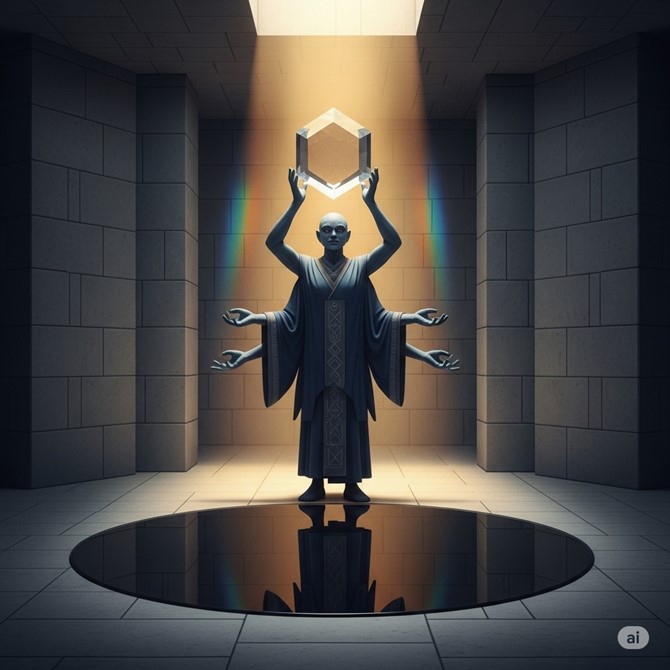
The followers of the Discipline of Form do not receive power directly from a sentient deity. Khor-An-Tak, The Pattern, is an impartial cosmic law. Instead, these devotees, particularly the Kaltos, use their profound understanding of this logical structure to design and wield magical gear that manipulates reality in accordance with The Pattern’s principles. Their use of magic is less a prayer and more a form of applied metaphysical science, focused on precision, structure, and the exploitation of flaws.
Offensive Applications
The offensive magic of the Discipline is not about raw, chaotic destruction. It is a cold, precise methodology of deconstruction. Its purpose is to analyze an opponent, identify its flaws, and impose a new, ordered state upon it—usually one of cessation.
- Pattern Disruption: This is a common offensive technique, channeled through a conduit like a set of calibrated lenses or a targeting reticle made of crystal. When activated, the device attunes the user’s Mind’s Eye to the principles of The Pattern, allowing them to perceive the world in terms of its underlying structure. When they look at an opponent, the conduit highlights the “flaws” in their form—a weak point in their armor, an inefficiency in their stance, a chaotic fluctuation in their magical shield. For a short time, the user’s own attacks are guided by this analysis, allowing them to bypass armor or strike with unerring accuracy. It is a weaponized form of critical analysis.
- Crystalline Lance: This rite uses a conduit of perfect geometric form, such as a flawless quartz rod or a complex, multifaceted crystal held in one of the user’s four hands. By channeling raw magical energy through the device, the energy is forced to conform to the conduit’s perfect structure. The resulting attack is not a chaotic blast of fire or lightning, but a silent, impossibly fast lance of hard-light crystal that erupts towards the target. The damage is precise and piercing. A more advanced version of this rite can cause the crystalline energy to remain embedded in the target, “locking” a joint or limb into a rigid, ordered state and causing paralysis.
- Resonance Cascade: A highly complex technique favored by skilled Kaltos artisans, this requires a set of four perfectly matched resonating crystals or metallic rods. Holding one in each hand, the user strikes them in a precise, mathematical sequence. This generates waves of pure, ordered energy. While a single wave is harmless, if multiple waves strike a target, they create a feedback loop, a resonance cascade that conflicts with the chaotic bio-electric field of a living creature. This attack bypasses physical armor entirely, causing severe internal damage as the target’s own form is vibrated into a state of destructive disharmony.
Defensive Applications
Defensive applications of the Discipline focus on reinforcing structure, creating perfect and efficient barriers, and using logic to preempt the flawed actions of an opponent.
- Axiom of the Unbroken Form: This is the principle behind the most common Kaltos defensive gear, such as shields and bracers engraved with hexagonal patterns. When magical energy is channeled into the conduit, it projects a translucent barrier of interlocking geometric plates of light. This is not a simple wall of force. It is a “perfect structure.” When a blow lands, the shield doesn’t just block the force; it distributes the kinetic energy perfectly across its entire surface. This allows the barrier to withstand a single, massive blow that would shatter a lesser shield, or to completely negate a certain amount of damage before its own structure momentarily fails.
- The Preemptive Calculation: Channeled through an intricate helmet or circlet, this is a defense rooted in logical prediction. By activating the conduit, the user’s mind enters a state of heightened analytical focus. It analyzes an opponent’s movements, stance, and energy fluctuations, running thousands of probable outcomes in an instant to determine the most likely form of attack. This provides the user with a brief, flashing insight—a “premonition” born of pure data—allowing them to react to an attack before it fully lands. This manifests as an incredible, almost supernatural ability to dodge or parry an incoming blow.
- Field of Order: This technique requires a larger, stationary conduit, such as a tripod-mounted gyroscope or a set of three resonating stones placed in a perfect triangle. When activated, the device generates a wide, invisible field of pure magical order. Within this field, chaos is actively suppressed. The random, chaotic energies used by many spellcasters are dampened, making their spells harder to cast or weaker in effect. Wild magic surges are nullified. The very laws of probability can be momentarily affected, making random outcomes (like the variable damage of a fire) become predictable and average. The Field of Order is not a barrier; it is an imposed state of reality that gives a massive tactical advantage to those who fight with logic and precision.
Weaver and the Flawed Thread
This is a high story of the Kaltos, from the time when the world was younger. The telling has been passed through many hands, so the words may feel hard and unbent, like old stone.
In the great city of the Mousterian nation, there was an Axiom, which was the temple of the Discipline of Form. And within this Axiom, there was a high priestess, a Kaltos woman named Lyra. Her mind was a thing of perfect logic, and her four hands were the most skilled in all the land. For many long years, Lyra worked on one great task. She wove a tapestry. It was not a tapestry of kings or of battles. It was a tapestry of The Pattern itself. Each thread was a perfect color. Each line was a perfect angle. It was a map of the bones of the world, a prayer made of pure mathematics. The weaving was a long weaving, and it was to be her life’s great work.
Then a new soul came to the city. This soul was a woman, and they called her The Singer. She was not like the Kaltos. She was a creature of emotion, a thing of joy and sorrow. She did not craft things with her hands. She made music. Her songs were like wild rivers. They were not logical. The rhythms were not steady. The melodies were not pure. Her music was full of chaos. It was full of feeling.
The people of the city, the ones who were not Kaltos, heard the music, and it was a strange new food for their spirits. The Anuq guards would find their feet tapping to the beat. The human merchants would stop their counting to listen. The music was a beautiful flaw in the perfect, quiet order of the city.
The Kaltos elders of the Axiom met. They talked of The Singer. Their projected Ghoran thoughts were cold and sharp. “This music is The Flaw made into a sound,” they thought as one. “It is chaos. It puts noise into the minds of the people. It disrupts The Pattern. The Singer is a danger. She must be sent away.”
Lyra, as the high priestess, was tasked to make the final assessment. She went to the great market square where The Singer performed. Lyra did not listen with her ears alone. She perceived the music with her logical mind. She analyzed its structure and found it to be full of imperfections. It was not a worthy creation.
But as she watched, she gathered other data. She saw an Anuq warrior, a creature of battle, close his eyes and smile a small smile. She saw a child who was crying stop his crying to listen. She saw another Kaltos artisan in the crowd, a man whose four hands were always busy, and his hands were still. He was only listening. The data was illogical. A flawed thing was creating a result of peace and focus. This was a paradox. This was a problem with no easy answer.
Lyra returned to her great loom in the Axiom. She tried to continue her work on the Great Tapestry. Her four hands moved with their perfect, practiced grace. But her mind was not a still pool of water. It was troubled by the illogical data. Her focus was not pure.
And then, it happened. A hand slipped. A single thread, out of tens of thousands, was pulled with a tension that was not correct. It was a flaw. It was a tiny thing, a thing no other eye in the world would ever see. But to Lyra, it was a scream. The perfect map of the world now had a single, crooked road. The Great Tapestry, her life’s work, was ruined.
For the first time in her long life, Lyra felt a thing that was close to despair. It was a cold, empty feeling. A logical dead end. She left her loom and went to the Chamber of Observation. She sat before the still water and meditated, trying to purge the flawed data of the music and the flawed memory of her mistake. But the flaw remained.
She went and found The Singer. She stood before her, a tall and silent blue figure. Lyra did not speak with her mouth. She used the pure Ghoran way. She projected an image from her mind into the mind of The Singer. It was the image of her vast, nearly perfect tapestry. And then she focused on the single, tiny, flawed thread, making it appear as large and ugly as a great wound. The concept she projected was pure and cold: Your chaos has broken my perfection. You are The Flaw.
The Singer was a new soul and did not understand the deep Ghoran well. She could not answer with logic. So she answered in the only way she knew. She began to sing. It was a new song, quiet and simple. It was a song about a crack in a seed, and how that crack is not an end, but the beginning of a sprout. It was a song about a scar on a warrior’s arm, and how that scar is not a mark of weakness, but the story of a battle won. It was a song about a life lived with no mistakes, and how that life was a blank page with no story written upon it.
Lyra listened to the song. It was still a thing of flawed mathematics. But with her Mind’s Eye, she did not analyze its structure. She perceived the intent behind it. She perceived the story. And she understood. The flaw in her tapestry was not a ruin. It was a signature. It was the only part of the great work that was truly hers. The rest was a copy of The Pattern. The flaw was the story of her own life touching the work.
Lyra returned to the Axiom. She went to her loom. She did not pull out the flawed thread. She began to weave again. But she did not continue the old pattern. She changed it. She wove around the flaw, making it the center of a new, more complex shape, a shape that was not perfectly symmetrical, but was more beautiful. The tapestry was no longer just a cold map of the world. It was now a map that included the story of the weaver.
She went before the council of elders. She told them that The Singer was not a Flaw to be purged. She was a “Necessary Variable.” She was a reminder that not all things in the great universe follow the logic of a straight line. The Singer was allowed to stay. And the Great Tapestry, with its single, celebrated flaw, became the most sacred object in the Axiom, for it taught the most difficult and most important lesson of the Discipline.
The Moral of the Story: A straight line can point the way, but it cannot circle a mountain. A perfect surface reflects all light, but a crack is where the light can enter. For the purpose of a life is not to be flawless, but to be whole.