
Species
The Anuq are a species of intelligent, humanoid avatars distinguished by their canid features. They are the most populous avatar type on the island of Moche, and their physical form is deeply intertwined with the nation’s cultural and religious iconography. Lineages of Anuq have ruled Moche for centuries, and their appearance is often seen by the populace as a sign of divine right and ancient heritage.
Physical Form and Sensory Traits
Anuq possess a lean, gracile humanoid body topped with the head of a desert jackal. Their forms are built for endurance and speed rather than raw strength, with long limbs and wiry musculature. The hands are humanoid, with five long, nimble fingers and non-retractable black claws that are thick but typically too dull for effective use in combat without being honed and maintained. Their legs are digitigrade, ending in padded, canid-like feet, a structure that makes them naturally quiet and swift runners.
Their heads are covered in a short, smooth coat of fur, and their long muzzles are filled with sharp, formidable teeth. Their most prominent features are their large, expressive ears, which are highly mobile and serve as their primary sensory organs.
- Olfactory Acuity: Their elongated snout grants them a sense of smell far more acute than that of most other humanoid avatars. They can track scents over long distances and identify individuals, spoiled food, or hidden substances with remarkable precision.
- Auditory Acuity: The large, independently mobile ears of the Anuq provide them with an exceptional sense of hearing. They can pinpoint the source of a sound with great accuracy and can hear frequencies well beyond the range of many other species. This makes them highly resistant to ambush and skilled at operating in low-visibility conditions.
- Vision: Their vision is sharp, with a slight advantage in dim light, granting them a greater ability to perceive detail in twilight or deeply shaded environments. Their eyes are typically gold, amber, or dark brown.
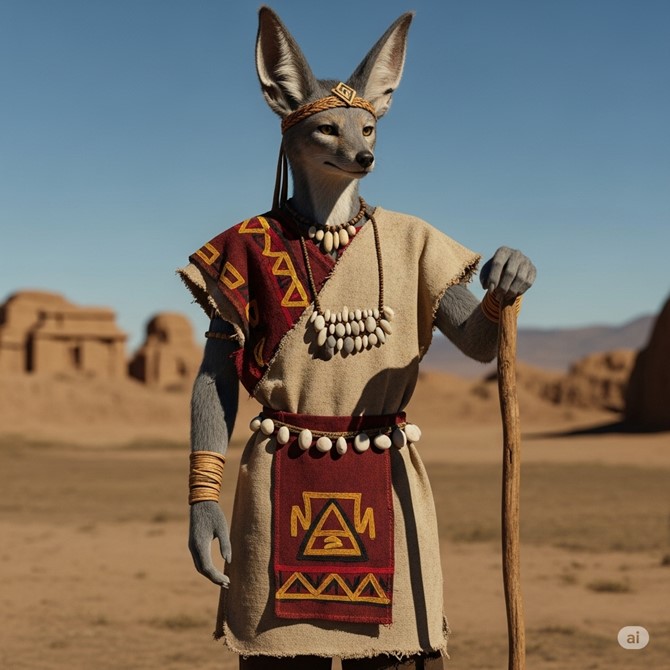
General Size
Anuq stand taller than the average human-like avatar, with males typically ranging from 6 feet 2 inches to 6 feet 8 inches (188 to 203 cm) and females from 5 feet 10 inches to 6 feet 4 inches (178 to 193 cm). Despite their height, their lean build makes them relatively light for their size. Adult males weigh between 160 and 190 pounds (72 to 86 kg), while females weigh between 140 and 170 pounds (63 to 77 kg).
Body Pattern
The fur of an Anuq is short and dense. Coloration typically mirrors that of desert canids, with the most common patterns being shades of fawn, tan, dusty grey, or reddish-brown. A darker saddle of fur across the back is common, as are white or cream markings on the muzzle, chest, and underside. Pure black or white fur is extremely rare and is often seen as a sign of a significant destiny or divine attention. Some noble lineages cultivate specific markings through generations of selective breeding, with patterns of spots or brindle stripes being a mark of high birth.
Life Cycle
The most defining biological trait of the Anuq is their twin-centric life cycle. Births almost universally result in identical twins. Single births are so rare as to be legendary. These twins share a powerful empathic bond from birth, growing, learning, and training together. Anuq mature quickly, reaching physical adulthood by the age of 16. Their natural lifespans, if not possessed by a long-lived character, are short and intense, averaging only 40 to 50 years. This compressed lifespan fosters a culture that values decisive action and the creation of a strong legacy. The deep bond between twins means they are inseparable companions. The death of one twin before the other inflicts a profound psychological wound on the survivor, a state known as k’taar, or “the half-life,” from which some never fully recover.
Potential Positives and Negatives due to their Physical Form
Positives:
- Their heightened senses of smell and hearing provide a significant tactical advantage, making them exceptional trackers and sentinels.
- Their digitigrade legs and light build make them natural long-distance runners with excellent stamina, well-suited for traversing the vast plains and deserts of Moche.
- The profound bond between Anuq twins results in an unparalleled degree of coordination in pairs or small groups.
Negatives:
- Their lean build, while agile, is less durable than that of more stocky species. Their base health tends to be lower before being modified by gear.
- The psychological trauma resulting from a twin’s death can be crippling for an Anuq avatar, even after being possessed by a character, as the avatar’s residual memories and emotional framework can bleed through.
- Their short natural lifespan imbues their culture with a sense of urgency that can manifest as recklessness.
Tags: Anuq, Canid, Humanoid, Avatar, Moche, Desert, Twin-born, Digitigrade, Warrior, Priest, Ruler, Tracker, Ritualistic, Loyal, Short-lived, Kutan Speaker, Noble
Specialized Item Slots Available
The unique physiology of the Anuq allows them to utilize specialized gear slots that other species cannot.
- Auricular Slots (2): Their large, sturdy ears are culturally pierced to support heavy and elaborate ornaments. This provides them with two dedicated Auricular slots. These slots can hold massive ear spools, resonant amplifiers, and other complex magical devices that would be too heavy or improperly shaped for other species, often used for items that enhance hearing, facilitate telepathic communication, or focus magical energies.
- Nasal Slot (1): The bridge of their muzzle can be fitted with specialized jewelry or guards. This provides a single Nasal slot, suitable for holding items like scent filters, alchemical residue analyzers, or enchanted rings that further heighten their olfactory senses.
Environmental Adaptability
Anuq are exceptionally well-adapted to the hot, arid, and semi-arid environments that dominate the island nation of Moche. Their bodies are efficient at regulating heat, and their natural stamina allows them to thrive in conditions that would exhaust other species. They are, however, poorly adapted to extreme cold. Their short fur and lean bodies offer little protection against frigid temperatures, causing them to become sluggish and vulnerable in icy or arctic climates.
Other Information
As the ruling class of Moche, the Anuq are the primary keepers of “High Kutan,” the formal, ritualistic version of the national language. They form the officer corps of the military, the highest echelons of the priesthood, and the master engineers of the nation’s magi-steam infrastructure. Their social structure is built around loyalty to one’s twin and one’s lineage above all else. This fierce loyalty makes them formidable political allies and implacable enemies. The art and architecture of the Moche nation are filled with their likeness, depicting them as warrior-priests, divine sovereigns, and heroic figures from the nation’s extensive history.
Sun-Scorched Twins and Whispering Mountain
It was in a time before the memories of many men that the land of Moche knew a great stillness. The sky was a bright and punishing blue, but the magic that gave life to the steam-factories and the glowing glyphs became thin, like weak soup. The people of Moche, and the Anuq who were their rulers, looked to the high peaks and felt a disquiet in their bones. The problem came, it was said, from the Whispering Mountain, which had ceased its whispering and now radiated only a deep and sorrowful silence.
In the great city of adobe and metal, there lived two brothers of the Anuq. They were of a high lineage and were named Xo’c and Ka’an. As is the way with the Anuq, they were twins, born of one egg of the womb, and their souls were so alike that one could not feel pain without the other tasting ash in his mouth. Their forms were swift and their senses were a marvel. When they ran, they were a single blur of motion across the sand. When they fought in the training pits, their movements were a song sung by two mouths at once. It was said by the elders, “To see Xo’c and Ka’an is to see one soul given the gift of two bodies to do its work.”
The rulers and priests gathered in the great pyramid. Their gear of platinum and gold seemed dull in the weak magic. The High Priest, whose muzzle was grey with years, stood before the assembly. His voice, speaking High Kutan, was heavy.
“The Whispering Mountain is sick. A great silence-stone from a forgotten age drains its power. The flow of magic to the lowlands is cut. A conduit, blessed by ritual, must be carried to the heart of the silence. It is a thing of great power, of hammered rhodium that sings with the memory of fire. The path is confusing. The mountain itself will try to trick the feet and the eyes. The one who makes this journey must have senses that are doubled. It must be one who is two, and two who are one.”
And so all eyes turned to Xo’c and Ka’an. They stood, their forms tall and proud, and they accepted the great burden.
They were given gear for the journey. Tunics of woven fiber that could turn a blade, and sandals whose leather was enchanted to not wear. And to them was given the conduit, a heavy rod of rhodium that hummed with stored power and felt warm to the touch, like a living thing.
To the desert they did go. The sun was a cruel, singular eye in the sky. The sand was hot and deep, and it drank their steps and made them thirsty. For days they walked. They spoke little, for their thoughts were already shared between them. When Xo’an felt the pang of thirst, Ka’an would offer the water skin. When Ka’an saw a shimmer of danger on the horizon, Xo’an had already loosened the blade in his sheath.
On the fourth day, the ground trembled. From the dunes rose a creature of great horribleness. Its body was like a leviathan of the deep ocean, but its skin was of polished, black glass. It moved not upon the sand but through it, and when it roared from the great angry hole of its mouth, the sound cracked the very air.
The Glass-Skinned Sand-Leviathan came upon them. Xo’c and Ka’an did not run. They moved as one. Xo’c threw a hooked spear on a long rope, a piece of gear from his pack, and its point found a crack in the creature’s glass hide. As the beast turned its fury on him, Ka’an ran, silent on his digitigrade feet, along its great back. With a war-pick forged with elemental fire, he struck a mighty blow upon the spear’s anchor point.
The glass skin exploded. The beast thrashed in its death throes, and a great shard, sharp as any razor, flew through the air. Xo’c, seeing it, cried out, but it was too late. The shard struck Ka’an in the side, a deep and terrible wound.
The great beast was dead, but the victory was hollow. The life-blood of Ka’an flowed out upon the hot sand. Xo’c carried his brother to the shade of a rock. He offered water. He used the healing salves from their packs, but the wound was too grave. The life of Ka’an was guttering like a cheap candle in a high wind. Xo’c felt his own strength failing, his heart beating with a half-beat, as his twin’s life faded.
They reached the foot of the Whispering Mountain. Ka’an could walk no more. He lay upon the ground, his breathing a shallow whisper.
“Brother,” Ka’an said, his voice thin. “I cannot climb. But you must. The conduit must reach the peak.”
“I will not leave you,” Xo’c said, and his own voice was broken. “We are one. To leave you is to leave my own heart behind.”
Ka’an smiled, a sad showing of his white teeth. He reached up and removed from his ear a great spool of gold, an item of power that sharpened the sense of hearing. “Then take my heart with you. Let my hearing guide your feet when your eyes are full of sorrow. Go now. For Moche. For our name.”
And so Xo’c did the hardest thing. He took the ear spool and placed it in his own ear. He took up the rhodium conduit. He began to climb the mountain alone, a man walking with one leg.
The path was a lie. Rocks shifted. The air shimmered with false images. The silence was a pressure that made his head ache. But through the gift of his brother’s gear, he could hear the true path. He heard the faint song of the rock that was solid, the groan of the illusion just before it vanished. He climbed and climbed, and the climbing was a great agony in his soul.
At the summit, in a bowl of scorched rock, was the source. It was a crystal of silent shadow, an object of anti-magic that pulsed with a deep blackness. It ate the sound, the light, the very magic from the air. It showed him a picture, not with light, but inside his head, through the eye of his mind. It showed him a future where he stood as the sole ruler of Moche, powerful and alone, his brother’s memory a source of strength, not sorrow. A ruler without the weakness of a shared heart.
Xo’c snarled, a true canid sound of defiance. He thought of his brother lying at the mountain’s foot, of their shared life. He lifted the rhodium conduit and, with a great shout of two names, his own and his brother’s, he thrust it into the ground beside the shadow crystal.
The effect was immediate. The conduit of rhodium released its stored fire, and the crystal of shadow shattered with a sound that was the opposite of sound, a silent scream that echoed across the nation. The oppressive silence was broken, and the air once again began to hum. The Whispering Mountain began to whisper once more, its voice a song of renewed magic.
Xo’c ran down the mountain, his heart full of a terrible hope. But he found only the still form of his brother. Ka’an’s spirit had fled his avatar, and in his place on the sand lay a single, flawless crystal that pulsed with a faint, internal light, the crystal of his final stillness.
Xo’c fell to his knees. The true k’taar took him then, a coldness and an emptiness that would never leave. He had saved his nation, but he had lost half of his soul. He picked up the crystal, the memory of his brother’s form, and held it to his chest. He returned to the city a hero, celebrated and mourned. He became a great ruler, known for his wisdom and his deep melancholy. He ruled with two hearts, but only one beat, and for all his short life, he was never seen without the crystal of his twin, which he wore in a pouch of soft leather, always, against his heart.
The Moral of the Story: A single arrow is strong, but a kingdom is but one body. A ruler with a half-soul governs only half a kingdom, for true strength is not found in the self that stands alone, but in the self that is shared.