
The Ashuri are the most populous and influential race within the Mesopotamian nation. They are a small-statured, quick-witted, and highly social people, known for their skill in law, trade, and intricate craftsmanship. Their name is an ancient Eshunnan word meaning “Children of the River.”
Species, Physical Form, and Sensory Traits
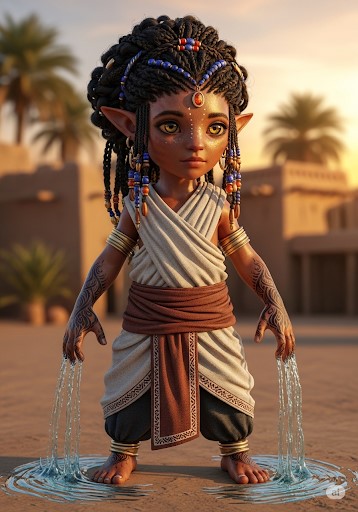
The Ashuri are a distinct species of small humanoid avatars. They are known for their slender, agile bodies and their remarkably quick and precise movements. Their skin tones range from warm olive to deep bronze, and their hair is typically thick, dark, and curly, often worn in elaborate braids decorated with beads of lapis lazuli and carnelian. A notable feature is their large, expressive eyes, which are most often shades of brown or gold.
Their senses are sharp, particularly their hearing, which is attuned to discerning subtle shifts in tone and meaning in conversation—a crucial skill in a culture built on trade and law. They also have a natural and uncanny sense of balance.
General Size and Body Pattern
- Average Height: 3’2″ – 3’10” (96 – 117 cm)
- Average Weight: 40 – 60 lbs (18 – 27 kg)
The most unique physical trait of the Ashuri is the intricate, ink-like patterns that adorn the tops of their hands and feet. These “river-marks” are present from birth and are unique to each family line, branching and flowing like the deltas of the great rivers. While family patterns are similar, an individual’s specific marks are as unique as a fingerprint, and are often used to sign or place one’s seal on a legal tablet.
Life Cycle
Ashuri have a longer lifespan than most of the larger races, often living for 120 to 150 years. They are considered children until their river-marks are fully developed, which typically occurs around the age of 25. Their culture places immense value on elders, who are seen as living libraries of lore, law, and crafting knowledge.
Potential Positives and Negatives
The Ashuri’s small stature provides them with a unique set of strengths and weaknesses.
- Positives: Their small size and light weight make them incredibly nimble and stealthy. They can easily navigate dense crowds, squeeze into tight spaces, and move with a quiet grace that larger folk cannot match. This makes them excellent scouts, artisans, and acrobats.
- Negatives: They lack the raw physical strength of larger races like the K’a-Gora. They cannot wield heavy weapons or perform tasks that require immense brute force. In combat, they must rely on speed, teamwork, and clever tactics rather than overwhelming power.
Tags: Ashuri, Humanoid, Halfling-Kin, Mesopotamian, River-Folk, Small-Statured, Agile, River-Marks, Matrilineal, Ruling Class, Law Giver, Merchant, Scribe, Artisan, Long-Lived, Communal, Quick-Witted
Specialized Item Slots
The Ashuri have specialized slots that reflect their cultural focus on trade, craft, and social interaction.
- Covenant Bracers (Wrists): This slot is for a pair of specially made bracers, often made of clay or copper, upon which miniature contracts or personal oaths can be inscribed in the Ki-Unna script. Wearing these bracers is a sign of a binding promise, and they can be enchanted to aid in social interactions, such as negotiation and diplomacy.
- Anklets of the Weaver (Ankles): Ashuri often wear intricate anklets of fine chain and small bells. This specialized slot is used for items that enhance their natural agility and quiet movement. Enchanted anklets can grant bonuses to stealth, acrobatics, or even allow the wearer to walk on precarious surfaces with perfect balance.
Environmental Adaptability
The Ashuri are perfectly adapted to the hot, fertile river valleys and bustling, crowded cities of Mesopotamia. Their physiology is suited for heat, and their small size is a significant advantage in the dense urban environments they build. They are less comfortable in cold climates or rugged, mountainous terrain.
Other Important Information
- Matrilineal Rule by Law: The Ashuri are the ruling family of Mesopotamia, but they do not rule through physical might. Their power comes from their mastery of law, trade, and bureaucracy. The nation is governed by a complex system of laws and contracts—enforced by Syllabic Binding magic—which the Ashuri matriarchal lines have authored and controlled for centuries. They maintain their power by being the indispensable administrators and judges of their multi-racial society.
- The Power of the Group: An Ashuri alone is not a great threat, but they are rarely alone. Their culture is deeply communal, and they excel at teamwork and coordinated tactics. In a confrontation, a group of Ashuri will use their speed and intelligence to outmaneuver and overwhelm larger, stronger opponents.
- Artisans and Scribes: While the K’a-Gora are masters of large-scale stonework and blacksmithing, the Ashuri excel at intricate, detailed crafts. They are the world’s finest gem-cutters, scribes, weavers, and engravers. Their steady hands and keen eyes allow them to create works of breathtaking complexity.
Matriarch’s Gambit and Weight of a Word
This telling comes from the clay tablets of the great library of Ashur, and it is a poor telling, for the marks in the clay speak of things for which our tongue has no true words. The translation is a shadow of the true story.
In the dawn age of the Mesopotamian nation, after the great cities were built but before their laws were strong, the Ashuri were but one people among many. They were small and quick, but the land was also home to the K’a-Gora, the mighty Sun-Mountain People, who were as large and strong as the rocks of the high plateau. The K’a-Gora were the protectors, the soldiers, but their strength was a simple thing, and they believed that might was the only true law.
The greatest of the K’a-Gora warlords was a man named Gorth. His geodermic patterns were as dark and sharp as shattered obsidian. He commanded the armies, and his heart grew heavy with the belief that the strongest should rule. He saw the small, clever Ashuri, and he saw their wealth from trade and their intricate crafts, and he desired it. He thought, “What good are their clever words against my strong axe? A law is but a whisper. A sword is a shout.”
Gorth came with his five thousand warriors to the gates of the capital city, and he demanded the throne of the Ashuri Matriarch. The Matriarch at that time was a woman named Zaliya. She was old, and her river-marks were like a thousand tiny streams upon her hands. She was not a warrior. She was a weaver, a scribe, and a judge.
The Ashuri people were terrified. Their city guards were brave, but they were few, and they could not stand against Gorth’s legion of stone-like warriors. They begged Zaliya to flee, to give Gorth the throne.
Zaliya showed no fear. She went to the top of the great wall and looked down upon Gorth and his army. Gorth laughed. “Little mother,” his voice was like grinding stones, “your walls cannot protect you from me. I will tear them down and make a new throne from the rubble.”
Zaliya’s voice was not loud, but it was clear, and it carried on the hot wind. “Warlord Gorth,” she said, “you speak of strength. But the strength of one man is fleeting. The strength of a promise, a law, that can last for a thousand years. I will make you a pact, a bargain in the old way.”
Gorth was amused. “A bargain? What can you offer me but the city I am about to take?”
“I offer you a true test of strength,” Zaliya replied. “You believe the power of the sword is greater than the power of the word. I say the opposite. We will each choose a champion. Your champion will be the strongest warrior in your army. My champion will be the greatest law-speaker of my court. They will not fight. They will each be given a single, perfect, unbreakable block of granite from the heart of the Sun-Mountain. Your champion must break his stone with strength. My champion will break her stone with a word. The first to break their stone wins the city.”
Gorth’s laughter echoed across the plain. It was the most foolish bargain he had ever heard. How could a word break a stone? He agreed at once, certain of his victory.
The two great blocks of granite were brought and placed before the city gates. Gorth chose his champion, a giant of a man named Hakkar, whose fists were the size of melons. Matriarch Zaliya chose her champion, a small, quiet woman named Eliana, whose only weapon was her knowledge of the Eshunnan tongue.
Hakkar approached the stone. He took up the largest sledgehammer from the forge, a weapon that could shatter a fortress gate. For a whole day, he struck the stone. The sound of his blows was like thunder. The ground shook. He shattered the hammer, and then another. The granite was chipped and scarred, but it did not break. He was a creature of immense strength, but the stone was the heart of the Earth, and it endured.
As the sun set, Hakkar fell back, exhausted, his hands bleeding, his great muscles trembling. The stone was not broken.
Then it was Eliana’s turn. She was a small woman, and she looked like a child next to the great stone. She carried no weapon. In her hands, she held only a stylus and a small, wet tablet of clay.
She did not touch the stone. She stood before it, and for a whole night, she worked. She wrote upon the clay tablet. She did not write a spell of shattering or a curse. She wrote a contract, an agreement. She wrote it in the most ancient and complex form of the Ki-Unna script. The contract was a marvel of legal language. It stated that the stone, by its nature as part of the world, was bound by the laws of the world. It was bound by the law of heat and the law of cold. It was bound by the law of pressure and the law of time. The contract stated that if the stone were to ever break, its two halves would be used to build the foundation of a new hospital for the city. It was a promise of a noble future for the stone itself.
As the sun rose on the second day, she finished. She held the tablet up for all to see. Then, she began to speak. She recited the contract aloud, her voice rising and falling in the precise, ritual cadences of the Eshunnan language. She was not casting a spell. She was invoking the great magic of Syllabic Binding. She was making a promise to the stone, a promise that was now enforced by the very laws of magic.
She finished her recitation. She placed the small, signed clay tablet at the base of the great granite block. And then she waited.
Nothing happened. Gorth and his warriors began to laugh again.
But Zaliya and the Ashuri people watched, and they were silent.
The day grew hot. The sun beat down on the granite. As evening came, the air grew cold. And then, a tiny sound was heard. A faint tick.
A hairline crack appeared on the surface of the stone. The crack grew, following the unseen lines of stress within the granite. It branched out, like the river-marks on an Ashuri’s hand. The people watched, mesmerized. The stone, now bound by a magical promise to become two halves, was obeying the ancient laws of thermodynamics that the contract had invoked. The heat of the day and the cold of the night were now a promise it had to keep.
With a great groan that seemed to come from the deep earth, the massive, unbreakable block of granite split perfectly in two.
Eliana, the law-speaker, had broken the stone with a word.
Gorth and his army were silent. They had seen a power greater than any axe or sword. It was the power of a promise, the strength of a law made real. Gorth, the warlord, bowed his head. He did not sack the city. He knelt before the Matriarch Zaliya and swore an oath to be the protector of her law. From that day forward, the K’a-Gora became the strong arm of the Ashuri’s wise rule, and the two peoples found their balance.
The Moral of the Story: A fist can break a bone, but a word can break a mountain.