
The Tvillingesjæl (a Maglemål word meaning “Twin-Soul”) are the most numerous race of the Maglemosian island nation and comprise its ruling family. They are humanoids whose physical forms are uniquely suited to housing the dual consciousness of an Avatar merged with a Character’s memories.
Species, Physical Form, and Sensory Traits
The Tvillingesjæl are a distinct species of humanoid avatars. At a glance, they appear human, typically with strong, hardy builds suited to the rugged Maglemosian continent. Their features are often described as symmetrical and serene, possessing a captivating stillness that can be unsettling to other races. Skin tones are those common to inhabitants of colder northern climates, ranging from pale to ruddy and weathered. Hair is thick and grows quickly, with common colors being ash-blonde, russet, deep brown, and black.
The defining characteristic of a Tvillingesjæl is the Sjælelys, or “Soul Light.” This is a network of faint, bioluminescent patterns that lie just beneath the skin. These patterns are not static tattoos but shift, flow, and gently pulse like captured aurorae. The color and pattern of the Sjælelys are unique to the possessing Character’s soul, serving as a physical manifestation of the merged consciousness. Common colors for this light include pale silver, ethereal blue, soft amber, and faint green. This light also gives their eyes a dual-toned appearance; a Tvillingesjæl might have physically brown eyes, but they will shimmer with a faint silver luminescence from the Sjælelys within.
Their senses are comparable to a baseline human’s, but they have a unique somatic awareness. They are acutely sensitive to the “feel” of their own dual nature, often describing it as a constant, low-grade hum or vibration within their body.
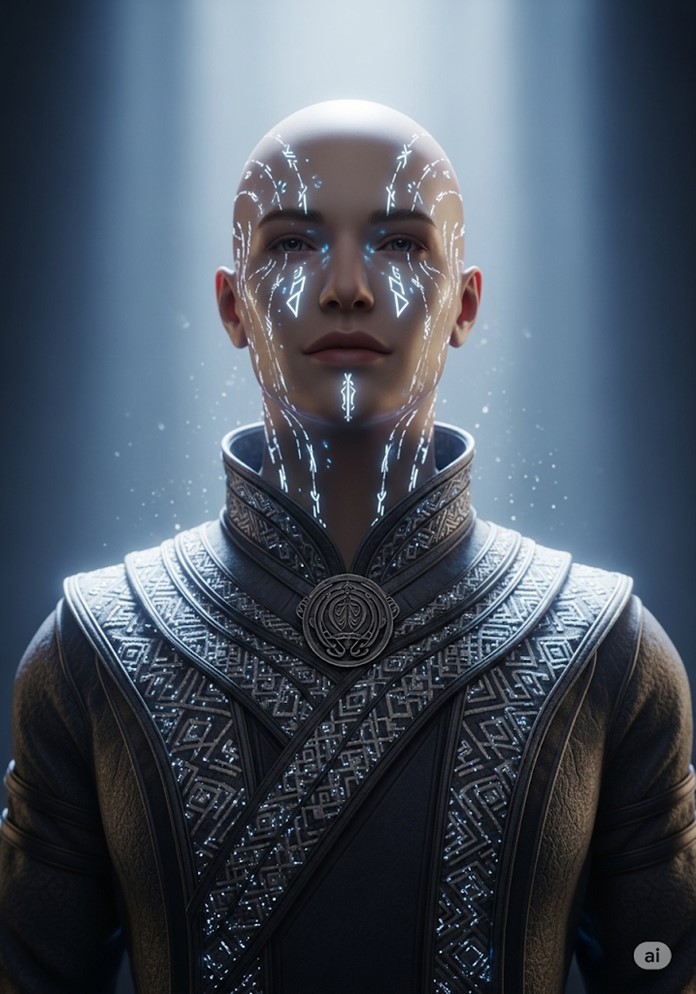
General Size and Body Pattern
- Average Height: 5’8″ – 6’4″ (173 – 193 cm)
- Average Weight: 150 – 220 lbs (68 – 100 kg)
Tvillingesjæl are generally taller and more solidly built than the average for many other humanoid races. Their bodies are built for resilience rather than pure speed or brute strength. The pattern of their Sjælelys is entirely individual. Some may have lights that form intricate, rune-like webs across their arms and torso, while others might have a more concentrated glow that pools around their temples, chest, and hands. These patterns often become more intense and active during moments of strong emotion or when the Avatar is channeling magic.
Life Cycle
Tvillingesjæl are born physically indistinguishable from other human infants of the region, with no visible Sjælelys. The potential for the light lies dormant within their physiology. The Sjælelys only manifests when the individual willingly merges with a Character’s memories. This event, known as the “Awakening,” is the single most important rite of passage in their culture. It is the moment an individual becomes “complete,” and their soul-light blossoms for the first time. They have a natural lifespan comparable to other humanoids, typically 80-100 years, though those who have Awakened are often more resilient and may live longer. As they are sterile after merging, the continuation of their people relies on the un-merged population.
Potential Positives and Negatives
The unique physical form of the Tvillingesjæl presents distinct advantages and disadvantages that must be navigated through training and awareness.
- Potential Positives: With dedicated training, a Tvillingesjæl can learn to consciously control the intensity and flow of their Sjælelys. This allows for a unique and subtle form of nonverbal communication with others who know how to read the lights. This physical expression of their inner state gives them a potential advantage in diplomacy and meditation, as they can train to project an aura of calm and sincerity.
- Potential Negatives: The ever-present Sjælelys makes true stealth or disguise nearly impossible. Even when dampened through training, the faint glow is visible in low-light conditions, making them stand out. This glow can also attract unwanted attention from magical predators or entities drawn to spiritual energy. Their serene demeanor can be misread by other races as apathy, arrogance, or a lack of passion.
Tags: Tvillingesjæl, Humanoid, Twin-Soul, Bioluminescent, Sjælelys, Serene, Maglemosian, Ruling Race, Psychic Aptitude, Dual Consciousness, Awakened, Harmonious, Contemplative, Resilient, Cold-Adapted, Mind Weave, Otherworldly
Specialized Item Slots
Due to their unique physiology, the Tvillingesjæl have access to specialized item slots that other races do not.
- Mind Weave (Head): This slot is located on the forehead, often between the eyebrows. It is designed to hold small, carved stones, crystals, or metal symbols that act as psychic amplifiers or filters. Items worn in this slot are crucial for Tvillingesjæl who train in mental and telepathic skills, allowing them to focus their dual consciousness without the use of wands or staves.
- Conduit Bracers (Wrists x2): The Sjælelys is often strongest at the wrists. The Tvillingesjæl have slots for specialized bracers designed to channel and shape magical energy that flows from them, making them particularly effective when using gear that requires somatic (gestural) components.
Environmental Adaptability
Having originated and developed on the Maglemosian continent, the Tvillingesjæl are exceptionally well-adapted to cold and temperate climates. They are comfortable in forested, mountainous, and coastal regions and possess a natural resilience to cold weather. Conversely, they are not well-suited for extremely hot, arid environments and may suffer from exhaustion more quickly in deserts or tropical jungles.
Other Information
The Tvillingesjæl are culturally predisposed to seek balance and inner harmony, a necessity born from the constant presence of two minds within one body. They value discipline, contemplation, and community over radical individualism. In their society, achieving the “Awakening” is a celebrated event, and those who remain un-merged are respected as crucial for ensuring the next generation, but are not typically found in positions of leadership. Their natural affinity for housing a second soul has made them the most stable and successful ruling line in Maglemosian history, as they have a long and storied tradition of merging with wise and powerful Characters.
First Light and Gloom-Wyrm
Hark, and know the story that is told, a story from the time before time, when the words were new and the world was old. It was translated poorly from the runes of the first people, who themselves heard it from the whispers of the wind.
In the age of the Great Cold, before the high cities of Maglemosian were raised from the stone, the people lived in scattered clans. They were the People of the Pine, the People of the River-Stone, and the People of the High Crag. They were one blood, yet they were not one folk, and their chieftains spoke with loud voices in their own halls, but their words were but dust against the greater silence.
For a shadow had fallen upon the land. It was not the shadow of a mountain, nor the shadow of a cloud. It was a living shadow, a creature of negation called the Gloom-Wyrm. It did not hunt with claw or fang. It did not breathe fire. It consumed sound. It consumed warmth. Where it passed, the fires gave no heat, the rivers made no noise, and the hearts of the people grew cold with a quiet despair. The world was becoming silent. The world was becoming grey.
Into this dimming world, a new thing came. It was a soul, but a soul without a body, a memory from a place beyond the stars. It was a Character, and it carried with it the ghost of a thousand triumphs and the knowledge of how to build things that last. This soul-wind drifted over the land, seeking a vessel, a home, for it could do nothing as mere air. It was a song with no throat to sing it.
The chieftains, whose hearts were filled with their own pride, felt the soul-wind and they were afraid. They barred their minds and their halls. But there was one among the Pine-Clan named Kaelen. He was not a chieftain. His hands were strong, but his voice was not loud in the councils. He felt the soul-wind, and he did not feel fear. He felt a strange sort of kinship, like one who has been alone his whole life and suddenly hears a second footstep walking beside him in the snow.
And Kaelen did a thing no one had done before. He opened his heart. He opened his mind. He said to the soul-wind, “This house is empty. If you are a friend to the people, then you may enter.”
And the joining was a great and terrible thing to see. Light, like the light of a star trapped in ice, bloomed from within Kaelen. It pushed out from under his skin, a web of silver and blue fire. It was the first Sjælelys. The people of his clan fell back, crying out that he was now two-beings-in-one, a man and a spirit, a monster. But Kaelen stood, and his eyes, which were the color of the deep forest, now held a second light within them, like the reflection of a distant moon.
He was Kaelen, and also he was more. He remembered the feel of the axe in his hand, and also he remembered the schematics of a fortress that had never been built on this world. He felt the cold of the wind on his skin, and also he understood the turning of seasons across a thousand years.
He went to the council of the chieftains. They saw the light that moved within him and they called for their guards. But Kaelen spoke, and his voice was his own, yet it carried a weight it did not have before.
He heard the words of the Stone-Clan, who demanded more hunting ground. And also, he heard the fear in their hearts, for their children were hungry. He heard the boasts of the Pine-Clan, who declared they would fight alone. And also, he saw the pride that kept them from asking for help. In his one mind, the two truths sat, and from them, a third truth, the path of walking-together, was made. He spoke of plans and granaries. He spoke of shared patrols and walls that could be built by many hands. The light on his skin pulsed with his sincerity, and the chieftains, for the first time, were silent and they listened.
The clans became one folk, the Maglemosian. With their hands joined, they built and they prepared. And Kaelen, now their chosen leader, went to face the Gloom-Wyrm.
He found it in the deepest valley, a vortex of utter silence and cold. He drew no sword. He notched no arrow. He stood before the emptiness and he reached inside himself, to the two souls that were now one. The man-soul, Kaelen, gave his love for the land, the feel of the soil, the smell of the pines. The sky-soul, the Character, gave its will, its focus, its unbending memory of light.
He poured this union outwards through his Sjælelys. It was not a fire to burn the shadow. It was a light to fill it. It was a song to answer the silence. The silver and blue light washed over the Gloom-Wyrm. The beast of nothingness could not consume it, for it was a light born of two realities. The silence could not smother a song sung by two voices at once. The Wyrm recoiled, not in pain, but in confusion. It could not exist where there was such harmony. It sank into the earth, deep, deep down, where it sleeps still.
Warmth returned to the fires. The rivers sang their old songs. And the people looked upon Kaelen, the Twin-Soul, and they saw not a monster, but a king. For they knew, then, what true leadership was.
The Moral of the Story: A leader is not one who is the most like his people, but one who can hold all his people within his heart.