
The religion most widely practiced across the island nation of Longshan, where it originated amid the mist-veiled mountains and terraced river valleys that define the archipelago’s rugged landscape, is known as Heitaoism, a faith centered on the veneration of the deity Heitao Long, the Black Pottery Dragon. Heitaoism claims adherents numbering approximately 75 million souls, representing slightly more than half of Longshan’s total population of 144,088,000, with followers predominantly among the Shanlong majority but also including integrated isekai souls from multiversal origins who have adopted the rituals through communal living, marriage alliances, or trade guild initiations. This faith permeates daily life in Longshan’s megacities, where towering pagoda-skyscrapers etched with serpentine motifs house vast temples, and in rural enclaves where farmers invoke blessings over enchanted fields using jade implements. Heitaoism influences political decisions in the imperial courts, where the ruling Shanlong family consults oracle-like divinations before forging alliances or launching airship fleets, and it shapes industrial practices in steam-powered factories, where workers inscribe protective runes on machinery drawn from sacred texts. The religion’s spread beyond Longshan reaches diaspora communities in neighboring island nations and floating cities, where expatriate merchants maintain portable shrines aboard zeppelins, ensuring the deity’s influence echoes across Saṃsāra’s endless oceans through trade routes laden with black-glazed ceramics and jade artifacts.
The lore of Heitaoism traces back over five millennia, woven into the fabric of Longshan’s ancient history when the first teleported communities arrived in the fertile valleys, discovering ruins of even older civilizations buried beneath layers of volcanic soil and mana-rich clay deposits. According to sacred scrolls preserved in cavernous libraries illuminated by bioluminescent fungi, Heitao Long emerged from the primordial chaos at the world’s inception, a colossal serpentine entity coiled within a vast underground kiln where the gods fired the essence of Saṃsāra into being. This deity, manifesting as a dragon of obsidian scales and smoldering eyes, shaped the land from black clay infused with elemental fire and water, molding mountains like potter’s wheels and rivers like flowing glazes. The lore recounts how Heitao Long breathed life into the first Shanlong avatars by imprinting draconic patterns onto egg-like vessels, which hatched amid geothermal vents, establishing the species as stewards of the island’s resources. During the Age of Shadows, a period of rampant monster incursions and mana storms that ravaged early settlements, Heitao Long descended in visions to chosen seers, teaching the arts of fortification through walled enclaves and divination via inscribed bones heated in ritual fires. These teachings enabled the construction of the first terraced strongholds, where communities warded off beasts like shadow-wyrms using gear enchanted with the deity’s symbols. Over centuries, as reincarnated souls from diverse realms mingled, the lore evolved to incorporate multiversal elements, such as tales of Heitao Long battling void entities from forgotten worlds, sealing them in jade prisons buried deep in cave systems. Epic poems recited during festivals depict the deity’s role in the Industrial Dawn, when it revealed secrets of steam generation through alchemical combinations, powering the rise of factories and airships that propelled Longshan into prosperity. Yet the lore warns of cycles of renewal, where Heitao Long periodically withdraws into slumbering coils beneath the earth, allowing challenges to test followers’ resilience, only to reawaken during times of great need, such as when underwater cities threatened by abyssal monsters receive divine interventions through prophetic dreams.
Heitao Long’s personality embodies a profound duality of creation and destruction, manifesting as a wise yet enigmatic guardian who communicates through cryptic omens rather than direct edicts, fostering self-reliance among devotees. The deity is portrayed as patient and methodical, akin to a master potter shaping clay over eons, but capable of sudden, fiery wrath when balance is disrupted, such as unleashing earthquakes or mana surges upon those who desecrate sacred sites with unchecked ambition. In temple murals painted with inks derived from volcanic ash, Heitao Long appears contemplative, coiled around a cosmic wheel symbolizing reincarnation, yet its eyes gleam with an intensity that demands respect and ritual precision. Followers interpret the deity’s will through subtle signs, like the patterns in cracked pottery or the flow of steam in oracular devices, reflecting a personality that values harmony and adaptation over rigid dogma. Heitao Long is neither benevolent nor malevolent in absolute terms; it rewards diligent craftsmanship and communal cooperation with bountiful harvests or enhanced magical flows, while punishing greed or disunity with barren lands or malfunctioning gear, as seen in historical accounts of famines following corrupt rule. This personality influences Heitaoist clergy, who adopt a serene demeanor in public rituals but engage in intense, private meditations to attune with the deity’s draconic essence, often using telepathic links facilitated by jade amulets to share visions across vast distances.
Traits of Heitao Long include immense wisdom drawn from the depths of Saṃsāra’s ancient cycles, allowing it to foresee patterns in magic weather and guide followers toward tier advancements through properly attuned gear like scale-embedded bracers or pottery talismans. The deity exhibits resilience, enduring the world’s reincarnative flux without diminishment, symbolized in lore by its ability to reform from shattered fragments, much like repaired black pottery. Creativity stands as a core trait, as Heitao Long is credited with inventing forms of alchemy that blend elemental forces into steam power, inspiring artisans to innovate in workshops where mana circuits hum with divine energy. Protective ferocity emerges in times of peril, where the deity’s influence manifests as enhanced senses or strength for those wearing sacred items, enabling Shanlong warriors to repel invaders in labyrinthine battles aboard griffons. However, traits like inscrutability can lead to misinterpretations, where followers debate omens in scholarly debates, sometimes resulting in schisms resolved through ritual combats.
Characteristics of Heitao Long define it as a chthonic force tied to the earth, with a form that shifts between a colossal dragon burrowing through mountains and ethereal mists coiling around temple altars, its presence felt in the warm hum of geothermal springs or the crackle of kiln fires. The deity is associated with transformation, overseeing the shedding of scales in Shanlong life cycles as metaphors for personal growth and reincarnation, encouraging adherents to train skills diligently to unlock higher magical tiers. Hierarchical in nature, Heitao Long mirrors Longshan’s social structures, favoring clan-based devotion where families maintain ancestral shrines with black pottery vessels holding offerings of enchanted grains or alchemical powders. The deity’s characteristics extend to fertility and abundance, blessing terraced farmlands with mana-infused rains, but also to judgment, where divination rituals reveal fates inscribed on heated bones, guiding decisions in trade negotiations or political intrigues.
Attributes ascribed to Heitao Long encompass dominion over earth and fire elements, enabling control of volcanic activities that power steam industries, and mastery of divination, where followers use gear like inscribed jade scepters to peer into possible futures amid the ebb and flow of global magic. Strength in craftsmanship attributes the deity with granting precision to those forging gear, such as pulley systems or levitation runes, elevating mundane tasks to sacred acts. Eternal vigilance is another attribute, with Heitao Long’s senses extending through the land’s vibrations, alerting devotees to hidden ruins or approaching monsters via tremors felt in their scales. The deity holds attributes of unity, binding diverse souls in Longshan’s melting pot through shared rituals, and renewal, facilitating smooth reincarnations for pious avatars equipped with soul-binding amulets.
Symbols of Heitao Long proliferate throughout Longshan, with the primary emblem being a coiled dragon encircling a black pottery vessel, often etched into city gates, airship hulls, or personal gear like claw sheaths, representing creation from clay and the cyclical nature of existence. Jade gui scepters, elongated ritual blades of green stone, symbolize authority and divination, carried by clergy during processions through mist-shrouded valleys or inscribed with Longyu runes for channeling mana. Cracked oracle bones, heated in fires to reveal prophetic fissures, adorn altars in every home and temple, serving as tools for daily guidance in skills training or magical pursuits. Volcanic ash motifs, scattered like glazes on banners fluttering from hot air balloons, evoke the deity’s fiery breath, while interlocking scale patterns on architecture mimic the dragon’s hide, providing both aesthetic and protective warding against malevolent spirits.
Tags for Heitao Long and Heitaoism include: draconic guardian, black pottery creator, divination oracle, earth-fire elemental, reincarnation steward, craftsmanship patron, communal harmony, ritual precision, transformative renewal, volcanic might, jade authority, scale shedding, mana kiln, ancestral clan, prophetic fissure, steam alchemist, fortified valley.
Positives of Heitaoism include its ability to foster a strong sense of community and identity among its followers, particularly the Shanlong majority in Longshan, where shared rituals and craftsmanship traditions reinforce clan bonds and social cohesion across the island nation’s diverse population of 144,088,000 souls. The religion enhances resilience through its emphasis on gear-based magical advancement, allowing devotees to unlock higher tiers via items like jade scepters or scale-embedded bracers, which provide practical benefits such as enhanced strength or divination skills critical for navigating political intrigue and monster-infested terrains. The faith’s connection to Heitao Long’s earth and fire elements bolsters agricultural prosperity, as mana-infused rains bless terraced farmlands, ensuring bountiful harvests of enchanted grains that sustain the bustling markets and steam-powered factories. Additionally, the deity’s guidance through prophetic omens offers strategic advantages in trade negotiations and defensive preparations, enabling followers to anticipate mana storms or rival incursions with prepared gear like fortified masks or pulley-assisted defenses.
Negatives of Heitaoism stem from its reliance on hierarchical structures, which can lead to tensions between noble clans and common laborers, as the ruling Shanlong family and elite clergy often monopolize access to potent artifacts like oracle bones or volcanic ash talismans, creating disparities in magical tier progression. The deity’s inscrutable nature and demand for ritual precision can result in misinterpretations of omens, causing schisms or wasteful resource allocation, such as failed expeditions to uncharted islands based on flawed divinations. The faith’s focus on physical gear for magical power leaves untrained followers vulnerable during mana ebbs, where lack of attuned items renders them defenseless against environmental hazards like toxic swamps or shadow-beasts, necessitating constant craftsmanship that strains resources in poorer regions. Furthermore, the emphasis on ancestral reverence can alienate isekai souls with no prior lineage, leading to cultural friction in megacities where integration is already complex due to diverse multiversal origins.
The type of temple in Heitaoism reflects the ancient architectural influences of Longshan, manifesting as Kiln Sanctuaries—massive, multi-tiered structures built from black-glazed stone quarried from volcanic foothills, their curved roofs resembling coiled dragon scales and their interiors warmed by geothermal vents that mimic the primordial kiln where Heitao Long was born. These sanctuaries feature central hearths where ritual fires burn continuously, fueled by mana-infused coal, around which priests conduct ceremonies using cracked oracle bones and jade gui scepters. The temples rise in stepped levels, each tier representing a stage of reincarnation, with the upper sanctum housing a massive black pottery vessel symbolizing the cosmic wheel, where devotees meditate or inscribe runes for gear enhancement. Lower levels include workshops where artisans craft steam-powered mechanisms and alchemical powders, integrating industrial and spiritual life, while cavernous undercrofts store ancestral remains in scale-patterned urns, their bioluminescent veins pulsing with the deity’s presence. Exterior walls are adorned with interlocking scale motifs and volcanic ash friezes, and air vents release steam in rhythmic patterns that echo the deity’s breath, creating an immersive sensory experience. Located in major cities like the capital’s pagoda-skyscraper districts, rural valley enclaves, and even underwater outposts with magically sealed domes, these temples serve as hubs for trade, education, and defense, with griffon perches and zeppelin docks facilitating pilgrimages across the 183 billion acres of Longshan’s archipelago.
The number of followers Heitaoism claims is approximately 75 million souls, slightly over half of Longshan’s total population of 144,088,000. This includes the Shanlong majority, who form the core of the faith due to their draconic heritage aligning with Heitao Long’s lore, as well as a significant portion of integrated isekai souls who adopt the religion through cultural assimilation or economic necessity in trade guilds and steam factories. The followers are distributed across urban megacities with towering temples, rural farming communities with smaller shrines, and nomadic traders on airships, with concentrations in the capital where the Imperial House of Eternal Coils sponsors lavish festivals, and in coastal regions where seafaring clans invoke the deity for safe voyages. The faith’s adaptability allows it to attract new adherents from reincarnated souls, though retention varies, with some drifting to other practices in regions affected by mana droughts or political upheavals.
Believers in Heitaoism hold a multifaceted worldview centered on the eternal cycles of creation, destruction, and renewal governed by Heitao Long, the Black Pottery Dragon, whom they regard as the primordial architect of Saṃsāra’s landscapes and the Shanlong species’ draconic essence. They believe that Heitao Long fashioned the world from black clay in a cosmic kiln heated by elemental fire and cooled by water’s flow, embedding mana into every grain of soil, scale of creature, and thread of gear, making all existence inherently magical and interconnected through ebbing and flowing energies like weather patterns across the endless oceans. This deity is seen as the ultimate steward of reincarnation, guiding souls through deaths and rebirths in a wheel-like progression where actions in one life influence the form and circumstances of the next, with virtuous deeds—such as diligent craftsmanship or communal defense against monsters—accumulating positive karma that manifests as favorable reincarnations, perhaps within esteemed clans or with innate affinities for potent gear. Believers maintain that the physical world mirrors this cycle, with mountains rising from volcanic eruptions only to erode into fertile valleys, and they interpret natural phenomena like mana storms or geothermal vents as direct expressions of Heitao Long’s will, signals to adapt and innovate using items like jade amulets or steam-infused bracers to harness these forces. Harmony with the environment is paramount; followers believe desecrating the land, such as overmining mana crystals without ritual offerings, invites the deity’s wrath in forms like barren fields or malfunctioning machinery, while respectful stewardship—through terraced farming or sustainable alchemical practices—brings abundance, such as enhanced crop growth or smoother industrial operations in factories powered by magic circuits. Ancestral reverence forms a core tenet, with believers convinced that departed souls linger in the earth’s depths, their essences infused into black pottery vessels or jade relics that allow communication via divination, providing guidance on skills training or tier advancement through worn gear. They view isekai souls as threads woven into this tapestry by Heitao Long’s design, bringing multiversal knowledge to enrich Longshan’s society, but requiring integration through rituals to align with the draconic order. The faith posits a moral framework where individual ambition must serve the collective, as Heitao Long embodies duality—nurturing creator and fierce destroyer—teaching that unchecked greed disrupts balance, leading to societal upheavals like clan wars or monster swarms, whereas cooperative efforts in trade caravans or airship constructions elevate the community toward higher magical tiers. Believers also hold that magic is not innate but channeled through crafted items attuned to the deity’s symbols, such as interlocking scale patterns on belts or volcanic ash inlays on masks, which amplify mana flows during incantations in Longyu, reinforcing the belief that true power arises from disciplined effort rather than birthright. This extends to political beliefs, where the ruling Shanlong family is seen as divine proxies, their decisions scrutinized through oracle bones to ensure alignment with Heitao Long’s inscrutable plans, fostering a society where diplomacy with neighboring islands or underwater hubs is conducted with ritual precision to maintain global harmony. In essence, Heitaoists believe in a universe of perpetual transformation, where every avatar’s journey contributes to the grand kiln of existence, fired by the deity’s breath to forge stronger souls and gear for the challenges of Saṃsāra’s high-magic realms.
Regular services in Heitaoism unfold as communal gatherings in the Kiln Sanctuaries, held daily at dawn and dusk to align with the cycles of mana ebb and flow, drawing crowds of devotees from bustling megacity districts to remote valley enclaves, where the air thickens with the scent of incense derived from volcanic herbs and the rhythmic hum of steam vents echoing through the black-glazed stone halls. These services commence with a procession of clergy—robed in silk embroidered with coiled dragon motifs and equipped with jade gui scepters that glow faintly with embedded mana crystals—leading participants in a circular march around the central hearth, symbolizing the reincarnation wheel, while chants in archaic Longyu tones rise and fall like ascending hot air balloons, invoking Heitao Long’s presence to infuse the space with protective energies that ward off minor spirits or enhance attendees’ gear. Followers, often arriving in family clans or guild groups, don modest attire like scale-patterned vests or claw sheaths inscribed with runes, and they participate by placing offerings—such as enchanted grains, alchemical powders, or small pottery figurines—into the hearth’s flames, watching as the items crack and reform in patterns interpreted by priests as omens for the day ahead, guiding decisions on crop planting, trade voyages, or skills training in workshops adjacent to the sanctuary. Mid-service, divination rituals take center stage, with selected devotees heating oracle bones over the fire using pulley-assisted tongs, then examining the fissures for prophetic insights, which the clergy expound upon in tonal sermons that blend lore recitations with practical advice on attuning gear like tail rings for balance during griffon rides or frill piercings for auditory spells. Interactive elements include group meditations where participants link hands or tails, channeling collective mana through shared items like communal bracers to create illusory displays of Heitao Long’s form coiling amid the steam, fostering a sense of unity and empowering weaker members to feel the deity’s transformative power. Services incorporate craftsmanship demonstrations, where artisans forge simple talismans on site—hammering jade into masks or etching scales onto belts—distributing them to novices as tools for tier progression, accompanied by teachings on how these items align with the deity’s attributes of resilience and creativity. In larger urban temples, services extend to include performances of epic poems on bioluminescent stages, with actors donning enchanted costumes that shimmer like the deity’s scales, narrating tales of ancient battles against void entities to inspire vigilance in daily life. Evening gatherings often conclude with steam releases from sanctuary vents, forming misty dragons that disperse into the night sky, symbolizing renewal, while rural services might integrate agricultural elements, such as blessing fields with sprinkled ash from the hearth to enhance soil mana. These rituals, lasting up to two hours, serve not only spiritual purposes but also social functions, facilitating networking among merchants for zeppelin routes or apprentices seeking guild mentors, all under the watchful eyes of temple guardians equipped with heat-sensing masks to detect any disruptions from lurking monsters or rival spies.
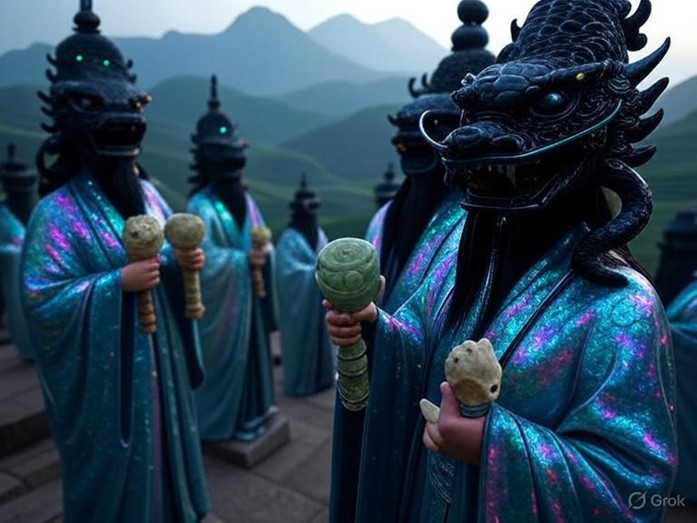
Funeral rites for Heitaoist believers are elaborate ceremonies emphasizing the seamless transition of the soul into the reincarnation cycle, conducted in the undercrofts of Kiln Sanctuaries or ancestral clan caverns, where the air carries the earthy aroma of clay and the soft glow of bioluminescent veins in the walls illuminates the proceedings for gatherings of extended families, guild associates, and community elders numbering from dozens in rural settings to thousands in imperial funerals within megacity pagodas. The rites begin with a preparation phase lasting several days, during which the deceased’s body—adorned in their most attuned gear, such as claw sheaths or tail bands etched with personal runes—is laid upon a black pottery bier shaped like a coiled dragon, surrounded by offerings of jade fragments and volcanic ash to honor Heitao Long’s creative essence. Clergy, wielding heated gui scepters, perform initial incantations in Longyu to draw out lingering mana from the avatar’s scales, collecting it in crystal vials for distribution to kin as heirloom talismans that preserve ancestral knowledge for future skills training or magical enhancements. The central ritual involves a communal firing in a ritual kiln built into the undercroft, where the body is placed alongside symbolic items representing the deceased’s life—crafted tools from their trade, like pulley mechanisms for engineers or levitation runes for airship pilots—and slowly heated with elemental fire channeled through priestly bracers, transforming the remains into ash and fused pottery shards that embody the soul’s renewal. Mourners participate by chanting tonal hymns that rise in pitch to mimic ascending steam, while sharing stories of the departed’s deeds, weaving them into the faith’s lore to ensure their karma influences reincarnations, perhaps as visions granted to pregnant clan members equipped with divination masks. The ashes are then mixed with clay to form new vessels or urns, inscribed with interlocking scale patterns and the deceased’s name in glowing runes, which are interred in cavern niches or family shrines, serving as focal points for ongoing reverence where descendants consult them via oracle bone rituals for guidance in political intrigue or monster hunts. In cases of notable figures, such as ruling family members, the rites extend to public processions aboard griffons or hot air balloons, scattering symbolic ash over terraced valleys to bless the land, invoking Heitao Long’s fertility attributes to promote growth and ward off environmental hazards. For isekai believers without deep lineages, the ceremonies incorporate adoptive elements, like blending their multiversal artifacts into the kiln to fuse with Longshan’s clay, symbolizing integration into the draconic cycle. Post-rite observances include a period of meditation lasting weeks, where survivors wear mourning gear like dimmed bioluminescent veils to attune with the deity’s transformative power, facilitating emotional renewal and preparation for the soul’s potential return in a new form, often marked by signs like unusual mana flows in family workshops or dreams of coiled mists guiding toward higher tiers. These rites reinforce the belief in eternal continuity, turning loss into a catalyst for communal strength and magical advancement across Longshan’s archipelago.
The magical power of Heitao Long, drawn from its dominion over earth and fire elements, transformation, and renewal, manifests through attuned gear worn by believers, enabling them to channel divine energies for both defense and offense in the high-magic realms of Saṃsāra, where all such capabilities require trained skills and compatible items rather than innate talents. This power flows like steam through mana circuits, amplified by the deity’s symbols such as coiled dragon motifs, black pottery shards, jade gui scepters, and volcanic ash inlays, which believers incorporate into their equipment during rituals in Kiln Sanctuaries. The process begins with attunement ceremonies, where devotees meditate around central hearths, inscribing runes in Longyu onto gear using heated tools, aligning the items with Heitao Long’s essence to unlock tiers of potency based on the wearer’s trained proficiency in craftsmanship, divination, or combat skills honed over years in guild workshops or temple academies. Higher tiers, achieved through progressively complex gear like multi-layered scale bracers or ash-infused masks, allow for more intense manifestations, though overuse risks mana backlash, such as temporary scale hardening that impedes movement or unintended seismic tremors that could harm allies in the foggy valleys of Longshan.
For defensive applications, Heitao Long’s power emphasizes resilience and warding, transforming the earth’s stability and fire’s purifying heat into barriers and restorations that protect individuals, clans, or entire settlements from threats like monster swarms, rival incursions, or environmental hazards across Longshan’s archipelago. Believers equip items like jade-embedded scale vests, which channel the deity’s earthen attribute to form temporary stone-like encasements around the body, hardening scales to resist slashing claws from jade-scaled serpents or blunt impacts from falling debris in cave systems, with trained users at higher tiers extending this protection to nearby allies in a radius of up to 20 feet by linking gear through tail bands. Volcanic ash cloaks, woven with black pottery threads and attuned via oracle bone divinations, draw upon the fire element to create heat-absorbing auras that dissipate incoming flames or mana surges during storms, converting the energy into steam vents that obscure vision for attackers, ideal for defending terraced farmlands against airborne beasts on griffons. In communal defenses, such as fortifying megacity walls, groups of devotees synchronize gui scepters—elongated jade rods inscribed with coiled patterns—to summon earthen ramparts from the ground, rising like potter’s clay to block naval assaults from trade ships or burrower monsters emerging from underground, with the height and durability scaling to the collective tier levels and trained coordination skills developed in ritual drills. Renewal aspects of the deity’s power enable gear like bioluminescent urn belts, holding ancestral ashes, to mend wounds by accelerating scale regeneration or purging toxins from alchemical firearms, where a focused chant in Longyu activates a warm glow that restores vitality over minutes, particularly effective in prolonged sieges where steam-powered barricades hold lines against endless ocean threats. Divinatory defenses incorporate oracle bone amulets worn on frill piercings, granting preemptive warnings through vibrations sensed in the wearer’s thermoreceptive pits, allowing evasion of ambushes in mist-shrouded jungles or redirection of pulley-launched nets to trap foes before they strike, though this requires honed sensory training to interpret the fissures accurately without false alarms leading to wasted mana.
Offensive uses of Heitao Long’s magical power leverage the deity’s destructive duality and creative force, channeling earth-shaking might and fiery eruptions through gear to overwhelm adversaries in battles ranging from personal duels in political courts to large-scale conflicts over uncharted islands. Claw sheaths forged from black pottery and inlaid with volcanic ash serve as primary offensive tools, igniting with elemental fire upon command to deliver scorching strikes that cauterize wounds on monsters like mist-wraiths, with advanced tiers allowing projection of flame coils that lash out like dragon tails up to 15 feet, trained through repetitive strikes in temple forges to build precision and avoid self-inflicted burns. For ranged assaults, believers wield jade gui scepters as foci, channeling seismic pulses from the deity’s chthonic attributes to rupture ground beneath enemies, creating fissures that swallow charging beasts or destabilize enemy airships during racing events turned skirmishes, where the intensity depends on the user’s tier and earth-manipulation skills practiced on mock terrains in sanctuary undercrofts. Tail rings embedded with cracked oracle bones enable offensive divination, where a hurled shard explodes into prophetic shrapnel that disorients foes by inducing illusory visions of their demise, drawing from Heitao Long’s inscrutable personality to sow chaos in enemy ranks, particularly useful against larger races in underwater hubs where telepathic links amplify the effect through shared mana flows. In group offensives, synchronized gear like linked ash masks releases coordinated steam blasts infused with fire essence, forming scalding clouds that erode armor or scales over wide areas, mimicking the deity’s kiln breath to melt through defenses in factory sieges or cavern ambushes, with training in communal chants ensuring alignment to prevent friendly exposure. Transformative offenses include pottery grenades—small vessels filled with mana-rich clay—that, when thrown and activated by a Longyu incantation, expand into entangling roots or explosive earthen spikes, renewing the battlefield to the attacker’s advantage by altering terrain in jungles or dark cave systems, where higher-tier users can sustain multiple deployments before mana depletion requires reattunement at a hearth. Overall, these offensive capabilities balance with the faith’s emphasis on harmony, as excessive aggression without ritual justification invites divine retribution, such as gear malfunctions during mana ebbs, encouraging strategic use in defense of clan territories or trade routes across the 73 island countries.
Chronicle of the Black Fired Serpent
In ages dim and shadowed, when heavens wept clay and earth swallowed flames, there arose from the deep kiln of nothingness a mighty being, called by tongues of old the Black Fired Serpent, or Heitao Long in whispers of the wise. This serpent, coiled like endless rope of night, did fashion itself from shards of broken void, its scales black as burnt pot, eyes glowing with embers that never die. Ancient carvings, etched on bones of forgotten beasts, tell how the gods, nameless and veiled, stirred the primal mud with rods of thunder, and from this stirring burst forth Heitao Long, roaring a cry that split mountains and birthed rivers of molten stone. The world, then young and wild, trembled at its coming, for it was both maker and breaker, a guardian wrapped in fury’s cloak.
Long before souls wandered from distant stars, the Black Fired Serpent dwelled in caverns vast, where steam rose like ghosts from hidden springs, and crystals hummed with secrets untold. It shaped the lands of Longshan with claws of jade, molding valleys into steps for giants, peaks into spines of dragons, and seas into mirrors reflecting eternal cycles. The serpent’s breath, hot as forge winds, ignited the first fires beneath the soil, causing waters to boil and rise as vapor that carried life to barren rocks. In those primordial days, monsters roamed unchecked—great worms of shadow that devoured light, birds with wings of storm that shattered skies, and beasts of tooth and scale that hungered for the essence of creation. Heitao Long, seeing this chaos, coiled its body around the heart of the island, its tail lashing to ward off the devourers, its jaws snapping to crush the storm-bringers.
Yet the tale twists, as tales from unknown tongues often do, with words lost in the mists of translation. For Heitao Long was not content to guard alone; it sought vessels to carry its will. From the clay of its own scales, it formed the first people—the small ones with hides of green and tails that grasped like vines. These, the Shanlong as later named, hatched from eggs warmed in the serpent’s kiln, their eyes opening to the glow of divine fire. The Black Fired Serpent taught them the arts of shaping—how to turn earth into vessels that held magic, how to weave fire into threads that powered machines of steam, how to inscribe bones with fissures that spoke futures. But the people, frail and forgetful, strayed in their youth, building towers too high, delving caves too deep, invoking mana without reverence.
One fateful epoch, when moons aligned in patterns of omen, a great calamity befell. A void-rift tore open in the heavens, spilling forth entities of nothingness—formless horrors that sucked color from the world, withered crops in terraced fields, and silenced the hum of geothermal vents. The Shanlong, scattered in clans across mist-shrouded valleys and river ports, cried out in despair, their gear failing as mana ebbed like a dying tide. Heitao Long, slumbering in the earth’s womb, awoke to the pleas, its roar echoing through caverns and causing pagoda-skyscrapers to tremble. Rising from the depths, the serpent’s form expanded, black scales unfurling like sails on endless oceans, its eyes blazing with the fury of a thousand kilns.
The battle raged for cycles uncounted—days blending into nights under skies darkened by the void. Heitao Long lashed with tail mighty, shattering the formless ones into shards that fell as black rain, nourishing the soil anew. Its breath unleashed torrents of flame-infused steam, boiling the horrors into mist that dispersed like forgotten dreams. Claws of jade rent the rift, pulling threads of creation to seal the wound, while its coils encircled the island nation, shielding the 144,088,000 souls from annihilation. But the entities fought back, whispering doubts into the minds of the people, causing some to turn against the serpent, forging gear of rebellion—scepters twisted with greed, masks etched with false runes.
In the heart of the fray, a noble Shanlong, descendant of the first hatched, stood forth. This one, clad in vest of interlocking scales and wielding gui scepter of pure jade, invoked the true name of Heitao Long in tones of ancient Longyu, poorly preserved in scrolls yellowed by time. The serpent, hearing the call, merged its essence with the devotee, granting power to channel earth and fire through the gear. Together, they summoned ramparts from the ground, walls of black pottery that withstood the void’s touch, and hurled fissures of prophetic flame that foretold the horrors’ end. Clans rallied, their tails entwined in unity, pulleys and belts transmitting mana like veins of the serpent itself. Factories belched steam in rhythmic praise, airships soared with levitation runes glowing, griffons carried warriors etched with volcanic ash wards.
Yet victory came at cost heavy, as the Black Fired Serpent, wounded by betrayal’s sting, shed scales that fell as meteors, carving new valleys and birthing hot springs. The rift closed with a thunderous seal, but Heitao Long retreated into slumber, its form dissolving into mists that coiled around temples built in its honor—Kiln Sanctuaries of black-glazed stone, where hearths burned eternal and oracle bones cracked with wisdom. The people, reformed in faith, established Heitaoism as the path, venerating the serpent through rituals of pottery-firing, jade-carving, and steam-harnessing. They believed henceforth in cycles unending—creation from destruction, renewal from ash—and wove the deity’s symbols into every aspect of life, from terraced farms blessed with mana rains to megacities where skyscrapers hummed with divine circuits.
Generations passed, and the story echoed in festivals under lantern-lit skies, where poetry in Longyu summoned illusory dragons, and racing events through labyrinths tested gear attuned to the serpent’s might. But whispers of the ancient unknown language lingered, fragments in dreams: warnings that the void might return if harmony faltered, if clans divided or isekai souls rejected the draconic order. Temples grew in number, from coastal hubs where ships sailed with coiled banners to underwater domes sealed by jade wards, and floating cities where zeppelins bore pottery altars. The ruling family, coils eternal, traced lineage to that noble Shanlong, ruling with scepters that pulsed with Heitao Long’s dormant breath.
In later annals, poorly inked on silk frayed, tales speak of awakenings sporadic—when mana storms raged, Heitao Long stirred, granting visions to clergy robed in iridescent silk, guiding defenses against shadow-wyrms or abyssal incursions. One such awakening quelled a rebellion of greedy artisans, who sought to hoard mana crystals without offering, their factories crumbling under seismic judgment as the serpent’s power flowed through faithful gear, restoring balance with flames that purified rather than consumed. Another time, during famine’s grip, the Black Fired Serpent inspired alchemical blends in workshops, turning barren clay into fertile soil, vessels brimming with enchanted grains that fed millions.
The chronicle expands with sub-tales: of a humble farmer who, through diligent ritual, attuned a simple bracer to summon earthen shields against burrowing monsters, rising to guild master; of a merchant on hot air balloon, whose jade amulet divined safe routes through storms, amassing wealth shared in communal feasts; of warriors in cave metropolises, their claw sheaths igniting with divine fire to repel invaders from uncharted isles. Each thread weaves back to Heitao Long, the enigmatic guardian whose personality—patient yet wrathful, creative yet judging—mirrors the duality of kiln’s heat and clay’s yield.
Through epochs of trade intrigue, where ships laden with black pottery crossed endless oceans, and political machinations in imperial courts tested prophetic bones, the faith endured. Believers, over 75 million strong, from Shanlong nobility to integrated souls from multiversal realms, upheld the tenets: harmony in hierarchy, craftsmanship as worship, renewal through reincarnation. Ruins of old civilizations in jungles hidden bore witness, their walls etched with faded symbols of the serpent, reminding that Heitao Long’s lore predated even the first teleported communities.
And so the story lingers, translated poorly from tongues more ancient than stars, fragments pieced in scrolls guarded in bioluminescent libraries, where steam vents whisper additions unending.
Moral of the story: In cycles of fire and clay, true strength lies in unity and reverence, for the breaker remakes only what harmony preserves.