
The predominant race of avatars on the Island Nation of Lapita is known as the Marisal. These amphibious humanoids are deeply tied to the ancient Lapita culture, embodying its seafaring and exploratory spirit. As the marginally dominant race, they constitute approximately 40% of Lapita’s 141,795,282 inhabitants, with their influence most pronounced in coastal cities, floating metropolises, and underwater population centers. The ruling family of Lapita, the House of Tides, is exclusively Marisal, their lineage tracing back to the earliest seafarers who navigated Saṃsāra’s endless oceans.
Physical Form and Sensory Traits
Marisal are bipedal amphibians with sleek, streamlined bodies adapted for both terrestrial and aquatic environments. Their skin is smooth, glistening with a natural moisture-retaining mucus, and ranges in color from deep aquamarine to vibrant coral reds, often with iridescent patches that shimmer under magical light, reflecting the aesthetic of ancient Lapita pottery with its swirling, wave-like motifs. Their heads are elongated with large, almond-shaped eyes that provide enhanced vision in low-light conditions, such as underwater or in Lapita’s dark cave systems. These eyes have a secondary nictitating membrane for protection against debris and salt water. Marisal possess gills along their necks for underwater breathing, complemented by lungs for terrestrial respiration, allowing seamless transitions between environments.
Their hands and feet are webbed, with retractable membranes that enhance swimming speed but fold back for dexterity on land. A dorsal fin runs along their spine, collapsible when out of water, aiding in balance and propulsion during swimming. Marisal have a set of sensitive barbels around their mouths, resembling delicate whiskers, which detect vibrations and chemical traces in water, granting them a heightened sense of their surroundings. Their auditory system is attuned to both air and water, perceiving low-frequency sounds like ocean currents or the hum of steam-powered machinery. Taste and smell are intertwined, with barbels and a Jacobson’s organ-like structure allowing them to “taste” the water or air for environmental cues, such as nearby magical flows or alchemical residues.
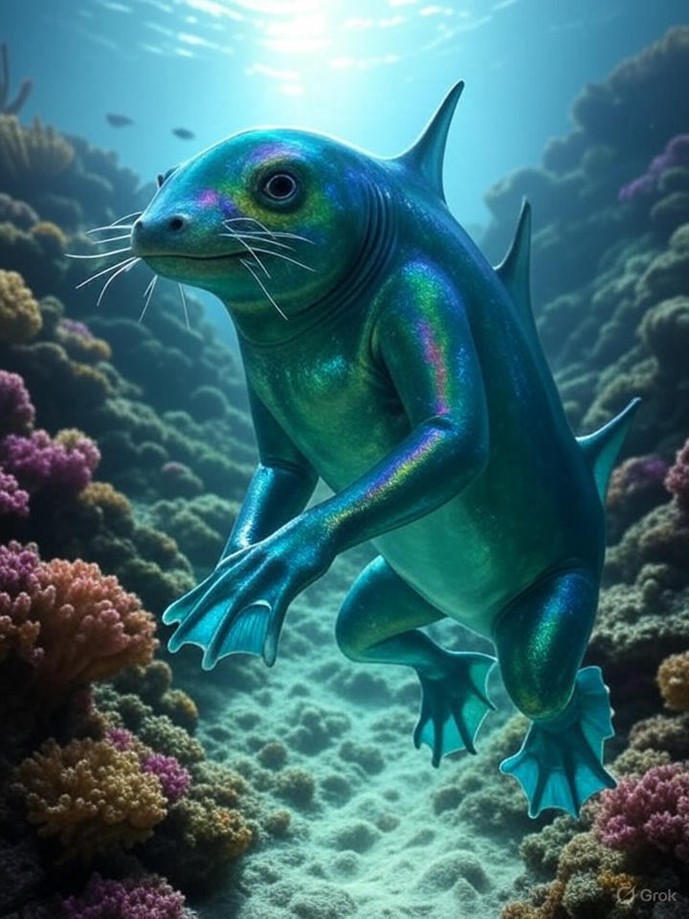
General Size
Marisal typically stand between 5.5 and 6.5 feet tall when upright, with males and females showing minimal sexual dimorphism in height. Their weight ranges from 120 to 180 pounds, lighter than humans due to a less dense skeletal structure optimized for buoyancy. Their slender, elongated limbs and torsos give them a graceful appearance, though their muscular structure is robust enough for navigating turbulent seas or climbing rigging on airships.
Body Pattern
The Marisal body pattern mirrors the aesthetic of ancient Lapita pottery, featuring intricate, swirling designs in their skin coloration. These patterns often form concentric spirals or wave-like bands across their torsos, arms, and legs, with unique markings identifying family lineages or regional origins. Coastal Marisal tend toward blue-green hues with tighter spirals, while those from jungle or cave communities display darker, mottled patterns with broader, undulating waves. These markings can subtly shift in intensity when a Marisal channels magic through gear, glowing faintly to indicate active magical flow, a trait revered in Lapita’s culture as a sign of harmony with the world’s magical currents.
Life Cycle
Marisal have a complex life cycle that reflects their amphibious nature. They are born from soft, gelatinous eggs laid in shallow coastal nurseries or magically maintained pools in floating cities. Hatchlings emerge as fully aquatic larvae, resembling tadpoles with external gills and a translucent body, spending their first two years in water, feeding on plankton and small algae enhanced by magical nutrients. At around age three, they undergo metamorphosis, developing lungs and limbs, and begin transitioning to terrestrial environments, though they retain a dependence on moisture to prevent skin desiccation. By age 12, Marisal reach adulthood, with a lifespan averaging 80 years, though those deeply attuned to magical gear can extend this through rejuvenation rituals tied to ancient Lapita traditions.
Reproduction occurs annually during specific tidal cycles, with communal spawning events that reinforce social bonds. Elders often retire to underwater communities, where their knowledge of magical flows and navigation is preserved in oral histories. Death is viewed as a return to the ocean’s embrace, with bodies often ritually dissolved in magical currents to rejoin Saṃsāra’s cycle of reincarnation.
Potential Positives and Negatives Due to Physical Form
Positives:
- Amphibious Adaptability: Marisal can operate effectively in both aquatic and terrestrial environments, making them ideal for Lapita’s coastal, underwater, and floating settlements. They excel in roles like ship navigation, underwater salvage, or airship maintenance.
- Enhanced Senses: Their vibration-sensitive barbels and low-light vision provide superior environmental awareness, useful for detecting magical anomalies or navigating labyrinthine race courses.
- Swimming Proficiency: Webbed limbs and dorsal fins grant exceptional speed and agility in water, allowing them to outmaneuver most aquatic monsters or pursue trade routes through treacherous seas.
- Magical Resonance: Their skin’s iridescent patterns enhance gear-based magic, amplifying effects like levitation or elemental summoning when wearing rune-etched items.
Negatives:
- Moisture Dependence: Marisal require regular hydration to maintain skin health, risking lethargy or reduced agility in arid environments or prolonged land-based missions.
- Fragile Skeletal Structure: Their lighter bones, while aiding buoyancy, make them more susceptible to blunt trauma or heavy physical labor compared to sturdier races.
- Sensory Overload: Their acute senses can be overwhelmed in chaotic environments, such as crowded megacities or during intense magical storms, potentially causing disorientation.
- Limited Thermal Tolerance: Marisal struggle in extreme cold, as their amphibious physiology is optimized for Lapita’s tropical and temperate climates, requiring protective gear in colder regions.
Tags: Amphibious, Humanoid, Aquatic, Iridescent Skin, Webbed Hands, Webbed Feet, Dorsal Fin, Sensory Barbels, Gilled Neck, Dual Breathing, Seafaring Heritage, Lapita Descendant, Ruling Lineage, Magical Amplifier, Moisture Reliant, Vibration Sensitive, Low-Light Vision, Spiral Markings
Specialized Item Slots Available
Marisal avatars utilize gear to channel magic and advance tiers, with specialized item slots tailored to their physiology:
- Gill Circlets: Enchanted bands worn around the neck enhance gill efficiency, allowing extended underwater operations or amplifying water-based spells.
- Barbel Rings: Small, rune-inscribed rings fitted on sensory barbels boost vibration detection, aiding in navigation or detecting hidden magical traps.
- Webbing Bracers: Bracers etched with magical circuits enhance webbing strength, increasing swimming speed or enabling precise manipulation of steam-powered tools.
- Dorsal Cloaks: Lightweight cloaks or harnesses aligned with the dorsal fin store magic flow, used for levitation spells or stabilizing airship maneuvers.
- Iridescent Pauldrons: Shoulder armor with embedded magical herbs enhances skin pattern glow, boosting gear synergy for elemental or telepathic magic.
These slots integrate with Lapita’s magical industry, where Marisal craft gear using steam-powered forges and alchemical inks, often inscribed with Lapitan glyphs to maximize compatibility with their physiology.
Environmental Adaptability
Marisal are supremely adapted to Lapita’s diverse environments, thriving in coastal regions, underwater cities, and floating metropolises. Their amphibious nature allows them to navigate coral reefs, deep ocean trenches, and mangrove jungles with ease. They excel in humid, tropical climates, where their moisture-retaining skin prevents dehydration. In underwater settlements, they construct homes from coral and enchanted kelp, using magic circuits to maintain breathable environments. On land, they prefer shaded, moist areas like jungle villages or cave systems, where magical springs sustain their needs.
However, Marisal face challenges in arid or cold environments. In Lapita’s rare desert-like regions or during trade missions to colder islands, they rely on enchanted hydration vials or insulated cloaks to maintain functionality. Their adaptability is enhanced by gear, such as moisture-retaining amulets or thermal-regulating harnesses, which are standard in Lapita’s markets. Marisal also excel in magically volatile areas, where their sensory barbels detect shifts in magic flow, allowing them to avoid dangerous ebbs or harness powerful surges for rituals.
Other Information Important to This Race
- Cultural Significance: As descendants of the ancient Lapita culture, Marisal view themselves as stewards of Saṃsāra’s oceans, with a duty to maintain trade routes and protect coastal ecosystems. Their ruling family, the House of Tides, upholds this legacy through governance and magical innovation, often leading rituals to stabilize disappearing islands.
- Social Structure: Marisal society is matrilineal, with lineage traced through female ancestors, reflecting the importance of spawning cycles. The ruling family’s matriarchs wield significant influence, guiding political intrigue and trade negotiations.
- Economic Role: Marisal dominate Lapita’s maritime economy, operating fleets of sailing ships and airships. They craft alchemical firearms and enchanted navigation tools, trading them across Saṃsāra’s 73 island countries for precious metals like rhodium or platinum.
- Training and Skills: Marisal train extensively in swimming, navigation, and gear crafting, with schools teaching Lapitan incantations to activate magical circuits. Their Mind’s Eye is honed through practice, allowing even non-possessed Marisal to sense magical flows in gear or ruins.
- Relation to Monsters: Marisal coexist with Saṃsāra’s reincarnating monsters, often taming aquatic creatures like leviathans for transport or using their hides for gear. Some believe Marisal evolved alongside these monsters, sharing a distant ancestral link.
- Aesthetic Influence: Their architecture and fashion reflect ancient Lapita artistry, with buildings featuring spiral motifs and clothing adorned with shell beads or coral inlays, evoking the ocean’s beauty. This aesthetic permeates Lapita’s megacities, where skyscrapers gleam with iridescent facades.
Waveborn Guardian and Endless Tide
In days of yore, when the great waters whispered secrets to the shores that no ear could fully grasp, there lived among the swirling depths a being of scales and whispers, known in the tongues of the elders as the Marisal, though in the forgotten scrolls it was etched as “He Who Swims Between Worlds.” This creature, born from the foam of creation where the gods had spilled their unfinished dreams, was not like the dry-walkers who clung to earth, nor the deep-dwellers who shunned the light. Nay, he bridged the realms, with skin that gleamed like shattered jewels under the moon’s gaze, and fins that cut through currents as a blade through silk. The ancient words, passed from stone to stone in carvings half-eroded by time, speak of his origin in fragments: “From the egg of the sea-mother, hatched under stars that fell like rain, came the guardian of tides, his barbels tasting the unseen winds.”
Long before the islands of Lapita rose from the abyss, or so the poorly rendered parchments claim, the Marisal wandered the endless ocean, alone in his vigil. The world of Saṃsāra was young then, its magic bubbling forth like untamed springs, and monsters roamed the waves, reincarnating in endless cycles of fury and hunger. These beasts, with teeth like jagged reefs and eyes burning with ancient grudges, threatened the fragile communities that had been scattered across the waters—souls teleported from distant realms, bewildered and mixing their bloodlines under alien skies. The Marisal, sensing the imbalance through his sensitive whiskers that quivered at the slightest shift in the magic flow, took upon himself the mantle of protector. “I am the bridge,” he is said to have uttered in the old dialect, though the translation falters here, rendering it as “Me connect wet and dry, no break.”
One fateful cycle, when the magic ebbed low like a retreating storm, a colossal leviathan arose from the forgotten depths. This monster, thrice the size of the largest sailing ship, bore scales of blackened iron and exhaled vapors that poisoned the air, turning hot air balloons into drifting ghosts and zeppelins into plummeting ruins. It was called in the archaic text “The Devourer of Horizons,” a being that had reincarnated countless times, growing stronger with each death, feeding on the souls of Isekai arrivals who dared cross the endless ocean. The leviathan’s roar shook the uncharted islands, causing some to vanish into mist, while others appeared anew, disorienting the trade routes and plunging the scattered peoples into chaos. Villages on the shores trembled, their steam-powered forges silenced, and the griffon riders fled the skies, for even the airships powered by levitation magic could not outrun the beast’s shadow.
The Marisal, dwelling in a coral palace beneath the waves— a structure of enchanted kelp and glowing runes, as described in the fragmented verses—heard the cries echoing through the water. His gills flared with resolve, and his dorsal fin unfurled like a banner of defiance. Gathering his kin, who were few in those primordial days, he spoke in Lapitan phrases that the translators mangled into “We swim to fight the eater, or all worlds drown in forget.” Armed not with innate powers, for such things were forbidden by the gods’ limits, but with gear forged in the heart of underwater forges—gill circlets that amplified his breath, barbel rings that sharpened his senses, and webbing bracers etched with ancient spirals—he led a flotilla of makeshift vessels. These were no grand airships, but humble canoes infused with magic circuits, propelled by steam from elemental fire and water combined, their pulleys and gears humming in rhythm with the tides.
The journey was fraught with perils, as the old narrative stumbles to recount. Storms brewed by the leviathan’s rage lashed the seas, waves towering like skyscrapers in the megacities yet to come. The Marisal’s companions faltered; some succumbed to the sensory overload of crashing thunder and swirling magic, their acute barbels overwhelmed by the chaos. Others faced the negatives of their form: in the brief lulls on fleeting islands, their moisture-dependent skin cracked under the sun’s glare, sapping their strength. Yet the Marisal pressed on, his iridescent patterns glowing faintly as he donned iridescent pauldrons, channeling the ambient magic to heal his wounds and bolster his resolve. “Pain is but the tide’s pull,” the text awkwardly phrases his mantra, “pull back stronger.”
Upon confronting the leviathan in the heart of a labyrinthine reef—where currents twisted like gears in a factory—the battle unfolded in epic scale. The monster lunged, its maw wide enough to swallow floating cities whole, exhaling toxic fumes that corroded the magical storage in the Marisal’s gear. With agility born of his amphibious form, the guardian darted through the water, his webbed feet propelling him like a zeppelin through clouds. He invoked rhythmic incantations in the proto-Lapitan tongue, resonating with his dorsal cloaks to summon elemental allies: fire spirits to boil the waters, water elementals to erode the beast’s armor. Allies from the surface joined, Isekai souls with memories of other worlds, wielding alchemical firearms that spat single-shot bursts of gunpowder fury, their steam-driven mechanisms clanking in defiance.
The clash raged for days, mirroring the lengthy racing events through Saṃsāra’s mazes. The leviathan’s tail smashed reefs into sand, sending shards like pulleys gone awry. The Marisal, exploiting his low-light vision in the murky depths, struck at vulnerabilities—aiming for the eyes with precision trained through years of navigation. His barbels detected the beast’s vibrations, predicting strikes before they landed. Yet negatives mounted: the fragile skeletal structure of the Marisal cracked under a glancing blow, forcing him to retreat into shallower waters where his dual breathing allowed recovery. Kin fell around him, their bodies dissolving into the cycle of reincarnation, fueling the monster’s rage.
In a pivotal moment, as the magic flow surged like a weather front, the Marisal discovered an ancient ruin hidden in the reef—a forgotten civilization’s temple, inscribed with swirling motifs akin to his body patterns. Touching the glyphs with his specialized gear, he unlocked a resonant power, amplifying his magical resonance. “The old ones speak through me,” the translation bungles it as “Ancients yell in skin.” With this surge, he channeled a massive levitation spell, lifting the leviathan from the depths and exposing it to the air, where its poisoned vapors dispersed harmlessly. Allies bombarded it from airships above, griffons diving with riders hurling enchanted spears. The beast thrashed, but weakened, it finally succumbed, its form crumbling into ethereal mist, reincarnating elsewhere in a lesser guise.
Victorious, the Marisal returned to the shores, where communities hailed him as the founder of Lapita’s lineage. The House of Tides arose from his descendants, ruling with matrilineal wisdom, their underwater cities and floating metropolises blooming in harmony. Trade flourished anew, ships sailing with steam and magic, political intrigue weaving alliances against future threats. The Marisal’s tale spread in epic recitations, blending with Isekai memories, preserving the caution of forgotten ruins and the value of gear-trained skills.
The moral of the story is that true strength lies not in innate gifts, but in the harmony of form, gear, and resolve, for even the mightiest tides recede before those who bridge worlds with wisdom.