
Devotion to Zǐliú-Mu, Heart-Within-the-Flow
Lore
Erlitou’s deep-river floodplain once split into ninety-nine braids, each meeting hidden vents where bronze-rich steam bubbled upward. Foundry ancestors recited that the torrents carried not only silt but spirit. At an eclipse when water glowed dull green, furnace walls cracked; from the vent rose Zǐliú-Mu, luminous like sunset copper beneath rippling tide. Three smith-seers beheld a heart-shaped crucible nested in her palms, molten yet unspilling. She asked no oaths, only hammered once upon bedrock. That strike quieted boil and fused ninety-nine channels into one tempered course. Ever since, worshippers gather where river and forge converge, believing each casting ladle echoes the prime hammer-fall.
Personality
• Steady as annealed bronze, disdaining haste or waste.
• Nurturing within boundaries—she shelters seedlings growing from slag hills yet scorches careless smelters who ignore quench rhythm.
• Speaks through rhythmic pulse: rising current beats warn of impurity, gentle swirl heralds assent.
• Remembers every tool ever cooled in her water; re-hearing its clang brings pride or admonition depending on its service.
Traits and attributes
• Domain over molten transition: governs the instant solid metal begins to glow and glowing metal prepares to flow.
• Essence threads through all copper veins; smiths claim raw ore “listens” for her breath.
• Grants brief “Flow-Sight,” allowing devout casters to perceive fault lines inside metal as whorls of river cloud.
• Balances heat with flood, punishing extremes: drought invites furnace back-drafts; reckless overflow quenches kilns mid-pour.
Characteristics followers emulate
• Threefold Temper Cycle: Heat (gather resolve), Quench (temper impulse), Flow (share result).
• Practise “Listening Pause” before striking metal—breathing slows until ear facets register river’s sub-harmonic.
• Wear single copper droplet pendant leaked from community crucible, signifying shared origin.
• Each oath sealed by dipping thumb into warm casting sand, imprinting swirl hearkening river eddy.
Symbols
• Central emblem: concentric ring crucible encasing a downward river spiral.
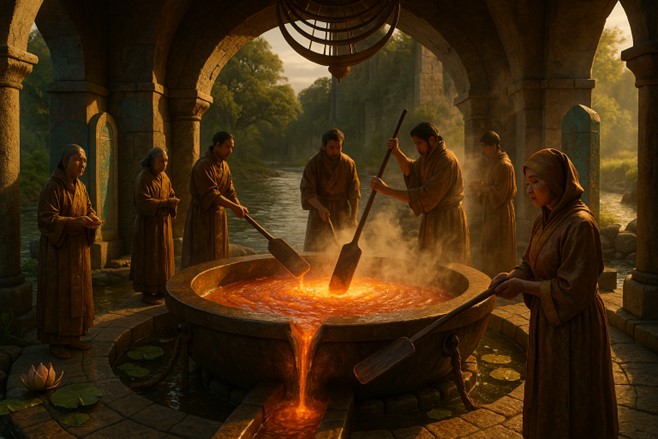
• Ritual tool: twin-handled paddle-ladle used to unite alloy swirl and water swirl in one motion.
• Shrine marker: waist-high clay stele glazed turquoise on upstream face, scorched ochre on downstream face.
• Colors: oxidized teal, smoldering umber, moonlit bronze.
Tags: Molten-Current, River-Crucible, Flow-Sight, Temper-Cycle, Heat-Quench, Copper-Vein, Eddy-Oath, Glazed-Stele, Hammer-Pulse, Alloy-Harmony, Listening-Pause, Shared-Origin, Balance-Doctrine, Slag-Gardens, Vent-Whisper, Forge-Ladle, Impurity-Warning
Positives
• Collective stability grows from the Covenant’s strict Heat–Quench–Flow cycle. Every smith, potter, canal-dredger, and steam-pump keeper pauses for the Listening Breath before action; that shared cadence synchronises work shifts, reduces molten spills, and lowers forge-room fatalities across the island’s thirty-nine foundry districts.
• “Flow-Sight” prayers whispered while alloy shines orange grant brief inner vision of hidden inclusions. Artisans report a fifty-percent drop in cracked bells, bursting boiler tubes, and leaky pump pistons once they adopt the rite, conserving scarce tin and sparing coastal forests from excess charcoal demand.
• River-shrines dredge silt rich in copper ions during annual Ebb Festivals, then channel it into slag-garden terraces that bloom hardy reed-grain. Those terraces produce a reliable third harvest even when monsoon timing falters, feeding urban laborers and stabilising grain-token prices.
• Temper-Cycle ethics—heat resolve, quench impulse, share yield—permeate civic courts. Mediation magistrates invite opposing guilds to pour ceremonial “joint ingots”; the gradual cooling period forces reflection, averting costly clan skirmishes that once plagued Erlitou’s canal markets.
• The doctrine’s impurity warnings include ecological clauses; foundry effluent must circulate through lotus ponds before re-entering main channels. Water-quality scryers document a measurable rise in downstream eel populations, benefiting fisher collectives.
Negatives
• The Covenant condemns alloy waste as sacrilege. Accidental over-pour or mis-timed quench triggers mandatory “Slag Vigil”: the responsible crew must watch the failed casting re-melt for a full night without rest. Repeat failures lead to tendon-searing charcoal tattoos that limit finger flexibility, effectively ending a craft career.
• Flow-Sight initiation requires inhaling furnace vapour steeped with river mist. Participants who misjudge breath counts risk scorched lung lining or copper poisoning. Breach of the proper cadence leaves lasting cough known as “Eddy Rasp.”
• During the bi-decadal Flood Temper Rite, the high river is dammed for thirty heartbeats, starving downstream water wheels and mills. Merchants lose an entire morning’s grind, breeding resentment among grain-speculators who favour rival minor faiths.
• Shrine warden edicts enforce strict river-bank zoning. Unauthorized docks, even for emergency cargo off-loading, earn heavy impurity levies. Some coastal hamlets complain that shrine inspectors wield these levies to extort bribes rather than protect the current.
• The Covenant discourages snow-melt irrigation, calling cold water a fracture omen. Highlands that rely on meltwater for tea terraces must pay “Warm Sluice tariffs” to draw furnace-warmed flow, tripling their seasonal overhead.
Type of temple
Primary sanctuaries—called Current-Hearth Confluences—straddle river bends where sub-surface vents warm the flow. Each complex begins with a crescent dock of oxidised teal stone inlaid with bronze rivulets that carry warm water into an inner annular moat. The central chamber is a circular forge podium, half open to sky, surrounding a vent–fed crucible three spans wide. Stone ribs arch overhead, bearing rows of clay chimes tuned to river-tide intervals; their continuous murmur guides worshippers’ breathing during ritual strikes. A rear apse houses a scriptorium of clay slips fired just enough to hold text yet still porous; these “Living Records” absorb forge vapour, darkening over decades and creating a tonal archive of island humidity. Lesser field chapels, nicknamed Eddy-Niches, consist of a waist-high portable crucible set upon four wheel-stilts with a collapsible bronze ramada, allowing canal crews to hold noon rites at dredge sites.
Number of followers
Census scrolls kept by the Office of Tempered Tribute record sixty-five million and four hundred thousand sworn adherents—just under three-fifths of Erlitou’s population. Among them, roughly twenty-two million hold full guild vows as pour-masters, vent-keepers, chime-scribes, river-sluice inspectors, or shrine wardens. The remaining forty-three million are seasonal or household devotees who attend Confluence rites at solstice, tithe copper leaf on market days, and keep thumb-size Crucible Droplet pendants over door lintels. About twelve million additional residents observe the rites only when casting personal tools or seeking water-divination, while a patchwork of hill-terrace animists and coastal wind-seers decline Covenant membership, citing chill-water ancestry or salt-spray traditions incompatible with molten doctrine.
Believers hold three unshakeable convictions spoken as linked verbs—Heat, Quench, Flow—and they frame every thought about flesh, metal, and water through those actions.
They believe that all substance is ore drawn upward through the will of Zǐliú-Mu, that life’s first gasp is the moment raw metal meets the softening furnace, and that the mortal journey is the repeated tempering of that ore until it rings with a clear note free of dross. They see impurity not as sin but as trapped waste-heat: anger left unvoiced, greed hoarded in secret ledgers, hesitation that interrupts proper quench timing. They teach that the river carries memory as invisible sediment; when it passes a shrine vent the memory condenses into brief eddies that whisper advice to those who keep their listening pause. They hold that Zǐliú-Mu values balance more than obedience—she rewards a well-timed release of molten alloy as readily as a flawless recitation, and she scalds the rash caster who cools metal before it is ready just as surely as she brings drought to villages that dam the current too long.
Regular services follow the cadence of the workday rather than a distant calendar. At first grey light the forge-gongs toll three single beats spaced by twenty heart-thuds; every believer—be they river bargeman, roof-tile potter, canal guard, or magistrate scribe—stops whatever motion the body was about to begin, closes eyes, and inhales the Listening Breath. On the exhale they whisper the copper-leaf mantra “Let ore know shape, let water know path.” Mid-morning each district shrine kindles the Crucible Hearth. Attendees queue in the outer crescent dock, palms sheltering thumb-sized copper droplets stamped with yesterday’s worries. They shuffle sunwise around the annular moat while a pair of paddle-ladle wardens swirl vent-heated water across crucible lips to raise soft steam. One at a time the faithful flick their droplet into the crucible, speak a four-tone couplet naming the worry, and watch the metal sink. Ladle wardens then strike crucible rim with bronze paddles; the note rises through the chime ribs overhead, and participants match their breathing to the ringing decay. Children too small to reach the rim place clay marbles on a copper slide, learning the rhythm before they bear real alloy.
At dusk the Quench Process begins. The same molten copper, now a single shimmering pool, pours through a stone weir into a waist-high trough fed by river water diverted through lotus-root pipes. As alloy and water meet, white steam thick with metallic scent roils skyward. Elders chant slow descending tones meant to draw impurity ghosts from the crowd and trap them in vapor that returns to the river as night dew. Finally the Flow Offering: cooled ingots are cracked free, weighed, and divided. One-tenth goes to shrine repairs, one-tenth to orphaned apprentices, and the rest is melted again into tiny droplets stamped for the coming dawn’s worries, closing the loop.
Funeral rites start the instant a believer’s breath stills. Kin tie a reed-fleece cord round the left wrist and thread the other end through a perforated copper bead. The bead is lowered into a nearby current so river pull stays gentle tension on the corpse, reminding neighbors that death already leans toward Flow. During the first night the body lies in a clay “temper cradle” set beside the family hearth; embers from the cradle’s vent warm the torso just enough to loosen joints as though easing alloy before a crucial bend. At sunrise pall-bearers transfer the body onto a cradle sledge and pull it in silent procession to the nearest Current-Hearth Confluence. Chime-scribes line the route striking short, rising notes only—falling intervals are forbidden lest they drag the spirit back toward raw ore.
Within the Confluence apse the corpse is seated upright on a bronze chair whose base rests in knee-deep river water warmed by vent steam. The presiding Flow-Mother removes a thin casting file and lightly scores the deceased’s ear facets, neck nape, and forearm channels, tracing the specialized item slots each Lianren carried in life, symbolically emptying them of any unfinished attunements. She places a bead of still-molten copper under the tongue—a token called the Red Echo—meant to answer Zǐliú-Mu’s first question at the riverbed gate. Witnesses chant an eight-beat hammer rhythm while shrine vent heat rises; the chair’s bronze seat warms, spinal oil glands sweat out last remnant waters, and the Red Echo melts, joining throat, chest, belly in one vertical rivulet. When the rivulet cools it becomes a narrow ingot sealed inside the ribcage.
The second phase is Quench Walk. The chair tilts forward and slides down a stone track directly into a half-submerged cauldron of lotus-laced river water. Sudden hiss mimics alloy meeting quench. Thin vapors rise, tinted turquoise by lotus resin; mourners inhale and exhale together five times, believed to share trace memories being released. When steam clears, only bone lattice and the cooled vertical ingot remain. Shrine smiths remove the ingot, re-melt it with a pinch of powdered bone, and cast it into twelve coin-slivers called Flow-Discs. Family keeps six discs, shrine archives three in Living Record racks, and three are banished downstream on reed rafts tipped from the annular moat into open current, carrying residue of personality out to sea.
The final rite, Hammer Pause, occurs one month later. At the hour when the deceased once began daily craft, the family hangs a clay chime fired from river silt mixed with a scoop of their slag-garden soil. They strike it once and only once each day for a full year. If the note rings clear on the anniversary, kin believe the spirit has fully joined Zǐliú-Mu’s Flow; if it clatters, they return to the Confluence, cast a fresh droplet into the crucible, recite the worry: “Echo wandering still,” and begin a second year of pause, confident that even the most stubborn impurity will in time melt, quench, and join the current.
Devotees never channel Zǐliú-Mu through bare flesh; power flows only when alloy, water, and cadence form a sealed circuit. Every defensive or offensive practice therefore requires a conduit—usually bronze forged in a Current-Hearth Confluence, quenched in river-lotus water, and etched with the molten spiral seal. The list below sets out common battlefield adaptations arranged from simplest single-bearer gear to large-scale stratagems. All obey normal attunement limits, recharge only after immersion in warm running water, and fail outright if exposed to frost salts.
Defense
Crucible-Guard Bracers
Wide bronze cuffs inlaid with copper veins. When the wearer strikes the bracers together following the three-beat heat cadence, latent Flow-Sight awakens; a thin film of rippling orange light spreads over skin and gear for five heartbeats, halving incoming kinetic force. The film cools to dark teal on the fifth beat, absorbing one additional blow before shattering into harmless steam. Bracers reheat themselves from body warmth but need river immersion or forge proximity (one hour) to regain the full two-stage protection.
Quench-Veil Pavilion
A collapsible frame of riveted bronze ribs packs into a backpack slot. Deployed, it forms a domed lattice that draws ambient moisture, producing a continuous curtain of tepid steam inside the dome. Arrows and thrown slag-glass shards slow markedly when they cross the veil; radiant heat from siege alchemists disperses rather than focusing. Each pavilion anchors itself by vent fins hammered into soft soil; on deck planking or stone tiles users must ladle one bucket of warm river water into the ribs every five minutes or the curtain thins.
Ladle-Weir Bulwark
Fortifications astride canals embed massive bronze sluice paddles inside the wall face. When defenders chant the four-tone quench hymn and push the paddles, river flow diverts through micro-vents, cooling the wall and exhaling white steam outward. That wet mist refracts light, imposing rolling concealment and dousing fire-gel charges hurled by attackers. If the chant cadence breaks, the paddles seize and require manual hammering to reset.
Echo-Current Counterpulse
Forge-sappers mount wide tuning plates along trench edges. When enemy sonic cannon or resonance-hammer crews pound earth to collapse trenches, defenders strike their plates in an offset rhythm. The interference cancels destructive wave peaks within a narrow arc, preventing ground liquefaction beneath the plates while letting distant soil absorb the remaining stress.
Offense
Spiral-Rim Maul
A two-hand bronze maul with a hollow head lined by helical slots. Before battle the head is half-filled with vent-heated river water and sealed. Each swing agitates the water; a valve inside vents super-heated steam through the spiral slots the instant the maul strikes, adding concussive force equivalent to a second bludgeon hit and spraying scald droplets within one pace. The water charge lasts six strikes; a new charge demands submersion in running water heated to forge temperature.
Molten-Weft Bolt
Arbalests fire short bronze bolts whose hollow cores hold bead-sized droplets of still-liquid copper kept molten by alloy memory. On impact the bead ruptures, bleeding a thumb-width smear that bonds to armor plates, fuses joints, or seals wound channels with searing heat. The bead remains semi-liquid for only three breaths; gunners recite a miniaturised heat cadence while cranking to prevent premature cooling.
Eddy-Channel Charge
Demolition teams hammer U-shaped bronze gutters into floodplain soil upstream of enemy encampments. At signal gong they breach a low river weir: water rushes into gutters, accelerates, then meets vent-heated steam jets piped from portable hearth sleds. The mix becomes a fast-moving low-pressure steam sheet that knocks troops off balance, muddies gear, and overturns light barricades. Teams must abandon sleds after two cycles, as slag accumulation clogs the jets.
Rivet-Scream Cast
Smith-seers load crucible ladles with partially molten slag and rotate them in rapid loops while chanting a rapid five-tone spiral. Centrifugal force and cadence shape the slag into needle-thin shards that whistle as they launch, guided by the chant’s harmonic. Shards travel erratically but pierce untempered wood, leather, and exposed flesh. Because the voice directs trajectory, line-of-sight is not strictly necessary, making this tactic valuable in dense fog generated by Quench-Veils.
Combined Maneuvers
Heat-Pinch Wall
Defenders erect Quench-Veil Pavilions behind a breastwork, then aim Spiral-Rim Mauls overhead. Steam from the mauls enters veil currents, superheating the curtain momentarily and expanding it outward as a scorching blast that repels siege ladders. Proper timing demands dual cadence callers: one counts maul strikes, the other modulates pavilion chant to open and close the curtain like a diaphragm.
Flow-Chain Encirclement
Three Ladle-Weir Bulwarks staggered around a fortified mound coordinate sluice release at alternating heartbeats. The resulting pulse trains push concentric waves of floodwater outward. Arbalest crews standing behind each bulwark fire Molten-Weft Bolts through gaps between waves, using glare to silhouette enemy silhouettes. The tide softens earth so Spiral-Rim Maul squads can breach cavalry charges if they wade into the mire.
Risks and Counters
All manifestations draw directly on ambient heat or river mass; cold fog grenades, frost-salt dust, or terrain lacking free water negate most channels. Over-stoking Spiral-Rim Mauls vents too much steam inward, warping the weapon. Continuous Quench-Veil operation exhausts water reserves; if curtain fails mid-volley, defenders become visible and drenched, risking hypothermia in night air. Eddy-Channel engineers carry copper-mesh ground rods—if these rods bend or snap, diverted current undercuts trenches and can wash friend and foe alike into the main river.
Properly timed and disciplined, these techniques turn Zǐliú-Mu’s molten-current doctrine into tactical muscle: soft when pressure must bend, unyielding when shape must hold, and always returning, in due course, to the river.
River Hammered the Empty Crucible and Steam Learned to Sing
Many flood-seasons before reeds first wrote numbers on clay, the ninety-nine braids of the Erlitou River slithered like thirsty serpents, refusing one another’s names. Villagers lived on mud tongues, each tribe calling water by its own echo and pouring bronze into tilted pits that cracked before sunrise. Metal forgot shape, blades bent like boiled twigs, and the riverbanks stank of green rust.
Came a night when the moon pulled her copper mirror from under clouds and flashed it across every braid. Shimmer struck a hidden vent where the river hissed warm breath. From foam climbed Zǐliú-Mu—skin of furnace glow, hair of circling eddies, heart a crucible whose rim never cooled. She stepped upon the central shoal and spoke not with words but with ripple, striking riverbed once with her bare heel. Water bolted upright as a single pillar, and the ninety-nine braids gasped, finding themselves fused into one tempered flood that pulsed like a bell struck under deep sand.
The tribes watched from cracked kilns and sagging foot-bridges. Their elders argued: “This walking heat will boil us away,” said Shield-of-Mud. “No, she brings softer bend to ore,” answered Reed-Eyes. While tongues wrestled, a child named Seven-Breath Fish scrambled to the shoal, his feet skin-thin from hunger. He cupped river in both palms and offered it back to the glowing woman, whispering broken syllables: “If river thrist, fish cry.” Zǐliú-Mu tilted her crucible heart so a single drop slipped, sizzling into the child’s water. That drop cooled emerald and became a curved ladle small enough for the boy’s hand.
With this ladle Seven-Breath Fish scooped mud, swirled, and poured. Mud spun into clay cylinder; clay fired under Zǐliú-Mu’s gaze, turning to uncracked crucible. Elders gasped; the ladle sang faint hum like far gong. Reed-Eyes and Shield-of-Mud knelt, but their knees made no splash—river had lowered itself, listening.
Zǐliú-Mu lifted both arms, palms dividing air in slow nine-stroke pattern. Every tribe felt hidden cadence vibrating jawbones. They mimicked her motion with sticks, boat oars, even empty hands. Sparks leapt from forge ruins, coiling back into coal beds, and molten bronze gathered itself inside crucibles newly shaped of river clay. First hammerfall landed: clonk, then hiss of quench, and a newborn blade sprang free, its edge reflecting one flooded sky instead of ninety-nine broken shards.
Thus began the Covenant. The tribes swore Heat for resolve, Quench for restraint, Flow for sharing. They carved river-spiral glyphs onto stele glazed half turquoise, half scorched umber—upstream face cool, downstream face warm. They forged paddle-ladles with twin handles to mix steam and alloy in mirrored strokes, and every dawn they struck a three-beat pulse so that breath, heart, and river kept matching steps.
But envy crawls where ore becomes jewel. A wandering kiln-lord named Cinder-Palm, banished for flooding terrace fields with slag, saw the single river and coveted its unbroken reflection. He stirred frost salts stolen from highland caves and forged jars of night-ice. One no-moon midnight he rolled these jars into the water at upstream narrows. Frost bit river’s skin; current stumbled, murmuring brittle, and the crucible hearts of Confluence shrines wept cracks. Steam broke cadence; anvil echoes returned hollow.
Villagers woke to hear forges coughing cold dust. Seven-Breath Fish—now grown, called Flow-Mother of the Central Confluence—felt fracture lines spider across her own ear facets. She gathered four paddle-ladles, each once kissed by Zǐliú-Mu, and marched with twenty smith-children into the narrows. They found Cinder-Palm chanting frost verses, his jars exhaling silver scream that turned water grey like dying ash.
Flow-Mother ordered her children to ram ladles deep into mud bank and stir. They struck riverbed on the heat cadence—three beats, then pause, then single echo beat. Mud loosened, swallowing the ice jars, silt stalking their chill. Ladles glided wider; water warmed as vent steam joined the swirl. Cinder-Palm howled; his frost jars cracked under unexpected heat, spewing ice shards that melted instantly into surging copper-bright foam. The river swallowed him like a quench gulp, leaving only faint hiss of regret.
Steam lifted, curled into spiral clouds above narrows, and in that mist Zǐliú-Mu’s outline shimmered again. She touched Flow-Mother’s cracked ear facets; fissures sealed as though brushed by molten varnish. Then deity reached into water and drew forth a broad crucible seat plated in turquoise glass. She placed it on the shoal and, with a single motion slower than dawn, lowered herself onto it. Her voice came at last, echo-soft yet louder than rapids: “If hearts keep cadence, river keeps song.” She sank through seat into water; crucible remained, glowing faint ember, proof of promise and warning of delay.
After that day, every Forge-Hearth Confluence keeps a set of river-call ladles ready. Three times each flood-season shrine wardens paddle molten alloy into lotus-root cooled troughs, forging Slag-Garden bricks that sponge poison before water rejoins current. When frost traders hear the story, they tread warily near narrows lest the river remember swallowing Cinder-Palm. Children learn first craft by tapping thumb-size copper droplets on their own wrists: clang, hush, clang—the resonance that holds water warm and blade true.
In quiet alleys gossip still claims Zǐliú-Mu sits unseen on her crucible seat at moonless hours, listening for cracks in the three-beat law. Some swear they hear gentle knocks inside river mud, like tiny hammers reminding drowsy city folk to keep Heat, remember Quench, and allow Flow.
Moral: When many streams temper into one current, the hammer that strikes must share each ripple, or frost will teach the cost of broken cadence.