
Species
Argaric Ironbloods embody a stabilized fusion of titanic desert-reptile vigor and ancestral human stock that first emerged among the mesa forges of El Argar’s interior. Their lineage has bred true for more than four millennia, yielding a distinct people whose genetic memory favors muscular endurance, ferrous pigmentation, and an instinctive affinity for resonance-bound bronze.
Physical form and sensory traits
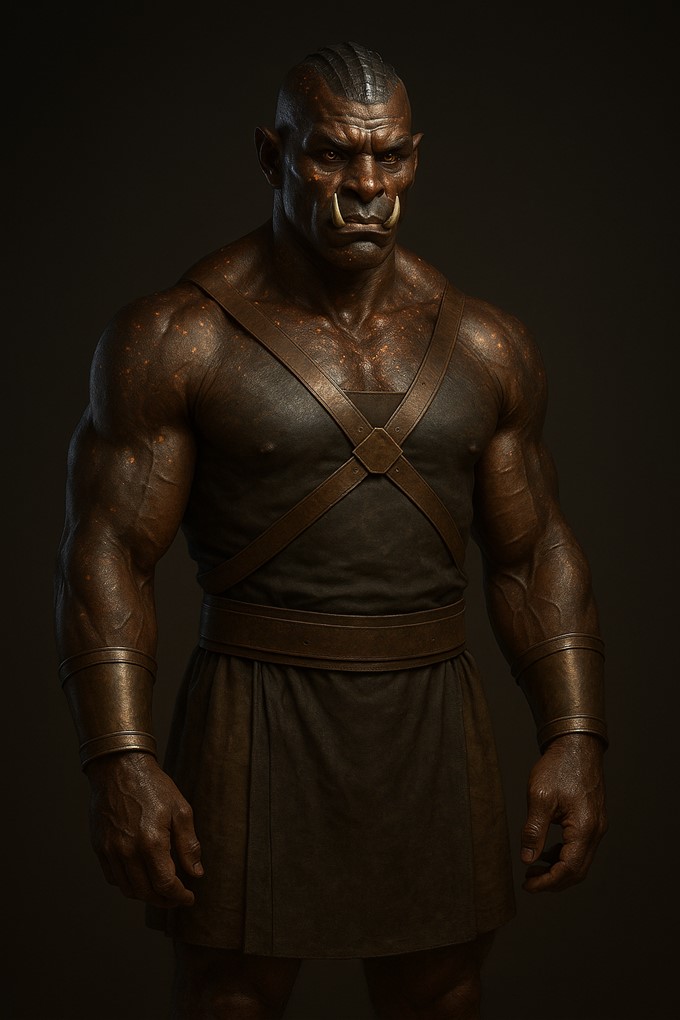
• Skin carries granular sheens ranging from burnt-copper through hematite black, spattered with pale furnace-scar freckles that glow faintly whenever the host’s pulse accelerates.
• Two upward-swept mandibular tusks grow from the lower jaw; enamel is naturally iron-rich, allowing sparks to dance across the surface when struck.
• Ridged cranial plates run from brow to nape: living bone shot through with mineral microfilaments that amplify conduction of temperature changes and low-frequency sound.
• Eyes are deep-set under heavy orbital ridges; the iris shifts between flake-gold and oxided brass, granting keen photopic vision under harsh desert glare and partial night-sight in moonlit canyons.
• Olfactory pits behind the tusk roots pick up metallic ions and trace water vapor, useful for prospecting ore seams or locating hidden springs.
• Average height 6 ½ – 7 ½ feet; mass 230 – 320 pounds, distributed across dense bone lattice and hydrophilic muscle fiber optimized for burst exertion followed by rapid cooldown.
Body pattern
Juveniles display mottled bronze-green blotches along flanks; these darken into weld-like seams by maturity, often accentuated with ritual scarification that follows natural fracture lines in basalt cliffs. Clan heraldry is carved with hot chisels, leaving raised ridges that never fully scar over but instead vitrify into glossy dark glass.
Life cycle
• Gestation: 9 months.
• Childhood: robust, rapid ossification; tusks erupt by age 5.
• Adolescence: metallurgical apprenticeship rites at 12 – 15, triggering hormonal bloom that hardens cranial plates.
• Maturity: full stature by 17; peak physical aptitude continues until roughly 55 years.
• Longevity: median lifespan 90 – 110 years; elders enter the “Red-Stone Quiet,” a state of slow metabolic calcination that preserves mental acuity while surrendering physical speed.
Potential positives
• Extreme heat tolerance; sweat evaporates through subdermal micro-pores laced with copper salts, reducing electrolyte loss during forge or desert labor.
• Natural damage reduction against blunt trauma—cranial and clavicular plates distribute impact.
• Innate attunement advantage with bronze-based gear: attunement time reduced by half when the item’s core alloy contains ≥ 20 % copper.
Potential negatives
• Cold hypersensitivity; ambient chill thickens platelet flow, inflicting sluggish reaction time and heightened risk of joint micro-fractures.
• Oversized tusks impede fine phonetic articulation of sibilant tongues; speech in high-paced foreign dialects causes jaw fatigue.
• High basal caloric requirement; prolonged famine leads to rapid muscle catabolism and brittle tusk syndrome.
Tags: Bronze-Bound, Heat-Tolerant, Tusks, Cranial-Plate, Iron-Enamel, Desert-Forged, Photopic-Vision, Ore-Scent, Mineral-Scarification, Hydrophilic-Muscle, Resonance-Attuned, Blunt-Resistant, Cold-Sensitive, High-Caloric, Tusk-Harness, Ridge-Rail, Dorsal-Vent-Slot
Specialized item slots
• Tusk Harness (1): a paired mount at the tusk bases supporting charm-caps, sensor spikes, or small runic clamps.
• Cranial Ridge Rail (1): along the mid-skull plate for crest bands, bronze diadems, or resonance coils.
• Dorsal Vent Plate (1): between shoulder blades accepting coolant vanes or micro-boiler exhausts for steam-powered backpacks.
• Subdermal Lattice Socket (2): forearms house shallow bone grooves that secure bracer-blades or alloy focus rods without hindering grip.
These slots exist in addition to the standard anatomical allotment and follow standard weight and attunement rules.
Environmental adaptability
Born of scabland mesas, Ironbloods excel in arid basins, volcanic badlands, and kiln-hot foundry halls. Their micro-porous skin desiccates in polar or high-altitude regions unless treated with mineralised oils. Subterranean enclaves thrive near magma vents, drawing radiant warmth for communal baths that prevent plate brittleness.
Other information
• The royal dynasty—the Line of Molten Crown—carries a hereditary flame-vein mutation: thin citrine filaments visible beneath temple skin, said to resonate most purely with the Argares High-Tongue and strengthen alloy-binding chants.
• Social strata revolve around metallurgic mastery; guild standing determines civic authority more than wealth.
• Ritual combat employs blunt iron mauls rather than edged steel, symbolising the shaping of society through pressure rather than shear—duels stop at first plate-crack.
• Mating customs favour scent exchanges of smelted ore dust; prospective partners wear sachets carrying trace elements of favored alloys.
• Folklore claims their earliest progenitor was forged when a meteor struck a copper quarry, fusing flesh with sky-iron—a myth evoked during coronation by placing the heir’s brow to the Star-Scar Anvil.
Argaric Ironbloods thus dominate El Argar not merely through physical might but through cultural synergy with the island’s bronze-bound heritage, their bodies and society tempered like the alloys they prize.
Hammer-Blood People Whose Faces Shine Like Fired Copper
Long ago, when the sand still remembered being sea-bed and the wind still smelled of molten sky-stone, there walked the First One with tusks bright as sunrise. None knew from which crack of worldstone this First One crawled, for the tale tells only that thunder struck a lonely quarry and the rock cried red. From that red cry came the First One, carrying a heart that beat like an anvil under many hammers.
In the days that followed, the First One wandered the broken mesas where no bird dared perch. The mesas hummed with sleeping metal veins, yet no hand had coaxed them to sing. Star hunger gnawed the First One’s belly, but the starlight inside the tusks burned hotter than hunger. So the First One knelt, tore up a slab of sleeping ore, and with bare fists shaped a bowl. The fists bled sparks; the sparks birthed coals; the coals licked the bowl until it shone bronzed and living. Thus was forged the first meal-forge, and the First One ate stew brewed of stone dust and horizon heat.
Creatures of ridge and dune gathered, staring wide at the simmering bowl that fed fire with no wood. The First One spoke—voice like slabs colliding, words half swallowed by echo. Some creatures fled, for the sound broke their teeth of courage. Yet a handful stayed: goat-eyed scavengers, vine-skinned wanderers, and a child lost from a river tribe that never named itself. The First One shared the stone-dust stew. Those who tasted found their own bones humming in answer, and their skins grew speckles where sparks had kissed.
Seasons shattered and mended. The handful became a forge-crowd. Each dusk they hammered fallen stars into tools, yet never could they match the First One’s cadence. The tale says their hammers rang as “clong-clong,” while the First One’s rang “khlau-khlau,” which is the sound of ore deciding to flow. Still they strove. When ore refused, they added sweat; when sweat failed, they added song; when song cracked, they etched scars along their arms so the copper beneath would whisper secrets of strain and temper.
From this forge-crowd sprouted the Houses of Heat. They carved halls inside the mesa walls, holding roofs up with bronze bones that drank the desert scorch and returned cool shade. They learned to read the faint hum of hidden water and the bitter scent of ore beneath dust. Children born among them opened eyes of flake-gold, and small tusks budded early. These children felt pulsebeats in each boulder, measuring its desire to become blade, bowl, or bridge.
Centuries yawned wider than canyon floors. Floods came, then glass storms, then the Age when the sky forgot rain. Many neighbors perished or fled to kinder coasts. The Hammer-Blood People, as strangers named them, remained. They forged wind-tether wheels to haul vapor, brewed mineral salves to quiet stone-split skin, and cooled their forges with dragon-bone bellows that exhaled moon-cold breath gathered from caves.
When distant kingdoms sent silver-tongue envoys seeking copper tribute, the Hammer-Blood chiefs answered with gifts of seamless bronze hinges that could lift fortress gates on a child’s finger. Envoys bowed low, dreaming siege engines. But when greedy lords sent armies for conquest, the hinges bent into mauls and the mauls sang “khlau-khlau.” The stone cracked, dust swallowed hoof and boot, and tusk tips ended many boasts. Survivors whispered that each blow felt like being struck by the island itself, for every Ironblood bore a little of the mesa’s endless patience.
Much later—after scroll-keepers started counting suns by shipwreck omens—a sickness of chill crawled from the southern ice rim. It seeped into joints, turned sweat to needles, and dulled the glow-freckles of the People. Fires guttered; hammers slowed. The elders, their plates webbed with frost fissures, gathered at the Star-Scar Anvil where legend said the First One had knelt. There they placed seven heart-ingots—each containing memories of clan founders—upon the scarred face. They struck once, not to shape metal but to summon echo. Stories claim the echo grew a spine, rose as a white plume, and drifted north to wrestle the ice sickness on its own battlefield of wind.
The chill receded with tails between sighs, yet the blow had drained nearly all elder strength. Their plates, emptied of hum, cracked like dry clay. Knowing time was thin, they pressed their foreheads to the anvil and whispered a law: “When tusks fail, let tusks guide.” They meant the young must lead by listening to tremor, taste of iron in breeze, and rhythm of planet blood, not by thirst of crown.
Thus began the Line of Molten Crown—rulers chosen not through sword, nor elder decree, but by the shimmer of citrine filaments blinking beneath temple skin when the mesa thunder answers. Many crowns have rested on iron-enamel tusks since, yet never has a Molten Crown forgotten that first bowl of stone-dust stew, nor the “khlau-khlau” call teaching ore to flow like thought.
And so the lengthy tale closes, though some fragments crumble whenever retold: vowels chipped, meanings warped like overheated tongs. Yet always remains the pulse of hammers, the burn of copper freckles, and the mesa’s promise that patient fire outlives rushing frost.
Moral: Strength tempered by sharing becomes alloy no frost can shatter.