
Deity: Trống-Tinh, the Heart-Drum Beyond Silence
Lore
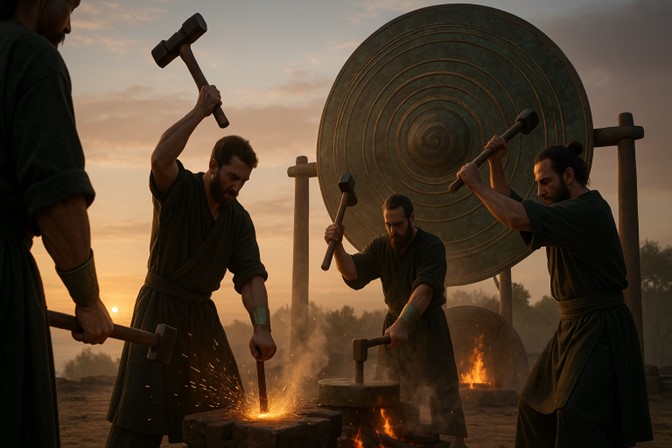
Before the first disc sang, mountain veins leaked living alloy into the sea. Three moonless nights later, the molten pool cooled into a spiral that beat like an unseen heart. That pulse called to cliff-smiths who molded the first drum. When its skin tightened, the drum voiced Trống-Tinh, a presence described as vibration made thought. Lightning struck the drum’s rim, scattering sparks that took form as teachers of cadence. These guides led islanders to time their forging to tides, thunder, and breath. Followers claim the war of geyser and cavern echo ended when Trống-Tinh separated noise from tone, gifting the world purposeful sound. Oral epics state that every newborn’s first heartbeat is counted into the deity’s endless rhythm—a ledger of all living pulses.
Personality
Trống-Tinh is impersonal in shape yet intimate in presence. Devotees liken communion to standing inside a bronze bell while mist falls: pressure, warmth, and absence of ordinary hearing. The deity rarely “speaks” in words; instead, worshippers sense tempo shifts in nearby wind chimes or water droplets. Patience defines the tone—slow accelerando foretells opportunity; sudden ritardando signals caution. Anger manifests as disharmony: tools misstrike, anvils crack, rivermills seize.
Traits and Characteristics
• Sovereign of Rhythm: governs intervals, cadence, beats, and the pause between.
• Alloy Steward: blesses copper-tin mixtures, guiding artisans to perfect ratios by ear.
• Moonlit Guardian: power ascends at night; new moons intensify whispers of guidance.
• Echo Weaver: knits distant sounds across valleys, letting priest-drummers converse through cliff walls.
• Balance Enforcer: punishes unmeasured clamor—those who hammer without pattern find metal crumbles to powder.
Attributes
Domain associations include bronze, verdigris patina, silent breath, stone amphitheaters, submerged grottoes, and heartbeats recorded on vellum scrolls. Sacred numbers are three and seven; sacred interval is the perfect fifth. Ritual implements: hand-held spiral gongs, bronze spindle flutes, and sand-filled hour-bowls that hiss in triplets while draining.
Symbols
Primary sigil: a double spiral enclosed in a circle, one coil turning sunwise, the other moonwise, joined by three short bars representing hammer, chisel, and breath. Secondary motif: a stylized drum broken open to reveal a star at its core, signifying the hidden pulse inside all matter. Colors: burnished copper, deep verdigris green, and moon-white highlights. Wearable emblem: narrow arm-rings etched with alternating grooves and notches matching personal pulse patterns measured at dedication.
Practice and Worship
Shrines cluster near foundries, river rapids, and basalt echo-caves. Congregational rites involve synchronized breathing followed by alternating strikes on water-drums and bronze plates, aligning circulatory rhythms to communal tempo. Initiates spend nine nights in resonant chambers, absorbing overtones that linger in bone. Festivals coincide with the silent node of the lunar cycle; drummers perform without skin heads, striking only rims so the audience feels vibration rather than hears tone. Offerings are measured in seconds of silence maintained by entire crowds; the deeper the hush, the greater the devotion.
Hierarchy
Forge-Cantors: senior clergy who know the seventy-one canonical pulse-chains.
Pulse-Bearers: monks who record heartbeats of the ill and attempt to retune irregular rhythms through low-frequency chants.
Verdigris Apprentices: novices tasked with tending spiral gardens—patterns raked into sand over bronze mesh, used to visualize sonic interference.
Followers
Roughly half the island nation adheres strictly, with millions more observing festivals for good fortune in craft or trade. The ruling house claims descent from the first drum-smith and acts as ceremonial High Metronome during state rituals.
Afterlife Notion
Believers state that upon death, an avatar’s crystal resonates once with original birth tempo, then the deity absorbs its echo into the Endless Measure—a cosmic composition never replayed the same way twice. Departed thus remain present as beat variations woven through future songs.
Tags
Bronze-faith, Drum-lore, Rhythm-worship, Moon-cadence, Echo-rites, Silence-offering, Forge-blessing, Verdigris-symbol, Pulse-chants, Spiral-sigil, Cadence-monks, Heartbeat-ledger, Cliff-communication, Alloy-sacred, Balance-edict, Vibration-presence, Festival-hush
The faith of Trống-Tinh grants several widely acknowledged advantages. Devotees report heightened rhythmic perception that translates into steadier hammer-strokes, more uniform alloy grain, and fewer flawed castings; communal breathing rites lower pulse variability, reducing black-lung and forge-stress ailments; cliff-echo prayer cycles create a shared sonar map of weather fronts and sea tremor, giving coastal villages earlier warnings of storm surge and submarine fault-slip; verdigris arm-rings worn after dedication slowly leach trace antiseptics, keeping minor wounds clean; and the silent-offering discipline nurtures exceptional group cohesion, because crowds trained to hold a hush of three hundred consecutive heartbeats seldom fracture under political discord.
Membership demands carry costs. Strict liturgical timing forces smiths to quench and reheat metal if the temple gong signals an unsanctified interval, wasting fuel and labor; louder celebrants who violate silence offerings face ritual shunning that may last a full lunar node, severing them from trade contracts brokered on temple grounds; Pulse-Bearers monitor heartbeat ledgers and may order weeks of restricted exertion for anyone whose rhythm drifts, which itinerant sailors consider an economic hardship; sacrilege such as striking a drum rim out of sequence provokes an alloy-crumble curse—temple records list tools reduced to powdered copper-tin within minutes—so artisans live in constant vigilance; and novitiate isolation chambers sometimes induce resonance vertigo, a disorienting hum in the skull that lingers for days.
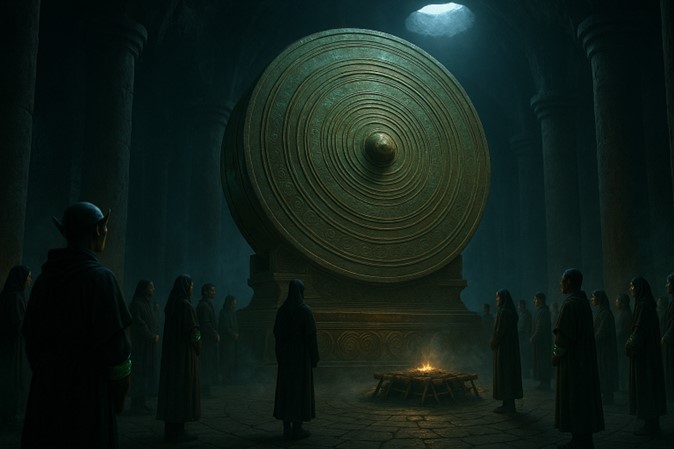
Temples manifest as Resonant Foundries—half shrine, half metallurgical hall—built into basalt bluffs or caverns where tidal wind can flow across bronze skin drums. A central spiral drum seven body-lengths wide anchors the sanctuary floor; the roof is a shell-backed oculus of overlapping plates tuned to different fifths so rain becomes a living hymn. Peripheral corridors curve inward, matching the Trống-Spiral script, guiding foot-traffic along an ever-tightening coil until worshippers stand within the drum’s perceived “heart.” Smaller Wayside Hush-Gardens dot trade roads: open-air rings of bronze posts that carry tensioned membrane ribbons and sand-bowls marking pulse intervals. No image of Trống-Tinh decorates these sites; presence is indicated by vibration alone.
As for numbers, temple census ledgers list approximately twenty-six million eight-hundred ninety-six thousand devoted adherents who attend monthly new-moon rites, maintain personal arm-rings, and tithe a fraction of forge output. An additional twelve million honour the deity on festival cycles—particularly the silence contests and forge-blessing ceremonies—without pledging full discipline. The remaining island population respects the faith’s acoustic laws in public spaces to avoid alloy-crumble misfortune, though they keep private loyalties elsewhere.
Believers hold that Trống-Tinh is not a distant personality but the primordial cadence woven through every living pulse, every molten altar, and every interval of true silence. They teach that the cosmos began as unmeasured clamor; when the Heart-Drum sounded its first beat, noise separated into ordered rhythm, granting matter its lattice and thought its memory. To remain in harmony, sentient beings must keep their personal heart-measure aligned with the Great Spiral that turns sunwise by day and moonwise by night. Each follower therefore vows three lifelong devotions.
• Cadenced Breath — conscious pacing of inhalation and exhalation so that at least one waking hour each day matches the temple’s bronze metronome; an erratic pattern invites disharmony, cracking tools or fraying community bonds.
• Forged Balance — never strike metal, wood, or flesh without first marking the beat; violence or craft divorced from rhythm is deemed “clatter,” the source of rust, famine, and civil strife.
• Hushed Interval — protect pockets of silence in all settlements, believing that the deity’s subtlest counsel enters the world only where no other sound intrudes.
Regular worship gathers at Resonant Foundries during the dark sliver before dawn, when night’s final silence meets the island’s first seabird calls. Congregants file along the inward-curling corridors, each step landing on floor inlays that taper distance between footfalls, training visitors to shorten stride until dozens can share a single breath. They assemble around the central spiral drum but do not strike it; instead, Forge-Cantors tap copper styluses against their own verdigris arm-rings, producing a faint staccato that sketches the liturgical pulse-chain of the day. Participants synchronize heartbeats by breathing in triplet patterns, guided by sand drifting through hour-bowls suspended on bronze arcs. After the alignment phase, Pulse-Bearers recite names and recorded birth-tempos of newborns, adding each fresh beat to the Endless Measure ledger. Final moments are reserved for pure stillness: three hundred heartbeats of utter quiet during which adherents focus on the faint vibration rising from the drum skin as ocean wind passes the oculus roof-plates. Services disperse wordlessly; trade negotiations and casual talk resume only beyond the foundry’s outer coil.
Funeral observances begin the instant an avatar’s death crystal emits its single resonant chime. Family members lift the body onto a low bronze litter whose frame is tuned to the deceased’s registered birth-tempo. The procession moves at exactly that cadence to a cliffside Hush-Garden, coaxing mourners to feel the lost rhythm in their own chests. There, Verdigris Apprentices place the crystal in a shallow bowl of seawater; as trace copper ions leach outward, the water vibrates, replaying the individual’s final heartbeat for all nearby to sense through soles and bones rather than ears. The body is set upon a lattice pyre of copper-bound bamboo; Forge-Cantors stroke rimless drums, producing air-pressure pulses that fan the flames without audible strike. When flesh and bone reduce to ash, smiths collect the residual verdigris and mix it into a fresh alloy ingot marked with the departed’s spiral glyph. The ingot is either forged into a small tool—often a chisel, nail-set, or tuning peg—to serve future generations, or offered back to the sea if the deceased lived as sailor or diver. As the ceremony ends, the litter frame is dismantled and its segments added to the Resonant Foundry’s archive racks, each bar a silent metronome preserving the tempo of every life returned to the Endless Measure.
Defensive applications of Trống-Tinh’s cadence
Rhythm-wrought bronze accepts and re-emits vibration; smith-priests exploit this by forging thin resonant plates into lamellar coats or tower shields. When a plate is tapped in the deity’s perfect fifth, a rippling counter-wave flares across its lattice, smothering oncoming force like a tide swallowing a drumbeat. Arrows strike with muffled thuds and tumble harmlessly; stone shot meets a bright shimmer, loses momentum, and falls as powder. Skilled Forge-Cantors embed hairline channels through the metal; a brief chant sends air through these micro-flutes, raising a dome of inaudible pressure that quells flames and turns spreading shockwaves aside.
Verdigris arm-rings function as portable silencers. A tap of the thumb on the ring’s groove releases a hush radius roughly three heartbeats wide; the zone drinks in clash and cry, preventing scouts from being heard while dulling the kinetic edge of blades that try to enter. Cliff garrisons line parapets with tripod gongs tuned to different intervals; when struck in choreographed sequence, their overlapping pulses form a standing barrier that fractures incoming sound-guided projectiles from sky leviathans.
Pulse-Bearers protect vessels by marking keel timbers with spiral glyphs. A cadence transmitted through the hull causes surface ripples to cancel each other around the prow, dulling ramming swells and allowing the ship to glide through storm crests like a whisper between beats.
Offensive applications of Trống-Tinh’s cadence
The same harmony that steadies forge walls can split stone. A bronze rod bored with helical grooves becomes a Striker-Staff: three measured taps against its butt send a focused pulse through the air. At ten paces the pulse hits like a smith’s hammer, concussing lungs or jolting a charging beast into collapse without visible weapon swing.
Battle drummers carry rimless field drums whose skins are stretched verdigris-tight. Beating a particular triplet rouses the alloy-crumble curse: ferric weapons within two man-lengths resonate out of tune with their own structure, shedding sparks then turning to brittle flakes. Heavier war gongs produce lower harmonics that travel through soil; enemy sappers feel the ground shiver up their shins moments before tunnel props splinter.
For close combat, Spiral-Edge chisels are forged from alloy mixed with ash of funeral verdigris. When swung in sync with the wielder’s heart, a faint green corona trails the blade; upon contact that energy enters the target object, expanding microfractures until helmets peel like fruit skin.
Chant-knots woven into shoulder cloaks let fighters project sudden silence outward—removing all battlefield noise for three counted beats. While foes reel in sensory void, worshippers dash or strike unopposed. Conversely, a rapid accelerando pulse shouted through bell-masks can jar an adversary’s heartbeat, causing momentary vertigo or even unconscious collapse in creatures whose rhythms cannot absorb the overpressure.
At sea, defenders mount Drum-Lance arrays—long bronze tubes capped by diaphragm heads. Two coordinated blows at opposite ends trap air, releasing it forward as a narrow vortex that batters sails to tatters and can cave a wooden hull if repeated. Reef patrols aim smaller versions downward; the shock plume stuns marauding shoal beasts or cracks shell of leviathan spawn before they breach harbor nets.
All such techniques rely on precise timing, breath control, and metal tuned to Trống-Tinh’s intervals. Without trained cadence, a casual clang produces only noise; with proper rhythm, it becomes the deity’s pulse made tangible—shield or hammer as the situation demands.
Echoes on Rim of Silent Drum
Long-ago-but-never-measured, before rivers learned to answer their own splashing and before anvils could remember the weight of any hammer, there drifted a hush so vast that even lightning walked barefoot. In that hush floated a bronze seed the size of a widow’s tear, spiralling inward upon itself like a frightened snail. The seed breathed once—whether out or in no chronicle agrees—and the exhalation was shape, pulse, and name together: Trống-Tinh.
From this single unvoiced beat rolled seven rimless waves. The first wave struck a mountain of sleeping iron, cracking it into six unequal cliffs whose hollows hummed with sudden wind; the second wave licked a salt plain until crystals stood arranged like toothless mouths singing nothing; the third wave curled around ten thousand drifting souls trying to recall the warmth of forgotten bodies, guiding them toward the cliffs where echoes waited to be born. Which cliff came first is disputed; which soul sang first is doubted; but all tales agree that each echo arrived empty-handed and left carrying a single drop of rhythm.
Among those souls staggered the one called Tảo-Khương-Một, though the name survives only in charred reed-scratches and can also mean Clay-Wet-Four depending on the missing diacritics. This wanderer had neither drum nor chisel nor heart, only a rattle of windbones strung along the spine. Seeing the cracked cliffs weeping hot dust, Tảo-Khương-Một set palm against the nearest fissure and felt the dust push back. Dust became breath, breath became tapping, tapping became memory, and memory burst into a sliver-thin chant:
Tap once—stone bends; tap twice—ore finds itself; tap thrice—silence counts.
No listener witnessed this verse, yet every ore-vein on the island crust turned its grain toward that three-tap law. Forging hammers sprouted in the hands of children who had never seen metal; waterwheels grew ribs of bronze overnight, spinning though the streams slept dry. All who awoke beneath these changes sensed a tether pulling heartbeats into the same cadence. They followed the tether across starlit terraces until meeting at the cracked cliffs.
There waited Tảo-Khương-Một, but changed beyond naming: skin carved by green patina glyphs, eyes ringed with mirror-bright copper, voice now a hollow tube where winds could find no purchase. The cracked cliffs melted at a whispered syllable, pooling into a single disc broader than the horizon. As the disc cooled, spiral ridges surfaced, each ridge etched by the fingerprints of those who would later forge, sail, harvest, and rule. The disc shuddered, swallowed its own center, and folded thrice, shrinking to a great drum without skin.
Witnesses disagreed on color—some saw midnight jade, some fresh-quenched iron—but all heard the silence that rose inside the hollow shell: a silence not empty but swollen, as if storing the next centuries’ thunder. That silence named itself Cathedral Hush and pressed every onlooker flat against the sand. When they could stand again, Tảo-Khương-Một had vanished, leaving foot-sized hollows filled with verdigris water that never evaporated even under hottest forge-wind.
The folk carried the drum onto a basalt plinth where three rivers meet, binding it upright with ropes of woven moonbeam. They struck its rim, and for a breath’s breadth nothing sounded; then the air everywhere within a thousand strides buckled, and every chest cavity thumped in unison. Arrows flew backward; draft animals knelt; clouds rolled their bellies to the sun. Frightened yet entranced, the folk struck again—softer, shorter—and this time each heart answered with its own shortened beat, finding harmony rather than submission.
Thus began the Counted Cadence: an unending sequence of strikes and spaces teaching lungs to measure, hands to hesitate, blades to choose moments before moving. Trade grown slow but true replaced quick bartering; quarrels ended after three heartbeats of hush because anger could not outpace the drum’s demand for pause. The island’s shoreline shifted, curving inward like the drum’s spiral until harbors fit vessels perfectly, as though coastline and hull shared one blueprint.
Centuries fell into the drum’s ledger. Yet memory of Tảo-Khương-Một blurred: some priests taught that the wanderer was the seed itself shed of bronze shell; others insisted Tảo-Khương-Một was merely the first ear to hear Trống-Tinh’s breath. In later scrolls, the wanderer became twin siblings, then a chorus of seven, then an entire village born legless, sliding across clay on bell-shaped hips. With each retelling the drum’s rim deepened, for scribes hammered fresh strips of bronze around its circumference, claiming every new doubt lengthened the path back to truth.
When war-voices rose among distant archipelagos, emissaries begged the drum for shield and spear. Forge-Cantors responded by tempering plates thin as cicada wings, tuning them to the drum’s perfect fifth. Worn as cloaks, these plates absorbed catapult stones and broke auric spears mid-flight. Yet the defenders refused to march further than the drum’s echo could reach, fearing a land where cadence might die unheard. Opponents mistook this restraint for weakness, advancing with iron call. At twilight the drum sounded thrice, and iron became dust on invading palms; war ended before swords could taste first blood.
Pride inhaled where gratitude should have settled. Younger smiths, impatient with three-beat rules, forged hollow bars of copper-lead hoping to strike twice and gain thrice speed. The deity’s cadence warped under their hands; bars rang discord and liquefied, flooding forges with poisonous fire. Witnesses speak of glowing pits that swallowed entire workshops, leaving behind only charred silence punctuated by irregular rattles—echoes of heartbeats that never again matched the ledger.
Chastened, the island renewed its vow. Forge-Cantors taught children to hear not merely the drum but the gap between strokes. Pulse-Bearers walked markets, counting hush along crowded lanes so coins clinked in sequence. Sailors carved spiral gouges into keels, ensuring hulls flexed to the measure of broken surf. Night hunts began only after the full disc of the moon fit within the first coil of a drawn circle on sand: proof that cosmic rhythm still mirrored mortal craft.
A final fragment survives on moss-eaten shale: When the Endless Measure fills, the drum will uncoil and become silence again; those whose hearts beat off-count shall fall into the widening hush, those who keep the time shall ride the last vibration to new hearing. Scholars argue whether this signals doom, rebirth, or mere poetic rust, for translation disagrees on which glyph means fall and which means rise. Still, every newborn receives an arm-ring grooved with birth-pulse, each groove a tiny promise that rhythm persists even when memory fractures.
Those who listen at low tide claim they hear Tảo-Khương-Một walking beneath the surf, tapping three times on shells so they remember to close with the moon. Others hear nothing and call the tale forged fancy. Yet everyone steps softer when approaching the drum-foundry, aware that the next hush might outlive their own measure.
Moral: Forge in silence first, for only a listened-for beat can carry weight without breaking the world it steadies.