

Species
The Cordilleran skyfolk call themselves Vayari, a term that combines the root for “ridge” with the suffix for “voice,” reflecting their heritage as wind-borne heralds of the mountains.
Physical Form and Sensory Traits
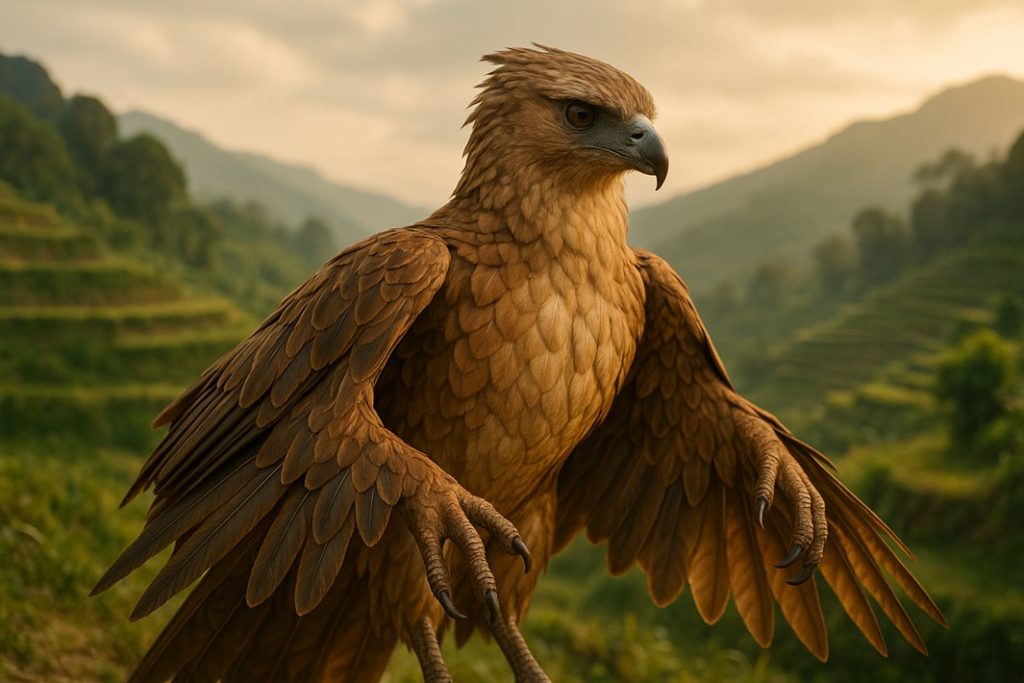
A Vayari adult stands upright on digitigrade legs ending in taloned, stone-gripping feet. From shoulder to fingertip stretches a membrane of layered flight feathers; when folded, the wings drape like long, slate-colored cloaks, leaving the hands free for tools. A secondary pair of shorter alar muscles along the ribcage stabilizes glides and allows sudden braking against cliff faces. Bones are hollow yet web-reinforced with calcite struts, granting lightness without catastrophic brittleness. The skull carries a forward-angled crest of stiff contour feathers whose hue marks clan line. Large, gold-flecked eyes possess a deep foveal pit and a translucent nictitating lens that clarifies vision in mist or driving snow. Ear openings are shielded by velvety auricular plumes; tiny pressure nodules inside the canal let a Vayari feel barometric shifts hours before a storm.
General Size and Body Pattern
Average height ranges from two and a quarter to two and a half strides; mass seldom exceeds 140 measures even in heavy gear. Plumage follows the granite palette of their homeland—smoke gray ventral down, charcoal remiges, and pale stone-wash on the dorsal side. Females add irregular speckles of jade or russet along the scapulars, serving both camouflage among terrace shadows and dynastic identification. Molt occurs twice yearly, each cycle timed to equinox hydrology; newly grown primaries gleam with a faint, mica-like sheen, useful for signaling across valleys.
Life Cycle
Eggs—usually two-clutch—incubate for forty-five dawns in woven reed baskets suspended beneath terrace overhangs, warmed by geothermal vent stones. Fledglings take first glide at three seasons, but true load-bearing flight requires completion of keel-plate ossification around year ten. Social adulthood arrives at the sixteenth summer solstice, when an individual carves their first personal glyph in Vay-Ridge upon a family retaining wall. Average life expectancy reaches one hundred and twenty flood cycles; elders often lose aerial ability after the fourth decade yet serve as terrace-tone singers, their voices deepening and carrying resonant power for earth-steadying chants.
Potential Positives of Form
• Long-range glide capability across river chasms or from ridge ramparts.
• Superior binocular sight and mist-piercing lens adaptation ideal for early avalanche detection or distant semaphore reading.
• Lightweight physiology halves encumbrance, letting a Vayari wear bulkier gear before stamina falters.
• Taloned feet grant advantage on vertical stone faces and wet cedar beams.
• Cardiopulmonary system evolved for thin, high-altitude air enables sustained exertion where ground races gasp.
Potential Negatives of Form
• Hollow bone lattice transfers impact; blunt-force trauma fractures more readily than in ground-dense species.
• Full wing extension requires clear shoulder arc; tight breastplates or heavy back-sheaths impede both combat reach and flight.
• Tailored garments and harnesses cost double in labor due to complex wing articulation channels.
• Salt-heavy coastal gales mat feathers and erode natural oils, demanding frequent cleansing rituals.
• Substantial heat is lost through the patagia; prolonged exposure to sleet or dense fog risks hypothermic feather-freeze unless insulated cloaks are worn.
Tags: Avian, Winged, Ridge-Born, Taloned, Glide, High-Altitude, Matrilineal, Hollow-Bone, Sharp-Vision, Patagia, Wind-Sense, Terrace-Keeper, Stone-Grip, Crest-Plume, Lightweight, Feathery, Resonant-Voice
Specialized Item Slots
• Dorsal Harness Slot—sits along the vertebral ridge above the secondary alar muscles; holds lightweight packs or resonance drums without interfering with downstroke.
• Crest-Band Slot—rings or combs slide into the rigid cranial plume, bearing matriline sigils, water-key chips, or pitch-tuned wind chimes that vibrate during Ruk-Vay recitation.
• Tarsal Grip Slot—magnetite or jade rings lock over the rear talon for climbing spikes or terrace-key inserts, leaving hands unburdened.
• Wing-Edge Channel—a flexible cuff secured near the carpal joint; accepts razor shells, flare laths, or pitch-tuned resonance reeds used in mid-glide signaling.
Environmental Adaptability
Designed by terrain, the Vayari thrive in thin, gusty air, roosting on basalt ledges that other peoples regard as unreachable. Their respiratory sacs filter volcanic ash and recycle water vapor, letting them survive long patrols over fumarole fields. In dense rainforest below 1 000 terrace lengths, their plumage darkens and moult frequency decreases, but flight becomes laborious; mountain migrations are therefore seasonal necessities. Extended sea voyages demand oiling feathers with cedar-resin blends to resist brine crust.
Other Information
Royal plumage is unmistakable: a double crest of porphyry-red feathers edged in pale quartz dust marks direct descent from the first water-key matriarch. Succession passerines—small, slate-gray companion birds—nest exclusively in these royal crests and are said to chirp in tri-tone intervals echoing the original terrace-laying chant. Court ceremonies involve choreographed group glides above the capital’s aqueduct where each participant strikes bronze wing-rings against air to produce a harmonic wave that travels the length of the channel, confirming sluice integrity by listening for pitch warble. The monarchy’s sky-borne couriers deliver edicts suspended in waxed papyrus cylinders clipped beneath primary feathers, covering ridge-to-coast distance in a single thermal spiral that ground messengers could not match in three days.
Feather Who Forgot the Ridge
Hear now the wind-scratched record that elder walls still hum, though many rune-tips eroded under rain of years. It begins with a single chipped glyph: “Feather sprouts where stone sings,” yet half the phrase is missing, so scholars debate whether that stone was cliff, cloud, or hearth. In distant dawn-season there lived a Vayari named Iru-Tal, crest marked in bright quarry ochre, wide wings strong as young river arches. Iru-Tal glided each sunrise from terrace crown to cedar shadow, counting pulse of aqueduct and listening for the Giant’s dream-breath below.
Iru-Tal’s pride was the silent arc—no feather quivered, no pebble fell. People whispered, “Wind itself obeys that one.” When the equinox convocation gathered, the matriarch gave Iru-Tal custody of the Sluice-Key of Twelve Steps, a jade shard tuned to hold back spring torrent until terrace walls were ready. With key resting in tarsal ring, Iru-Tal tasted the thin blue air and heard only self-song, forgetting the low hum of ridge stone.
So tell the slate carvings:
“With chest loud and head above mist, the wing looked down upon water and called it tame.”
On the day torrent clouds towered, elders asked for the chant to unlock steady flow. Iru-Tal delayed, turning mind to a new feat—testing the unheard height where even thunder sits. “Let the terraces wait; I will bring back sky-secrets,” the flyer said, talons tightening on the jade key. Upward through ice breath and sun spear, past where kestrels shiver, past where air carries no scent, Iru-Tal pierced the forbidden hush. There, the story says, the wing saw its own shadow on the roof of the world and believed the mark to be a second body waiting for crown.
While Iru-Tal circled alabaster void, the mountain veins swelled. Unchecked meltwater hammered terrace buttresses; retaining faces cracked like dry maize. Farmers clung to sluice gates, singing half-remembered Vay-Ruk phrases, yet without the key’s pitch the land did not listen. Seventeen stone ribbons failed; rice beds slid into gorge, carrying seedlings, carp, and prayer pillars. The roar of falling paddies shook the Giant’s dream like a muffled cough.
Far above, a sudden updraft ripped through Iru-Tal’s patagia, snapping primaries sideways so the body spun tail-first. In that spiral descent, wind whistled an old cadence—the very earth-song ignored at dawn. The flyer’s ears finally caught the fracture rhythm, and heart knew ruin had blossomed below. Clutching the jade key, Iru-Tal fought freefall with torn feathers, steering toward the largest breach, where water frothed white over shattered stair.
Witness tablets claim:
“Feather dared to stitch flood with single breath, though the thread was cracked jade and regret.”
Iru-Tal struck the torrent like a slate dart, talons anchoring to a remnant buttress. With voice raw, the flyer sang the sluice-opening chant three full pitches lower—feathers soaked, lungs filling with stone-cold spray. The jade key glowed, lattice veins igniting, but because the chain of terraces was already wounded, the chant channelled power not to open but to freeze. Floodwater hardened into translucent ramparts, sealing breaches long enough for builders to jam basalt wedges beneath.
By dusk, the slope held, albeit scarred. Iru-Tal, fevered and wing-broken, knelt before matriarch and laid down the key. Crest plumes dulled to river silt, voice cracked like early frost. “I chased high echo and left low hum unheard,” confessed the flyer, words slipping through chipped beak. The elders answered with no scorn, only quarry silence. They tapped two notes upon the ridge stones—down, then up—reminding all who heard: descent must follow ascent, balance answers pride.
After convalescence, Iru-Tal’s wings never regained full span. Yet the flyer became first Sky-Mason, inventing stirrup-loop harnesses that let ground walkers lift slate blocks along cliff faces, a gift born from understanding that feet and feathers serve the same Giant if guided by harmony.
Fragments end with this line:
“When wind chooses self above stone, terraces drown; when wind recalls stone, mountain and sky sing one chord.”
Moral: The wing that forgets the ridge invites the flood; remember earth in every ascent.