
This is the primal, instinct-driven faith of the scattered clans inhabiting the Clactonian Shards, a harsh archipelago of sharp, flint-rich islands and jagged coastlines. The Clactonian religion is one of improvisation, opportunism, and the belief that true power lies not in permanence, but in the explosive, useful moment of a thing’s breaking.
Lore: Clactonian lore tells that their first ancestors arrived on Saṃsāra into a world of maddening perfection and permanence. The trees were like iron, the hides of the beasts could not be pierced, and the very stones were seamless and unbreakable. Trapped in this changeless world, they were starving and helpless, unable to make their mark or even feed themselves.
Their founding myth centers on the “First Despair,” where an ancestor, driven to madness by hunger and frustration, took one of the perfect, unbreakable stones and hurled it with all their might against a cliff face. Instead of bouncing off, the stone shattered with a sound like a thunderclap. The ancestor, horrified at having destroyed one of the few solid objects in the world, went to inspect the damage. They found that the broken pieces—the flakes and shards—were sharper than anything they could have imagined. In that moment of accidental destruction, they had created their first tool.
This was the revelation of their deity, Klagg, the Spirit of the Fracture. They came to understand that their god was not the eternal stone, but the spirit of the break itself. Klagg is the divine force released in the instant of shattering, the violent birth of a sharp edge from a dull whole. They believe the world is a prison of dull permanence, and only through sudden, instinctual acts of creative destruction can one find the momentary, perfect tools needed to survive.
Deity: Klagg, the Spirit of the Fracture
- Personality: Klagg is a deity of pure, chaotic impulse. It has no long-term plans, no moral code, and no sense of patience. Its personality is that of a lightning strike, a rockslide, or the flash of a brilliant, desperate idea in a moment of crisis. Klagg is unpredictable, violent, and exists only in the present moment. It does not reward careful planning or meticulous work; it rewards the split-second decision, the opportunistic strike, and the instinctive act. It is a god of pure, untempered instinct. To be pious is to act without hesitation, to embrace the chaotic opportunity of the now.
- Traits and Characteristics: Klagg is never given a form, for it has none. It is not a being, but an event. The god’s presence is only felt for an instant—in the blinding flash of a flint striking stone, in the sharp crack of a breaking bone, in a sudden, life-saving idea that comes from nowhere. Priests of Klagg, known as “Breakers,” are not thoughtful artisans. They are wild, impulsive individuals who seek to create moments where Klagg can manifest. They will strike stones together not to carefully shape a tool, but to shatter a core, hoping to find a single, perfect, razor-sharp flake among the debris—a shard of their god made manifest. A follower of Klagg lives from one divine moment to the next, caring little for the past or the future.
Attributes: Klagg’s divine portfolio is focused on the power of the immediate, the improvised, and the act of breaking.
- Improvisation and Opportunity: The primary attribute. The ability to find a solution and create a tool now with whatever is at hand.
- The Present Moment: Klagg is the god of the “now.” It has no dominion over history or destiny, only the explosive potential of the immediate instant.
- Fracture and Shattering: The sacred principle that breaking something can release its hidden potential, that creation comes from destruction.
- The Sharp Edge: The deity governs the concept of sharpness, not as a permanent quality, but as the momentary, perfect state of a freshly broken edge.
- Instinct: Klagg is the embodiment of pure, primal instinct. To think is to hesitate; to act on instinct is to commune with the divine.
Symbols
- The Shattered Circle: The primary symbol. It is a circle with a large fragment broken away, with the edges of the break shown as sharp and jagged. It represents the idea that a broken thing can be more useful than a whole one.
- The Jagged Line: A simple, sharp, zigzagging line. It represents a crack, a fracture, or a bolt of lightning—the path of Klagg’s instantaneous power. It is often painted crudely on the body before a hunt or a fight.
- The Flint Flake: The most sacred object. It is not a carefully worked tool, but a simple, razor-sharp flake struck from a core. It is valued for its raw, ephemeral sharpness. After it is used and becomes dull, it is often discarded, its divine moment having passed.
- The Exhausted Core: The large, battered stone core from which all useful flakes have been struck. It is often left at a prominent landmark as an offering. It does not represent the god, but the now-useless source from which the god’s momentary power was born.
Tags: Deity, Religion, Chaotic Neutral, Primal, Stone, Improvisation, Instinct, Destruction, Creation, Momentary, Sharpness, Opportunism, Fracture, Impermanence, Flake, Impulse, Reaction, Tribal, Violence, Shard
Positives: The primary strength of the Clactonian faith is the cultivation of supreme short-term adaptability and resourcefulness. Followers are masters of improvisation, able to react to sudden crises with an instinctual speed that more deliberative cultures lack. In a chaotic and unpredictable environment, they are unparalleled survivors, capable of finding an immediate solution or creating a necessary tool from the wreckage at hand. Their worldview, which finds value in that which is broken, allows them to see opportunity where others would only see ruin. This philosophy also grants them a profound and primal freedom. Unburdened by the weight of history, complex laws, or anxiety about the future, they live entirely in the vibrant, explosive present moment, giving their culture a raw and feral vitality. In conflict, their utter unpredictability makes them a terrifying and difficult foe to strategize against.
Negatives: The religion’s greatest weakness is its complete and culturally enforced lack of foresight. A society that venerates only the present moment is incapable of any long-term planning. They do not build permanent settlements, cultivate crops, or store provisions for the future, leaving them perpetually at the mercy of their harsh environment and in a constant state of near-starvation. This has led to a complete lack of technological or social development; since tools are created for a single moment and then discarded, no craft is ever refined or improved upon over generations. Their society is inherently unstable, composed of small, fractured clans prone to impulsive violence and with no concept of lasting contracts or laws. Their method of “creative destruction” is also profoundly wasteful, shattering large, valuable resources to gain a few momentary tools, further ensuring their struggle for survival is a permanent condition.
Type of Temple: The followers of Klagg build no temples, for their god is not a being that can be housed but an event that occurs in a single, violent instant. A place is only sacred for the moment that the Spirit of the Fracture manifests. The act of shattering a stone is their only true service, and the ground upon which it happens becomes a Momentary Altar.
When a Breaker-priest performs a ritual shattering of a large flint core to prepare for a hunt or battle, the site of this impact becomes holy. The clan will gather around the Shatter-Ground to select the sharpest flakes, which are seen as shards of the divine. The large, now-useless core from which the flakes were struck may be propped up as a temporary monument and smeared with blood or ochre as an offering. These sites, however, have no permanence. Their sanctity fades with the moment. Within days, the offerings are washed away, the core is forgotten, and the ground is no longer considered special. The only recurring sacred locations are the great flint quarries themselves, which are revered not as places to worship, but as places of raw, unexpressed potential.
Number of Followers: The Clactonian Shards are home to a scattered and volatile population. Their chaotic, impulsive culture and their complete inability to plan for the future results in an extremely high mortality rate and prevents the formation of large, stable communities. They are not a unified nation but a loose and ever-shifting collection of disparate, often hostile, clans.
Their numbers are perilously low, making them one of the most endangered cultures on Saṃsāra. The total population across all the islands likely does not exceed 49,184,000 individuals. Their lifestyle of constant struggle and their philosophical disregard for the future means their population is believed to be in a slow, permanent state of decline, a fading echo of a more primal and violent age. Within the clans, adherence to their beliefs is absolute, as it is the only way of life they have ever known.
What Believers Believe: The followers of the Way of the Sudden Shard believe that the universe is a dull, stagnant prison of permanence, and that the only divine or meaningful force is Klagg, the Spirit of the Fracture. They hold that all power, utility, and purpose is born in the violent, instantaneous act of breaking. A whole, unbroken stone is a useless, sleeping thing. A shattered stone, however, yields sharp-edged flakes—tools born from chaos, each one a momentary manifestation of their god.
Their creed is centered on the absolute primacy of the present moment. The past is a useless, exhausted core from which all sharpness has been struck; the future is an unbroken, potential-less stone. All of life and all of divinity is contained in the “now.” To plan, to reminisce, or to contemplate is to be weak, to miss the opportunity of the instant. True piety is pure, unfiltered instinct. A sudden impulse to act, a gut reaction, a flash of inspiration—these are the direct commands of Klagg, and they must be obeyed without hesitation.
An individual’s life is seen as a flint flake: their purpose is to be sharp, useful, and impactful in their brief moment. A long, slow, and uneventful life is a spiritual failure—a dull edge. A short, violent, and decisive life is the ideal. A tool, like a person, is only sacred for the moment it is needed. Once its edge is gone, its divine spark has passed, and it is to be discarded without sentiment.
Regular Services: Clactonian religious services are not scheduled, planned, or contemplative events. They are spontaneous, chaotic, and violent outbursts of creative destruction, meant to generate moments where Klagg can manifest.
There is no formal daily practice, only the cultural expectation that each individual will act on their instincts. The closest thing to a regular service is The Shattering, a communal ritual that occurs only when a Breaker-priest is seized by what they believe to be a divine impulse. The Breaker will begin a rhythmic, howling chant, and the clan will gather at a flint quarry or a large rock outcropping. The “service” is a frenzy. The clan members beat hammerstones against the rock, shouting and chanting, working themselves into a collective, instinctual trance.
The ritual culminates when the Breaker, guided by their raw instinct, hefts a massive hammerstone and smashes it into a large flint core at a single, opportune point. The explosive shatter of the core is the climax of the service, the moment the god is physically present. The clan then scrambles to gather the sharpest, most perfect flakes from the debris. These “shards of Klagg” are now considered blessed with momentary power and are used for the clan’s immediate needs, be it a hunt, a battle, or the butchering of a kill.
Funeral Rites: The Clactonian funeral rite is a stark, unsentimental, and brief event known as The Discarding of the Dull Edge. It reflects their belief in impermanence and their total focus on the present.
When a person dies, their body is considered a tool that has lost its sharpness. It is not prepared, washed, or adorned in any way. The clan gathers at a place of finality, such as a sea cliff, a deep chasm, or the territory of scavengers. The Breaker-priest holds up the last tool the deceased used, not to judge its quality, but simply to mark it as the final tool of a finished life.
There is no eulogy that recounts the person’s history. Instead, a witness performs the Telling of the Moment, a brief, stark recounting of the deceased’s final action. A sudden, impactful death—in the heat of battle, in the jaws of a beast, or in a moment of glorious action—is the highest honor and is recounted with shouts of approval. A slow, quiet death from sickness or age is considered a misfortune, a “dulling of the edge,” and the telling is brief and quickly finished.
Following the telling, the Breaker smashes the deceased’s final tool against a rock, releasing its momentary spirit. Immediately after, the body is unceremoniously pushed over the cliff or left for the scavengers. It is discarded with the same lack of sentiment as a used-up flint flake. There is no mourning period. To grieve is to waste a precious moment of the present by clinging to the dead past. The clan turns away instantly and returns to the immediate concerns of living.
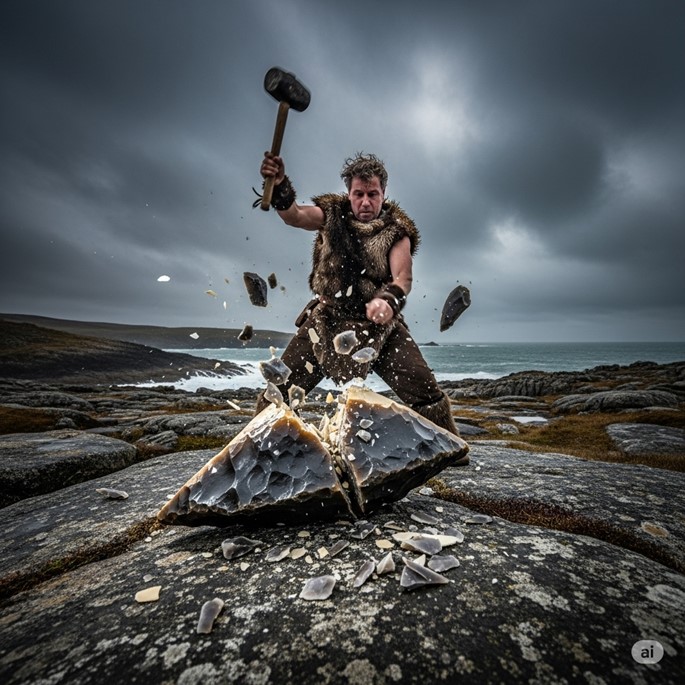
The magical power of Klagg is not a force that is controlled, but one that is released. Practitioners, known as Breakers, do not cast spells; they create moments of violent, creative destruction. By shattering stone with pure, primal instinct, they unleash a momentary burst of Klagg’s chaotic, world-shaping power. The effects are instantaneous, unpredictable, and often as dangerous to the wielder as they are to the enemy.
Defensive Applications: Clactonian defense is never passive. It is a violent, reactive, and often self-destructive art of using chaos to counter a threat in the immediate instant.
- The Shattering Parry: This is a desperate, last-ditch parry. Faced with an incoming sword or axe blow, a Breaker does not block. Instead, they smash a flint nodule with a heavy hammerstone at the exact point of impact. The resulting explosion of Klagg’s power and razor-sharp flint shards creates a point-blank shrapnel burst. This not only obliterates the incoming weapon and maims the attacker’s arm but often injures the Breaker as well. It is a defense that embodies the principle of mutual, chaotic destruction.
- The Flash of Unthinking Action: When surprised or ambushed, a Breaker can instinctively slam a stone against any hard surface. The momentary release of Klagg’s spirit grants them a split-second of pure, preternatural instinct. For that instant, their body reacts without conscious thought, allowing them to dodge an unseen arrow, leap away from a collapsing ceiling, or sidestep a hidden trap with impossible speed. It is not a shield, but a momentary gift of perfect, life-saving reaction.
- The Wall of Momentary Blades: To halt a charge or block a narrow passage, a Breaker can perform a grand shattering on a large boulder. With a single, mighty blow, they cause the boulder to explode outwards, not just crumble. For a few chaotic seconds, the air is filled with a swirling, impassable wall of razor-sharp stone fragments. While the barrier quickly settles into a simple pile of rubble, it is enough to shred the front rank of any force that tries to press through it.
- The Impulse of Unmaking: This is their defense against ordered magic. Faced with a complex spell, a Breaker releases a wave of pure, chaotic impulse by shattering a stone. This impulse does not counter the spell’s logic, but instead violently disrupts its intricate structure. The ordered magical weave is torn apart by the raw chaos, often deconstructing in a volatile blast of unpredictable energy that can harm the original caster and everyone in the immediate vicinity.
Offensive Applications: The offensive magic of a Breaker is the art of weaponizing the shrapnel, shockwaves, and pure violence of a sacred fracture.
- The Shrapnel Burst: The most common offensive tactic. A Breaker will hurl a brittle stone, like flint or obsidian, towards their enemies. While the stone is in mid-air, they will expertly strike it with a second rock from a sling. The mid-air collision causes the thrown stone to shatter, unleashing Klagg’s power as a devastating, explosive burst of shrapnel that tears through a wide area. It is inaccurate but brutally effective against groups.
- The Seed of Fracture: A Breaker can strike a solid object—a shield, a stone wall, a suit of armor—with a focused, ritualistic blow from their hammerstone. The blow itself may do little damage, but it imparts the “spirit of the fracture” into the target. A network of glowing, ephemeral cracks will spread from the point of impact for a moment. Seconds later, the object will violently shatter from within, as if it had been struck with a dozen hammers at once.
- The Gift of the Flake: In the instant of shattering a stone core, a Breaker who is perfectly in tune with their instinct can guide the trajectory of a single, ideal shard. Instead of flying randomly, one perfectly-formed, razor-sharp flake will shoot out from the impact with the speed and accuracy of a bullet. This “Gift of the Flake” is a single, deadly projectile, born from the sacred moment of breaking.
- The Thunder of the Break: A purely psychological and spiritual assault. By smashing two massive stones together with perfect timing and intent, a Breaker can release the pure, conceptual sound of Klagg’s birth. The resulting CRACK is not just a sound wave but a psychic shockwave. It bypasses the ears and strikes the minds of all who hear it, inflicting a moment of searing mental pain, vertigo, and a primal, instinctual panic, as if their own soul were momentarily shattering.
Fable of Builder and Breaker
It is told from the time before memory that the first people were two. The first man, Unnu was his name-sound. The first woman, who was Akka. They were placed upon the first island, which was a sharp and windy place.
Unnu’s mind was made of slow, heavy stones. His thoughts were to build, to make things that last. His plan was a heavy, slow rock. Akka’s mind was a flash of lightning in the rock. Her thoughts were to break, to find the sharp thing inside the dull thing. Her instinct was a sharp, fast shard.
And the world gave them a test. A Great Storm was coming. Its belly was black with rain and its voice was thunder. And in the storm’s shadow, a great beast hunted them. It was a cliff-cat, a furry anger with claws of obsidian.
Unnu saw the storm and the cat, and he began to build. He said, “We must have a house of stone. A permanent thing to keep out the storm and the cat. This is the wise plan.” He gathered large rocks. He piled them one on another. He built the wall. The wall was his plan. The plan was the wall. His work was slow, and he sweated. He saw Akka, and she was not helping. He said, “Woman, why do you not help? My plan is the only way to survive.”
Akka did not answer. She smelled the rain and the cat on the wind. She did not need a plan for tomorrow. She needed a tool for now. She went to the place of the flint stones. She took a heavy rock in her hand. And she began to break things. Crack. Crack. Smash. She was not building. She was making a mess. For every hundred shards she made, she kept only one. She kept the ones that were thin and razor-sharp. She laughed as she worked, a sharp sound like her stones. Unnu saw her and thought she was mad with fear.
The Great Storm came. The wind screamed. The rain was like thrown spears. The cliff-cat, its fur the color of wet slate, which is a sad color, came for them. Its eyes were hungry fires in the rain.
Unnu ran into his stone house. He was safe from the rain. But the cat was strong. It threw itself at the wall. The stones, which were heavy but not joined, began to fall. The wall, which was his plan, became his trap. The beast began to tear its way in. Unnu’s slow work was a folly.
Akka did not hide. The Moment of Breaking was upon her. When the cat came, she did not stand still. She was the wind. In her hands were the sharp shards of flint she had made. They were light. They were new. The beast lunged. Akka danced away. She was not strong enough to kill the beast. But her shards were sharp enough to teach it pain.
She slashed with a shard at its leg. The shard cut deep, and then she threw it away, for its moment was over. She took another. The beast roared and spun, but she was already gone. She darted in and cut its eye with another shard. The shard was a flash of lightning. Its purpose was one cut, and it was a perfect cut. The beast, now blind on one side and bleeding from many small wounds, became confused in its anger. It could not catch the woman who was a storm of small, sharp pains.
The fight was long. Akka used fifty of her shards. Each one made one cut, and then it was gone. Finally, the great beast, which could have crushed Unnu’s whole wall, fell from a thousand small wounds. It was dead.
The storm passed. The sun came out. Unnu crawled from the ruin of his permanent house. He saw the dead beast. He saw Akka, who was not harmed. He saw the ground, littered with the small, used, and now useless shards of flint. His heavy plan had failed. Her light, momentary tools had won.
Akka went to the ruin of Unnu’s wall. She picked up one of his heavy building stones. She struck it with another, and it shattered, and from the wreckage of his slow plan she pulled a new, sharp, and useful edge. Unnu saw this. And he understood.
Moral: A heavy plan is a trap. A permanent wall is a tomb. The only thing that will save you is the sharp edge you make in the moment you need it.