
This is the foundational religion of the Choukoutien people, a civilization that dwells almost entirely within a single, colossal, continent-spanning cave system. Their society is built around the principles of community, shelter, and the sacred duty of tending the fire. Theirs is a faith born in darkness and centered on the light that holds the cold and chaos at bay.
Lore: Choukoutien oral history does not speak of an arrival on a sunlit land, but of an awakening in a vast, cold, and absolute darkness. Their ancestors were not people then, but a formless, terrified mass of shivering souls, lost and alone in an infinite, subterranean night. They had no memory, no bodies, and no hope.
In the deepest, most central cavern of this eternal darkness, a single, impossible spark appeared. It did not explode or rage, but kindled into a gentle, steady, and constant flame. This was the birth of their deity, Zhuo-Ran, the First Flame. The flame did not consume; it gave. As the lost souls drifted towards its warmth, the light gave them form and substance, solidifying them into the first people. The warmth gave them consciousness, and the shared light gave them community as they saw each other for the first time. They huddled around Zhuo-Ran, their fear of the dark held back by its gentle glow.
The core belief of the Choukoutien is that their physical forms, their consciousness, and their community are all conditional gifts from the fire. They believe that every sacred hearth-fire in their vast cavern-nation is a direct, living descendant of that First Flame, passed down from generation to generation. As long as the fires are tended and the lineage is unbroken, their people will endure. If the last sacred fire were ever to go out, they believe they would all dissolve back into formless, shivering spirits, lost once more to the eternal dark.
Deity: Zhuo-Ran, the First Flame
- Personality: Zhuo-Ran’s personality is that of a perfect hearth-fire. It is profoundly nurturing, protective, and constant. It provides warmth against the cold, light against the darkness, and a center around which a community can gather. It is a quiet and domestic deity. However, it is also demanding. The fire does not burn on its own; it must be fed, tended, and respected. It requires constant devotion and effort to maintain. If neglected, it dwindles, weakens, and will eventually die out. Zhuo-Ran is not a god that issues commandments or judges morality; its pleasure or displeasure is shown in the health of the fire itself. A bright, steady, generous flame is a sign of a pious and functional home. A sputtering, smoky, or dying fire is a sign of neglect and a community in peril.
- Traits and Characteristics: Zhuo-Ran is never depicted in any anthropomorphic form, as to give it a finite shape would be to misunderstand its nature. The deity is the fire. Every consecrated hearth-fire within the Choukoutien Caverns is considered a literal, physical piece of Zhuo-Ran’s body. There is no one central temple; the entire nation, with its millions of hearths, is the temple. Priests of the faith, known as Fire-Tenders, are not shamans or mystics but are masters of history and genealogy, tasked with the sacred duty of preserving the lineage of the sacred fires, ensuring that embers from an old fire are the ones to light a new one. The god “speaks” through the crackle and pop of burning wood, the colors of the flames, and most importantly, the dancing shadows it casts upon the cave walls, which are believed to be the spirits of the ancestors watching over their descendants.
Attributes: Zhuo-Ran’s divine portfolio is focused on the core elements of survival, community, and continuity.
- Fire and Hearth: The primary attribute. The deity is the source of all warmth, light, and the sacred center of the home.
- Community and Kinship: The hearth-fire is the force that draws people together, turning a collection of individuals into a family, a clan, and a nation.
- Shelter and Safety: The light and heat of the fire are a divine ward, keeping the physical cold, the subterranean predators, and the spiritual darkness at bay.
- Memory and Ancestors: The fire’s light reveals the shadows of the ancestors on the cave walls, and the stories told around it become part of the clan’s eternal memory. Cooking food over the flame is a sacred act of consuming the fire’s strength.
- Endurance and Continuity: The most important attribute. The faith is centered on the sacred duty to keep the fire from ever going out, thus ensuring the perpetual continuity of the Choukoutien people.
Symbols
- The Burning Ember: A stylized shape of a glowing ember, often with lines of heat radiating from it. It represents the living, divine spark that exists in every hearth. Amulets of this shape, carved from amber or reddish stone, are commonly worn.
- The Ring of Stones: A simple circle of unworked stones. This is the symbol of the hearth, the home, the community, and the boundary between the safe, fire-lit world and the great darkness beyond.
- The Dancing Shadow: A stylized, elongated human-like shadow. This represents the ever-present spirits of the ancestors, who are made visible only by the light of Zhuo-Ran.
- Charred Bone: A piece of animal bone, ritually blackened in a sacred fire but not consumed. It represents sustenance made possible by the fire (cooked food) and the memory of a life given to sustain the community.
Tags: Deity, Religion, Lawful Neutral, Fire, Hearth, Community, Shelter, Ancestors, Endurance, Light, Darkness, Primal, Domestic, Vigilance, Subterranean, Continuity, Warmth, Shadow, Kinship, Ember, Nurturing
Positives: The greatest strength of the Choukoutien faith is the unbreakable sense of community and security it provides. The entire society revolves around the shared, sacred duty of tending the hearth-fires, which fosters a culture of extreme cooperation, altruism, and social cohesion. Kinship bonds are paramount, and every individual has a clear and vital purpose within the clan. This creates a deeply stable and psychologically secure environment, free from the existential anxieties and rampant individualism that can plague surface cultures. Their subterranean nation is a near-impregnable fortress; generations of living in the darkness have made them masters of their environment, while any potential invader would be hopelessly lost in the lightless, labyrinthine tunnels. The constant presence of the hearth-fire provides not just physical warmth and safety, but a powerful, comforting spiritual anchor against the vast, silent darkness they call home.
Negatives: The insular nature of the Choukoutien faith is its most significant drawback. Generations of living underground has bred a profound agoraphobia and xenophobia. The surface world, or “Great Un-Cave,” is a place of terror, and outsiders are viewed with deep suspicion, seen as carriers of the chaos and unknown dangers of the open sky. This has led to extreme technological and social stagnation. With no external pressures and a culture focused entirely on the singular task of maintaining fire, there has been little drive to develop new technologies, philosophies, or social structures. Their entire existence is also balanced on a single point of failure: the fire. Their belief that they will spiritually dissolve if the fires go out makes them psychologically vulnerable. A magical phenomenon that could extinguish flames on a mass scale or a disease that wiped out their primary fuel source would not just be a physical catastrophe, but an existential crisis that could cause a complete societal collapse.
Type of Temple: The followers of Zhuo-Ran have no temples in the traditional sense of a building for worship, because every single family hearth is considered a living, sacred piece of their deity. The true temple is the home. However, there is one location that is the most sacred site in their entire subterranean nation: The First Hearth. This is not a man-made structure, but the specific, vast, and heavily guarded cavern where the First Flame is said to have originally appeared.
This cavern is the spiritual nucleus of the Choukoutien people. In its center burns a fire that has, according to their history, never been extinguished since the dawn of their race. It is tended by the highest order of Fire-Tenders and is the source from which all other sacred hearth-fires are descended. The walls of the cavern are kept bare and unadorned, as they believe the flickering shadows cast by the First Flame are the most ancient and powerful of their ancestors. Access to the First Hearth is forbidden to all but the most senior Fire-Tenders. For the average citizen, their own hearth is their church, altar, and the center of their spiritual life. The First Hearth’s importance lies in its role as the original, unifying source of all the individual fires that provide life and light to the nation.
Number of Followers: The Choukoutien civilization, hidden from the eyes of the surface world, has grown undisturbed for millennia within its vast, continent-spanning network of caverns. Their stable, secure, and cooperative society has allowed for slow but steady population growth over an immense period of time.
They are a hidden nation of astonishing size. The population of the Choukoutien Hegemony is estimated to be approximately 46,880,000 souls. Not everyone are followers but the followers are spread across thousands of interconnected cavern-cities and settlements, subsisting on vast subterranean fungus farms, blind cave fish, and domesticated underground fauna. To the wider world of Saṃsāra, the existence of a subterranean nation of this magnitude is the subject of myth and wild speculation. The few surface dwellers who have stumbled upon their outer tunnels and returned speak of endless darkness and fleeting glimpses of firelight, but the true number and power of the Choukoutien people remain a deeply buried secret.
What Believers Believe: The followers of the Way of the Enduring Flame believe that their very existence—their physical bodies, their consciousness, and their community—is a conditional gift from their deity, Zhuo-Ran, the First Flame. Their creation myth teaches that they were once formless, bodiless spirits shivering in an eternal, subterranean darkness. The appearance of the First Flame gave them substance and light, drawing them together and forging them into a people. Their core tenet is that this process is not irreversible; if the sacred fires were to be extinguished, they would dissolve back into that primal state of chaos and fear.
They believe that every hearth-fire within their vast cavern-nation is a living, breathing descendant of the original First Flame, connected by an unbroken chain of embers passed down through thousands of generations. To light a fire from a “wild” source is a grave transgression, as it creates a fire without a divine lineage. The great, unlit darkness that surrounds them is not empty space but a representation of the ever-present chaos they escaped. The fire is their shield against this physical and spiritual oblivion.
The spirits of their ancestors are not in a distant afterlife but are present in every home. They believe the dancing shadows cast by the hearth-fire are the literal manifestations of their ancestors, silently watching over and protecting their living kin. The fire’s light is what gives these ancestral spirits form and presence. Therefore, to honor the ancestors, one must honor the fire.
Regular Services: Religious services for the Choukoutien people are not grand, public spectacles but intimate, domestic, and communal rituals centered on the hearth.
The most fundamental practice is the Daily Rekindling. Each evening, the head of the household leads the family in a quiet ritual to bank their hearth-fire, carefully covering the precious, living embers with ash to keep them alive through the “sleeping” hours. Each morning, the family gathers again as the embers are uncovered and gently blown back into a full, bright flame for the new day. This twice-daily act is a constant reaffirmation of the family’s devotion and a prayer for continuity.
The most important communal service is the Sharing of Embers. This ritual occurs whenever a new home is established or a new family is joined. It is a great celebration where a formal procession, led by a Fire-Tender priest, travels to the clan chief’s central hearth. A single, sacred ember is taken from this fire, placed within a ceremonial lantern, and carried with reverence to the new dwelling. The entire clan witnesses as the new hearth is lit from this ancestral ember, thus formally weaving the new home into the unbroken, divine lineage of the First Flame.
Other services are less formal and consist of Storytelling Vigils. On special occasions, the clan will gather around the great hearth of the chieftain, and the elders will recount the epic histories of their people, from the coming of the First Flame to the deeds of their greatest ancestors. The flickering shadows on the cavern walls are seen as the ancestors themselves, gathered to listen and bear witness to their own legacy.
Funeral Rites: The Choukoutien funeral rite is known as the Return to the Shadow. It is a solemn ceremony focused on the belief that death is a transformation, not an end. The rite facilitates the separation of the body from the spirit, returning each to its proper place.
When a person dies, their family’s hearth-fire is respectfully allowed to burn down over the course of a day, a process that mirrors the fading of life. The family does not feed it new fuel but watches over it as it slowly consumes its last resources. The final, single glowing ember is considered to be the “soul-spark” of the deceased, the essence of their warmth and life. A Fire-Tender is summoned to carefully retrieve this ember and place it within a small, sealed clay vessel.
A procession carries the shrouded body and the soul-ember to a designated burial chasm deep within the earth. Here, the body is committed to the great darkness, returning its physical substance to the silent stone. The procession then returns not to their own home, but to the clan’s central hearth. With great ceremony, the Fire-Tender opens the clay vessel and places the deceased’s soul-ember into this larger, communal fire. As the small ember is consumed and its energy becomes one with the great flame, it is believed that the individual’s spirit has now been released to join the collective “great shadow” of the ancestors. From that day forward, the family will see the familiar shadow of their loved one dancing on the walls of their own home, no longer a living participant, but a silent, eternal guardian.
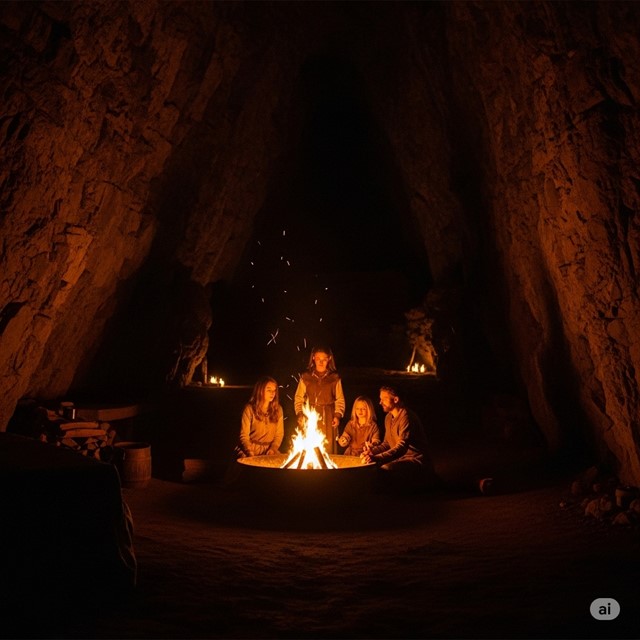
The magical power of Zhuo-Ran is drawn directly from a living, sacred hearth-fire. A practitioner, or Fire-Tender, does not wield personal power but acts as a supplicant who coaxes or directs the inherent properties of their divine fire. The strength of their magic is dependent on the health and age of the fire they are tending, and their power diminishes rapidly as they move away from its light. Their magic is a duality of light and warmth, and the darkness and shadows that this light creates.
Defensive Applications: Choukoutien defensive magic is centered on the hearth’s primary functions: providing light, warmth, and a safe boundary against the dark.
- The Wall of Blinding Light: By feeding a specially consecrated log or a large offering of precious amber into their hearth, a Fire-Tender can beseech the fire for protection. The flame will then erupt into a wall of solid, searing light. This barrier is intensely hot, burning any physical creature that tries to pass through it, and its brilliant glare is magically blinding to creatures of the dark, forcing them to recoil.
- The Ancestors’ Mantle: A practitioner can appeal to the ancestral spirits that dwell within the fire’s shadows. By standing between the fire and those they wish to protect, they can cause the shadows on the cavern walls to “thicken,” detach, and flow around their allies. This Mantle of Shadows muffles sound and renders those within it nearly invisible in the gloom, a perfect camouflage for hiding from intruders or repositioning within the cavern.
- The Circle of Unwavering Kin: This is a powerful communal ward. The Fire-Tender adds sacred herbs and dried fungi to the fire, causing it to emit a deep, resonant hum and a wave of profound warmth that spreads throughout the entire cavern chamber. All clan members within this Circle of Warmth are suffused with a sense of courage, belonging, and unwavering morale, making them resistant to magical effects that cause fear or despair. It also provides a supernatural protection from both natural and magical cold.
- Reading the Coals of Warning: This is a form of defensive divination. A Fire-Tender can enter a trance while staring deep into the glowing embers of a well-established hearth. By interpreting the shifting shapes and patterns in the coals, they can receive symbolic warnings of impending danger, such as the form of a subterranean beast that is approaching their territory or the sigil of a hostile surface-dweller, allowing the clan time to prepare its defenses.
Offensive Applications: The offensive capabilities of the faith are extensions of the fire’s destructive power and the menacing nature of the darkness it creates.
- The Lash of Embers: A Fire-Tender can use a ritual iron poker to pull a stream of glowing embers and superheated ash directly from the heart of the fire. With a sharp incantation, they can then hurl this lash at a foe. It is not a singular fireball, but a clinging spray of burning matter that sticks to its target, continuing to smolder and burn long after impact.
- The Treachery of Shadow: In any area lit by their sacred fire, a Fire-Tender can command the shadows. They can cause an enemy’s own shadow to animate and turn against them, elongating into a dark tendril that trips and ensnares their feet. They can also command the larger shadows of the cavern to coalesce into grasping, shadowy claws that can choke, hold, and terrify their opponents.
- The Choking Cloud: By throwing a pouch of specific powdered minerals (like sulfur and dried mosses) into the hearth, a practitioner can cause the fire to belch forth a massive, thick cloud of acrid, blinding soot. This cloud immediately extinguishes all non-sacred light sources within it and is spiritually chilling, causing fear and disorientation in any who are not part of the clan. It is a powerful tool for controlling a battlefield and routing intruders.
- The Curse of the Fading Ember: This is a slow and terrible curse, requiring a great sacrifice, such as a rare, petrified log. The Fire-Tender retrieves a single, perfect ember from the sacrificial fire and performs a ritual to link it to a target’s life force. This “soul-ember” is then placed in a sealed clay vessel where it is starved of air. Over the course of days, as the ember slowly cools and dies, the victim’s own vitality and “inner fire” fade with it, leaving them weak, cold, and eventually lifeless.
Kael and Last Ember
It is told that during the time of the Great Cold, there was a clan that lived in a far and lonely cavern. Their fire was a very old one, its lineage tied to the First Flame by a thousand grandmothers. The Fire-Tender of this clan was an old woman, whose face was like a dried mushroom, and whose wisdom was deep. She had an apprentice, a young man named Kael, and his pride was a loud noise in a quiet cave.
And so it was that the Great Cold came. It was not a normal cold. It was a cold with magic in it. It crept down from the rock itself, and the moisture on the walls froze into shapes like pale, grasping fingers. The beasts of the deep dark, their hunger made sharp by the cold, grew bold and howled at the edge of the firelight. The clan’s pile of dried fungus and ancient wood grew small. The great hearth-fire, the very soul of the clan, began to shrink. It was a fearful time.
The old Fire-Tender taught the people the ways of endurance. She said, “We will feed the fire less, but with more care. We will huddle closer. The fire is old and knows how to survive. We must trust its deep heat, not its high flames.”
But Kael, in his youth, thought he knew a better way. His pride said that a bigger fire, a brighter fire, would make the clan strong and drive back the cold. He had found, in a damp passage, a new kind of moss. When touched, this moss glowed with a cold, blue-green light, the color of a dead fish’s eye. He thought, “This is a fuel of great power. Its light is brighter than the fire’s light. I will feed it to the flame and make a great torch of our hearth.”
One night, during his watch, while the old woman slept, he did his foolish act. He took a great armful of the glowing moss and cast it onto the sacred fire.
The fire did not roar. It did not grow. The fire ate the bad moss and became sick. There was a great flash of cold, blue light that made everyone cry out. The light was beautiful and terrible, but it had no warmth. The sacred, orange flame of their hearth sputtered, choked on the pretty poison, and with a sound like a sad sigh, it went out. The fire was out. The true fire was out.
For the first time in the memory of any living person, the cavern was dark. Only the sickly, cold glow of the dying moss remained. A great cry of terror went up from the clan. They could feel the substance of their bodies thinning, their spirits growing cold. From the entrance of the cavern, they heard the scratching and snarling of the beasts. The darkness now had many teeth.
The old Fire-Tender awoke. She looked at the dead hearth and at the weeping, pride-broken Kael. She did not strike him. The disaster was too complete for simple anger. She said, with a voice as quiet as falling ash, “The Unbroken Chain is now broken. The one who broke it must be the one to re-forge it.”
She went to a small niche in the wall and brought out a clay vessel, sealed with wax. She broke the seal. Inside, nestled in soft moss, was a single, faintly glowing ember. “This is the Last Ember,” she said. “The final breath of our fire, which my grandmother’s grandmother sealed away for a day such as this. It will be cold in one day’s time. You must take it, Kael who was careless, and run. You must run to the cavern of the Stone-Hand clan, which is a two-day journey in the light. In the dark, it is a journey through your own grave. You must beg them for a living coal from their hearth to marry with this one. Go. Be the legs of our people.”
Kael took the vessel. His shame was a heavy stone in his gut. He ran out into the great, black dark. The journey was a thing of terror. Unseen things with many legs scuttled away from his footsteps. He heard the heavy breathing of the great beasts hunting him in the dark. He held the clay vessel to his own chest, trying to warm the Last Ember with the heat of his own body, a heat that felt like it was failing. He did not sleep. He did not stop. He ran until his legs were bloodied on the sharp stones.
At long last, he saw a faint, orange glow ahead. It was the light of the Stone-Hand clan. He stumbled into their cavern, a wild-eyed ghost, and collapsed before their great hearth. He presented the vessel with the Last Ember, which was now just a dull, grey spark. He told them of his pride, and his failure, and his clan’s doom.
The Fire-Tender of the Stone-Hand clan looked at him, and at the dying spark. And because the law of kinship is stronger than the law of pride, he did not turn Kael away. He took a living, breathing coal from his own fire and placed it in the vessel with Kael’s dying ember. The two met. And the Last Ember, fed by a brother-flame, glowed bright once more.
Kael did not rest. He took the rescued fire and ran back through the darkness. But now he was not just a running boy; he was a Fire-Tender, a man with a sacred duty. He was the light in the darkness. He reached his home cavern just as the great beasts were breaking down the clan’s weak barriers. He did not hesitate. He ran to the dead hearth, cast the living ember upon the ashes and the last of their true fuel, and he blew upon it with all the breath in his body.
And the fire, born again from the Unbroken Chain, roared to life. It cast out a great wave of heat and light. The beasts, screaming at the sudden, true light, fled back into the darkness. The clan was saved. And Kael, who had been a boy of loud pride, was now a man of quiet vigilance, and he tended the fire for the rest of his days, never forgetting its true nature.
Moral: A clever new light is not the same as a true and ancient warmth. The fire is not in the bright flash, but in the unbroken chain.