
The predominant race of the island nation of Capsian is a hardy and agile people known as the Sal-Vyr. Their unique physiology is perfectly suited to the rugged landscapes of their homeland, and their cultural identity is deeply intertwined with their physical form. The ruling matrilineal monarchy of Capsian is composed of Sal-Vyr, and their physical traits are often seen as the embodiment of the nation’s strength and resilience.
Species
The Sal-Vyr are a unique species of sentient beings native to the island continent of Capsian. The name “Sal-Vyr” is derived from their own language, Sal-Kwe, and roughly translates to “the Chisel-Folk” or “the Skilled People,” a reference to their culture’s deep connection to craftsmanship and the act of carving their existence from the world. They are the most populous race in Capsian, forming the vast majority of the nation’s 37,664,000 citizens.
Physical Form and Sensory Traits
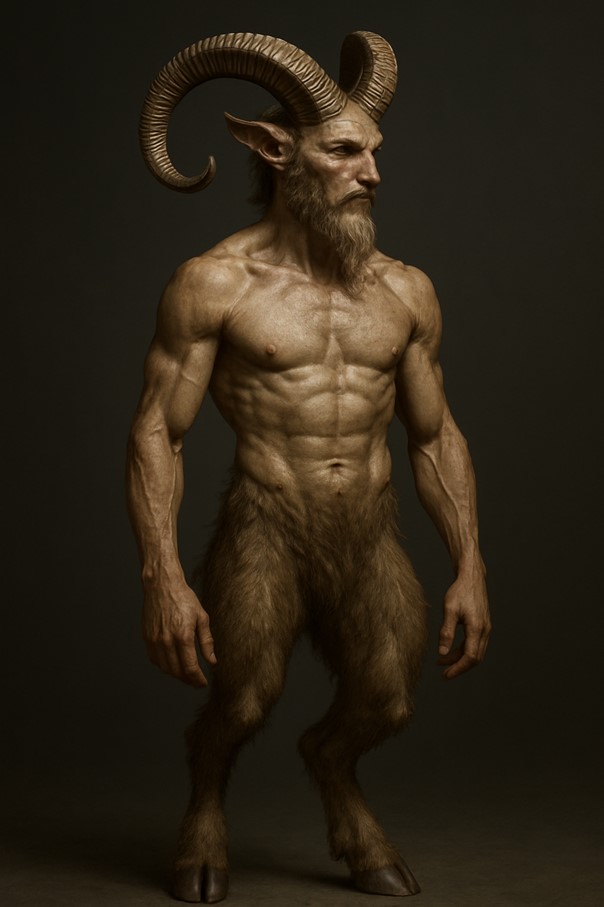
The Sal-Vyr possess a striking physical form that blends humanoid and caprine features. Their upper bodies—including the torso, arms, and head—are humanoid in shape and proportion. Their lower bodies, from the waist down, are distinctly goat-like, with powerful, digitigrade legs covered in short, coarse fur that ends in hard, cloven hooves. This unique anatomy grants them an incredible sense of balance and agility.
Their heads are adorned with a pair of horns that grow in a wide variety of shapes and sizes, including tight spirals, long sweeping curves, and thick, ridged arcs. These horns are a primary indicator of individuality and are often meticulously cared for, carved, polished, or fitted with precious materials.
The sensory traits of the Sal-Vyr are honed by their environment.
- Vision: They possess sharp eyesight, adept at spotting subtle movements across the vast grasslands of the interior or the glittering expanse of the sea.
- Hearing: Their hearing is acute, capable of discerning the direction of faint sounds echoing through the deep canyons or the subtle creak of a ship’s rigging.
- Balance: Perhaps their most exceptional trait is a preternatural sense of balance, centered in their inner ear and coordinated with their powerful leg muscles. This allows them to navigate treacherous cliff faces, narrow ledges, and the pitching decks of ships with uncanny ease.
General Size
Sal-Vyr are generally shorter and more compact than a typical human but are significantly denser due to their powerful musculature and solid leg bones. An adult Sal-Vyr typically stands between 4’10” and 5’8″ (147 cm to 173 cm) tall. Their weight is proportionally heavy for their height, usually ranging from 150 to 240 pounds (68 to 109 kg), with much of that mass concentrated in their powerful legs.
Body Pattern
The fur on their lower bodies ranges in color from creams and tans that match the dry grasslands, to grays and charcoals that blend with the coastal rock, to deep browns and blacks. The patterns are usually solid, though dappled or spotted patterns are not unheard of, particularly among specific family lines.
Their primary form of physical distinction and cultural expression comes from their horns. Horns vary immensely in texture, color, and shape. Some are smooth and dark like obsidian, while others are chalky and ridged like ancient limestone. It is a vital cultural practice for the Sal-Vyr to adorn their horns. They are often inscribed with intricate Kwe-Chisel script, inlaid with shell or precious stones, or fitted with rings of magically-attuned metals. The horn adornments of an individual tell a story of their lineage, accomplishments, and profession.
Life Cycle
The Sal-Vyr life cycle adheres to the fundamental principles of Saṃsāra. A newborn Sal-Vyr, or a kid, is born mundane and without access to magic. Their hooves and horns are soft and cartilaginous at birth, hardening over the first few years of life. A significant part of their childhood is spent in compulsory education, where they learn to walk, run, and climb on their unique legs while also being taught Sal-Kwe, history, and a craft. Adulthood is reached at the onset of reproductive capability, which is also when the individual gains the ability to use magic through the attunement of gear. A Sal-Vyr’s average lifespan is around 120 years, their robust bodies enduring the hardships of their rugged environment well into old age.
Potential Positives and Negatives Due to Their Physical Form
Positives:
- Unmatched Mobility: Their hooved legs and innate balance make them exceptional climbers and leapers, able to traverse rocky terrain, mountains, and canyons that would be impassable to others.
- Natural Defense: Their hard hooves can deliver powerful kicks, and their horns can be used to parry or gore in close-quarters combat.
- Stability: Their low center of gravity and splayed hooves make them incredibly stable on their feet, able to stand firm against strong winds on cliff edges or the lurching of a ship in a storm.
Negatives:
- Aquatic Awkwardness: The density of their legs and their body structure make them poor natural swimmers. This is a significant disadvantage for a culture so tied to the sea, and it has driven them to become master shipbuilders and innovators of magical navigation to compensate.
- Stealth Difficulty: Their hard hooves are loud on stone or wood floors, making stealth a challenging skill to master without magical assistance.
- Limited Footwear: They cannot wear traditional boots or shoes, relying on the natural durability of their hooves or specially crafted hoof-plates for protection in hazardous environments.
Tags: Sal-Vyr, Hooved, Horned, Caprine, Agile, Climber, Capsian, Artisan, Coastal, Nomadic, Self-reliant, Pragmatic, Resilient, Inscriber, Matrilineal, Storyteller, Monarchy
Specialized Item Slots Available
The unique physiology of the Sal-Vyr provides them with two specialized slots for magical gear, which are central to their use of magic and their cultural expression.
- Horn Mounts: The horns are considered a primary gear slot. Sal-Vyr can fit their horns with carved rings, inscribed metal plates, or socketed gems. These items often function as magical foci, mnemonic aids for complex Kwe-Sal chants, or conduits for channeling personal power into their crafting.
- Hoof Plates (Sabots): These are masterfully crafted plates made of metal, stone, or dense shell that can be fitted to their hooves. These plates can be enchanted or inscribed with runes for various effects, such as silencing their steps, providing traction on ice, increasing kicking power, or leaving temporary magical traces on the ground.
Environmental Adaptability
The Sal-Vyr are perfectly adapted to the primary environments of Capsian. Their physiology allows them to thrive in the island nation’s vertical and rugged landscapes, from the great interior mesas to the jagged coastlines. They are naturally resilient to the harsh sun of the inland plains and the salty spray of the coast. Their cultural adaptations, such as their mastery of shipbuilding and weather-magic, have allowed them to overcome their physical limitations regarding the sea, turning a potential weakness into a source of national strength and innovation.
Other Information Important to This Race
As the predominant race and ruling lineage of Capsian, Sal-Vyr culture is synonymous with the nation’s culture. Their physical ability to climb and stand firm in treacherous places is a powerful metaphor for their philosophy of self-determination and resilience. The act of “climbing” is a common theme in their stories and art, representing social mobility, the acquisition of skill, and the creation of a lasting legacy. Their architecture often forgoes stairs in favor of steep, textured ramps and multi-level open-air structures that play to their climbing strengths. Their very being reinforces the core Capsian belief: that one must be strong and sure-footed to carve a worthy story into the great canvas of the world.
Unadorned Horns and Great Carving
And it was in the Age of Salt-Sting, when the sky held its breath for many seasons, that the rule of the Sal-Vyr was given to the Queen Elara. The line of her mother was long and etched with glory upon the Great Galleries, but Elara’s spirit carried a heavy stone. For her horns, which should have been her pride and the testament of her lineage, were small and without the noble curve. They were plain points, like those of a yearling kid, and the high-born of the coastal cities named her in their private whispers the Horn-Shamed One. Her story, they murmured, was a faded one before it had been truly told.
In this time of the Queen’s doubt, the world itself grew restless. It is said in the telling that the great ocean, which is the border of all things, took umbrage with the land. The reason for its anger is not written clearly; some say it was the sigh of a sleeping monster on the seabed, others a punishment for a promise made and then lost to memory. What is known is that the water began to climb. It did not come as a single wave of violence, but as a slow, inexorable rising, a tide that did not fall back. Day by day it consumed the low shores, and the salt of its breath poisoned the fields near the coast.
The Sal-Vyr of the great stone city Kwe-Sar came before the Queen with fear in their voices. Their leader was a man of great pragmatism, Borin Stone-Hand, whose own horns were thick as ancient trees and carved with the geometric patterns of a master engineer. He made a showing of his plans, which were lines on flattened hide, a story of rock defeating water.
“Great Queen,” his voice was a deep sound, like stones grinding. “We must make a mark of defiance. We will build a Great Wall, a seaward fortification so vast it will tell the ocean that this land has been claimed and its story is not finished. It is a story of hard things, a story of will.”
And many of the coastal folk struck their hooves on the stone floor in agreement, for this was their way: to build, to carve, to make a statement of permanence against the chaos.
Then came the delegations from the inland plains, the nomadic clans who walked the path of the Etched World. Their speaker was Varna Ochre-Palm, a shaman whose face was a map of many seasons and whose horns, though slender, were painted with the symbols of a hundred epic hunts. She made a different showing, of sacred dusts and pigments held in tortoise shells.
“Queen of the Unwritten,” she began, and her voice was like the wind that whispers through canyons. “A wall is a silent word, and the ocean does not hear it. You cannot command the water, for its story is older than ours. We must not defy it, but persuade it. We must go to the Gallery of the Sky-Tooth and paint a new chapter. We will paint the story of the water’s retreat. We will tell the tale of the tide’s apology with such truth that Taziri, who is the Great Canvas, will make it real.”
And the inland clans chanted their assent, for this was their way: to define, to tell, to shape reality not with brute force but with the power of a story told with conviction.
The Queen Elara was caught between the hard place and the painted place. Her council was divided, and her people looked upon her small horns and saw not a ruler, but a question. That night, she went to her chambers and looked upon her reflection in a polished shield. She saw the horns of a child, unadorned and without a story. And a thought came to her, not from her mind, but from the deep spirit of her people. The problem was not the horn, but the story she had yet to write. She understood then that the arguments of her people were two halves of a single truth.
She called for both Borin Stone-Hand and Varna Ochre-Palm. To them she spoke, and her voice was no longer small. “The Man of Measured Rock wishes to make a mark of stone. The Teller of Faded Pictures wishes to make a mark of story. Both will be done. We will not build a wall to block the water. We will carve a new path for it. And we will not only paint a story of retreat. We will paint the story of our own great work.”
She led them not to the coast, nor to the inland galleries, but to the Dragon’s Spine, the great mountain range that divided the two regions. She pointed to the highest peak, a terrible and unclimbable spire where no Sal-Vyr had ever stood. “There,” she said. “From that peak, we will carve a great channel, a new riverbed down the far side of the mountains, to the great desert basin that thirsts. We will give the rising water a new place to go. The work of carving the stone will be the physical mark. The story of the carving, painted as we do it, will be the magical mark. The deed and the telling will be one.”
It was a thing thought impossible. The peak was sheer, the work immense. But the Queen’s conviction was a new thing, a fire in her. She was the first to begin the ascent. Her small horns were no hindrance. Her Sal-Vyr feet, made for climbing, found purchase where none seemed to exist. With feet of sureness, she climbed. With hands of purpose, she climbed. Inspired, her people followed. The stone-workers of the coast brought their enchanted chisels. The storytellers of the plains brought their sacred paints.
As Borin’s people began the great, thundering work of carving the mountain, Varna’s people painted the story of their labor onto the nearby cliffs in real-time. They painted the heroic figures of the masons. They painted the Queen, small-horned but resolute, directing the work. They painted the great channel deepening with every strike of the chisel. And as the two works progressed as one, the magic took hold. The stone yielded more easily. The workers felt a strength not their own.
When at last the great channel was cut, a vast scar of purpose upon the mountain, the Queen herself struck the final blow that opened the way to the sea. The rising ocean, given this new path, poured into the channel, its anger turned to purpose. It flowed down the mountain, becoming a new river, and filled the great desert basin, turning a wasteland into a vast inland sea. The coastal lands were saved.
When Elara descended, her people looked at her. Her horns were unchanged, still small, still plain. But they no longer saw a Horn-Shamed One. They saw the Queen of the Great Carving, whose mark was not an adornment on her head, but a river that had remade the world. She had not been given a great story by her ancestors; she had forged one that was entirely her own.
Moral: Thus it is known that the horn is but the place for the story, and not the story itself. A great mark is measured by its depth on the world, not by its height on the head.