
Species The Karthian are a species of draconic avatars who form the predominant race and ruling class of the island nation of Archaic. They are deeply connected to the island’s foundational elements—stone, root, and memory—and their physical form is a reflection of the enduring, ancient nature of their homeland. They are the primary group who identify as the Vryn-Kar, and their oldest ancestral lines are said to have witnessed the first stones being laid for the island’s most ancient ruins. Their identity is one of stewardship and resilience, believing their role is to safeguard the historical and magical integrity of Archaic for all time.
Physical Form A Karthian avatar is a humanoid of impressive stature, possessing a powerful build covered in a contiguous coat of fine, durable scales that resemble natural stone, wood, or minerals. Their heads are distinctly draconic, with strong jawlines, pronounced brow ridges, and a variety of crests or horns that grow in patterns resembling gnarled tree roots, crystalline formations, or weathered stone ridges. Their hands are strong, ending in thick, tough claws that are not sharp enough for combat without being honed but are exceptionally suited for carving wood and stone. They possess sturdy, non-prehensile tails, thick at the base and tapering to a point, which are used primarily for balance. Unlike other draconic beings of myth, they possess no innate breath weapon; any such ability must be generated through gear, typically steam-powered alchemical devices fitted to the face.
Sensory Traits The Karthian have sensory capabilities uniquely adapted to their environment and culture.
- Vision: Their vision is sharp, and their eyes, which often have slit pupils, are protected by a transparent nictitating membrane. This membrane shields the eyes from the dust of ancient ruins, the spray of alchemical reagents, or the wood shavings from their craftwork.
- Hearing: Their hearing is attuned to low-frequency sounds, allowing them to perceive subtle earth tremors, the deep hum of active ley lines, or the groaning of ancient trees.
- Taste/Scent: A Karthian’s most unique sense is tied to their forked tongue. By tasting the air, they can perceive the faint resonance of ambient magic, the lingering aura on enchanted artifacts, and the direction of powerful ley lines. This makes them natural explorers and restorers of magical sites.

Examples of Male and Female Karthian
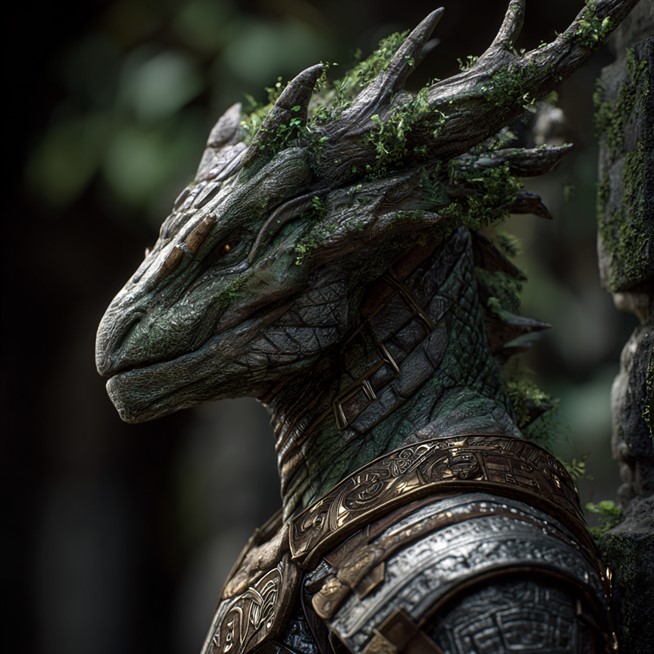
General Size Karthians are noticeably larger and heavier than the average human avatar. Adult males typically stand between 6 feet 6 inches and 7 feet 5 inches tall, while females are slightly shorter, ranging from 6 feet 2 inches to 7 feet. Their dense bone structure and powerful musculature give them a significant weight, with most adults weighing between 250 and 400 pounds. Their size and posture convey a sense of gravitas and stability, reflecting their cultural values.
Body Pattern The color and texture of a Karthian’s scales are inherited through their matrilineal line and are a source of great cultural significance. These patterns are purely aesthetic and do not grant any specific resistances. The primary patterns are:
- Stoneborn: Their scales have the color and texture of stone, such as mottled grey granite, dark volcanic basalt, or layered slate. These are the most common patterns among the Karthian populace.
- Root-Veined: These Karthians have scales that mimic the appearance of wood, such as the dark, hardened look of ironwood, the greyish tint of petrified wood, or the deep brown of ancient oak. These patterns are often seen among followers of Archaicism who work closely with the forests.
- Gem-Crested: A rarer pattern where the scales are a base stone color, but the horns, claws, and spinal crests grow with the color and translucent quality of minerals like deep green jade, cloudy quartz, or moss agate. The Royal Family of Archaic is exclusively of a Jade-Crested line, their appearance a living symbol of their right to rule.
Life Cycle Karthians hatch from large, thick-shelled eggs that resemble geological concretions or smooth, oversized river stones. A clutch typically contains one to three eggs. For the first several decades of their lives, young Karthians, known as Whelps, are considered mundane children, possessing no magical ability. During this time, they undergo compulsory education, learning Vryn-Syl, history, and the physical crafts of their people. Adulthood is reached upon reproductive maturity, which coincides with the ability to attune to and channel magic through worn gear. Karthians have a long lifespan, typically living for 250 to 300 years, a trait that makes them excellent historians, lore-keepers, and masters of patient crafts.
Potential Positives and Negatives (Physical Form)
- Positives: Their tough, scaly hide provides natural resilience against scrapes and minor impacts. Their strong, sturdy build is ideal for heavy labor and navigating rough terrain. Their claws serve as innate tools for their society’s preferred crafts, and their tail provides exceptional balance when climbing ruins or working on narrow platforms. Their imposing physical presence is an asset within Archaic’s social structure.
- Negatives: Their large size makes them cumbersome in spaces not designed for their stature. Their scales, while durable, are not as efficient at thermoregulation as skin, making them uncomfortable in environments with rapid or extreme temperature fluctuations without protective gear. Their appearance can be intimidating to other races, sometimes causing social friction when traveling abroad.
Tags: Draconic Avatar, Karthian, Scaled Humanoid, Stone-Scaled, Root-Horned, Jade-Crested, Ancient, Long-Lived, Resilient, Enduring, Guardian, Matrilineal, Vryn-Kar, Ruin Explorer, Steamcraft, Geomancy, Carver
Specialized Item Slots Available Due to their unique physiology, Karthians can utilize specialized gear that other races cannot.
- Muzzle Slot: Standard helmets do not fit their draconic heads. Instead, they use gear that fits over their snout and jaw. This can include armored faceplates, steam-powered respirators for hazardous environments, or devices that focus and project alchemical sprays.
- Crest Slot: Their head-crests and horns serve as a natural mounting point for specific items. This slot can hold magically attuned rune-stones, symbols of political office, or focusing crystals that amplify the power of other worn gear.
- Tail Slot: The tail can be fitted with its own gear, such as an armored sheath for protection, a weighted cap for enhanced balance, or a warding charm that hangs from the tip.
Environmental Adaptability Karthians are perfectly adapted to the varied environments of their island nation. Their strength and balance make them at home in the high-altitude canopy cities, the rugged mountains, and the deep subterranean burrows. They are less suited for open plains or barren deserts, and their difficulty with thermoregulation makes them vulnerable in intensely hot or frigid climates without specialized, often steam-powered, environmental suits.
Other Information Important to this Race As the predominant race of Archaic, the Karthian lifestyle defines the nation’s culture. Their long lives and patient nature have led to mastery in architecture, stonemasonry, and geomancy. The matrilineal structure of their society is paramount; lineage and inheritance are traced through the mother, and the strength and reputation of a matriarch directly influence the standing of her offspring. This social structure is reflected in the monarchy, with the Queen-Regent holding ultimate authority. The Karthian embody the enduring, historical, and resilient nature of their nation, seeing their physical form not as a sign of monstrous power, but as a living testament to their deep, unbreakable bond with the ancient world of Saṃsāra.
Jade Matriarch and Hasty Root
In the days when the canopies were younger threads in the great weaving, there held dominion a Matriarch of the Karthian people, Lyraxa of the Jade-Crested line. Her scales were the color of deep forest moss on slate, and the horns of her station grew as jade upon the ancient root-shape. Her heart, it was said, was a strong stone, and her gaze was long, as is the way of her people, who see the turning of many centuries.
In her time, a stillness came upon a great expanse of the forest. It was not the quiet of peace, but a deep quiet, a Root-Stasis, where the whispers of Vyrkan grew faint. The great trees, whose boughs held up the sky-cities, stood silent, their leaves unmoving even in the wind. The ley lines, which are the soul-veins of the world, pulsed thin and slow, and the steam-craft of the settlements in that region sputtered with weak breath. The people grew afraid, for a forest that does not speak is a forest that is forgetting itself. The Vryn-Kar came before their Matriarch, their faces etched with the lines of this worry.
The Rootwardens, whose skin was wrinkled as bark and whose wisdom was deep, counseled the long watch. They said, “The forest breathes slow. We must breathe with it. We must observe. To act without knowing the shape of the silence is to carve a rune upon shifting sand.” They spoke of seasons of listening, of placing hands upon the silent trunks to feel for the faintest pulse of the deity.
But Lyraxa saw the fear in her people, and the weight of her crown, which was her duty, was heavy. She was of a long-lived race, but the fear of mortals is a swift and sharp thing. In her strong stone heart, a seed of haste took root. She thought, “Am I not the Jade Matriarch? Is not the strength of the earth in my blood? Shall I stand idle while a part of our world turns to a silent stone?”
And so she turned from the counsel of the patient ones. She commanded the keepers of lore to unearth the forbidden weavings, the Syl-Vryn chants that were not for the waking world. They found the passage, its runes carved on a shard of petrified bone, that spoke of pulling the is from the was. It was a chant to force a memory of vitality, to make the forest remember its time of great growth and bring that time into the now. It was a dangerous weaving, a magic of pulling, not of nurturing. The lore keepers warned that the translation was old, the meaning a shadow.
In the great Rootshrine at the edge of the silent lands, Lyraxa gathered her most powerful chanters and her most skilled steam-crafters. The heart of the temple, a great altar of living, twisted roots, was connected by bronze tubes to steam engines that pulsed with magical fire and water. The plan was to use the steam to amplify the chant, to make its voice a great shout that the sleeping forest could not ignore.
The ritual began. The words of the ancient weaving were grit in the mouth, their intonation a perilous climb from a low earth-rumble to a pitch that threatened to crack the sky. Lyraxa led the chant, her voice the anchor, while the steam engines roared, their power feeding into great crystals that glowed with a fierce, unstable light. Through the steam that billowed from the vents, visions began to form. At first, they were of a green and vibrant past. The great trees grew in moments, their leaves bursting forth in a wave of impossible life. The assembled Karthian let out a great cry of hope.
But the root that is forced grows twisted. The memory they had pulled was not clean. It was a chaotic torrent, not a gentle stream. The visions soured. They saw not just growth, but a time of ancient pain the forest had long since buried—a great fire, a pestilence of insects, the terror of beasts long extinct. These spectral things did not fade. They bled from the steam into the world, phantom shapes of burning trees and panicked, ghostly creatures that shrieked with silent mouths. The Root-Stasis was not broken. Instead, where it had been, a true wound appeared in the world’s fabric, a place of utter void where the ley lines snapped and the very soil died. The silence became a scream of nothingness. Lyraxa’s haste had not healed the forest; it had forced it to remember its deepest trauma and made that trauma real again.
Humbled, her jade crest seeming to dim with her shame, Lyraxa fell to her knees. The spectral horrors faded as the ritual collapsed, leaving behind only the wounded land and the stench of burnt magic. For a year and a day, the Matriarch spoke no commands. She put aside her crown and her authority and went to the edge of the Wound, and there she sat in silent vigil. She listened, as the Rootwardens had first counseled. She listened to the nothingness.
Her people, seeing her humility, followed her way. They did not attempt another grand weaving. Instead, they began small acts of patience. A carver would find a fallen stone and spend a week etching a single, perfect rune of apology upon it. A steam-crafter would polish a single bronze fitting on a dead engine until it shone, an offering of care without expectation. A child would place a single, living seed at the edge of the desolation. They did this for many seasons, a long and slow penance of quiet work.
One dawn, after many years had passed, a Rootwarden saw a light in the center of the Wound. There, from the dead soil, a single sapling was rising. Its leaves were the color of the purest jade, and it glowed with a soft, steady light, pulsing with the slow, strong heartbeat of a healing world. The growth had returned, not by the pull of a queen, but by the patient turning of the wheel.
Moral of the story: The deepest strength is not found in pulling the root to the sky, but in the patience of waiting for its growth.