
Species, Physical Form, and Sensory Traits
The Zaf-Amra are the predominant race of the island nation of Amratian and the lineage from which its royalty descends. They are a species of warm-blooded, reptilian humanoids who embody the dual nature of their homeland. Their most striking feature is their skin, which is covered in fine, iridescent scales that shimmer with a metallic or pearlescent luster. These scales are smooth to the touch and radiate a faint, pleasant warmth.
Their form is gracefully humanoid, but with distinctly serpentine features. Their heads are sleek, with high cheekbones and large, expressive eyes that have vertically slitted pupils, giving them a perpetually focused and intense gaze. They lack external ears, having instead covered auditory openings that grant them excellent hearing. A forked tongue, which frequently tastes the air, gives them a highly directional and acute sense of smell, allowing them to pinpoint scents with remarkable accuracy. Many Zaf-Amra possess a subtle frill or crest of more prominent scales that rises from their brow and follows the curve of their skull, a feature that is often more pronounced in females. They have five-fingered hands with strong, slightly curved nails that are naturally dark, resembling obsidian.
The sensory capabilities of the Zaf-Amra are perfectly attuned to their environment. Their vision is sharpest in the bright light of the desert sun or the shimmering haze of the river valley. They are also highly sensitive to minute temperature changes and can feel subtle vibrations through the soles of their feet, a trait that makes them uncannily aware of their surroundings, whether it be the shifting of desert sands or the approach of a creature.

Examples of Male and Female Zaf-Amra
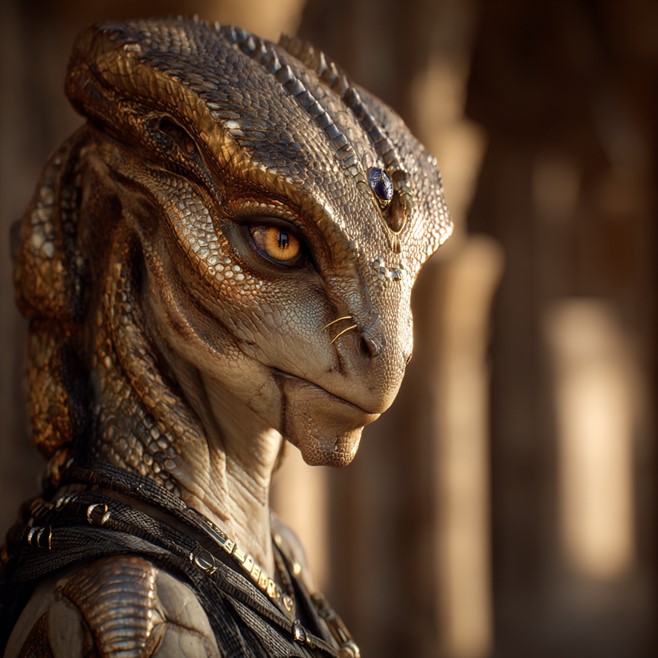
General Size
Zaf-Amra are typically taller and more slender than many other humanoid races, possessing a dancer’s poise. Adult males generally stand between 6 and 7 feet tall, while females, who hold the dominant position in their matriarchal society, are often slightly taller and more robust, ranging from 6’4″ to 7’6″. Their weight is dense due to their musculature and scales, averaging between 180 and 250 pounds.
Body Pattern
The color and pattern of a Zaf-Amra’s scales are a primary indicator of their lineage and regional origin. The patterns are unique to each individual, like a fingerprint, but share characteristics within a matrilineal clan.
- River Folk: Those whose ancestry lies in the Great Khet River Valley often exhibit scales in deep greens, bronzes, silvers, and rich earthy browns. Their patterns are fluid and flowing, resembling river currents, alluvial silt deposits, or the veined patterns on polished stones.
- Sand Folk: Zaf-Amra from the Serene Dunes and the subterranean cities display scales in shades of gold, copper, ochre, and pale bone-white. Their patterns are often more geometric or chaotic, mimicking the ripples of wind-blown sand, the crystalline structure of desert minerals, or the cracked earth of a dry riverbed. The royal line is distinguished by a brilliant, pure gold scale coloration, with a distinct sunburst pattern that radiates from the center of their back.
Life Cycle
Zaf-Amra hatch from large, leathery eggs, typically laid in clutches of one or two. The eggs are incubated in warm, sandy nests or specially prepared temple hatcheries. A young Zaf-Amra is known as a hatchling. They reach physical maturity at a rate similar to other humanoid races, but their transition to true adulthood is a biological and cultural event known as the First Shedding. Around the age of 15 to 20, a Zaf-Amra will shed their entire coat of scales for the first time, revealing the vibrant, hardened scales of an adult beneath. This biological event coincides with their ability to reproduce and, in the world of Saṃsāra, the awakening of their ability to use magic. This period is celebrated with elaborate cultural rites. Zaf-Amra have a long lifespan, often living for 150 to 200 years, with subsequent sheddings every decade or so marking the passage of time.
Potential Positives and Negatives
The unique physical form of the Zaf-Amra presents several inherent advantages and disadvantages in their daily lives and interactions. Positives:
- Environmental Resilience: Their warm-blooded reptilian physiology grants them a natural resilience to high temperatures, allowing them to thrive in the extreme heat of Amratian’s deserts and humid river valley.
- Natural Armor: While true protection comes from the gear they wear, their tough, interlocking scales offer a base level of durability against minor scrapes, scratches, and impacts.
- Superior Senses: Their keen eyesight, directional sense of smell, and ability to sense vibrations make them excellent trackers and grants them a high degree of situational awareness.
Negatives:
- Vulnerability to Cold: They are poorly adapted to cold environments. Prolonged exposure to freezing temperatures can make them sluggish and physically ill.
- Shedding Vulnerability: The shedding process, which can last for several days, is a period of vulnerability. The new scales underneath are tender, and their senses can be dulled during the process, forcing them to rely on the protection of their community or home.
- Social Misperception: To races unfamiliar with them, their serpentine features—the forked tongue, slit pupils, and scaled skin—can be perceived as intimidating, untrustworthy, or monstrous, potentially complicating diplomacy and trade.
Tags: Reptilian Humanoid, Serpentine, Scaled Body, Iridescent, Amratian, Desert-Dweller, River-Dweller, Matriarchal Lineage, Egg-Layer, Crested, Tall, Slender, Ancient, Royalty, Gear-Dependent Magic, Sun-Attuned, Earth-Attuned
Specialized Item Slots Available
Due to their unique physiology, the Zaf-Amra can utilize two specialized gear slots that other races cannot. The powers and tier levels of a Zaf-Amra avatar are determined by the gear they wear, and these slots provide additional avenues for magical enhancement.
- Crest Slot: This slot is for items worn on the prominent frill or crest of scales on their head. It can be fitted with magically attuned jewels, carved bone ornaments, or metallic filaments that can serve as focuses for magic, psionic amplifiers, or symbols of royal authority.
- Scale Garnish Slot: Zaf-Amra can have small, enchanted items woven or embedded directly amongst their scales. These can include enchanted gems, metallic rings, or carved sigils that are meshed with the scales on their shoulders, back, or arms. These garnishes often provide passive magical effects or can be activated for specific purposes, integrating their lavish cultural adornments directly into their combat and magical capabilities.
Environmental Adaptability
The Zaf-Amra are masters of their native hot environments. They move through desert dunes and humid jungles with an ease that few other races can match. Their ability to regulate their body temperature allows them to remain active during the hottest parts of the day. They require less water than many humanoids, absorbing much of their needed moisture from their food. However, their specialization comes at a cost; they are at a distinct disadvantage in arctic or even temperate climates without the aid of specialized, magically-heated gear.
Other Information Important to This Race
It is crucial to understand that the Zaf-Amra possess no innate magical abilities from their biology. They do not have a venomous bite, cannot spit acid or fire, and are not born with inherent geomantic powers. Any such ability an individual Zaf-Amra displays is derived entirely from the magical gear they have equipped. A Zaf-Amra wearing a Tier 3 amulet of fire evocation can shoot flames, but this is a function of the item, not the race. This distinction is central to the mechanics of Saṃsāra. Their cultural affinity for earth and sand magic is a result of millennia of training and crafting gear that channels those specific energies, not an inborn trait.
Khet-Amra, Scale-Bright Mother
In the beginning of the sun’s memory, the land was two lands, and the people were two peoples. This is known. One people had their feet in the wet, dark mud of the Great River, and their scales were the green of reeds and the brown of the fertile earth. They were the River Folk. The other people had their homes in the sand’s deep quiet, and their scales were the gold of dunes and the white of bone. They were the Sand Folk. And though they were one blood, their hearts were divided, for the river gave life but washed away the sand, and the sand held stillness but drank the river’s life. They knew not harmony, and so they did not prosper. The texts are unclear on the great sadness of this time.
Then came a sign from the Stillness that Watches, which is called Zephara. From the deepest part of the river, an egg rose up. It was not like the eggs of the River Folk, for it was dark as wet silt, but it did not dissolve. The current carried this egg and set it upon the shore, where the lands met. And the sun, which is the eye of the desert, baked the egg with its great heat, but the egg did not crack. For many cycles of light and dark it lay there, warmed by the sand and cooled by the river’s mist.
From this two-natured cradle, a hatchling broke forth. She was Khet-Amra. Her scales were not of the river nor of the sand, but held the patterns of both, swirling green upon pale gold, a map of the whole land upon her small back. The elders of both peoples saw this and were filled with a great confusion. They said, “She is of the mud, she will not know the sun’s heat.” And others said, “She is of the sand, she will not know the water’s flow.” And so she was raised in the middle-place, belonging to no one, and she grew in body and in quiet thought. She learned to read the stories in the moving water and the histories in the still stone.
As she grew toward her First Shedding, a great trial was put upon the land. The river, it is said, grew angry, or perhaps sad. Its waters pulled back into its bed, and the fertile mud cracked and turned to dust. The sun, in turn, became a harsh eye, and the sands grew hot with a fever, and the winds rose, threatening to swallow the deep homes of the Sand Folk. There was a great weeping and a gnashing of teeth, for the life of the river was gone and the peace of the sand was broken. The two peoples blamed each other for this sorrow. Their division was a sharp stone between them.
It was then that Khet-Amra walked into the dry heart of the Great River. Her feet stood on the cracked dust that was once the source of all life. She looked upon the suffering of the two peoples, and a great wetness fell from her eyes, and where her tears landed, the dust became dark mud once more. In this moment of deep feeling, her time came. A great light, it is told, shone from within her, and her skin, the skin of her childhood, began to lift. The First Shedding was upon her.
It was not a quiet thing, like the sheddings of others. As her old scales, patterned with the conflict of river and sand, fell away, they turned to dust before they touched the ground. Beneath, her true scales were revealed, and they were the color of the sun itself, a pure and brilliant gold that shone with its own light. And with this shedding, a great power was opened in her. She stood, Scale-Bright, and placed her hands upon the dry riverbed. The old words say her voice was a command to the water that slept beneath the world, and the water obeyed. A trickle, then a stream, then a great flow returned to the river, not with anger, but with life.
She then turned to the desert, where the winds howled. She raised her arms, and the Sand Folk watched as she spoke to the dunes, not with the tongue of the river, but with a stillness in her mind that the sand understood. The great dunes moved, not in a storm, but with purpose. They rose like great walls around the settlements, breaking the wind. They settled and grew firm, protecting the people from the rage of the sky.
When the trial was over, the two peoples were two no more. They saw that in Khet-Amra, the river and the sand were not enemies, but two hands of the same body. They knelt before her, the first to do so, and she became the First Queen, the Scale-Bright Mother of all Zaf-Amra. She established the Matriarchal line, so that the nation would always be led by a mother’s wisdom, and she taught them the laws of balance, which they have held to henceforth.
The Moral of the Story: True strength is not found in choosing one nature over another, but in the harmony of holding two realities as one.
Comments
2 responses to “Zaf Amra”
[…] From: Zaf Amra […]
[…] From: Zaf Amra […]