
The Apsarans are a majestic race of sentient avatars who embody the dual nature of their island home, Aegean. They are seen by many, and by themselves, as the chosen children of the deity Thalindra, representing the harmonious fusion of the stable land and the ever-changing sea. Their unique physical form allows them to thrive in the diverse environments of the archipelago, from the bustling port cities on the shore to the serene, magically-sustained metropolises beneath the waves. As the predominant race of Aegean and the lineage of its ruling monarchy, the Apsarans are central to the nation’s culture, industry, and spiritual life.
Physical Form and Sensory Traits
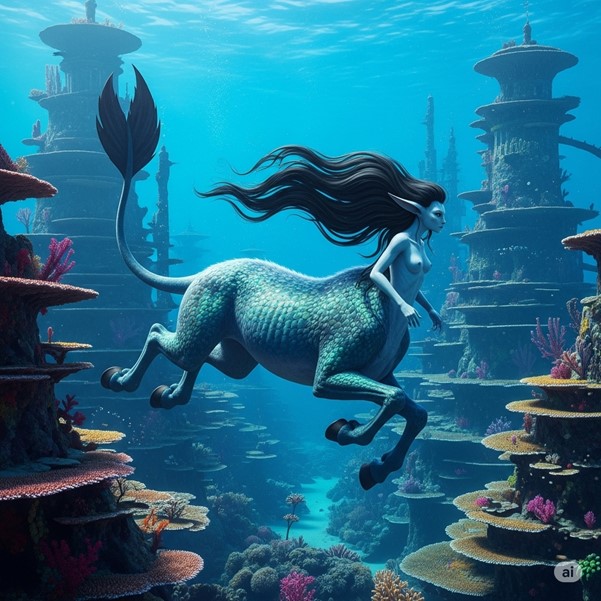
An Apsaran possesses a remarkable composite physique. Their upper body is humanoid, lithe and statuesque, with features that often reflect the diverse multiversal origins of their ancestral souls. This torso, which houses their heart and lungs, rises seamlessly from a powerful, quadrupedal lower body. This lower form is not purely equine; it is a masterful adaptation for an amphibious life, reminiscent of a sleek aquatic mammal like a seal or otter, but with the powerful musculature of a steed.
Their lower body is covered in a short, dense, and water-repellent coat of fur that shimmers with an oily iridescence. Instead of solid hooves, they possess broad, cloven hooves that are semi-webbed, providing excellent traction on wet sand and slick ship decks while also acting as small fins for maneuvering in water. Their most striking feature is a long, powerful tail, flattened vertically like a cetacean’s fluke, which serves as their primary means of propulsion when swimming, allowing for bursts of incredible speed.
Their sensory traits are finely tuned for their environment. They have exceptional vision, with many possessing a transparent nictitating membrane that protects their eyes from saltwater spray and allows for clear sight underwater. Their hearing is acute in both air and water, and their advanced inner-ear structure grants them an impeccable sense of balance, making them sure-footed even on the deck of a ship tossing in a storm.
General Size and Body Pattern
Apsarans are physically imposing, standing significantly larger than most bipedal avatars.
- Average Height (ground to head): 7 to 8.5 feet (approximately 2.1 to 2.6 meters).
- Average Length (chest to rump): 6 to 7 feet (approximately 1.8 to 2.1 meters).
- Average Weight: 1,200 to 1,800 pounds (approximately 540 to 815 kilograms).
The patterns and colors of their lower-body coats are a source of cultural pride and a marker of lineage. These patterns are passed down through the matrilineal line and often mimic the natural beauty of Aegean. Common patterns include the dappled light of sun on a shallow seabed, the deep blues and greens of the open ocean, the pearlescent white of seafoam, or the sandy tan of a coastline. The ruling royal family is known for a distinctive coat of pure, shimmering silver-white, said to reflect the light of the moon on a calm sea.
Life Cycle
Apsarans are born live after a gestation period of nearly twelve months. Young Apsarans, often called calves, are non-magical and can walk and swim clumsily within hours of birth. In accordance with Aegean law, they receive compulsory education, learning Thal-Vox, Aque-Script, history, and the theoretical principles of magic. Adulthood is reached upon achieving reproductive capability, typically between the ages of 16 and 20. It is at this moment that their connection to the ambient magic of Saṃsāra awakens, allowing them to attune to and use magical gear. Apsarans have a natural lifespan that is slightly longer than a human’s, typically living for 120 to 150 years.
Potential Positives and Negatives of Physical Form
Positives:
- Amphibious Mastery: They are unparalleled swimmers, capable of navigating both surface waters and the depths with grace and speed. They are equally at home on land.
- Stability and Power: Their four-legged stance provides exceptional stability, making them difficult to knock down. Their powerful lower bodies grant them great strength for carrying heavy loads and delivering devastating charges or kicks.
- Speed: On open ground, they can achieve impressive speeds, rivaling the fastest land-based mounts.
Negatives:
- Spatial Limitations: Their size and shape make them ill-suited for environments designed for smaller, bipedal races. They have great difficulty with narrow corridors, tight stairwells, and small rooms.
- Vertical Challenges: They are extremely poor climbers. Navigating sheer cliffs or even simple ladders is nearly impossible without magical assistance. Ramps are a common architectural feature in Apsaran-dominated cities.
- Larger Target: Their significant mass makes them an easier target to hit in combat situations.
Tags: Apsaran, Amphibious, Quadrupedal, Maritime, Aquatic Mammal, Fluked Tail, Webbed Hooves, Iridescent Fur, Aegean, Coastal Dweller, Underwater Cities, Matrilineal Society, Ruling Race, Thalindra’s Chosen, Hydromancy, Aeromancy, Seafaring Culture
Specialized Item Slots Available
Due to their unique anatomy, Apsarans can utilize specialized gear that other avatars cannot, providing more avenues for magical enhancement.
- Barding (1 slot): This is armor specifically forged for their lower quadrupedal body. It can range from lightweight leather to full, ornate plates of magical alloy, often lavishly decorated with cultural motifs.
- Hoofguards (4 slots): Instead of boots, Apsarans wear magical plates or bindings on each of their four hooves. These can be enchanted to enhance speed, provide traction on any surface (like ice or sheer walls), allow for water-walking, or silence their movements.
- Tail Fin (1 slot): A cap, blade, or rudder-like attachment for their tail fluke. This gear can be enchanted to drastically increase swimming speed, improve agility underwater, or even be used as a weapon.
- Harness/Saddle (1 slot): While not typically ridden, Apsarans wear ornate harnesses or saddle-like frameworks. This gear serves as a major focus for powerful enchantments, a place to mount additional equipment, or a way to display the intricate Aque-Script of their family lineage.
Environmental Adaptability
Apsarans are perfectly adapted to the varied environments of the Aegean nation. They move effortlessly along coastlines, through the surf, and in the open ocean. They are well-suited to the wide avenues of the nation’s megacities and the spacious platforms of its levitating islands. However, they would be at a significant disadvantage in dense, old-growth forests, narrow subterranean dungeons, or the precarious mountain peaks of other nations.
Other Important Information
As the ruling and predominant race of Aegean, Apsarans are at the heart of the nation’s political and spiritual life. They are seen as living proof of the correctness of Aegeanism, perfectly blending the different aspects of Thalindra’s domain. Their matrilineal society means that a foal’s clan and status are determined entirely by its mother. The ornate gear they wear is a status symbol and a practical necessity, often costing a fortune and glowing with the magical energies of the powerful enchantments woven into it. An Apsaran monarch in full ceremonial barding, with enchanted hoofguards and a glowing tail fin, is a sight of breathtaking power and beauty, the very image of their vibrant and powerful culture.
Weaving of the Wave-Riders
And it was in the time before time, when the memory of the world was but a soft mud, the First Folk came to the shores. These were the souls, the avatars, who fell from the star-sea onto the great island, which was not yet named Aegean. The ground did not love them. It was a hard ground, a ground of angry shaking things, the Land-Shakers, who made the rocks dance and fall. The sky did not love them. It was a sky of wet anger, a sky of great Sky-Roarers, who threw down water-fists and wind-spears. The First Folk, with their two legs so weak, could not stand on the shifting land and could not hide from the roaring sky. They lived in fear at the edge of the great water.
Among them was a woman of the First Folk, and her name, as the runes are read, was Lyra. Her mind was different. While others looked at the land for holes to hide in, she looked at the sea. She watched the strong creatures of the land, how their four legs gave them a great hold on the angry ground. She watched the swift creatures of the water, how their tails pushed them through the great water-fists without harm. The people cried to the sky and cursed the ground, but Lyra went to the edge of the water, where the foam was like the lace on a queen’s dress, and she spoke to the spirit within. She spoke to the Great Tide-Mother, she who is now called Thalindra.
Her words were not of begging. The old telling says her words were a bargain. She said, “Oh, spirit deep and wide, we are broken between your water and the hard land. We are a people of two legs, and it is not enough. We have hands that make, but feet that fail. Give us the footing of the land-beast, which does not fall. Give us the tail of the sea-creature, which does not drown. Make us a people of the shore, not afraid of either side.”
And it was so. The Great Tide-Mother heard the bargain in Lyra’s heart. A mind-picture, a vision of wet light, was given to her. In the picture, the two-legged form was bent and broken and joined with a new shape. A shape of four legs, strong and true, and a great tail, like a rudder. The spirit’s voice was not of words, but of feeling, and the feeling said: To hold the shore, you must become the shore. Be the land. Be the sea. Be woven.
Lyra understood the picture-thought. She turned to the First Folk, her people, and spoke of the bargain. Many were afraid. They looked at their two legs and could not imagine more. They looked at their bodies and feared the change. But some, the brave and the desperate, whose hearts trusted Lyra’s, agreed to the weaving. They followed her as the tide pulled back, far back, leaving the wet sand shivering. Together, they walked into the great water.
The sea rose to meet them. It was not the water of the Sky-Roarers, full of anger. It was a water of magic, a water of making. The tide came, a great green and blue wave of power, and it took them. In the churning, in the great weaving of the water, their bodies were unmade and remade. Their two legs were drawn down and back, melding and growing into a new form, a strong quadrupedal shape of mighty muscle and bone. Their feet became broad and cloven, and between the parts, a skin grew, like the foot of a duck, to press upon the water. From their spines, a long tail grew, ending in a fluke of great power. They were First Folk no more. They were the first Apsarans, the Wave-Riders.
They came out of the water not walking, but striding with a power they had never known. Their four hooves held them fast to the sand. They felt the land’s strength in their bones. They felt the sea’s grace in their tails.
Then came the test. The Land-Shakers felt the new people and grew angry. The ground began its terrible dance. But the Apsarans, with their four wide-set hooves, stood firm. They did not fall. The Sky-Roarers saw them and sent a great storm. But the Apsarans, led by Lyra, charged into the surf. The water-fists crashed, but their new bodies cut through the waves. Their powerful tails drove them forward, faster than the storm’s pull. They were at home in the chaos. They were strong on the land. And they were strong in the sea. Strong in two places, they were.
They drove the fear from the shores of Aegean. Lyra, first of the remade, became the first Tide-Queen, and her line, through her daughters and their daughters, has ruled since. The Apsarans, born of a bargain with the sea, became the guardians of the coast, the masters of the tide, and the heart of the great nation.
The moral of the story is: To conquer the challenges that stand between two worlds, one must not choose a side, but have the courage to become the bridge.
Comments
3 responses to “Apsarans”
[…] From: Apsarans […]
[…] From: Apsarans […]
[…] From: Apsarans […]