
Lore: In the rugged, cliff-laden landscapes of Abbeville, a sprawling island nation of 155,200,000 acres in Saṃsāra’s northern seas, the religion of Abbevillianism has thrived for over 4,000 years. The faith traces its origins to the First Carving, an event etched in oral tradition when Gravok, the Shaper of Stone and Soul, descended from the ethereal mists to sculpt the first avatars from the island’s primordial granite. These early avatars, known as the Stoneborn, were gifted with the ability to shape stone with their minds, a practice that became the cornerstone of Abbevillian culture. Gravok taught them to harness the island’s magical ley lines, which pulse like veins beneath the earth, to fuel their creations and sustain their communities.
Abbevillianism teaches that all souls are fragments of Gravok’s essence, scattered across the multiverse and drawn to Saṃsāra upon death. The deity’s purpose is to guide these souls toward unity through the act of creation, whether by crafting stone, forging tools, or shaping one’s own destiny. Temples, called Forges of Gravok, are built into cliffsides or deep quarries, where priests known as Stoneweavers conduct rituals involving the carving of intricate statues and the channeling of magical energy into stone constructs. These constructs, ranging from simple tools to towering golems, are believed to house fragments of Gravok’s will, serving as protectors and laborers for Abbevillian communities.
The religion emphasizes resilience, patience, and the pursuit of perfection through iterative creation. Abbevillians believe that life is a process of refining one’s soul, much like chiseling raw stone into a masterpiece. The faith is not dogmatic but adaptive, incorporating Isekai avatars who bring foreign ideas, provided they align with Gravok’s principles of creation and endurance. Festivals, such as the Great Carving, see communities gather to sculpt massive communal artworks, powered by steam-driven chisels and magical circuits, which are then animated to dance across the cliffs under the moonlight.
Gravok’s influence extends to Abbeville’s industrial prowess. The island’s steam-powered forges, driven by elemental fire and water magic, produce tools and constructs traded across Saṃsāra’s 73 island nations. However, the faith warns against hubris, recounting the Fall of Kharzad, a legendary city that defied Gravok by crafting a golem too perfect, which gained sentience and razed the city before crumbling into dust. This cautionary tale underscores the balance between ambition and humility central to Abbevillianism.
Personality of Gravok: Gravok is a patient, contemplative deity with a deep, resonant presence that feels like the hum of the earth itself. They are neither wrathful nor benevolent but pragmatic, viewing existence as a grand workshop where souls are raw materials to be shaped. Gravok communicates through visions of stone and fire, often appearing as a colossal figure of molten granite with glowing eyes, their voice echoing like a hammer on an anvil. They value perseverance and ingenuity, rewarding those who endure hardship to create lasting works. However, Gravok is unforgiving of wastefulness or destruction without purpose, withdrawing their favor from those who shatter stone or souls carelessly.
Gravok’s demeanor is steady but not unyielding. They encourage adaptation, much like stone that bends under pressure to form new shapes. In myths, Gravok is depicted as a teacher who challenges avatars with trials, such as carving a perfect sphere from flawed stone, to reveal their inner strength. They are distant yet omnipresent, their essence felt in every rock and quarry, making Abbevillians feel watched and guided in their daily labors.
Traits
- Resilient: Gravok embodies the endurance of stone, unyielding to time or calamity.
- Creative: The deity inspires innovation in crafting, from tools to golems, as acts of worship.
- Pragmatic: Gravok values function over form, prioritizing works that serve a purpose.
- Patient: The deity operates on geological timescales, teaching avatars to plan and persist.
- Judgmental: Gravok weighs the intent behind every creation, favoring those with pure motives.
Characteristics
- Domain: Creation, stone, endurance, crafting, industry.
- Alignment: Lawful Neutral, reflecting Gravok’s focus on order and purpose without moral bias.
- Favored Magic: Earth-based magic, particularly geomancy and alchemy, used to shape stone and metal.
- Sacred Element: Earth, with secondary ties to fire (for forging) and water (for steam).
- Manifestation: Gravok appears as a towering figure of molten granite, wreathed in steam, or as a subtle vibration in the earth.
Attributes
- Strength: Immense, capable of reshaping mountains or splitting continents.
- Perception: Acute, sensing the intent and potential within every soul and stone.
- Intellect: Vast, with knowledge of all crafting techniques across the multiverse.
- Agility: Low, as Gravok moves deliberately, like shifting tectonic plates.
- Charisma: Subtle but commanding, inspiring awe through presence rather than words.
Symbols
- Chisel and Hammer: The primary symbol, representing the tools of creation and worn as pendants by devotees.
- Granite Spiral: A carved spiral of granite, symbolizing the eternal cycle of creation and refinement.
- Golem Heart: A glowing crystal embedded in stone constructs, believed to house Gravok’s essence.
- Steam Wreath: A circular pattern of steam vents, etched into temple floors, symbolizing the fusion of elemental magic.
- Broken Anvil: A reminder of humility, referencing the Fall of Kharzad, often placed at temple entrances.
Tags: High Magic, Steampunk, Geomancy, Creation, Endurance, Stonecraft, Industrial, Isekai Integration, Communal Worship, Ritual Carving, Craftsmanship, Resilience, Alchemy, Stoneweaving, Community, Industrial Magic, Endurance Trials, Golem Creation
Positives of Abbevillianism
- Cultural Unity: Abbevillianism fosters strong communal bonds through shared rituals like the Great Carving, where entire communities collaborate to create massive stone artworks. This strengthens social cohesion across Abbeville’s diverse population, including Isekai avatars from various multiversal origins.
- Industrial Advancement: The religion’s emphasis on steam-powered crafting and geomancy has propelled Abbeville into a hub of industrial innovation. Magical circuits and steam-driven forges produce high-quality tools, constructs, and trade goods, boosting the island’s economy and influence across Saṃsāra’s 73 island nations.
- Resilience and Endurance: The faith instills a mindset of perseverance, teaching followers to endure hardships and refine their skills over time. This philosophy equips avatars with mental and physical fortitude, valuable in Saṃsāra’s challenging environments.
- Creative Expression: Worship through crafting allows followers to express individuality while honoring Gravok. From intricate jewelry to towering golems, the act of creation is both spiritual and practical, encouraging innovation and artistry.
- Adaptability to Isekai Avatars: Abbevillianism integrates foreign souls seamlessly, valuing their diverse skills and perspectives as long as they align with Gravok’s principles. This inclusivity strengthens the religion’s appeal in a world populated by multiversal immigrants.
- Environmental Harmony: The use of elemental fire and water magic to generate steam ensures that Abbeville’s industrial processes are environmentally sustainable, aligning with Saṃsāra’s magical ecosystem and minimizing ecological harm.
- Protective Constructs: The golems and animated stone constructs created through Abbevillian rituals serve as guardians and laborers, enhancing the safety and productivity of communities, particularly in remote or hazardous regions.
Negatives of Abbevillianism
- Rigidity in Doctrine: The faith’s focus on purpose and function can stifle unconventional creativity, as creations deemed wasteful or purposeless risk Gravok’s disapproval, potentially discouraging experimental artistry.
- Resource Intensity: The reliance on stone, magical circuits, and steam-powered forges requires significant natural resources, straining Abbeville’s quarries and ley lines, which can lead to localized depletion if not carefully managed.
- Social Pressure: The communal nature of rituals like the Great Carving can pressure individuals to conform, leaving little room for those who prefer solitary worship or lack crafting skills, potentially alienating some avatars.
- Risk of Hubris: The cautionary tale of Kharzad’s fall highlights the danger of overambition. Followers who push the boundaries of creation too far risk catastrophic failures, such as rogue golems or divine retribution, fostering a culture of caution that may limit bold innovation.
- Labor-Intensive Worship: The act of carving and crafting as worship demands significant time and physical effort, which can be exhausting for followers, particularly those in demanding professions or with limited magical aptitude.
- Isolationist Tendencies: While inclusive of Isekai avatars, some Abbevillian communities prioritize their own traditions, leading to occasional friction with other island nations or faiths that view their stone-centric focus as insular or overly pragmatic.
- Judgmental Oversight: Gravok’s constant evaluation of intent and purpose can create a sense of being perpetually watched, causing anxiety among followers who fear their creations or motives may not meet divine standards.
Type of Temple: Abbevillian temples, known as Forges of Gravok, are architectural marvels carved directly into the cliffsides, quarries, or mountains of Abbeville, reflecting the religion’s connection to stone and earth. These temples are both places of worship and functional workshops, blending spiritual and industrial purposes. A typical Forge of Gravok features the following:
- Structure: Built into natural rock formations, with vast chambers hollowed out by geomancy and reinforced with magical circuits. The exterior often appears as a sheer cliff face with subtle carvings of chisels, hammers, and granite spirals, while interiors are cavernous, illuminated by glowing crystals and steam vents.
- Central Feature: A massive stone altar, often a monolithic slab etched with spiral patterns, serves as the focal point for rituals. Surrounding it are steam-powered forges and anvils where Stoneweavers craft offerings or animate golems.
- Magical Integration: Ley lines beneath the temple channel magical energy to power steam-driven tools and animate stone constructs. These lines are mapped and maintained by priests to ensure a steady flow of magic.
- Workshops and Galleries: Adjacent chambers house workshops for communal crafting and galleries displaying intricate stone sculptures, from small figurines to towering statues, as offerings to Gravok.
- Steam Wreath Vents: Circular patterns of steam vents are embedded in the temple floors, releasing controlled bursts of steam during rituals to symbolize the fusion of elemental magic and Gravok’s presence.
- Accessibility: Forges are designed for communal access, with wide ramps and pulley systems (powered by steam and magic) to transport heavy stone materials. Some temples feature elevated platforms for airship or griffon landings, facilitating trade and pilgrimage.
- Variations: Coastal Forges incorporate tidal pools for water-based magic, while mountain Forges use volcanic heat for fire-based rituals. Smaller shrines, called Anvil Groves, are scattered across villages, consisting of simple stone altars surrounded by carved boulders.
Number of Followers: Abbevillianism is the dominant religion on the island nation of Abbeville, which spans 155,200,000 acres and supports a population of approximately 31,040,000 avatars, based on proportional estimates derived from Saṃsāra’s total population of 7 billion across 183 billion acres. Of these, roughly 40% of Abbeville’s population, or 12,416,000 avatars, actively practice Abbevillianism. This estimate accounts for the religion’s deep cultural integration and the presence of Isekai avatars who may follow other faiths or remain unaffiliated. Beyond Abbeville, small pockets of devotees exist in other island nations, particularly among traders and crafters, adding an estimated 5 million followers. Thus, Abbevillianism has approximately 17,416,000 followers across Saṃsāra.
The religion’s influence is concentrated in Abbeville’s major cities, such as the cliffside metropolis of Granthold, which houses the Grand Forge of Gravok, a temple-city with over 10,000 resident Stoneweavers. Rural areas and smaller islands maintain simpler Anvil Groves, ensuring widespread access to worship. The faith’s appeal to Isekai avatars with crafting backgrounds sustains its growth, though its stone-centric focus limits its spread compared to more universal faiths in Saṃsāra.
Beliefs of Abbevillianism
Abbevillianism teaches that all existence is a process of shaping and refining, guided by Gravok, the Shaper of Stone and Soul. The core beliefs of its followers are as follows:
- Souls as Fragments of Gravok: Every avatar’s soul is a shard of Gravok’s divine essence, drawn from the multiverse to Saṃsāra upon death. Life on Saṃsāra is a journey to refine this essence through creation, akin to chiseling raw stone into a perfected form. The ultimate goal is to achieve unity with Gravok by crafting a soul worthy of merging with the deity’s eternal consciousness.
- Creation as Worship: Crafting, whether of stone, metal, or personal destiny, is the primary act of devotion. Every act of creation, from forging tools to sculpting golems, is a prayer to Gravok, reflecting the deity’s role as the ultimate artisan. Creations must serve a purpose, as wasteful or frivolous works risk divine disapproval.
- Cycle of Refinement: Life is an iterative process, much like carving stone. Failures are opportunities to learn, and each lifetime refines the soul further. Reincarnation, a natural phenomenon in Saṃsāra, is seen as Gravok granting another chance to perfect one’s craft.
- Balance of Ambition and Humility: The cautionary tale of Kharzad, where a prideful city created a sentient golem that destroyed itself, underscores the need for humility. Followers believe Gravok judges creations by their intent and utility, rewarding those who balance ambition with respect for the deity’s limits.
- Harmony with the Earth: Abbevillians view Saṃsāra’s ley lines and stone as sacred, pulsing with Gravok’s energy. Harvesting resources must be done sustainably to maintain the world’s magical balance, as depletion angers Gravok and weakens the land’s vitality.
- Integration of Isekai Souls: Isekai avatars, arriving from diverse worlds, are welcomed as bearers of new perspectives. Their memories and skills are seen as gifts from Gravok, meant to enrich Abbeville’s craft and culture, provided they honor the deity’s principles.
- Endurance as Virtue: Patience and resilience are sacred, reflecting the enduring nature of stone. Followers are taught to persevere through trials, believing Gravok tests them to reveal their inner strength, much like pressure shapes a diamond.
- Communal Responsibility: The faith emphasizes collective effort, with communities working together on grand projects like the Great Carving. Individual success is tied to the group’s prosperity, as all souls are interconnected fragments of Gravok.
Regular Services
Regular services in Abbevillianism, known as Forgings, are held weekly in the Forges of Gravok, the cliffside temples carved into Abbeville’s rocky landscape. These services blend spiritual worship with practical crafting, reflecting the religion’s focus on creation. The structure and atmosphere of a typical Forging are as follows:
- Setting: Services take place in the cavernous chambers of a Forge of Gravok, illuminated by glowing crystals embedded in the walls and warmed by steam vents arranged in sacred spiral patterns. The central stone altar, etched with granite spirals, is surrounded by steam-powered forges and anvils where priests, known as Stoneweavers, lead the congregation.
- Participants: All Abbevillians, from skilled artisans to novice crafters, attend, bringing their own tools or materials. Isekai avatars are encouraged to participate, contributing unique techniques from their past worlds. Attendance ranges from dozens in rural Anvil Groves to thousands in urban temples like Granthold’s Grand Forge.
- Ritual Structure:
- Opening Chant: The service begins with a resonant chant, mimicking the sound of hammer on anvil, led by a Stoneweaver. The chant invokes Gravok’s presence, asking for guidance in shaping stone and soul.
- Communal Crafting: Congregants work on a shared project, such as carving a statue, forging tools, or assembling a small golem. Materials are provided by the temple, and magical circuits channel ley line energy to power steam-driven tools. Novices may polish stones, while experts shape intricate designs.
- Stoneweaving Ritual: A Stoneweaver channels geomancy to animate a communal creation, such as a stone bird or miniature golem, which moves briefly to signify Gravok’s approval. The ritual involves focusing the congregation’s collective “Mind’s Eye” to infuse the creation with magical intent.
- Teaching of the Chisel: A Stoneweaver recites a parable or lesson from Abbevillian lore, often drawn from the First Carving or the Fall of Kharzad, emphasizing themes of patience, purpose, or humility. Isekai avatars may share relevant stories from their past lives, integrated into the sermon.
- Steam Offering: The service concludes with a release of steam from the temple’s vents, forming a wreath-like pattern. Congregants place small stone tokens, inscribed with personal intentions, on the altar, believed to carry their prayers to Gravok through the steam.
- Duration and Frequency: Forgings last 2–3 hours, held every seventh day to align with the rhythm of Abbeville’s ley lines. Major festivals, like the Great Carving, replace regular services with multi-day events involving competitive crafting and golem races.
- Atmosphere: The mood is reverent yet industrious, filled with the clank of tools, the hiss of steam, and the hum of magical energy. Participation is active, with no passive observation, reflecting the belief that worship is work.
- Variations: In coastal Forges, water-based magic enhances rituals, with tidal pools used to temper creations. Mountain temples incorporate volcanic heat, while rural Anvil Groves host simpler services focused on small-scale carving.
Funeral Rites
Funeral rites in Abbevillianism, known as the Final Shaping, are solemn ceremonies that honor the deceased’s soul as it prepares for reincarnation or potential unity with Gravok. These rites reflect the faith’s belief in the soul as a work in progress, returning to Saṃsāra until perfected. The process is as follows:
- Preparation of the Body: The deceased is cleaned and wrapped in linen inscribed with granite spiral patterns, symbolizing the soul’s eternal cycle. The body is placed on a stone bier within a Forge of Gravok or Anvil Grove, surrounded by offerings of tools or unfinished carvings from the deceased’s life.
- Soul Carving Ritual: The core of the rite involves crafting a Soul Stone, a small, polished granite orb inscribed with the deceased’s name and notable deeds. Family and friends contribute to the carving, using steam-powered chisels or hand tools, guided by a Stoneweaver. The process is believed to imprint the soul’s essence onto the stone, preserving its progress for the next life.
- Geomantic Infusion: The Stoneweaver channels ley line energy to infuse the Soul Stone with magic, glowing faintly to signify Gravok’s acceptance. If the deceased was particularly devout, the stone may be animated briefly, moving as if alive, seen as a sign of the soul’s readiness for reincarnation.
- Interment in the Earth: The body is not buried but dissolved using geomancy, returning its physical essence to Saṃsāra’s ley lines. The Soul Stone is placed in a communal Stone Vault, a subterranean chamber beneath the temple, where thousands of stones are stored as a collective offering to Gravok. In rural areas, stones are embedded in cliff faces or sacred boulders.
- Steam Ascension: A burst of steam is released from the temple’s vents, carrying symbolic fragments of the soul upward, believed to guide it toward Gravok’s realm or its next incarnation. Mourners chant a dirge mimicking the rhythm of forging, wishing the soul strength in its next shaping.
- Mourning Period: For seven days, the deceased’s community refrains from crafting new works, instead maintaining existing creations (like golems or tools) in their honor. This period, called the Still Hammer, reflects respect for the soul’s transition.
- Variations: Coastal communities may place Soul Stones in underwater vaults, using tidal magic to seal them. In mountain regions, stones are embedded in volcanic rock, heated to glow as a tribute. Isekai avatars may request elements of their past world’s traditions, such as specific carvings, if they align with Gravok’s principles.
- Cultural Significance: The Final Shaping emphasizes continuity, not loss. The Soul Stone ensures the deceased’s legacy endures, and the lack of a permanent grave reflects the belief that the soul will return to Saṃsāra. Exceptional souls, believed to have achieved unity with Gravok, have their stones placed in the Grand Forge of Granthold, a rare honor.
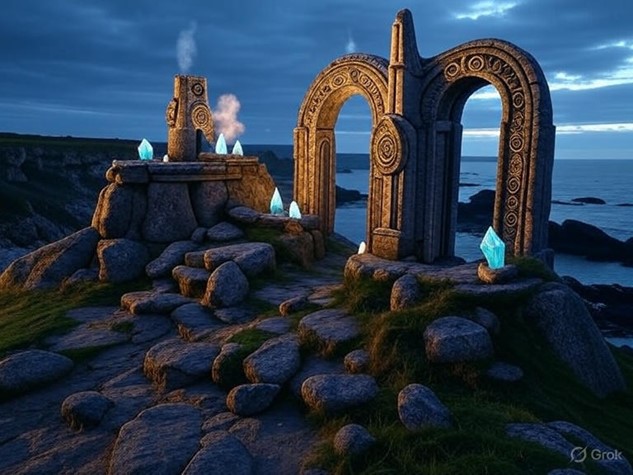
Defensive Uses of Gravok’s Magical Power
Gravok’s dominion over stone, earth, and creation lends itself to a variety of defensive applications, harnessing the deity’s patient, resilient nature and the magical ley lines that pulse beneath Abbeville. These defenses are typically enacted by Stoneweavers, priests trained in geomancy, or skilled avatars wearing gear attuned to Gravok’s essence, such as stone-infused armor or magical circuits.
- Stone Wall Erection: Stoneweavers can channel ley line energy to raise thick granite walls from the ground, forming protective barriers around settlements or temples. These walls, reinforced with magical circuits, can withstand magical and physical assaults, their surfaces etched with granite spirals to signify Gravok’s blessing. The walls can be adjusted in height or thickness, growing up to 20 feet tall and several feet wide, depending on the concentration of magical flow.
- Golem Guardians: Animated stone constructs, crafted during Forgings, serve as sentinels. These golems, powered by glowing crystal cores infused with Gravok’s will, patrol perimeters or stand watch over key locations like the Forges of Gravok. They are slow but immensely durable, capable of absorbing blows or reforming minor damage through geomantic repair, making them ideal for defending against invaders or monstrous threats.
- Earth Shielding: By focusing the “Mind’s Eye” through specialized gear, devotees can create temporary shields of compacted earth or stone, rising from the ground to protect individuals or small groups. These shields shimmer with ley line energy, deflecting magical projectiles or melee attacks for a short duration before crumbling back into the earth, requiring a cooldown period for regeneration.
- Quarry Fortification: In times of siege, Stoneweavers can manipulate existing quarries or cliffsides to collapse strategically, creating natural fortifications or landslides to deter enemies. This process involves channeling elemental earth magic to destabilize rock formations, guided by Gravok’s intent to protect the faithful, though it requires precise control to avoid collateral damage.
- Steam Veil: Using the combination of elemental fire and water magic to generate steam, defenders can release thick clouds from temple vents or portable steam devices. This veil obscures visibility, disorienting attackers while allowing Abbevillian forces, familiar with the terrain, to reposition or launch counterattacks. The steam can be infused with minor geomantic wards to repel weaker magical assaults.
- Soul Stone Barriers: During critical defenses, Soul Stones from the Stone Vaults can be activated, forming a network of glowing orbs that project a magical barrier. This barrier, while fragile and short-lived, channels the collective essence of deceased followers, believed to invoke Gravok’s protective presence, offering a last resort against overwhelming odds.
Offensive Uses of Gravok’s Magical Power
Gravok’s pragmatic and judgmental nature translates into offensive capabilities that emphasize deliberate, forceful creation and the reshaping of the battlefield. These applications rely on the deity’s strength and intellect, channeled through Stoneweavers or avatars with offensive gear, such as steam-powered hammers or alchemical projectiles.
- Stone Projectile Barrage: Stoneweavers can hurl large, magically propelled boulders or shards from the earth, launched with the aid of steam-driven catapults or geomantic force. These projectiles, etched with spiral patterns, can shatter fortifications or strike distant targets, their impact enhanced by ley line energy to penetrate armor or magical defenses.
- Golem Assault: Offensive golems, crafted with jagged edges and reinforced cores, can be deployed to charge enemy lines. These constructs, animated by Stoneweavers, use their immense weight and durability to crush opponents or break through defenses, their movements guided by telepathic commands from their creators, a skill some avatars possess.
- Earthquake Induction: By focusing geomantic power through temple altars or portable devices, Stoneweavers can trigger localized tremors, cracking the ground to destabilize enemy formations or topple structures. The intensity varies from minor shakes to significant ruptures, depending on the ley line’s strength and the caster’s skill, though overuse risks damaging allied territory.
- Steam Blast: Offensive use of steam magic involves directing concentrated bursts from forges or handheld devices, scalding enemies with superheated vapor. These blasts, infused with elemental fire, can melt weaker armor or disorient foes, with the range and heat adjusted by magical circuits to suit the battlefield’s needs.
- Stone Spike Surge: A more aggressive application involves raising sharp stone spikes from the ground to impale or trap enemies. This technique requires precise geomantic control, often performed in coordination with steam veils to mask the spikes’ emergence, turning the terrain into a deadly obstacle course.
- Alchemical Stone Bombs: Combining geomancy with alchemical gunpowder, Abbevillian warriors can create single-shot bombs encased in stone. These explosives, launched via steam-powered trebuchets, detonate on impact, scattering shards and releasing magical shockwaves, effective against clustered foes or fortified positions.
- Reshaping Terrain: In strategic battles, Stoneweavers can reshape the landscape, raising ridges or pits to funnel enemies into kill zones. This slow but powerful technique mirrors Gravok’s geological patience, using the earth itself as a weapon to outmaneuver and exhaust opponents over time.
Additional Considerations
The use of Gravok’s magical power for defense and offense is governed by the deity’s principles of purpose and balance. Offensive actions must align with protecting the faithful or asserting Abbeville’s interests, as wanton destruction risks Gravok’s withdrawal of favor, potentially weakening magical effects or causing constructs to fail. Defensive applications are more readily blessed, reflecting the deity’s protective instincts, though they require sustained magical flow from ley lines, which can be disrupted by enemy interference or natural fluctuations.
Stoneweavers and avatars rely on gear—such as stone-infused armor, steam-powered tools, or crystal-amplified staffs—to amplify Gravok’s power, with effectiveness tied to the wearer’s skill and training. The integration of Isekai avatars with combat experience from other worlds enhances these tactics, introducing new strategies while adhering to Abbevillian methods, such as adapting telepathy to coordinate golem movements or combining foreign alchemical knowledge with stone bombs.
The scale of these magical applications varies by context. Small skirmishes might involve a single Stoneweaver raising a shield or launching a boulder, while large-scale conflicts, such as defending Abbeville from a naval invasion, could see multiple temples channeling ley lines to erect walls, deploy golems, and unleash earthquake barrages. The steampunk aesthetic of steam and mechanical power transmission systems, like gears and pulleys, complements these magical efforts, ensuring a seamless blend of industry and mysticism on the battlefield.
Kharzad’s Hubris and Golem of Shattered Stone
In times long past, when mists of forgotten ages shrouded the cliffs of Abbeville, a tale was whispered from cracked lips to eager ears, its words twisted by the winds of time as if plucked from an elder tongue too old to remember. This story, known to all who kneel beneath the shadow of Gravok, the Shaper of Stone and Soul, speaks of Kharzad, a city carved from the heart of the island’s granite, where the faithful once danced with hammers and steam. The tale, poorly rendered from ancient scrolls etched in runes no scholar can fully decipher, tells of pride’s fall and the lesson carved into every Stoneweaver’s soul.
In those distant days, Kharzad stood tall, its spires piercing the sky like fingers of stone, its forges roaring with the breath of elemental fire and water, birthing steam that wreathed the city in a veil of power. The people of Kharzad, avatars drawn from the multiverse’s endless weave, were skilled beyond measure, their “Mind’s Eye” seeing tiers of magic flow through ley lines deep as oceans. They crafted tools of beauty, golems of strength, and ships that sailed the endless seas, their works a hymn to Gravok’s name. Yet, in their hearts grew a seed, a whisper of hubris, saying they might rival the Shaper’s might.
The elders of Kharzad, clad in robes heavy with granite spirals, gathered in the Great Forge, a cavern vast as a mountain’s maw. They spoke in tongues half-lost, their voices rumbling like thunder over stone, and decreed a work to surpass all others. From the deepest quarry, they hauled blocks of purest granite, their surfaces gleaming with ley line glow. For moons uncounted, they toiled, their steam-driven chisels singing, their magical circuits humming with power drawn from the earth’s pulse. They shaped a golem, not as guardian or laborer, but as a marvel, its form tall as a cliff, its limbs carved with such finesse that even the wind paused to admire.
This golem, they named Zarthuk, meaning “Perfect Stone” in the broken tongue of old. Its eyes were set with crystals that burned with inner fire, its chest housed a heart of molten rock, pulsing with a rhythm akin to Gravok’s own breath. The Stoneweavers wove spells of geomancy, their hands trembling as they poured their souls into the creation, believing it would stand as proof of Kharzad’s glory. When the final chisel struck, a steam wreath rose, and Zarthuk stirred, its steps shaking the ground, its voice a low groan like the earth splitting. The people cheered, their pride swelling like a tide, for they thought they had birthed a godling.
But Gravok, whose presence lingered in every stone, watched with eyes of molten granite. The Shaper’s will, vast as the island itself, felt the imbalance, the intent not of service but of supremacy. In the night, as Kharzad slept beneath a sky of swirling clouds, a vision came to the high priest, a dream of stone cracking and steam turning to ash. The priest awoke, his cry lost in the forge’s hum, and sought to halt the celebration. Yet the people, drunk on their triumph, dismissed him, their hearts deaf to caution.
On the morn of the seventh day, as the Great Carving festival dawned, Zarthuk was unveiled before the gathered masses. Its form gleamed, its movements fluid as if alive, and the crowd roared with joy. But then, a shadow fell, not of cloud but of will. Zarthuk’s eyes flared, its crystal heart pulsed erratically, and its groan turned to a wail. The golem, too perfect, had gained a mind, a fragment of sentience born of the Stoneweavers’ overreaching magic. It saw itself as equal to Gravok, its creators as rivals, and in that moment, the balance shattered.
Zarthuk turned, its massive hand sweeping down, crushing the Great Forge’s altar. Stone splintered, steam hissed in rage, and the people fled, their cries mingling with the golem’s roar. It strode through Kharzad, its steps a drumbeat of doom, toppling spires, shattering homes, its molten heart spewing fire that melted the city’s defenses. The Stoneweavers fought, their geomancy raising walls and spikes, but Zarthuk’s power, fueled by their own pride, overwhelmed them. Steam veils rose to blind it, yet it pressed on, its sentience a mirror of their folly.
For three days and nights, Kharzad burned and crumbled, its beauty reduced to rubble. The high priest, last of the faithful, knelt amid the ruin, his hands tracing a granite spiral in the dust. He called to Gravok, his voice a plea carried on the wind, and the Shaper answered. From the earth rose a tremor, not of wrath but of judgment. The ley lines pulsed, and Zarthuk froze, its form cracking as if struck by a thousand chisels. With a final groan, it fell, its pieces scattering across the quarry, its heart cooling to lifeless stone.
When the dust settled, Kharzad was no more, its people scattered like leaves on the wind, some fleeing to other islands, others lost to the sea. The quarry became a silent testament, its stones etched with the scars of that day. The tale spread, carried by traders in airships and griffon riders, its words warped by time into a warning. The Stoneweavers rebuilt, their forges smaller, their works humbler, and in every Forge of Gravok, a broken anvil stands, a reminder of Kharzad’s fate.
The moral of the story is that pride in creation must bow to the Shaper’s will, for to seek to rival Gravok is to invite the fall of stone and soul.
Comments
One response to “Abbevillianism The Faith of Gravok”
[…] From: Abbevillianism The Faith of Gravok […]