
Candleholm is a modest but well-maintained labyrinth carved into soft limestone beneath a cluster of three hills in the agricultural heartlands of one of Saṃsāra’s island nations. The entrance sits at the base of the central hill, marked by a simple archway adorned with carved candle motifs that give the place its name. The labyrinth earned its designation through the practice of its founders, who placed enchanted candles at every intersection and chamber entrance, creating a warm, welcoming glow that distinguishes it from darker, more foreboding underground complexes.
Lore and History
Candleholm was established approximately four hundred years ago by a coalition of farming families who fled surface conflicts between warring noble houses. These refugees, mostly possessed avatars with memories of persecution and violence, sought a place where they could live peacefully without being conscripted into endless territorial disputes. They chose this location because the limestone was soft enough to carve with basic tools yet stable enough to support extensive tunneling.
The founder, a tier-three avatar named Mirella Softpick who possessed the body of a badger-folk engineer, had memories of mining techniques from a previous life in a dwarven hold. She organized the initial excavation using principles of load distribution and natural support columns that have kept Candleholm stable for centuries. Her original candle, still burning through magical renewal in the central plaza, serves as both memorial and promise that the light of community will never extinguish.
Over generations, Candleholm grew from a desperate hideaway into a thriving trade stop. Its location beneath three hills that produce excellent grain, vegetables, and livestock made it valuable as a storage and distribution center. Surface farmers discovered that the constant cool temperature and humidity of the upper chambers perfectly preserved their harvests. What began as convenience evolved into partnership, with surface and underground communities developing symbiotic relationships.
Reason for Construction
Candleholm was built primarily as a refuge and secondarily as a storage facility. The founding families needed protection from surface violence while maintaining access to farmland. The limestone hills offered both hiding and harvest. As peace gradually returned to the region, the labyrinth’s purpose shifted toward commerce and community rather than pure survival.
The soft limestone allowed relatively rapid expansion without requiring tier-three or tier-four craftspeople with advanced magical tools. Tier-one and tier-two avatars could accomplish most excavation work using basic picks, shovels, and patience. This accessibility meant the community could grow organically as families saved resources and expanded their living spaces over time.
Social Purpose
Candleholm serves as a market town and waystation for travelers moving between larger population centers. Its reputation for fairness and hospitality attracts merchants, adventurers, and refugees seeking temporary shelter or permanent homes. The community prides itself on accepting all species and avatar types without prejudice, though they maintain strict rules against violence within their walls.
The labyrinth functions as neutral ground where rival factions can meet to negotiate without fear of ambush. Several trade agreements and peace treaties have been signed in Candleholm’s central plaza over the decades, adding to its reputation as a place of reconciliation and cooperation.
Families who live in Candleholm typically work in food preservation, storage management, market stalls, or hospitality services for travelers. Many residents maintain surface gardens during growing seasons while returning to underground homes for safety and comfort. This dual lifestyle creates a culture that values both sunlight and shadow, surface and stone.
Geological Environment and Amenities
The limestone surrounding Candleholm is cream-colored with occasional veins of pale gray and rust-orange where iron deposits have oxidized. The stone carves smoothly but leaves a fine dust that necessitates regular cleaning. Water seepage through the porous rock creates natural humidity that ranges from comfortable to slightly damp depending on the season and depth.
Three levels comprise the main inhabited sections of Candleholm, descending approximately three hundred feet total. The first level lies thirty to sixty feet below the surface and contains residential quarters, market stalls, and public gathering spaces. Magical candles in iron sconces line every corridor at twenty-foot intervals, providing reliable illumination without smoke or heat. The carved ceiling reaches eight to twelve feet high in most areas, with the central plaza boasting a twenty-foot vaulted dome.
The second level, sixty to one hundred fifty feet down, houses storage chambers, workshops, and food production facilities. Massive fungal gardens grow in humid chambers where water drips constantly from the ceiling. Insect farms occupy sealed rooms to prevent escapes. A natural underground stream flows through the eastern section, providing fresh water and powering a small mill wheel that grinds grain and fungi into flour.
The third level, one hundred fifty to three hundred feet deep, remains partially wild. Some chambers have been developed into emergency shelters, secure vaults for valuable goods, and experimental growing areas for rare fungi. Other sections remain natural caverns where adventurers occasionally venture seeking the blind cave fish that spawn in deep pools or hunting the pale salamanders that grow as large as dogs in the darkness.
Amenities include three inns with common rooms and private quarters, a dozen market stalls operating daily, two taverns brewing both surface ales and fungal wines, a temple complex honoring multiple gods with individual shrines, a healer’s hall staffed by tier-two avatars with medical knowledge, a small forge for basic metalwork and tool repair, public baths fed by the underground stream and heated by magical warming stones, a community granary that stores food for emergencies, and a modest library containing agricultural manuals, maps, and historical records.
Size and Population
Candleholm houses approximately eight hundred permanent residents and accommodates another one to two hundred transients at any given time. The labyrinth’s tunnels stretch roughly two miles in total length across all three levels, with inhabited areas comprising about sixty percent of that distance. Unexplored or undeveloped sections remain closed behind locked doors or warning markers.
The central plaza measures one hundred feet in diameter, serving as the community’s heart where festivals, meetings, and daily socializing occur. Major corridors are fifteen feet wide to allow cart traffic, while residential side passages narrow to six feet. Individual dwelling spaces range from single rooms of one hundred square feet for unmarried individuals to multi-room family quarters spanning five hundred square feet.
Surrounding Area
The three hills above Candleholm rise gently from surrounding farmland, each reaching about two hundred feet above the plains. The central hill bears the main entrance, while the eastern and western hills have emergency exits disguised as natural caves. Surface structures include farmhouses, barns, granaries, and a small shrine to agricultural deities.
Rich soil covering the hills produces wheat, barley, root vegetables, and grazing land for sheep and cattle. Orchards on the southern slopes yield apples, pears, and stone fruits. A paved road runs past the central hill, connecting two larger cities three days’ journey apart. The nearest major settlement lies half a day’s walk to the north, a walled town of five thousand souls where surface dwellers conduct most of their business.
Natural hazards are minimal. The region experiences no volcanic activity, and earthquakes occur rarely. The biggest dangers come from occasional bandit groups targeting travelers on the road, though Candleholm’s guards maintain a watch and can seal the main entrance within minutes if threatened.
Characteristics
Candleholm’s defining characteristic is its pervasive warmth, both literal and metaphorical. The magical candles cast a golden glow that softens stone edges and creates dancing shadows. The temperature remains constant at roughly sixty degrees, comfortable for most species with light clothing or natural fur. Humidity keeps the air from feeling stale, though visitors from dry climates sometimes find it oppressive.
The community embraces a culture of shared meals and communal decision-making. Major choices affecting the labyrinth require town meetings where all permanent residents may voice opinions. A council of five elected members handles day-to-day administration, serving two-year terms with no consecutive re-election allowed. This prevents power consolidation while ensuring experienced voices guide the community.
Architectural style emphasizes functionality over decoration, though residents personalize their spaces with paint, tapestries, carved door frames, and potted fungi. The overall aesthetic is clean, organized, and welcoming. Visitors consistently note the lack of refuse or clutter in public spaces, a point of pride for Candleholm’s residents who maintain rigorous cleaning schedules.
Sound echoes moderately through the corridors, enough that loud arguments or celebrations carry but not so much that normal conversation disturbs neighbors. Musicians occasionally perform in the central plaza, where the dome’s acoustics enhance string instruments and voices beautifully.
Tags
Trading post, refugee haven, neutral ground, agricultural support, waystation, beginner-friendly, multi-species community, market town, food storage, peaceful territory, accessible depth, stable construction, well-lit passages, communal governance, moderate magic flow, limestone caverns, three-level system, underground stream, fungal gardens, insect farms, temple complex, healer services, public baths, emergency shelters, mixed surface-underground culture
Positives
Candleholm offers exceptional safety for tier-one characters. The upper two levels qualify as somewhat safe areas where armor class doubles, and guards patrol regularly. The community actively welcomes newcomers and provides orientation services for those unfamiliar with underground living. Housing costs remain affordable, with simple rooms available for two silver pieces per week or one gold per month, including access to communal meals in the main plaza.
Employment opportunities exist for characters willing to work. Market stalls need assistants, storage chambers require inventory management, fungal gardens demand tending, and caravans constantly seek guards for the surface roads. Tier-one characters can find honest work that pays enough to cover living expenses while accumulating the tier-one magical items needed for advancement.
The market provides access to basic tier-one equipment, weapons, armor, and magical items at reasonable prices. While not a major magical goods marketplace, Candleholm’s merchants maintain connections to suppliers in larger cities and can order specific items with two to four weeks’ notice. The healer’s hall offers medical services at cost, making recovery from injuries affordable.
Candleholm’s library, though modest, contains practical information valuable to beginning adventurers. Maps of the surrounding region, bestiaries describing local monsters, guides to edible and poisonous fungi, and historical accounts of nearby ruins provide research opportunities. The librarian, a tier-three avatar possessed by someone with archival memories, gladly assists those seeking knowledge.
The community’s neutrality creates opportunities for characters to meet contacts from various factions without committing to any particular allegiance. Information flows freely in the taverns, and discretion is culturally valued. A character can build a reputation here without making powerful enemies elsewhere.
The third level offers controlled adventure opportunities. The partially explored natural caverns provide a training ground where tier-one characters can face appropriate challenges like giant rats, aggressive fungi, and blind cave predators without the extreme dangers found in deeper, wilder labyrinths. Experienced residents sometimes lead guided expeditions for newcomers wanting to gain combat experience safely.
Negatives
Candleholm’s very safety and accessibility make it somewhat boring for characters seeking excitement or rapid advancement. The community discourages risk-taking that might endanger residents, and guards quickly intervene in public disputes. Characters with violent tendencies or those seeking constant action will find the peaceful atmosphere stifling.
The selection of magical items remains limited to common tier-one goods. Characters seeking rare or powerful equipment must travel to larger cities, as Candleholm’s merchants focus on practical tools rather than exotic artifacts. The wait times for special orders frustrate impatient adventurers.
The constant humidity affects certain items and materials negatively. Leather requires regular treatment to prevent mildew, metal tools need frequent oiling against rust, and paper documents must be stored carefully. Characters from dry climates may find the moisture uncomfortable, and those with respiratory sensitivities sometimes struggle with the ever-present limestone dust despite regular cleaning.
Space constraints mean privacy is minimal. Walls are thin enough that conversations in adjacent rooms can be heard clearly. The communal culture expects participation in shared meals and community events, which some find intrusive. Individualists who prefer solitude will struggle with the constant social expectations.
The third level’s dangers, while appropriate for tier-one characters, offer limited rewards. The monsters encountered drop minimal loot, and the unexplored chambers rarely contain significant treasure. Characters expecting dungeon crawls filled with ancient artifacts will be disappointed by mundane findings like blind fish, common fungi, and perhaps a few silver coins dropped by previous explorers.
Economic opportunities, while stable, offer limited potential for wealth accumulation. Honest work pays living expenses but rarely generates the capital needed to purchase expensive magical items or fund major expeditions. Characters must be patient and frugal, slowly building their resources over months rather than weeks.
The community’s strict rules against violence extend to self-defense training. Weapons must be peace-bonded in public areas of the first level, and practicing combat techniques requires special permission and designated training spaces on the second level. Characters wanting to maintain combat readiness may find the restrictions frustrating.
Candleholm’s reputation as neutral ground means all factions pass through, including those with conflicting goals. Characters may find themselves lodging in the same inn as their future enemies or drinking beside those they’ll eventually fight. This creates social complexity and potential awkwardness that some find uncomfortable.
The surrounding surface area, while peaceful, lacks dramatic features. No ancient ruins dot the landscape, no mysterious forests hide secrets nearby, and no legendary monsters threaten the farmlands. Characters seeking heroic opportunities must travel days to reach more adventure-rich regions, using Candleholm merely as a starting point rather than a destination.
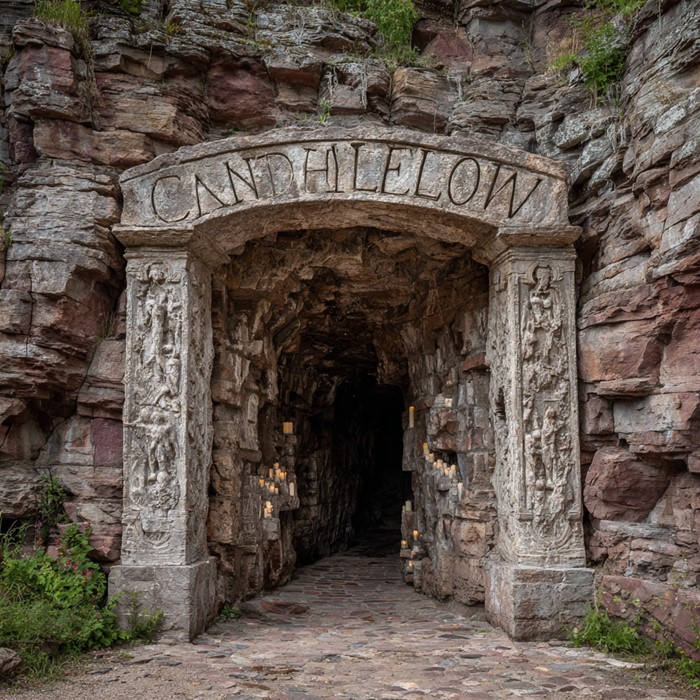
The Entrance to Candleholm
The main entrance to Underground 847 of Candleholm sits at the base of the central hill’s southern face, where erosion and deliberate excavation have created a natural-looking grotto approximately thirty feet wide and twenty feet high at its peak. The opening faces the main road, visible to travelers but recessed enough to avoid direct exposure to weather. During heavy rains, water cascades down the hillside on either side of the entrance but rarely flows directly into the opening due to clever drainage channels carved into the surrounding rock.
The archway itself is the labyrinth’s most distinctive feature. Carved from the natural limestone over decades by multiple generations of craftspeople, it depicts hundreds of individual candles in various states of burning. Some stand tall and fresh, others are half-melted, and a few show just the last stub of wax with flame still dancing. The candles interweave with carved vines, flowers, and the occasional small creature like beetles, mice, and birds. The overall effect suggests that life persists and light endures regardless of circumstances.
Above the arch, letters carved two feet high spell out “CANDLEHOLM” in Common, with smaller inscriptions in Dwarvish, Elvish, and three other prevalent languages welcoming travelers and promising sanctuary. The stone shows signs of regular maintenance, with chisel marks indicating where damaged sections have been repaired and smoothed.
Two wooden doors, each ten feet tall and six feet wide, hang on massive iron hinges within the archway. The dark oak planks are bound with iron bands and reinforced with internal bracing visible through gaps. During daylight hours, both doors stand open, fastened back against the interior walls. At night or during emergencies, they can be closed and barred from inside using three thick timber beams that slot into iron brackets.
A guard post flanks each side of the entrance just inside the doors. These alcoves, carved seven feet deep into the walls, provide shelter for two guards per shift. Simple wooden benches offer seating, and small tables hold logbooks where guards record arrivals and departures. Weapon racks hold spears and crossbows for emergencies, while lanterns supplement the magical candlelight during shift changes.
The entrance tunnel extends forty feet into the hillside at a gentle downward slope of roughly ten degrees. The passage measures fifteen feet wide and ten feet high, with the ceiling smoothed into a barrel vault that provides structural stability. The limestone here shows its natural cream color with rust-orange streaks where iron-rich water has stained the surface over centuries.
Magical candles in iron wall sconces appear every ten feet on alternating sides of the tunnel. Each candle burns with a steady golden flame that never flickers, never diminishes, and never requires replacement. The iron sconces are simple but well-crafted, with a cup to catch non-existent wax drippings and a small hook where travelers can hang wet cloaks to dry.
The floor of the entrance tunnel has been paved with flat limestone tiles fitted closely together and worn smooth by four centuries of foot traffic. The tiles show discoloration in the center where countless boots, paws, hooves, and other ambulatory appendages have passed. During wet weather, the tiles can become slippery, and rough-cut grooves carved across the width every five feet provide traction.
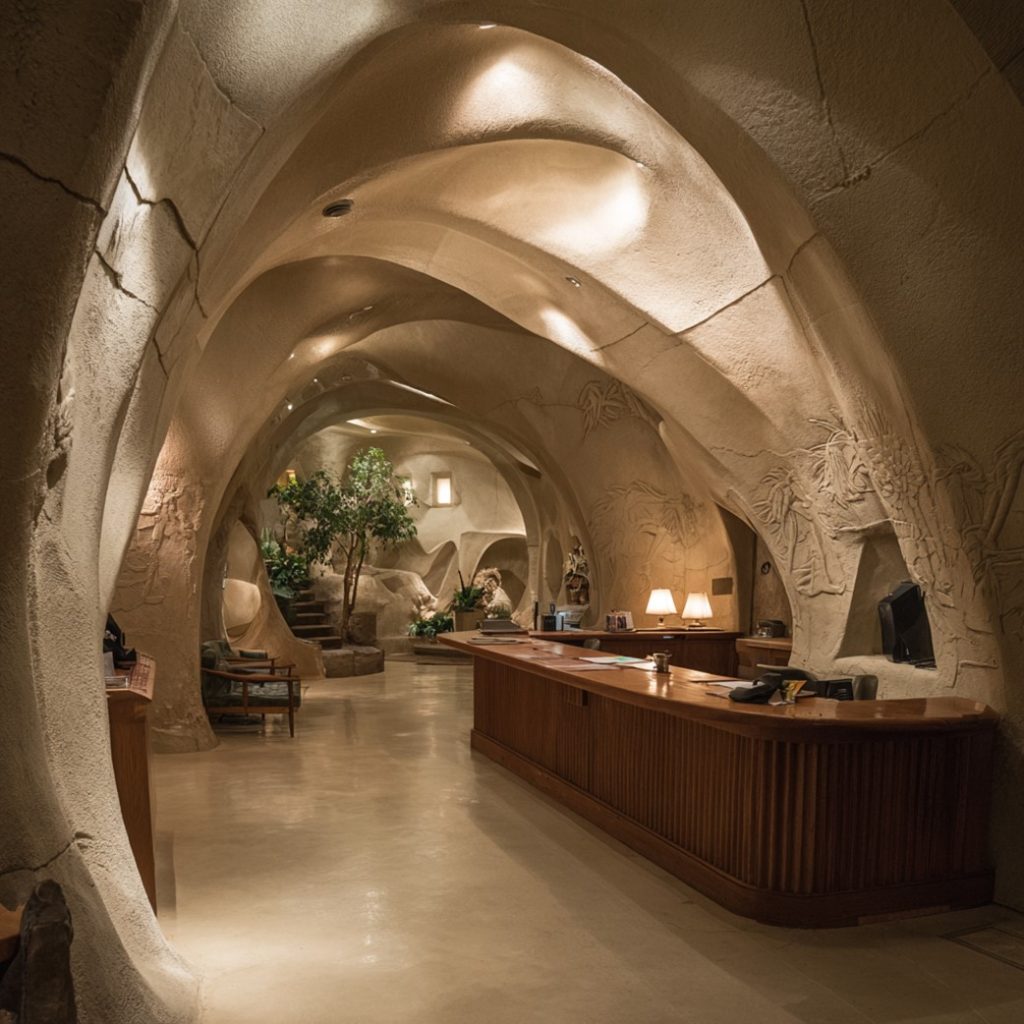
The Greeting Hall
The entrance tunnel opens into the Greeting Hall, Candleholm’s first major chamber and the transition point between surface world and underground life. This oval room measures sixty feet long by forty feet wide, with a ceiling that rises to fifteen feet at the center. The space serves multiple purposes: security checkpoint, information center, and psychological decompression zone for those unaccustomed to underground environments.
The Greeting Hall’s walls curve smoothly, lacking sharp corners that might feel threatening or claustrophobic. Carved relief panels depict scenes from Candleholm’s history, including the founding excavation, the first harvest festival, and the signing of various peace treaties in the central plaza. These panels are painted in earth tones that complement the natural limestone, and magical candles positioned to cast dramatic shadows bring the carved figures to life.
A large wooden desk sits directly ahead of the entrance tunnel, positioned to allow those manning it clear views of anyone entering. This reception desk is typically staffed by two community members during busy hours and one during quieter periods. They greet visitors, answer questions, provide directions, and assess potential threats. A large ledger records all visitors who intend to stay more than a few hours, noting names, species, apparent tier level, and stated business.
Behind the desk, a wooden board displays current information: available lodging with prices, market stalls operating that day, scheduled events or meetings, notices seeking workers, warnings about sections under repair, and community announcements. The board is updated each morning and whenever significant changes occur.
To the left of the entrance as one enters, a sitting area offers benches and chairs where travelers can rest after their journey. Small tables provide surfaces for setting down packs or enjoying refreshments. A water station with clay cups and a barrel of fresh water from the underground stream allows visitors to quench their thirst. A simple latrine alcove with a privacy curtain addresses immediate biological needs, with signs directing visitors to the public baths for more thorough cleansing.
To the right, a merchant’s alcove operates as a general store selling basic supplies that travelers frequently need: torches (despite the magical lighting, some prefer carrying their own), rope, rations of dried fungi and preserved meat, waterskins, basic tools, candles (mundane ones, as the magical versions are not sold), healing salves, antitoxins for common poisons, and maps of the surrounding region. The merchant on duty can also arrange delivery of purchases to lodging or storage if visitors have made arrangements.
Three passages exit the Greeting Hall beyond the reception desk. The central passage, marked with a hanging sign reading “Central Plaza,” is the widest at fifteen feet and serves as the main thoroughfare. The left passage, marked “Residential – East,” narrows to ten feet and leads to housing districts. The right passage, marked “Market & Services,” matches the left in width and provides access to commercial areas.

Central Plaza
Following the central passage for one hundred feet, descending gradually, brings visitors to Candleholm’s heart: the Central Plaza. This circular chamber spans one hundred feet in diameter and features a vaulted dome ceiling that reaches twenty feet at its apex. The dome’s interior surface has been carved with a representation of a night sky, complete with constellations known across Saṃsāra. Small crystals embedded in the stone at star positions catch and reflect the candlelight, creating a twinkling effect.
At the exact center of the plaza stands Mirella’s Candle, the original magical flame lit by Candleholm’s founder. The candle itself is three feet tall and one foot in diameter, carved from a single piece of translucent white stone that glows from within. It sits atop a five-foot-tall cylindrical pedestal inscribed with the names of founding families and significant community members who have passed. The flame burning above the stone candle is golden-white and warm, though it produces no heat that might damage the stone.
Concentric circles of different colored limestone tiles radiate outward from Mirella’s Candle, creating a pattern reminiscent of a target or ripples in water. The outermost circle, nearest the walls, is dark gray. The next is cream, then rust-orange, then pale gray, and finally white surrounding the central pedestal. Community members ascribe no mystical significance to these circles, though children play games involving them and some ceremonies use them as position markers.
Stone benches carved from the floor itself line the plaza’s perimeter, providing seating for two hundred people during community gatherings. Between the benches, alcoves carved into the walls house various community resources. A message board allows residents to post notices seeking workers, selling goods, or organizing social events. A small shrine honors the gods collectively, with a carved altar where offerings of food, crafted items, or coins can be left. A community calendar carved into stone and updated with chalk marks shows scheduled festivals, meetings, and events.
Eight passages radiate from the Central Plaza like spokes on a wheel, each leading to different sections of the labyrinth. Hanging wooden signs above each passage identify destinations: “Residential – East,” “Residential – West,” “Residential – North,” “Market Street,” “Workshop Quarter,” “Temple Complex,” “Down to Level Two,” and “Return to Entrance.”
The plaza serves as Candleholm’s social center. During meal times, residents bring food and eat together on the benches or sitting on the floor. Musicians perform in the evening, with the dome’s acoustics carrying their music beautifully. Children play supervised games while adults discuss business, politics, or gossip. Festivals transform the space with decorations, temporary stalls, and celebration.
Market Street
The passage marked “Market Street” extends one hundred fifty feet in a gentle curve, lined on both sides with merchant stalls and small shops. The corridor maintains a width of fifteen feet to allow two-way cart traffic, with the ceiling at ten feet. Magical candles every ten feet provide bright, even illumination ideal for examining merchandise.
Market stalls are semi-permanent structures built from wood and cloth. Each occupies a space roughly ten feet wide by eight feet deep, carved slightly into the wall to create a recessed alcove. Wooden counters face the corridor, with shelves and storage behind. Cloth awnings in various colors stretch overhead, giving each stall distinct visual identity. During operating hours, goods are displayed prominently; overnight, wooden shutters secure merchandise.
Twelve major stalls line Market Street, offering diverse goods and services:
Earthgrain Provisions sells surface grains, flour, dried fruits from the hillside orchards, honey from surface beekeepers, and preserved meats. The proprietor, a human woman named Dalla Fenn who is tier-one, maintains excellent relationships with surface farmers and guarantees freshness.
The Fungal Harvest specializes in underground-grown foods. Dozens of mushroom varieties, from button-sized to massive caps as large as dinner plates, are displayed fresh daily. Dried and powdered fungi, mycelium flour, fermented fungal paste, and fungal-based seasonings fill jars and sacks. The owner, a gnome named Pipp Deeproot at tier-two, personally tends the growing chambers and knows every variety’s properties.
Ironbark Tools and Hardware offers tools for farming, crafting, and excavation. Hammers, chisels, picks, shoves, saws, planes, and specialized tools for various trades hang from wall racks. The proprietor, a half-orc smith named Grenda Ironbark at tier-two, operates the forge on level two and brings finished work to the market stall.
Threadways Clothing and Textiles sells garments suitable for underground living: practical work clothes, simple dresses and tunics, heavy cloaks for surface travel, soft leather boots, and cloth wraps. The seamstress, an elderly elf named Silesta who is tier-three, creates custom orders and repairs damaged clothing.
The Healer’s Stall operates as a satellite of the Healer’s Hall. Basic medical supplies, healing salves, bandages, poultices, antitoxins, and remedies for common ailments are sold here. A tier-one assistant staffed the stall and can provide basic first aid for minor injuries.
Brightwick Candles and Lamps sells mundane lighting supplies for those traveling beyond Candleholm. Tallow candles, wax candles, oil lamps, lanterns of various sizes, flint and steel, and lamp oil in ceramic bottles are available. The candlemaker, a human man named Vess Brightwick at tier-one, also maintains Candleholm’s magical candles though he cannot create them.
Stonemason’s Showcase displays decorative and functional stonework. Carved door frames, decorative wall panels, stone furniture, mortars and pestles, whetstones, and custom stone containers are offered. The mason, a dwarf woman named Thordis Hammerfell at tier-two, takes commissions for residential improvements.
Beastkeeper’s Supplies caters to those with animal companions or who work with livestock. Feed, grooming tools, leather tack, training aids, and remedies for common animal ailments fill the shelves. The proprietor, a halfling named Milo Beastwise at tier-one, boards animals on level two for travelers.
The General Goods stall offers miscellaneous items that other merchants do not carry. Rope, parchment, ink, quills, simple jewelry, dice and games, tobacco and pipes, small musical instruments, and whatever oddments the proprietor has acquired. The merchant, a human named Joras Finn at tier-one, has connections to traveling caravans and sometimes acquires unusual items.
Brewmaster’s Corner sells alcoholic beverages. Surface ales and wines share space with fungal beers, fermented moss drinks, and distilled spirits made from underground plants. Clay jugs, bottles, and casks in various sizes allow customers to purchase amounts appropriate to their needs. The brewmaster, a human man named Darvos Reed at tier-two, operates the brewery on level two.
Rare Finds and Curiosities is operated by an elderly human woman named Mirna Copperwick at tier-three. This stall specializes in minor magical items, unusual objects recovered from the third level, and oddities brought by traveling merchants. The inventory changes constantly. Tier-one characters can sometimes find basic magical items here, though prices reflect the scarcity.
The Scribe’s Desk provides writing services, document preparation, map copying, and basic legal assistance. The scribe, a human man named Aldric Penwright at tier-two, can draft contracts, write letters for the illiterate, copy documents, and notarize agreements. He also sells basic writing supplies.
Residential Districts
Three residential districts extend from the Central Plaza, designated East, West, and North. Each follows a similar layout but houses different demographics and has developed distinct character over generations.
The passages leading to residential areas narrow to ten feet wide with eight-foot ceilings, creating more intimate spaces. Side corridors branch off the main passages every fifty to one hundred feet, creating a network of interconnected hallways. The magical candles space out to every fifteen feet in residential areas, providing enough light for safety while allowing residents to supplement with personal lighting in their homes.
Individual dwellings are carved into the walls on both sides of corridors. Entry doors range from simple wooden planks to more elaborate carved and painted versions, depending on the resident’s wealth and preferences. Most doors feature knockers or bells, and small plaques or chalk marks identify occupants. Windows are obviously impossible, but many residents carve small decorative niches beside their doors where they display plants, sculptures, or personal items that express their identity.
The smallest dwellings are single rooms approximately ten feet by ten feet with eight-foot ceilings. These bachelor quarters include a sleeping pallet or simple bed, storage chest, small table with chair, and personal belongings. A shared latrine and washing station at the end of each corridor serves multiple single-room occupants. Rent for these spaces averages two silver pieces per week.
Family dwellings consist of two to five rooms connected by interior doorways. A main living space of roughly twelve feet by fifteen feet serves for cooking, eating, and socializing. Smaller sleeping chambers branch off, each eight feet by ten feet. Some larger dwellings include a dedicated storage room or workroom. These family quarters have private latrines, small cisterns fed by the underground stream, and ventilation shafts that draw in fresh air. Rent ranges from five silver to two gold pieces per month depending on size and location.
The East Residential district houses primarily working-class families: farmers who tend the surface fields, fungal gardeners, insect farm workers, and manual laborers. This district has a practical, no-frills atmosphere. Decorations are minimal, doors are simple, and the focus is on function over form. A common room near the district’s entrance provides space for residents to gather, share meals, and let children play together.
The West Residential district is home to merchants, craftspeople, and professionals. Dwellings here show more individual expression, with carved door frames, painted walls, and decorative elements. Residents have invested in improving their spaces over time. A small library room contains books and scrolls that residents share communally. A music room with decent acoustics allows residents to practice instruments without disturbing neighbors.
The North Residential district accommodates transients, new arrivals, and those between permanent housing. The rooms are generally maintained by the community and rented short-term. Furnishings are basic but functional. A hospitality coordinator manages assignments and collects rent. Many residents here are saving money to afford better housing in the East or West districts, or are passing through on longer journeys.
Temple Complex
The passage marked “Temple Complex” leads to a cluster of interconnected chambers dedicated to religious practice. Candleholm’s founders recognized that residents worshipped many different gods, and rather than favor one over others, they created a shared sacred space where all faiths could be honored.
The main temple chamber is roughly forty feet by sixty feet with a vaulted ceiling reaching eighteen feet. The walls are left deliberately plain, without carved images that might favor particular deities. Instead, residents have painted murals over the centuries, creating a layered palimpsest of religious art. Older images show through newer ones, suggesting the continuity of faith through changing times.
A central altar carved from white limestone serves all faiths. Residents place offerings here according to their traditions: coins, food, crafted items, written prayers, or symbolic objects. A collection box allows worshippers to contribute to temple maintenance, with funds used to purchase incense, candles for ceremonies, and materials for festivals.
Six smaller shrine rooms branch off the main temple, each dedicated to different pantheons or religious philosophies. Residents claiming those faiths maintain their shrine rooms, cleaning them, refreshing offerings, and conducting private ceremonies. The shrines currently active honor agricultural deities, gods of craft and forge, nature spirits, gods of knowledge and magic, deities of death and the afterlife, and gods of travel and commerce.
A meditation chamber carved into the rock behind the main temple provides silent space for contemplation. This circular room, thirty feet in diameter, has a domed ceiling and minimal lighting from a single central magical candle. Cushions arranged around the perimeter allow multiple people to meditate simultaneously while maintaining personal space.
The temple complex also includes living quarters for the temple keeper, currently an elderly human woman named Sister Valna at tier-two. She maintains the space, mediates disputes between different faith groups, and provides spiritual counseling to residents seeking guidance. Her quarters consist of a small bedroom, study, and receiving room where she meets with those requesting private conversations.
A library of religious texts occupies a side chamber. Scrolls, books, and tablets containing prayers, philosophical treatises, mythological accounts, and theological debates line wooden shelves. Sister Valna welcomes anyone to study here, regardless of their faith or lack thereof. She believes knowledge should be shared freely.
Workshop Quarter
The passage to the Workshop Quarter leads to a section of level one where craftspeople maintain their workspaces. The corridor widens to twenty feet to accommodate moving materials and finished goods. The ceiling rises to twelve feet, and ventilation shafts are more numerous here to manage heat, fumes, and dust from various crafting processes.
Ten workshop spaces line the corridor, each carved as a room approximately twenty feet by twenty feet with twelve-foot ceilings. Wooden doors can be closed for security but are typically left open during working hours, allowing passersby to observe craftspeople at their work.
The carpenter’s workshop is filled with wood in various stages of processing. Planks lean against walls, sawdust covers the floor despite regular sweeping, and the scent of fresh-cut timber permeates the space. A workbench running along one wall holds saws, planes, chisels, and other tools. The carpenter, a human man named Tomas Woodwise at tier-one, creates furniture, doors, tool handles, and wooden components for larger projects.
The leatherworker’s shop smells of tanned hides and dyes. Stretched skins dry on frames, while finished leather pieces hang from ceiling hooks. A cutting table dominates the center, with knives, punches, and needles organized precisely. The leatherworker, a half-elf woman named Sendra Tanbark at tier-two, produces boots, belts, pouches, armor components, and custom orders.
The potter’s workshop contains a wheel powered by foot pedal, shelves holding unfired clay pieces, and a kiln built into the back wall that vents through a chimney shaft to the surface. Clay in various colors is stored in sealed containers. The potter, a gnome named Quillan Earthmold at tier-one, creates dishes, cups, storage jars, decorative items, and fired bricks used in construction.
The weaver’s space holds two looms of different sizes, baskets of dyed yarn, and spinning wheels. Finished textiles hang as displays, showing the quality of work. The weaver, a human woman named Marta Threadwise at tier-two, produces cloth for clothing, decorative tapestries, rugs, and bags.
The jeweler’s workshop is the most secure, with a heavy door that locks and bars over the single window opening to the corridor. Inside, a well-lit workbench holds delicate tools for setting stones, shaping metal, and polishing finished pieces. The jeweler, a dwarf man named Gorin Gemhand at tier-three, works with precious metals and stones acquired through trade, creating rings, necklaces, bracelets, and occasionally magical items when he can obtain proper components.
The glassblower’s space contains a furnace burning at high temperature, fed by magical heating stones rather than conventional fuel. Rods, pipes, and tools for shaping molten glass hang within easy reach. Finished pieces—bottles, vials, decorative items, and glass panes—are displayed carefully. The glassblower, a human man named Fennick Clearflame at tier-two, produces both functional and artistic works.
The bookbinder’s workshop smells of leather, glue, and parchment. A cutting table, pressing boards, sewing frames, and shelves of materials fill the space. The bookbinder, an elf named Lorien Pagekeeper at tier-two, creates blank books, repairs damaged texts, and binds documents into permanent volumes.
The basket weaver’s area overflows with dried reeds, willow branches, fungal stems, and other flexible materials. Various baskets in progress hang from ceiling hooks. The basket weaver, a halfling woman named Pip Weavebright at tier-one, creates storage baskets, carrying baskets, decorative display baskets, and specialized containers for specific purposes.
The instrument maker’s workshop contains partially built lutes, flutes, drums, and stringed instruments. Wood shavings mix with bone dust and metal filings. The instrument maker, a human man named Davrin Soundshaper at tier-two, crafts musical instruments and also repairs damaged ones.
The alchemist’s laboratory occupies the final workshop space. Shelves hold countless bottles, jars, and vials containing liquids, powders, and preserved specimens. A work table features burners, distillation apparatus, mortars and pestles, and measuring instruments. The alchemist, a tiefling named Zareth Mixwell at tier-three, produces healing potions, antitoxins, acids, alchemical fire, and various specialty compounds for customers willing to pay premium prices.
Public Baths
A passage marked “Baths” leads to one of Candleholm’s most appreciated amenities. The public baths occupy a large chamber fed by the underground stream that flows through level two. Water is diverted through carved channels, heated by magical warming stones, and collected in three pools of different temperatures.
The bath chamber measures fifty feet by seventy feet with a fifteen-foot ceiling supported by four carved pillars. Moisture condenses on the ceiling and walls, giving everything a perpetual sheen. The floor is tiled with water-resistant stone that has been textured to prevent slipping. Wooden benches line the walls where bathers can sit to remove clothing or rest between soaks.
The cold pool, fifteen feet in diameter and four feet deep, contains water directly from the stream at its natural temperature of roughly fifty-five degrees. This pool is used for quick washing, cooling down after a hot soak, or by those who prefer cold bathing.
The warm pool, twenty feet in diameter and five feet deep, is the most popular. Warming stones embedded beneath the pool floor heat the water to approximately ninety degrees. Bathers can relax here, soaking away the aches of labor or travel. Stone seats carved into the pool’s sides allow people to sit in water up to their shoulders.
The hot pool, twelve feet in diameter and three feet deep, contains water heated to one hundred degrees. This pool is used for shorter periods, as extended soaking at this temperature becomes uncomfortable. Those with sore muscles or joint pain particularly appreciate the hot pool’s therapeutic effects.
Changing areas separated by cloth curtains provide privacy for those uncomfortable with communal nudity, though most regular bathers grow accustomed to the casual atmosphere. Wooden cubbies allow bathers to store clothing and belongings while bathing. An attendant, usually a tier-one resident earning wages, monitors the baths during operating hours, ensuring safety, cleanliness, and appropriate behavior.
Soap made from rendered fats and lye is provided in communal bars near each pool. Rough cloths for scrubbing hang on hooks. Clay vessels hold various oils and ointments for skin care after bathing. The baths are free for residents and cost one copper piece for visitors.
The Descent to Level Two
The passage marked “Down to Level Two” slopes downward at a fifteen-degree angle, descending ninety feet over the course of three hundred feet of corridor. The passage maintains a width of twelve feet and a ceiling height of ten feet. Magical candles appear every twenty feet, creating pools of light with shadows between.
Halfway down the ramp, a guard station monitors traffic. The guards, typically two on duty, ensure that unauthorized persons do not enter level two without escort or permission. They maintain a logbook tracking who goes down and when they return. This security measure protects the food production areas from contamination, theft, or sabotage.
At the bottom of the ramp, the corridor opens into a distribution hub where multiple passages lead to different sections of level two. This circular chamber, thirty feet in diameter, serves as the main transition point between levels. A carved map on one wall identifies the various sections and their purposes.
Level two contains the fungal gardens, insect farms, storage chambers, workshops requiring more space or ventilation than level one provides, the forge, the brewery, animal stables, the mill, and access to the underground stream. The atmosphere on level two is noticeably more humid and cooler, with temperature around fifty-five degrees. The smell shifts from the relatively neutral stone-and-candle scent of level one to earthier aromas of growing things, animals, and industry.
Flame That Would Not Die
A Tale of Candleholm
In the time when hills had no names and roads wandered where they willed, there came to the land of fertile soils a woman whose shape was not her birth-shape. She who had been called Mirella in her before-life, she who remembered the deep places of stone-dwelling people, she who now walked in the body of one who digs with strong claws and lives beneath the earth—this Mirella Softpick came to three hills that rose like the humps of a sleeping beast.
The land around these hills was torn by the anger of those who claimed to own it. Lords whose names are forgotten fought with lords whose faces time has erased. They took from the people who worked the soil all that could be taken—sons for armies, daughters for camps of following, grain for feeding warriors, metal for making weapons of ending. The people grew thin. The people grew afraid. The people looked to the hills and saw only grass and stone.
But Mirella who-was-not-Mirella, she looked with eyes that remembered. In her before-life in the deep places, she had learned the speaking-with-stone, the understanding-of-weight, the knowledge-of-where-to-cut-and-where-to-leave. She touched the central hill with claws that knew digging. She said to those who would listen, “The stone here is soft. The stone here is strong. The stone here will hide us while we wait for the anger to pass.”
Some believed. Some followed. Some thought her mad with the madness that comes from having two lives in one head.
Those who believed gathered tools. They brought hammers that were not for war but for shaping. They brought chisels that were not for carving enemies but for carving shelter. They brought their children, their elders, their animals, their seeds, their memories of how life was before lords decided to be angry.
Mirella who-remembered-stone said, “We will make light that does not die, so that we may always find our way back to each other.” She took wax from the hives of stinging-fliers. She took tallow from the fat of grass-eaters. She shaped a candle large as a child. She spoke words over it that came from her before-memories, words that tasted of deep earth and eternal burning. She struck flint to steel, and the candle caught flame, and the flame was golden like the last sun before night, but it did not consume the wax, and it did not diminish, and it did not die.
“This is our promise,” said Mirella who-spoke-with-two-voices. “While this flame burns, we do not abandon each other. While this flame burns, there is hope in darkness. While this flame burns, the light of community endures.”
They began to dig.
The stone was kind to them, being soft like cheese under the knife but not so soft that it crumbled. They cut passages that sloped gently downward, so that water would run away and not pool. They carved chambers with ceilings that curved, so that weight would distribute and not crush. They left pillars of uncut stone, so that the hill above would not collapse into the hollows below.
At every place where passages met, they placed a candle. Not the great candle of Mirella, but small flames that she blessed with the same words, so that all of Candleholm—for so they named their hidden place, their sanctuary of lights—all of it glowed with warmth that did not burn and light that did not fail.
The digging took many turnings of seasons. Some who began the work died before it was finished, for even in the safety of stone, time claims all bodies eventually. But their memories remained in those who carried on. Their children knew the stories of the first cuts, the first chambers, the first nights sleeping beneath stone instead of sky.
Above them, the anger of lords continued. Armies marched across the land. Crops burned. Villages emptied. But the three hills seemed insignificant, and the lords ignored them in their haste to reach more important battles elsewhere.
In the hidden passages beneath the hills, life continued. Women bore children in chambers lit by candles that never needed replacement. Men worked stone and wood and grew strange plants that needed no sun. The old taught the young the skills of living in the between-place, neither fully of the surface nor fully of the deep earth.
It came to pass that a great lord, fleeing from a greater lord who had defeated him, sought to hide in the three hills. His soldiers searched for caves or hollows where their master might conceal himself. They found the entrance to Candleholm.
The people within grew afraid. They had no weapons of war. They had built no defenses against armed men. They gathered in the central chamber around Mirella’s great candle and waited for violence to descend upon them.
The defeated lord entered with soldiers at his back. He saw the carved archway decorated with candles in stone. He saw the passages glowing with light that cast no shadows of threat. He saw families huddled together, protecting children with their bodies but not raising fists against him.
“What place is this?” demanded the lord, for he had never seen such a thing—a place of refuge that did not also prepare for battle.
Mirella who-was-old-now stepped forward. In her before-life she had known lords and their ways. She bowed with the precise depth that showed respect without showing fear. “This is Candleholm, a place where light does not die. We have no armies here. We have no treasures worth taking. We have only shelter, and we offer it to all who come in peace.”
The lord looked at the great candle burning at the chamber’s center. He looked at the faces of those who watched him—not with hatred, not with defiance, but with wary hope. He looked at his soldiers, young men who had watched too much ending, and he saw their weariness mirrored in the candle’s flame.
“I am defeated,” said the lord, and there was something broken in his voice. “My lands are taken. My house is destroyed. My family is scattered. I came seeking a cave to hide in until I could gather strength to continue fighting. But I am tired. I am so very tired of fighting.”
Mirella who-spoke-for-Candleholm said, “Then stop fighting. Rest here. Eat our food. Sleep in our shelter. When your strength returns, you may choose what to do with it. But while you are here, you harm no one, and no one harms you. This is our only law.”
The lord looked long at the eternal flame. Then he removed his sword and laid it at the base of Mirella’s candle. His soldiers did the same. They stayed in Candleholm three turnings of the moon. They ate mushroom bread and drank fungal beer. They helped dig new chambers and repair old ones. They learned the ways of peaceful labor.
When they left, they did not return to war. They scattered to different directions, seeking new lives in places where no one knew their names or their former allegiances.
Word of this spread across the land. A place where enemies could rest. A place where the defeated found sanctuary. A place where light never died.
Others came. Some fleeing battles. Some fleeing hunger. Some fleeing memories that haunted them. Candleholm grew. New passages extended from the old. New chambers were carved from patient stone. The population swelled.
In time, the wars above ended, as all wars eventually end, either through victory, exhaustion, or the death of those who began them. The land grew peaceful again. Farms returned to the hillsides. Trade routes re-established. But Candleholm did not empty. Those who had found community beneath the stone chose to remain. Those born in the glow of eternal candles knew no other home.
Mirella who-had-started-it-all grew old even in her strong-clawed body. She gathered the people around her great candle one final time. “I am dying,” she said, for she knew the feeling from before-life memories. “But the flame does not die. Remember this: I am not the light. I merely showed you where to place it. You are the keepers of the flame now. You must decide each day whether to maintain it or let it fail.”
“How could we let it fail?” asked the young ones, for they had never known a time when the candles did not burn.
“By forgetting why we lit them,” said Mirella who-was-becoming-only-memory. “We lit them so we would not lose each other in darkness. We lit them so strangers could find their way to us. We lit them so hope would have a place to rest. If you ever use these lights only for yourselves, if you ever turn away those who seek shelter, if you ever let fear make you cruel—then the lights will still burn, but they will illuminate nothing worth seeing.”
She died that night. Her body dissolved into sparks as possessed bodies do, leaving behind only the items she had carried and a crystal that held some fragment of what she had been. They placed the crystal in the base of her candle’s pedestal, and some said the flame burned brighter after that, though others claimed it only seemed so because they were grieving.
Generations passed. Candleholm became known across the land. Merchants stopped there to trade. Adventurers rested there between delving into dangerous places. Refugees found permanent homes there. The community developed its own culture, its own traditions, its own identity separate from any surface nation.
There came a time when a plague swept across several islands of Saṃsāra. It was a sickness of the lungs that made breathing difficult and death likely. The sick were shunned. Entire villages burned their ill in pyres rather than risk contamination. Fear made people into monsters.
A family fleeing such a village—mother, father, three children—arrived at Candleholm’s entrance. They bore the signs of early sickness: the fever-flush, the labored breathing, the distinctive cough. The guards at the entrance knew these signs. The guards had heard the stories of the plague.
One guard said, “We cannot let them in. They will infect everyone. Candleholm will become a tomb.”
The other guard said, “But if we turn them away, they die. We are supposed to be a place of sanctuary.”
They argued while the sick family waited, swaying with exhaustion. Other residents gathered, drawn by the commotion. Opinion divided sharply. Some said safety of the many outweighed compassion for the few. Others said abandoning the sick betrayed everything Candleholm represented.
The debate grew heated. Voices rose. Some residents began gathering belongings, threatening to leave if the sick were admitted. Others stood firm that turning away the desperate violated the community’s founding principle.
An old woman who had lived in Candleholm since childhood pushed through the crowd. She was tier-three, powerful enough to be respected, old enough to be heard. She walked to where the sick family huddled and stood beside them.
“I remember a story,” she said. “When Candleholm was new, a defeated lord came seeking shelter. He could have killed everyone here. Instead, he was shown mercy, and mercy transformed him. Who among you is so certain these sick ones cannot be helped? Who among you is wise enough to know absolutely that admitting them means death for us all?”
“It is not wisdom to take foolish risks!” shouted someone from the crowd.
“Perhaps not,” agreed the old woman. “But it is certainly foolishness to abandon our purpose out of fear. If we turn them away, what do we become? Just another place that protects itself at any cost. Just another group that forgets mercy when mercy becomes inconvenient.”
She turned to face the crowd fully. “I will take them to the third level. There are sealed chambers there, far from the main population. I will care for them. If they recover, they may join us. If they die, I will ensure proper burial. If I sicken, I will remain in isolation until I recover or die. The risk is mine to take.”
“And if you die?” asked someone. “What then? We lose you and gain nothing.”
The old woman smiled. “Then you will have lost someone who believed Candleholm’s light was worth maintaining even at personal cost. You will have to decide if that loss teaches you to be more careful or more courageous.”
She took the family down to the third level. She tended them in isolation. Days passed. Weeks passed. The community waited, anxious and divided. Some prepared to seal the third level permanently if necessary. Others organized supplies to send down—food, medicine, clean water.
After one full turn of the moon, the old woman returned. She was tired and thinner, but healthy. Behind her came the family, also thin but alive. The children’s cough had cleared. The parents’ breathing was steady.
“The sickness passed,” said the old woman. “Not through any magic, but through rest, clean air, good food, and hope. They are no danger now.”
The family settled in Candleholm. The father became a farmer of surface crops. The mother worked in the fungal gardens. The children grew strong and eventually had children of their own. To this day, their descendants live in Candleholm, and every generation tells the story of the old woman who risked everything to uphold a principle.
But that is not the end of the tale, for stories in Candleholm are never truly finished while the candles burn.
There came another time—the times are always coming, for that is the nature of time—when a young person arrived at Candleholm carrying a tier-two sword they had found in the ruins below the third level. The sword was beautiful, etched with flowing script and glowing faintly with enchantment. The young person, being only tier-one, should not have touched it. But curiosity and ambition are strong in the young.
The pain began immediately. Every few minutes, health drained away as the gods’ punishment for wearing items beyond one’s tier. The young person came to the Healer’s Hall, dying slowly, but unwilling to release the sword.
“Put it down,” said the healers. “It is killing you.”
“But it is mine,” said the young person. “I found it. It is the most beautiful thing I have ever seen. Once I advance to tier-two, I can wield it properly. I just need to hold on until then.”
“You will die long before you accumulate enough attuned items to advance,” said the healers. “You have perhaps hours, not days.”
“Then heal me,” demanded the young person. “Use your magic. Use your potions. Keep me alive while I attune more items quickly.”
The healers explained that this was not possible. The attunement process took time. The tier system existed for reasons. The gods had established these rules and enforced them with divine power that no healing could counteract. The only solution was to release the sword.
The young person refused. Pride, it seems, is sometimes stronger than survival instinct.
As death approached, the young person’s parent came to the Healer’s Hall. This parent had lived in Candleholm for decades, had contributed to the community, had raised children to be good citizens. Now this parent watched one of those children dying from stubborn foolishness.
“Please,” begged the parent to the healers. “Save my child.”
“We cannot,” said the healers gently. “Only your child can save themselves by releasing the sword.”
The parent turned to the young person. “Let go of the sword.”
“No,” said the young person, tears streaming but grip still firm on the weapon’s hilt. “You do not understand. All my life I have been ordinary. I have no great talents. I have achieved nothing remarkable. This sword is special. If I can keep it, I will be special too.”
The parent knelt beside the bed where the young person lay dying. “You think a sword makes you special? You think an object defines your worth? Listen to me. I have memories from a before-life. I was once someone important, someone powerful, someone whose name was known across a kingdom. And I died. All that importance, all that power, all that fame—it meant nothing when death came. I was reborn into this life, into this body, into this community. And here, in this place where light never dies, I learned something I had not known in my before-life: worth comes not from what you possess but from what you contribute. You are special because you are loved. You are remarkable because you exist and we care about your existence. The sword is just metal. You are life.”
The young person looked at the parent. Looked at the healers. Looked at others who had gathered, all wearing expressions of concern and care. Looked at the sword, so beautiful, so deadly.
“But if I let it go,” whispered the young person, “I am just… ordinary again.”
“No,” said the parent firmly. “If you let it go, you are wise. Wisdom is not ordinary. Wisdom is rare and precious. Wisdom is worth far more than any sword.”
The young person’s grip loosened. The sword fell to the floor with a clatter that echoed through the chamber. The pain stopped immediately. Color returned to the young person’s face. Breathing eased. Life flooded back.
The parent embraced the child, and both wept—one from relief, one from shame.
Later, when the young person had recovered fully, the sword was placed in a secure vault. The community decided that tier-two items found in the deep should be stored until someone of appropriate tier could use them safely. They created rules about treasure hunting on the third level. They established procedures for handling dangerous finds.
The young person never forgot the lesson. Years later, after legitimately advancing to tier-two through patience and proper accumulation of appropriate items, that same person returned to the vault. The sword was still there, still beautiful, still glowing with enchantment.
The person, no longer young, looked at it for a long time. Then turned away without taking it.
“I do not need it anymore,” said the person who had once been willing to die for it. “I know my worth now, and it is not measured in swords.”
These stories and a thousand others are known in Candleholm. They are told around Mirella’s great candle during festivals. They are shared in taverns over fungal beer. They are whispered to children before sleep in the gentle glow of eternal flames.
Some stories are happy. Some are sad. Some are strange. Some are funny. But all of them, in their own way, are about the same thing: how people maintain light in darkness, how communities endure through change, how hope persists when everything else fails.
Travelers who visit Candleholm often ask about the candles. “How do they burn without consuming wax? What magic powers them? Who created them?”
The residents answer, “Mirella Softpick created the first one with magic she remembered from a before-life. But the magic that keeps them burning is simpler than you think. The candles burn because we believe they should. We maintain them because we value what they represent. They are powered not by complicated enchantments but by communal agreement that light matters more than darkness.”
Some travelers find this answer unsatisfying. They want technical explanations, specific spell formulas, detailed magical theory. But the residents of Candleholm know that some truths are too simple to be complicated.
The candles burn. The community endures. Strangers find sanctuary. Fear does not rule. Hope has a home.
This is Candleholm. This is the place where light does not die. This is the underground labyrinth built four hundred years ago by desperate people who needed shelter and created instead a legacy.
When Mirella dissolved into sparks at her death, some say her memories did not disperse but remained in the stone itself. They say if you press your hand against the walls of Candleholm and listen very carefully, you can feel the rhythm of her heartbeat still echoing through the limestone. They say the labyrinth itself remembers her, and in remembering her, it remembers its purpose.
But these are only stories, and who can say what is true when speaking of memories and magic and meaning?
What is certain is this: the candles burn. They burned yesterday. They burn today. They will burn tomorrow. And as long as they burn, Candleholm endures—not perfect, not paradise, but persistent. A place where ordinary people try, day after day, to maintain something extraordinary.
The flame that would not die teaches us that light, once lit, requires tending. It teaches us that sanctuary, once established, must be defended not with weapons but with principles. It teaches us that communities survive not because they never face challenges but because they repeatedly choose to face those challenges together.
This is the story most known about Underground 847 of Candleholm, translated poorly from telling to telling across four hundred years, shaped by countless voices, changed by time and memory and the peculiar way stories transform when passing through different lives and different languages and different understanding.
But beneath all the changes, beneath all the variations, beneath all the retellings—the core remains constant, like the candle that burns but does not diminish:
The Moral: The greatest treasures are not those we claim for ourselves, but those we maintain for others. A flame kept burning through generations outshines any sword, no matter how powerful. And the light of community, tended carefully by ordinary people doing ordinary kindness, proves more enduring than the glory of heroes whose names time forgets.
Or, said more simply for those who prefer simplicity: tend the light you wish to live by, for darkness waits patiently for neglect.