
From: Void Archive
Lore: The Scroll of Voidwalk is an ancient artifact that holds the secrets of a rare and potent teleportation spell. It is said to have been created by a group of powerful interdimensional mages who sought to transcend the limitations of physical travel. Legends speak of a long-lost city situated in the heart of an astral plane, where the Scroll of Voidwalk was first inscribed by a visionary mage. The silver runes adorning the delicate scroll are believed to channel the energies of the void, enabling the caster to briefly step into the ethereal realm and emerge at a distant location.
Use: The Scroll of Voidwalk is a tool of unparalleled mobility and strategic advantage. When the spell on the scroll is properly invoked, it allows the caster to momentarily bypass physical barriers, geographical obstacles, and even magical wards. By momentarily stepping into the void, the caster is able to traverse vast distances in an instant, arriving at their desired location unimpeded. This teleportation ability can be a game-changer in situations that demand quick travel, surprise attacks, or evading pursuit.
Tier One Stats:
- Value: The Scroll of Voidwalk is an extremely rare and sought-after magical item. Its value is estimated at 2,500 gold pieces due to the powerful nature of the teleportation spell it contains.
- Skills: To effectively use the Scroll of Voidwalk, the character must have proficiency in the Arcana skill. This proficiency allows them to comprehend the complex incantations and correctly channel the magical energies required for the spell.
- Cost: Obtaining the Scroll of Voidwalk as a level one character would be a significant accomplishment. It could be acquired through a perilous quest, as a reward from a powerful mage, or discovered within the depths of an ancient and treacherous dungeon.
- Requirements: The character must possess a minimum Intelligence score of 15 to successfully decipher and utilize the intricate magical formula inscribed on the scroll. Additionally, the caster must have a spellcasting ability or access to magical power, such as being a spellcaster class or having an arcane focus.
- Tags: Ancient, Teleportation, Ethereal, Rare, Arcane, Strategic, Interdimensional Magic, Void Energy, Silver Runes, Astral Travel, Tactical Mobility, Limited Charges, Dimensional Risk, Arcane Mastery, Planar Connection, Strategic Escape
Positives:
- Swift Travel: The Scroll of Voidwalk provides an extraordinary means of fast travel, allowing the caster to cover great distances instantly. This ability enables characters to reach remote locations quickly, escape dangerous situations, or launch surprise attacks with unparalleled speed.
- Bypassing Obstacles: The scroll allows the caster to bypass physical barriers, such as walls, locked doors, or treacherous terrains. It grants the ability to navigate through obstacles that would otherwise impede progress, providing tactical advantages and access to hidden areas.
- Strategic Advantage: The Scroll of Voidwalk offers a strategic advantage in battles and conflicts. It allows the caster to position themselves effectively, surprise opponents, or retreat from unfavorable situations. This versatility makes it an asset in both offensive and defensive scenarios.
Negatives:
- Limited Uses: The Scroll of Voidwalk typically contains a limited number of charges, allowing for only a few uses before the magic within is depleted. Once all charges are expended, the scroll becomes a mere historical artifact until it can be recharged or recreated through rare and complex rituals.
- Dimensional Instability: Teleportation through the void is not without risks. The caster may occasionally experience disorientation, nausea, or temporary weakness after using the scroll. Misjudging the destination coordinates or teleporting into a hazardous location within the void can have severe consequences.
- Magical Attention: The powerful magical energies emanating from the scroll may attract the attention of magical beings, interdimensional creatures, or covetous mages. Other entities may be intrigued by the ability it bestows upon the caster and may seek to acquire or control the scroll for their own purposes.
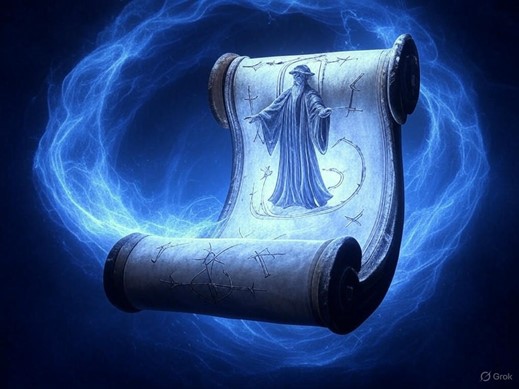
The Scroll of Voidwalk, being a rare and powerful artifact, would not be sold in conventional marketplaces. Its acquisition and sale would occur in specialized environments and through unique channels. Here’s a description of where and how it might be sold:
- Mage’s Tower: Within the towering spires of ancient mage academies or isolated sorcerer’s retreats, the Scroll of Voidwalk might be sold. These mystical environments are home to powerful spellcasters who possess the knowledge and resources to recognize the value of such an artifact. The scroll could be obtained through negotiation, trade, or by proving one’s magical prowess through a challenge or task.
- Planar Crossroads: Located at the intersections of different planes of existence, planar crossroads serve as meeting points for entities and travelers from various realms. In these interdimensional hubs, enigmatic beings, dimensional merchants, or interplanar brokers might offer the Scroll of Voidwalk for sale. These transactions could involve bartering with rare materials, favors, or even performing specific tasks in other planes.
- Black Market of Portals: Within hidden, illicit establishments that cater to the darker side of magic and interdimensional travel, such as the Black Market of Portals, the Scroll of Voidwalk might find its way into the hands of unscrupulous dealers. These shadowy markets operate in secret corners of major cities, hidden realms, or even demiplanes accessible only to those with knowledge of their existence.
Once in possession of the Scroll of Voidwalk, the end results and usage would depend on the character’s intentions and goals. Some possibilities include:
- Tactical Maneuvers: The Scroll of Voidwalk grants characters the ability to strategically position themselves on the battlefield or gain the upper hand in conflicts. It can be used for surprise attacks, flanking maneuvers, or evading enemies by teleporting to advantageous positions.
- Swift Travel and Exploration: The scroll enables characters to travel swiftly and bypass physical barriers, opening new possibilities for exploration. It can be used to access remote locations, hidden dungeons, or even other planes of existence, facilitating quests, gathering valuable information, or retrieving ancient artifacts.
- Rescue and Escape: In dire situations, the Scroll of Voidwalk allows characters to swiftly escape danger or rescue allies. It provides a means of retreat when overwhelmed by enemies, granting a vital lifeline in treacherous encounters.
- Strategic Retreat: The scroll can serve as a tool for strategic retreat, allowing characters to regroup, reassess situations, or lure enemies into advantageous positions. It offers an escape route when faced with overwhelming odds, ensuring survival, and preserving resources.
- Trading and Diplomacy: The Scroll of Voidwalk can be used for diplomatic purposes by quickly traversing vast distances to engage in negotiations, attend crucial meetings, or deliver messages. It provides characters with a means of building alliances, facilitating trade, or solving conflicts efficiently.
- Arcane Knowledge: The scroll’s teleportation spell holds secrets and mysteries tied to the nature of interdimensional travel. Characters who study the scroll can gain deeper insights into dimensional magic, enhancing their understanding of arcane arts and potentially unlocking new spells or magical techniques.
Path of the Void Wanderer
In the shadowed dawn of Saṃsāra, when the islands were but scattered seeds upon the endless sea and the stars wept tears of light into the void, there existed a time when the boundaries between realms were as fragile as a whisper, easily crossed by those who knew the way. It was in this ancient age, long before the gods bound the fates of mortals with their decrees, that the Scroll of Voidwalk was inscribed by a visionary mage named Zorathar, a man who sought to transcend the limits of the physical world. The tale of its creation and the perils it unleashed is one of the most revered legends in the lore of Saṃsāra, its words passed down through the ages, carved into the walls of astral temples and chanted in the rituals of the wise.
Zorathar was a mage of unparalleled ambition, dwelling in the lost city of Astralyn, a metropolis situated in the heart of an astral plane where the skies shimmered with the light of a thousand dimensions. Astralyn was a place of wonder, its streets paved with starlight, its towers reaching into the void, but it was also a place of danger, for the astral plane was a realm of chaos, its energies wild and untamed. Zorathar had come to Astralyn as a young man, seeking the secrets of interdimensional travel, for he believed that the physical world was but a shadow of the greater realms beyond. He spent years studying the energies of the void, learning to harness its power, until he became one of the most powerful mages in the city.
The mages of Astralyn were a secretive group, known as the Order of the Starlit Path, and they sought to transcend the limitations of physical travel, to walk between worlds as easily as one might cross a room. Zorathar, as their greatest visionary, proposed the creation of an artifact that would allow its user to step into the void and emerge at a distant location, bypassing the barriers of the physical world. The Order agreed, and they gathered in the Spire of Eternity, a tower at the heart of Astralyn where the energies of the astral plane were strongest, to begin the work of crafting the Scroll of Voidwalk.
The creation of the scroll was a ritual of immense power, one that required the Order to channel the energies of the void itself. They gathered materials from the farthest reaches of the astral plane: parchment made from the skin of a void serpent, its scales shimmering with the light of the abyss; ink distilled from the tears of a starborn entity, its essence glowing with the power of creation; and silver runes forged from the dust of a fallen comet, their light pulsing with the rhythm of the cosmos. These materials were brought to the Spire of Eternity, where the Order worked in a chamber lit by the glow of the astral plane, its walls shimmering with the reflections of countless realms.
The inscription of the scroll was a labor that spanned decades, for the spell it contained was one of great complexity. Zorathar chanted in a language older than the stars, a tongue he had learned from the whispers of the void itself. The runes he inscribed on the parchment glowed with a silvery light, each one a conduit for the energies of the astral plane. The ink flowed like a river of starlight, each drop carrying the weight of a thousand dimensions. As the ritual reached its peak, the Spire of Eternity trembled, and a vortex of energy erupted from the scroll, spiraling into the sky and tearing a rift in the fabric of the astral plane. The rift drew the attention of the Voidborn, ancient entities who guarded the boundaries between realms, their forms a shifting mass of shadow and light.
The Voidborn descended upon Astralyn, their voices a cacophony of rage, warning Zorathar that the scroll’s magic would disrupt the balance of the realms, creating rifts that could unravel the very fabric of existence. But Zorathar, consumed by his ambition, ignored their warning. He completed the scroll, its runes glowing with the power of the void, and he used it for the first time, stepping into the void and emerging on a distant island in the physical world. The journey was instantaneous, the barriers of distance and space meaningless in the face of the scroll’s magic. Zorathar returned to Astralyn, triumphant, and the Order rejoiced, believing they had created a tool that would allow them to explore the multiverse and bring knowledge to the people of Saṃsāra.
But the scroll’s power came with a cost, one that the Order did not foresee. The rifts it created in the astral plane grew larger with each use, drawing the attention of more Voidborn, their presence a threat to the city. The first to suffer the scroll’s curse was a young mage named Lirien, a woman who had joined the Order after escaping a life of servitude. Lirien used the scroll to teleport to a distant plane, hoping to find a lost artifact, but the rift she created destabilized the void, and she emerged in a realm of chaos, her body wracked with disorientation and her mind filled with the whispers of the Voidborn. She returned to Astralyn, but she was never the same, her spirit weakened by the journey, her body aging years in moments.
Zorathar was shaken by Lirien’s fate, but he refused to abandon the scroll. He continued to use it, teleporting across the planes to gather knowledge and power, each journey creating new rifts, each rift drawing more Voidborn to Astralyn. The city began to crumble, its towers falling into the void, its streets filled with the shadows of the Voidborn. The Order fought to protect their home, but they were no match for the ancient entities, their magic unable to withstand the chaos of the void. Zorathar, in a final act of desperation, used the scroll to teleport the entire city into the physical world, hoping to save it from destruction. The spell worked, but the cost was great: Astralyn was scattered across the islands of Saṃsāra, its pieces lost to time, its people dispersed, their memories of the city fading like a dream.
Zorathar survived the teleportation, but he was a broken man, his body weakened by the energies of the void, his mind haunted by the whispers of the Voidborn. He hid the Scroll of Voidwalk in a forgotten dungeon, its runes still glowing with the power of the void, hoping to keep it from falling into the wrong hands. He lived out his days as a hermit, wandering the islands, his name forgotten, his legacy a warning to those who would tamper with the boundaries of the realms.
Over the centuries, the Scroll of Voidwalk resurfaced many times, each user drawn to its power and humbled by its cost. Some used it to travel great distances, bypassing the barriers of the physical world to reach remote locations. Others used it in battle, teleporting to gain a strategic advantage over their enemies. But all who used it faced the same truth: the scroll’s magic was unstable, its rifts a danger to the fabric of reality, its power a beacon to the Voidborn. The scroll became a legend, a relic of both wonder and caution, sought after by those who craved its mobility and feared by those who knew its history.
The last known wielder of the scroll was a mage named Tharion, who lived four thousand years ago in the city of Starhaven, a metropolis built on the edge of a great chasm. Tharion was a scholar of the arcane, a man who had spent his life studying the mysteries of the multiverse. He acquired the scroll from a planar crossroads, trading a fortune in astral gems for the chance to use it. Tharion used the scroll to teleport to a lost temple, seeking an ancient artifact, but the rift he created drew the attention of a Voidborn, its form a mass of shadow and light. The Voidborn attacked, its power overwhelming, and Tharion was forced to use the scroll to escape, teleporting back to Starhaven. He hid the scroll in a mage’s tower, its light concealed behind wards of protection, hoping to keep it from falling into the wrong hands.
The Scroll of Voidwalk remains a symbol of the power and peril of interdimensional travel, a reminder of the delicate balance between the realms. Those who seek it are warned to use it with care, for its runes hold the power to traverse the void, but also the power to unleash chaos upon the world.
Moral of the Story: The boundaries of the realms are not to be crossed lightly, for to walk the void is to risk the balance of all things, and the scroll that opens the path may lead to wonder, but it also leads to the shadows that dwell beyond.