
From: The Shifting Enigma
Echo of the Shadow Walker
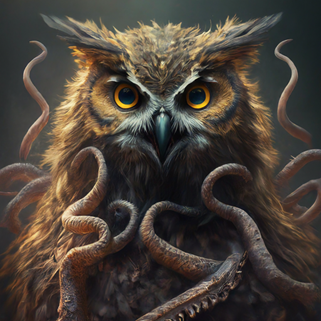
This hulking, malformed creature is composed of mismatched animal parts that shift and blur. It might have the head of a lion on the body of an owl, with tentacles for a tail. The chimera is fiercely territorial, and its presence disrupts the magical fabric of the room, making spells fail unpredictably.
Lore of the Paradoxical Chimera: This abomination was not born but made – a cruel testament to the gnome’s mastery turned madness. In attempting to merge disparate life energies, he crossed boundaries no sane mind should tread. Scraps of stolen vitality, a lion’s roar, an owl’s silent stare, a cephalopod’s grasping hunger – these and more swirl within their grotesque form.
- Unnatural Existence: The Chimera doesn’t function based on biological needs. It’s an echo of broken life forces bound to the shifting currents of arcane energy within the labyrinth. It exists purely to guard a key area, driven by a warped sliver of the gnome’s fractured intent.
- Beacon of Disruption: Its mere presence twists the magical weave. Channeled energy sputters and fizzles within its domain, and raw chaos crackles around it. This isn’t merely a creature, but a walking breach in reality itself.
- Lingering Voices: At times, fragmented cries of the original creatures trapped in its essence break through – ghostly roars, a screech, or pathetic whimpers of creatures whose forms are mangled echoes within.
Paradoxical Chimera: Tier One Stats
- Size: Large (occupies a space roughly 10ft. x 10ft.)
- HP: 30-35
- Armor Class: 14 (patchwork hide, unpredictable anatomy makes targeting difficult)
- Speed: 30 ft.
- Abilities: STR 16 (+3), DEX 12 (+1), CON 15 (+2), INT 4 (-3), WIS 8 (-1), CHA 6 (-2)
- Skills: Perception +3, Intimidation +5
- Damage Resistances: Piercing and Bludgeoning (due to thick, mismatched hide)
- Condition Immunities: Charmed, Frightened, Paralyzed
- Senses: Darkvision 60 ft.
- Challenge Rating: 3-4
Strategy:
- Territorial Guardian: Focused on defending a core area at all costs. Driven by animalistic instinct and the warped sliver of the gnome’s protective intent.
- Shifting Form: Its form constantly morphs, granting and losing different attacking abilities momentarily, adding chaos to combat.
Attacks:
- Bite: +6 to hit, 2d6+3 piercing damage
- Claw: +6 to hit, 2d4+3 slashing damage
- Tentacle Slam: +6 to hit, 1d8+3 bludgeoning damage, potential to grapple on hit (target may attempt a Strength save to break free)
- Unstable Aura (Recharge 5-6): All creatures within a 15ft. radius must make a Wisdom saving throw or have a spell, potion effect, or magical item ability either backfire or simply fizzle with unpredictable results.
Vulnerabilities:
- Radiant Energy: Channels of holy or pure life energy disrupt its malformed existence, dealing double damage.
- Dispel Magic: Successful casting directly on the Chimera can temporarily weaken it (-2 penalty to attacks for 1d4 rounds) or create momentary openings in its defenses.
Tags: Construct (amalgam), Large, Aberrant, Chaotic, Magic Disrupting
Battle Behavior
- Chaos Embodied: Every swing of its mismatched limbs, every gnashing jaw, brings a new configuration. One moment it might lunge with clawed paws, the next whip out stinging tentacles, then rear back to bellow forth an ear-splitting roar. This unpredictability is its strength.
- Disruptive Presence: The Chimera’s aura warps more than just active magic. The terrain itself glitches and stutters during the fight. Floor tiles might sprout grasping vines, gravity momentarily reverses, or spectral versions of the adventurers flicker alongside the real ones.
- Unliving Endurance: This isn’t about survival, but a warped sense of duty. Even mortally wounded, parts of the Chimera might break away and attempt crude forms of attack, gnashing with broken teeth or whipping with severed tentacles. Its final downfall is as horrifying as the battle itself.
Environment: The Chimera is not a roaming creature, but a static terror within the labyrinth:
- Arcane Nexus: It’s found within a room overflowing with raw arcane energy. This power sustains its warped form and amplifies its reality-disrupting aura. The chamber likely warps as the Chimera does, making the battlefield itself the foe.
- Lair of Failed Creations: Some speculate similar chimeras might have existed but collapsed under the strain of their existence. Such unstable creations leave grotesque markers: pools of unidentifiable protoplasm, claw marks on walls fused with feathers, and half-digested relics of unknown origin.
- The Guardian’s Prize: This room likely holds something incredibly valuable for the gnome to warrant such a horrific defense mechanism. Its prize – whether object, chamber, or knowledge – lies beyond the Chimera’s territory.
Defeating the Chimera leaves a scene of visceral chaos, yet even this might have twisted use:
- Raw Arcane Essence: Its form dissipates, leaving a concentrated pulse of unstable magical energy. Handled unwisely, this sparks destructive results, while a skilled arcane manipulator could channel it for a single, immensely powerful (though unpredictable) spell effect.
- Echoes of Life: Fragments of the original creatures remain within the residue: a lion tooth, owl feathers, scales from unknown sources. Such items act as conduits for nature-focused magic, but have a taint of chaos upon them.
- A Broken Shield: With the Chimera gone, the reality-disrupting effects linger for a while, though diminished. This could provide partial temporary cover from divination magic or scrying effects targeting this area.
(Below male and female Paradoxical Chimera are shown.)

Perception of:
- Sight
- Visual Description: This involves the most basic description of the creature: shape, size, color, texture, any unique physical features, how it moves, etc. This is the foundation of understanding what you’re looking at.
- Positives: Provides immediate clues about the creature’s nature (predator, prey, etc.), threat level, potential capabilities.
- Negatives: Limited by lighting conditions, line of sight, and potentially deceptive appearances.
- Sound
- Auditory Description: The noises the creature makes: vocalizations (growls, hisses, roars, speech), movement (footsteps, rustling, slithering), and any other sounds associated with it.
- Positives: Can give clues about the creature’s size, location (even when unseen), emotional state, and actions.
- Negatives: Interpretation can be tricky; sounds can be misleading or masked by surroundings.
- Smell
- Olfactory Description: The scent of the creature. This can be a distinctive animal smell, something foul indicating decay, a metallic odor that hints at machinery, etc.
- Positives: Offers information invisible to the eye, helps establish presence even if hidden.
- Negatives: Highly dependent on wind and environmental factors, sense of smell varies drastically between species.
- Touch
- Tactile Description: The feel of the creature if contact is made: the texture of its skin/fur/scales, the temperature (hot, cold), dampness or dryness, even vibrations generated by the creature.
- Positives: Offers direct information about the creature’s physical makeup.
- Negatives: Requires close proximity, inherently risky/dangerous.
- Taste
- Gustatory Description: This is much less common but could occur if fluids from the creature were sampled – blood, secretions, etc. The taste might be metallic, acrid, sweet, etc.
- Positives: Provides very specific information about the creature’s biology.
- Negatives: Extremely rare as a reliable perception source; potentially carries risk through poisons or disease.
- Extra-Sensory
- Intuitive Sense: A “gut feeling” – a sense of unease, danger, or even peacefulness in the creature’s presence without tangible explanation.
- Positives: Taps into subtle cues or unconscious pattern recognition.
- Negatives: Easily unreliable, prone to personal biases.
- Magical/Psychic Sense: In a fantasy setting, a sense of magical auras, ill intent, or psychic emanations surrounding the creature.
- Positives: Detects the metaphysical nature of a creature, offers insight unavailable to normal senses.
- Negatives: Requires special abilities/powers, interpretation can be complex.
- Intuitive Sense: A “gut feeling” – a sense of unease, danger, or even peacefulness in the creature’s presence without tangible explanation.
- Important Considerations
- No single sense gives a complete picture – combine sensory information for better understanding.
- Perception is fallible. Fear, preconceptions, or lack of experience can bias interpretations.
- The environment influences perception. Darkness obscures sight, loud noises drown out subtle sounds, etc.
Ballad of the Shadow Walker
In the age before ages, when the earth was yet young and the tongue of our elders was like the whisper of unborn winds, there were tales spun of beings neither of light nor darkness. Of these twilight entities, the Shadow Walker was most feared, and most misunderstood.
It was said this creature could slip between the folds of the world, its form ever-shifting. Some nights it tread lightly, an insubstantial mist tracing the curves of trees. On others, it snarled as a wolf with eyes of burning coal, or hissed like a serpent of monstrous size. But always, it remained shrouded in a darkness so deep it swallowed the stars themselves.
Stories were passed from trembling lips of how the Shadow Walker could consume whole villages in a single night, leaving behind naught but chilling silence. In some tellings, its hunger was for flesh; in others, for dreams and starlight whispers. Whole generations cowered under the pale moon, fearful of any flicker of unnatural shadow.
But as centuries wound into the heart of the world, a wrinkle appeared in the tapestry of terror. A lone scholar, drawn to the mystery like a moth to flame, penned a legend different in kind. He told of a time the Shadow Walker did not bring desolation but lingered on the edge of a fire-lit camp. No cries pierced the night, only an unspoken exchange of fear and…something akin to sorrow.
His quill flowed ever on, etching tales of the Shadow Walker as a watcher, a guardian caught between realms. It stood against other threats lurking in the twilight places. Sometimes, a child who wandered too far into the wild was nudged homeward by an unseen force. When armies raged against armies, leaving wounded to bleed upon the moon-kissed battlefield, it was whispered that a gentle darkness carried some from the threshold of death.
Were these simply fanciful inventions of a hopeful heart? Or had centuries of dread obscured the truth of a complex being neither savior nor fiend? The tapestry of history unravels. It is up to each heart to weave their own meaning from the fragmented threads.
Moral of the Story: Fear obscures understanding. Before casting judgment, seek first to know the hidden truths.
Suggested conversions to other systems:
Call of Cthulhu
- Theme: Cosmic horror, the price of forbidden knowledge, sanity versus survival.
- Sanity Cost: Witnessing the Shadow Walker in its shifting forms incites significant Sanity loss (perhaps 1D6 or based on Willpower). Direct interaction or prolonged study carry greater costs.
- Investigation: Research reveals fragments of lore from its Ballad. Finding more complete clues requires delving into occult sources, archaeological sites, or perhaps dreams triggered by a special artifact.
- Stat Block: Emphasize elusiveness & psychological threat. SAN damage on sighting, perhaps temporary penalties to relevant skills/stats as doubt gnaws at investigators. Include shifting physical forms (mist, wolf, etc.) with moderate combat stats to maintain suspense.
Blades in the Dark
- Theme: Murky bargains, the dangers of meddling in the occult, rival gangs exploiting fear for leverage.
- The Whisper: The Shadow Walker is a legendary Whisper, an occult force exploited by the daring. Rituals are rumored to temporarily bind it for protection, intimidation, or assassination… at potentially immense psychological/supernatural cost.
- Clocks: Use clocks to track a ritual, growing rumors of sightings as the ritual nears completion, potential negative consequences (increased Ghost Field Activity, riled rival scores with “supernatural” suspicions).
- Resistance: Resist with Resolve – failures drain stress rapidly, successes may reveal lore clues or glimpses into the nature of the bargain required.
Dungeons & Dragons (5e)
- Theme: High fantasy horror, planar beings. Shadow Walker could be tied to Shadowfell.
- Creature Type: Fey or Aberration could fit its elusive and otherworldly nature.
- Abilities: Invisibility at will, phasing through solid objects, fear aura, perhaps an attack that drains life or temporarily shadows victims. Emphasis on hit-and-run tactics to instill dread.
- Lair Actions: Shifting shadows in its lair cause disorientation and create illusory threats.
Knave
- Theme: Survival horror, desperate heroes. Itemize a few core traits, allowing flexibility in its application by the GM.
- Suggested Traits: Ethereal (Difficult 12 Defense or escape against physical attacks), Chilling Presence (Nearby foes roll Disadvantage on appropriate checks), Shapechanger (Illusion or actual, up to GM interpretation).
Fate
- Theme: Narrative agency, consequences of choices. Emphasize Aspects to drive action.
- Aspects: “Bound Between Worlds,” “Sower of Doubt,” “Hunger Beyond Flesh” are examples that can compel action both for and against PCs.
- Consequences: Use consequences associated with failed rolls to build up psychological strain, doubt, lingering effects of the Shadow Walker’s presence.
Numenera/Cypher System
- Theme: Weird science-fantasy, legacy of a lost civilization, the risks of exploring the ancient unknown.
- Creature Level: Challenging level (5-6+) to reflect its danger and elusiveness.
- Abilities: May be a construct with energy drain attacks, teleportation, phasing through matter. Alternatively, an extra-dimensional entity inflicting Intellect damage with psychic/fear effects.
- Cyphers: Include single-use items that temporarily ward off the Shadow Walker, reveal a weakness, or even glean fragments of its true nature through fleeting mental contact.
Pathfinder (2e)
- Theme: Planar mystery, curses of ancient knowledge, potential ally or implacable foe depending on character actions.
- Creature Type: Aberration or Outsider (Extraplanar), alignment of Chaotic Neutral could fit best.
- Stat Block: Medium Size, high Perception and Stealth, moderate melee with damage based on life drain or bypassing armor. Innate spellcasting (disguise self, darkness, shadow walk)
- Weaknesses: Vulnerability to light-based spells or attacks, possibly disrupted by magical circles or bindings tied to its home plane.
Savage Worlds
- Theme: Pulp action horror, “things man wasn’t meant to know” vibe.
- Hindrances: “Yellow” (cowardly when confronted with the uncanny), “Curious” (drawn to investigate the creature). *New Hindrance: “Shadow Touched” *(haunted by fleeting visions, vulnerable to fear effects).
- Powers: Use existing powers: Bolt (shadow blast), Obscure (area of darkness), Puppet (for subtle manipulation of victims), Teleport, Drain (tied to life essence).
- Setting Rules: The Shadow Walker thrives in areas of Weirdness, gaining strength based on fear present in a location.
Shadowrun
- Theme: Neon-noir conspiracy, the Shadow Walker could be a twisted spirit, dangerous magical experiment, or an AI program run amok.
- Type: Free Spirit (of questionable intent), or a particularly corrupted Shedim.
- Powers: Materialization, Astral Perception, Essence Drain, Illusion spells, Combat Sense to enhance its slippery nature.
- Matrix: If an AI entity, focus on hacking & bypassing security instead of physical manifestations. It could manipulate drones, or leave unsettling, cryptic messages to taunt those attempting to track it.
Starfinder
- Theme: The vast unknown of space holds many enigmatic beings. Shadow Walker could be from the Dimension of Dreams, or a creature formed from living dark matter.
- Creature Type: Aberration, possibly tied to a chaotic neutral deity that embodies twilight and uncertainty.
- Stat Block: Focus on resistances to various energy damage types, phasing ability, attacks that inflict temporary debuffs (blindness, confusion) simulating its disorienting effect.
- Spacecraft Combat: May attack by draining shields, interfering with sensors, or creating ghostly doubles to distract from its true location.
Traveller
- Theme: Focus on discovery & cultural misunderstanding. Players might encounter Shadow Walker on an alien world, where the natives revere or fear it based on their own cosmology.
- Psionics: Treat the Shadow Walker’s abilities as powerful psionic manifestations: Teleportation, Telepathy (for unsettling visions or mental taunts), potential Precognition to make it exceptionally hard to corner.
- Focus on Investigation: Emphasize social skills and deciphering of strange customs & beliefs linked to the origins of the creature. Combat against it should be a last resort when understanding fails.
Warhammer (40K or Fantasy)
- Theme: In 40K, it’s a daemon of the Warp, or corrupted Xenos horror. In Fantasy, a shadowy denizen of Ulgu, the Realm of Shadows.
- Chaos Corruption: Emphasize its ability to cause fear, insanity, and sow discord. Include mutations caused by prolonged exposure to its presence.
- Stat Block: Use existing Daemons of Tzeentch as a foundation for 40K (shapechanging, psychic blasts). For Fantasy, adapt malign spirits of shadows with high Ethereal defense and armor-bypassing attacks.