
From: The Ledgerdome of Mystic Calculus
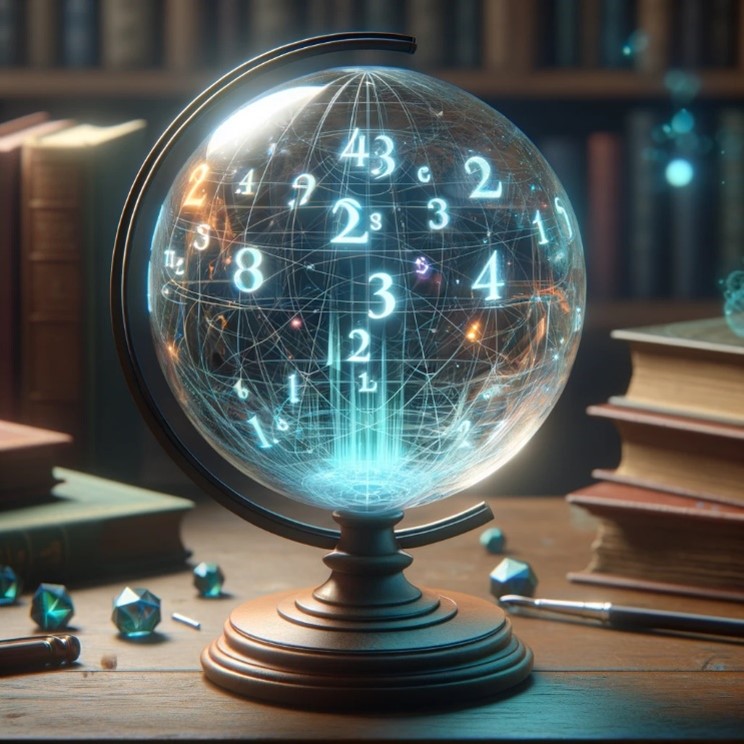
These globes project holographic numerical and geometric figures, allowing students to visualize complex mathematical concepts in three dimensions. They are particularly useful in geomathematics and algorithmic spell crafting courses.
Lore: Numerical Projection Globes, also known as “Orbs of Geomathematic Insight”, were first conceptualized by the renowned mathematician and mage, Archimedes of the Arcane. In his pursuit to merge the tangible with the abstract, Archimedes discovered a way to project mathematical truths into a visible, tangible form. These globes use a combination of ancient geomancy and cutting-edge arcane technology, allowing for the manifestation of mathematical concepts into three-dimensional space.
Crafted from crystal harvested from the enchanted Echoing Caves of Numeria, these globes are infused with elemental magic that resonates with the fundamental laws of mathematics and geometry. The intricate internal mechanism involves an array of magical lenses and ethereal projectors, fine-tuned by skilled artificers to ensure precision and clarity.
Cultural Significance: In the academic realms of Saṃsāra, Numerical Projection Globes are seen as symbols of intellectual enlightenment and the pursuit of higher knowledge. They are often found in prestigious institutions, revered not only as tools of learning but also as artifacts representing the harmonious blend of magic, mathematics, and art. Mastery of these globes is considered a significant academic achievement, reflecting a deep understanding of the universe’s underlying geometrical and numerical nature.
Tier One Stats Gained:
- Intelligence: +4
- Wisdom: +2
- Spatial Awareness: +3
Skills Gained:
- Enhanced Geomathematics: Improves the ability to understand and manipulate geometric and mathematical concepts.
- Advanced Algorithmic Comprehension: Aids in grasping complex algorithms and their applications in spellcrafting.
Effects:
- 3D Visualization: Projects complex mathematical and geometric figures in three dimensions, enhancing understanding and analysis.
- Augmented Learning: Accelerates the learning process in fields related to mathematics, geometry, and spellcrafting algorithms.
- Spellcraft Precision: Improves the precision and efficacy of algorithm-based spellcasting.
Use:
- Educational Tool: Widely used in academic settings for teaching advanced geomathematics and algorithmic spell crafting.
- Research Aid: Assists researchers and arcanists in visualizing and solving complex mathematical problems.
- Spell Design: Used by spellcrafters to design and refine new spells with a strong mathematical component.
Tags: Geomathematics, Algorithmic Magic, Academic Artifact, Magical Tool, Educational Enhancement
The Numerical Projection Globes are invaluable assets in Saṃsāra’s academic circles, offering a unique and immersive way to explore the realms of mathematics and magic. They embody the world’s commitment to blending academic rigor with magical innovation, preparing students and scholars alike for the complex intellectual challenges of their time.
Recipe for Recreating Numerical Projection Globes
- Ingredients Needed:
- Echoing Cave Crystal: Specially harvested crystal from the Echoing Caves of Numeria, known for its ability to resonate with magical and mathematical energies.
- Elemental Magic Essences: Core elements of Fire, Air, Earth, and Water, each attuned to specific geometric and numerical properties.
- Ethereal Projector Lens: Crafted from fine, magically conductive glass, used to project and focus the numerical holograms.
- Arcane Conductive Wiring: Wires made from a blend of silver and mythril, enchanted to transmit magical energies efficiently.
- Luminous Ink: Enchanted ink used for inscribing precise mathematical runes inside the globe.
- Tools Required:
- Geomantic Resonator: A device used to align the crystal with geomantic energies.
- Elemental Infusion Cauldron: For imbuing the crystal with elemental essences.
- Precision Engraving Tools: Necessary for inscribing magical runes on the crystal and lenses.
- Magical Soldering Set: For assembling and connecting the arcane conductive wiring.
- Holographic Calibration Device: To fine-tune the projection and ensure accuracy.
- Skill Requirements:
- Advanced Geomancy: Essential for aligning the crystal with geomantic energies.
- Elemental Magic Proficiency: Required for infusing the crystal with elemental essences.
- Runecraft Expertise: Necessary for engraving mathematical runes with precision.
- Arcane Engineering: Skills in constructing and assembling magical devices.
- Magical Calibration: To adjust the projections for clarity and precision.
- Preparation Steps:
- Crystal Preparation: Use the Geomantic Resonator to align the Echoing Cave Crystal with geomantic energies, preparing it for elemental infusion.
- Elemental Infusion: In the Elemental Infusion Cauldron, imbue the crystal with elemental essences, each corresponding to different geometric properties.
- Runes Inscription: With precision engraving tools, inscribe mathematical runes on the crystal and the ethereal projector lens using luminous ink.
- Assembly: Use the magical soldering set to assemble the arcane conductive wiring, connecting the infused crystal to the ethereal projector lens.
- Calibration: Place the assembled globe in the Holographic Calibration Device, adjusting settings to ensure accurate and clear projections.
- Final Enchantment: Conduct a final enchantment to bind all components together, activating the globe’s full geomathematical and algorithmic potential.
Crafting a Numerical Projection Globe is a complex process requiring a blend of various magical and technical skills. The completed globe stands as a testament to the artisan’s mastery over both the arcane and the scientific, embodying the spirit of intellectual exploration in Saṃsāra.
Distribution and Sale of the Numerical Projection Globe Recipe
Where and How the Recipe is Sold:
- Magical Academies and Universities: The recipe is primarily available in institutions specializing in geomathematics and arcane studies. It’s often shared among academic circles, especially in environments that focus on the integration of magic and science.
- Guilds of Arcane Artificers: Guilds dedicated to the crafting of magical artifacts, especially those with a focus on educational tools, are known to trade or sell the recipe. These guilds maintain high standards for who can access such advanced knowledge.
- Arcane Marketplaces: In larger cities or realms where magical trade is common, the recipe might be sold in specialized marketplaces. Transactions for such high-value recipes are typically conducted in secure and discreet manners.
Environment of Sale:
- Scholarly and Magical Conferences: The recipe is sometimes exchanged at conferences and gatherings of mages, scholars, and artificers, often as part of larger transactions involving knowledge and magical items.
- Private Auctions: Exclusive auctions dealing in rare and powerful magical artifacts and knowledge sometimes include such recipes among their lots.
Cost and Value:
- Cost: Given its complexity and the rarity of some ingredients, the recipe is quite expensive. It’s often traded for other valuable magical knowledge, artifacts, or a significant sum of gold or its equivalent in Saṃsāra’s economy.
- Value: The recipe is highly valued for its educational and practical applications, especially in prestigious academic settings. Owning the recipe is seen as a mark of high status in magical and scholarly communities.
End Results and Usage:
- Educational Tool: The globe is extensively used in academic settings for teaching complex mathematical theories and spellcrafting, making abstract concepts tangible and easier to understand.
- Research: Scholars and researchers use the globe to visualize and solve intricate mathematical problems, and in the development of new spells or magical theories.
- Magical Design and Engineering: Artificers and spellcrafters use the globe in the design and testing of new magical constructs, items, and spells, particularly those requiring precise mathematical understanding.
The Numerical Projection Globe recipe holds significant status in the realms of Saṃsāra, representing a pinnacle of achievement in the fields of magical academia and artifact crafting. Its possession is a testament to an individual’s or institution’s dedication to the pursuit of knowledge and magical innovation.
Perception of the Five Senses and Extra-Sensory Aspects of the Completed Numerical Projection Globe
- Visual Perception:
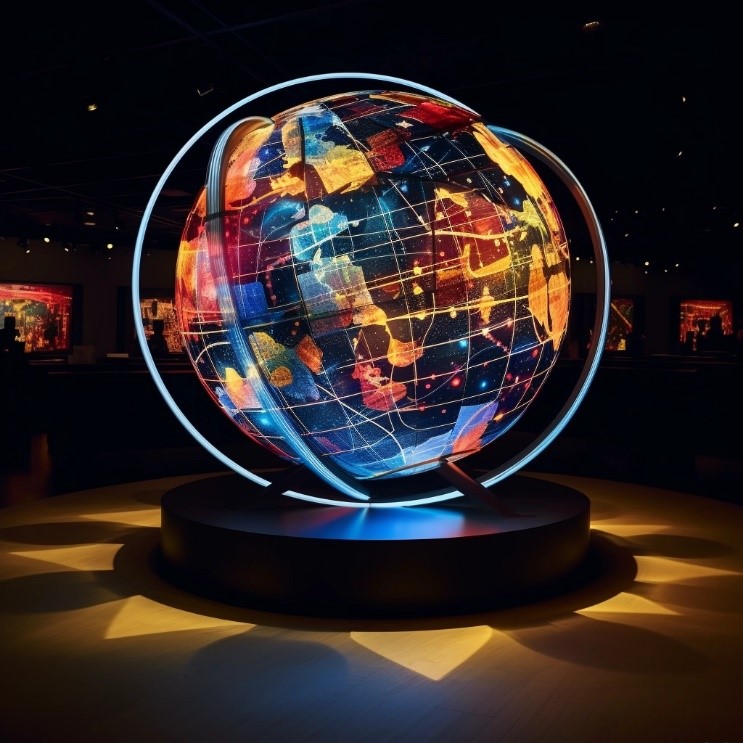
- What is Perceived: The globe emits bright, holographic numerical and geometric figures in three dimensions.
- Description: These projections are vivid and clear, displaying a spectrum of colors as they illustrate complex mathematical concepts.
- Positives: The stunning visual display aids in comprehension and provides an immersive learning experience.
- Negatives: Prolonged exposure to the bright projections might be straining to the eyes.
- Auditory Perception:
- What is Perceived: A soft humming sound emanates from the globe when activated.
- Description: This sound is rhythmic and calming, syncing with the patterns of the projections.
- Positives: The hum can be soothing and enhances concentration.
- Negatives: In a quiet environment, the continuous humming might become a distraction.
- Tactile Perception:
- What is Perceived: The surface of the globe is smooth and cool to the touch.
- Description: The globe has a solid, reassuring weight, indicating its sturdy construction.
- Positives: The quality build and texture provide a sense of durability and value.
- Negatives: The globe might be heavy to handle for some users.
- Olfactory Perception:
- What is Perceived: There’s a faint scent of ozone when the globe is active.
- Description: This smell is reminiscent of the air after a thunderstorm, likely due to the discharge of magical energies.
- Positives: The scent can create an atmosphere of mystique and academic seriousness.
- Negatives: Some might find the ozone smell unusual or slightly unpleasant.
- Gustatory Perception:
- What is Perceived: The globe does not directly engage the sense of taste, but there might be a metallic taste in the mouth when near an active globe.
- Description: This taste is akin to the sensation experienced near active magical fields or equipment.
- Positives: It adds to the overall sensory experience of interacting with a powerful magical tool.
- Negatives: The taste might be off-putting to some.
- Extra-Sensory Perceptions:
- Magical Resonance:
- Perceived: A sense of flowing arcane energy emanating from the globe.
- Description: This energy can be felt as a tingling sensation or a slight vibration in the air.
- Positives: Enhances the user’s connection to the globe’s magical functions.
- Negatives: Sensitive individuals might find the energy flow overwhelming.
- Intuitive Mathematical Insight:
- Perceived: An enhanced understanding and perception of mathematical concepts when interacting with the globe.
- Description: Users report a heightened sense of clarity and comprehension regarding complex calculations and theories.
- Positives: Facilitates deeper learning and appreciation of mathematical principles.
- Negatives: May lead to overreliance on the globe for mathematical understanding.
- Magical Resonance:
The Numerical Projection Globe, upon completion, provides a multi-sensory experience that extends beyond visual learning. It embodies the fusion of magic, technology, and education, making it not just a tool for learning but an artifact of sensory and extrasensory interaction. The positives generally outweigh the negatives, particularly in enhancing the educational and research capabilities of those in the magical realms of Saṃsāra.
The Legend of Archimedes’ Sphere
In an age when the stars whispered secrets to those who dared to listen, there existed a realm bathed in the mystery of numbers and shapes. It was a world where geometry and magic intertwined, casting shadows of knowledge yet to be discovered. In this realm, there lived a sage named Archimedes of the Arcane, whose mind danced with numbers and whose soul sung with the geometries of the cosmos.
The story tells of Archimedes’ quest to capture the essence of the universe in a single object. He sought to create a tool that would unveil the hidden symmetries of creation, a tool that would bridge the mortal mind with the celestial mechanics of the cosmos. Guided by visions in his dreams, Archimedes journeyed to the Echoing Caves of Numeria, a place where reality bent to the will of mathematics.
Within the heart of the caves, under the light of a confluence of celestial events, Archimedes began his work. He took a crystal, clear as the first drop of dawn, and bathed it in the essences of the four elements. He whispered to it the secrets of the stars, and etched upon it runes of power. As he worked, the cave echoed with the music of the spheres, a harmony that resonated with the very fabric of the universe.
When the final rune was set, the crystal glowed with an inner light, projecting figures and forms of exquisite mathematical beauty. It was a globe that held within it the dance of numbers and shapes, a symphony of geometry and light. Archimedes named it the Sphere of Celestial Mechanics, a tool to gaze into the heart of the universe.
Moral of the Story: The Sphere of Celestial Mechanics, known now as the Numerical Projection Globe, stands as a testament to the pursuit of knowledge and the power of understanding. It reminds us that in the quest for understanding the mysteries of the universe, one must harmonize the elements of reality and the abstract, bridging the gap between the known and the unknown. The journey of discovery is not just about finding answers, but about learning to see the harmony in the chaos, the order in the randomness of existence.
Conversion to other systems:
Adaptation for Call of Cthulhu (7th Edition)
Numerical Projection Globes
- Sanity Loss: 0/1D3 (viewing complex projections)
- Effect: Grants +20% to any skill checks involving mathematics, engineering, or geometry. Use in scenarios requiring understanding of complex patterns or puzzles.
Adaptation for Blades in the Dark
Numerical Projection Globes
- Quality: Tier 3
- Effect: Provides +1d to rolls for Tinker when working with complex mechanisms or Study when analyzing patterns. Can attract attention from rival scholars or arcane entities.
Adaptation for Dungeons & Dragons (5th Edition)
Numerical Projection Globes
- Item Type: Wondrous item, rare
- Effect: Grants advantage on Intelligence (Investigation) and Intelligence (Arcana) checks that involve deciphering complex patterns or creating intricate magical constructs.
Adaptation for Knave
Numerical Projection Globes
- Item Type: Magical Item
- Effect: User gains +3 on rolls related to deciphering puzzles, understanding ancient architectures, or crafting complex magical items. Overuse can lead to a temporary -1 on all rolls due to mental fatigue.
Adaptation for Fate
Numerical Projection Globes
- Aspect: “Orb of Mathematical Mastery”
- Effect: Once per session, the user can use the globe to gain a significant advantage in overcoming an obstacle that involves complex calculations or pattern recognition.
Adaptation for Numenera & Cypher System
Numerical Projection Globes
- Level: 4
- Effect: Reduces the difficulty of tasks related to mathematics, engineering, or deciphering complex patterns by two steps. Prolonged use might cause mental fatigue, resulting in a temporary reduction in Intellect Pool.
Adaptation for Pathfinder (2nd Edition)
Numerical Projection Globes
- Item Level: 6
- Type: Wondrous Item
- Effect: Grants a +2 item bonus on skill checks for Engineering, Arcana, or any check involving understanding or creating complex structures or magical formulas. Overuse may lead to a -1 status penalty on these checks until rested.
Adaptation for Savage Worlds
Numerical Projection Globes
- Item Type: Arcane Device
- Effect: Adds +2 to any Knowledge (Mathematics) or Knowledge (Engineering) roll. When used in Dramatic Tasks involving complex problem-solving, it counts as an automatic success with a raise. Continuous use can lead to Fatigue.
Adaptation for Shadowrun (6th Edition)
Numerical Projection Globes
- Type: Magical Focus
- Rating: 3
- Effect: Grants +2 dice for any Engineering or Arcana test that involves understanding or designing intricate structures or magical patterns. Prolonged use may cause 1 point of Stun damage due to mental strain.
Adaptation for Starfinder
Numerical Projection Globes
- Item Level: 5
- Type: Technomagical Item
- Effect: Provides a +2 circumstance bonus on Engineering, Mysticism, and Computers checks involving complex calculations or structures. Excessive use can lead to a -1 penalty to Intelligence-based checks for 1 hour.
Adaptation for Traveller (Mongoose 2nd Edition)
Numerical Projection Globes
- Type: Advanced Equipment
- Effect: Gives a +2 DM to any skill checks involving Astrogation, Engineering, or Science (Mathematics). Continuous use in a single session may result in a -1 DM penalty due to mental fatigue.
Adaptation for Warhammer Fantasy Roleplay (4th Edition)
Numerical Projection Globes
- Type: Enchanted Item
- Effect: Grants a +10% bonus to any Intelligence-based tests involving architecture, engineering, or arcane studies. Prolonged use over an hour requires an Endurance test or suffer 1 fatigue.