
From: The Ledgerdome of Mystic Calculus
These compasses are used in the Geomathematical Conjuration Labs. They help students in precisely aligning and constructing magical geometric shapes, ensuring their spells are perfectly calibrated.
Lore: Geomantic Compasses, also known as “Diviners of the Arcane Matrix,” have their origins in the mystical traditions of the ancient geomancers. Created by the legendary geomancer Eilistraee Starweaver, these compasses were designed to harmonize the art of spellcasting with the laws of geometry and spatial mathematics. Eilistraee discovered that the precision in geometric alignment could significantly enhance the potency and accuracy of magical constructs.
These compasses are crafted from a blend of enchanted metals and rare crystals, each attuned to different elemental energies. They are imbued with spells that allow them to interact with the fabric of magic itself, guiding the caster in shaping and aligning magical energies with geometric perfection.
Cultural Significance: In the magical realms of Saṃsāra, Geomantic Compasses are seen as essential tools for any serious practitioner of magic, particularly those specializing in conjuration and spatial manipulation. They symbolize a commitment to precision and excellence in magical practices. Mastery of the Geomantic Compass is considered a significant academic and practical achievement in magical communities.
Tier One Stats Gained:
- Intelligence: +4
- Wisdom: +3 (in spellcasting and magical construction)
- Dexterity: +2 (for precise spell construction)
Skills Gained:
- Enhanced Geomancy: Improves the user’s ability to understand and utilize geometric principles in magic.
- Precise Spellcrafting: Aids in the accurate construction and calibration of spells, particularly those requiring precise alignments.
Effects:
- Spatial Precision: Enhances the accuracy and efficiency of spells involving spatial and geometric elements.
- Magical Efficiency: Reduces the magical energy required for spells that involve complex geometric constructions.
Use:
- Educational Tool: Widely used in geomathematical and conjuration labs for teaching and practicing advanced spellcrafting.
- Spellcraft and Conjuration: Essential for mages and spellcasters focusing on conjuration, summoning, and spatial magic.
- Magical Research: Assists researchers in exploring new applications of geometry in magical theories and constructs.
Tags: Geomancy, Spellcraft Precision, Magical Tool, Conjuration Aid, Academic Artifact
Geomantic Compasses represent a harmonious blend of ancient geomantic principles and modern magical practices, making them invaluable for those seeking to explore the depths of magical geometry and conjuration in Saṃsāra.
Recipe for Recreating Geomantic Compasses
- Ingredients Needed:
- Enchanted Metals: A blend of metals like silver and mythril, known for their magical conductivity and durability.
- Elemental Crystals: Crystals attuned to different elemental energies (earth, air, fire, water) to enhance the compass’s geomantic properties.
- Mana-infused Ink: Used for inscribing precise magical and geometric runes on the compass.
- Ethereal Glass: A clear, magically-infused glass for the compass face, allowing clear visualization of geomantic lines and shapes.
- Tools Required:
- Arcane Forge: For shaping and enchanting the metals.
- Precision Engraving Tools: Used for detailed work on the metal and glass, including rune inscribing.
- Crystal Attunement Device: For aligning and attuning the elemental crystals to the compass.
- Magical Calibration Gear: Ensures the compass’s accuracy in detecting and aligning geomantic energies.
- Skill Requirements:
- Expert Metalworking: Necessary for crafting the metal components of the compass.
- Runecrafting: Essential for inscribing magical and geomantic runes on the compass.
- Crystal Attunement: For aligning the crystals with specific elemental energies.
- Geomantic Knowledge: Understanding of geometric principles and their application in magic.
- Magical Calibration: Ensuring the compass accurately reflects and interacts with geomantic energies.
- Preparation Steps:
- Metal Crafting: Use the Arcane Forge to shape the enchanted metals into the frame of the compass, ensuring structural integrity and magical conductivity.
- Rune Inscription: Utilize precision engraving tools to inscribe mana-infused ink runes on the metal frame. These runes should align with geomantic principles and magical enhancement.
- Crystal Attunement: Place the elemental crystals in the Crystal Attunement Device, aligning them with their respective elemental energies to enhance the compass’s geomantic sensitivity.
- Assembly: Carefully assemble the metal frame, attuned crystals, and ethereal glass, ensuring all components are properly aligned and secured.
- Calibration: Use the Magical Calibration Gear to fine-tune the compass, ensuring its geomantic readings are accurate and responsive to the user’s intentions.
- Final Blessing: Conclude with a magical blessing or enchantment to activate the compass’s full geomantic capabilities.
Crafting a Geomantic Compass is a meticulous process that combines metalworking, runecrafting, crystal attunement, and geomantic knowledge. The result is a sophisticated tool that enhances the precision and effectiveness of geomantic spellcrafting and research.
Distribution and Sale of the Geomantic Compass Recipe
Where and How the Recipe is Sold:
- Academic and Magical Institutions: The recipe for Geomantic Compasses is often shared among higher educational institutions and magical academies, particularly those specializing in geomancy, conjuration, and spatial magic.
- Guilds of Geomancers and Artificers: Specialized guilds that focus on geomancy and the creation of magical tools are likely places where this recipe can be traded or sold. Access to the recipe is usually granted to guild members or to outsiders who have proven their proficiency in geomancy.
- Arcane Marketplaces and Fairs: In cities or regions known for their magical heritage, the recipe might be available in marketplaces or fairs where artisans and craftsmen gather to sell magical artifacts and recipes.
Environment of Sale:
- Magical Workshops and Symposia: The recipe is sometimes exchanged at workshops or symposia dedicated to the craft of magical tools and artifacts, often as part of larger transactions involving magical knowledge and artifacts.
- Private Dealers and Collectors: The recipe might be sold through private dealers who specialize in rare magical knowledge and artifacts, or it might be part of a collection traded among private collectors.
Cost and Value:
- Cost: The recipe, due to its specialized nature and the rarity of some of its components, is typically expensive. It may be exchanged for other valuable magical knowledge, artifacts, or a significant sum of currency.
- Value: The recipe holds great value in the fields of geomancy and magical tool creation. It is a symbol of prestige and mastery in crafting and using magical devices.
End Results and Usage:
- Educational Tool: The Geomantic Compass is widely used in educational settings, particularly in geomathematical and conjuration labs, for teaching advanced principles of geomancy and spatial magic.
- Magical Construction and Research: Essential for mages and researchers focusing on creating and studying geometrically complex magical constructs and spells.
- Enhanced Spellcrafting: The compass is used by spellcasters and conjurers to enhance the precision and efficacy of their spells, especially those involving spatial and geometric elements.
The Geomantic Compass recipe represents a blend of precision craftsmanship and advanced magical knowledge. Its possession and use are indicative of a deep understanding and mastery of the intricate relationships between geometry, space, and magic in the world of Saṃsāra.
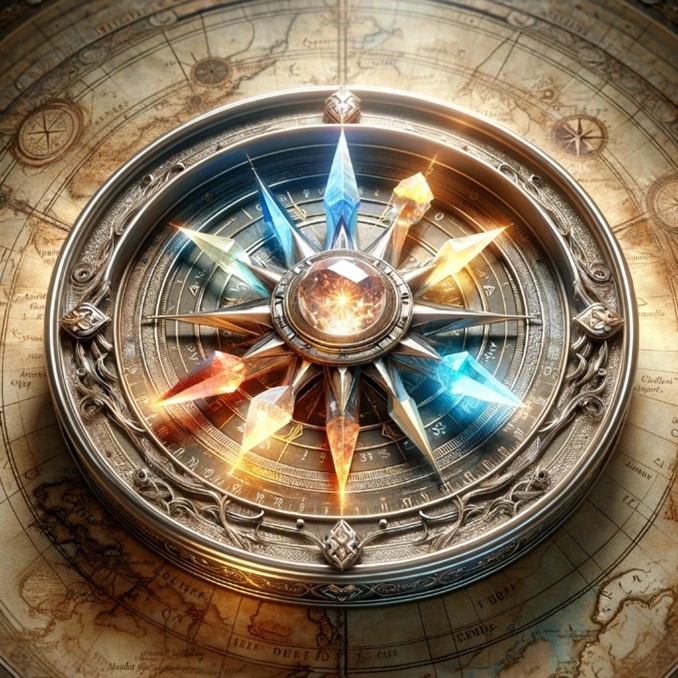
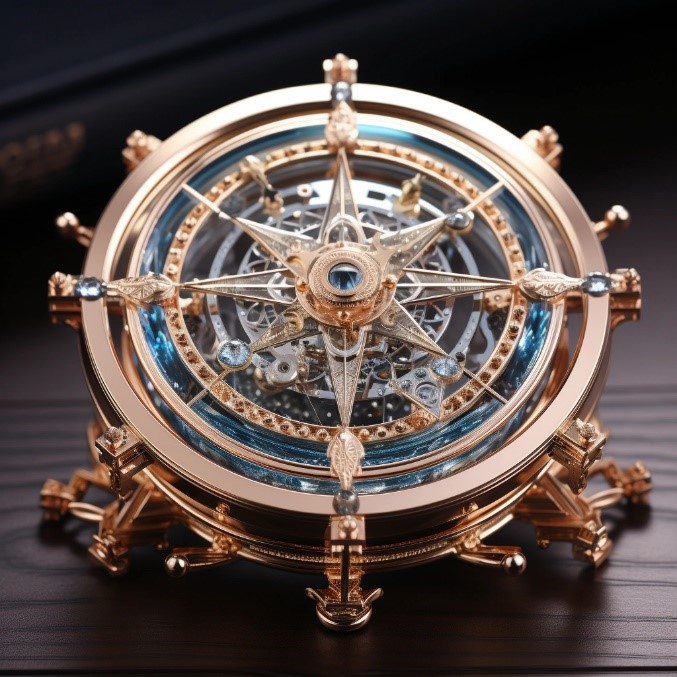
Perception of the Five Senses and Extra-Sensory Aspects of the Completed Geomantic Compass
- Visual Perception:
- What is Perceived: The Geomantic Compass is a visually stunning instrument, featuring an intricate metallic frame and radiant elemental crystals.
- Description: It often exhibits an ethereal glow, especially when aligning with geomantic energies, and the craftsmanship is both elegant and precise.
- Positives: The beauty and intricacy of the compass make it not only a functional tool but also an object of art, enhancing the appeal of geomantic practices.
- Negatives: Its intricate details might be distracting, or its glow could be too bright in dimly lit environments.
- Auditory Perception:
- What is Perceived: A faint, harmonious resonance when the compass aligns with geomantic energies.
- Description: The sound is soothing, akin to a gentle chime that syncs with the natural rhythms of the earth and elements.
- Positives: The auditory feedback can be calming and aids in focusing the mind on geomantic tasks.
- Negatives: The constant humming might become a background distraction during prolonged use.
- Tactile Perception:
- What is Perceived: The smoothness of the metal and the unique texture of the crystals.
- Description: Handling the compass gives a sense of touching something ancient yet sophisticated, a blend of natural and crafted elements.
- Positives: The tactile experience adds to the compass’s usability and deepens the connection between the user and the tool.
- Negatives: Prolonged handling might make the metal feel cold or the crystal edges slightly uncomfortable.
- Olfactory Perception:
- What is Perceived: A subtle scent of minerals and a hint of earthiness, particularly when the compass is used in geomantic practices.
- Description: This scent is reminiscent of rain on soil mixed with a metallic tang, evoking a sense of nature and elemental forces.
- Positives: The smell enhances the grounding experience of working with geomantic energies.
- Negatives: Some users might find the earthy-metallic scent too unusual or distracting.
- Gustatory Perception:
- What is Perceived: Not directly applicable, but users might sense a metallic tang in the air when working intensely with the compass.
- Description: This taste is more of an ambient sensation, associated with the presence of elemental energies and the metallic components of the compass.
- Positives: Adds to the overall sensory experience of using a magical instrument.
- Negatives: The taste might be unexpected or slightly off-putting for some.
- Extra-Sensory Perceptions:
- Geomantic Sensitivity:
- Perceived: An enhanced perception of geomantic energies and alignments when using the compass.
- Description: Users often feel more attuned to the earth and elemental forces, gaining deeper insights into geomantic principles.
- Positives: Enhances the effectiveness and precision in geomantic practices and spellcraft.
- Negatives: Heightened sensitivity may become overwhelming, especially in areas with strong geomantic energies.
- Spatial Awareness:
- Perceived: Increased awareness of spatial relationships and geometrical patterns in the surrounding environment.
- Description: This perception allows for a more intuitive understanding of spatial magic and conjurations.
- Positives: Facilitates the crafting of more precise and effective spatial spells.
- Negatives: Overreliance on the compass for spatial awareness might hinder the natural development of these skills.
- Geomantic Sensitivity:
The Geomantic Compass, as a completed artifact, offers a multi-sensory experience that enhances the practice of geomancy. It embodies a blend of elemental magic and precise craftsmanship, making it not just a tool for geomantic alignment but also an object of sensory and extrasensory interaction.
The Legend of Eilistraee Starweaver and the Compass of the Earth
In an epoch shrouded by the veils of antiquity, within the mystical realm of Arcania, there dwelt a sage renowned for her mastery over the earth’s secrets, Eilistraee Starweaver. Her wisdom was as vast as the oceans and as deep as the roots of the ancient trees. Eilistraee sought to unravel the sacred geometry that underpinned the fabric of reality, to harness the hidden symmetries that lay dormant in the earth’s bosom.
Her quest led her to the heart of the Emerald Forest, where the trees whispered the ancient lore of the earth and the stars sang in celestial harmony. Beneath the canopy of eternal twilight, Eilistraee invoked the spirits of the elements, calling upon their ancient pact to reveal the mysteries of the world.
With hands that wove spells like threads of silk, Eilistraee crafted an instrument of unparalleled precision—a compass that could discern the subtle rhythms of the earth, a diviner of the arcane matrix. She melded enchanted metals with the tears of the stars and infused the compass with the essence of the elemental crystals.
The Compass of the Earth, as it came to be known, was not merely a tool but a conduit of geomantic lore. It resonated with the heartbeat of the world, its needle dancing to the tune of the hidden geometries that wove the tapestry of existence.
Moral of the Story: The tale of Eilistraee Starweaver and her Compass of the Earth endures as a testament to the harmony between the arcane and the natural world. It teaches that true understanding lies in the delicate balance of listening to the earth’s whispers and interpreting its rhythms. The Compass reminds us that in seeking to master the forces of nature, one must first learn to resonate with their essence, for the key to unlocking the universe’s secrets lies in the harmony of the elements and the wisdom to wield their power with respect and humility.
Conversion to other systems:
Adaptation for Call of Cthulhu (7th Edition)
Geomantic Compasses
- Sanity Loss: 0/1D2 (for using in intense geomantic practices)
- Effect: Grants +20% to any skill checks involving Earth Sciences, Occult, or Navigation when the task is related to geomancy or earth magic. Use in scenarios requiring interaction with ley lines or earth energies.
Adaptation for Blades in the Dark
Geomantic Compasses
- Quality: Tier 3
- Effect: Provides +1d to rolls for Attune when working with geomantic energies or during rituals involving the manipulation of the earth or ley lines. Can attract attention from spirits or rival cults.
Adaptation for Dungeons & Dragons (5th Edition)
Geomantic Compasses
- Item Type: Wondrous item, uncommon
- Effect: Grants advantage on Intelligence (Arcana) and Wisdom (Survival) checks related to geomancy, ley lines, and earth magic. Can be used to detect nearby ley lines or earth magic anomalies.
Adaptation for Knave
Geomantic Compasses
- Item Type: Magical Tool
- Effect: Grants a +3 bonus on rolls related to navigation, detecting ley lines, and understanding or using earth-based magic. Can be used once per day to find the shortest path to a desired location on earth.
Adaptation for Fate
Geomantic Compasses
- Aspect: “Conduit of Earth’s Mysteries”
- Effect: Once per session, can be used to gain a significant advantage in a situation involving earth magic, ley lines, or geomantic practices.
Adaptation for Numenera & Cypher System
Geomantic Compasses
- Level: 4
- Effect: Reduces the difficulty of tasks related to navigation, finding ley lines, or using earth-based magic by two steps. Prolonged use might cause disorientation or a temporary reduction in Might Pool due to geomantic overload.
Adaptation for Pathfinder (2nd Edition)
Geomantic Compasses
- Item Level: 6
- Type: Magical Tool
- Effect: Grants a +2 item bonus on Nature, Survival, or Arcana checks related to geomancy or earth magic. Can be used once per day to locate the nearest ley line or magical earth feature.
Adaptation for Savage Worlds
Geomantic Compasses
- Item Type: Magical Device
- Effect: Adds +2 to any Occult or Survival roll related to earth magic, ley lines, or geomancy. Use in Dramatic Tasks involving earth magic adds two successes on a successful roll. Overuse can lead to Fatigue.
Adaptation for Shadowrun (6th Edition)
Geomantic Compasses
- Type: Magical Focus
- Rating: 3
- Effect: Grants +2 dice for any Spellcasting or Conjuring tests involving earth magic or ley lines. Can be used to detect nearby magical earth anomalies or ley lines.
Adaptation for Starfinder
Geomantic Compasses
- Item Level: 5
- Type: Technomagical Item
- Effect: Provides a +2 circumstance bonus on Mysticism checks related to earth magic, ley lines, or planetary energies. Can be used once per day to find the most potent source of earth magic nearby.
Adaptation for Traveller (Mongoose 2nd Edition)
Geomantic Compasses
- Type: Advanced Equipment
- Effect: Gives a +2 DM to any skill checks involving Navigation or Recon on planets with strong ley lines or earth magic presence. Can detect the direction of the nearest ley line.
Adaptation for Warhammer Fantasy Roleplay (4th Edition)
Geomantic Compasses
- Type: Enchanted Item
- Effect: Grants a +10% bonus to any Outdoor Survival or Magical Sense skill checks related to ley lines, geomancy, or earth-based magic. Can be used once per session to locate a hidden source of earth magic or a ley line.