
Level: Tier 1
Stats: None
Skills: Advantage on Sleight of Hand or Performance checks (illusions or trickery)
Cost: 250 gold pieces
Tags: Tools, Magical, Deception, Trickery, Sleight of Hand, Performance, Illusion, Arcane, Craftsmanship, Visual, Sound, Disguise, Misdirection, Subterfuge, Arcana, Artistry
Special: Minor illusion creation without spellcasting
Lore: The Illusionist’s Toolkit is a compact and specialized set of tools and materials crafted specifically for practitioners of illusion magic and deception. It is rumored to have been first created by a legendary illusionist who sought to provide aspiring illusionists with the means to hone their craft and create mesmerizing illusions.
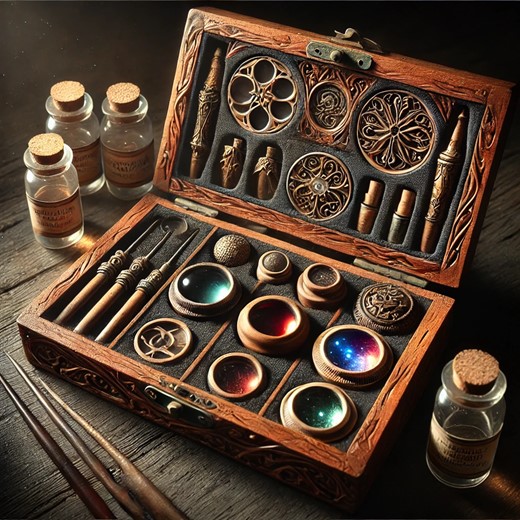
Use: The Illusionist’s Toolkit contains a carefully curated selection of items, including colored lenses, special inks, powders, and small magical devices. These tools are essential for the creation and execution of illusions and trickery. When utilizing the toolkit, the creature gains advantage on Sleight of Hand or Performance checks that involve illusions or deceiving others, reflecting the enhanced capabilities provided by the toolkit’s specialized tools and materials.
Additionally, the Illusionist’s Toolkit allows the creature to create minor illusions without the need for spellcasting. By employing the various items within the toolkit, the user can conjure simple visual illusions, such as small objects or illusory sounds, to further enhance their deceptive capabilities. While these minor illusions may not be as potent as those produced through spellcasting, they still serve as effective tools for misdirection and creating an atmosphere of mystique.
The Illusionist’s Toolkit is a highly prized possession among illusionists, tricksters, and those who rely on subterfuge and misdirection. Its value of 250 gold pieces accounts for the specialized components, craftsmanship, and the magical devices included within the toolkit.
In the world of Saṃsāra, the Illusionist’s Toolkit might be found in various specialized shops, each catering to different aspects of magical, theatrical, and artisan communities. The shops where this item is bought and sold reflect the diverse needs and interests of illusionists, entertainers, and artisans. The pricing of the toolkit varies based on the shop’s location, clientele, and reputation for quality.
- Arcane Curiosity Shops
- Shop Description: These are small, dimly lit establishments often tucked away in alleyways or hidden markets. They specialize in rare magical items, scrolls, and artifacts. The shopkeeper is typically a retired or practicing mage, well-versed in magical arts, especially in illusion and enchantment. Shelves are filled with shimmering objects, crystal orbs, and spell components, creating an air of mystery.
- Cost: 300 gold pieces – In these shops, the Illusionist’s Toolkit is presented as a rare magical tool, often showcased behind glass displays. The higher price reflects the rarity of the toolkit and the shop’s magical expertise.
- Theatrical Prop Emporiums
- Shop Description: These shops are popular with entertainers, actors, and street performers. They are bustling with activity, selling costumes, props, special effects equipment, and makeup. Shopkeepers, usually former or aspiring performers, have a flair for dramatics, constantly showing off the latest gadgets and tricks.
- Cost: 250 gold pieces – Here, the toolkit is sold at its base price, as it is a practical tool for performers. The shop offers various illusion-based props and gadgets for trickery, and the Illusionist’s Toolkit is a prized item among professional illusionists and stage magicians.
- Wizards’ Supply Stores
- Shop Description: Located in major cities or near magical academies, these shops cater to wizards and magic practitioners of all kinds. They carry a wide range of spell components, magical tools, alchemical ingredients, and scrolls. The shopkeepers are usually trained wizards who provide advice on the most effective tools for specific schools of magic.
- Cost: 275 gold pieces – Though primarily catering to traditional magic users, these shops offer the toolkit for those who focus on illusion magic, reflecting the premium placed on high-quality magical craftsmanship.
- Street Markets and Traveling Merchants
- Shop Description: In the bustling street markets of Saṃsāra, merchants from all over the world sell their goods. These vibrant marketplaces offer everything from trinkets to magical artifacts. Traveling merchants, often illusionists or tricksters themselves, sell items like the Illusionist’s Toolkit from their carts or temporary stalls, attracting attention with dazzling displays of minor illusions.
- Cost: 220-240 gold pieces – Sold at a slightly lower price due to the more casual setting, the toolkit is a popular purchase for street performers and adventurers seeking practical illusion tools. Prices are negotiable, especially if the buyer is willing to haggle.
- Craftsmen’s Guilds and Artisan Workshops
- Shop Description: In artisan districts, guilds and workshops dedicated to fine craftsmanship, artistry, and invention can be found. These establishments produce intricate tools for artists, smiths, and alchemists. The shopkeepers are skilled artisans themselves, crafting high-quality magical tools with great attention to detail.
- Cost: 275-300 gold pieces – In these workshops, the toolkit is crafted with care and precision, with some even featuring custom modifications or enhancements for wealthy clientele. The slightly higher price reflects the superior craftsmanship and reputation of the guild.
- Black Market and Shadowy Dealers
- Shop Description: Hidden from the eyes of the law, black market dealers and shadowy vendors sell rare and forbidden items. These shops are frequented by rogues, thieves, and illusionists who value discretion. The shop itself is typically located in the underbelly of cities or in remote locations.
- Cost: 200-230 gold pieces – Here, the Illusionist’s Toolkit can be purchased at a bargain, though it may be slightly used or of dubious origin. The lower price reflects the risk involved in buying from a black market dealer and the questionable nature of the items sold.
Each type of shop reflects the different aspects of Saṃsāra’s culture, from high magic and scholarly pursuits to practical theatrical use and underground dealings. The price and availability of the Illusionist’s Toolkit vary depending on the quality, demand, and location, offering a range of buying experiences.
The Illusionist’s Toolkit can serve as both an offensive and defensive tool in various roleplay scenarios, enabling creative approaches to problem-solving, deception, and combat. Its potential for trickery, subterfuge, and misdirection makes it a versatile asset in a wide range of environments, from bustling cities to dark forests or even deep within ancient ruins.
- Defensive Roleplay Uses
- Urban Environment – City Streets or Marketplaces
- Scenario: A group of city guards is pursuing the illusionist, suspecting them of theft or mischief. Using the Illusionist’s Toolkit, the character quickly creates a minor illusion of a different person or animal standing in their place while they slip away unnoticed. The illusion could be a mundane figure, like a beggar, or a more dramatic decoy, such as a noble or street performer.
- Roleplay: “As the guards close in, the illusionist deftly pulls out a small lens from the toolkit, positioning it to catch the sunlight. A flash of light creates a brief but convincing image of a bewildered old woman standing where the illusionist was moments before, allowing the character to blend into the crowd and vanish into a nearby alley.”
- Wilderness – Dense Forest or Mountain Pass
- Scenario: While being chased by a group of bandits, the illusionist uses the toolkit to conjure an illusory wall of thick brush or fallen trees, giving the appearance of an impassable obstacle. This forces the pursuers to change direction or pause to find a way around.
- Roleplay: “Surrounded by towering trees and rocky outcrops, the illusionist scatters powders from the toolkit, murmuring incantations to create the image of a dense thicket that spans the narrow mountain path. As the bandits approach, they stop, confused, and begin searching for another route, giving the illusionist precious time to escape.”
- Dungeon or Ruins
- Scenario: Exploring a long-abandoned ruin, the illusionist and their group trigger a trap, causing a deadly swarm of mechanical creatures to descend. The illusionist uses their toolkit to create an illusory door or hallway, confusing the swarm and luring it in the wrong direction.
- Roleplay: “As gears whir and the sound of approaching clockwork creatures echoes down the stone corridor, the illusionist dips their fingers into a jar of fine dust from the toolkit. With a wave of the hand, an illusory door appears on the opposite wall, and the mechanical swarm veers toward it, allowing the party to duck into a hidden alcove and wait for the danger to pass.”
- Urban Environment – City Streets or Marketplaces
- Offensive Roleplay Uses
- Urban Environment – Tavern or Public Square
- Scenario: During a tense confrontation with a rival gang or a group of hostile adventurers, the illusionist uses the toolkit to create the illusion of reinforcements, such as additional fighters or city guards, to intimidate the enemy or force them into a hasty retreat.
- Roleplay: “Cornered in a dark alley, the illusionist pulls out a prism from the toolkit, refracting the light from nearby lanterns. Within moments, a dozen heavily armored guards appear at the mouth of the alley. The rival gang freezes in fear, unsure whether to fight or flee, as the illusionist grins, knowing the bluff has bought them a crucial advantage.”
- Wilderness – Ambush or Stealth Attack
- Scenario: The illusionist and their allies are preparing an ambush. Using the toolkit, the character creates an illusion of a lone, vulnerable traveler or bait, drawing the enemy into a trap.
- Roleplay: “The illusionist arranges a few colored lenses from the toolkit on the forest floor, carefully positioning them to catch the fading daylight. Soon, the image of a lone traveler limping along the path appears, enticing the enemy to close in. As they approach, the real ambush is sprung, with arrows and spells flying from the treetops.”
- Dungeon or Combat Arena
- Scenario: In the midst of battle with a powerful foe, the illusionist uses the toolkit to conjure illusory hazards, such as spikes or a pitfall, tricking the enemy into repositioning themselves or retreating into a disadvantageous area.
- Roleplay: “Facing down a hulking monster in the heart of the ancient dungeon, the illusionist quickly grabs a handful of shimmering powder from the toolkit, scattering it toward the stone floor. In an instant, the ground beneath the monster appears to split open, revealing a deep pit lined with jagged spikes. The creature hesitates, taking a step back, giving the party time to regroup and strike.”
- Urban Environment – Tavern or Public Square
- Mixed Offensive/Defensive Uses
- Escape and Evasion – Underground Sewers or Maze
- Scenario: The illusionist is fleeing through an intricate maze or underground sewer system, pursued by enemies. They use the toolkit to create an illusion of multiple pathways, making it harder for their pursuers to follow.
- Roleplay: “Panting from the chase, the illusionist reaches into their toolkit and quickly sprinkles enchanted dust into the damp air. The walls shimmer, and soon the corridor seems to split into three different paths. The pursuers halt, arguing about which way to go, as the illusionist slips silently into a hidden passage.”
- Distraction and Confusion – Marketplace or Castle Hallway
- Scenario: Needing to distract guards or divert attention, the illusionist uses the toolkit to create an illusion of a commotion, such as a loud noise or an illusory crowd, to cover their movements.
- Roleplay: “In the heart of a crowded marketplace, the illusionist discreetly flicks a small wand from the toolkit. A cacophony of shouting erupts from the other side of the square as illusory townsfolk appear to argue over a spilled cart of fruit. The guards rush to break up the disturbance, giving the illusionist the perfect window to slip into the noble’s manor undetected.”
- Escape and Evasion – Underground Sewers or Maze
The Illusionist’s Toolkit allows for a range of creative roleplaying moments, both in combat and social scenarios. Its power lies in the subtle manipulation of perception, turning simple tricks into powerful tools of defense and offense, often without the need for direct confrontation. The character using the toolkit can remain a step ahead of enemies, creating confusion, fear, and misdirection to maintain control over the situation.
Perception of Activation:
- Sight
- Perception: When the Illusionist’s Toolkit is activated, the colored lenses and magical devices within it begin to shimmer faintly. The fine powders and inks glow softly, casting a spectrum of iridescent light that flickers like a mirage. Small, illusionary objects—such as floating wisps of light or faint outlines of creatures—briefly appear and fade in the air.
- Description: These visual effects can be subtle or vibrant, depending on the user’s intent. Small, quick illusions may manifest like wisps of smoke or glittering reflections, while more complex images (such as decoys or shifting landscapes) seem almost real at a glance, blending seamlessly with their surroundings.
- Positives: Creates highly convincing illusions that can deceive enemies or divert attention. The ethereal glow gives an air of mystery and enhances the illusionist’s performance.
- Negatives: Bright or exaggerated illusions may draw unwanted attention, especially in stealth situations. Prolonged use may cause visual fatigue, making it harder to distinguish real from illusory objects.
- Sound
- Perception: Soft, otherworldly whispers accompany the activation, with the faint ringing of bells or chimes as the illusions come into effect. Illusory sounds—like distant footsteps, laughter, or breaking glass—can also be created to add to the deception.
- Description: The toolkit’s sound illusions are often faint and disorienting, designed to make targets question what they are hearing. These sounds can be amplified depending on the illusionist’s skill, creating anything from gentle, ambient noise to loud, sudden distractions.
- Positives: Highly effective for creating confusion, misdirecting attention, or providing cover for an escape.
- Negatives: Overuse may cause echoes or distortions, which can give away the illusion. Some sounds may unintentionally blend together or become too chaotic, leading to disbelief.
- Touch
- Perception: When interacting with the toolkit or its illusions, there is a light, tingling sensation on the skin. Illusory objects may feel real for a brief moment—cool to the touch or warm depending on the illusion—before they vanish.
- Description: This sensation creates a convincing tactile response when handling illusionary objects or surfaces. However, the sensation fades quickly, which can reveal the illusion’s falsehood if inspected too closely.
- Positives: The brief tactile response can sell the illusion effectively in short interactions, especially during quick deceptions.
- Negatives: Prolonged contact reveals the illusion’s falseness. Touch-sensitive beings or creatures with keen senses may detect the lack of substance more quickly.
- Smell
- Perception: A faint scent, often of lavender, sandalwood, or incense, lingers in the air when the toolkit is in use. Illusions may carry mild scents that correspond to their nature—such as the fresh smell of a garden or the acrid scent of smoke.
- Description: Illusory smells are subtle and add an extra layer of depth to the deception. They are usually pleasant or neutral but can be adjusted to mimic more pungent odors if needed.
- Positives: Adds believability to illusions, particularly in environments where scent plays a role (e.g., nature, taverns, or burning structures).
- Negatives: The scent fades quickly, and it can be difficult to mask or maintain a convincing odor for long. Beings with strong olfactory senses may detect the difference sooner than others.
- Taste
- Perception: If the illusion involves food or drink, the taste might momentarily reflect the appearance of the item. Sweet, salty, or bitter flavors may linger on the tongue for a second before fading into nothingness.
- Description: Illusions of food and drink provide a fleeting taste, adding another layer of realism to tricks involving sustenance. This effect is usually subtle and more for theatrical effect than true deception.
- Positives: Useful in tricking targets into believing in a feast or tempting them with false offerings.
- Negatives: The taste fades almost instantly, making it ineffective for long-term ruses or in cases where taste is critical to the deception.
- Extra-Sensory Perception (ESP)
- Magical Aura
- Perception: Those attuned to magic may sense a faint distortion in the magical weave when the toolkit is activated. The air shimmers with an invisible energy, and the illusion’s presence feels like a subtle ripple in the arcane fabric of the surroundings.
- Description: This aura enhances the illusion’s realism for non-magical observers but can be a giveaway to those sensitive to magic. Some might feel the presence of magic as a slight pressure in the air or a tingling in their fingertips.
- Positives: Increases the illusion’s believability for most onlookers. Adds a layer of magical depth that makes the toolkit’s effects harder to detect by average individuals.
- Negatives: Spellcasters or creatures with arcane awareness may quickly sense the illusion’s unnatural nature, making them harder to fool.
- Mental Manipulation
- Perception: Creatures sensitive to telepathy or mind-affecting magic might experience a brief disorientation or mental tug when in the presence of an illusion created by the toolkit. This can manifest as fleeting thoughts or images in the mind, hinting at the falsehood of what they perceive.
- Description: The mental aspect of the illusion can either reinforce its effects or cause subtle discomfort for telepaths or psychics. It creates an artificial layer of reality that interacts with the mind, but prolonged exposure may cause confusion or mild cognitive dissonance.
- Positives: Adds an additional layer of realism for targets not trained in telepathy, helping to anchor the illusion in their mind. Can distract or mislead those who rely on mental acuity to sense reality.
- Negatives: Telepaths or creatures with strong mental defenses might detect this manipulation and reject the illusion more quickly, becoming resistant to its effects.
- Emotional Resonance
- Perception: Empaths or those attuned to the emotional spectrum may sense a faint trace of emotions tied to the illusion. This could be a sense of joy, fear, curiosity, or unease, depending on the illusion’s purpose.
- Description: The illusion can manipulate the ambient emotional atmosphere, subtly influencing those nearby to feel a certain way. This effect is particularly useful in social situations or for non-combat trickery, enhancing the illusion’s persuasive power.
- Positives: Enhances the emotional immersion of the illusion, making it easier to influence targets’ decisions, perceptions, or reactions.
- Negatives: Strong-willed individuals or those with control over their emotions may recognize the artificial nature of the emotional pull, becoming suspicious or resistant.
- Magical Aura
- Positives:
- Creates highly immersive illusions that engage multiple senses, making them difficult to detect by ordinary means.
- Useful for both offense and defense, allowing for flexible and creative applications in combat, social settings, or exploration.
- Enhances the illusionist’s ability to manipulate perceptions in real-time, giving them a strategic advantage in various scenarios.
- Negatives:
- Beings with heightened senses or magical awareness may detect the illusion more easily, especially if they are familiar with illusion magic.
- Prolonged or excessive use of the toolkit can lead to sensory overload, making the user or nearby creatures question reality.
- Some illusions fade quickly or break down under close scrutiny, especially in environments with heightened sensory awareness, like combat or highly alert scenarios.
Crafting Recipe: Illusionist’s Toolkit
- Materials Needed:
- Carved Wooden Box (Rare Wood) – 1
- Must be made from a rare, magical wood such as Ebonbark or Moonwillow to enhance the magical properties.
- Colored Crystal Lenses – 5
- Sourced from naturally occurring magical crystals, such as Prismalite or Aetherglass.
- Arcane Ink – 3 vials
- A special blend of enchanted ingredients, including Shadowsap, Nightshade Oil, and Etherium Dust.
- Illusion Powder – 2 pouches
- Made from finely ground Phantomstone, Fairy Dust, and a pinch of Gleamfish Scales.
- Small Magical Devices – 2
- Includes enchanted mirrors, prisms, and tiny mechanical gears infused with Illusory Magic.
- Binding Charms – 3
- Small enchanted runes crafted from Silverthread and Lunarstone.
- Leather Straps or Silk Lining – 1 roll
- For securing the tools in the box, made from Nightdrake Hide or enchanted Spider Silk.
- Carved Wooden Box (Rare Wood) – 1
- Tools Required:
- Carving Tools – For etching runes and symbols into the wooden box.
- Arcane Foci – A magical tool to channel and infuse energy into the items, such as a Wand of Enchantment or Crystal Orb.
- Alchemy Kit – For blending inks and powders, including Measuring Flasks, Mixing Bowls, and Grinders.
- Jeweler’s Tools – To craft and set the colored lenses and small devices in place.
- Enchanter’s Rune Stone – Used to inscribe and infuse the binding charms with illusion magic.
- Skill Requirements:
- Enchanting (Intermediate) – To infuse items with illusion magic and bind them to the toolkit.
- Alchemy (Basic) – For mixing illusion powders and inks with precision.
- Artisan Crafting (Advanced) – To carve intricate symbols into the wooden box and create the delicate magical devices.
- Jeweler’s Craft (Basic) – To craft and fit the colored lenses and magical mechanisms into place.
- Runesmithing (Basic) – To engrave and activate the binding charms and arcane symbols.
- Crafting Steps:
- Prepare the Wooden Box:
- Using Carving Tools, carefully etch runes and arcane symbols onto the inside and outside of the wooden box. These symbols help channel and store illusion magic.
- Sand the box to a smooth finish, and line the interior with Leather Straps or Silk Lining to secure the items.
- Create the Colored Lenses:
- Using Jeweler’s Tools, cut and shape the Prismalite or Aetherglass into five precisely angled lenses. Each lens should reflect light in a way that distorts reality.
- Embed small illusion runes onto the edges of each lens using the Enchanter’s Rune Stone.
- Mix the Arcane Ink and Illusion Powder:
- Combine Shadowsap, Nightshade Oil, and Etherium Dust in your Alchemy Kit to create three vials of Arcane Ink. Ensure the ink shimmers slightly, signifying its magical properties.
- Grind Phantomstone and Gleamfish Scales together with Fairy Dust to create two pouches of Illusion Powder, which sparkles faintly when disturbed.
- Assemble the Magical Devices:
- Using Jeweler’s Tools, craft two small magical devices: one prism and one enchanted mirror, each no larger than a coin. Insert gears and arcane foci within to allow them to generate minor illusions when activated.
- Test each device by holding them under direct light and ensuring that they refract reality subtly.
- Infuse the Binding Charms:
- Using Silverthread and Lunarstone, craft three small Binding Charms. Engrave each charm with runes using the Enchanter’s Rune Stone and then imbue them with illusion magic by channeling energy through your Arcane Focus.
- Place one charm on the box and attach the other two to specific tools within the kit, like the lenses or ink vials.
- Assemble the Toolkit:
- Arrange the lenses, ink vials, powders, and devices inside the wooden box. Secure each item with Leather Straps or place them in fitted slots.
- Place the Binding Charm on the lid, ensuring that the magical energy flows through the entire kit.
- Channel your energy one final time through the Arcane Focus to activate the binding and complete the enchantment process.
- Test the Toolkit:
- Activate the toolkit by creating a minor illusion, such as a floating image or sound. Ensure that the components work in harmony and that the illusion can be maintained without spellcasting.
- Prepare the Wooden Box:
Upon completing these steps, you will have successfully recreated the Illusionist’s Toolkit, ready to be used for illusions, deceptions, and magical performances.
Tale of the Wandering Light and the Forgotten Box
Long ago, in the days where shadows walked on their own and light was scarce among the lands, there was a humble sorcerer, by name lost but often spoken as He of Fading Voice. This sorcerer was known for neither great power nor mighty deeds but for tricking both men and spirits alike with mere flickers of the hand. His illusions, they say, could turn day into dusk and hide treasures in plain sight. But it was not his power alone that made him feared. No, it was the box, that box of the hidden mind.
The box, small in size and simple in shape, carried inside wonders that none could fathom—lenses that shone like the moon caught in a still lake, inks that flowed like the thoughts of dreamers, and powders light as whispers. Each tool spoke with its own tongue, and together they became the sorcerer’s greatest weapon. But of the box’s creation, no man nor spirit knows, for the sorcerer, it is said, stumbled upon it in a place where earth met sky, a place not found on maps but only in stories forgotten by storytellers.
One tale whispers that the box was made by a trickster god, punished to never again deceive but allowed to place all his craft into an object. Some say it was crafted in the forgotten age of the Silent Ones, whose names the winds refuse to carry. The sorcerer, unwittingly or perhaps knowingly, took the box as his own, and with it, he walked unseen where others could not tread, spoke untruths that none could question, and hid from the eyes of the knowing.
With this Box of Illusions, as it came to be called, the sorcerer wandered from town to town, each place seeing only what he wished them to see. He became a merchant in one land, a king in another, and in yet another, he vanished entirely, leaving nothing but stories behind. For each who thought they met him saw only their own desires or fears reflected. Yet, as time passed, the sorcerer grew weary, for his own eyes became clouded by the many lies he weaved, and he could no longer remember his own face in the mirror.
In his final days, the sorcerer, now known as The Forgotten Light, wished to be seen truly once more, to feel the earth beneath his feet without illusion. He sought counsel from the sages of the winds, but they could not help him. He pleaded with the spirits of the rivers, but they turned away. It was then, they say, that the box began to glow with an inner light, brighter than any he had seen. In his despair, he threw the box away, casting it into the dark abyss of the world, where no hand nor eye could ever find it again.
But the light from the box was too strong to remain hidden. It reached out beyond the abyss, through time and place, and whispers of the sorcerer’s tricks and his wondrous box spread far and wide. Many have since sought the box, for its powers to deceive and conceal are unmatched. But it remains lost, waiting, perhaps, for another wandering soul to find it, as the sorcerer once did.
Moral: What deceives the eyes may one day deceive the heart, and in such lies, even the brightest light may wander forgotten.
Suggested conversions to other systems:
Call of Cthulhu (7th Edition)
Name: Illusionist’s Toolkit
- Type: Magical Artifact
- Description: A compact set of magical tools that allows the user to create minor illusions and trickery. Crafted by an unknown illusionist of old, it is now a rare and sought-after item.
- Stats & Mechanics:
- Uses: The toolkit allows the user to create minor visual and auditory illusions.
- Roll: When using the toolkit, the investigator must succeed in an Art/Craft (Illusion) roll or a Sleight of Hand roll to create convincing illusions.
- On a success, the illusion lasts for 1D10 minutes.
- On a failure, the illusion falters, giving away its false nature.
- Sanity Cost: Using the toolkit too frequently or for darker purposes may incur a 1D3 Sanity loss, as the user’s grip on reality begins to fade.
- Magical Charge: The toolkit holds 1D6 charges, which are used to power illusions. One charge is consumed per illusion. Charges can be recharged through occult rituals, requiring a Cthulhu Mythos roll and 1D4 magic points.
- Positives:
- Grants a +10% bonus to Disguise and Fast Talk when using illusions for deception.
- Negatives:
- If an investigator fails three consecutive Sleight of Hand or Art/Craft checks, they suffer a temporary inability to distinguish illusions from reality.
Blades in the Dark
Name: Illusionist’s Toolkit
- Type: Fine Tool
- Load: 1 (Fine Item)
- Description: A set of small lenses, powders, and arcane devices used to create subtle illusions and trickery. Favored by Whisperers, Shadows, and anyone looking to manipulate perception.
- Mechanics:
- Effect: The toolkit allows the user to push their illusionary effects one tier higher. For example, simple illusions appear more real, and complex illusions last longer or are more difficult to detect.
- Fine Item: Grants increased effect when used with actions that rely on deception, misdirection, or arcane illusion, such as Attune, Sway, or Prowl.
- Special Abilities:
- Illusory Distraction: You can use the toolkit to create an illusory distraction. Roll Attune or Sway with increased effect. On a success, the illusion holds for the duration of the scene or until directly challenged.
- Flashback Option: You may declare a flashback where you used the toolkit to set up an illusion in advance, providing increased effect for an ambush or escape plan.
- Positives:
- +1 to actions involving misdirection or illusion in a controlled situation.
- Negatives:
- If the toolkit is used during a Desperate action and the roll fails, the illusion backfires, causing suspicion or attracting unwanted attention.
Dungeons & Dragons (5th Edition)
Name: Illusionist’s Toolkit
- Wondrous Item (Uncommon, requires attunement by a spellcaster)
- Description: This small, enchanted box contains colored lenses, powders, and arcane devices that allow the user to create minor illusions without the need for spell slots.
- Stats & Mechanics:
- Minor Illusion: The toolkit allows the user to cast the Minor Illusion cantrip at will, even if they don’t know the spell.
- Advantage on Illusion Spells: When using the toolkit to assist with casting illusion spells, the caster gains advantage on any Arcana or Performance checks related to maintaining or improving the illusion’s quality.
- Illusory Misdirection: Once per long rest, the user can use the toolkit to cast Silent Image without expending a spell slot.
- Recharge: The Silent Image ability recharges after a long rest.
- Positives:
- Advantage on Deception or Performance checks that involve illusion-based trickery.
- Negatives:
- The toolkit has no effect on creatures that can see through illusions, such as those with Truesight or the See Invisibility spell.
Knave
Name: Illusionist’s Toolkit
- Type: Magical Item
- Description: A small, portable kit containing various materials and tools for creating illusions. It is often sought after by those who rely on deception and misdirection.
- Mechanics:
- Illusion Creation: The toolkit allows the user to create minor illusions with a 2-in-6 chance of success. The illusions last for 1D6 rounds or until touched.
- Tools of Trickery: The user can create visual or auditory illusions, but not both at the same time.
- Charges: The toolkit has 3 charges. Each use consumes 1 charge. Charges can be restored by spending downtime in a library or magical workshop.
- Failure Consequence: If the illusion fails, it backfires, alerting nearby enemies or causing the illusion to behave unpredictably (e.g., flickering or revealing its falseness).
- Positives:
- If successful, the illusion is highly convincing, allowing the user to use it for distraction or deception.
- Negatives:
- If used repeatedly, the chance of failure increases by 1-in-6 for each successive attempt until the user takes a long rest.
Fate Core
Name: Illusionist’s Toolkit
- Type: Magical Artifact
- Aspects:
- “Tools of the Trickster”
- “Craft Illusions, Shape Reality”
- Description: A finely crafted set of lenses, powders, and mystical tools used to create convincing illusions, favored by those who seek to manipulate perception.
- Stats & Mechanics:
- Create Advantage: The toolkit provides a +2 bonus when used to create an advantage through Deception or Crafting when creating illusions or misdirection.
- Stunts:
- Illusionary Mastery: Once per session, use the toolkit to automatically succeed at a Deceive or Create Advantage roll related to illusion or misdirection, provided the narrative supports the action.
- Convincing Mirage: Spend a Fate point to extend the effect of an illusion, making it last through an entire scene unless disrupted.
- Positives:
- Provides strong narrative control in creating illusions that shift the course of a scene.
- Negatives:
- Opponents can overcome the illusions with a successful Notice or Investigate roll if they suspect trickery.
Numenera & Cypher System
Name: Illusionist’s Toolkit
- Level: 3
- Type: Artifact
- Description: A small kit of lenses, powders, and strange, esoteric devices that allow the user to create highly convincing illusions.
- Stats & Mechanics:
- Effect: The toolkit allows the user to create visual or auditory illusions within immediate range. The illusions last for 10 minutes or until touched, providing distraction or deception.
- Roll: On a successful Intellect-based task (difficulty 3), the illusion is convincing. Failure causes the illusion to flicker or behave erratically, potentially revealing its nature.
- Depletion: 1 in 1D10 – Each use risks depletion, which disables the toolkit until recharged or repaired.
- Minor Effect: The illusion becomes more elaborate or believable, causing confusion or hesitation in affected targets.
- Major Effect: The illusion holds long enough to complete a significant task or deceive even highly perceptive enemies.
- Positives:
- Can be used for creating distractions or deceiving enemies in tense situations, with a wide variety of illusionary effects possible.
- Negatives:
- Depletion means that overuse risks rendering the toolkit unusable without repair.
Pathfinder (2nd Edition)
Name: Illusionist’s Toolkit
- Item Level: 2 (Uncommon, Magical)
- Category: Adventuring Gear
- Bulk: L (Light)
- Description: This compact set of lenses, powders, and arcane instruments allows the user to create minor illusions to deceive, distract, or entertain.
- Stats & Mechanics:
- Minor Illusion (Cantrip): The toolkit allows the user to cast Minor Illusion at will, as if from a wand. The illusion can be auditory, visual, or both.
- Illusion Focus: Grants a +2 circumstance bonus to Deception and Performance checks when creating illusions with the toolkit.
- Illusory Distraction (Once per Day): Once per day, the user can cast Illusory Object as a first-level spell without expending a spell slot.
- Positives:
- Provides a steady resource for illusion spells, along with skill bonuses for illusion-related deception or performance.
- Negatives:
- The item’s effects are limited to basic illusions, and it has no effect on creatures with Truesight or those immune to illusions.
Savage Worlds (Adventure Edition)
Name: Illusionist’s Toolkit
- Type: Magical Item
- Description: A finely made set of colored lenses, powders, and mystical tools that allow the user to create realistic illusions and distractions.
- Stats & Mechanics:
- Effect: The toolkit allows the user to cast the Illusion power without spending Power Points. It provides a +2 bonus to rolls related to Performance or Persuasion when creating illusions.
- Power: The toolkit replicates the effects of the Illusion power but is limited to basic visual or auditory effects (no complex imagery or physical interaction).
- Recharge: The toolkit requires 24 hours to recharge after three uses in a 24-hour period.
- Positives:
- Grants free use of the Illusion power, allowing for multiple uses without the need for Power Points.
- Negatives:
- Limited by a recharge period and cannot replicate physical interaction, making the illusions purely visual or auditory. Creatures with arcane senses or immunity to illusions can easily detect the falseness.
Shadowrun (6th Edition)
Name: Illusionist’s Toolkit
- Type: Magical Gear (Foci)
- Description: A set of finely crafted lenses, powders, and small magical devices used by illusionists to enhance the realism and complexity of their illusions.
- Stats & Mechanics:
- Focus Rating: 3
- Effect: The Illusionist’s Toolkit acts as a Rating 3 Focus for spells within the Illusion category. It provides a +3 dice pool bonus to any Spellcasting tests related to illusions.
- Drain Resistance: Reduces Drain from illusion spells by 2, making it easier to maintain complex illusions without strain.
- Bonding Cost: 9 Karma (Focus Rating × 3).
- Astral Perception: The toolkit faintly glows in the astral plane, alerting those with astral perception to its magical nature. It can be used as a tool in ritual magic to enhance group illusions.
- Positives:
- Provides significant bonuses to illusion-based magic and helps mitigate Drain, allowing illusionists to maintain their spells for longer periods.
- Negatives:
- Requires the user to bond with the toolkit to use its effects. Its astral signature makes it more detectable to astral entities and those with magical perception.
Starfinder
Name: Illusionist’s Toolkit
- Item Level: 4 (Magical Item)
- Price: 2,200 credits
- Bulk: L (Light)
- Description: This kit contains a set of lenses, powders, and compact arcane devices that enhance the realism and detail of illusions, allowing the user to create more believable visual and auditory illusions.
- Stats & Mechanics:
- Effect: The toolkit allows the user to cast the Holographic Image spell once per day. This functions as the spell Holographic Image (2nd level) without the need to expend a spell slot.
- Skill Boost: Provides a +2 enhancement bonus to Bluff or Diplomacy checks when attempting to deceive someone using illusions created by the toolkit.
- Illusory Holo: Once per long rest, the toolkit allows the user to create a small, temporary illusory object (no larger than 1 cubic foot) that lasts for 1 hour.
- Recharge: Requires 24 hours to recharge its daily ability.
- Positives:
- Enhances deception-based abilities and provides a free daily casting of Holographic Image.
- Negatives:
- Limited to one use per day for the Holographic Image ability, and the illusions cannot interact physically with objects or beings.
Traveller (Mongoose, 2nd Edition)
Name: Illusionist’s Toolkit
- Tech Level: 11
- Cost: 50,000 Credits
- Description: This compact toolkit contains a variety of advanced holographic projectors, sound emitters, and sensory disruptors designed to create illusions capable of deceiving even sophisticated sensors and optical systems.
- Stats & Mechanics:
- Effect: The toolkit allows the user to project holographic illusions that mimic real objects, people, or environments. These illusions can deceive visual sensors, thermal detectors, and simple AI systems. It requires a Deception or Electronics (sensors) check (Difficulty 8) to set up.
- Illusory Setup: Takes 10 minutes to set up an illusion. The illusion lasts for up to 1 hour or until interacted with physically. A successful Recon or Electronics (sensors) check by others (Difficulty 8) can reveal the illusion’s false nature.
- Charges: The toolkit holds 5 charges, with each illusion consuming 1 charge. Recharges require 12 hours in a powered environment.
- Positives:
- Effective against low-level AI and basic detection systems. Can be used to create deceptive holograms for infiltration, escape, or misdirection.
- Negatives:
- Illusions are purely holographic and do not hold up to physical interaction. More advanced systems may see through the illusion without requiring a check.
Warhammer 40k (Wrath & Glory)
Name: Illusionist’s Toolkit
- Type: Arcane Tool
- Rarity: Rare
- Keywords: Archeotech, Psyker
- Description: An ancient set of psychic lenses, powders, and mystical devices created in the long-forgotten days of the Dark Age of Technology. It enhances a psyker’s ability to create illusions, manipulating the minds of those around them.
- Stats & Mechanics:
- Effect: The Illusionist’s Toolkit grants a psyker a +2 bonus to any Psychic Mastery tests related to the Illusion Discipline or similar psychic powers.
- Focus: Once per session, the toolkit allows the psyker to create an illusion so convincing that it forces those affected to pass a Willpower test (DN 5) or act as if the illusion is real for the remainder of the scene.
- Warp Hazard: The use of the toolkit increases the chance of triggering a Perils of the Warp by +1 whenever an illusion power is used.
- Positives:
- Provides substantial bonuses to psychic illusion powers and allows for narrative control by creating convincing illusions.
- Negatives:
- Increases the likelihood of invoking Perils of the Warp, making it a risky tool for untrained or reckless psykers. Can lead to severe consequences if things go wrong during psychic use.
Comments
2 responses to “Illusionists Toolkit”
[…] Illusionist’s Toolkit: This compact toolkit contains various tools and materials necessary for creating illusions and deception. It includes an assortment of colored lenses, special inks, powders, and small magical devices. The Illusionist’s Toolkit grants advantage on Sleight of Hand or Performance checks involving illusions or trickery. It also allows the creature to create minor illusions without the need for spellcasting. […]
[…] Illusionist’s Toolkit: The colored lenses and shadow-inks provide the sensory-mapping core. […]