
Lore: In the enchanting realm of Saṃsāra, where art and expression thrive, the Suckerthespian Mask was born from the ingenuity of a group of wandering thespians known as the Echoing Masquerade. These performers had an uncanny ability to adopt the personas of various creatures and beings, drawing inspiration from the unique traits of creatures adorned with circular adhesive suckers. The Suckerthespian Mask was created to allow its wearer to embody different roles with unparalleled authenticity.
Description: The Suckerthespian Mask is an exquisite half-mask made from a delicate blend of polished wood and iridescent materials. It features an arrangement of circular plates designed to resemble the adhesive suckers found on creatures like octopuses and leeches. The mask is ingeniously designed to adhere gently to the wearer’s face, evoking an otherworldly aura that enhances their acting abilities.
Stats:
- Rarity: Common
- Level Requirement: Tier 1
- Acting Bonus: +1
- Slots: Face
Color: The Suckerthespian Mask comes in an array of captivating hues, ranging from deep oceanic blues to shimmering shades of silver and gold.
Cost: 30 gold pieces
Tags: Acting, Disguise, Adhesive, Performance, Persona, Expression, Theater, Mimicry, Charisma, Artistry, Masquerade
Use: When a character dons the Suckerthespian Mask, their capacity for adopting various roles and personas is greatly enhanced. The adhesive properties of the circular plates create a subtle connection between the mask and the wearer’s expressions, allowing them to convey emotions and mimic the mannerisms of different characters with remarkable authenticity.
Additional Information:
- The Suckerthespian Mask can be worn over the upper half of the face, leaving the lower half open for speech and expression.
- While the mask enhances acting abilities, it does not provide the wearer with any magical or supernatural abilities to transform physically into the creatures they mimic.
- The mask’s adhesive effect is not strong enough to hinder the wearer’s ability to remove it easily. It can be taken off and put on swiftly.
- Characters with a creative flair might customize their Suckerthespian Mask by adding intricate designs, gemstones, or additional elements that tie into their preferred acting personas.
- As characters progress in their acting skills and abilities, they might seek out enchantments or enhancements to further amplify the mask’s effects.
Roleplaying Emphasis: The Suckerthespian Mask places a spotlight on the character’s dedication to the art of acting. Wearers of this mask might exhibit a sense of mystery and allure, embodying a myriad of personas and characters that captivate audiences. Whether adopting the persona of a charismatic noble, a mischievous imp, or a wise old sage, the Suckerthespian Mask becomes a powerful tool in the hands of those who wish to immerse themselves fully in their roles and captivate the hearts and minds of those who watch their performances.
The Suckerthespian Mask, a common Tier 1 item in the world of Saṃsāra, costs 30 gold pieces and enhances acting abilities with a +1 Acting Bonus. Designed for thespians, it appeals to performers, artists, and those who thrive on expression and roleplay. Given its purpose and the cultural context of Saṃsāra—a high-magic, steampunk-inspired world with a medieval-to-Renaissance societal structure—the mask is likely to be found in shops catering to entertainers, artisans, and adventurers who value performance. Below is a detailed exploration of the types of shops where this item might be bought and sold, their characteristics, locations, and transaction methods, along with the cost in each context, reflecting Saṃsāra’s diverse trade and cultural systems.
- Theater Outfitters and Performance Halls
- Description: These shops are vibrant hubs for performers, located within the cultural districts of Saṃsāra’s megacities or floating market platforms. They supply costumes, props, and accessories like the Suckerthespian Mask, catering to actors, bards, and traveling troupes. The interiors are adorned with colorful fabrics, mirrors, and steam-powered mannequins displaying outfits. Performance halls often have attached shops, where thespians gather to rehearse and trade gear. The air is filled with the sound of laughter, music, and the hum of magical circuits powering stage lights.
- Where Found: Common in somewhat safe areas (where AC is doubled), such as walled towns or larger cities with thriving arts scenes. They are especially prevalent in metropolises with millions of souls, like those on the 73 island countries, or in floating cities where airships deliver performers.
- How Bought and Sold:
- Buying: The Suckerthespian Mask is displayed on a velvet pedestal, its iridescent hues catching the light of steam-powered lamps. Shopkeepers, often retired performers, may ask buyers to perform a short improvisation to prove their dedication to the craft before selling. Payment is made in gold pieces, counted on a mechanical scale, with transactions recorded in a steam-powered ledger. In busy shops, a small crowd of actors might gather to watch the sale, applauding the buyer’s performance.
- Selling: Sellers present the mask to the shopkeeper, who inspects its polished wood and adhesive plates using their Mind’s Eye to verify authenticity. They may ask the seller to demonstrate its acting enhancement by adopting a persona. Offers range from 18-22 gold pieces, ensuring a profit margin. Sellers who perform exceptionally during the demonstration might secure 25 gold pieces, as the shopkeeper sees value in the mask’s history of use.
- Cost:
- Buying: 30 gold pieces standard, though in prestigious performance halls in megacities, the price might rise to 35 gold pieces due to high demand from professional thespians.
- Selling: 18-22 gold pieces, with well-maintained masks or those with notable performance histories fetching up to 25 gold pieces in cultural hubs.
- Artisan Markets and Festival Bazaars
- Description: Open-air markets in Saṃsāra’s trade cities are lively with color and sound, where artisans sell handcrafted goods, including masks, costumes, and magical trinkets. Stalls are decorated with banners and illuminated by magical circuits, with steam-powered carts vending snacks to festival-goers. Artisans specializing in performance gear craft items like the Suckerthespian Mask, often showcasing their work during theater festivals or cultural celebrations. These markets attract a diverse crowd, from local performers to travelers arriving by hot air balloons or griffons.
- Where Found: Found in normal areas (where AC is standard), such as coastal trade cities or floating market platforms, and in somewhat safe areas within walled towns, especially during festivals celebrating Saṃsāra’s arts and history.
- How Bought and Sold:
- Buying: The mask is displayed at a stall dedicated to performance accessories, its oceanic blues and shimmering silver drawing attention. Merchants, often artisans themselves, describe the mask’s origins with the Echoing Masquerade, encouraging buyers to try it on and perform a brief scene. Haggling is expected, with gold pieces exchanged after a lively negotiation. Some merchants accept bartered goods, like minor props or costumes, in lieu of coin.
- Selling: Sellers approach artisans who recognize the mask’s value, often demonstrating its acting enhancement by adopting a persona on the spot. The merchant offers 15-20 gold pieces, cautious of market saturation. A seller who captivates a crowd during their demonstration might secure 22 gold pieces, as the merchant sees potential for resale.
- Cost:
- Buying: 28-32 gold pieces, with skilled hagglers securing it for as low as 28 in competitive markets.
- Selling: 15-20 gold pieces, occasionally 22 if the mask is in pristine condition or tied to a notable performance.
- Traveling Performance Caravans
- Description: These nomadic troupes of thespians, musicians, and dancers travel Saṃsāra’s islands in steam-powered wagons or zeppelins, performing in villages and ruins alike. Their caravans double as mobile shops, with interiors packed with costumes, instruments, and items like the Suckerthespian Mask. Exterior banners proclaim their shows, and they set up temporary stages in clearings or near trade routes, offering their wares to locals and adventurers.
- Where Found: Found in normal or unsafe areas (where AC is halved), such as backwoods, jungles, or uncharted islands. They avoid deathly areas due to the risk but frequent places where performances can draw crowds, like near ruins or small islands.
- How Bought and Sold:
- Buying: The mask is presented during a caravan’s performance break, often as part of a dramatic reveal in a play. Buyers must earn the troupe’s favor, perhaps by joining an impromptu performance or sharing a story. Transactions involve gold pieces, counted carefully due to the caravan’s transient nature, or bartered props and costumes if coin is scarce.
- Selling: Sellers must impress the troupe, often by using the mask to perform a scene that resonates with the caravan’s themes. Offers range from 16-20 gold pieces, with higher prices (up to 23) if the mask has been used in a notable performance. The troupe may trade costumes or tickets to their next show instead of gold.
- Cost:
- Buying: 32-36 gold pieces, reflecting the caravan’s remote operations and the mask’s appeal to performers.
- Selling: 16-20 gold pieces, or equivalent value in bartered goods, with exceptional masks fetching up to 23 gold pieces.
- Adventurers’ Guild Halls
- Description: Guild halls in Saṃsāra cater to adventurers who often double as performers, using their skills to entertain or deceive. These halls, located in port cities or near airship docks, stock gear for both combat and roleplay, including items like the Suckerthespian Mask. The interiors are rugged yet lively, with steam-powered contraptions organizing inventory and walls decorated with trophies from past quests. Guild members trade tales of their exploits, and some halls host small stages for performances.
- Where Found: Found in normal areas, like port towns or trade hubs, and somewhat safe areas in larger cities, especially where adventurers gather before expeditions across the 73 island countries.
- How Bought and Sold:
- Buying: The mask is displayed alongside other roleplaying gear, such as cloaks or enchanted instruments. Adventurers can test its fit and adhesive plates, which glow faintly when viewed with the Mind’s Eye. Transactions are straightforward, with gold pieces exchanged after a quick negotiation. Some guild halls offer discounts to members, reducing the price slightly.
- Selling: Sellers must prove the mask’s authenticity, often by demonstrating its acting enhancement in a guild hall performance. The shopkeeper offers 17-21 gold pieces, considering its utility for adventurers who use disguise or persuasion. Masks with a history of successful deceptions might fetch 24 gold pieces.
- Cost:
- Buying: 30 gold pieces standard, with guild members paying 28 gold pieces as a perk.
- Selling: 17-21 gold pieces, with higher offers (up to 24) in guild halls valuing performance gear.
- Temple Theaters and Cultural Sanctuaries
- Description: Temples dedicated to gods of art, expression, or trickery often maintain theaters and cultural sanctuaries where performances are acts of worship. These serene spaces, filled with the hum of magical circuits and the scent of incense, are staffed by priests who view acting as a divine art. Attached shops sell items like the Suckerthespian Mask, often used in sacred plays. The theaters are hidden within temple complexes, accessible to those who honor the gods of performance.
- Where Found: Located in designated safe areas (where AC is tripled), such as guarded temple districts in megacities or fortified island monasteries. They are rare outside these sanctuaries due to their sacred nature.
- How Bought and Sold:
- Buying: The mask is offered to those who demonstrate reverence for the art of performance, often through a ritual act or a short performance for the priests. Buyers pay in gold pieces, which are blessed before being stored in temple vaults. The transaction is solemn, with the priest emphasizing the mask’s role in sacred plays. Prices are fixed to honor its sanctity.
- Selling: Selling requires a formal petition to the temple, with the seller explaining their reason for parting with the mask. If accepted, the temple offers 20-23 gold pieces, valuing the item’s artistic significance. The mask is then archived or resold to a worthy performer.
- Cost:
- Buying: 30 gold pieces, with no haggling permitted due to the temple’s reverence for the item.
- Selling: 20-23 gold pieces, reflecting the temple’s commitment to preserving such items for future performances.
- Additional Notes on Transactions
- Currency: Gold pieces are standard across Saṃsāra, often stamped with symbols of the 73 island countries or artistic motifs. In remote areas or festival markets, bartering with minor props, costumes, or services (like performing a scene) is common.
- Authentication: The Mind’s Eye is used to verify the mask’s authenticity, revealing its +1 Acting Bonus and connection to the Echoing Masquerade. In unsafe areas, additional proof may be required to avoid counterfeit items.
- Cultural Context: The Suckerthespian Mask is highly valued in artistic and adventuring circles but less so among common folk who prioritize practical gear. In cultural hubs, its price may rise during theater festivals or after a notable performance by the Echoing Masquerade.
- Transport: Shops in port cities or airship hubs receive masks via trade routes, while traveling caravans and temple theaters rely on their own networks. In underwater cities or cave systems, the mask might be rarer, increasing its cost by 5-10 gold pieces.
This detailed breakdown covers the primary venues where the Suckerthespian Mask is bought and sold, reflecting Saṃsāra’s vibrant performance culture and intricate trade systems.
The Suckerthespian Mask, a common Tier 1 item in the world of Saṃsāra, grants a +1 Acting Bonus and enhances the wearer’s ability to adopt various roles and personas with authenticity. Crafted by the Echoing Masquerade, this half-mask made of polished wood and iridescent materials adheres gently to the face, amplifying expressions and mannerisms. While its primary function is performance-based, creative roleplaying allows characters to use the mask for defensive and offensive purposes in diverse environments, leveraging its acting enhancement and the Mind’s Eye ability. Below is a detailed exploration of how characters might roleplay the Suckerthespian Mask for defense and offense across Saṃsāra’s safety levels—designated safe areas, somewhat safe areas, normal areas, unsafe areas, and deathly areas. The descriptions align with Saṃsāra’s high-magic, steampunk-inspired setting, its cultural emphasis on performance, and the mechanics of the Mind’s Eye.
Roleplaying the Suckerthespian Mask: General Context — The Suckerthespian Mask’s core ability is to enhance acting, making it ideal for deception, persuasion, and impersonation. Defensively, it can be used to mislead enemies or avoid conflict by adopting convincing personas, while offensively, it can manipulate foes or inspire allies through performance. The Mind’s Eye complements these uses by providing insights into creatures or concepts, which the character can incorporate into their roleplay. Roleplaying emphasizes the character’s identity as a performer, exuding charisma and mystery, and using the mask’s adhesive plates to amplify their expressions in varied environments.
- Designated Safe Areas (AC Tripled)
- Environment Description: These heavily guarded areas, such as temple theaters, fortified cultural sanctuaries, or academic enclaves in megacities, are havens where conflict is rare but not impossible. The environment is structured, with steam-powered stage lights, magical wards, and attentive guards. Temples of art gods or performance halls are common, filled with props and costumes, and the air hums with the energy of rehearsals.
- Defensive Roleplay:
- Scenario: During a sacred play in a temple theater, a rival troupe attempts to sabotage the character’s performance by accusing them of theft, risking expulsion. The character dons the Suckerthespian Mask and adopts the persona of a revered priestess, using the mask’s acting enhancement to deliver a heartfelt monologue denying the accusation. They perform with such authenticity—gestures graceful, voice trembling with feigned sorrow—that the audience and priests believe them, defusing the situation. They might say, “I, High Priestess Vaelora, swear by the gods of art, I am innocent of this crime!”
- Mechanics: The +1 Acting Bonus grants an advantage on a Charisma (Performance) roll (if using a D&D-like system) or enhances the believability of the persona, ensuring the deception succeeds. The tripled AC ensures the character is safe from physical retaliation, allowing them to focus on verbal defense. The Mind’s Eye might passively reveal the rival troupe’s motivations, aiding the character’s improvisation.
- Roleplay Flavor: The character adjusts the mask, its iridescent hues shimmering under stage lights, as they fully embody the priestess, their eyes glistening with unshed tears, captivating the audience with their performance.
- Offensive Roleplay:
- Scenario: In a formal acting competition within a cultural sanctuary, the character faces a smug opponent who mocks their skills. Using the mask, they adopt the persona of a legendary warrior from Saṃsāra’s history, delivering a ritual-chanted monologue (over 6 seconds) that intimidates their rival into faltering. They name the warrior to double the effect, saying, “I am Thalric the Bladebound, and your words are but dust before my legacy!” The opponent, shaken, performs poorly, conceding the competition.
- Mechanics: The +1 Acting Bonus enhances the intimidation, potentially granting an advantage on a Charisma (Intimidation) roll. The ritual chant increases the effect by up to 25%, and naming the warrior doubles it, making the performance psychologically devastating. The safe environment ensures no physical backlash.
- Roleplay Flavor: The character’s mask glints with silver and gold, their voice booming with the warrior’s authority, as they stride across the stage, embodying a historical figure with such intensity that the audience gasps.
- Somewhat Safe Areas (AC Doubled)
- Environment Description: Walled towns or bustling city districts, such as trade hubs or theater quarters, offer moderate safety. These areas are alive with performers, merchants, and airship docks, but threats like thieves or jealous rivals can emerge. The environment mixes stone architecture with steam-powered machinery and magical circuits, with stages set up in squares for public performances.
- Defensive Roleplay:
- Scenario: In a crowded city square, a thief targets the character during a street performance. Using the Suckerthespian Mask, the character quickly adopts the persona of a city guard, barking orders with authority, “Halt, thief! By the captain’s decree, you’ll face justice!” The thief, deceived by the authentic tone and mannerisms, flees without stealing, believing the character to be a real guard. The Mind’s Eye passively reveals the thief’s nervous demeanor, confirming their susceptibility to intimidation.
- Mechanics: The +1 Acting Bonus enhances the deception, potentially granting an advantage on a Charisma (Deception) roll. The doubled AC provides a buffer against a potential attack, allowing the character to focus on their performance. The mask’s adhesive plates amplify their stern expression, selling the persona.
- Roleplay Flavor: The character tilts their head, the mask’s oceanic blues catching the light, as they square their shoulders and adopt a commanding stance, their voice cutting through the crowd’s noise with the authority of a guard.
- Offensive Roleplay:
- Scenario: During a tavern performance, a heckler disrupts the character’s act, threatening to ruin their reputation. The character uses the mask to adopt the persona of a mischievous imp, taunting the heckler with a normal-chanted spell (under 6 seconds) that mocks their behavior, naming the imp to double the effect: “Little imp Zorak sees your folly, fool!” The crowd laughs, and the heckler, humiliated, storms off, leaving the character victorious.
- Mechanics: The +1 Acting Bonus aids the performance, potentially granting an advantage on a Charisma (Performance) roll to sway the crowd. The spell’s true-name effect doubles its impact, ensuring the heckler’s embarrassment. The doubled AC protects against a potential bar brawl.
- Roleplay Flavor: The character’s mask shimmers with gold, their eyes twinkling with mischief as they dance around the heckler, their voice high-pitched and teasing, embodying the imp with infectious energy that wins the crowd’s favor.
- Normal Areas (Standard AC)
- Environment Description: Most of Saṃsāra’s world, including trade roads, coastal villages, or uncharted islands, falls into this category. These areas are diverse, with open seas, jungles, or ruins, and threats like pirates or monsters are common. Magic flows freely, and steam-powered ships or griffons are used for travel, often with performers entertaining onboard.
- Defensive Roleplay:
- Scenario: On a trade ship crossing the endless ocean, pirates board, seeking to capture the crew. The character uses the Suckerthespian Mask to adopt the persona of a fearsome pirate captain, speaking with a gravelly voice and commanding presence, “I be Captain Voryn, scourge of these seas—stand down, or taste my steel!” The pirates, deceived, hesitate, giving the crew time to rally and repel the invaders. The Mind’s Eye might actively reveal (after a few minutes) the pirates’ fear of legendary captains, informing the choice of persona.
- Mechanics: The +1 Acting Bonus enhances the deception, potentially granting an advantage on a Charisma (Deception) roll. Standard AC means the character must be cautious, relying on their performance to avoid direct combat. The mask’s adhesive plates amplify their menacing expression.
- Roleplay Flavor: The character adjusts the mask, its silver hues glinting in the sunlight, as they swagger across the deck, their voice booming over the waves, fully embodying the pirate captain with a menacing glare.
- Offensive Roleplay:
- Scenario: In a coastal village, the character encounters a corrupt official extorting locals. During a public performance, they use the mask to adopt the persona of a wise sage, delivering a ritual-chanted speech (over 6 seconds) that exposes the official’s crimes, naming the sage to double the effect: “Sage Lyrion sees your greed, oppressor—face the people’s wrath!” The crowd, inspired, turns on the official, forcing them to flee.
- Mechanics: The +1 Acting Bonus enhances the speech, potentially granting an advantage on a Charisma (Persuasion) roll to rally the crowd. The ritual chant increases the effect by up to 25%, and the true name doubles it, ensuring the crowd’s reaction. Standard AC requires vigilance against retaliation.
- Roleplay Flavor: The character’s mask glows with deep blue, their voice calm and authoritative as they stand tall, gesturing with the wisdom of a sage, their performance stirring the crowd into action.
- Unsafe Areas (AC Halved)
- Environment Description: These perilous regions, such as dense jungles, forgotten ruins, or contested borders, are filled with danger. Monsters, traps, or hostile factions lurk, and the environment is harsh, with crumbling structures or volatile magical weather. Traveling performance caravans often pass through, performing for locals despite the risks.
- Defensive Roleplay:
- Scenario: In a jungle clearing, a monstrous beast attacks the character’s caravan during a performance. The character uses the Suckerthespian Mask to adopt the persona of a revered beast-tamer from Saṃsāra’s history, speaking in soothing tones, “I am Klythera, friend of all creatures—calm, great one.” The beast, momentarily deceived, hesitates, allowing the caravan to escape. The Mind’s Eye passively reveals the beast’s territorial nature, guiding the choice of persona.
- Mechanics: The +1 Acting Bonus enhances the deception, potentially granting an advantage on a Charisma (Deception) roll to calm the beast. Halved AC makes the character vulnerable, requiring quick thinking to avoid a fight. The mask’s adhesive plates amplify their gentle expression.
- Roleplay Flavor: The character kneels, the mask’s gold hues reflecting the jungle’s dim light, as they extend a hand, their voice soft and melodic, embodying the beast-tamer with serene confidence.
- Offensive Roleplay:
- Scenario: Facing a rival adventurer in a ruined theater, the character uses the mask to adopt the persona of a vengeful spirit, delivering a silent-chanted spell (25% less damage) to unnerve their opponent, naming the spirit to double the effect: “Spirit of Eryndor curses you!” The rival, shaken by the eerie performance, fumbles their attack, giving the character an opening to strike.
- Mechanics: The +1 Acting Bonus enhances the intimidation, potentially granting an advantage on a Charisma (Intimidation) roll. The true-name effect doubles the spell’s impact, compensating for the silent casting’s reduction. Halved AC makes the character vulnerable, requiring a swift follow-up.
- Roleplay Flavor: The character’s mask shimmers with silver, their movements ghostly as they whisper the curse, their eyes wide and haunting, fully embodying the spirit to terrify their foe.
- Deathly Areas (AC Eliminated)
- Environment Description: These are the most dangerous regions, such as cursed ruins, abyssal caves, or battle-scarred wastelands, where every attack hits. Survival is unlikely, and only the boldest performers venture here, often to stage daring performances for glory. The environment is chaotic, with unstable magic and relentless foes.
- Defensive Roleplay:
- Scenario: In a cursed necropolis, undead warriors pursue the character after a performance gone wrong. The character uses the Suckerthespian Mask to adopt the persona of a necromancer, commanding the undead in a booming voice, “I am Valthara, mistress of death—return to your graves!” The undead, deceived, pause, giving the character a chance to flee. The Mind’s Eye actively reveals (after a few minutes) the undead’s susceptibility to authority, informing the persona.
- Mechanics: The +1 Acting Bonus enhances the deception, potentially granting an advantage on a Charisma (Deception) roll. With no AC, the character relies entirely on their performance to survive. The mask’s adhesive plates amplify their commanding expression.
- Roleplay Flavor: The character stands tall, the mask’s deep blue glowing faintly, as they raise their arms, their voice echoing with dark authority, embodying the necromancer with desperate intensity.
- Offensive Roleplay:
- Scenario: Battling a demonic entity in a forsaken theater, the character uses the mask to adopt the persona of a holy avenger, delivering a ritual-chanted spell (over 6 seconds) to inspire courage in their allies, naming the avenger to double the effect: “Avenger Sylvara blesses us—strike true!” The allies, emboldened, attack with renewed vigor, overwhelming the demon.
- Mechanics: The +1 Acting Bonus enhances the inspiration, potentially granting an advantage on a Charisma (Performance) roll to boost allies. The ritual chant increases the effect by up to 25%, and the true name doubles it, ensuring a significant morale boost. With no AC, the character risks everything on this performance.
- Roleplay Flavor: The character’s mask shines with gold, their voice ringing with divine fervor as they raise a prop sword, their performance a beacon of hope in the darkness, rallying their allies.
- Roleplaying Nuances Across Environments
- Performer’s Persona: In all environments, the character roleplays as a thespian, using the mask to project charisma and mystery. They might adjust the mask’s fit, trace its circular plates, or adopt exaggerated gestures, reinforcing their identity as a master of performance.
- Environmental Interaction: The mask’s iridescent hues and adhesive plates provide visual cues for roleplaying. In safer areas, characters use this to captivate audiences or NPCs; in dangerous areas, it’s a tool for survival, with hurried adjustments signaling urgency.
- Social Dynamics: NPCs may react to the mask’s use, with performers praising the character’s talent, foes underestimating their combat potential, or locals seeking their aid in cultural events. The character might leverage this reputation to deceive or inspire.
- Emotional Weight: The constant adoption of personas can emotionally tax the character, as per Saṃsāra’s mechanics. Roleplaying in deathly areas might include moments of exhaustion, with the character clutching the mask for reassurance, reflecting the strain of performance under pressure.
- Mechanical Considerations
- Mind’s Eye Synergy: Passive activation provides quick insights for defense (e.g., reading a foe’s demeanor), while active “identify” (requiring minutes) suits offensive strategies (e.g., uncovering a cultural weakness). Overuse risks overwhelm, which the character might roleplay as a faltering performance or disorientation.
- Spellcasting: The mask enhances spellcasting when performance informs the spell (e.g., naming a persona). Ritual chants are riskier in unsafe or deathly areas due to disruption, requiring roleplayed caution.
- Item Limits: As a face-slot item, the mask occupies one of the avatar’s 14-20 slots. Characters must balance it with other gear, roleplaying decisions about prioritizing performance over combat-oriented items.
- Mana Boost: In dire situations (e.g., deathly areas), the character might use a mana boost point to survive a lethal hit, roleplaying it as the mask’s performance energy shielding them at the last moment.
This exploration highlights how the Suckerthespian Mask can be roleplayed for defense and offense across Saṃsāra’s diverse environments, blending theatrical flair with strategic survival.
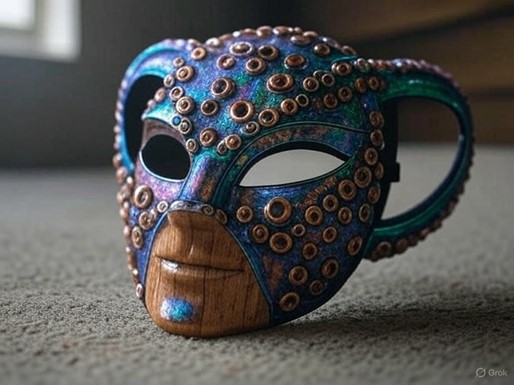
Perception of Activation: The Suckerthespian Mask, when activated in the world of Saṃsāra, creates a sensory and extrasensory experience that reflects its purpose of enhancing acting abilities and embodying personas. Below is a detailed breakdown of what is perceived through the five senses and multiple extrasensory perceptions, from both the user’s and observer’s perspectives, along with the positives and negatives of activation. This aligns with the high-magic setting, the mask’s lore as a creation of the Echoing Masquerade, and the mechanics of the Mind’s Eye.
- User’s Perspective (The Wearer)
- Sight: The user sees the iridescent materials of the mask shimmer with a subtle, pulsating glow, shifting between deep oceanic blues, silvers, and golds, as if the mask is alive with emotion. The circular plates, resembling adhesive suckers, emit a faint bioluminescent sheen, their edges softly illuminating the upper half of the user’s face. Through the Mind’s Eye, the user perceives a faint overlay of the persona they’re adopting—ghostly images of a noble’s court, a mischievous imp’s lair, or a sage’s study, depending on the role they embody.
- Sound: A delicate, melodic hum resonates from the mask, like the soft chime of glass bells, harmonizing with the user’s voice as they speak or perform. The user hears echoes of their adopted persona’s voice layered over their own—a noble’s commanding tone, an imp’s mischievous giggle—enhancing their performance. During active use (e.g., a prolonged performance), these echoes can multiply, creating a chorus of voices that feels immersive but potentially overwhelming.
- Touch: The polished wood feels cool against the user’s face initially, but warms as the mask activates, creating a sensation like a gentle embrace. The adhesive sucker plates tingle as they adhere lightly to the skin, their suction subtle but grounding, amplifying the user’s facial expressions. Prolonged use can cause a slight itchiness around the edges, signaling the risk of sensory overload.
- Smell: A faint scent of saltwater and forest wood wafts from the mask, evoking the natural origins of its materials—octopus-inspired suckers and polished wood from ancient trees. There’s a hint of floral perfume, reminiscent of a thespian’s dressing room, which grows stronger during intense performances.
- Taste: The user experiences a subtle, sweet taste on their tongue, like honey mixed with a hint of sea salt, reflecting the mask’s oceanic inspiration. This sensation intensifies during active use, blending with a faint dryness, as if they’ve been speaking lines for hours on a stage.
- Extrasensory Perceptions:
- Persona Resonance: The user feels a deep connection to the persona they adopt, as if their mind merges with the character’s essence. They sense the persona’s emotions—confidence of a noble, cunning of an imp—guiding their actions and words.
- Audience Awareness: A heightened awareness of the audience’s reactions emerges, with the user intuitively sensing their emotions—captivation, amusement, or fear—allowing them to adjust their performance dynamically.
- Emotional Echoes: The Mind’s Eye amplifies their empathy, letting them feel the emotional weight of the persona’s backstory, such as a noble’s burden of leadership or a sage’s wisdom, which can be both inspiring and draining.
- Positives:
- The sensory feedback immerses the user in their role, making performances feel authentic and captivating, enhancing their confidence as a thespian. The glowing plates and echoing voices provide clear indicators of activation, boosting their stage presence.
- The extrasensory perceptions allow the user to connect deeply with their audience, tailoring their performance to evoke the desired response, which is invaluable in social or deceptive scenarios (e.g., impersonating a guard to avoid conflict).
- The grounding suction and warm wood foster a sense of connection to the art of performance, reducing performance anxiety and helping the user stay in character, even in high-stress environments.
- Negatives:
- The echoing voices and persona resonance can be distracting, especially in chaotic environments like unsafe or deathly areas, potentially causing the user to miss immediate threats or falter in their performance.
- Prolonged activation (e.g., extended performances) risks sensory overload, with the itchiness becoming uncomfortable and the chorus of voices overwhelming, triggering the Mind’s Eye’s overwhelm debuff (temporary inability to use the ability or short-term debuffs).
- The emotional weight of the persona’s backstory can be taxing, leading to psychological strain, such as feeling a noble’s grief or an imp’s guilt, aligning with Saṃsāra’s character development mechanics.
- Observer’s Perspective (Someone Watching the User)
- Sight: The observer sees the mask’s iridescent materials shimmer with a soft, pulsating glow, cycling through blues, silvers, and golds, creating an otherworldly aura around the user’s face. The circular sucker plates emit a faint bioluminescent light, their edges casting a subtle halo over the user’s upper face. The user’s expressions are amplified—every smile, frown, or glare appears exaggerated and captivating, as if the mask is a conduit for their emotions.
- Sound: A faint, melodic hum, like glass bells, emanates from the mask, audible to those nearby. The observer hears the user’s voice take on layered tones, as if multiple voices speak at once—a noble’s authority, an imp’s mischief—making their performance mesmerizing. During intense performances, the observer might catch snippets of these layered voices, creating an eerie, theatrical effect.
- Touch: The observer doesn’t directly feel the mask, but if they touch the user during activation, they might sense a slight warmth radiating from the user’s face, as if the mask’s energy extends outward. The air around the user feels charged with a subtle static, like the prelude to a magical performance.
- Smell: The observer detects a faint scent of saltwater and forest wood, mixed with a hint of floral perfume, as if the user has just stepped off a stage. The aroma is subtle but evocative, growing stronger during prolonged performances, enhancing the theatrical atmosphere.
- Taste: The observer experiences no direct taste, but if they’re sensitive to magic (e.g., another Mind’s Eye user), they might feel a dryness in their mouth, mirroring the user’s experience, as a sympathetic magical response to the performance energy.
- Extrasensory Perceptions:
- Magical Aura: The observer senses a faint magical aura emanating from the mask, a tingling awareness of its high-magic nature, common in Saṃsāra’s steampunk-inspired world.
- Emotional Resonance: The observer feels a secondhand emotional pull from the user’s performance, experiencing awe, amusement, or fear, depending on the persona the user adopts, making the performance deeply impactful.
- Persona Presence: If the observer has the Mind’s Eye, they might sense the user’s adopted persona as a faint psychic echo, feeling the noble’s authority or the imp’s cunning without fully understanding it.
- Positives:
- The glowing mask and layered voices signal to allies that the user is in their element, enhancing trust in their ability to deceive or inspire, which is useful in social or combat scenarios.
- The theatrical aura and scent of perfume elevate the user’s mystique, making them appear charismatic and captivating, which can aid in social interactions (e.g., persuading NPCs or intimidating foes).
- The observer’s emotional resonance with the performance strengthens group morale, especially when the user inspires allies, as seen in offensive roleplay scenarios.
- Negatives:
- The glowing mask can draw unwanted attention in dangerous environments, making the user a target for enemies who recognize its magical nature or mistake them for a high-value performer.
- The layered voices and the user’s intense demeanor might unsettle allies or NPCs, especially in tense situations, potentially straining social dynamics (e.g., NPCs fearing the user’s otherworldly aura, as per gameplay implications).
- If the user succumbs to overwhelm, the observer might witness their distress—faltering speech, a strained expression, or a sudden drop in performance energy—which could alarm the group and lower morale.
Broader Context in Saṃsāra: The sensory and extrasensory perceptions of the Suckerthespian Mask’s activation reflect its role as a tool for performance, aligning with Saṃsāra’s vibrant cultural emphasis on art and expression. The user’s experience reinforces their identity as a thespian, while the observer’s perspective highlights the mask’s theatrical allure and potential social implications. The positives enhance gameplay by providing roleplaying opportunities and social advantages, while the negatives introduce risks and challenges, ensuring balance as per the game’s mechanics (e.g., the Mind’s Eye not being a solution to every problem).
Suckerthespian Mask Crafting Recipe — This recipe outlines the process to recreate an item like the Suckerthespian Mask in the world of Saṃsāra, a high-magic setting where performance and magic intertwine. The mask, originally crafted by the Echoing Masquerade, enhances acting abilities with a +1 Acting Bonus and occupies a face slot. The crafting process reflects Saṃsāra’s medieval-to-Renaissance technology level, incorporating magical elements and steam-powered tools, while adhering to the game’s mechanics and cultural emphasis on art.
- Materials Needed
- Polished Wood (1 square foot): Sourced from an ancient tree, preferably one near a coastal region of Saṃsāra, to reflect the mask’s oceanic inspiration. The wood must be polished to a smooth finish to achieve its delicate texture.
- Iridescent Shell Fragments (3 ounces): Harvested from deep-sea creatures like iridescent mollusks found in Saṃsāra’s endless ocean, used to create the mask’s shimmering hues of blue, silver, and gold.
- Sucker Sap (1 ounce): A sticky, bioluminescent sap extracted from jungle vines that mimic the adhesive properties of octopuses and leeches, used to craft the mask’s circular plates.
- Thespian’s Thread (5 yards): A magical thread spun from the silk of a rare Saṃsāran moth, known for weaving cocoons in theater ruins, used to bind the materials with an enchantment that enhances performance.
- Essence of Perfume (1 vial): Distilled from flowers used in the dressing rooms of the Echoing Masquerade, often found in cultural sanctuaries or festival markets, to infuse the mask with a floral scent.
- Blue Pigment (1 ounce): Derived from crushed oceanic minerals, used to dye the mask and enhance its deep blue tones.
- Tools Required
- Steam-Powered Carving Lathe: A compact device used by Saṃsāran artisans, powered by elemental water and fire to generate steam, capable of carving intricate designs into wood with precision.
- Magical Circuit Brush: A fine-tipped tool that channels magic flow to apply glowing sap, common in Saṃsāra’s crafting workshops, requiring a steady hand for detailed work.
- Polishing Wheel: A traditional, foot-pedal-operated wheel, often enchanted to ensure a mirror-like finish on wood, preserving its natural grain while enhancing its elegance.
- Sewing Kit (Enchanted): A set of needles and awls infused with minor magic to ensure the Thespian’s Thread binds properly, preventing fraying and enhancing durability.
- Ritual Cauldron: A small, copper cauldron inscribed with artistic runes, used to mix and heat magical components like sucker sap and essence of perfume.
- Skill Requirements
- Woodworking (Tier 1): Basic proficiency in carving and shaping wood, ensuring the mask is both functional and elegant.
- Performance Knowledge (Tier 1): The ability to understand theatrical aesthetics, using the Mind’s Eye to replicate the Echoing Masquerade’s design principles.
- Enchanting (Tier 1): Fundamental skill in infusing items with minor magical effects, necessary to activate the sucker sap’s glow and bind the Thespian’s Thread.
- Crafting (Tier 1): General competence in assembling magical items, ensuring the mask meets the quality of a common Tier 1 item.
- Crafting Steps
- Shape the Wood: Use the steam-powered carving lathe to shape the polished wood into a half-mask, approximately 6 inches wide and 4 inches tall, designed to cover the upper half of the face. Carve out eye holes and a gentle curve to fit the face comfortably, taking 1 hour to ensure precision. The wood should retain its natural grain while being smoothed to a delicate finish.
- Polish and Dye the Mask: Secure the wooden mask on the polishing wheel and operate it for 30 minutes to achieve a mirror-like finish, enhancing its elegance. Mix the blue pigment with water in the ritual cauldron, heating it over a small flame until it forms a vibrant dye. Apply the dye to the mask using a soft cloth, ensuring an even coat of deep oceanic blue, and let it dry for 20 minutes.
- Embed Iridescent Shell Fragments: Crush the iridescent shell fragments into a fine powder and mix with a small amount of water to create a shimmering paste. Using a fine brush, apply the paste to the mask’s surface in swirling patterns, focusing on areas around the eye holes and edges to create a shimmering effect of silver and gold. This process takes 40 minutes to ensure the iridescence catches the light naturally.
- Create Circular Sucker Plates: Using the magical circuit brush, etch six circular plates (each 0.5 inches in diameter) onto the mask, three on each side, resembling adhesive suckers. This takes 10 minutes per plate (60 minutes total), as the brush channels magic flow to create a latent glow. Heat the sucker sap in the ritual cauldron until it becomes a viscous gel, then apply it into the etched circles, filling them to create a smooth, bioluminescent surface that will glow when activated. Let it set for 15 minutes.
- Infuse with Essence of Perfume: Pour the vial of essence of perfume into the ritual cauldron with the remaining sucker sap. Stir for 5 minutes while chanting a silent spell (immediate, 25% less effective) to bind the scent to the mask. Dip the Thespian’s Thread into the mixture, soaking it for 10 minutes to absorb the perfume’s aroma and magical properties, enhancing the mask’s theatrical aura.
- Sew and Bind the Mask: Thread the enchanted sewing kit with the infused Thespian’s Thread. Sew the edges of the mask to reinforce its structure, ensuring the thread’s magic enhances durability. This takes 20 minutes and requires careful stitching to maintain the mask’s elegant shape. Attach small loops of thread at the sides to secure the mask to the wearer’s face, ensuring it can be easily removed.
- Final Enchantment: Hold the completed mask in both hands and perform a normal spell chant (under 6 seconds, with a flourish) to awaken its performance-enhancing properties. Name a legendary thespian from Saṃsāra’s history to double the enchantment’s effect (e.g., “By the Echoing Masquerade’s legacy, perform!”). The sucker plates should glow faintly, confirming the +1 Acting Bonus. This step takes 1 minute, including attunement, as per the game’s attunement rules.
- Crafting Notes
- The total crafting time is approximately 3 hours and 5 minutes, accounting for carving, polishing, and enchantment steps.
- Ensure all materials are sourced respectfully, as per Saṃsāra’s cultural reverence for art—using wood or shells from sacred sites without permission may anger local communities or gods of performance.
- The mask occupies one face slot and must be attuned (1 minute) before use, as per the game’s rules. It is a common Tier 1 item, suitable for avatars of any level, but higher-tier characters crafting it may face penalties for using items below their tier (e.g., pain and HP loss).
Saga of the Suckerthespian Veil
In the vibrant realm of Saṃsāra, where the arts flourish amidst a high-magic tapestry and history spans millennia, the Suckerthespian Mask carries a tale whispered in theater halls and cultural sanctuaries. Known as “The Saga of the Suckerthespian Veil,” this story is the most renowned narrative tied to the mask’s origin, passed down through generations. It is said to have been poorly translated in ancient times from an even older, unknown language, its words muddled by the passage of time, yet its essence preserved through the performances of the Echoing Masquerade. The tale weaves a narrative of artistry, deception, and the power of performance, reflecting Saṃsāra’s cultural reverence for expression in a world of magic and steampunk ingenuity.
Many moons past, in the age when Saṃsāra’s islands were still finding their names and the gods set limits upon the craft of mortals—no machines of spark, no webs of thought, but magic to fuel the heart—there lived a band of wanderers called the Masquerade of Echoes. These were players of tales, dancers of dreams, singers of sorrow and joy, who roamed the seventy-three lands of islands, their stages built of wood and steam, their voices a magic of their own. They bore no weapons, save their words, and no armor, save their masks, for they believed the truest power lay in the roles they played.
The Masquerade of Echoes was led by a woman named Sylvaris, she who wore a face of many faces. Sylvaris was a master of the art, her voice a river that could be a noble’s command or a child’s laughter, her steps a storm or a breeze. She and her troupe sought to bring light to the dark places of Saṃsāra, to the jungles where monsters roared, to the caves where shadows whispered, to the cities where millions lived in towers of stone. But the world was not always kind to their craft, for some saw their performances as trickery, a magic too close to deceit.
In a time of great unrest, when the islands warred over trade and magic flowed wild like a storm, the Masquerade of Echoes came to a city of the sea, a place of floating platforms and airships, where the people loved art but feared the unknown. The city was ruled by a lord named Krythar, a man of iron will and cold heart, who banned all performances, calling them lies that poisoned the mind. Krythar’s guards patrolled the streets, their steam-powered spears glowing with magic, and any who dared to sing or dance were cast into the deep waters below.
Sylvaris, with her Sight of Mind—a gift all in Saṃsāra shared—saw the city’s sorrow, the people’s hearts heavy with silence. She vowed to bring back their joy, but Krythar’s wrath was a shadow too great to face with song alone. The Masquerade of Echoes gathered in secret, in a hidden cave beneath the floating city, where the waves sang their own songs. There, Sylvaris spoke to her troupe, her voice a whisper of hope, “We must craft a veil, a face of faces, to wear the roles of all beings, to fool even the hardest heart.”
The troupe, guided by the magic that bubbled in Saṃsāra, sought the gifts of the sea and forest. They dove into the endless ocean, where the waters glowed with the light of magic, and gathered shells that shimmered like the sky at dawn, blues and silvers and golds. They climbed the ancient trees of the jungle, where vines clung like the arms of sea beasts, and took their sap, sticky and glowing, a sap that held fast yet let go with ease. From the ruins of old theaters, they gathered threads spun by moths of memory, threads that hummed with the echoes of past plays.
With these, Sylvaris and her troupe crafted the Suckerthespian Veil, a half-face of polished wood, its surface gleaming with the shells’ light, its edges marked with circles of sap that clung like the suckers of the deep ones. They sewed the veil with the threads of memory, their hands guided by chants of magic, the words lost to time but the power alive. The veil was a thing of beauty, its colors a dance of ocean and star, its circles glowing when worn, a magic that let the wearer become any soul they dreamed.
Sylvaris donned the Suckerthespian Veil, and the magic of Saṃsāra answered. She felt the roles of all beings flow into her—noble, imp, sage, beast—her voice and steps shifting with each. The veil’s circles held fast to her face, their glow a beacon of art, and she knew it was ready. The Masquerade of Echoes planned their greatest performance, a play to free the city from Krythar’s grip, a play of deception and truth.
On the night of the new moon, when the city’s lights dimmed, the troupe crept into the central square, where Krythar’s palace loomed. Sylvaris, with the Suckerthespian Veil, became a guard of Krythar’s own, her voice deep and her stance firm, the veil’s magic making her every word a command. She ordered the guards to gather, claiming a threat from the sea, and they obeyed, for the veil made her their own. The troupe, hidden in the shadows, set up their stage, their props moved by steam and magic, their music a hum of hope.
When the guards were gone, Sylvaris shed the guard’s role and became a spirit of the sea, her voice a wail of waves, her steps a dance of tides. The people, drawn by the sound, came to the square, their eyes wide with wonder. The Masquerade of Echoes played their tale—a story of a city silenced, of a lord who feared joy, of a spirit who brought song back to the hearts of all. The people wept and laughed, their voices rising in song, a defiance of Krythar’s ban.
Krythar, hearing the noise, stormed from his palace, his steam-spear glowing with rage. He saw Sylvaris, her Suckerthespian Veil shining, and knew her for a player. But the people, their hearts alight with the troupe’s performance, stood between Krythar and the Masquerade of Echoes, their voices a shield of song. Sylvaris, now a noble of old, spoke with a voice of command, naming a hero of the city’s past to double her words’ power, “I am Eryndor, founder of this place—let art live, or let this city fall!”
The people roared, their song a storm, and Krythar, seeing their will, fled into the night, his rule broken by the power of performance. The Masquerade of Echoes played until dawn, their Suckerthespian Veil a symbol of their victory, its glow a light for all who loved art. Sylvaris taught others to craft the veil, its making a secret of the troupe, and the Suckerthespian Veil became a tool for all who wished to wear a face of faces, to bring joy where there was none.
The Masquerade of Echoes traveled on, their performances a legend across Saṃsāra, until Sylvaris merged with an avatar of a great songbird, her memories joining a gestalt of minds. The Suckerthespian Veil lived on, its glow a reminder of the night art triumphed over silence, a tale poorly translated but deeply felt.
Moral of the Story: Art holds the power to break even the hardest chains, for in performance, truth and deception dance as one to free the heart.
Suggested conversions to other systems:
Call of Cthulhu 7th Edition
Item Name: Mask of the Echoing Veil
- Type: Artifact (Minor Magical Item)
- Description: An exquisite half-mask of polished wood and iridescent materials, shimmering in oceanic blues, silvers, and golds, with circular sucker plates that glow faintly when active. It enhances the wearer’s ability to adopt personas, making their performances uncannily authentic.
- Mechanics:
- Acting Enhancement: Grants a Bonus Die to Charm and Fast Talk rolls when the wearer adopts a persona to deceive or persuade others (e.g., impersonating an authority figure). This reflects the +1 Acting Bonus in Saṃsāra.
- Activation (Persona Adoption): As a Major Action, the wearer can spend 1 Luck point to activate the mask for 10 minutes, enhancing their performance. During this time, they gain a Bonus Die to Art/Craft (Acting) rolls, and observers must roll against their POW (difficulty equal to wearer’s POW/5) to detect the deception. Using this ability more than once per day costs 1D4 Sanity points, reflecting Saṃsāra’s overwhelm mechanic as a creeping dread from embodying other personas.
- Sensory Effects: When activated, the mask glows faintly, emits a melodic hum, and smells of saltwater and perfume. This can cause a -10% penalty to Stealth rolls in quiet environments due to the hum, and the Sanity cost reflects the unsettling nature of the mask’s otherworldly aura.
- Roleplaying Notes:
- Investigators might use the mask to infiltrate cults or deceive NPCs, but the Sanity cost and glowing effect make it risky in high-stakes situations, fitting Call of Cthulhu’s tone of cosmic horror.
- The mask’s origin with the Echoing Masquerade can tie into a Mythos mystery—perhaps the troupe uncovered eldritch secrets through their performances, leaving the mask tainted with a subtle, alien influence.
Blades in the Dark (v8.2)
Item Name: Veil of the Masquerade
- Type: Asset (Tier I, Fine Quality)
- Description: A delicate half-mask of polished wood and iridescent hues, adorned with glowing sucker plates, designed to enhance theatrical performances and deceptions.
- Mechanics:
- Acting Enhancement: When used, the Veil of the Masquerade improves the wearer’s Effect by one level (e.g., from Limited to Standard) on Sway or Consort actions involving deception or performance (e.g., impersonating a noble to infiltrate a gala). This reflects the +1 Acting Bonus in Saṃsāra.
- Special Ability (Persona Shift): As a downtime action, the wearer can spend 1 Stress to attune to the mask, gaining a temporary playbook ability from another crew member for one score (e.g., a Slide adopting a Cutter’s Not to Be Trifled With). This represents adopting a persona with authenticity. Using this ability again before a long rest increases Stress cost by 1 each time (e.g., 2 Stress, then 3), reflecting Saṃsāra’s overwhelm as mental strain.
- Drawback: The mask’s glowing plates and melodic hum impose a -1d to Finesse rolls for stealth during a score, as its theatrical aura draws attention. Additionally, if the wearer takes a Trauma from Stress while using the mask, they gain the Vice Haunted by Personas, reflecting the emotional toll of constant role-shifting.
- Roleplaying Notes:
- The mask suits Slides or characters with a flair for deception, enhancing their ability to navigate Doskvol’s underworld through performance. Crews might use it to pull off elaborate cons, but the Stress cost and stealth penalty add risk, fitting Blades’ gritty tone.
- The mask’s origin can tie into Doskvol’s occult history—perhaps the Echoing Masquerade were a forgotten troupe who performed for spirits, leaving the mask imbued with ghostly echoes.
Dungeons & Dragons 5th Edition (2024 Rules)
Item Name: Suckerthespian Mask
- Type: Wondrous Item, Common (requires attunement)
- Description: This half-mask, crafted from polished wood and iridescent materials, shimmers in blues, silvers, and golds, with circular sucker plates that glow faintly when active. It enhances the wearer’s ability to adopt personas, making their performances strikingly authentic.
- Mechanics:
- Attunement: Requires 1 minute to attune, reflecting Saṃsāra’s attunement rules. Only one creature can be attuned at a time; if another attunes, the previous wearer feels a psychic jolt (flavor only).
- Acting Enhancement: Grants a +1 bonus to Charisma (Performance) and Charisma (Deception) checks, mirroring the +1 Acting Bonus.
- Persona Adoption (Active Use): As an action, the wearer can concentrate for 1 minute to adopt a persona, gaining advantage on Charisma (Performance) and Charisma (Deception) checks to impersonate a specific type of creature or role (e.g., a noble, a guard) for 1 hour. This can be used once per long rest; additional uses require a DC 13 Wisdom saving throw, with failure causing 1 level of exhaustion due to sensory overload (Saṃsāra’s overwhelm).
- Sensory Effects: When activated, the mask glows, hums melodically, and smells of saltwater. This imposes disadvantage on Stealth checks in quiet environments due to the hum, and the exhaustion reflects the strain of embodying personas.
- Roleplaying Notes:
- The mask suits bards, rogues, or sorcerers with a theatrical flair, enhancing their social interactions and deceptions. The glow and hum can draw attention, aiding Persuasion checks with NPCs who value performance (DM’s discretion), but the stealth penalty adds risk in sneaky scenarios, fitting D&D’s balance.
- The mask’s origin with the Echoing Masquerade can tie into a campaign’s lore—perhaps the troupe performed for fey or dragons, leaving the mask imbued with a subtle enchantment.
Knave 2nd Edition
Item Name: Masquerade Veil
- Type: Magic Item (1 slot, Common)
- Description: A half-mask of polished wood and iridescent materials, glowing with oceanic hues and adorned with sucker plates, designed to enhance the wearer’s ability to perform and deceive.
- Mechanics:
- Acting Enhancement: Grants a +1 bonus to Charisma checks involving performance or deception (e.g., acting, impersonating), reflecting the +1 Acting Bonus.
- Persona Adoption: The wearer can spend 1 minute attuning to the mask (as per Saṃsāra’s rules) to adopt a persona, gaining advantage on Charisma checks to impersonate a specific role or creature for 1 hour. This can be used once per day; additional uses require a Will save (DC 12), with failure causing the Stunned condition for 1 turn due to sensory overload (Saṃsāra’s overwhelm).
- Drawback: The mask’s glowing plates and melodic hum impose disadvantage on Dexterity checks for stealth while active, as its theatrical aura draws attention. Additionally, if the wearer fails a Will save while using the mask in a high-stress situation (e.g., combat), they gain a temporary flaw, Haunted by Echoes, imposing disadvantage on Will saves until they rest, reflecting the emotional toll of personas.
- Roleplaying Notes:
- The mask fits Knave’s minimalist, old-school vibe, offering a simple but flavorful boost to social interactions. It suits characters who rely on guile over combat, but the stealth penalty and potential flaw add risk, aligning with Knave’s deadly tone.
- The mask’s origin can be a mystery for the GM to expand—perhaps the Echoing Masquerade were a cult of performers who vanished after a cursed play, leaving the mask as a relic of their art.
Fate Core System (2013, with 2023 Updates)
Item Name: Veil of Echoed Roles
- Type: Stunt (Aspect with Mechanical Benefits)
- Description: This half-mask, crafted from polished wood and iridescent materials in oceanic blues, silvers, and golds, glows faintly with circular sucker plates when active, enhancing the wearer’s ability to embody personas with striking authenticity.
- Mechanics:
- Aspect: Echoes of the Masquerade – This aspect can be invoked to aid in performances or deceptions, reflecting the wearer’s theatrical prowess. It can also be compelled to represent the emotional toll of adopting personas (e.g., distraction from a persona’s lingering emotions).
- Stunt: Persona’s Echo – Once per session, the wearer can spend a Fate Point to gain a +2 bonus to Deceive or Performance rolls when adopting a persona (e.g., impersonating a noble to infiltrate a court), reflecting the +1 Acting Bonus in Saṃsāra. Alternatively, they can create an advantage (e.g., Convincing Disguise) based on their performance, such as convincing enemies they’re a harmless merchant. Using this stunt a second time in a session requires a Will roll (Overcome, difficulty 2); failure creates a temporary aspect like Overwhelmed by Personas with a free invoke for the GM, reflecting Saṃsāra’s overwhelm mechanic.
- Sensory Effects: When activated, the mask glows, hums melodically, and smells of saltwater and perfume. This can justify a compel (e.g., the glow drawing unwanted attention in a stealth scenario), adding narrative tension.
- Roleplaying Notes:
- The mask suits characters with aspects like Master Thespian or Deceptive Performer, enhancing their ability to navigate social scenes or deceive foes. Invoking its aspect can boost performances in dramatic moments, while compels can reflect the psychological strain of constant role-shifting, fitting Fate’s narrative-driven tone.
- The mask’s origin with the Echoing Masquerade can tie into a campaign’s themes—perhaps the troupe performed for otherworldly beings, leaving the mask with a subtle, mystical resonance.
Numenera & Cypher System (2018 Numenera Discovery/Destiny & 2023 Cypher System Rulebook)
Item Name: Thespian’s Sucker Veil
- Type: Cypher (Level 1, Wearable)
- Description: A half-mask of polished wood and iridescent materials, shimmering in blues, silvers, and golds, with glowing sucker plates that adhere gently to the face, enhancing the wearer’s ability to adopt personas with uncanny authenticity.
- Mechanics:
- Acting Enhancement: When worn, the cypher grants an asset to tasks involving deception or performance (e.g., impersonating someone, delivering a convincing speech), reducing the difficulty of such tasks by one step, reflecting the +1 Acting Bonus in Saṃsāra.
- Persona Shift (Activation): The wearer can activate the cypher as an action (1 minute of focus, per Saṃsāra’s attunement rules) to adopt a persona for 1 hour, gaining a +2 bonus to a single roll involving deception or performance (e.g., convincing a guard they’re a superior officer). This can be used once before the cypher is depleted; attempting to use it again before a 10-hour rest requires an Intellect roll (difficulty 3), with failure costing 2 Intellect points due to mental strain (Saṃsāra’s overwhelm).
- Drawback: The mask’s glowing plates and melodic hum increase the difficulty of stealth tasks by one step while active, as its theatrical aura draws attention. Additionally, if the wearer fails the Intellect roll, they suffer a minor intrusion (GM’s choice, e.g., a haunting memory of a persona distracts them at a critical moment), reflecting the emotional toll.
- Roleplaying Notes:
- The mask fits characters like Nanos, Jacks, or Speakers in Numenera, or any Cypher character focused on social interaction, enhancing their ability to deceive or inspire. The stealth penalty and mental strain add risk, aligning with the Cypher System’s focus on discovery and danger.
- In Numenera, the mask could be a numenera artifact repurposed by the Echoing Masquerade, perhaps originally used by an ancient civilization to commune with other dimensions through performance.
Pathfinder 2nd Edition (2024 Remaster)
Item Name: Suckerthespian Mask
- Type: Worn Item (Face), Level 1, Common (requires investment)
- Description: A half-mask of polished wood and iridescent materials, glowing with oceanic hues and adorned with sucker plates, designed to enhance the wearer’s theatrical performances and deceptions.
- Mechanics:
- Investment: Requires 1 minute to invest, aligning with Saṃsāra’s attunement rules. Only one creature can invest in it at a time; if another invests, the previous wearer feels a psychic twinge (flavor only).
- Acting Enhancement: Grants a +1 item bonus to Deception and Performance checks, reflecting the +1 Acting Bonus in Saṃsāra.
- Activate (Persona Adoption): [Interact] (1 minute); Frequency: once per day; Effect: The wearer adopts a persona, gaining a +2 item bonus to a single Deception or Performance check to impersonate a specific role or creature (e.g., a noble, a guard) within the next hour. Using this ability again before a day requires a DC 15 flat check; failure causes the Stunned 1 condition (reflecting Saṃsāra’s overwhelm).
- Drawback: The mask’s glowing plates and melodic hum impose a -1 penalty to Stealth checks while active, as its theatrical aura draws attention. If the wearer fails the flat check, they also take a -1 status penalty to Will saves for 1 hour, reflecting the emotional strain of embodying personas.
- Roleplaying Notes:
- The mask suits bards, rogues, or investigators focused on social skills, enhancing their ability to deceive or perform in Golarion’s diverse settings. The stealth penalty and potential Stunned condition add risk, fitting Pathfinder’s tactical balance.
- The mask’s origin can tie into Golarion’s lore—perhaps the Echoing Masquerade were a troupe from the River Kingdoms, using the mask to perform for fey or deceive tyrants, leaving it imbued with a subtle enchantment.
Savage Worlds Adventure Edition (SWADE, 2018 with 2023 Updates)
Item Name: Masquerade Performer’s Veil
- Type: Enchanted Item (Minor Artifact)
- Description: A half-mask of polished wood and iridescent materials, shimmering in blues, silvers, and golds, with glowing sucker plates that enhance the wearer’s ability to adopt personas with striking authenticity.
- Mechanics:
- Acting Enhancement: Grants a +1 bonus to Performance and Persuasion rolls involving deception or roleplaying (e.g., impersonating someone, delivering a dramatic speech), reflecting the +1 Acting Bonus in Saṃsāra.
- Power (Persona Shift): The wearer can spend 1 minute attuning to the mask (per Saṃsāra’s rules) to activate its power (Costs 1 Power Point, Duration: 1 hour). They gain a +2 bonus to a single Performance or Persuasion roll to impersonate a specific role or creature. This can be used once per day; additional uses require a Spirit roll (Target Number 4), with failure causing 1 level of Fatigue due to mental strain (Saṃsāra’s overwhelm).
- Drawback: The mask’s glowing plates and melodic hum impose a -1 penalty to Stealth rolls while active, as its theatrical aura draws attention. If the wearer becomes Incapacitated while using the mask, they gain the Quirk Hindrance (Minor, Haunted by Personas), reflecting the emotional toll of constant role-shifting, until they recover.
- Roleplaying Notes:
- The mask fits characters with high Charisma or the Performer Edge, enhancing their ability to deceive or inspire in Savage Worlds’ pulpy, action-oriented settings. The stealth penalty and Fatigue risk add tension, aligning with SWADE’s fast-paced gameplay.
- The mask’s origin can tie into a setting’s lore—perhaps the Echoing Masquerade were a troupe in a steampunk fantasy world, using the mask to perform for otherworldly beings, leaving it imbued with a subtle magic.
Shadowrun 6th Edition (2019, with 2023 Updates)
Item Name: Masquerade Veiltech
- Type: Cyberware (Headware, Essence Cost: 0.1, Availability: 8, Cost: 1,500¥)
- Description: A sleek half-mask of polished wood and iridescent materials, augmented with subtle biotech circuitry mimicking Saṃsāra’s magical origins, shimmering in blues, silvers, and golds with glowing sucker plates that enhance the wearer’s ability to adopt personas.
- Mechanics:
- Acting Enhancement: Grants a +1 dice pool modifier to Con and Performance tests when adopting a persona (e.g., impersonating a corporate exec to infiltrate a facility), reflecting the +1 Acting Bonus in Saṃsāra.
- Persona Matrix (Active Use): As a Major Action, the wearer can activate the mask’s biotech circuitry (1 minute to attune, per Saṃsāra’s rules), gaining a +2 dice pool modifier to a single Con or Performance test within the next hour. This can be used once per day; additional uses require an Edge expenditure (1 Edge) and a Willpower + Charisma (3) test, with failure causing 1 level of Stun Damage due to neural feedback (Saṃsāra’s overwhelm).
- Drawback: The mask’s glowing plates and faint hum impose a -1 dice pool modifier to Stealth tests while active, as its theatrical aura draws attention. If the wearer glitches on a test while using the mask, they suffer a minor Matrix glitch (e.g., a persona’s voice echoes in their mind, distracting them for a turn), reflecting the emotional toll of role-shifting.
- Roleplaying Notes:
- The mask suits Faces or Deckers who use deception to navigate the Sixth World’s shadows, enhancing their social infiltration skills. The Stun Damage and stealth penalty add risk, fitting Shadowrun’s high-stakes tone.
- The mask’s origin can tie into the Sixth World’s lore—perhaps the Echoing Masquerade were a pre-Awakening troupe whose designs were rediscovered and augmented by a corp, blending magic and tech.
Starfinder 2nd Edition (2024)
Item Name: Thespian’s Sucker Mask
- Type: Worn Equipment (Face), Level 1, Common
- Description: A half-mask of polished wood and iridescent materials, glowing with oceanic hues and adorned with sucker plates, infused with nanites that enhance the wearer’s ability to adopt personas with striking authenticity.
- Mechanics:
- Acting Enhancement: Grants a +1 item bonus to Deception and Performance checks, reflecting the +1 Acting Bonus in Saṃsāra.
- Persona Nanites (Activate): [Interact] (1 minute); Frequency: once per day; Effect: The wearer activates the mask’s nanites, gaining a +2 item bonus to a single Deception or Performance check to impersonate a specific role or creature (e.g., a Vesk soldier, a corporate envoy) within the next hour. Using this ability again before a day requires a DC 15 Fortitude save; failure causes the Fatigued condition (reflecting Saṃsāra’s overwhelm).
- Drawback: The mask’s glowing plates and melodic hum impose a -1 penalty to Stealth checks while active, as its theatrical aura draws attention. If the wearer fails the Fortitude save, they also take a -1 status penalty to Will saves for 1 hour, reflecting the emotional strain of embodying personas.
- Roleplaying Notes:
- The mask suits Envoys, Operatives, or Solarians focused on social skills, enhancing their ability to deceive or perform in the Pact Worlds’ diverse settings. The stealth penalty and Fatigued condition add risk, fitting Starfinder’s sci-fi adventure tone.
- The mask’s origin can tie into Starfinder’s lore—perhaps the Echoing Masquerade were an ancient troupe from a lost world, their designs rediscovered and enhanced with nanotech by a Drift-faring culture.
Traveller 2nd Edition (2023 Mongoose Publishing)
Item Name: Echo Veil
- Type: Personal Gear (Augment, TL 10, Cost: Cr2,000, Weight: 0.1 kg)
- Description: A half-mask of polished wood and iridescent materials, shimmering in blues, silvers, and golds, with glowing sucker plates powered by micro-sensors that enhance the wearer’s ability to adopt personas with authenticity.
- Mechanics:
- Acting Enhancement: Grants a DM +1 to Deceive and Perform checks when adopting a persona (e.g., impersonating a noble to gain access to a starport), reflecting the +1 Acting Bonus in Saṃsāra.
- Persona Projection (Active Use): The wearer can activate the mask’s micro-sensors (1 minute to attune, per Saṃsāra’s rules) to project a persona for 1 hour, gaining a DM +2 to a single Deceive or Perform check. This can be used once per day; additional uses require an END 8+ check, with failure causing 1D fatigue damage (Saṃsāra’s overwhelm).
- Drawback: The mask’s glowing plates and faint hum impose a DM -1 to Stealth checks while active, as its theatrical aura draws attention. If the wearer fails the END check, they also suffer a DM -1 to INT checks for 1 hour, reflecting the mental strain of embodying personas.
- Roleplaying Notes:
- The mask suits Travellers like Envoys or Rogues who rely on social skills to navigate the Third Imperium’s intrigues, enhancing their ability to deceive or perform. The fatigue and stealth penalty add risk, fitting Traveller’s focus on survival and exploration.
- The mask’s origin can tie into Traveller’s universe—perhaps the Echoing Masquerade were a pre-Imperial troupe whose tech was rediscovered on a frontier world, blending ancient artistry with modern sensors.
Warhammer Fantasy Roleplay 4th Edition (2018, with 2023 Updates)
Item Name: Veil of the Echoing Players
- Type: Trapping (Magic Item, Common)
- Description: A half-mask of polished wood and iridescent materials, glowing with oceanic hues and adorned with sucker plates, imbued with minor magic that enhances the wearer’s ability to adopt personas with striking authenticity.
- Mechanics:
- Acting Enhancement: Grants a +10 bonus to Charm and Perform (Acting) tests when adopting a persona (e.g., impersonating a noble to infiltrate a court), reflecting the +1 Acting Bonus in Saṃsāra.
- Persona Charm (Active Use): The wearer can spend 1 minute attuning to the mask (per Saṃsāra’s rules) to activate its magic for 1 hour, gaining a +20 bonus to a single Charm or Perform (Acting) test to impersonate a specific role or creature. This can be used once per day; additional uses require a WP test (TN 60), with failure causing 1 Corruption point due to the strain of channeling personas (Saṃsāra’s overwhelm).
- Drawback: The mask’s glowing plates and melodic hum impose a -10 penalty to Stealth tests while active, as its theatrical aura draws attention. If the wearer gains Corruption from overuse, they also gain the Minor Mutation Echoing Whispers (hear faint voices of past personas, -5 to WP tests until cleansed), reflecting the emotional toll.
- Roleplaying Notes:
- The mask suits Entertainers, Spies, or Witches in the Old World, enhancing their ability to deceive or perform in Warhammer’s grim setting. The Corruption risk and stealth penalty add danger, fitting WFRP’s dark tone.
- The mask’s origin can tie into the Old World’s lore—perhaps the Echoing Masquerade were a troupe blessed (or cursed) by Ranald, the god of trickery, leaving the mask imbued with a subtle, chaotic magic.