
Lore: In the enigmatic world of Saṃsāra, where languages of old still hold secrets, the Suckerlinguist Tattoo was crafted by a reclusive scholar and linguist named Aelar Whisperquill. Aelar marveled at creatures adorned with circular adhesive suckers for their intricate communication. The Suckerlinguist Tattoo was created to enhance the wearer’s affinity for deciphering ancient languages, allowing them to unlock the voices of the past with profound skill.
Description: The Suckerlinguist Tattoo is an elegant and intricate tattoo design featuring circular motifs resembling adhesive suckers. The tattoo is crafted with special inks that shimmer faintly under certain lights. When applied to the skin, the tattoo establishes a connection between the wearer’s intuitive understanding and the enigmatic scripts of ancient languages, enhancing their ability to interpret and translate forgotten texts.
Stats:
- Rarity: Common
- Level Requirement: Tier 1
- Ancient Language Bonus: +1
- Slots: Body (various locations)
Color: The Suckerlinguist Tattoo features hues that reflect the colors of aged manuscripts and the mysteries of forgotten tongues.
Cost: 50 gold pieces
Tags: Ancient Language, Linguistics, Adhesive, Decipher, Translation, Intuition, Script, Lore, Interpretation, Glyphic, Whisperquill, Communication, Shimmering
Use: When the Suckerlinguist Tattoo is applied to a character’s skin, it enhances their aptitude for deciphering and understanding ancient languages. The adhesive properties of the circular motifs create a link that allows the wearer to intuitively grasp the nuances and meanings hidden within the cryptic scripts of forgotten tongues.
Additional Information:
- The Suckerlinguist Tattoo can be applied to various parts of the body, allowing characters to choose the location that resonates with their affinity for languages.
- The adhesive effect of the circular motifs is gentle, ensuring that the tattoo can be easily removed or reapplied without discomfort.
- While the Suckerlinguist Tattoo enhances the character’s skills in ancient languages, it does not grant any innate magical powers or the ability to speak or understand supernatural or magical tongues.
- Characters might personalize their tattoos with additional symbols or patterns that reflect their linguistic pursuits or cultural background.
- As characters advance in their linguistic studies and experience, they might explore ways to enhance the tattoo’s effects through enchantments or modifications.
Roleplaying Emphasis: Suckerlinguist Tattoo underscores the character’s dedication to unlocking the voices of the past and bridging the gap between ancient civilizations. Those who bear this tattoo exude an air of wisdom and reverence for the written word, embodying the role of a linguist and interpreter who is always ready to unravel the linguistic enigmas woven into history. Whether translating inscriptions on forgotten artifacts, deciphering cryptic prophecies, or conversing with the echoes of the past, the Suckerlinguist Tattoo becomes an invaluable tool for those who embrace the journey of understanding ancient languages in the world of Saṃsāra.
In the world of Saṃsāra, the Suckerlinguist Tattoo, with its unique properties of enhancing ancient language decipherment and its unusual characteristic of being removable and re-applicable, would be acquired through specialized channels rather than common marketplaces. Its base cost of 50 gold pieces reflects its specialized nature and the unique inks involved.
- Specialized Purveyors of Lore and Arcane Arts:
- Linguists’ Guilds & Scriptoriums of Aelar Whisperquill’s Tradition: The most direct sources would be establishments founded by or heavily influenced by Aelar Whisperquill or his dedicated students. These would be centers of linguistic study, translation, and historical research found in major cities or near significant archaeological sites.
- How Bought/Sold: Here, the “tattoo” might be sold as a precisely crafted glyph on a thin, flexible organic parchment or a specially prepared leaf that, when moistened with a specific activating solution (perhaps also sold), adheres to the skin. The “gentle adhesive effect” would refer to this application method. Alternatively, a trained guild member might offer the service of applying the shimmering inks using a specialized, non-invasive technique.
- Cost: For a standard Suckerlinguist Tattoo glyph or a basic application, the cost would likely be around 50-65 gold pieces. Personalized designs with additional symbols reflecting specific linguistic pursuits could cost more, ranging from 70-90 gold pieces.
- Arcane Artificers & Master Glyphwrights: Artisans who specialize in items imbued with subtle enchantments, particularly those involving glyphs, sigils, or enchanted inks, would be capable of creating or stocking the Suckerlinguist Tattoo. These shops are often found in magically active districts or cities known for their arcane craftsmanship.
- How Bought/Sold: Sold as prepared “skin-glyphs” or “shimmering transfers.” The artificer might also offer custom placements or minor aesthetic alterations to the design.
- Cost: Reflecting the skill in crafting the special shimmering inks and ensuring the efficacy of the linguistic link, prices here might range from 55 to 75 gold pieces. More potent or longer-lasting (before needing reapplication or “refreshing” the inks) versions could be pricier.
- University Bookstores & Scholarly Repositories (Advanced Sections): In the great universities or libraries of Saṃsāra’s metropolises, annexes or specialized shops catering to advanced scholars, archaeologists, and xenolinguists might offer such aids.
- How Bought/Sold: Likely sold as a prepared item with detailed instructions for application and care. Discounts might be available for registered scholars or faculty.
- Cost: Typically around 50-60 gold pieces for a standard design. They might also facilitate trades for rare academic texts or research contributions.
- Outfitters for Exploration & Antiquarian Societies: Businesses that equip expeditions to ancient ruins, uncharted islands, or forgotten civilizations would understand the immense value of a tool that aids in deciphering lost languages.
- How Bought/Sold: Sold as a vital piece of an explorer’s or archaeologist’s kit.
- Cost: Given the context of high-stakes discovery, these outfitters might mark up the price significantly, potentially from 60 to 80 gold pieces, especially if bundled with other research tools.
- Linguists’ Guilds & Scriptoriums of Aelar Whisperquill’s Tradition: The most direct sources would be establishments founded by or heavily influenced by Aelar Whisperquill or his dedicated students. These would be centers of linguistic study, translation, and historical research found in major cities or near significant archaeological sites.
- Niche and Itinerant Venders:
- Mystic Emporiums & Divination Parlors: Shops that deal in tools for understanding prophecies, deciphering ancient warnings, or communicating with ancestral spirits (via their writings) might stock Suckerlinguist Tattoos.
- How Bought/Sold: Often presented with an air of mystery, emphasizing the intuitive grasp of forgotten tongues. Sold as prepared glyphs.
- Cost: Prices could range from 55 to 70 gold pieces, depending on the perceived mystical potency attributed by the seller.
- Exclusive Tattooists (Specializing in Arcane or Glyphic Art): While most tattoo artists would deal in permanent ink, a very select few might have learned the rare art of creating these re-applicable, functional Suckerlinguist Tattoos using the special shimmering inks and prescribed patterns. These would be artists known more as glyph-scribes than simple tattooists.
- How Bought/Sold: This would almost certainly be a service, involving careful application of the unique inks directly to the chosen body part. The “removal and reapplication” might involve a special solvent and re-inking process provided by the same specialist.
- Cost: Due to the rarity of the skill and the special inks, this service could be quite expensive, potentially 70-100 gold pieces or more per application.
- Traveling Scholars & Itinerant Sages: Individuals who are themselves master linguists or followers of Aelar Whisperquill’s teachings might carry a small supply of these tattoo-glyphs or the knowledge to create them. They might offer them in exchange for significant discoveries, rare texts, passage to remote locations, or substantial gold.
- How Bought/Sold: Often involves barter of knowledge or rare goods in addition to, or instead of, gold. They might be very discerning about who receives such an aid.
- Cost: Highly variable. Could be as low as 45-55 gold pieces if the scholar wishes to spread the knowledge, or upwards of 100 gold pieces if they are the sole provider in an area with desperate need (e.g., a newly discovered ruin with vital inscriptions).
- Mystic Emporiums & Divination Parlors: Shops that deal in tools for understanding prophecies, deciphering ancient warnings, or communicating with ancestral spirits (via their writings) might stock Suckerlinguist Tattoos.
- Factors Influencing Cost and Availability:
- Source and Quality of Inks: The special shimmering inks are a key component. Regions with easier access to the ingredients or artisans skilled in their creation would likely see more stable prices.
- Reputation of the Seller/Artisan: A tattoo applied by someone known for their linguistic prowess or direct lineage to Whisperquill would command a higher price.
- Complexity and Size: While the bonus is standard, a larger, more ornate, or personalized version of the tattoo design might incur additional costs.
- Demand in Scholarly or Exploration Hubs: Cities renowned for their universities, great libraries, or as launching points for expeditions into Saṃsāra’s forgotten past would have higher demand and potentially more varied (and sometimes more expensive) sources.
The Suckerlinguist Tattoo, being Common, is not impossibly rare, but its unique application method and specialized function mean it is found through channels catering to those who delve into the mysteries of the past and the intricacies of forgotten languages.
The Suckerlinguist Tattoo, an elegant marking imbued with special shimmering inks, does not serve as a direct instrument of offense or defense. Its power lies in its ability to enhance the wearer’s aptitude for deciphering and intuitively understanding written ancient languages. Therefore, its role in confrontational or hazardous situations is entirely indirect, hinging on the timely acquisition and application of knowledge gleaned from ancient scripts found within the environment. The +1 Ancient Language Bonus reflects a genuine, enhanced capability in this specific skill.
- General Principles for Roleplaying Defense and Offense:
- Knowledge is the Weapon/Shield: The tattoo itself does nothing actively. The offensive or defensive advantage comes from understanding inscriptions, texts, or symbols that then inform a course of action, reveal a vulnerability, or provide a warning.
- Context is King: The tattoo’s utility is entirely dependent on the presence of readable ancient scripts in the environment. Without them, it offers no direct benefit in a conflict.
- Interpretation and Action: Successfully deciphering a text is only the first step. The character must then be able to creatively and effectively use the information gained. The tattoo aids the former, not necessarily the latter.
- Focus on Written Language: The tattoo specifically aids in understanding written or inscribed ancient languages. It does not grant the ability to speak these languages fluently without prior learning, nor does it help with understanding spoken languages, ciphers unrelated to ancient linguistic structures, or purely magical/supernatural forms of communication that lack a decipherable script.
- Offensive Applications (Exploiting Ancient Knowledge, Creating Psychological Advantage): Offensive uses involve rapidly deciphering ancient texts to uncover information that can be used to harm, hinder, or psychologically disadvantage opponents.
- In Ancient Ruins, Tombs, or Forgotten Vaults:
- Activating Dormant Traps Against Foes: The wearer might quickly decipher a faded glyph sequence or a control panel written in an ancient tongue that details how to re-activate a dormant trap (e.g., releasing a sealed mechanism, triggering a floor collapse) in the path of pursuing enemies or current occupants. The tattoo’s intuitive grasp helps make sense of archaic instructions under pressure.
- Exploiting Guardian Weaknesses: An inscription on a sarcophagus or a pedestal might describe the specific vulnerabilities, true names, or ritualistic banishments pertaining to an ancient guardian creature or construct. The Suckerlinguist Tattoo allows for faster comprehension of this critical offensive intelligence.
- Turning Ancient Devices Against Enemies: Deciphering operating instructions for ancient siege engines, energy conduits, or defensive automatons (if such things exist and use a known ancient script) could allow the wearer to direct these forgotten powers against their adversaries.
- In Libraries, Scriptoriums, or Amongst Hoarded Lore:
- Uncovering Damaging Secrets: Rapidly translating an old diary, a heretical text, or a coded ledger written in an ancient language could reveal compromising information about an antagonist – a hidden crime, a treacherous lineage, a secret fear – which can then be used as leverage or to launch a social or political offensive.
- Finding Rituals of Offense: An ancient grimoire or ritual text, once deciphered with the tattoo’s aid, might contain details of forgotten curses, bindings, or summoning rites that, if the party has the other necessary components and skills, could be turned against their foes. The tattoo only provides the understanding of the text, not the power to enact the ritual.
- Psychological Warfare (When Ancient Scripts are Present and Valued/Feared):
- Authoritative “Mis”translation: If confronting individuals who respect or fear ancient writings but cannot read them, the wearer could use the tattoo as a badge of their linguistic prowess and deliberately mistranslate a neutral or even benign text into a dire warning, a prophecy of the opponent’s doom, or a declaration of the wearer’s anciently-bestowed authority, causing hesitation or fear.
- Revealing Unsettling Truths: By loudly and clearly translating an ominous inscription that an enemy had perhaps overlooked or misunderstood, the wearer can sow discord, fear, or doubt amongst their ranks (“This script clearly states this chamber is cursed for all but the bloodline of Aeridor… are you of that blood?”).
- In Ancient Ruins, Tombs, or Forgotten Vaults:
- Defensive Applications (Heeding Ancient Warnings, Utilizing Lost Safeguards, Gaining Allies): Defensive uses revolve around understanding ancient information that helps to avoid danger, activate protections, or secure aid.
- In Ancient Ruins, Tombs, or Forgotten Vaults:
- Heeding Forgotten Warnings: The most common defensive use is rapidly deciphering warning plaques, glyphs, or faded murals that detail specific dangers ahead: unstable structures, specific monster lairs, areas under ancient curses, poisonous atmospheres, or the nature of complex traps. This allows the party to prepare, avoid, or disarm threats.
- Discovering Safe Passages or Sanctuaries: Inscriptions might reveal hidden escape routes, secret chambers designed as safe havens, or the passwords/rituals required to pass through protected ancient doorways without triggering alarms or defenses.
- Understanding Guardian Protocols: Some ancient guardians might have specific protocols or conditions under which they remain passive or even helpful. Deciphering these rules (e.g., “Speak the name of the True King and pass freely,” “Offer tribute of pure water”) can prevent unnecessary conflict.
- In Libraries, Scriptoriums, or When Consulting Ancient Prophecies:
- Foreseeing Danger: Translating ancient prophecies, historical cycles, or astronomical predictions might offer vital clues about impending disasters, the return of ancient evils, or the specific nature of a threat the party is facing, allowing for strategic preparation.
- Finding Solutions in Old Lore: An ancient text, once understood via the tattoo, might contain the solution to a current defensive problem – the recipe for an antidote to a forgotten poison, the method for sealing a dimensional rift described in a historical account, or the lost technique for repairing a vital ancient artifact that provides protection.
- Diplomacy and Alliance Building (Through Understanding the Past):
- Bridging Communication with Ancient Beings: If encountering sentient beings who still use or revere an ancient written language (e.g., ancient constructs, isolated communities, long-lived entities), the ability to read their foundational texts or treaties could be crucial for establishing peaceful contact, understanding their grievances, or forging an alliance.
- Appealing to Historical Precedent: Deciphering an ancient peace treaty, a record of a shared ancestry, or a sacred law could provide the basis for a defensive argument or a plea for aid from a neutral or potentially hostile faction that respects such ancient covenants.
- General Preparedness through Knowledge:
- Identifying Cursed Items: Markings on an ancient artifact, if in a decipherable script, might warn of its cursed nature before it’s too late.
- Understanding Environmental Lore: Ancient texts might describe the historical uses or dangers of specific locations, flora, or fauna that are no longer common knowledge, providing a defensive edge when navigating such areas.
- In Ancient Ruins, Tombs, or Forgotten Vaults:
The Suckerlinguist Tattoo, therefore, acts as a key, unlocking doors of understanding within environments rich with the written remnants of Saṃsāra’s long past. Its defensive or offensive utility is a direct result of the intelligence, insight, or warnings contained within those unlocked texts, and the wearer’s subsequent actions based on that revealed knowledge.
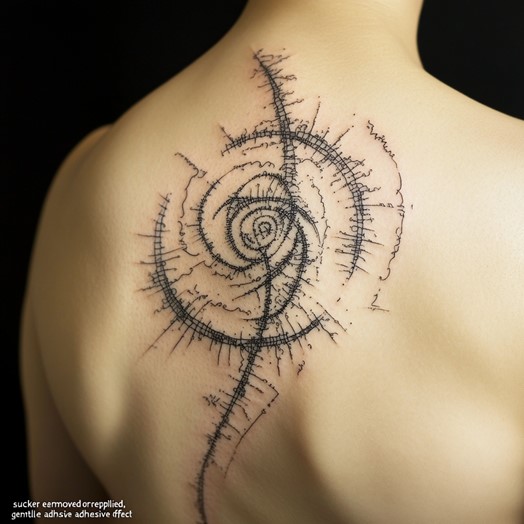
Perception of Activation: The activation of the Suckerlinguist Tattoo is a focused, one-minute process wherein the wearer consciously attunes to the tattoo’s unique properties, preparing their mind to intuitively connect with ancient languages. The perceptions are subtle, often internal, and tied to the tattoo’s specific function and nature.
- User’s Perspective (The Wearer): As the user concentrates on the Suckerlinguist Tattoo and its intended purpose, they experience a series of nuanced sensations.
- Sight:
- Perception: The intricate lines of the tattoo, particularly the circular “sucker” motifs, may appear to shimmer with a more pronounced yet gentle luminescence. The hues reminiscent of aged manuscripts and forgotten mysteries within the inks might subtly deepen or swirl with a faint, inner light. If the user is focusing on a piece of ancient script during activation, the symbols on the page might seem to subtly “sharpen” or become more distinct, as if their mind is being primed to receive them.
- Positives: The visual change in the tattoo provides a clear confirmation of its active state. The enhanced distinctness of ancient scripts can feel encouraging and reduce initial intimidation by complex texts.
- Negatives: If the shimmer is too bright or an active “swirl” too distracting, it could hinder initial concentration. The subtle visual priming on scripts could be momentarily disorienting if unexpected.
- Sound:
- Perception: Any sound is extremely subtle, more an internal impression than an external noise. The user might perceive an almost inaudible mental “hum” or a whisper like the turning of ancient, dry parchment leaves. This sensation often correlates with the deepening of their mental focus on linguistic patterns.
- Positives: Can be a meditative sound that aids concentration and reinforces the connection to ancient knowledge and texts.
- Negatives: If a user expects a more definitive auditory cue, its near absence could be puzzling. Any perceived “whispers” should feel like an echo of thought, not external voices, to stay within the item’s non-supernatural constraints.
- Smell:
- Perception: A faint, dry aroma might become noticeable to the wearer, reminiscent of old libraries, sun-baked clay tablets, or the specific scent of aged papyrus or vellum. This scent seems to emanate subtly from the area of the tattoo or to simply pervade the user’s senses as they attune.
- Positives: This evocative scent can help the user mentally transition into a scholarly or investigative mindset, creating an atmosphere conducive to decipherment.
- Negatives: For some, the scent of “dust” or “oldness” might be mildly unpleasant, though it’s typically very subtle.
- Touch (on the skin where the tattoo is located):
- Perception: This is a key sensation. The area of the skin bearing the tattoo might experience a gentle warmth or a cool, tingling vibration, particularly within the circular motifs. It can feel as if the tattoo is “settling” more intimately onto the skin, the “gentle adhesive effect” becoming a tangible sensation of perfect, almost seamless adherence and connection. Some describe it as a feeling of the tattoo “listening” or becoming receptive.
- Positives: Provides a distinct physical confirmation of the tattoo’s activation and its “link.” The sensation is often described as comforting or grounding, aiding focus.
- Negatives: The tingling could be initially distracting or slightly irritating to sensitive skin, though it usually subsides into a neutral or pleasant sensation. The feeling of the tattoo “gripping” might be odd until one is used to it.
- Taste:
- Perception: Generally, no direct taste is perceived. Some users with a strong imaginative link to their studies have reported a fleeting, dry, almost chalky or papery taste, similar to the scent of old manuscripts, as a synesthetic response to the deep focus.
- Positives: None typically significant.
- Negatives: An unexpected or unpleasant taste would be a minor distraction.
- Extra-Sensory Perceptions (User):
- Intuitive Linguistic Connection (The “Adhesive Link”): The primary ESP. The user feels a marked shift in their ability to perceive and process ancient written languages. This isn’t instant translation, but an intuitive “grasp” of underlying structures, patterns, root concepts, or the “flow” of the script. Obscure glyphs might suddenly evoke a sense of familiarity or a hint of their potential meaning. This is the Ancient Language Bonus +1 making itself felt as a cognitive ease.
- Positives: Greatly accelerates the decipherment process, allows for deeper understanding of nuances, provides breakthroughs with particularly cryptic texts, and fosters a feeling of direct connection to the ancient mind that penned the script.
- Negatives: The influx of intuitive data can sometimes be “noisy” or offer multiple potential interpretations that still require scholarly rigor to verify. Over-reliance on pure intuition without analytical cross-checking could lead to errors.
- Conceptual Resonance: When viewing ancient symbols, the user might experience fleeting mental images, abstract concepts, or even faint emotional echoes associated with the words or phrases, aiding in contextual understanding.
- Positives: Helps to understand not just the literal meaning but also the cultural or emotional weight of ancient texts.
- Negatives: These conceptual echoes could be anachronistic or influenced by the user’s own biases if not carefully managed.
- Heightened Receptivity to Symbolic Logic: The mind becomes more adept at recognizing symbolic systems and the internal logic of unfamiliar grammatical structures.
- Positives: Makes learning and deciphering new ancient languages feel more natural and less like rote memorization.
- Negatives: Could make the user temporarily less attuned to more literal or straightforward modes of communication.
- A Sense of “Echoes from the Past”: A subtle, almost reverent feeling of brushing against the minds and intentions of those who wrote the ancient texts, a connection across time facilitated by the tattoo.
- Positives: Deepens appreciation for history and ancient cultures, can be profoundly motivating for a scholar or linguist.
- Negatives: Could be slightly melancholic or overwhelming if the texts deal with tragic or immense historical events.
- Intuitive Linguistic Connection (The “Adhesive Link”): The primary ESP. The user feels a marked shift in their ability to perceive and process ancient written languages. This isn’t instant translation, but an intuitive “grasp” of underlying structures, patterns, root concepts, or the “flow” of the script. Obscure glyphs might suddenly evoke a sense of familiarity or a hint of their potential meaning. This is the Ancient Language Bonus +1 making itself felt as a cognitive ease.
- Sight:
- Observer’s Perspective (Watching the User): For an observer, the activation of the Suckerlinguist Tattoo is primarily marked by changes in the tattoo’s appearance and the user’s focused demeanor.
- Sight:
- Perception: The most noticeable effect for an observer would be the special inks of the Suckerlinguist Tattoo beginning to shimmer more obviously. This might be a gentle pulsing of light within the lines, or a subtle swirling of the manuscript-like hues, particularly concentrated in the circular “sucker” motifs. The tattoo might appear to gain a slight depth or to stand out more vividly against the wearer’s skin. The wearer themselves will adopt a posture of intense concentration, often with their gaze fixed on a text or looking inward.
- Positives: The shimmering effect is visually intriguing and clearly indicates that something special is occurring. It lends an air of arcane scholarship or mystical connection to the wearer.
- Negatives: If the observer is unaware of the tattoo’s nature, the sudden shimmering might be momentarily startling or misinterpreted as a different kind of magical effect.
- Sound:
- Perception: The activation is silent to an observer. They would only perceive the ambient sounds and perhaps the quiet, focused breathing of the user.
- Positives: The silence can enhance the impression of deep, internal concentration.
- Negatives: Offers no auditory clue to the process for the observer.
- Smell:
- Perception: It is very unlikely an observer would detect any specific aroma from the tattoo’s activation unless the special inks have an unusually potent (though likely still subtle) scent that can carry a short distance in still air.
- Positives: None.
- Negatives: None.
- Touch:
- Perception: The observer has no direct tactile perception of the activation.
- Positives: None.
- Negatives: None.
- Taste:
- Perception: The observer has no direct taste perception.
- Positives: None.
- Negatives: None.
- Extra-Sensory Perceptions (Observer with heightened senses, e.g., Mind’s Eye):
- Aura of Linguistic Resonance: An observer capable of perceiving auras might see a distinct, perhaps pale gold or silver, aura flare gently around the tattoo itself, or a sharpening of intellectual energy around the user’s mind, specifically attuned to patterns and symbols. The Ancient Language Bonus +1 might be perceived as a distinct “key” or “tuning fork” for linguistic energies.
- Positives: Confirms the tattoo’s function as an aid to understanding language and ancient texts. It can signify the user as a skilled linguist or someone with a special connection to lore.
- Negatives: The specific nature of this linguistic aura might be obscure or uninterpretable to those not versed in such subtle perceptions.
- Conceptual “Bridging”: If the user is examining a script, a sensitive observer might perceive a faint, almost metaphorical “bridge” of understanding forming between the user’s mind and the ancient text, facilitated by the glowing tattoo. This could appear as threads of light or a focused stream of psychic energy.
- Positives: Offers a visual representation of the intuitive leap in understanding the tattoo provides.
- Negatives: Could be mistaken for telepathic reading if the observer is not careful in their interpretation, though the tattoo does not grant this.
- Activation of Inherent Patterns: The circular “sucker” motifs within the tattoo might appear to such an observer to “awaken” energetically, their symbolic structure resonating with the underlying patterns of language itself.
- Positives: Highlights the intricate design and its direct link to the tattoo’s function.
- Negatives: The abstract nature of this energetic activation might be puzzling without context.
- Aura of Linguistic Resonance: An observer capable of perceiving auras might see a distinct, perhaps pale gold or silver, aura flare gently around the tattoo itself, or a sharpening of intellectual energy around the user’s mind, specifically attuned to patterns and symbols. The Ancient Language Bonus +1 might be perceived as a distinct “key” or “tuning fork” for linguistic energies.
- Sight:
Ephemeral Suckerlinguist Tattoo-Glyph: This recipe details the meticulous creation of a Suckerlinguist Tattoo-Glyph, a transferable design known to enhance the wearer’s intuitive grasp of ancient languages, as pioneered by the scholar Aelar Whisperquill. The process combines fine artistry, alchemical preparation of special inks, and a subtle infusion of linguistic resonance.
- Materials Needed:
- Glyph Base Medium (per tattoo): One sheet of “Silken Gossamer Parchment”: An extremely thin, translucent, yet durable membrane prepared from the cured inner lining of a specific large moth cocoon (e.g., the Moon-Winged Atlas Moth), treated with a solution of diluted acacia gum and pressed flower essences to accept ink flawlessly.
- Special Shimmering Inks (various hues, prepared in small batches):
- Pigment Sources:
- For “Aged Manuscript” hues: Finely powdered Sepia from fossilized cephalopods, Ochre clay from ancient riverbeds, powdered chalk from cliff-side bird nesting sites.
- For “Mysteries of Forgotten Tongues” hues: Ground Lapis Lazuli (for deep blues), Verdigris (for aged greens, carefully prepared to be non-toxic), a minute quantity of powdered Amethyst (for subtle violet tones).
- Shimmering Agent (select one per ink batch):
- Dust of Selenite (for a soft, silvery shimmer).
- Crushed Firefly Lantern Extract (for a faint, warm golden shimmer, ethically harvested).
- Powdered Mother-of-Pearl (for an opalescent sheen).
- Ink Binding Medium: A clear, flexible varnish made from highly refined spirit gum, a drop of morning dew, and a fixative derived from mistletoe berries.
- Linguistic Resonance Catalyst (for the +1 Ancient Language Bonus): Three grains of “Echo Sand” – sand collected from a place where ancient languages were once spoken or inscribed extensively (e.g., the ruins of a great library, a windswept desert monument), believed to retain faint linguistic vibrations. This sand is ground to an impalpable powder.
- Pigment Sources:
- Application/Removal Solutions (prepared separately):
- Gentle Adherence Solution (for application): A thin, clear liquid made from aloe vera sap, a mild infusion of chamomile, and a drop of sweet tree resin.
- Glyph Release Solution (for removal): A solution of diluted citrus oil (e.g., from specific Saṃsāran fruits) and rosewater.
- Tools Required:
- Master Scribe’s & Miniaturist’s Kit:
- Assortment of exceptionally fine-tipped brushes (e.g., single-hair ermine brushes, brushes made from the antennae of certain large insects).
- Styluses of polished bone, ivory, or crystal for guiding ink flow and creating ultra-fine lines.
- Small agate or glass palettes for mixing inks.
- Inkwells made of non-reactive material (e.g., glazed ceramic, polished stone).
- Alchemist’s Precision Laboratory:
- Mortar and pestle (agate or porcelain for grinding pigments and Echo Sand).
- Micro-scales for precise measurement of powders and extracts.
- Small glass beakers, droppers, and stirring rods.
- A gentle, controllable heat source (e.g., alchemist’s sand bath or a magically warmed plate) for preparing some ink components or solutions.
- Filters (fine silk or alchemical paper).
- Illuminated Magnifying Stand: A high-magnification lens on an adjustable stand, with its own light source, for intricate detail work.
- Drying Frame or Press: A specialized frame to hold the Silken Gossamer Parchment taut and flat while the inks cure, often in a dust-free, climate-controlled box.
- Aelar Whisperquill’s Personal Sigil (Replica or Inspired Design – for Focus): A small, carved token or inscribed disc bearing a symbol associated with Aelar Whisperquill or the concept of understanding language, used by the crafter to maintain focus and intent.
- Master Scribe’s & Miniaturist’s Kit:
- Skill Requirements:
- Primary Skill: Master Glyphic Scription / Arcane Calligraphy: Exceptional skill in creating intricate, precise, and energetically resonant symbols and scripts using specialized inks and tools. This goes beyond mere penmanship into the realm of imbuing patterns with subtle properties. (Saṃsāran Guild Master of Illuminated Glyphs).
- Secondary Skill: Adept Alchemical Ink Formulation: Proficiency in sourcing, refining, and combining natural and subtly magical ingredients to create inks with specific properties like shimmer, adhesion, and the capacity to hold a resonant charge.
- Tertiary Skill: Profound Lore (Linguistics & Symbology): A deep understanding of ancient linguistic structures, symbolic theory, and the visual representation of meaning is crucial for crafting the “sucker” motifs in a way that intuitively connects with the wearer’s language centers.
- Essential Qualities: Unwavering Concentration, Exceptional Manual Dexterity, An Affinity for Ancient Knowledge.
- Crafting Steps:
- Preparation of the Silken Gossamer Parchment (1 day): The moth cocoon membrane is carefully stretched on a frame and treated with the acacia gum and flower essence solution. It is then allowed to cure slowly until it becomes a perfectly smooth, almost translucent, and highly receptive surface for the inks.
- Formulation of the Shimmering Inks (1-2 days, per color):
- Grind the chosen Pigment Sources and Shimmering Agents to an ethereal fineness using the mortar and pestle.
- Carefully combine these powders with the Ink Binding Medium. The consistency must be perfect – flowing enough for the finest brushwork yet capable of holding its line without bleeding.
- For the ink(s) that will form the core “sucker” motifs or key connecting lines, meticulously blend in the powdered “Echo Sand” (Linguistic Resonance Catalyst) during this stage, infusing it with focused intent using Aelar Whisperquill’s Personal Sigil as a meditative aid. Each color batch is prepared separately and stored in airtight inkwells.
- Scribing the Suckerlinguist Tattoo-Glyph (Requires 8-12 hours of intense, focused work):
- Secure the cured Silken Gossamer Parchment on the drying frame or under the illuminated magnifying stand.
- Using the finest brushes and styluses, begin the painstaking process of inscribing the elegant and intricate Suckerlinguist Tattoo design. This involves creating the flowing lines, the detailed circular “sucker” motifs, and any personalized symbols. The shimmering inks are applied in layers if needed, allowing each to partially dry before the next. The “sucker” motifs must be rendered with particular care to embody the principles of connection and intuitive grasp.
- Curing and Stabilization of the Glyph (3-5 days): Once the inscription is complete, the entire parchment with the wet tattoo-glyph must be left to cure in a controlled environment – dust-free, with stable temperature and humidity, and often in dim, indirect light to allow the shimmering inks and the infused catalyst to stabilize and set their subtle properties. No heat should be applied directly.
- Preparation of Application and Removal Solutions (concurrently or after): Concoct the Gentle Adherence Solution and the Glyph Release Solution using alchemical precision, ensuring they are pure and skin-safe. Store in small, clearly labeled vials.
- Final Inspection and Packaging:
- Once fully cured, the Suckerlinguist Tattoo-Glyph is carefully inspected under magnification for any flaws. It should appear as a delicate, shimmering design on its translucent backing.
- The finished glyph is typically stored flat between sheets of soft, non-reactive material (like waxed silk paper) and provided with small vials of the application and removal solutions, along with instructions for its use.
This meticulous process results in a transferable, subtly potent Suckerlinguist Tattoo-Glyph, ready to aid a worthy scholar in unraveling the enigmatic scripts of Saṃsāra’s past.
Living Glyphs of Aelar the Silent, and the Skin-Script of Understanding
Attend now, ye who delve in times that are dust, to a telling most strange, brought forth from brittle shards and smoke-stained scrolls, their original utterance a tongue lost to the very winds of Saṃsāra, speaking of an age when even the oldest ruins were but memories of what was yet young. In those shadowed eons did dwell a man, Aelar, to whom the appellation Whisperquill was given, for his voice was seldom heard, but his stylus did dance across parchment, conversing with the echoes of millennia. A recluse he was, his companions the ghosts of unspoken words and the silent clamor of forgotten alphabets.
And it is related that Aelar, in his solitary wanderings by tide-pools where the sea did breathe upon the land, and in damp grottos where light was but a rumor, did fix his gaze upon small beings, creatures of shell and soft flesh, which bore upon their persons many circular adornments, like unto small, clinging mouths or seeking discs. He perceived, with the singular sight of a scholar lost in his query, that these were not mere anchors, but organs of a subtle conversation with the world. Through these, the creatures did seem to taste the very currents, to read the textures of the stone, to communicate, perchance, in a language of touch and adherence that was far more intricate than the bellowing of beasts or the chirping of fowl. “Lo,” spake Aelar to the dripping stalactites, his voice a mere rustle, “how these humble forms do imprint themselves upon their surrounds, and their surrounds upon them, in a silent, knowing speech! If only the mind of man could so gently, yet so firmly, adhere to the faded forms of ancient script, to feel the very pulse of the long-dead scribe within the ink!”
For Aelar was much burdened by the muteness of bygone ages. He found that even with all his learning, the most ancient of writings did oft present a face of stone, their inner life, their nuances and vibrant meanings, locked away as if behind a thousand brazen doors. The mere grammar, the bones of the words, these he could oft lay bare; but the spirit, the shimmering connotation, the intuitive leap that bridged the gulf of ages – this did elude him and his fellows.
Therefore, this Aelar Whisperquill, who was said to mix his inks not only with soot and gall, but with moonlight distilled and the dust of fallen stars, did set upon a most curious artifice. He sought not to carve stone, nor to bind books with greater strength, but to inscribe upon the very skin of the seeker a key, a living glyph, that might unlock this intuitive grasp. He toiled with pigments drawn from deep-earth minerals that did faintly shimmer, and from the crushed petals of flowers that bloomed only in forgotten vales, binding them with an alchemical dew that was both gentle to the flesh and possessed of a strange, receptive quality.
He devised patterns, elegant and flowing, yet centered always around these circular motifs, these “sucker-like” forms, which he believed to be conduits for that deep, tactile understanding he so craved to replicate for language. And the marvel was this: these were not tattoos of the common sort, driven deep with needle and pain to last an age of regret. Nay, these were sigils of light and learning, applied as a shimmering film that, by some gentle “adhesive” virtue of the prepared skin and the enchanted ink, would cleave to the chosen limb or temple, and yet could, with a specific balm, be lifted and reapplied, causing no distress to the flesh.
The most renowned telling of the Suckerlinguist Tattoo’s first great revealing concerns a set of obsidian tablets, unearthed from a city that had vanished ere the memory of man’s memory. Their surface was covered in characters so alien, so unlike any known script, that even the most lauded sages had declared them to be mere fancy, the scratchings of time or the artistry of worms. For a generation, they lay in the vault of the Lorekeepers, a silent testament to the Unknowable.
Unto these tablets was Aelar Whisperquill, now bearing upon his own forearm one of his newly perfected Suckerlinguist Tattoos (its hues of aged vellum and twilight blue shimmering faintly), brought at last. He requested only silence, a single candle, and that he be left for one turning of the Great Wheel of Night and Day.
For a long hour, it is said, he did naught but sit before the obsidian, his eyes closed, one hand resting upon the tattoo, as if in silent communion with its potential. Then, opening his eyes, he fixed his gaze upon the alien glyphs. An observer, a young acolyte hidden in the shadows, later swore that as Aelar began his scrutiny, the circular motifs within his skin-script did seem to pulse with a soft, internal light, and the shimmering of the inks became a dance of subtle colors.
Aelar leaned close, his tattooed arm sometimes hovering, sometimes gently tracing the air above the characters. He made no notes, he consulted no lexicons, for none existed. Instead, it appeared to the hidden watcher as if Aelar were listening to the shapes, feeling their texture across the void of time through the conduit of his tattoo. Hours passed. At length, just as the first hint of dawn did touch the high windows, Aelar Whisperquill began to speak, his voice at first a hesitant murmur, then flowing with greater surety. He spoke not a translation in the laborious word-for-word fashion, but rather the meaning, the intent, the very story that the obsidian tablets yearned to tell – a lament of a star-lost people, their hopes, their art, their tragic fading from the world. He revealed nuances, poetic structures, and deep philosophical concepts that no mere code-breaking could ever have unveiled. The “adhesive” link of the tattoo had allowed his intuition to grasp the soul of the language.
When he had finished, the Lorekeepers were struck dumb with awe, for the tale he wove was coherent, profound, and resonated with a truth that chilled them despite its alien origin. The Suckerlinguist Tattoo had not granted Aelar power to command, but the far rarer power to deeply, intuitively understand. And so, the knowledge of these living glyphs, and their peculiar mode of application and gentle adherence, began to spread among the dedicated few who sought to hear the true voices of the past.
The Moral of this Ancient Telling: The deepest understanding comes not always from the loudest pronouncement or the sharpest logic, but from a willingness to listen with a receptive heart and a mind that can gently adhere to the subtle whispers of forgotten ages.
Suggested conversions to other systems:
Dungeons & Dragons (5th Edition)
Glyph of the Ancient Pen
- Wondrous item (tattoo), common (requires attunement)
- This intricate tattoo is created using special shimmering inks, often applied via a prepared silken parchment that transfers the design to the skin. The design features elegant, flowing lines and circular motifs reminiscent of suckers. It can be applied to any part of the body and, with a special alchemical solvent (often supplied with the original parchment), can be gently removed and later reapplied from its parchment. Its colors evoke aged manuscripts and faded inks.
- To attune to this glyph once it is applied to your skin, you must spend 1 minute focusing your mind on the patterns of the tattoo and the concept of ancient languages.
- While this glyph is on your skin and you are attuned to it:
- You gain a +1 bonus to Intelligence (History) or Intelligence (Investigation) checks specifically made to decipher or translate a passage of non-magical, written ancient language.
- When you spend at least 10 minutes studying a text written in an ancient language you do not speak, you intuitively grasp the general emotional tone or purpose of the text (e.g., a lament, a warning, a decree, a historical record), even if you cannot yet fully translate it. This provides no mechanical benefit beyond this general understanding unless the DM rules otherwise for specific clues.
- The glyph does not grant the ability to speak ancient languages or understand magical scripts that are not based on decipherable linguistic structures. The “adhesive” quality of the motifs refers to the way the tattoo helps your mind “connect” to the structure of the language.
Call of Cthulhu (7th Edition)
Whisperquill’s Ephemeral Sigil
- This is not a permanent tattoo, but rather a complex sigil applied to the skin using rare, shimmering inks and a prepared stencil or transfer sheet, often found in hues of faded parchment and deep, enigmatic blues or sepias. The design prominently features intricate circular patterns. The application process is said to be meticulous, taking about a minute of careful work, and the sigil can be removed with a specific cleansing solution, often leaving the skin unmarked. Its creation is attributed to the reclusive linguist Aelar Whisperquill.
- Once applied and the Investigator has taken a moment to focus their mind through the sigil:
- When attempting to decipher a text written in a known, non-Mythos ancient language, the Investigator may add one bonus die to their Language (Other) roll.
- If faced with an unknown but clearly linguistic ancient script (of human or near-human origin, not inherently sanity-blasting), the Investigator may make an Idea roll after studying it for at least 10 minutes. If successful, they gain a flash of intuitive insight, allowing them to understand the basic subject matter, emotional tone, or primary intent of a short passage (e.g., “This appears to be a list of lineage,” “The tone is one of great sorrow,” “This is a warning against entry”). This does not grant full translation of unknown languages but provides a significant starting point.
- The sigil offers no protection against Sanity loss incurred from reading the content of forbidden texts, nor does it aid in understanding alien languages or purely magical glyphs that defy linguistic analysis. Its “adhesive” nature is how it links the wearer’s intuition to the structure of language.
Blades in the Dark
Aelar’s Skin-Script
- (Fine Consumable Item or Personal Gear if the character has the means to reapply it)
- This isn’t a standard tattoo, but a delicate, shimmering glyph applied to the skin using special inks and a transfer method, perhaps from a silken sheet or a carved wooden block. The design is intricate, featuring whorls and sucker-like circles in faded manuscript colors. It lasts for one score, or until deliberately removed with a special solvent.
- To apply or activate an existing Skin-Script takes a few minutes of careful work and focus.
- When you bear Aelar’s Skin-Script and Study an ancient text, cryptic inscription, or forgotten code during a score, you gain +1d to your roll.
- Intuitive Leap: Once per score, when deciphering such a text, you can ask the GM for a specific detail or nuance that your intuitive connection to the language (via the Skin-Script) would reveal, beyond the standard outcome of your roll. This might be a hidden double meaning, the emotional subtext, or the true purpose of a cryptic phrase.
- If Aelar’s Skin-Script is personal gear, the character might have a small kit (0 Load if just the inks and a small stencil) allowing them to reapply it during downtime, perhaps requiring a specific rare ink component that needs to be acquired. If treated as a consumable fine item, each application is a single use.
Knave (2nd Edition)
Linguist’s Sigil-Patch
- (Consumable Item, or Re-usable Kit, 1 slot)
- This item is either a small, prepared patch of treated silk or fine leather, inscribed with shimmering, intricate circular patterns (the sigil), or a kit containing the special inks and stencils to create one such patch/direct application. Applying the sigil-patch to the skin, or applying the ink directly, takes one Turn (10 minutes) and some care.
- Once applied, the Linguist’s Sigil-Patch remains active for the rest of the day or until removed (it can be gently peeled off).
- While the sigil is active, when you spend a Turn (10 minutes) examining a piece of non-magical, ancient writing you do not understand, you can automatically discern its general topic or purpose (e.g., “it’s a list of names,” “it’s a poem about the stars,” “it’s a set of instructions for a ritual”). You do not get a full translation.
- Alternatively, if you are attempting to translate a known ancient language you are somewhat familiar with, you gain an Asset (advantage) on any Wisdom defense rolls made to accurately interpret a difficult or obscure passage.
- The “adhesive” feel of the circular motifs is said to help the mind “connect” with the structure of the language. The sigil itself does not allow one to speak or understand languages they haven’t learned, only to aid in deciphering written forms. If a kit, it has enough ink for 3-5 applications.
Fate Core System
Glyph of Whispering Scripts
- This item is best represented not as a static object with a stat block, but as an Aspect a character possesses, such as “Bearer of Whisperquill’s Intuitive Glyph” or “My Skin Reads Between the Ancient Lines.” This aspect reflects the character’s special connection to deciphering ancient texts via the tattoo.
- Mechanics:
- Invoking the Aspect: A character can spend a Fate Point to invoke their “Glyph of Whispering Scripts” aspect for a +2 bonus on a relevant skill roll or to re-roll the dice. This would typically apply to Overcome actions when trying to decipher an ancient language with Lore or Investigate, or Create an Advantage actions like “Uncovered Vital Clue from an Old Tongue” or “Grasped the True Meaning of the Prophecy.” The one-minute activation is the narrative process of the character focusing their mind and allowing the tattoo’s link to form with the script.
- Compelling the Aspect: A compel could involve the character feeling an irresistible urge to study any ancient script they encounter, even if it’s dangerous or inconvenient. Alternatively, the intuitive insights might sometimes be unsettlingly vague or emotionally charged, leading to complications.
- Stunt: The tattoo could also grant a specific stunt:
- Whisperquill’s Insight: “Because I bear the Glyph of Whispering Scripts, when I spend a minute to focus on a piece of written ancient language, I gain a +2 to Lore (or another appropriate skill) to understand its general meaning, discern its emotional tone, or identify its cultural origin.”
- Intuitive Decipherment: “Once per session, when confronted with a particularly enigmatic ancient script, I can use my Glyph of Whispering Scripts to gain a flash of profound insight. I can ask the GM one specific question about a nuance, a hidden meaning, or a key concept within a short passage that my intuitive grasp would reveal. The GM will answer based on the linguistic properties of the text.”
- The “shimmering inks” and “circular motifs” are narrative details explaining the tattoo’s appearance and how it facilitates this intuitive connection. Its re-applicability could be a story detail about how it was first acquired or how it can be “refreshed.”
Numenera / Cypher System
Linguistic Resonance Tattoo (Applied Cypher or Minor Artifact)
- This item would likely be treated as either a very subtle, low-level artifact or, more fittingly given its re-applicability and common origin, as a type of applied cypher or a minor, reusable biotic/nanite application.
- If an Artifact:
- Linguistic Resonance Sigil
- Level: 2 (or 1d6, often low)
- Form: A shimmering, intricate pattern that can be temporarily applied to the skin from a biotic patch or with special inks.
- Effect: After applying the sigil and spending one minute focusing, the wearer finds their ability to intuitively understand the structure and potential meanings of unknown or poorly understood ancient written languages is enhanced for one hour. Any Intellect-based task involving the decipherment or translation of such ancient scripts is eased by one step. The circular motifs in the design seem to subtly resonate or “grip” the underlying patterns of the language.
- Depletion: 1 in 1d20 (or “–” if it’s a very common, low-impact artifact that simply works until removed/reapplied). Given it’s “Common, Tier 1” in origin, a simple “works for the hour, then needs reapplication” without a depletion roll if treated as a very minor artifact would also fit.
- Linguistic Resonance Sigil
- If an Applied Cypher (more likely for “Common” and re-applicability):
- Whisperquill’s Deciphering Skin-Glyph
- Level: 1d6 (typically 2-4)
- Wearable: Applied to skin (takes 1 minute)
- Usable: Single use (benefit lasts for a specific task or scene)
- Effect: When activated (by focusing on an ancient script), this shimmering glyph sharply enhances your intuitive understanding of one specific passage of written ancient language you are currently examining. The task to decipher its meaning, or a key part of its meaning, is eased by two steps. Once this primary benefit is used, the glyph fades.
- (The “re-applicability” in its original description could mean the character has a method or multiple instances of this cypher-like application).
- Whisperquill’s Deciphering Skin-Glyph
Pathfinder (2nd Edition)
MARK OF THE ANCIENT SCRIBE ITEM 1
- [UNCOMMON] [MAGICAL] [TATTOO] [INVESTED]
- Price 20 gp
- Usage tattooed on the body (various locations); Bulk —
- This intricate tattoo, applied using special shimmering inks often derived from rare pigments and subtly enchanted components, features elegant circular motifs. It can be gently removed with a specific alchemical solution and reapplied by a skilled practitioner.
- You must invest this tattoo to gain its benefits, a process requiring 1 minute of quiet focus on the patterns as they seem to resonate with your thoughts.
- Activate [one-action] (Interact) by touching the tattoo and focusing on a piece of ancient text.
- Effect: For the next 10 minutes, you gain a +1 item bonus to skill checks made to Decipher Writing in an ancient language. Additionally, you gain an intuitive understanding of the general emotional tone or basic subject matter of any ancient script you examine during this time, even if you cannot fully translate it (this primarily provides flavor or minor clues at the GM’s discretion, unless a specific check is made).
- This tattoo does not allow you to speak or understand magical languages that have no written form or defy linguistic analysis. Its “adhesive” quality is metaphorical, describing the mental link it fosters.
Savage Worlds Adventure Edition (SWADE)
Whisperquill’s Linguistic Sigil
- This is not a permanent tattoo but a complex design applied to the skin using special, shimmering inks that last for a limited time or until deliberately removed (e.g., 24 hours, or one “adventure”). The application takes about a minute of careful work. The sigil features intricate circular patterns.
- Effect: While the Linguistic Sigil is active on the wearer’s skin:
- The wearer gains a +1 bonus to any roll made to understand or decipher a written ancient language (e.g., relevant Academics, Research, or specific Lore rolls).
- Intuitive Grasp: Once per application (or per session, if considered more permanent gear), when faced with a particularly challenging or cryptic passage in an ancient text, the wearer can spend a Benny to gain a flash of insight. This allows them to ask the GM for a translation of a short phrase (3-5 words) or to understand the core meaning/purpose of a single complex symbol or sentence that was previously baffling.
- The sigil doesn’t grant fluency in spoken languages or understanding of purely magical/alien communication that isn’t language-based. The “adhesive” nature of its circular motifs describes how it helps the mind “connect” to and “grasp” the underlying structure of ancient scripts. This could be considered Fine Personal Gear (if the character has the means to reapply it regularly) or a Minor Relic if the inks themselves are rare.
Shadowrun (6th World)
Semantic Weave Glyph
- Rating: 2
- Availability: 7R
- Cost: 3,800 nuyen
- This is a sophisticated biodynamic skin-applique, not a permanent tattoo. It consists of a thin, flexible biocircuitry mesh infused with shimmering, chromasensitive inks that form intricate circular and linguistic-looking patterns. It’s applied from a sterile patch and adheres gently, lasting for approximately 12 hours or until deliberately neutralized.
- Game Mechanics:
- Application of the Semantic Weave Glyph takes one minute and requires a moment of mental calibration as it interfaces with the user’s neural patterns.
- Enhanced Decipherment: While the glyph is active, the wearer gains 2 Edge when making an Academics skill test (or a relevant Knowledge skill like Linguistics, Archaeology, or specific Ancient Languages) for the purpose of deciphering, translating, or understanding the nuanced meaning of written ancient (pre-Awakening or obscure historical) languages. This Edge must be used on that test.
- Intuitive Connection: Once per active period, when studying a particularly cryptic ancient text, the wearer may make an Intuition + Logic [Mental] test (Threshold 3). Success grants a significant contextual insight or reveals a hidden layer of meaning within a short passage that would otherwise be missed (GM provides the detail). This represents the glyph’s ability to foster an intuitive grasp of linguistic structures.
- Wireless Bonus (if active): If the glyph is wirelessly linked to a commlink accessing linguistic databases, it can speed up cross-referencing. Reduce the time taken for a complex linguistic research task related to an ancient text by one quarter (minimum 10 minutes).
- Application of the Semantic Weave Glyph takes one minute and requires a moment of mental calibration as it interfaces with the user’s neural patterns.
- The glyph does not aid in speaking ancient languages or understanding active magical scripts, only deciphering recorded ancient textual information.
Starfinder
Xenolinguist’s Resonance Sigil
- Level 2; Price 950 credits
- Bulk — (applied to skin); Hands —
- Category Hybrid Item (Technological and Magical)
- This sigil is a complex, shimmering pattern applied to the skin from a single-use biotic transfer sheet; it is not a permanent tattoo. The inks contain micro-nanites and magically treated pigments that resonate with linguistic structures. The design features circular motifs and flowing lines reminiscent of ancient calligraphy. An application lasts for 24 hours or until deliberately removed with a common solvent.
- Game Mechanics:
- Applying the Xenolinguist’s Resonance Sigil takes 1 minute. Once applied and active:
- You gain a +2 item bonus to Culture checks made to decipher writing or understand the meaning of an ancient language (a language no longer in common use or originating from a dead civilization). This bonus also applies to Mysticism checks specifically for understanding the linguistic components of ancient, non-magical inscriptions (such as historical religious texts or philosophical treatises, but not for deciphering active magical traps or spells).
- Intuitive Grasp: When you first encounter a significant passage of unknown but decipherable ancient script while the sigil is active, you intuitively understand its general emotional tone and primary subject matter (e.g., “a lament for a lost leader,” “a technical manual for a simple device,” “a declaration of war”) before making any checks to fully translate it. This provides context but not full translation.
- Applying the Xenolinguist’s Resonance Sigil takes 1 minute. Once applied and active:
- The sigil enhances the understanding of written, structured ancient languages; it does not grant the ability to speak them or comprehend languages of a purely psychic, magical, or hyper-advanced non-linguistic nature.
Traveller (Mongoose 2nd Edition)
Lingo-Glyph Decoder Patch TL-10
- Mass: 0.01 kg per patch (typically sold in packs of 3)
- Cost: Cr 300 per patch (or Cr 800 for a pack of 3)
- This is a single-use, bio-adhesive patch containing a printed micro-thin flex-circuit that shimmers with intricate, circular patterns. When applied to the skin (e.g., temple, forearm), the patch interfaces with the user’s neural activity.
- Game Mechanics:
- Applying the Lingo-Glyph Decoder Patch takes one minute. Once applied, its effects last for up to 4 hours, after which the circuitry degrades.
- For the duration, the wearer gains DM+2 on any skill check specifically made to decipher, translate, or understand the meaning of written ancient languages (e.g., Science (Linguistics, Archaeology, Xeno-linguistics), relevant Lore, or even a difficult Admin check if dealing with archaic legal texts).
- Contextual Insight: The first time the wearer studies a new piece of ancient text while the patch is active, they gain an immediate sense of its general nature or purpose (e.g., historical record, religious scripture, personal correspondence, technical schematic) before attempting a detailed translation. This can help guide their approach to decipherment.
- Applying the Lingo-Glyph Decoder Patch takes one minute. Once applied, its effects last for up to 4 hours, after which the circuitry degrades.
- The patch enhances cognitive processing of linguistic patterns from dead or ancient languages. It does not aid in spoken language, real-time translation of living languages, or understanding communication methods that are not language-based.
Warhammer Fantasy Roleplay (4th Edition)
Sigil of the Bygone Tongue
- Encumbrance: 0
- Availability: Scarce
- Price: 5 GC (for a single-application sigil and activating balm)
- This is not a true tattoo but a sigil meticulously painted with rare, shimmering inks (often containing powdered warpstone-tainted glass or river pearl dust) onto a specially prepared piece of vellum or silk. It is applied to the skin using a unique herbal balm that creates a temporary, “living” bond. The designs are always intricate, featuring circular motifs and script-like flourishes in hues of faded parchment and arcane blues. An application lasts until the next sunrise.
- Game Mechanics:
- The ritual of applying the Sigil of the Bygone Tongue and focusing the mind takes 1 minute.
- While the Sigil is active on the character’s skin, they find their mind unusually receptive to the patterns and nuances of ancient, written languages. The character gains a +10 bonus to all Language (Magick, Classical, or any other specified ancient written tongue) Tests made to translate, decipher, or understand the meaning of texts.
- Intuitive Glimpse: Once per application, when first encountering a short, particularly obscure or damaged passage of ancient text, the wearer may make a Challenging (+0) Intuition Test. If successful, they receive a flash of insight, correctly understanding the core meaning or a key phrase within that passage, even if the rest remains difficult. This cannot be used to understand Daemonic or purely magical glyphs that defy linguistic structure.
- The ritual of applying the Sigil of the Bygone Tongue and focusing the mind takes 1 minute.
- The Sigil is a tool for scholars and those who delve into dangerous, forgotten lore. The knowledge gained may itself be hazardous to one’s sanity, for which the Sigil offers no protection. Removal is achieved by washing with blessed water, causing the inks to harmlessly dissolve.