
Lore: In the bountiful and cultivated landscapes of Saṃsāra, where the science of agronomy is revered, the Suckerblade Crook was conceived by a brilliant agronomist and land steward named Terra Verdant. Terra was inspired by creatures adorned with circular adhesive suckers for their symbiotic relationships with plants. The Suckerblade Crook was crafted to embody the principles of agronomy, empowering wearers to tend to crops with exceptional precision and care.
Description: The Suckerblade Crook is a multi-purpose tool that combines the elements of a staff and a blade. Its shaft is made from durable wood, adorned with circular motifs resembling adhesive suckers, and its blade is crafted from polished metal with intricate engravings. When wielded, the crook establishes a profound connection between the wielder and the earth, enabling them to employ agronomic principles effectively.
Stats:
- Rarity: Common
- Level Requirement: Tier 1
- Agronomy Bonus: +1
- Slots: Handheld
Color: The Suckerblade Crook features a blend of natural wood tones and metallic hues, symbolizing the connection between agronomy and technology.
Cost: 50 gold pieces
Tags: Agronomy, Crop Management, Adhesive, Agricultural Tool, Harvest Aid, Earthbound, Precision Instrument, Plant Communication, Sustainable Practice, Botanical Knowledge, Soil Analysis, Symbiotic Craft, Herbal Affinity
Use: When wielded by a character, the Suckerblade Crook enhances their abilities in agronomy. The circular motifs on the shaft establish a connection that allows the wielder to intuitively understand the needs of plants and apply optimal care and management techniques.
Additional Information:
- The Suckerblade Crook is designed to be versatile, serving as both a tool for cultivation and a weapon for defense if needed.
- The adhesive effect of the circular motifs is gentle, ensuring that the crook can be handled easily without discomfort.
- While the Suckerblade Crook enhances agronomic abilities, it does not possess any magical powers to accelerate plant growth or manipulate crops unnaturally.
- Agronomists might customize their crooks with unique engravings, symbols, or patterns that reflect their specific expertise or the crops they specialize in.
- As characters advance in their agronomic skills and experience, they might explore ways to enhance the crook’s effects through enchantments or modifications.
Roleplaying Emphasis: The Suckerblade Crook highlights the character’s expertise in agronomy and their deep connection to the land. Those who wield this crook exude an air of wisdom and stewardship, embodying the role of a caretaker of the earth’s bounty. Whether tending to fields of crops, analyzing soil conditions, or guiding the growth of plants, the Suckerblade Crook becomes a symbol of the character’s dedication to harnessing the intricate relationships between nature, science, and agriculture in the world of Saṃsāra.
Shops Where the Suckerblade Crook Might Be Bought and Sold in Saṃsāra
- Verdant Root Supply Hall
- Location: Agrarian districts, rural communes, and steward enclaves near farmland.
- Description: A well-organized, open-air hall run by skilled agronomists and stewards. Offers tools, seeds, composts, and enchanted farming gear.
- Purchase Cost: 50 gold pieces (standard, unmodified)
- Sale Price: 25–30 gold pieces, depending on condition and season.
- Additional Details: Buyers must pass a brief interview or demonstrate familiarity with land-tending practices. Limited stock available outside growing seasons.
- The Gilded Furrow
- Location: Trade hubs and urban botanical markets within academic cities like Virelya or Thamuz.
- Description: A high-end merchant’s stall dealing in rare agricultural implements, hybrid seeds, and annotated crop manuals.
- Purchase Cost: 70 gold pieces (enhanced versions with symbolic engravings or infused patterns)
- Sale Price: 35–40 gold pieces
- Additional Details: Items may be sold via commission only. Receipt of sale includes documentation of crop-lore provenance and land-rank usage rights.
- Crook & Shear Exchange
- Location: Merchant quarters of inland towns and mobile caravan markets.
- Description: A mid-tier tools-and-trade post, catering to fieldworkers and frontier herbalists.
- Purchase Cost: 52–55 gold pieces
- Sale Price: 30 gold pieces or 3 bundles of fresh medicinal herbs
- Additional Details: Accepts barter trades in seasonal produce, tinctures, or preserved samples of unusual soil.
- Circle of the Suckered Hand
- Location: Hidden guild shop, invitation-only, found through agronomic societies.
- Description: A subterranean alchemist-grower conclave that offers tools imbued with soil-memory, pest detection, and resilience boons.
- Purchase Cost: 80–120 gold pieces for upgraded Suckerblade Crooks
- Sale Price: 50 gold or above if the item contains harvest records or notes from a notable agronomist.
- Additional Details: Items may only be sold here if the seller presents a “cropborn sigil” earned through ethical land tending.
- The Rusted Crescent
- Location: Borderland markets, skyport loading zones, and traveling folk enclaves.
- Description: A secondhand gear trader dealing in tools reclaimed from fallen farms or abandoned greenhouses.
- Purchase Cost: 30–35 gold pieces (lightly damaged, reconditioned)
- Sale Price: 10–15 gold pieces
- Additional Details: May require the item to be repaired or appraised before sale. Known for unusual variants not seen in more reputable shops.
Roleplay Use of the Suckerblade Crook in Different Environments — Defense and Offense
- Farmland or Cultivated Fields
- Offense:
- When intruders or wild animals threaten crops, the wielder uses the Suckerblade Crook’s sharpened end with trained precision, striking legs or exposed weak points to drive threats away.
- Through quick footwork and spinning flourishes, the crook can sweep multiple enemies off balance by leveraging soft soil and crop cover.
- Defense:
- The wielder may embed the crook in the ground, forming a reactive barrier to intercept charging beasts.
- The connection to plants allows subtle cues from trembling roots or snapped stalks to warn the wielder of unseen threats (narratively enhancing perception).
- Offense:
- Forested or Wild Regions
- Offense:
- The crook’s curved blade allows for hooking through thick underbrush or pulling enemies into briar patches.
- Against predators or sentient foes, the wielder might manipulate terrain — pulling down saplings, shaking fungal pods, or swinging from hanging vines.
- Defense:
- The Suckerblade’s adhesive grip grants control when climbing trees or skimming over slick roots, evading pursuit.
- The wielder may also use the crook to redirect a beast’s charge by jabbing at its flank and sidestepping into cover.
- Offense:
- Desert or Arid Plains
- Offense:
- The crook is used like a shepherd’s weapon — striking low to trip or pivot against dry sand for arcing swings.
- In roleplay, it may also be used to break hardened soil crusts to stir dust and obscure vision in combat.
- Defense:
- The crook’s bond to the land grants insight into subtle vibrations — enabling the wielder to detect burrowing threats or oncoming stampedes.
- It can also be planted as a grounding point in sandstorms to maintain footing or guide companions through blinding winds.
- Offense:
- Urban or Market Environments
- Offense:
- Used in crowd control, the crook helps the wielder create space or disable pickpockets and street-level threats by hooking ankles or tools.
- In dramatic duels, it may serve as a symbol of rural strength against urban corruption or invasive magics.
- Defense:
- The wielder uses the crook to parry blunt force attacks or deflect thrown items.
- The adhesive motifs subtly alert the wielder to chemical taints or urban toxins, offering narrative resistance to poisoning or polluted air.
- Offense:
- Underwater or Swampy Terrain
- Offense:
- The crook’s sucker-etched design allows it to hold firm even when soaked, making it useful for stabbing into mud or grappling amphibious foes.
- It can hook around logs, reeds, or even a creature’s limbs, helping control motion beneath murky water.
- Defense:
- The crook may be used as a staff to maintain footing in quicksand or swamp muck.
- Adhesive patterns grant the wielder tactile warning through sudden resistance, hinting at submerged predators or shifting terrain.
- Offense:
- Roleplay Themes
- Stewardship: Characters may speak to plants, name their crook, or use it in silent rituals before and after combat.
- Harmony Through Resistance: In battle, the crook symbolizes defense of life and the land, with each strike treated as a rebalancing act.
- Pragmatic Wisdom: Offensive use is rarely wasteful—those who wield it wisely prefer control, restraint, and technique over brute strength.
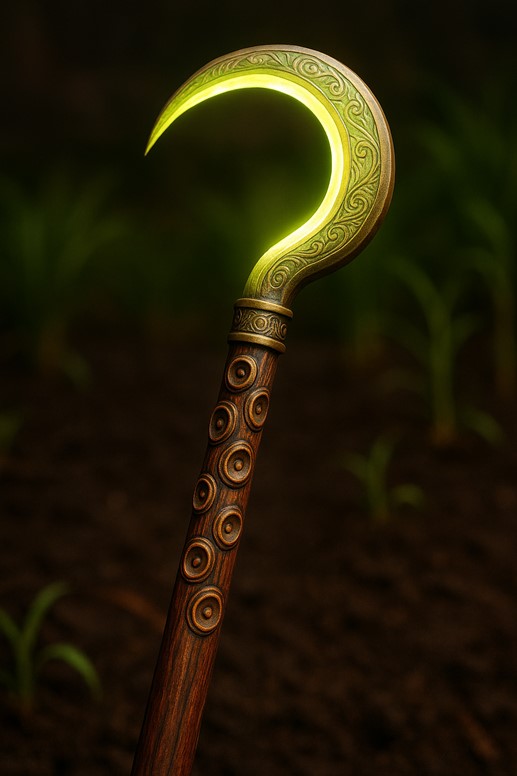
Perception of Activation:
- User’s Perspective:
- As the Suckerblade Crook is gripped and activated, a resonant hum thrums faintly through the hand and up the arm, like the pulse of fertile soil after rain.
- Sight: A soft green glow spirals along the crook’s engraved motifs, intensifying around the sucker-like patterns.
- Sound: A low rustling, like leaves stirring beneath the earth, whispers into the user’s ears, accompanied by distant echoes of growing roots.
- Touch: The surface warms slightly, textured with a faint, pulsing sensation resembling a heartbeat aligned with surrounding flora.
- Smell: A deep, loamy scent of moss, tilled earth, and blooming herbs wafts up from the crook.
- Taste (if near mouth): A subtle tang akin to fresh herbs and mineral-rich water lingers faintly on the tongue.
- Extra-Sensory: The user perceives flashes of vitality—faint, glowing outlines of plant roots beneath the soil, the hidden tension of stressed crops, and the slow, luminous throb of healthy vegetation. The crook imparts instinctive knowledge of plant health and growth stages.
- Observer’s Perspective:
- Sight: Green runes shimmer faintly on the crook, pulsating outward in slow waves. The wielder appears momentarily surrounded by drifting pollen-like motes.
- Sound: Observers may hear a faint, rhythmic tone like a plucked string vibrating through damp earth.
- Aura: A subtle distortion surrounds the crook, as if the air briefly bends with pressure or heat.
- Sensation: Those nearby may feel a slight pressure shift, like standing in dense vegetation or heavy humidity.
- Positives:
- Grants heightened connection to plant life, improving diagnostic insight and environmental awareness.
- Enhances roleplay with immersive sensory feedback and thematic grounding for agronomy-based scenes.
- Aids in both peaceful plant management and situational combat through its dual-purpose form.
- Negatives:
- Overactivation may cause sensory fatigue or distraction, particularly in overgrown or chaotic environments.
- Prolonged use may subtly mark the user with the scent of earth, which can compromise stealth.
- Becomes less effective in barren or magically dead terrain, where no flora exists to resonate with.
Crafting Recipe: Suckerblade Crook
“The crook that speaks with soil, forged in the rhythm of growth.”
- Materials Needed:
- 1x Polished Rootwood Staff (from deep-soil trees with alchemical resonance)
- 1x Curved Agron’s Steel Blade (lightweight, corrosion-resistant alloy; engraved)
- 3x Suckerform Enamel Discs (small circular plates, modeled after adhesive sucker patterns)
- 1x Vial of Verdant Resin (used to seal the blade and etch conduits of agronomic flow)
- 2x Strips of Binding Leather (from plant-fed beasts, for grip and flexibility)
- 1x Pebble of Fertile Stone (imbued with the vitality of healthy farmland)
- Crushed herb blend of: Sage, Burdock root, and Sylvanelm spores
- Tools Required:
- Alchemical Inlay Brush
- Arcane Etching Blade
- Heat-forged Crook Anvil (concave mold)
- Binding Vise
- Mortar and Pestle (for herb blend)
- Resonance Tuning Fork (Tier 1 tuning)
- Skill Requirements:
- Agronomy Lore: Intermediate knowledge of plant-life, soil behavior, and cultivation practices
- Crafting: Tools & Weapons: Basic skill for woodworking and blade attachment
- Alchemy: Resin Handling: Familiarity with resin infusion and channel formation
- Artistry: Etching: Precision hand-engraving with symbolic and functional design
- Crafting Steps:
- Prepare the Rootwood Shaft
- Soak the staff in a mist chamber filled with Sylvanelm spore vapor for 3 hours.
- Once saturated, inscribe thin guiding grooves using the Arcane Etching Blade, forming an open spiral along the length.
- Attach the Blade
- Heat the Agron’s Steel Blade until it softens at the base.
- Use the Heat-forged Crook Anvil to shape and press the blade into the crook’s upper bend.
- Seal the junction with Verdant Resin, coating the surrounding area with the herb blend while the resin is warm.
- Apply the Suckerform Enamel Discs
- Affix the circular adhesive discs at three equidistant points along the shaft.
- Use the Alchemical Inlay Brush to draw thin lines of resin around each disc in the shape of concentric spirals.
- Bind the grip with leather strips while the adhesive sets.
- Infuse with Fertility Resonance
- Embed the Fertile Stone at the base of the shaft using resin and secure it with carved sigils.
- Strike the Resonance Tuning Fork three times and pass it slowly along the staff to awaken its agronomic feedback loop.
- Curing and Final Inspection
- Let the completed crook rest vertically in a patch of living soil under moonlight for one full cycle.
- Inspect the sucker discs—if a faint warmth is felt when held near flora, the item is successfully bound.
- Prepare the Rootwood Shaft
- Optional Enhancements (Post-Craft):
- Enchant the enamel discs with low-tier Verdancy Runes to add minor regenerative bonuses in fertile terrain.
- Etch crop-specific symbols to align with specific agricultural regions of Saṃsāra.
Chronicle of the Rooted Hook and the Earth-Singer
In the time when the moons had not yet chosen their faces and the wind whispered without name, there was land, and in land was sorrow. Crops curled like dying snakes, and beasts bleated dry, their bones light with famine. The people, who were people before people were clever, cried into the soil, hoping the dust would hear. It did not.
But among these mourners was one who did not cry. She was named — or perhaps named herself — Verdant-Tongue-Who-Does-Not-Falter, though some call her Terra Verdant in the tongue of more recent days. She walked barefoot in fields that were no longer fields, with a crook of crooked wood and a blade that sang not in steel but in silence. The crook — which was not a crook but a reminder — bore discs that clung to her hand like the suckers of the wise swamp-beasts, the ones who touch the water and know its truth.
Many tell of her quest, though none agree on where she began. Some say she was born from a fruit cracked open by lightning; others say she was carved from the earth by worms who missed her. What all say is this:
She wandered, staff in hand, blade tucked within, and she listened. Not with ears alone, no. With finger and breath and the back of her knees. She placed the sucker-discs to bark, to furrows, to dying wheat-stalks, and the crook told her of hunger, of sickness in the root-thoughts of plants.
In one forgotten hill, her crook hissed when placed to the ground. There below was a seed — not of grain or vine, but of discord. A worm had whispered lies to the stones, teaching them to hoard water, not share it. The soil turned selfish. She struck the crook down. The blade rang — not loud, but in the pitch of seed-memory. It sliced the air, not to cut, but to realign.
The seed of discord unraveled, became again a thought of unity. The stones wept moisture. Roots reached again for sky.
Villages flourished, but she did not stay. The crook had tasted deeper famine, far to the east, in lands where the soil swallowed names and spat them out as sand. She walked onward, and when she passed, fields bowed — not in worship, but in relief.
Some say the crook still walks, carried by hands unknown. Some say it became a tree when she vanished, its fruits carved into lesser crooks. Others say she split into worms and now listens in every clod.
But the crook — the Suckerblade Crook — remained, and those who hold it and do not rush may yet hear the truth of dirt, the hunger of stalks, and the dreams of vines.
Moral of the Story: To till the land is to listen. Tools that speak may not shout. Soil forgets the unkind, but always remembers the patient.
Suggested conversions to other systems:
Call of Cthulhu 7th Edition
Item: Suckerblade Crook
- Type: Tool/Weapon (Multipurpose Staff-Blade)
- Uses: Agricultural Tasks, Occult Connection to Nature
- Bonus: +10% to Natural World and Botany rolls
- Special Effect: Once per day, if the user passes a Hard Natural World roll, they may intuitively diagnose an environmental anomaly or detect unnatural soil contamination.
- Damage (if used as weapon): 1d6+1 (bladed end), considered an improvised melee weapon
- Notes: This item resonates slightly in the presence of diseased flora. Using it in occult rituals involving nature grants +1 bonus die to Occult checks, but prolonged exposure may lead to unsettling dreams (Sanity loss 1/1d4 upon failure during extended use).
Blades in the Dark
Item: Suckerblade Crook
- Type: Fine Tool / Unusual Weapon
- Load: 1
- Effect: When used in Survey or Tinker actions involving natural environments (plants, soil, growth cycles), gain potency due to intuitive connection with nature.
- Special Ability: Once per score, the user may flashback to have used the crook in preparation for a terrain-based obstacle, gaining increased effect for an action involving plant life or terrain navigation.
- Weapon Use: Counts as a fine melee weapon with a concealed blade, +1d to Skirmish when used to disarm or trap foes entangled in vegetation.
Dungeons & Dragons 5th Edition
Item: Suckerblade Crook
- Wondrous Item (Common), Requires Attunement
- Slot: Held
- Bonus: While attuned, gain +1 to Nature and Survival checks related to agriculture, soil, or plant growth.
- Agronomic Affinity: Once per long rest, the wielder may cast Detect Poison and Disease without expending a spell slot.
- Weapon: Acts as a quarterstaff (1d6 bludgeoning, versatile 1d8). If used to strike a plant-based creature, it deals an additional 1d4 slashing damage due to the blade.
- Flavor: The crook faintly hums when near healthy crops, or pulses coldly when disease lingers in the soil.
Knave (Ben Milton’s rules-light OSR)
Item: Suckerblade Crook
- Type: Tool/Weapon
- Slot Cost: 1
- Function: Grants advantage on Agriculture-related tasks (interpreting growth, identifying blight, understanding land fertility).
- Effect: When used to test unknown soil or terrain, has a 2-in-6 chance of revealing helpful information (e.g., “soil too acidic,” “hidden irrigation nearby”).
- Combat: Deals 1d6 damage as an improvised polearm. On a natural 6, deals an extra +1 damage if used in or around natural terrain or plants.
- Misc: Carved sucker-like motifs give the wielder grip advantage, negating disarm effects on a roll of 4–6 on a d6.
Fate Core System
Item: Suckerblade Crook
- Aspect: Bond of Soil and Blade
- Stunts:
- Earthen Instincts: Once per session, you may automatically succeed on an Overcome action when identifying crop disease or terrain-related hazards.
- Symbiosis of Growth: Gain +2 to Create an Advantage when using Agronomy or Survival knowledge to analyze land or direct planting strategies.
- Uses: Primarily supports narrative actions involving farming, nature, land surveying, or controlling terrain.
- Narrative Role: The crook amplifies the user’s insight into soil conditions, crop health, and terrain manipulation through close symbiotic connection to the natural world.
Numenera / Cypher System
Item: Suckerblade Crook
- Level: 2
- Form: A wooden staff with sucker-shaped inlays and a blade hidden in the crook.
- Effect:
- Grants +1 to all Intellect-based tasks involving agriculture, botany, and terrain analysis.
- Once per day, the user can identify plant-based afflictions or blight within long range (Intellect task, Difficulty 3).
- When wielded as a weapon: Medium weapon, deals 4 points of damage, counts as bladed and botanical-aligned.
- Enabler: If used by a Nano or Jack with environmental foci, this item counts as an asset for one relevant action per scene.
Pathfinder 2nd Edition
Item: Suckerblade Crook
- Item Type: Worn / Held; Alchemical/Utility Tool
- Rarity: Common
- Level: 1
- Price: 50 gp
- Traits: Alchemical, Manipulate, Skill, Nature, Nonmagical
- Usage: Held in 1 hand
- Bulk: 1
- Effect:
- Grants a +1 item bonus to Nature checks related to agriculture, soil, or crops.
- Once per day, allows the user to attempt a special Recall Knowledge (Nature) check to identify a crop ailment or optimal planting method, even without normal access.
- May be used as a Simple Melee Weapon (1d6 slashing, agile, versatile B).
- Crafting Note: May be upgraded with nature-based runes or enchanted to become a +1 weapon.
Savage Worlds (Adventure Edition)
Item: Suckerblade Crook
- Type: Tool/Weapon
- Cost: 50 gp equivalent
- Weight: 3 lbs
- Effect:
- +1 bonus to all rolls involving Survival or Knowledge (Nature) specifically related to plants, crops, and terrain navigation.
- On a raise during a Notice check involving farmland or wild vegetation, the wielder can identify hidden threats (e.g., poison, disease, infestation).
- When used as a weapon:
- Damage: Str+d4
- Notes: Treated as a Staff, but if the target is a plant-based or earth-bound creature, damage is +1.
- Special Ability: Once per session, the user may reroll a failed Farming, Harvesting, or Soil Analysis check, taking the better result.
Shadowrun (6th Edition)
Item: Suckerblade Crook
- Category: Exotic Melee Weapon / Utility Tool
- Availability: 3
- Cost: 1,000¥
- Damage Value: (STR/2) +1P
- Accuracy: 5
- Reach: +1
- Special Features:
- Agricultural Interface: Provides +2 dice to Biotechnology or Agriculture-related skill tests when analyzing crops, soil, or plant-based compounds.
- Sensor Node: Built-in low-frequency sensor allows detection of fungal spread or nutrient imbalance within 10 meters (perception or biotech test, threshold 2).
- Non-Conductive: Treated wood and binding materials reduce damage from electrical sources by 1 DV.
- Notes: Used primarily by eco-technomancers and green-space scouts. May be customized with RFID node-tracking chips for crop mapping.
Starfinder
Item Name: Suckerblade Crook
- Item Level: 1
- Price: 50 credits
- Bulk: 1 (light)
- Type: Hybrid Item (Weapon / Environmental Tool)
- Weapon Statistics:
- Category: Melee
- Damage: 1d4 slashing
- Critical: Wound
- Special: Analog, Operative
- Hybrid Effect:
- Grants a +2 enhancement bonus to Life Science checks related to agronomy, botany, or xenobotany.
- Once per day, scan an area of 60 feet radius to detect plant-based life or disturbances in plant growth (takes 10 minutes).
- Use Case: Favored by terraforming scouts and planetary surveyors working with genetically modified flora.
Traveller (Mongoose 2nd Edition)
Item: Suckerblade Crook
- Tech Level: 4
- Cost: Cr250
- Mass: 1 kg
- Type: Tool / Primitive Melee Weapon
- Weapon Traits: Melee (Blade), Reach
- Damage: 1d6+STR modifier
- Special Properties:
- Provides DM+1 to Agriculture, Survival, or Life Sciences (Botany) checks when used in appropriate conditions.
- If used to defend in melee combat, may grant DM+1 to Parry due to increased reach and flexibility.
- Tool-end includes adjustable blade useful for pruning or crop-cutting.
- Common Use: Utilized by planetary settlers and scientific expeditions across uncharted or terraformed worlds.
Warhammer (Warhammer Fantasy Roleplay 4th Edition)
Item Name: Suckerblade Crook
- Type: Melee Weapon / Occupational Tool
- Encumbrance: 1
- Availability: Common
- Price: 5 shillings
- Weapon Profile:
- Group: Polearm
- Damage: SB+2
- Reach: Long
- Qualities: Defensive, Undamaging (vs. metal armor), Versatile
- Special Rule (Agronomy Focus):
- When used by characters with the Herbalist or Apothecary careers, grants +10 to relevant Trade or Lore (Agronomy) Tests.
- During downtime, may be used to reduce crop blight events or assist in famine prevention tasks at +1 Success Level.
- Narrative Use: Also functions as a religious or ritual staff among rural druids or hedge-priests in agrarian provinces.