
Lore: In the vibrant expanse of Saṃsāra, where ecosystems thrive and the balance of nature is revered, the Aquavista Agronome was ingeniously crafted by an astute agronomist named Flora Seaspring. Flora marveled at the intricate interdependencies of aquatic life forms and the intricate network of underwater ecosystems. The Aquavista Agronome was designed to enhance the wearer’s understanding of agronomy and ecological harmony, allowing them to cultivate crops with the same interconnected approach as underwater habitats.
Description: The Aquavista Agronome is a woven headband adorned with delicate aquatic motifs and shimmering gemstones that reflect the colors of the sea. The central gemstone emits a soothing, natural light, symbolizing the connection between the wearer’s agronomic skills and the intricate balance of aquatic ecosystems. When worn, the agronome establishes a link between the wearer’s grasp of agronomy and the symbiotic relationships of aquatic life, enabling them to cultivate crops with a holistic understanding.
Stats:
- Rarity: Common
- Tier: 1
- Agronomy Bonus: +1
- Slots: Gills
Color: The Aquavista Agronome features a palette of blues and greens, reminiscent of underwater environments and reflecting the harmony between cultivation and the interconnectedness of life.
Cost: 45 gold pieces
Tags: Agronomy, Ecology, Aquatic, Harmony, Cultivation, Symbiosis, Nature, Sustainability, Underwater, Balance, Growth
Use: When worn by a character, the Aquavista Agronome enhances their ability to apply agronomic principles, fostering ecological balance while cultivating crops. The agronome’s connection to underwater ecosystems allows the wearer to channel their agronomic skills, enabling them to optimize planting patterns, manage soil health, and cultivate crops that thrive within harmonious environments.
Additional Information:
- The Aquavista Agronome is designed to be comfortably worn over the wearer’s gills, primarily catering to characters born in underwater environments.
- The agronome does not grant any innate magical powers, nor does it provide the wearer with the ability to commune with aquatic creatures or control ecosystems.
- Characters might choose to personalize their agronomes with additional symbols or motifs that reflect their preferred cultivation techniques or favored aspects of aquatic life.
- As characters advance and refine their understanding of agronomy, they might explore ways to enhance the agronome’s effects through enchantments or modifications.
Roleplaying Emphasis: The Aquavista Agronome underscores the character’s dedication to the art of agronomy and ecological balance. Those who wear this agronome exude an air of wisdom and reverence for the natural world, embodying the role of an individual who cultivates crops with the same mindful approach as aquatic creatures nurture their habitats. Whether harmonizing with ecosystems, promoting sustainable farming, or embracing the interplay between life forms, the Aquavista Agronome becomes a cherished tool for those who embrace the journey of agronomy in the world of Saṃsāra.
The Aquavista Agronome, a woven headband designed to enhance agronomic understanding through a connection to aquatic ecosystems, is a common Tier 1 item in the world of Saṃsāra, valued at a base cost of 45 gold pieces. Its trade and availability vary across the diverse landscapes and cultures of this high-magic, steampunk-inspired world, which spans 73 island countries, uncharted isles, underwater cities, and floating metropolises, with a population of over 7 billion souls deeply tied to ecological balance. Below is a detailed exploration of the types of shops where the Aquavista Agronome might be bought and sold, the environments in which these shops operate, and how the item’s cost fluctuates based on location, demand, and cultural significance.
- Coastal Agrarian Markets
- Description: Found in coastal towns and villages like Seagrove Hollow, agrarian markets are bustling hubs where farmers, fishers, and agronomists trade goods tied to cultivation and ecological harmony. These markets are often set in open plazas with stalls made of driftwood and coral, decorated with woven seaweed banners and glowing shells that illuminate the area with a soft blue-green light, reflecting the ocean’s influence.
- How It’s Sold: The Aquavista Agronome is displayed on woven mats, its shimmering gemstone catching the light to attract buyers. Vendors, often agronomists or fishers with a deep respect for nature, demonstrate its use by wearing it and describing how it enhances their understanding of crop patterns, often pointing to nearby fields thriving with symbiotic planting. Buyers must attune to the item (1 minute, per Saṃsāra’s rules) to test its +1 Agronomy Bonus, with vendors guiding aquatic avatars through the process. Transactions are typically in gold pieces, but bartering with seeds, rare corals, or enchanted fertilizers is common.
- Cost: 45–50 gold pieces. The base price of 45 gold pieces is standard, but high demand during planting seasons or in areas with struggling crops can increase the cost slightly. In somewhat safe areas (doubled AC) like Seagrove Hollow’s walled market, prices may rise due to the security and steady flow of buyers.
- Locations: Common in coastal agrarian hubs like Seagrove Hollow, known for its steam-powered irrigation systems, or smaller villages like Coral Bloom, where fields border the sea. These markets are often in normal areas (standard AC) or somewhat safe areas (doubled AC).
- Underwater Eco-Havens
- Description: In underwater population centers like the city of Aquavale, eco-havens are serene marketplaces operated by water-breathing agronomists and ecologists, often tied to the legacy of Flora Seaspring, the Agronome’s creator. These havens are built into coral reefs or enchanted glass domes, accessible via air-filled chambers for surface-dwellers, and focus on goods that promote ecological balance, making the Agronome a staple item.
- How It’s Sold: The Agronome is showcased on a pedestal of woven kelp, its gemstone glowing softly under bioluminescent light. Vendors, typically merfolk or aquatic avatars, demonstrate its effects by wearing it and explaining how it helps them cultivate underwater crops like kelp forests or coral-based gardens, emphasizing its +1 Agronomy Bonus. Buyers are encouraged to attune (1 minute) and test its effects, often in a nearby aquatic garden. Payment is in gold pieces, but bartering with rare deep-sea plants, enchanted shells, or services (e.g., tending a reef garden) is preferred. The attunement process is treated as a ritual, reflecting the item’s connection to ecological harmony.
- Cost: 50–60 gold pieces. The higher price reflects the item’s cultural significance to underwater communities and the challenge of sourcing materials in the deep. In designated safe areas (tripled AC) within these havens, prices may increase due to the exclusivity and protective magical wards.
- Locations: Found in underwater cities like Aquavale, a sprawling network of coral gardens, or smaller reef settlements like Deepbloom Sanctuary. These havens are typically in normal areas (standard AC) or designated safe areas within guarded eco-zones.
- Steam-Powered Trade Caravans in Rural Islands
- Description: Across Saṃsāra’s rural islands, steam-powered caravans—large vehicles fueled by magical steam (elemental water and fire)—travel through jungles, plains, and coastal paths, bringing agricultural tools and mystical items to remote farming communities. These mobile shops are run by nomadic traders who cater to farmers and ecologists, offering items like the Agronome to enhance crop yields.
- How It’s Sold: The Agronome is stored in a steam-sealed crate to protect its woven structure from humidity. Traders, often former farmers with a knack for storytelling, demonstrate its use by wearing it and describing how it helped them cultivate a bountiful harvest, emphasizing its ecological benefits. Sales are brisk due to the caravan’s limited visits, and payment is often in gold pieces or bartered goods like harvested crops, woven baskets, or magical compost. Buyers are taught the attunement process (1 minute), though demonstrations are brief due to time constraints.
- Cost: 40–50 gold pieces. Prices vary based on the caravan’s route and the availability of agricultural goods in the region. In unsafe areas (halved AC), such as wild jungle trails, prices may drop to encourage quick sales, while in normal areas (standard AC), they align closer to the base cost.
- Locations: Common along trade routes connecting islands like Verdant Isle or in temporary encampments near rivers and lakes. These caravans avoid deathly areas (nullified AC) due to the risk of ambushes.
- Agricultural Guilds in Megacities
- Description: In towering megacities like Ironreef, agricultural guilds operate within steam-powered skyscrapers, catering to urban farmers, scholars, and ecologists who manage rooftop gardens or subterranean farms. These guilds, housed in structures with glass domes and magical irrigation systems, stock items like the Agronome for those seeking to cultivate crops in harmony with nature, even in urban settings.
- How It’s Sold: The Agronome is displayed alongside other farming tools, its gemstone glowing softly in a glass case. Guild members, trained in both agronomy and magical theory, demonstrate its use by attuning (1 minute) and explaining how it optimizes planting patterns in their rooftop gardens, showcasing its +1 Agronomy Bonus. Buyers can test the item in a controlled garden space, and payment is typically in gold pieces, though high-value items like mana-infused seeds are accepted. The attunement process is facilitated on-site, ensuring proper use.
- Cost: 50–55 gold pieces. The urban setting and demand from city farmers increase the price, especially in somewhat safe areas (doubled AC) within city walls. In designated safe areas (tripled AC), such as guarded guild districts, prices may reach the upper end due to the prestige of the establishment.
- Locations: Prevalent in metropolises like Ironreef, where skyscrapers feature rooftop farms, or Starhaven, a city with subterranean kelp gardens. These guilds are usually in somewhat safe or designated safe areas.
- Hidden Eco-Sanctuaries in Uncharted Isles
- Description: Scattered across uncharted islands, hidden eco-sanctuaries are secluded retreats operated by reclusive ecologists or followers of Flora Seaspring’s teachings. These sanctuaries, often disguised as natural groves or submerged reefs, cater to those who seek sustainable farming methods, offering items like the Agronome to aid in their ecological endeavors.
- How It’s Sold: The Agronome is presented with reverence, often placed on a bed of seaweed within a sacred grove. The seller, a hermit-like ecologist, tests buyers by asking them to attune (1 minute) and describe how they would use it to cultivate a sustainable crop, ensuring they align with the sanctuary’s values. Payment is flexible, accepting gold pieces, rare plants, or services like planting a new garden. The attunement process is part of the transaction, treated as a rite of ecological commitment.
- Cost: 40–45 gold pieces. The lower price reflects the lack of overhead in these remote locations, but the difficulty of reaching the sanctuary keeps prices near the base cost. These sanctuaries are often in unsafe areas (halved AC) or normal areas (standard AC), relying on their seclusion for protection.
- Locations: Found on uncharted isles like Greenveil Atoll or in submerged reefs near the Coral Bloom Expanse. These sanctuaries are rare and require exploration or local knowledge to locate.
- Floating Agricultural Hubs
- Description: High above Saṃsāra’s oceans, floating agricultural hubs like Skybloom Nexus are massive platforms suspended by hot air balloons and magical levitation. These hubs serve as neutral trading grounds for farmers and ecologists from across the islands, offering items like the Agronome to those managing sky gardens or seeking to cultivate crops during long voyages.
- How It’s Sold: The Agronome is sold in compact, wind-resistant stalls, often alongside seeds and farming tools. Merchants demonstrate its use by wearing it and describing how it helps them manage sky gardens, emphasizing its ecological benefits. Transactions are swift, favoring gold pieces for their universal acceptance, though rare airborne plants like cloud blossoms are also valued. Buyers are taught the attunement process (1 minute), but they must handle it themselves post-purchase due to the hub’s fast-paced environment.
- Cost: 45–55 gold pieces. The price reflects the hub’s accessibility and the item’s utility for sky farmers. In designated safe areas (tripled AC) on well-guarded platforms, prices may rise due to the secure environment and high demand.
- Locations: Common at hubs like Skybloom Nexus, a floating city of tethered airships with sky gardens, or smaller docking stations above trade routes. These hubs are typically in normal areas (standard AC) or designated safe areas.
- Trade Dynamics and Cultural Notes
- Bartering: Bartering is a key aspect of Saṃsāra’s economy, especially in eco-havens and hidden sanctuaries, where gold is less valued than rare plants, enchanted soils, or ecological services. In urban guilds and floating hubs, gold pieces are preferred, but trades involving seeds or fertilizers are common.
- Cultural Significance: In underwater communities, the Agronome is seen as a tribute to Flora Seaspring’s legacy, and its sale often involves sharing stories of her work. In agrarian markets and guilds, it’s treated as a practical tool for sustainable farming, emphasizing its +1 Agronomy Bonus and gill slot utility.
- Availability: The item’s common rarity ensures it’s widely available in areas tied to agriculture or aquatic ecosystems, but it’s rarer in urban or non-aquatic regions, where prices may increase by 5–10 gold pieces due to import costs.
- Transport: The Agronome’s woven structure is lightweight and easily transported via steamships, airships, or griffon couriers. However, in unsafe or deathly areas (halved or nullified AC), merchants may avoid carrying it due to the risk of damage or theft.
- Roleplaying Opportunities
- Coastal Markets: Players can engage in lively bartering scenes, using their character’s knowledge of agronomy to negotiate a better price. A vendor might offer a discount if the player shares a sustainable farming technique they’ve learned.
- Underwater Eco-Havens: Visiting these havens can involve earning the trust of merfolk farmers, adding depth to the purchase. Players might roleplay tending a kelp garden with the Agronome, strengthening their bond with the item.
- Hidden Eco-Sanctuaries: Finding these sanctuaries can be a quest, requiring players to navigate uncharted waters or befriend aquatic creatures for guidance. The purchase might come with a task, such as planting a new grove to honor Flora Seaspring.
- Floating Hubs: The fast-paced environment encourages quick negotiations, but players can leverage their character’s reputation as an ecologist to gain favor, perhaps unlocking rare seeds or farming tips from the vendor.
The Aquavista Agronome’s trade reflects Saṃsāra’s vibrant, ecologically conscious economy, where magic and steam power facilitate commerce across diverse environments. Its accessibility and utility make it a sought-after item for farmers, ecologists, and adventurers dedicated to cultivating crops in harmony with the natural world.
The Aquavista Agronome, a common Tier 1 item in the world of Saṃsāra, is a woven headband adorned with aquatic motifs and a central gemstone, designed to enhance agronomic understanding through a connection to aquatic ecosystems. With a +1 Agronomy Bonus and a gill slot, it fosters ecological balance in cultivation, but its utility can extend to defensive and offensive applications in various environments across Saṃsāra’s high-magic, steampunk-inspired world of 73 island countries, uncharted isles, underwater cities, and floating metropolises. Below is a detailed exploration of how characters can roleplay the use of the Aquavista Agronome for defense and offense in different environments, emphasizing the immersive and interactive aspects of the setting.
- Coastal Environments (Beaches, Ports, and Coral Reefs)
- Description: Coastal regions in Saṃsāra, such as the port of Seagrove Hollow or the coral reefs near Coralspire, are rich with marine life and interconnected ecosystems. These areas range from normal (standard AC) to somewhat safe (doubled AC) within walled ports. The environment features sandy shores, steam-powered docks, and bioluminescent flora that enhance ecological connections.
- Defensive Roleplay:
- Scenario: A party is ambushed by bandits on a beach while gathering coastal herbs. The character, an aquatic agronomist, activates the Agronome by focusing on the surrounding ecosystem, its gemstone glowing softly. They sense the symbiotic relationship between nearby dune grasses and burrowing crabs, realizing the crabs can be encouraged to create a defensive barrier. The character scatters seeds to attract the crabs, which dig up sand to form a temporary wall, slowing the bandits’ advance. The character roleplays calm focus, their gills fluttering as they channel ecological insight, describing the crabs as “the shore’s guardians.”
- Mechanics: The +1 Agronomy Bonus enhances the character’s ability to manipulate the ecosystem, applied as a bonus to a check to understand and influence local wildlife (e.g., a Nature or Survival check). The Mind’s Eye (passive activation) reveals the crabs’ symbiotic role, while active use (a few minutes, requiring an identify item) could confirm their defensive potential. In a somewhat safe area (doubled AC), the party’s defenses are bolstered, making the barrier more effective.
- Roleplay Emphasis: The character kneels on the sand, their hands tracing the headband as the gemstone glows, narrating the ecosystem’s harmony with a reverent tone. They might guide allies to stay behind the barrier, reinforcing their role as a protector through ecological wisdom in the coastal setting.
- Offensive Roleplay:
- Scenario: While harvesting coral-based crops near a reef, the party is attacked by a rival farming group. The character uses the Agronome to analyze the reef’s ecosystem, identifying a patch of toxic algae that can be disturbed to release a cloud of irritants. They direct allies to stir the algae with a pole, creating a noxious haze that drives the rivals back. The character roleplays intense concentration, their gills quivering as they channel ecological knowledge, warning allies to hold their breath.
- Mechanics: The +1 Agronomy Bonus aids in identifying the algae’s properties, applied to a check to analyze the environment (e.g., a Nature or Intelligence check). The Mind’s Eye (active) reveals the algae’s toxic nature, guiding the strategy. In a normal area (standard AC), the algae’s effect is reliable but requires careful execution to avoid harming the party.
- Roleplay Emphasis: The character stands amidst the reef, their headband glowing as they describe the algae as “the reef’s silent defender.” They might shout instructions to allies, immersing the party in the strategic use of the ecosystem, highlighting their role as a tactical ecologist.
- Underwater Environments (Reef Cities, Ocean Trenches, and Submerged Ruins)
- Description: Underwater locales like the city of Aquavale or the Deepbloom Sanctuary reefs are vibrant with bioluminescent flora and aquatic life. These areas range from normal (standard AC) to designated safe (tripled AC) in guarded eco-havens. The water amplifies the Agronome’s connection to ecosystems, but visibility and movement challenges require careful coordination.
- Defensive Roleplay:
- Scenario: In an ocean trench, the party is pursued by a predatory sea serpent. The character, a merfolk farmer, uses the Agronome to analyze the trench’s ecosystem, its gemstone glowing as they sense a symbiotic relationship between bioluminescent jellyfish and a coral shelf. They guide the party to swim through the jellyfish, whose light creates a disorienting glow that confuses the serpent, allowing escape. The character roleplays serene focus, their tail fin steady as they channel ecological harmony, describing the jellyfish as “the deep’s lanterns.”
- Mechanics: The +1 Agronomy Bonus enhances the character’s understanding of the ecosystem, applied to a check to identify the jellyfish’s role (e.g., a Nature or Survival check). The Mind’s Eye (passive) confirms their non-aggressive nature, while active use could reveal their disorienting effect. In a normal area (standard AC), the maneuver relies on the character’s skill to avoid provoking the jellyfish.
- Roleplay Emphasis: The character’s voice is muffled by water, but they describe the vision with poetic calm, guiding allies through the glowing swarm. They might gesture to allies to swim in formation, reinforcing their role as a guide in the perilous underwater environment.
- Offensive Roleplay:
- Scenario: While tending an underwater kelp garden in Aquavale, the party is ambushed by sahuagin raiders. The character meditates with the Agronome, sensing a symbiotic relationship between the kelp and a school of territorial fish. They disturb the kelp to provoke the fish, which swarm the sahuagin, driving them away. The character roleplays intense focus, their gills fluttering as they channel ecological insight, urging allies to stay clear of the fish.
- Mechanics: The +1 Agronomy Bonus aids in understanding the fish’s territorial behavior, applied to a check to manipulate the ecosystem (e.g., a Nature or Intelligence check). The Mind’s Eye (active) reveals the fish’s protective instincts, informing the strategy. In a designated safe area (tripled AC), the party’s enhanced defenses make the maneuver safer.
- Roleplay Emphasis: The character channels a focused demeanor, their headband glowing as they describe the fish as “the garden’s protectors.” They might narrate the kelp’s sway as a call to action, immersing allies in the ecological and tactical nature of the encounter.
- Inland Environments (Lakes, Rivers, and Caves)
- Description: Inland areas, such as lakes near steam-powered trade routes or dark cave systems with underground rivers, host smaller ecosystems like aquatic plants and amphibians. These areas are often normal (standard AC) or unsafe (halved AC) due to their proximity to wild territories. The Agronome’s ecological connection is less direct but still effective in enclosed or water-adjacent spaces.
- Defensive Roleplay:
- Scenario: In a flooded cave system, the party is cornered by cave-dwelling predators. The character, an ecologist, uses the Agronome to analyze the cave’s ecosystem, its gemstone glowing as they sense a symbiotic relationship between luminescent moss and small aquatic insects. They encourage the insects to swarm the moss, creating a bright flash that temporarily blinds the predators, allowing the party to escape. The character roleplays calm focus, their hands tracing the headband as they channel ecological harmony, describing the moss as “the cave’s light.”
- Mechanics: The +1 Agronomy Bonus enhances the character’s understanding of the ecosystem, applied to a check to identify the moss-insect relationship (e.g., a Nature or Survival check). The Mind’s Eye (passive) confirms the insects’ behavior, while active use could reveal the flash’s potential. In an unsafe area (halved AC), the character must act quickly to avoid harm.
- Roleplay Emphasis: The character kneels near the moss, their headband glowing as they describe the ecosystem with reverent awe. They might guide allies to shield their eyes, reinforcing their role as a wise ecologist in the dark, dangerous environment.
- Offensive Roleplay:
- Scenario: While crossing a river, the party is attacked by river bandits. The character uses the Agronome to analyze the river’s ecosystem, identifying a patch of carnivorous water plants that can be provoked to entangle the bandits’ boats. They direct allies to disturb the plants, which lash out and trap the bandits, halting their pursuit. The character roleplays intense concentration, their gills quivering as they channel ecological knowledge, warning allies to stay clear.
- Mechanics: The +1 Agronomy Bonus aids in identifying the plants’ behavior, applied to a check to manipulate the ecosystem (e.g., a Nature or Intelligence check). The Mind’s Eye (active) reveals the plants’ carnivorous nature, guiding the strategy. In a normal area (standard AC), the plants’ effect is effective but requires careful execution.
- Roleplay Emphasis: The character stands on the riverbank, their headband glowing as they describe the plants as “the river’s sentinels.” They might shout instructions to allies, immersing the party in the strategic use of the ecosystem, highlighting their role as a tactical ecologist.
- Aerial Environments (Airship Decks and Floating Cities)
- Description: High above Saṃsāra’s oceans, airships and floating cities like Skybloom Nexus are normal (standard AC) or designated safe (tripled AC). The Agronome’s connection to aquatic ecosystems is less direct, but it can tap into atmospheric moisture or distant water sources to influence airborne ecosystems like sky gardens. The open air amplifies its magical resonance but requires creative application.
- Defensive Roleplay:
- Scenario: On an airship under attack by sky pirates, the character uses the Agronome to analyze the sky garden on the deck, its gemstone glowing as they sense a symbiotic relationship between the garden’s vines and a flock of small birds. They encourage the birds to swarm the pirates by scattering seeds from the garden, creating a distraction that allows the airship to escape. The character roleplays calm focus, their headband glowing as they channel ecological harmony, describing the birds as “the sky’s protectors.”
- Mechanics: The +1 Agronomy Bonus enhances the character’s understanding of the sky garden’s ecosystem, applied to a check to influence the birds (e.g., a Nature or Survival check). The Mind’s Eye (active) reveals the birds’ symbiotic role, ensuring the distraction works. In a designated safe area (tripled AC), the maneuver is low-risk.
- Roleplay Emphasis: The character stands amidst the garden, their headband glowing as they describe the ecosystem with serene wisdom. They might signal allies to brace for the swarm, reinforcing their role as a strategic ecologist in the high-stakes aerial chase.
- Offensive Roleplay:
- Scenario: At a floating trade hub, the party is ambushed by rogue griffon riders. The character uses the Agronome to analyze the hub’s sky garden, identifying a patch of thorny vines that can be provoked to lash out. They direct allies to disturb the vines, which whip at the griffons, forcing them to retreat. The character roleplays intense focus, their headband glowing as they channel ecological knowledge, urging allies to act quickly.
- Mechanics: The +1 Agronomy Bonus aids in identifying the vines’ defensive properties, applied to a check to manipulate the ecosystem (e.g., a Nature or Intelligence check). The Mind’s Eye (active) reveals the vines’ behavior, guiding the strategy. In a normal area (standard AC), the vines’ effect is effective but requires coordination.
- Roleplay Emphasis: The character channels a focused demeanor, their headband glowing as they describe the vines as “the garden’s defenders.” They might narrate the vines’ movement as a natural retaliation, immersing allies in the tactical and ecological nature of the skirmish.
- Additional Roleplaying Considerations
- Magic and Conduits: The Agronome serves as a magical conduit (per Saṃsāra’s rules), focusing the character’s thoughts to tap into ecological harmony. Roleplaying its use involves describing the flow of magic, such as a tingling in the gills or a warmth in the gemstone, enhancing immersion.
- Mind’s Eye Integration: The Mind’s Eye enhances roleplay by providing instant (passive) or detailed (active) insights into ecosystems. Characters might narrate visualizing “stats” as glowing runes, such as a plant’s toxic properties or a creature’s symbiotic role, guiding their defensive or offensive tactics.
- Environmental Challenges: In unsafe (halved AC) or deathly areas (nullified AC), characters must roleplay caution, as using the Agronome risks drawing attention. For example, in a deathly jungle river, provoking carnivorous plants might attract a larger predator, requiring quick adjustments.
- Avatar Diversity: Aquatic avatars (e.g., merfolk) naturally excel with the Agronome’s gill slot, roleplaying seamless integration with its magic. Non-aquatic avatars (e.g., humanoids) might describe awkward but determined efforts to use it, adding depth to their character’s journey.
- Chanting Mechanics: While the Agronome doesn’t involve chanting for its primary effect, characters might use Normal chanting (a few words, under 6 seconds) to enhance their focus, increasing the clarity of ecological insights by up to 25%. Roleplaying this involves reciting phrases like “Harmonize with the deep,” adding a mystical layer to their actions.
- Strategic and Narrative Impact
- Defense: The Agronome’s defensive uses focus on protection through ecological manipulation, such as creating barriers or distractions with symbiotic creatures. Roleplaying emphasizes the character as a guardian of nature, using ecosystems to shield the party, which suits those who value harmony and caution.
- Offense: Offensive uses highlight the character as a tactician, leveraging ecosystems to disrupt foes indirectly through natural defenses like toxic algae or territorial creatures. Roleplaying involves strategic foresight, reflecting the character’s ability to shape outcomes through ecological knowledge, appealing to those who favor indirect combat roles.
- Story Arcs: Using the Agronome can lead to quests, such as restoring a dying reef garden or teaching a village sustainable farming methods inspired by aquatic ecosystems. Characters might grapple with the responsibility of maintaining ecological balance, adding depth to their arc as they balance cultivation with survival.
The Aquavista Agronome’s ecological focus encourages creative roleplay, blending natural harmony, strategy, and narrative in Saṃsāra’s diverse environments. Whether creating a crab-dug barrier to fend off bandits or provoking territorial fish to scatter enemies, characters wielding this item embody the role of a wise agronomist, enriching the immersive experience of the world.
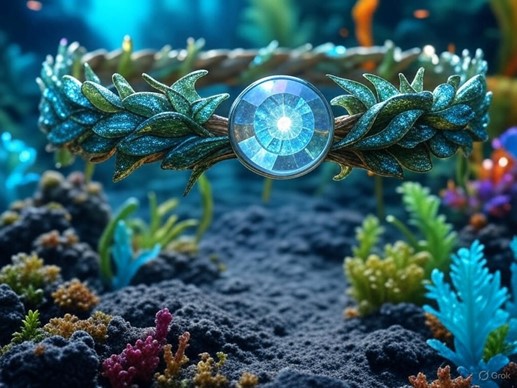
Perception of Activation: The Aquavista Agronome, a woven headband adorned with aquatic motifs and a central gemstone in the world of Saṃsāra, activates with a soothing, natural light that symbolizes the connection between agronomic skills and aquatic ecosystems. This common Tier 1 item, with its +1 Agronomy Bonus, creates a multisensory experience that resonates with both the user and observers, enhancing their understanding of ecological harmony. Below is a detailed exploration of these perceptions from the user’s and observer’s perspectives, including positives and negatives, across the five senses and additional metaphysical senses like the Mind’s Eye and magical awareness.
- User’s Perspective
- Sight: When the user activates the Agronome by focusing their thoughts on ecological harmony, the central gemstone emits a soothing, natural light in a palette of blues and greens, reminiscent of underwater environments. The light pulses gently, casting delicate reflections of aquatic motifs across the woven headband, which shimmers with bioluminescent flecks. If underwater, the glow interacts with surrounding bioluminescent flora, creating a harmonious interplay of light that mirrors the interconnectedness of aquatic life.
- Sound: The user hears a faint, melodic hum emanating from the gemstone, akin to the gentle ripple of waves or the distant song of coral reefs. The hum resonates through their gills, creating a harmonic vibration that feels like a whisper of Saṃsāra’s ecosystems, guiding their agronomic insights toward balance and sustainability.
- Touch: The woven headband feels soft and slightly cool against the user’s gills, its texture reminiscent of seaweed swaying in a current. As the Agronome activates, a subtle warmth spreads from the gemstone, pulsing in sync with the light, creating a comforting sensation that connects the user to the natural world.
- Smell: A delicate scent of fresh seaweed and blooming underwater flora wafts from the Agronome, evoking the crisp aroma of a thriving aquatic ecosystem. This fragrance is invigorating, grounding the user in the ecological essence of the item’s magic, though it fades quickly in open air environments.
- Taste: If the user is underwater, they might taste a faint hint of saltwater and minerals as the Agronome’s magic interacts with the surrounding water, a sensation akin to sipping from a pristine reef spring. This taste is subtle but reinforces the connection to aquatic life.
- Extrasensory Perceptions:
- Mind’s Eye: The user’s metaphysical ability activates passively, revealing the Agronome’s stats: its +1 Agronomy Bonus and gill slot. With active use (requiring a few minutes of concentration and an identify item), the user visualizes the symbiotic relationships within nearby ecosystems as glowing patterns—plants, creatures, and their interdependencies—manifesting as runes or threads in their mind.
- Magical Awareness: The user feels a gentle flow of magical energy, a cool, refreshing sensation that courses through their gills and mind, as if they’re tapping into Saṃsāra’s magical weather. This awareness confirms the item’s attunement (1 minute, per Saṃsāra’s rules) and enhances their ecological understanding.
- Ecological Resonance: The user experiences a deep sense of harmony and balance, feeling emotionally connected to the ecosystems they influence. This can be uplifting, as they sense the health of the natural world, but also burdensome if the ecosystem is suffering, reflecting its pain in their emotions.
- Positives:
- The sensory feedback (glowing gemstone, melodic hum, and seaweed scent) immerses the user in their role as an ecologist, enhancing their ability to roleplay a character dedicated to ecological balance.
- The Mind’s Eye provides strategic insights, such as identifying symbiotic relationships that can be used for defense (e.g., crabs creating a barrier), allowing the user to protect their party through natural means.
- The ecological resonance fosters a deeper narrative experience, encouraging the user to explore their character’s connection to Saṃsāra’s ecosystems and the legacy of Flora Seaspring.
- Negatives:
- The glowing gemstone and audible hum can draw attention in unsafe areas (halved AC), making the user a target for predators or foes who might sense the magical disturbance.
- Overuse of the Mind’s Eye (active activation) risks overwhelm, causing temporary debuffs like mental fatigue or inability to use the ability again without a cooldown, as the user struggles to process complex ecological patterns.
- The ecological resonance can be emotionally taxing; if the user senses a dying ecosystem, they might feel grief or guilt, impacting their focus or decision-making in critical moments.
- Observer’s Perspective
- Sight: Observers see the Agronome’s gemstone emit a soothing light in blues and greens, its gentle pulsing casting reflections of aquatic motifs across the headband. The woven strands shimmer with bioluminescent flecks, creating a serene glow that evokes the beauty of underwater ecosystems. In underwater settings, the light harmonizes with bioluminescent flora, creating a captivating display; in air, the glow stands out against darker environments like caves or jungles.
- Sound: The melodic hum is audible to observers, sounding like a distant ripple of waves or the faint song of a coral reef. The sound carries a natural quality, evoking a sense of peace or wonder, though it may feel eerie to those unfamiliar with aquatic magic. It resonates more strongly in enclosed spaces, such as caves, where echoes amplify its presence.
- Touch: Observers don’t directly touch the Agronome, but they may feel a subtle vibration in the water or air as the hum resonates, creating a faint ripple effect. In underwater environments, this vibration is more pronounced, felt as a gentle current against the skin or gills, adding a tactile layer to the experience.
- Smell: Observers catch a faint whiff of fresh seaweed and underwater flora, carried by the magical aura of the Agronome. The scent is stronger in enclosed spaces like underwater grottos, where it lingers, but dissipates quickly in open air or strong currents.
- Taste: Observers don’t taste anything directly, but if they’re close to the user in an underwater environment, they might sense a subtle mineral tang in the water as the Agronome’s magic interacts with the surroundings, faintly altering the water’s flavor.
- Extrasensory Perceptions:
- Mind’s Eye: Observers with the Mind’s Eye (all sentient beings in Saṃsāra) passively perceive the Agronome’s basic stats: its name, rarity (Common), and purpose (agronomic enhancement). With active use, they might identify its +1 Agronomy Bonus and gill slot, seeing these as glowing symbols in their mind.
- Magical Awareness: Observers sense a gentle ripple of magical energy emanating from the Agronome, a subtle flow that resonates with Saṃsāra’s high-magic environment. They can tell the item is a conduit for the user’s magic, though they may not grasp the full extent of its ecological focus.
- Emotional Resonance: Observers feel a subtle emotional pull from the Agronome’s hum, often a sense of peace or harmony that mirrors the user’s connection to nature. However, if the user senses a troubled ecosystem, observers might feel a fleeting unease, as if the natural balance is shifting.
- Positives:
- The visual and auditory spectacle of the Agronome’s activation can inspire awe in observers, enhancing the user’s reputation as a wise ecologist or farmer, especially in communities that value ecological balance.
- The magical ripple can reassure allies, confirming the user’s connection to Saṃsāra’s ecosystems, particularly in defensive scenarios where ecological manipulation helps the party avoid danger.
- The emotional resonance can foster group cohesion, as observers feel the user’s harmony, aligning the party’s focus during tense situations.
- Negatives:
- The glowing gemstone and audible hum can reveal the party’s position in unsafe (halved AC) or deathly areas (nullified AC), attracting the attention of monsters or foes drawn to magical disturbances.
- Observers unfamiliar with aquatic ecosystems might find the seaweed scent or vibrations unsettling, especially if they lack a connection to nature.
- The emotional resonance can be disruptive; if the user senses a struggling ecosystem, the unease felt by observers might cause tension or doubt, particularly if they misinterpret the user’s intent.
- Broader Implications in Saṃsāra
- Roleplaying Opportunities: The sensory and extrasensory perceptions enhance immersive roleplay. Users might describe the tingling in their gills as “the heartbeat of the deep,” while observers narrate the gemstone’s glow as “a reflection of the ocean’s balance.” These perceptions deepen the narrative, tying characters to Saṃsāra’s ecological themes.
- Strategic Considerations: The Agronome’s activation can be a double-edged sword. In designated safe areas (tripled AC), the glow and hum are less risky, allowing users to focus on the positives (e.g., creating a defensive barrier). In deathly areas (nullified AC), the negatives dominate, as the sensory output might attract overwhelming threats.
- Cultural Context: In underwater communities like Aquavale, the Agronome’s activation is seen as a tribute to Flora Seaspring’s legacy, and observers might react with reverence, offering blessings to the user. In land-based metropolises like Skybloom Nexus, its use might draw curiosity or skepticism, with observers questioning the user’s ecological insights.
The activation of the Aquavista Agronome creates a rich, multisensory experience that immerses both user and observer in Saṃsāra’s high-magic world. Its sensory and extrasensory effects enhance roleplay, offering opportunities for strategic and emotional engagement, while also presenting risks that characters must navigate carefully.
Tidegrow Wreath Crafting Recipe
- Materials Needed
- Enchanted Seaweed Strands (8 strands): Sourced from the bioluminescent reefs of Saṃsāra, these strands are imbued with minor magical properties, ideal for channeling ecological energies. They form the headband’s woven structure.
- Aquatic Gemstone (1): A small, shimmering gemstone, such as a sea sapphire or aquamarine, naturally resonant with aquatic magic. It serves as the wreath’s central piece, enhancing the wearer’s agronomic connection.
- Coral Beads (10 small beads): Harvested from Saṃsāra’s shores, these beads are used to create the aquatic motifs, adding both aesthetic and magical resonance to the wreath.
- Elemental Water Essence (1 vial): A magical liquid derived from elemental water, often traded in coastal markets, used to infuse the wreath with aquatic affinity and ecological harmony.
- Kelp Thread (1 spool): A fine, durable thread spun from kelp fibers, used to bind the components together while maintaining their magical properties.
- Tools Required
- Weaving Needle: A fine, enchanted needle designed for working with magical fibers like seaweed strands, ensuring they retain their mystical properties during crafting.
- Steam-Powered Carver: A handheld device fueled by magical steam (combining elemental water and fire), used to shape the coral beads and etch aquatic motifs into the gemstone.
- Infusion Tray: A shallow, enchanted tray that blends elemental essences with physical materials, often found in mystical workshops or coastal forges.
- Binding Clamp: A small, steam-powered clamp used to secure the headband’s components during assembly, ensuring a tight weave.
- Polishing Cloth: A soft cloth infused with minor enchantments to polish the gemstone, enhancing its glow and magical conductivity.
- Skill Requirements
- Crafting (Ecological Artifacts) – Novice Level: The crafter must have basic training in crafting items tied to ecological magic, understanding how to channel nature-based energies.
- Magical Infusion – Novice Level: The crafter needs rudimentary knowledge of infusing items with magical essences, ensuring the wreath can enhance agronomic understanding.
- Agronomy – Basic Proficiency: The crafter must be able to test the wreath’s ecological effects, requiring a basic ability to understand symbiotic relationships and cultivation techniques (similar to the skill needed to use the item effectively).
- Crafting Steps
- Prepare the Seaweed Strands: Select 8 enchanted seaweed strands, ensuring they are free of imperfections. Soak them in a vial of elemental water essence for 10 minutes to enhance their magical conductivity and flexibility.
- Weave the Headband Base: Using the weaving needle, braid the seaweed strands into a headband, approximately 20 inches long and 1 inch wide, designed to fit comfortably around the gills. Create a small loop at the center to hold the aquatic gemstone, ensuring the strands form a palette of blues and greens.
- Shape the Coral Beads: Use the steam-powered carver to shape the 10 coral beads into small, rounded pieces, each about 0.5 inches in diameter. Etch subtle aquatic motifs (e.g., waves, fish) into each bead to enhance the wreath’s connection to underwater ecosystems.
- Attach the Coral Beads: Thread the coral beads onto the headband using the kelp thread, placing them evenly along the woven strands to create a decorative pattern. Secure each bead with a small knot to ensure they remain in place without disrupting the headband’s flexibility.
- Etch the Gemstone: Use the steam-powered carver to etch a simple wave motif into the aquatic gemstone, enhancing its resonance with aquatic magic. This process takes 5 minutes and ensures the gemstone can channel ecological harmony.
- Polish the Gemstone: Use the polishing cloth to buff the gemstone, bringing out its shimmering glow and enhancing its magical conductivity. This step ensures the gemstone can emit the soothing, natural light described in the original item.
- Attach the Gemstone: Secure the polished gemstone into the central loop of the headband using the binding clamp and kelp thread, tying it tightly to ensure it remains in place during use. The gemstone should sit at the center, radiating its magical energy.
- Infuse the Wreath: Place the assembled wreath into the infusion tray and pour the remaining elemental water essence over it. Let it soak for 10 minutes to infuse the entire item with aquatic affinity, ensuring it harmonizes with the wearer’s agronomic skills.
- Test the Wreath: Wear the wreath around the gills and focus on a nearby ecosystem (e.g., a small garden or aquatic habitat) to test its effects. The crafter, using their basic agronomy proficiency, should feel a heightened understanding of symbiotic relationships (e.g., optimal planting patterns), confirming the item’s functionality. If the effect is weak, re-infuse with elemental water essence as needed.
- Attune the Wreath: Meditate with the wreath for at least 1 minute to attune it (per Saṃsāra’s attunement rules for worn items). This step ensures the item is ready for use, granting its +1 Agronomy Bonus and gill slot functionality.
The completed Tidegrow Wreath mirrors the Aquavista Agronome’s stats: Common rarity, Tier 1, +1 Agronomy Bonus, and gill slot. It features a palette of blues and greens, enhancing the wearer’s ability to cultivate crops with ecological harmony, making it a valuable tool for agronomists and ecologists in Saṃsāra’s diverse environments.
Weaver of the Tide’s Bounty
In the ancient cycles of Saṃsāra, when the seas danced with untamed magic and the islands were but whispers on the waves, there lingered a tale, scratched on kelp scrolls and murmured in broken chants, of a sacred relic known as the Tide’s Bounty. This artifact, now called the Aquavista Agronome, was woven by a wise agronomist named Flora Seaspring, a soul of the deep who sought to mirror the ocean’s harmony in the fields of the land. The story, poorly translated from a tongue older than the coral reefs, is the most known legend of the Tide’s Bounty, a saga of balance, defiance, and the eternal bond between sea and soil.
In the dawn of the fifth cycle, when the gods still stirred the tides with their breath, there lived Flora Seaspring, a merfolk of the Verdant Abyss, whose gills shimmered like the first light on water. Flora was no mere farmer; her mind was a garden, her heart a sea, and she saw the world as a tapestry of life—fish and coral, kelp and crab, all woven in a dance of balance. Yet the islands above suffered, their fields barren, their people hungry, for they knew not the ways of the deep. Flora, moved by their plight, vowed to bring the ocean’s wisdom to the land, to teach them to grow as the sea grows, in harmony and plenty.
Flora swam to the surface, her tail cutting through currents, her hands clutching strands of enchanted seaweed and a gemstone that glowed with the light of the deep. She stood on the shores of Seagrove Hollow, where the people toiled in fields that yielded naught but dust. They shunned her, calling her a creature of the abyss, but Flora, undeterred, spoke of the sea’s ways—of kelp that nurtured fish, of coral that sheltered life, of tides that fed the whole. The people listened, wary but desperate, and Flora began her work, planting seeds in patterns that mirrored the reefs, guiding the soil as the currents guide the waves.
But the fields were cursed, blighted by a shadow born of greed. Long ago, the island’s chieftain, Gorvax, had defied the gods, reaping the land without care, breaking the balance of life. The goddess of growth, Sylvara, had cursed the soil, her wrath a blight that withered all it touched. Gorvax, now a shadow of his former self, sought to stop Flora, fearing her work would anger the gods further. He sent his warriors to drive her away, their spears gleaming with malice. “Begone, sea-witch!” they cried, “The land is ours to break!”
Flora, though gentle, was fierce in her purpose. She wove the seaweed strands into a headband, her fingers trembling with urgency, and set the gemstone at its heart, her prayers a song to Sylvara. Her craft was simple, a humble weave, but her spirit poured into it a love so pure that the goddess herself took notice. Sylvara touched the headband with a breath of magic, and it glowed with blues and greens, its gemstone humming with the power to see as the sea sees. Flora named it the Tide’s Bounty, for it brought the ocean’s balance to the land.
She wore the headband, its strands wrapping her gills, and focused on the fields, her mind merging with the currents of life. The gemstone glowed, and she saw—the blight’s roots, the soil’s pain, the patterns that could heal. She taught the people to plant in harmony, to nurture the soil as the sea nurtures the reef, and the fields bloomed—crops of grain and fruit, thriving as the coral thrives, a testament to the ocean’s wisdom. Gorvax’s warriors faltered, their spears lowered, for they too hungered, and the sight of abundance softened their hearts.
But the blight was not so easily undone. Gorvax, enraged by Flora’s success, called upon the shadow of his greed, summoning a storm of thorns to tear the fields apart. Flora, with the Tide’s Bounty, saw the storm’s coming, its roots in Gorvax’s heart, and she knew the land could not heal while he lived. She confronted him, her voice a tide, her headband glowing with the light of the deep. “The sea gives, Gorvax, but you take without return,” she said. “Yield, or the balance will claim you.”
Gorvax laughed, his greed a storm, and struck at Flora with a blade of shadow. But the people, now loyal to her, stood with her, their hands sowing seeds that grew into vines, guided by Flora’s vision. The vines bound Gorvax, their thorns his own curse turned against him, and he fell, his greed undone by the very land he had broken. The blight lifted, the fields flourished, and the people of Seagrove Hollow sang Flora’s name, calling her the Weaver of the Tide.
Yet Flora’s heart grew heavy with pride. She believed the Tide’s Bounty was her own, a gift of her making, and she sought to force the land to grow beyond its balance, to mirror the sea in every field, every island. She planted without rest, her will a tide that swept too far, and the ecosystems groaned under her ambition. Sylvara, angered by her hubris, descended in a whirl of leaves and waves, her voice a storm that shook the shores. “Flora,” she roared, “you were to nurture, not to dominate! The balance of life is not yours to force!” With a gesture, Sylvara dimmed the Tide’s Bounty, stripping its divine blessing, leaving it a humble tool, its light a faint echo of its former glory.
Flora fell to her knees, her gills quivering, and wept into the soil. She saw her error, the imbalance she had sown, and vowed to teach others to grow with care, to honor the dance of life. The people took the Tide’s Bounty, vowing to pass its tale to all who would sow, and Flora returned to the Verdant Abyss, where she spent her days tending the reefs, her lessons a guide for the humble.
The Tide’s Bounty, now known as the Aquavista Agronome, remains a tool of balance, its gentle glow a reminder of Flora’s journey, its power a lesson for those who would grow without harmony.
Moral of the Story: True growth blooms in balance, not in force; for to honor the dance of life is to thrive, but to break it is to wither.
Suggested conversions to other systems:
Call of Cthulhu (7th Edition)
Item Name: Reefgrow Circlet
- Description: A woven headband of enchanted seaweed, glowing with blues and greens, adorned with aquatic motifs and a gemstone that pulses with natural energy. Crafted by an ancient aquatic agronomist, it enhances the wearer’s understanding of ecological balance, allowing them to cultivate with the wisdom of the deep, though its use risks stirring the attention of eldritch aquatic forces.
- Stat Block:
- Type: Magical Artifact
- Sanity Cost: 1d4 Sanity points to attune (one-time); 1 Sanity point per use if the user fails a POW roll (see below).
- Requirements: Must be worn around the gills or head and activated through 1 minute of attunement (per Saṃsāra’s rules). User must have at least 20% in the Natural World skill to attune properly, reflecting familiarity with ecosystems.
- Effects:
- Ecological Insight: The user can attempt to gain insight into an ecosystem within 50 yards. Roll a POW test (difficulty based on the ecosystem’s complexity: Easy for a small garden, Hard for a corrupted reef). Success reveals a detail (e.g., optimal planting patterns, a symbiotic relationship), granting a +5% bonus to a related skill roll (e.g., Natural World, Survival) for the next hour, reflecting the +1 Agronomy Bonus scaled for CoC.
- Harmonize Growth: As a separate action, the user can roll a Natural World test (Normal difficulty) to stabilize an ecosystem (e.g., purify a small patch of soil, calm agitated wildlife), taking 1 hour of work.
- Drawbacks:
- Each use risks attracting the attention of aquatic eldritch entities (1-in-6 chance per use, cumulative). If triggered, the Keeper rolls on an aquatic encounter table (e.g., a Deep One scout appears).
- Prolonged use (more than 3 times per day) requires a CON roll (Hard difficulty). Failure causes 1d6 damage from magical strain, as the circlet’s connection to the deep overwhelms the user.
- Balance Notes: The Reefgrow Circlet fits Call of Cthulhu’s horror themes with its Sanity cost and risk of eldritch attention, while the POW and Natural World tests ensure it’s not a guaranteed solution, aligning with the system’s investigative focus. The skill requirement ties its use to ecological knowledge, and the drawbacks reflect Saṃsāra’s risks in unsafe areas.
Blades in the Dark (Version 1.0)
Item Name: Seagrove Band
- Description: A headband of glowing seaweed strands with a gemstone, the Seagrove Band enhances the wearer’s understanding of Doskvol’s murky ecosystems, from canal algae to underground fungal networks. It’s a tool for scoundrels and whisperers who cultivate hidden gardens or manipulate nature in the city’s shadows, reflecting Saṃsāra’s ecological focus.
- Stat Block:
- Type: Arcane Implement (Fine Quality)
- Load: 1 (Light)
- Effects:
- Ecological Manipulation: When used (1 action, 1 stress, 1 minute to attune per Saṃsāra’s rules), the wielder rolls Survey to manipulate a nearby ecosystem. Effect is based on Tier:
- Tier 0-1: Limited (a small distraction, 1 tick on a clock, e.g., algae clouding water).
- Tier 2-3: Standard (a moderate effect, 2 ticks, e.g., vines slowing foes).
- Tier 4+: Great (a significant effect, 3 ticks, e.g., fungal spores disorienting enemies).
- Add +1d to the roll if used near water (reflecting Saṃsāra’s aquatic focus).
- Ecological Manipulation: When used (1 action, 1 stress, 1 minute to attune per Saṃsāra’s rules), the wielder rolls Survey to manipulate a nearby ecosystem. Effect is based on Tier:
- Cultivate Harmony: As a downtime activity (1 action), the wielder can use Survey to gain +1d on a Reduce Heat roll by cultivating a hidden garden, reflecting the +1 Agronomy Bonus scaled for Blades.
- Drawbacks:
- Heat: Each use adds +1 Heat to the crew’s score, as the band’s glowing gemstone draws attention from Doskvol’s gangs or authorities.
- Overuse: Using the Band more than twice per score risks a 4-segment “Ecological Backlash” clock. Each additional use ticks the clock by 1. If filled, the ecosystem reacts negatively (e.g., toxic spores, aggressive wildlife), creating a new obstacle.
- Balance Notes: The Seagrove Band integrates with Blades’ risk-reward mechanics, using Survey to reflect its ecological nature in Saṃsāra. The Heat and backlash clock ensure its use has consequences, fitting the system’s gritty tone, while the fine quality and +1d bonus near water maintain its utility in aquatic settings.
Dungeons & Dragons (5th Edition)
Item Name: Tidebloom Circlet
- Description: A headband of enchanted seaweed strands, glowing with blues and greens, adorned with aquatic motifs and a gemstone that pulses with natural magic. It enhances the wearer’s agronomic skills, allowing them to cultivate with the wisdom of Saṃsāra’s aquatic ecosystems, a tool for druids and farmers alike.
- Stat Block:
- Type: Wondrous Item, Common
- Attunement: Requires attunement (1 minute, per Saṃsāra’s rules).
- Properties:
- Agronomy Bonus: Grants a +1 bonus to Intelligence (Nature) or Wisdom (Survival) checks related to cultivation and ecological balance, reflecting the +1 Agronomy Bonus.
- Harmonize Ecosystem: As an action, the user can focus on a small ecosystem within 30 feet (e.g., a garden, a pond) to stabilize it for 1 hour, granting advantage on one Intelligence (Nature) or Wisdom (Survival) check made within that area during the next 10 minutes (e.g., to cultivate crops, calm wildlife). Once used, this feature cannot be used again until the next dawn.
- Drawbacks:
- Using the Harmonize Ecosystem feature in a hostile environment (e.g., a blighted area, akin to Saṃsāra’s unsafe areas) has a 10% chance (roll a d10, triggers on a 1) to attract a hostile creature (CR 1/4, e.g., a Swarm of Insects), drawn by the magical disturbance.
- The item occupies a “gill slot” (a custom magic item slot per Saṃsāra’s rules), limiting the user to one such item unless they have additional slots from other gear.
- Balance Notes: The Tidebloom Circlet fits D&D 5e’s magic item framework, with its Common rarity and once-per-day use ensuring balance at low levels. The +1 bonus directly translates Saṃsāra’s stat, while the Harmonize Ecosystem feature provides utility without combat power, aligning with the item’s non-combat focus. The drawback adds risk, reflecting Saṃsāra’s unsafe areas, and the gill slot ties it to the setting’s mechanics.
Knave (2nd Edition)
Item Name: Seawind Crown
- Description: A headband of glowing seaweed strands with a central gemstone, the Seawind Crown glows with the blues and greens of Saṃsāra’s oceans. It enhances the wearer’s ability to cultivate with ecological harmony, a tool for adventurers in a world of interconnected life.
- Stat Block:
- Type: Magic Item
- Slots: 1 (occupies 1 inventory slot; also counts as a “gill slot” per Saṃsāra’s rules, limiting the user to 1 such item unless modified by gear).
- Effects:
- Cultivate Harmony: Once per day, the user can focus with the Crown (1 action, 1 minute to attune per Saṃsāra’s rules) to gain a +1 bonus to a single Wisdom or Intelligence check related to cultivation or ecological balance within the next 10 minutes, reflecting the +1 Agronomy Bonus. This can improve crop growth or stabilize an ecosystem (e.g., purify soil, attract beneficial insects). Roll a d6: on a 1, the effect backfires, harming the ecosystem (e.g., attracting pests, GM discretion).
- Sense Ecosystem: As a free action, the user can roll a Wisdom check (DC 10) to sense the health of a nearby ecosystem, gaining a +1 bonus to their next survival-related roll (e.g., foraging, avoiding natural hazards).
- Drawbacks:
- Using the Crown in a dangerous area (GM discretion, akin to Saṃsāra’s unsafe areas) imposes a -1 penalty to the user’s armor defense for 1 hour, as the glowing gemstone attracts unwanted attention (e.g., predators or rivals).
- The item cannot be used if the user is carrying more items than their Constitution score allows (per Knave’s slot rules), as the gods of Saṃsāra impose limits on magical gear (20 minus tier, adjusted for Knave).
- Balance Notes: Knave’s minimalist system emphasizes simplicity and risk. The Seawind Crown provides utility through its agronomy bonus and ecosystem sense, balanced by its once-per-day limit and backfire chance. The armor penalty reflects Saṃsāra’s unsafe area mechanics (halved AC), adapted for Knave, and the slot restriction ties into both Knave’s inventory system and Saṃsāra’s gear limits.
Fate Core System (2013)
Item Name: Seawind Harmony Band
- Description: A woven headband adorned with aquatic motifs, glowing with blues and greens, its central gemstone emitting a soothing light. The Seawind Harmony Band channels the ecological wisdom of Saṃsāra’s oceans, enhancing the wearer’s ability to cultivate with natural harmony, a tool for farmers and ecologists in a world where life thrives in balance.
- Stat Block:
- Type: Extra (Magical Item)
- Aspects:
- Guardian of Ecological Balance
- Glowing Tide Wisdom
- Fragile Natural Weave
- Stunt:
- Harmonize Growth: Once per scene, you can spend a fate point to create an advantage like Balanced Ecosystem or Thriving Crops by focusing with the Band. Roll Crafts (or an appropriate skill like Lore) against a difficulty of +2. Success creates a situation aspect with one free invoke, representing an enhanced ecosystem (e.g., a garden that repels pests, crops that yield more). Success with style grants two free invokes.
- Stress and Consequences:
- Using the Band in a high-stress environment (e.g., a conflict in an unsafe area, per Saṃsāra’s halved AC equivalent) risks the Fragile Natural Weave aspect being compelled. If compelled, the Band temporarily loses its power for the scene, requiring a downtime action to re-attune (1 minute, per Saṃsāra’s rules).
- Cost: 1 Refresh (to reflect its utility and the risk of overuse).
- Balance Notes: The Seawind Harmony Band aligns with Fate’s narrative focus through aspects and stunts, allowing flexible use in ecological scenarios. The fate point cost and compel risk balance its power, reflecting Saṃsāra’s high-magic setting and the item’s limitations (e.g., attracting attention in unsafe areas). The Refresh cost ensures it’s a meaningful choice for character builds.
Numenera & Cypher System (Numenera 2nd Edition, Cypher System 2023)
Item Name: Aquacultivator’s Crest
- Description: A headband of enchanted seaweed strands with a glowing gemstone, the Aquacultivator’s Crest pulses with the natural magic of Saṃsāra, enhancing the wearer’s ability to cultivate with ecological harmony. In the Ninth World (Numenera) or a fantasy setting (Cypher System), it’s a relic of a lost aquatic civilization, channeling the wisdom of underwater ecosystems.
- Stat Block (Numenera):
- Type: Cypher
- Level: 2
- Usable: Worn around the gills or head (1 minute to attune, per Saṃsāra’s rules).
- Effect: When activated (an action), the user can focus to enhance an ecosystem within short range (50 feet). Roll an Intellect task (difficulty 2). Success grants a +1 asset to a related task (e.g., cultivation, survival) for the next 10 minutes, reflecting the +1 Agronomy Bonus scaled for Numenera. Alternatively, the user can stabilize a small ecosystem (e.g., purify soil, attract beneficial insects), taking 1 hour of work.
- Drawback: Using the Crest in a dangerous area (equivalent to Saṃsāra’s unsafe areas) increases the difficulty of all tasks by 1 step for 1 hour, as the glowing gemstone attracts attention (GM intrusion: a level 3 predator or rival appears).
- Depletion: 1 in 1d20 (checked after each use).
- Stat Block (Cypher System):
- Type: Artifact
- Level: 2
- Effect: As above, with the same activation and effects.
- Drawback: As above, with a GM intrusion risk in dangerous areas.
- Depletion: 1 in 1d20.
- Balance Notes: The Aquacultivator’s Crest fits Numenera’s focus on strange artifacts and Cypher’s flexible system. Its level 2 status reflects its Common rarity in Saṃsāra, with limited uses (depletion) ensuring balance. The drawback mirrors Saṃsāra’s unsafe area mechanics, and the attunement time aligns with the setting’s rules, grounding it in the world’s lore.
Pathfinder (2nd Edition)
Item Name: Coral Bloom Wreath
- Description: A headband of enchanted seaweed strands, glowing with blues and greens, adorned with aquatic motifs and a gemstone that pulses with natural magic. The Coral Bloom Wreath enhances the wearer’s agronomic skills, allowing them to cultivate with the ecological harmony of Saṃsāra’s oceans.
- Stat Block:
- Item Level: 1
- Type: Worn Item
- Price: 5 gp (adjusted from Saṃsāra’s 45 gold pieces, scaled for Pathfinder’s economy).
- Bulk: L
- Usage: Worn around the gills or head; requires 1 minute to attune (per Saṃsāra’s rules).
- Traits: Common, Magical, Transmutation
- Activate [one-action] (Mental, Concentrate)
- Effect: You focus with the Wreath, gaining a +1 item bonus to Nature checks related to cultivation or ecological balance for the next 10 minutes, reflecting the +1 Agronomy Bonus scaled for Pathfinder. Alternatively, you can stabilize a small ecosystem within 30 feet (e.g., purify a patch of soil, attract beneficial insects) by spending 10 minutes of work, granting a +1 circumstance bonus to a related Nature check for the next hour. This effect has a cooldown of 1 hour.
- Drawbacks:
- Using the Wreath in a hazardous area (akin to Saṃsāra’s unsafe areas) imposes a -1 circumstance penalty to your AC for 1 minute, as the glowing gemstone attracts hostile attention (GM discretion).
- The Wreath occupies a “gill slot” (per Saṃsāra’s rules), limiting the user to one such item unless they have additional slots from other gear.
- Balance Notes: The Coral Bloom Wreath aligns with Pathfinder 2e’s item level and action economy, with its level 1 status matching its Common rarity in Saṃsāra. The one-action activation and 1-hour cooldown balance its utility, while the bonus and ecosystem effect reflect its agronomic focus. The AC penalty mirrors Saṃsāra’s unsafe area mechanics, and the gill slot ties it to the setting’s gear restrictions.
Savage Worlds (Adventure Edition, SWADE)
Item Name: Tidegrow Band
- Description: A headband of enchanted seaweed strands with a glowing gemstone, the Tidegrow Band glows with the blues and greens of Saṃsāra’s oceans. It enhances the wearer’s agronomic skills, allowing them to cultivate with ecological harmony in a world where magic powers steam-driven industry and the seas hold endless life.
- Stat Block:
- Type: Arcane Device
- Weight: 1
- Cost: 45 silver (scaled from Saṃsāra’s 45 gold pieces, adjusted for Savage Worlds’ economy).
- Effects:
- Cultivate Harmony: As an action (1 minute to attune, per Saṃsāra’s rules), the user focuses with the Band (Survival roll, TN 4). On a success, they gain a +1 bonus to Survival rolls related to cultivation or ecological balance for the next 10 minutes, reflecting the +1 Agronomy Bonus. On a raise, the bonus increases to +2. On a failure, the Band cannot be used again for 1 hour.
- Stabilize Ecosystem: The user can spend 1 Power Point (PP) to roll Spirit (TN 4) and stabilize a small ecosystem within 10 yards (e.g., purify soil, attract beneficial insects), taking 10 minutes of work. Success grants a +1 bonus to the user’s next Survival roll within the next hour.
- Drawbacks:
- Using the Band in a dangerous area (per Saṃsāra’s unsafe areas) imposes a -1 penalty to the user’s Parry for 1 minute, as the glowing gemstone attracts threats (GM discretion: a Wild Card predator may appear).
- The Band counts as 1 of the 10 activated items an avatar can attune (per Saṃsāra’s rules), limiting its use if the user is at their attunement cap.
- Balance Notes: The Tidegrow Band fits Savage Worlds’ fast-paced mechanics, using Survival and Spirit rolls to reflect its agronomic nature in Saṃsāra. The bonus and stabilization effects are balanced by the roll requirement and PP cost, while the Parry penalty mirrors Saṃsāra’s unsafe area mechanics. The attunement limit ties it to the setting’s gear restrictions, ensuring compatibility.
Shadowrun (6th Edition)
Item Name: Tidal Growth Talisman
- Description: A woven headband of enchanted seaweed strands, glowing with blues and greens, adorned with aquatic motifs and a gemstone that pulses with natural magic. In the Sixth World, the Tidal Growth Talisman is a rare talisman used by eco-shamans and urban farmers to cultivate with the wisdom of Saṃsāra’s aquatic ecosystems, relying on magic rather than tech to fit Saṃsāra’s tech-free setting.
- Stat Block:
- Type: Magical Focus (Enchanting)
- Force: 1
- Availability: 6R
- Cost: 2,000 nuyen (scaled from Saṃsāra’s 45 gold pieces, adjusted for Shadowrun’s economy).
- Karma to Bond: 1
- Effect:
- Enhance Cultivation: As a Complex Action (1 minute to attune, per Saṃsāra’s rules), the user can focus to enhance their agronomic skills. Roll Enchanting + Magic vs. Threshold 2. Success grants a +1 dice pool bonus to a related test (e.g., Biotech, Survival) for the next hour, reflecting the +1 Agronomy Bonus scaled for Shadowrun. This can improve crop growth or stabilize a small ecosystem (e.g., an urban garden).
- Sense Ecological Balance: The user can roll Intuition + Magic (Threshold 2) to sense the health of a nearby ecosystem within 50 meters, gaining a +1 dice pool bonus to a related test (e.g., Perception to spot blight, Survival to forage) for the next 10 minutes.
- Drawbacks:
- Using the Talisman in a dangerous area (akin to Saṃsāra’s unsafe areas) imposes a -1 dice pool penalty to all Physical tests for 1 hour, as the glowing gemstone attracts hostile attention (GM discretion: a toxic spirit or feral critter may appear).
- The Talisman counts as 1 of the 10 activated items an avatar can attune (per Saṃsāra’s rules), limiting its use if the user is at their attunement cap.
- Balance Notes: The Tidal Growth Talisman fits Shadowrun’s magic system as an enchanting focus, with its Force 1 status reflecting its Common rarity in Saṃsāra. The Enchanting and Intuition tests ensure skill-based use, while the penalty in dangerous areas mirrors Saṃsāra’s unsafe area mechanics (halved AC). The lack of tech components ensures compatibility with Saṃsāra’s setting.
Starfinder (1st Edition, 2023 Updates)
Item Name: Aquacult Band
- Description: A headband of enchanted seaweed strands with a glowing gemstone, the Aquacult Band is a magical artifact from Saṃsāra, adapted for Starfinder as a non-technological relic that harnesses mystical energies to enhance agronomic skills on alien worlds. It’s used by explorers and farmers on water-rich planets, relying on magic rather than tech to align with Saṃsāra’s constraints.
- Stat Block:
- Type: Magic Item
- Level: 1
- Price: 300 credits (scaled from Saṃsāra’s 45 gold pieces, adjusted for Starfinder’s economy).
- Bulk: L
- Usage: Worn around the gills or head; requires 1 minute to attune (per Saṃsāra’s rules).
- Effect:
- Enhance Cultivation: As a standard action, the user can focus with the Band to gain a +1 insight bonus to Life Science or Survival checks related to cultivation or ecological balance for the next 10 minutes, reflecting the +1 Agronomy Bonus scaled for Starfinder.
- Stabilize Ecosystem: The user can activate the Band (1 action) to stabilize a small ecosystem within 30 feet (e.g., purify a patch of soil, attract beneficial insects) by spending 10 minutes of work, granting a +1 insight bonus to a related Life Science or Survival check for the next hour. This effect has a 1-hour cooldown.
- Drawbacks:
- Using the Band in a hostile environment (akin to Saṃsāra’s unsafe areas) imposes a -1 penalty to the user’s AC for 1 minute, as the glowing gemstone attracts attention (GM discretion: a CR 1/2 creature may appear).
- The Band occupies a “gill slot” (per Saṃsāra’s rules), limiting the user to one such item unless they have additional slots from other gear.
- Balance Notes: The Aquacult Band fits Starfinder’s magic item framework, with its level 1 status reflecting its Common rarity in Saṃsāra. The bonus and stabilization effects are balanced by the cooldown and limited duration, while the AC penalty mirrors Saṃsāra’s unsafe area mechanics. The non-technological nature ensures it fits Saṃsāra’s tech-free setting, focusing on mystical energy.
Traveller (2nd Edition, Mongoose Publishing 2022 Update)
Item Name: Eco-Tide Wreath
- Description: A headband of enchanted seaweed strands with a glowing gemstone, the Eco-Tide Wreath is an artifact from Saṃsāra, adapted for Traveller as a magical relic from a low-tech, magic-rich world. It enhances agronomic skills, used by explorers to cultivate on ocean planets, relying on mystical resonance rather than electronics to fit Saṃsāra’s constraints.
- Stat Block:
- Type: Artifact
- TL: 0 (reflecting Saṃsāra’s lack of advanced tech).
- Weight: 0.5 kg
- Cost: Cr 500 (scaled from Saṃsāra’s 45 gold pieces, adjusted for Traveller’s economy).
- Effect:
- Enhance Cultivation: The user can focus with the Wreath (1 minute to attune, per Saṃsāra’s rules; 1 significant action) to enhance their agronomic skills. Roll Survival 8+ (DM +1 if on an ocean planet). Success grants a +1 DM to a related skill check (e.g., Survival, Science) for the next 10 minutes, reflecting the +1 Agronomy Bonus scaled for Traveller. Failure means the Wreath cannot be used again for 1 hour.
- Stabilize Ecosystem: The user can roll Science 8+ to stabilize a small ecosystem within 15 meters (e.g., improve soil, attract beneficial insects), taking 10 minutes of work, granting a +1 DM to a related skill check for the next hour.
- Drawbacks:
- Using the Wreath in a dangerous environment (akin to Saṃsāra’s unsafe areas) imposes a -1 DM to all physical skill checks for 1 hour, as the glowing gemstone attracts attention (GM discretion: a local predator or rival may appear).
- The Wreath counts as 1 of the 10 activated items an avatar can attune (per Saṃsāra’s rules), limiting its use if the user is at their attunement cap.
- Balance Notes: The Eco-Tide Wreath fits Traveller’s exploration focus, with its TL 0 status aligning with Saṃsāra’s tech-free setting. The Survival and Science rolls ensure skill-based use, while the drawback reflects Saṃsāra’s unsafe area mechanics. The attunement limit ties it to the setting’s gear restrictions, maintaining compatibility.
Warhammer Fantasy Roleplay (4th Edition)
Item Name: Tidefarmer’s Crown
- Description: A headband of enchanted seaweed strands, glowing with blues and greens, adorned with aquatic motifs and a gemstone that pulses with natural magic. In the Old World, the Tidefarmer’s Crown is a relic blessed by Manann, god of the seas, enhancing the wearer’s agronomic skills with the wisdom of aquatic ecosystems, though its use risks drawing the ocean’s wrath.
- Stat Block:
- Type: Trapping (Magical)
- Encumbrance: 1
- Price: 5 gold crowns (scaled from Saṃsāra’s 45 gold pieces, adjusted for WFRP’s economy).
- Availability: Rare
- Effect:
- Enhance Cultivation: As an Action (1 minute to attune, per Saṃsāra’s rules), the user can focus with the Crown to enhance their agronomic skills. Roll Trade (Agriculture) (TN based on user’s Int) to gain a +10 bonus to a related test (e.g., Trade, Lore) for the next 10 minutes, reflecting the +1 Agronomy Bonus scaled for WFRP. On a failure, the Crown cannot be used again for 1 hour. On a Critical Failure, a troubling imbalance occurs (e.g., crops wither), imposing a -10 penalty to Fellowship tests for 1 hour.
- Stabilize Ecosystem: The user can roll Lore (Plants) to stabilize a small ecosystem within 10 yards (e.g., purify soil, attract beneficial insects), taking 10 minutes of work, granting a +10 bonus to a related test for the next hour.
- Drawbacks:
- Using the Crown in a dangerous area (akin to Saṃsāra’s unsafe areas) imposes a -10 penalty to Toughness tests for 1 hour, as the glowing gemstone attracts hostile attention (GM discretion: a creature of Manann’s wrath may appear).
- The Crown occupies a “gill slot” (per Saṃsāra’s rules), limiting the user to one such item unless they have additional slots from other gear.
- Balance Notes: The Tidefarmer’s Crown fits WFRP’s gritty tone, with its cultivation and stabilization effects balanced by skill rolls and the risk of critical failures. The Toughness penalty reflects Saṃsāra’s unsafe area mechanics, and the gill slot ties it to the setting’s gear limits. The Manann connection adds flavor, aligning with WFRP’s lore while maintaining Saṃsāra’s magical focus.