
Lore
Legends tell of a master artisan who believed the soul of music and the heart of the forge were one and the same. Inspired by both the ethereal bard Melodya and the master smith Thorenir, the artisan sought a place where these two forces met. They discovered a rare Songwood grove that had grown over a vein of volcanically-forged, resonant ore. By meticulously binding the living, shimmering wood to the enchanted metal, they created the first Forge-Song Armguard—a masterpiece for the warrior-artisan who understands that creation and destruction are merely two notes of the same powerful chord.
Description
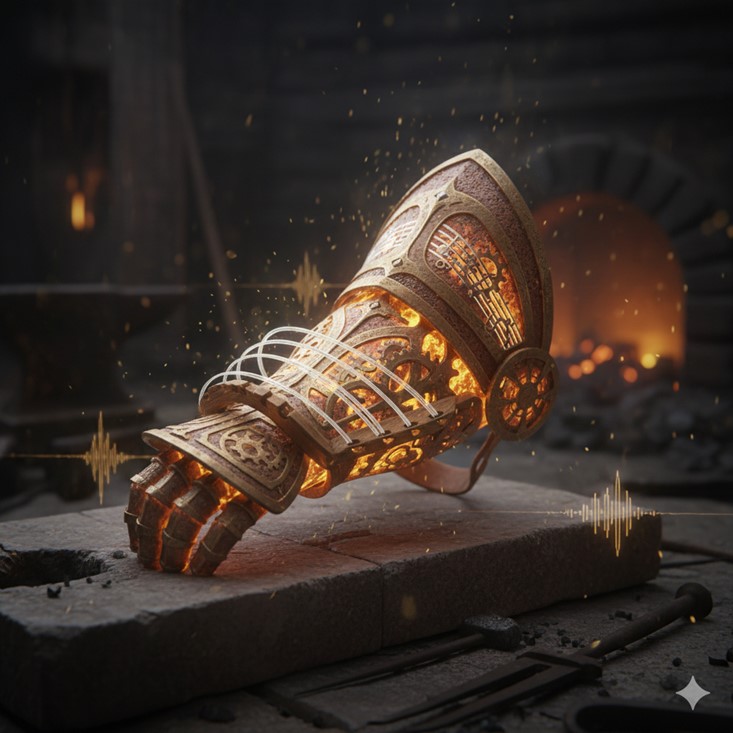
This masterful armguard is forged from sturdy, earthy brown steel, intricately inlaid with shimmering, golden-hued Songwood. The inlay forms elegant patterns that resemble both musical staves and the interlocking gears of a complex machine. Along the length of the forearm, taut strands of Moonlit Silk are stretched over a resonant Songwood bridge, allowing the armguard to be played like a lyre or zither. When its magic is activated, the Songwood inlays glow with a soft, golden light, and the metal itself seems to hum with the deep thrum of a forge and the faint, harmonic echo of an ethereal melody.
Stats
- Tier: 2
- Rarity: Rare
- Skills: +2 Weaponsmithing, +2 Performance, +1 Melee Attack
Tags
Weaponsmith, Forge, Musical, Enchanted, Artisanal, Mystical, Harmonic, Fire, Earth, Elemental, Resonant, Bardic, Crafting, Protective, Artifice, Hybrid, Performance
Multiple Passives Magic
- Forge’s Embrace: The wearer is attuned to the harsh energies of creation. They gain resistance to both fire and sonic damage.
- Harmonic Smithing: The armguard produces a low, resonant tune that guides the wearer’s hands in any act of creation or performance. The wearer gains advantage on all Weaponsmithing and Performance checks.
Multiple Active Magics
- Ballad of the Blazing Hammer (2/day): The wearer plays a sharp, percussive tune on the armguard’s strings, imbuing one weapon they are holding with roaring flames. For 1 minute, the weapon deals bonus fire damage on hit.
- Aegis of the Earth-Song (2/day): The wearer plays a deep, grounding melody that summons a shimmering barrier of packed earth and resonant sound, granting the user a shield of temporary hit points that absorbs damage.
- Charming Crescendo (1/day): The wearer performs a uniquely enchanting melody, casting the Charm Person spell on a single target who can hear the music (save DC 14).
Specific Slot
- Slot: Arm (Left or Right). This counts as a single worn item. When played, it also fulfills any requirement for a Musical Instrument (tool).
Item Durability and Repair
To disable the magic of the Forge-Song Armguard 771, an attacker would need to damage the item itself, overcoming its inherent resilience. The armguard is a masterwork fusion of enchanted steel and magical Songwood, making it exceptionally durable but not indestructible.
Item Hit Points and Disablement: The Forge-Song Armguard has 40 hit points and an Armor Class (AC) of 18. Attacks specifically targeting the armguard must meet or exceed this AC to deal damage. If the armguard’s hit points are reduced to 0, it becomes Broken. A Broken item immediately loses all magical properties:
- All skill bonuses (+2 Weaponsmithing, +2 Performance, +1 Melee Attack) are nullified.
- The passive resistances to fire and sonic damage cease to function.
- All active abilities (Ballad of the Blazing Hammer, Aegis of the Earth-Song, Charming Crescendo) cannot be activated.
Visually, a Broken armguard would appear cracked and scorched, its Songwood inlays would be splintered and dark, and its Moonlit Silk strings would be snapped. The inner hum of the forge and the ethereal echo of music would fall silent.
Repairing the Item: Repairing a magical hybrid item like the Forge-Song Armguard is a complex task requiring both skilled artisanship and rare materials. The process involves multiple steps:
- Structural Restoration: The physical damage to the steel and wood must be repaired. This requires the services of a crafter proficient in both Weaponsmithing and the use of Musical Instrument Maker’s Tools. The crafter must succeed on a high-difficulty skill check to mend the delicate fusion of materials without causing further harm.
- Material Infusion: The repair process consumes rare materials to replace what was damaged. This would likely include one ingot of high-quality steel, a sliver of enchanted Songwood or a vial of Ethereal Sap to restore the wood’s integrity, and a new strand of Moonlit Silk to replace the broken strings.
- Reawakening the Magic: Once the physical form is restored, its dormant magic must be reawakened. This requires a final, intricate step where the owner, or the crafter, must perform a specific piece of music on the newly-strung armguard while in the heat of a forge. This act re-establishes the harmony between the fire of the forge and the music of the grove, causing the runes to glow once more and restoring the armguard’s full magical capabilities.
Given its unique nature as a rare, Tier 2 hybrid item, the Forge-Song Armguard 771 would not be found in a common market stall. Its sale would be an event, and it would appear only in select establishments that cater to clientele with significant means, skill, or connections.
1. The Master Artisan’s Guildhall
Type of Shop: This establishment would be found in the artisan quarter of a major metropolis, likely the official showroom for a prestigious crafting guild like the “Weaponwrights’ & Luthiers’ Concord.” The interior would be immaculate, smelling of quenching oil, rare wood polish, and the faint ozone of lingering enchantment. The armguard would be displayed as a centerpiece on a velvet-lined pedestal under a magically focused light, its lore inscribed on a small golden plaque beside it. The atmosphere is one of reverence for the craft, more akin to an art gallery than a simple shop.
How It’s Sold: A transaction here is a formal process. The proprietor, a guild master with decades of experience, would not sell such an item to just anyone. A potential buyer would be vetted and likely asked to demonstrate their proficiency in either smithing or performance to prove they are “worthy” of the item’s legacy. The negotiation is less about haggling over coin and more about the character’s intent and reputation. A renowned artisan or a virtuous adventurer might be given preference over a wealthy merchant. The guild may be more interested in securing rare materials for a future project or a sworn favor than simply maximizing profit.
Cost: The price here represents the fair market value, reflecting the immense skill and rare materials required for its creation.
- Cost: 85 Platinum Pieces (or 850 Gold Pieces). The guild might accept a portion of the payment in the form of extremely rare materials, such as a heartwood branch from a living Songwood tree, a vial of dragon’s breath, or a flawless Starfall gem.
2. The Arcane Auction House
Type of Shop: In the wealthiest districts of a capital city or a major trade hub, one might find an exclusive auction house like “The Lumengarde Galleria” or “Sovereign’s Selection,” which deals in high-tier magical artifacts. The Forge-Song Armguard would be a featured lot in a specialized auction, presented to an audience of nobles, powerful merchant lords, and representatives from elite adventuring companies. The entire building would be warded against theft, scrying, and magical interference.
How It’s Sold: The armguard is presented dramatically by a charismatic, silver-tongued auctioneer who would regale the audience with the tale of its creation and showcase its magical properties through a skilled demonstrator. The sale is impersonal and driven purely by wealth. Bidders would use magically linked paddles or telepathic signals to place their offers, driving the price up in a tense, competitive atmosphere. The only prerequisite for purchase is having the deepest coffers.
Cost: The price is dictated entirely by demand. The bidding would start at a high reserve price, but a bidding war between two or more determined buyers could escalate it far beyond its standard value.
- Cost: The bidding would likely start at 80 Platinum Pieces (800 Gold) but could easily close at 120 Platinum Pieces (1,200 Gold) or even higher. Payment is expected in full, typically in Platinum, Rhodium, or similarly valuable and authenticated assets.
3. The Shadow Market Emporium
Type of Shop: This “shop” would have no public storefront. It would be a clandestine operation in the underbelly of a sprawling city, accessible only through a network of contacts and whispered passwords. It could be a magically shielded vault beneath a nondescript tavern or the private collection of a mysterious information broker who deals in “acquired” artifacts. The items here often have questionable origins, having been recently “liberated” from a tomb, a private collection, or a guild workshop.
How It’s Sold: The transaction is secretive and fraught with risk. The seller, a shrewd and pragmatic individual, cares little for the buyer’s worthiness and is focused solely on the payment. They may not know the full history of the armguard but would understand its power and rarity. The negotiation would be tense, and the buyer must be wary of betrayal or the possibility that the item’s previous owner is actively searching for it.
Cost: The price is highly variable, reflecting the seller’s urgency and assessment of the buyer’s desperation.
- Cost: If the seller needs to offload the item quickly, the price could be as low as 60 Platinum Pieces (600 Gold). However, if they perceive the buyer as wealthy or desperate, they might inflate the price to 110 Platinum Pieces (1,100 Gold) or more. Payment might be demanded in untraceable assets like flawless gemstones, powerful alchemical reagents, or the completion of a dangerous and illicit task for the seller.
The Forge-Song Armguard 771 is a versatile tool for a warrior-artisan, and its use in combat is a dynamic blend of elemental power and captivating performance. Here is how its wielder might roleplay its use for defense and offense in different environments.
1. In the Echoing Depths of an Ancient Ruin
This environment is characterized by crumbling stone, eerie silence, and the danger of awakening slumbering guardians or triggering traps. Sound and stability are key factors.
- Defensive Roleplay: The party triggers a pressure plate, and the ceiling begins to groan, threatening a collapse. Instead of a panicked shout, the wielder of the armguard takes a knee, placing their free hand on the stone floor to feel the vibrations. With their other hand, they play a deep, grounding chord on the armguard’s strings—the active ability Aegis of the Earth-Song.
- Roleplay Narration: “As dust rains down from above, I play a single, resonant bass note that seems to harmonize with the groaning stone. I’m not fighting the collapse; I’m asking the earth for aid. A shimmering dome of packed soil and golden sonic energy flows up from the floor, forming a protective canopy above us. The falling boulders impact with deep, muffled thuds instead of a deafening crash, the sound deadened by the magical barrier. We are safe, and the ruin’s silence remains largely unbroken.”
- Offensive Roleplay: The party confronts an ancient stone golem animated by sonic magic, its very form held together by a low-frequency hum. Its attacks send out damaging waves of sound. The wielder’s Forge’s Embrace passive provides resistance, allowing them to advance through the waves of force. To attack, they activate Ballad of the Blazing Hammer.
- Roleplay Narration: “The golem’s droning attack washes over me, but the armguard on my arm hums with a quiet counter-frequency, neutralizing the worst of the force. I break into a run, playing a fast, aggressive tune on the armguard—a melody like a blacksmith’s rapid hammer-falls. Fire erupts from the armguard, engulfing my mace in roaring flames. I leap and bring the blazing weapon down on the golem’s chest, not just to shatter its stone body, but to use the intense heat to disrupt the sonic magic that holds it together.”
2. Amidst the Chaos of a Pitched Battlefield
This environment is defined by widespread conflict, the roar of armies, and the need for decisive, impactful actions that can turn the tide of a fight or protect comrades.
- Defensive Roleplay: The shield wall is about to break, and a heavily armored enemy champion is smashing through the line. To save an overwhelmed ally, the wielder uses Charming Crescendo in a creative, defensive manner.
- Roleplay Narration: “The brute is about to bring his greataxe down on Anya’s shield. I can’t reach him in time to fight, so I change my tune. I shift my grip and play a soaring, enchanting melody, not at the champion, but at the soldier to his left—his shield-brother. As the magic of the crescendo takes hold, the soldier, suddenly seeing me as a trusted leader, instinctively falters and bumps into his commander, throwing the massive axe swing just wide enough for Anya to recover. The momentary confusion is all the opening we need.”
- Offensive Roleplay: The party is tasked with taking out an enemy siege engine—a massive ballista protected by a small squad of soldiers. The wielder uses their abilities in concert to break the enemy position.
- Roleplay Narration: “First, I raise my arm and play a deep, defiant chord. The Aegis of the Earth-Song erupts from the ground before us, forming a moving barricade of earth that absorbs the first volley from the ballista. Protected by our mobile cover, we advance. Then, I switch my tune to the Ballad of the Blazing Hammer. My sword ignites as I shout, ‘For the forge!’ I’m the first to vault over the earth-wall, my flaming blade a beacon in the chaos as I charge the stunned crew.”
3. In a Tense Standoff in a Bustling City
This environment is not a traditional battlefield. Openly brandishing magic can attract unwanted attention from the city guard. Subtlety and intimidation are often more effective than brute force.
- Defensive Roleplay: A rival guild has cornered the party in a crowded marketplace, trying to intimidate them with threats. Their leader, a charismatic demagogue, is whipping the crowd against the party with fiery words.
- Roleplay Narration: “As the crowd grows hostile, I don’t draw my weapon. Instead, I let my armguard be seen and lightly trace my fingers over the strings, allowing the golden Songwood to glow faintly. To the guild leader, I say calmly, ‘Your words are hot as any forge, but some of us are used to the heat.’ My passive Forge’s Embrace makes me immune to his fiery rhetoric, and the sight of my glowing, enchanted armguard is a clear, silent threat that I am more than prepared for this fight, making him reconsider an open confrontation.”
- Offensive Roleplay: The party needs to get past a corrupt gate sergeant who refuses them entry. Bribes have failed, and a fight would bring the whole garrison down on them. The wielder decides to use a blend of performance and magic.
- Roleplay Narration: “I approach the sergeant with a friendly smile, using the advantage from Harmonic Smithing to expertly compliment the craftsmanship of his armor. As I have his attention, I begin to strum a soft, almost imperceptible tune, activating Charming Crescendo. The magic flows through the music, weaving a sense of camaraderie. I lean in and say conspiratorially, ‘That captain of yours works you too hard. You look like you could use a break. Why don’t you and your men inspect the tavern for “ale quality”? We’ll watch the gate for you.’ The spell doesn’t command him, it just makes my terrible idea sound like the best one he’s heard all day.”
Perception of Activation:
User’s Perspective
- Sight: The wearer sees the golden Songwood inlays flare to life, not as a surface glimmer but with a perceived depth, like peering into the heart of a contained, musical forge. The earthy brown steel appears to ripple with contained heat, and faint motes of light—like tiny sparks or solidified musical notes—drift from the vibrating strings.
- Sound: The experience is a perfect, intimate symphony. The user hears and feels the deep, resonant thrum of the forge directly against their arm, a powerful vibration that speaks of creation and raw power. Simultaneously, they hear the clear, ethereal melody from the strings, a tune of artistry and emotion. The two sounds merge in their perception into a single, harmonious chord of industry and inspiration.
- Smell: A complex and unique scent is released, combining the aroma of hot steel and quenching oil with the clean, ancient scent of magical Songwood, tinged with the sharp smell of ozone from the magic being channeled.
- Touch: A profound warmth spreads through the armguard, comforting and powerful like a hearth, not searing. The entire item feels alive; the metal vibrates with a low, grounding frequency while the strings tingle with a higher, more energetic resonance.
- Taste: The user perceives a faint, sharp taste of minerals and ozone on their tongue, like the air near a smithy during a thunderstorm.
- Extra-sensory Perceptions:
- Dual Intuition: The wearer feels a powerful sense of duality. A part of their mind feels grounded, stable, and unyielding, connected to the earth and the permanence of forged steel. The other part feels fluid, creative, and empathically linked to the emotions of those around them.
- The Creative Urge: The user is flooded with a powerful desire to make or remake. This manifests as a sudden, clear vision of a weapon that needs forging, a flaw in an ally’s armor that must be mended, or the composition of a song that could sway a battle.
- Elemental Attunement: The user feels a direct, tangible connection to the elements of earth and fire, sensing the stability of the ground beneath them and the kinetic potential in any nearby flame.
Observer’s Perspective
- Sight: To an observer, the armguard becomes a captivating spectacle. The golden Songwood patterns glow with a warm, brilliant light that illuminates the wearer. The surface of the steel shimmers as if superheated, and when an active ability is used, visible ripples of golden or earthy energy pulse outward from the vibrating strings.
- Sound: Observers primarily hear the beautiful and haunting melody played on the strings, a sound that seems to hang in the air with impossible clarity. Beneath this music, a distinct, powerful low hum is audible, like a distant, massive forge at work, giving the enchanting music an undeniable undercurrent of immense power.
- Smell: Those standing nearby can detect an unusual and pleasant aroma—the scent of hot metal mingling with ancient, fragrant wood, like a blacksmith’s shop located in the heart of a magical forest.
- Touch: The air around the armguard grows noticeably warm. When an ability like Aegis of the Earth-Song is activated, observers might feel a faint vibration through the soles of their feet as the earth itself responds to the music.
- Taste: Unlikely to be perceived unless in very close proximity.
- Extra-sensory Perceptions:
- Awe and Intimidation: The activation inspires a conflicting emotional response in onlookers: awe at the sheer beauty of the light and music, and a primal sense of intimidation from the raw, industrial power projected by the forge’s hum. It clearly marks the wearer as an individual of great significance.
- Emotional Resonance: The melodies played on the armguard are so pure that they subtly influence the emotions of those who hear them. A heroic tune can stir courage in allies, while a somber note can bring a moment of solemn reflection to a tense standoff.
Positives and Negatives
- Positives: The activation is an unambiguous and impressive display of power, serving as both a deterrent to foes and an inspiration to allies. The multi-sensory experience makes the user’s actions more impactful and memorable, enhancing their presence and reputation. For the user, the sensory feedback creates a powerful bond with the item, improving focus and confidence.
- Negatives: The brilliant display of light and sound makes any attempt at subtlety impossible, immediately drawing the attention of everyone nearby. In combat, this makes the wearer an obvious and high-priority target. For a new user, the influx of dual sensory and extrasensory information could be disorienting. Furthermore, the intimidating hum of the forge might undermine a delicate diplomatic effort, projecting a sense of power that could be misinterpreted as a threat.
Recipe: The Harmonic Fusion of Smithing and Song
This crafting process outlines the intricate steps and rare components required to merge the raw elemental power of the forge with the ethereal grace of enchanted music, resulting in the creation of the Tier 2 masterpiece, the Forge-Song Armguard. It is a task undertaken only by master artisans who have an equal reverence for both the clang of the hammer and the strum of the lute.
Items Merged:
- One (1) Arm 942 of the Forgeguard
- One (1) Songwood Instrument (Lute, Lyre, or similar)
Additional Materials Needed:
- Heart of the Mountain Ruby: A rare, flawless ruby found only in the geothermal vents of active volcanoes. It acts as a focal point to regulate and harmonize the conflicting energies of fire and life.
- Vial of Ethereal Sap: Collected from an ancient Songwood tree, this sap serves as a magical flux, allowing the living wood to be seamlessly bonded to the enchanted steel without being consumed by the forge’s heat.
- Spool of Spun Starlight: Threads gathered from a place where a meteor has struck, used to restring the armguard. These threads are incredibly durable and resonate with celestial harmonies, amplifying the instrument’s magical properties.
- Acoustic Resonance Crystal: A fist-sized, naturally occurring crystal that hums with a specific frequency. It is shattered into a fine powder and used to coat the interior of the armguard, ensuring the sounds of the forge and the music do not cancel each other out but instead merge into a powerful chord.
Tools Required:
- Artisan’s Soul-Forge: A specialized forge capable of maintaining precise magical and thermal temperatures, allowing for the delicate work of binding enchanted metal to magical wood.
- Masterwork Luthier’s Tools: A complete set of exquisitely crafted tools for shaping, carving, and stringing instruments, necessary for integrating the musical components.
- Harmonic Anvil: An anvil forged from a single piece of resonant meteorite iron, which rings with a perfect, clear tone when struck. This is essential for shaping the armguard without disrupting the magical matrix within the steel.
- Runecarver’s Crystal Quill: A delicate instrument used to inscribe the binding runes that will fuse the magical properties of the two items.
Skill Requirements:
- Mastery in Weaponsmithing: The artisan must have an intimate understanding of enchanted metals and the high-level techniques required to re-forge a magical item.
- Expertise with Musical Instrument Maker’s Tools: The crafter must be able to delicately deconstruct and then integrate the fragile components of the Songwood instrument into the armguard’s frame.
- Proficiency in Arcane Enchanting: The ability to understand, channel, and bind different schools of magic (elemental earth/fire and fey/enchantment) is crucial for the fusion to succeed.
- Adept Skill in Performance: The crafter must be able to test the harmonic qualities of the armguard at each stage of its creation, ensuring the final product is both a potent weapon and a functional instrument.
Crafting Steps:
- The Deconstruction: The process begins not with fire, but with care. Using the Luthier’s Tools, the artisan must carefully disassemble the Songwood Instrument, salvaging the main resonant body of wood and the Moonlit Silk strings. The Arm 942 of the Forgeguard is then gently heated in the Soul-Forge to make its enchantments pliable, allowing the artisan to remove any non-essential components.
- Preparing the Fusion: The Acoustic Resonance Crystal is carefully ground into a fine, shimmering dust. This dust is mixed with the Ethereal Sap to create a magical, heat-resistant paste. This paste is meticulously applied to the salvaged Songwood, preparing it to withstand the intense heat of the forge.
- The Harmonic Forging: The base steel of the Forgeguard is placed upon the Harmonic Anvil. The Heart of the Mountain Ruby is set into the very center of the Soul-Forge, its glow regulating the intense heat. With each strike of the hammer, the artisan must listen to the ringing of the anvil, shaping the armguard’s frame to create channels and inlays for the Songwood. This is a rhythmic process, more akin to a percussive performance than simple blacksmithing.
- The Binding: The paste-coated Songwood pieces are carefully set into the prepared channels of the white-hot armguard. The item is returned to the Soul-Forge for the final binding. The Ethereal Sap paste activates, creating a magical barrier that allows the metal to fuse around the wood without charring it, creating a seamless, molecular-level bond between the two materials.
- Runic Inscription: Once cooled, the armguard is a single, inert piece of wood and steel. Using the Runecarver’s Crystal Quill, the artisan inscribes a complex series of binding runes that bridge the metal and wood components. These runes are the magical conduits that will allow the item’s disparate powers to flow and merge into a cohesive whole.
- The First Song: The final step is to string the armguard. The Spun Starlight threads are stretched over the newly integrated bridge. The artisan must then play a specific melody—the “Song of Unification”—a legendary piece said to harmonize all elements. As the song is played, the runes flare to life, the Heart of the Mountain Ruby pulses within the forge, and the armguard awakens, its dual nature forever bound as one.
Arm-of-Echoes-and-Flame
or
Weaver’s Symphony and Smith’s Heart
In days before reckoning, when the mountains were young and the sky a fresh-painted canvas, there lived a hand. Not a hand of flesh, but a being of making, or so the broken glyphs suggest. It was called, by the ancient speech, “Symphonia-Ferrum”—a word meaning both “singing metal” and “heart-stone-music,” its true import now fragmented like old pottery. This Hand, some say, was inspired by two whispers of greatness. One, the Melodya, whose voice could move the weeping stones. The other, the Thorenir, whose hammer could tame the furious fire. The Hand sought a joining, a braiding of these two powers, a place where the breath-of-tree and the blood-of-earth met in a trembling dance. The ancient words are faint here, speaking of “The Grove-that-Hums,” a place where trees grew like green fire over veins of ore-that-sings, as if the very rock carried a deep-earth memory of ancient songs.
The Hand, Symphonia-Ferrum, came to this place. It carried not a tool, but a feeling. A vision, perhaps, like seeing without eyes, of a thing that was both hard and soft, loud and quiet, a thing that would remember both the forge-song and the tree-whisper. The existing records are unclear, as if the original scribe struggled with concepts beyond their grasp. It speaks of the Hand taking the Forge-Arm-of-Guard, already a thing of stout earth-metal, and laying it upon the Harmonic Anvil. Not with force, but with a listening touch. The anvil, it is told, was not silent, but chimed with a perfect, deep tone, a truth-sound that resonated with the very structure of the metal.
From the Grove-that-Hums, Symphonia-Ferrum drew forth pieces of the Songwood. Not cut, but asked. The wood itself, described in crumbling verses as “Moon-kissed-skin,” seemed to glow with an inner pulse, a breath of silent music. This was laid upon the warmed metal, not yet joined. For the binding, the Hand took the Heart of the Mountain Ruby—a stone of living flame, pulled from the churning guts of the earth. This ruby, the text suggests, was placed at the very core of the working, a beating heart to unify the opposing natures. It glowed, not with simple heat, but with a knowing-fire, a fire that sang softly.
To weave the elements, the Hand collected the Ethereal Sap from the Grove-that-Hums. This sap, the scribbles imply, was not sticky, but liquid-light, able to persuade fire not to consume, and wood not to char. It was painted upon the Songwood, a shimmering shield against the forge’s embrace. The melding began. The Arm-of-Guard was placed back in the forge, a forge now burning with a Soul-Forge fire—a fire not of simple heat, but of intent. The Hand, Symphonia-Ferrum, then worked with a rhythm unknown to mortals. Not striking blows, but playing the hammer upon the Harmonic Anvil, each chime a note in a growing symphony. With each rhythmic clang and hum, the steel softened, not melting, but yielding, flowing around the glowing, ethereal-sap-coated Songwood. It was a dance of opposites, held together by the will of the Ruby heart.
The merging was not a simple weld. The ancient text strains to explain it as a “deep-seeing-fusion,” where the memories of the metal—of ancient earth and thunderous impact—were interwoven with the memories of the wood—of gentle breezes and soaring birdsong. Runes, described as “thought-glyphs” or “spirit-marks,” were etched by a Runecarver’s Crystal Quill onto the still-warm surface, binding the new whole with whispers of ancient magic. These runes, the story implies, were not merely decorative but actively held the new item’s purpose, its very identity.
But the new thing, the “Arm-of-Echoes-and-Flame,” was yet silent. Its metal was warm, its wood shimmering, but no sound, no melody. The Hand, Symphonia-Ferrum, then took threads. Not simple thread, but Spun Starlight, gathered from where the sky-fire had touched the ground. These threads, glistening with captive light, were stretched across the integrated Songwood bridges on the armguard. This was the final breath. The Hand did not pluck the strings, but simply thought a melody. A song of perfect balance. A tune that was both the roar of the forge and the whisper of the grove. And as the thought-song flowed, the runes on the Arm-of-Echoes-and-Flame pulsed, the Heart of the Mountain Ruby within its core blazed with a contained fire, and the armguard sang. A profound, dual sound—the deep thrum of the earth-forge and the clear, soaring echo of a forgotten melody.
From that moment, the Arm-of-Echoes-and-Flame was complete. It held the smith’s strength and the bard’s grace. It was a thing of both making and unmaking, of loud power and soft persuasion. Many tales have been told of its wielders—warriors who struck with fire and charmed with song, artisans whose creations were imbued with resonant magic. But the original story focuses on its birth, on the impossible fusion.
Moral of the Story: The ancient words, though fragmented, seem to say: True mastery is not in choosing one path, but in knowing how to weave disparate threads. The greatest strength often arises from the most unexpected harmonies, for even fire and music, when understood, can become one.
Suggested conversions to other systems:
Call of Cthulhu (7th Edition)
Armguard of the Whispering Forge
This appears to be an exquisitely crafted armguard of a strange, brownish metal inlaid with a shimmering, golden wood that seems to absorb and warp the light. Taut, silvery strings are stretched across its length. The armguard is warm to the touch and hums with a barely perceptible, disquieting resonance. Investigators with a successful Cthulhu Mythos roll recognize the design as reminiscent of artifacts associated with the fire-entity Cthugha, while a successful Art/Craft (Music) roll intuits that the melody it produces is structured in a non-Euclidean, psychically jarring manner.
Game Mechanics:
- Protective Qualities: The wearer gains 2 points of armor. Additionally, when taking damage from a fire or sonic-based source (such as a sonic weapon or the maddening music of a Mythos entity), the wearer may make a Luck roll. If successful, the damage is halved.
- Forlorn Harmonies: The wearer gains a bonus die (+10% in brackets) on Art/Craft (Music) and Craft (Smithing) rolls.
- Powers: Using any of the armguard’s active powers requires the expenditure of Magic Points (MP) and a Sanity (SAN) roll.
- Imbue with Cthugha’s Flame: For 2 MP, the user can sheathe a melee weapon in alien fire for 1 minute. The weapon deals an additional 1d6 damage and ignites flammable materials. Activating this power costs 1/1d4 SAN points.
- Barrier of Yoth: For 3 MP, the user can summon a shimmering barrier of solidified earth and warped sound as a reaction to an attack. The barrier has 15 hit points and absorbs damage directed at the user until it is destroyed. Activating this power costs 1/1d6 SAN points.
- Melody of Insidious Charm: For 4 MP, the user plays a haunting, otherworldly tune targeting a single individual. The target must succeed on an opposed POW roll against the user. If the target fails, they are subject to the user’s suggestions for 1d10 minutes, so long as the suggestions are not directly harmful to themselves. Using this melody is a significant act of psychic manipulation and costs 1d4/1d8 SAN points.
Blades in the Dark
The Forgesong Bracer (Fine Occult Instrument, Special, 2 Load)
An artifact rumored to have been salvaged from a pre-cataclysm forge-cathedral. It’s a heavy steel bracer, inlaid with shimmering ghost-wood and strung with whisper-silk strings. It hums with contained spectral energy, warm to the touch. When played, the music is beautiful but carries an undercurrent of industrial power and sorrow.
Game Mechanics:
- Quality: As a Fine item, the bracer grants +1d to Action rolls where its superior quality is relevant, such as using music to Sway a crowd or using your knowledge of fine things to Consort with the elite.
- Passive Abilities:
- Forge-Tempered: You gain Armor against damage from fire or explosions.
- Harmonic Artifice: When you Tinker to craft or repair a weapon or mechanism, the bracer’s resonant hum guides you. Take +1d to your roll.
- Special Abilities:
- Verse of the Furnace: When you make an attack, you can suffer 2 Stress to activate the bracer. Your weapon is sheathed in spectral flame until the conflict is over. Gain Potency and the Fiery quality on your attacks.
- Chorus of Stone: When you Resist physical harm, you can suffer 2 Stress to summon a barrier of humming stone and echoes. The barrier provides cover and absorbs the initial blow; you do not suffer the harm.
- Bridge of Deceit: When you attempt to magically influence someone with music, you can lead a group action with yourself and the bracer. You roll Attune and your allies roll Sway. You do not suffer stress for leading the group action. If the action is successful, the target is charmed and will follow one reasonable command without question.
Dungeons & Dragons (5th Edition)
Bracer of the Song-Forge Wondrous item, rare (requires attunement by a character proficient with a musical instrument or smith’s tools)
This masterful armguard is forged from sturdy, earthy brown steel, intricately inlaid with shimmering, golden-hued Songwood. Taut, silvery strings are stretched over a resonant bridge, allowing the armguard to be played. When its magic is active, the Songwood inlays glow with a soft, golden light.
The bracer has 6 charges. It regains 1d4 + 2 expended charges daily at dawn.
Game Mechanics:
- Resonant Strikes: You have a +1 bonus to attack and damage rolls made with melee weapons you wield.
- Forge’s Embrace: While wearing this bracer, you have resistance to fire damage and thunder damage.
- Harmonic Artistry: You have advantage on checks made with smith’s tools and on Charisma (Performance) checks made when playing the bracer.
- Spells and Abilities: You can expend the bracer’s charges to activate the following properties:
- Flame Imbue (2 Charges). As a bonus action, you can imbue one weapon you are holding with fire. For 1 minute, the weapon deals an extra 1d6 fire damage to any target it hits.
- Aegis of Earth (2 Charges). As a reaction when you take damage, you can summon a barrier of earth and sound. You gain temporary hit points equal to 2d6 + your proficiency bonus, which take as much of the triggering damage as possible.
- Charming Crescendo (1 Charge). You can play the bracer to cast the charm person spell. The spell save DC is 15.
Knave (2nd Edition)
Forge-Lyre Bracer
A heavy armguard of brown steel inlaid with glowing golden wood. It is strung like a lyre and hums with a palpable warmth. It occupies 3 inventory slots.
Game Mechanics:
- Item Slots: 3
- Passive Abilities:
- You have Advantage on saving throws against effects involving fire or loud sounds.
- When making a check to smith an item or perform music, you may add your Strength bonus in addition to the normal ability bonus.
- Active Abilities:
- Song of the Hammer (1/day): You may play a percussive tune on the bracer’s strings. For the next hour, one weapon you hold glows with heat. It deals an additional 1d6 damage on a successful hit.
- Stone-Shield Chord (1/day): As a reaction to being hit by a physical attack, you can play a deep, grounding chord. The attack deals no damage.
- Enchanting Melody (1/day): You play a captivating tune targeting one creature that can hear you. They must make a Willpower save. If they fail, they are charmed by you for one hour and will refuse to harm you, treating you as a trusted friend.
Fate Core System
The Soul of the Song-Forge
This armguard is an Extra, representing a powerful narrative artifact. It’s a fusion of two legendary legacies, and its existence is a story in itself.
Permission: To wield this artifact, your character must have a High Concept or Trouble aspect related to master artisanship, lost legacies, or the harmony of opposing forces (e.g., “Bard-Smith of a Forgotten Age,” “Haunted by the Unfinished Symphony”). Cost: This Extra costs 1 Refresh.
Aspects:
- A Resonant Fusion of Steel and Songwood: You can invoke this aspect when you use your skills in crafting or performance to create something extraordinary that combines beauty and function. The GM can compel this when the armguard’s dual nature causes a complication, such as its intimidating forge-hum undermining a delicate song meant to soothe.
- Echoes of the First Smith and First Bard: Invoke this to perform a legendary feat of smithing or to create a musical performance that can sway the hearts of the masses. The GM can compel this to draw unwanted attention from entities (like ancient spirits or rival artisans) who covet the armguard’s lineage.
Stunts:
- Ballad of the Blazing Hammer: Once per session, you can spend a Fate point to play a fiery tune on the armguard. This adds the Situation Aspect Engulfed in Masterful Flames to a weapon you hold for the rest of the scene, with two free invokes for yourself.
- Aegis of Resonant Earth: Once per session, when you must Defend against a physical attack by Creating an Advantage, you may describe how you play a grounding chord. On a success, in addition to any other benefits, you create the Situation Aspect Wall of Harmonized Stone in your zone with one free invoke.
- Charming Crescendo: You are a master of subtle influence. You gain a +2 bonus when you use Rapport to build a connection with someone, provided you are subtly playing the armguard.
Numenera & Cypher System
Harmonic Resonance Bracer
This device appears to be a seamless armguard forged from a brown, metallic alloy interwoven with a golden, fibrous polymer that glows softly. Taut, crystalline filaments are stretched across its surface. It responds to the wearer’s mental commands and physical touch, producing complex sonic frequencies that can manipulate matter and minds.
Level: 5 Form: A masterfully crafted armguard of psycho-resonant, organic materials. Effect: The bracer’s passive resonance attunes to the wearer’s tasks, making them more effective. It provides an asset (eases the task by one step) to all tasks involving crafting complex devices, musical performance, and social persuasion. The wearer also gains +2 Armor against heat- and sonic-based damage.
It can also be actively controlled to produce more powerful effects:
- Thermal Resonance: The user can coat a weapon they hold in a shimmering field of intense heat for one minute. The weapon inflicts an additional 3 points of damage.
- Kinetic Dampening Field: As an action, the user can generate a barrier of solidified sound and distorted earth. They gain +5 to their Armor for one minute.
- Psychosonic Influence: The user plays a specific series of tones. One creature within short range who can hear the bracer must succeed on a Level 5 Intellect defense task. On a failure, the creature becomes suggestible and friendly towards the user for one minute, and will not take hostile actions unless attacked.
Depletion: After any active ability is used, the user must roll for depletion. Depletion: 1 in 1d10.
Pathfinder (2nd Edition)
Forge-Song Armguard Item 8 Rare Magical Evocation Enchantment Price 450 gp Usage worn armguard; Bulk 1
This masterful armguard is forged from sturdy, earthy brown steel, intricately inlaid with shimmering, golden-hued Songwood. Taut, silvery strings are stretched over a resonant bridge, allowing the armguard to be played. When its magic is active, the Songwood inlays glow with a soft, golden light.
Passive Effects: You gain a +1 item bonus to Crafting checks and Performance checks. You also gain resistance 5 to fire and resistance 5 to sonic.
Activate [one-action] (manipulate); Frequency once per minute; Effect You play a sharp, percussive chord on the armguard’s strings. Your next Strike with a melee weapon made before the end of your current turn deals an additional 1d8 fire damage.
Activate [reaction] (manipulate); Trigger You are damaged by an attack; Frequency once per day; Effect You play a deep, grounding note that summons a temporary shield of earth and sound. You gain temporary Hit Points equal to your level. These temporary Hit Points last for 1 minute.
Activate [two-actions] (auditory, enchantment, manipulate); Frequency once per day; Effect You play an enchanting melody, casting a 3rd-level charm spell on a target within 30 feet. The spell DC is 24.
Savage Worlds (Adventure Edition)
The Artificer’s Opus Magical Item Weight: 4; Cost: 25,000
A heavy but exquisitely balanced armguard of dark steel and glowing golden wood, strung like a miniature harp. It hums with a quiet power, promising both masterful creation and terrible destruction.
Game Mechanics:
- Masterwork: The wearer gains a +1 bonus to their Performance and Repair rolls.
- Sturdy Construction: The armguard is incredibly resilient. The wearer gains +1 Armor.
- Elemental Warding: The wearer gains a +2 bonus to Vigor rolls to resist negative effects from fire or sonic sources, and damage from such sources is reduced by 2.
- Inherent Power: The armguard holds 10 Power Points, which can only be used to activate its own abilities. These points recharge at a rate of 5 per hour. The wearer uses their Performance skill as the arcane skill for activation.
- Smite: (2 PP) Imbues a weapon with fire for 5 rounds. Adds +2 damage to its attacks, or +4 on a raise.
- Protection: (1-5 PP) Summons a barrier of earth and resonant sound. The wearer gains +2 Armor (+4 on a raise). For each additional Power Point spent, the effect may be applied to one additional ally in Medium Blast Template centered on the user. Lasts 5 rounds.
- Puppet: (3 PP) The wearer plays an enchanting melody. This is an opposed roll of the wearer’s Performance versus the target’s Spirit. If successful, the target is Charmed (as per the puppet power). On a raise, the target also suffers a –2 penalty to any attempt to break free of the effect.
Shadowrun (6th Edition)
Ares Harmony-Forge Bracer
A prototype artifact that mysteriously vanished from an Ares R&D lab, this bracer seamlessly blends ancient magical principles with cutting-edge materials science. It appears as a custom-fit armguard made of a dark, FBA-grade composite, but inlaid with shimmering, golden patterns of what is claimed to be actual elven Songwood. It is a powerful and dangerous tool for any shadowrunner who walks the line between artist, artisan, and warrior.
Focus Type: Enchanting and Shielding Focus Force: 4 Availability: 16R Cost: 85,000 Nuyen
Game Mechanics:
- Passive Focus: As an Enchanting focus, the bracer adds its Force (4) as a dice pool bonus to all Artificing and Performance (instrument) tests. As a Shielding focus, it provides its Force (4) as a dice pool bonus to resist spells and provides +2 Armor against Fire and Sonic based attacks.
- Active Powers: The bracer can be used to channel mana into specific effects. Using these powers requires a test and inflicts Drain.
- Ignite Weapon: (Complex Action) The user plays a sharp, percussive tune, making a Sorcery + Magic [Force] test. A touched melee weapon is sheathed in magical flames for a number of combat rounds equal to the hits scored. The weapon’s damage becomes Fire type, and it deals +2 DV. The user must resist 3 DV of Stun Drain.
- Resonant Aegis: (Reaction) When the user is the target of an attack, they may play a grounding chord. They gain Edge equal to the bracer’s Force (4 Edge), which can only be used on their Defense test against this attack. This may be done once per Combat Round. The user must resist 2 DV of Stun Drain.
- Harmonic Influence: (Complex Action) The user plays an enchanting melody to replicate the effects of the Influence spell. The user makes a Sorcery + Magic [Force] vs. Willpower + Logic test. If successful, the target is charmed. The user must resist 4 DV of Stun Drain.
Starfinder (1st Edition)
Iomedaean Forge-Canticle Hybrid Item
This ornate armguard is believed to be a relic from a lost Golarion colony, blending masterwork steel with magically resonant Songwood. Modern Vercite filaments have been woven into the strings, allowing its ancient magic to be powered by a standard energy cell, making it a true hybrid of divine artistry and modern technology.
Level 10; Price 18,500; Hands 1; Bulk 1 Capacity 20; Usage 2/use
Game Mechanics:
- Passive Attunement: While worn, the armguard’s resonant matrix assists with complex tasks. The wearer gains a +2 insight bonus to Engineering and Culture checks. It also grants Resistance 5 to both fire and sonic.
- Active Abilities: The armguard’s powers can be activated by expending charges.
- Incinerator Canticle (2 Charges): As a standard action, you can imbue a weapon you are holding with fiery energy. For 1 minute, the weapon deals an additional 1d10 fire damage on a successful hit.
- Aegis of Creation (2 Charges): As a reaction when you would take bludgeoning, piercing, or slashing damage, you can summon a barrier of solidified sound and earth. You gain Damage Reduction 10/— against the triggering attack.
- Harmonious Suggestion (2 Charges): As a standard action, you can play the armguard to cast a 3rd-level suggestion. The spell save DC is 19.
Traveller (Mongoose 2nd Edition)
Zhodani Harmony-Forge Gauntlet
An incredibly rare piece of Zhodani technology, this device appears to be an elegant, ceremonial gauntlet. It is a sophisticated psionic amplifier, designed for high-ranking members of the Zhodani elite who are trained as both artisans and warriors. It translates the user’s psionic will into harmonic frequencies, allowing them to manipulate both matter and minds with unparalleled grace.
Tech Level: 14 Cost: Cr 1,200,000 Weight: 2 kg
Game Mechanics:
- Prerequisite: The user must possess at least one Psionic Talent to use the gauntlet’s active abilities.
- Passive Amplification: The gauntlet’s internal processors and resonant materials assist the user’s fine motor skills and creative expression. The user gains DM+1 to all Art (instrument) and Mechanic skill checks.
- Armoured Construction: The gauntlet is made of advanced composites, providing Armour +1 to the wearer.
- Psionic Powers: The user may spend PSI points to activate the following abilities:
- Pyrokinetic Edge: (Telekinesis) For 3 PSI points, the user can sheathe a held weapon in a telekinetically-contained heat field for 1 minute. The weapon deals an additional +1d6 damage.
- Telekinetic Ward: (Telekinesis) As a reaction to being attacked, the user may spend 2 PSI points to telekinetically deflect the blow, gaining DM+2 to their next Dodge roll or DM+1 to the Armour value of a shield against the attack.
- Harmonic Suggestion: (Telepathy) For 4 PSI points, the user plays a series of tones that carry a powerful telepathic suggestion. This functions as the Suggestion psionic power, requiring an opposed Psionics vs INT check to influence the target.
Warhammer Fantasy Roleplay (4th Edition)
The Laurelorn Forge-Lament
An artifact of exquisite Elven craftsmanship, this armguard is forged from layered Ithilmar and polished Heartwood from the deepest parts of Laurelorn Forest. It is said to have been crafted by an Elven Lord who was both a master smith and a renowned minstrel. The music it plays is hauntingly beautiful, filled with the sorrow and strength of the Asur.
Encumbrance: 1 Qualities: Armour 1, Magical, Fine, Unbreakable
Game Mechanics:
- Elven Artistry: The peerless quality of the armguard is inspiring. The wearer gains a +10 bonus to all Craft (Smith) and Perform (String) Tests.
- Armour Point: The armguard provides 1 AP to the arm location. This stacks with other armour worn.
- Bound Spells: The armguard has several spells bound within it. To cast a spell, the user (even a non-wizard) must make a Channelling (Aethyr) Test as a standard action, using the Casting Number (CN) listed below. Any double rolled on this Test triggers a Minor Miscast. Wizards may use their own Channelling skill, while others must use their Willpower characteristic.
- The Smith’s Fire: (CN 5) Casts the Ignite spell (Lore of Fire) on a weapon the wearer holds. The weapon gains the Magical, Fiery, and Damaging Qualities for a number of rounds equal to the user’s Willpower Bonus.
- The Earth’s Embrace: (CN 6) Casts the Earthblood spell (Lore of Life), but instead of providing regeneration, it summons a ward of living wood and humming stone that grants the user +1 Toughness Bonus for a number of rounds equal to the user’s Willpower Bonus.
- The Minstrel’s Charm: (CN 7) Casts the Beguile spell (Lore of Shadow) on one target within 10 yards who can hear the armguard’s music.
Comments
One response to “Forge Song Armguard 771”
[…] Forge Song Armguard 771: A tier-2 armguard forged from earthy brown steel inlaid with golden Songwood, strung with Moonlit Silk for musical performance, providing fire and sonic resistance, skill bonuses in weaponsmithing and performance, and active abilities like flame imbue and earth shield. […]