
Lore
• In traveling playhouses and border-town amphitheaters, performers learned early that costumes alone were not enough. Props vanished, cues were missed, and masks cracked at the wrong moment. The Masked Rehearsal was devised by stage-magi who understood that performance is not deception, but controlled truth. These slots were enchanted to remember intention rather than weight, allowing an actor to carry what a role requires without breaking character or motion. Over time, the item spread among troupes, spies, diplomats, and ritual speakers—anyone whose survival depended on being believed.
Description
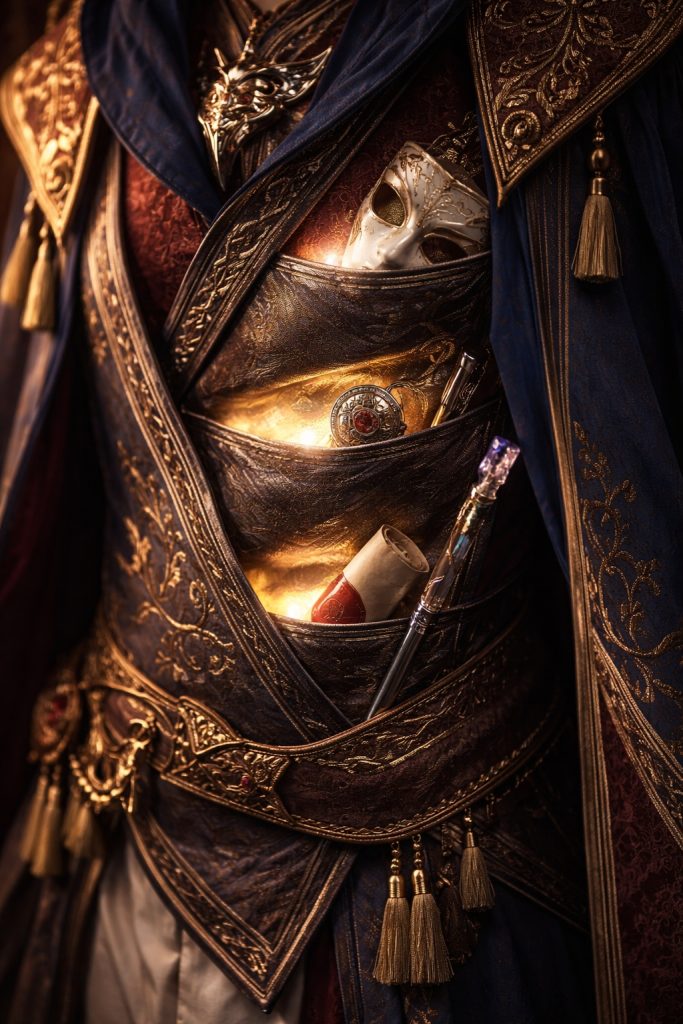
• A tailored performance garment—most often a short mantle, sash, or inner vest—lined with discreet, illusion-softened anchor points.
• When inactive, the additional slots are invisible even to close inspection, appearing as natural folds or decorative stitching.
• When a role is consciously assumed, the slots subtly align, making props, masks, signets, and small tools feel instinctively “where they should be,” as if the body remembers them from rehearsal.
Stats and Specific Slot
• Tier: 1
• Rarity: Common
• Slot: Worn (Mantle / Sash / Inner Garment — chosen at creation, occupies one slot total)
• Additional Slots Granted:
– Two micro-slots for small performance items (mask fragment, coin, token, vial-sized prop, signet)
– One specialized prop-slot that may hold a single small theatrical item (hand-mask, collapsible script wafer, charm-focus, or similar)
• Items stored in these slots count toward total carried items but cannot be dropped accidentally through distraction, social pressure, or emotional stress.
Skills Gained While Openly Worn
• Acting or Performance: heightened control of voice, posture, and timing while in-character
• Deception or Disguise-related social skill: improved maintenance of persona under scrutiny
• Insight (role-reading): improved ability to sense when others are performing or posturing
Passive Magics
• Rehearsed Presence: While openly worn, the avatar finds it easier to remain emotionally consistent within an assumed role, reducing tells caused by fear, surprise, or fatigue.
• Prop Memory: The avatar instinctively knows which slot contains which item without looking, even while distracted or speaking.
• Stage Weight Redistribution: Items stored in the slots do not subtly alter posture or silhouette, preventing awkward bulges or movements that might break character.
Activable Magics
• Assume the Part (limited): Upon consciously committing to a role, the avatar may draw or stow one item from the slots as part of speech or gesture, without breaking flow or attention.
• Cue Recall (limited): Once per scene, the avatar may steady themselves mid-performance, suppressing hesitation or verbal stumble caused by stress, surprise, or interruption.
• Exit With Grace (limited): When leaving a social or performative situation, the avatar may conceal one minor mistake or inconsistency in their portrayal, reframing it as intentional or unnoticed.
Tags
Performance, Disguise, Social, Illusion-Touched, Lightwear, Prop-Bound, Persona, Subtle Magic, Urban, Cultural, Non-Combat, Theatrical, Rolecraft, Persona-Weaving, Social-Stealth, Costume-Magic, Voice-Control, Gesture-Tuned, Mask-Bearing, Narrative-Driven, Crowd-Reading, Identity-Fluid
Acquisition and Trade of Slots 6142 of the Masked Rehearsal
How This Item Is Obtained
• Earned through participation in a traveling troupe’s formal rehearsal cycle, where the avatar proves discipline, timing, and emotional control over multiple performances.
• Granted as payment-in-kind after completing public performances, diplomatic reenactments, or morale-boosting spectacles for towns, guilds, or minor courts.
• Crafted as a personalized commission by stage-magi or illusion-tailors after a period of observation, during which the avatar demonstrates consistent role discipline.
• Recovered from abandoned playhouses, collapsed amphitheaters, or caravan theaters where costumes and props were left bound to lingering performance magic.
• Occasionally awarded as a symbolic gift when an avatar successfully plays a role that prevents violence, resolves conflict, or preserves social harmony.
Types of Shops and How It Is Bought and Sold
• Traveling Theater Wagons
– Sold quietly alongside costumes, masks, scripts, and stage charms.
– Transactions often involve negotiation, favors, or proof of performance rather than pure currency.
– Typical cost: 12 to 18 silver, or equivalent service value.
• Cultural Outfitters and Performance Tailors
– Specialized clothiers who cater to bards, heralds, diplomats, ritual speakers, and entertainers.
– The item is fitted to the wearer and subtly personalized.
– Typical cost: 15 to 22 silver, depending on fabric quality and minor customization.
• Urban Curio Shops in Arts Districts
– Displayed as a “utility garment” rather than a magical item, appealing to actors, con artists, and social climbers.
– Often sold with warnings about misuse or poor discipline.
– Typical cost: 18 to 25 silver.
• Guild Exchanges for Performers or Messengers
– Available to members at reduced cost or as part of initiation kits.
– Non-members may purchase only with sponsorship or reputation.
– Typical cost: 10 to 15 silver for members, higher for outsiders.
• Secondary Markets and Private Trades
– Commonly traded hand-to-hand among performers after troupe dissolutions or career changes.
– Value depends heavily on condition and subtle attunement to prior roles.
– Typical resale value: 6 to 10 silver.
General Trade Notes
• The item is rarely advertised as magical; its value is understood culturally rather than overtly.
• Buyers who lack training in performance or role discipline often fail to use it effectively, reducing resale demand.
• In some regions, ownership by non-performers is viewed with suspicion, as the item is associated with social manipulation rather than combat power.
Roleplay Applications Across Environments: Defense and Offense
Urban and Civic Environments
• Defense: In cities, courts, and marketplaces, the item enables the avatar to defend themselves socially rather than physically. By maintaining a convincing role—actor, courier, minor official, or performer—the avatar can deflect suspicion, delay confrontation, or redirect hostile attention toward harmless explanations. Guards hesitate, crowds soften, and accusations lose momentum when the avatar’s presence feels rehearsed and appropriate.
• Offense: Used offensively, the avatar can destabilize rivals by exposing cracks in their performances—mirroring authority, exaggerating etiquette, or subtly outshining them in public exchanges. The controlled use of props and timing allows social pressure to be applied without open threats, damaging reputations or forcing opponents into revealing missteps.
Noble Courts and Formal Gatherings
• Defense: Within structured environments of etiquette, the item allows the avatar to remain composed under scrutiny. Misstatements, nervous reactions, or unexpected questions are absorbed into the role as deliberate flourishes, preventing social harm or political escalation.
• Offense: The avatar can weaponize performance by guiding conversations, stealing focus, or reframing debates theatrically. A well-timed reveal or gesture can shift alliances, embarrass adversaries, or subtly corner a target into an unfavorable public stance.
Wilderness and Border Settlements
• Defense: Among strangers and isolated communities, the item supports the avatar in projecting a harmless or familiar identity—entertainer, storyteller, pilgrim—reducing the likelihood of immediate violence. Props emerge naturally, reinforcing the narrative and lowering hostility.
• Offense: When needed, the avatar can sow doubt or confusion among hostile groups by adopting multiple believable roles over time, creating misinformation, hesitation, or internal distrust without direct confrontation.
Criminal and Underworld Settings
• Defense: In illicit environments, maintaining a consistent persona is survival. The item helps the avatar avoid revealing fear or uncertainty, protecting them from exploitation or testing by criminal figures.
• Offense: The avatar may manipulate expectations, play competing factions against one another, or bait adversaries into revealing intentions through staged vulnerability or confidence.
Performance Spaces and Public Assemblies
• Defense: On stages, in taverns, or during rituals, the avatar’s confidence and flow prevent heckling, disruption, or escalation. Mistakes become part of the act, insulating the avatar from ridicule or anger.
• Offense: Performance itself becomes the weapon. The avatar can influence crowd mood, inspire dissent, shame targets indirectly, or elevate allies through narrative framing and symbolic gestures.
Combat-Adjacent Situations
• Defense: While not a combat item, it can delay or soften violence by reframing encounters—stalling for time, de-escalating tempers, or creating openings to withdraw safely.
• Offense: The item supports misdirection immediately before or after violence, such as masking intent, drawing attention away from allies, or setting up a decisive moment through distraction rather than force.
Perception of Activation:
User’s Perspective:
As the item activates, the avatar feels a subtle tightening and release along the garment’s seams, as if the fabric briefly inhales and settles into a new posture. A gentle warmth spreads across the torso, centered around the concealed slots, accompanied by a faint rhythmic pulse like a measured breath before stepping onto a stage. The texture of the cloth becomes momentarily more responsive under the fingers—silk-smooth yet firm—giving the sense that every hidden pocket knows what it holds. Sounds nearby seem slightly dampened and clarified at once, allowing the avatar to better judge timing, cadence, and pauses in speech or movement. A fleeting taste of coppered air and perfumed oils brushes the back of the throat, evoking dressing rooms, makeup powders, and old velvet curtains.
Extra-sensory sensations arise as layered impressions rather than images: practiced confidence, remembered applause, and the awareness of multiple possible personas aligning just beneath the skin. The avatar senses which identity would best fit the moment, as if roles were hanging just out of sight, ready to be donned.
Observer’s Perspective:
To onlookers, the item’s activation is understated but unmistakable. The garment’s embroidery catches the light in a slow, deliberate shimmer, and faint motes of color—gold, wine-red, and deep indigo—briefly trace the lines of its pockets before fading. Small trinkets or symbols resting within the slots seem to shift minutely, aligning themselves without being touched. The avatar’s posture subtly changes: shoulders square or soften, stance refines, and gestures gain theatrical precision. Voices spoken immediately after activation carry clearer projection and intentional cadence, as though shaped by an unseen stagecraft.
Extra-sensorily, those attuned to magic or emotion may sense a gentle social gravity around the wearer, a pull that encourages attention, curiosity, and belief.
Positives:
The activation sharpens timing, presence, and adaptability, allowing the avatar to transition between roles or emotional tones with fluid ease. Hidden items are accessed with instinctive certainty, reducing hesitation or fumbled movements. Social situations feel more navigable, as cues from crowds, individuals, and environments become easier to read and respond to convincingly.
Negatives:
The heightened performative awareness can blur the boundary between genuine feeling and adopted persona, leaving the avatar briefly uncertain which reactions are authentic. Prolonged activation may cause mental fatigue, expressed as emotional hollowness or over-analysis of one’s own gestures and speech. In quiet or intimate settings, the subtle aura of performance may feel intrusive, drawing attention when discretion would be preferable.
Recipe: Weave of the Quiet Stage
Materials Needed:
• Fine performance-grade fabric (silk, velvet, or soft-spun linen treated for durability)
• Thread of moon-silver or light electrum alloy (for reinforced seams and slot binding)
• Resonant charm beads (small, neutral-focus charms attuned to emotion and memory)
• Stage-ink tincture (a mixture of lampblack, distilled perfumes, and trace mana salts)
• Memory-lace ribbon (a thin ribbon enchanted to retain gestures and posture patterns)
• Soft leather or flexible bark-cloth for internal pocket lining
Tools Required:
• Precision tailor’s kit (needles, shears, chalk, tension frame)
• Enchanting stylus or fine runic awl
• Low-heat mana press or warming stone (to set enchantments without scorching fabric)
• Stitching frame or loom suitable for layered garments
• Polishing cloth and binding wax for final seal
Skill Requirements:
• Tailoring or Garment Craft (trained)
• Basic Enchantment or Magical Weaving (trained)
• Performance or Acting familiarity (practical understanding of movement and posture)
• Fine Motor Control and Patience (implicit; errors reduce slot stability)
Crafting Steps:
• Cut the base garment according to the intended worn slot, allowing extra internal space where concealed slots will sit without disrupting movement or silhouette.
• Stitch the primary seams using standard thread first, ensuring comfort and balance when worn.
• Replace key seam lines with moon-silver or electrum thread, forming reinforced channels where the additional slots will exist.
• Line each concealed slot with soft leather or bark-cloth, shaping them to hold small items securely without shifting during movement.
• Sew the memory-lace ribbon along the interior spine or collar line of the garment, anchoring it with small, even stitches.
• Using the enchanting stylus, inscribe minimal runic marks along the inner hems and slot seams, focusing on concepts of recall, adaptability, and presence rather than power.
• Warm the garment gently on a mana press or warming stone while applying stage-ink tincture in thin lines over the runes, allowing the enchantment to set into the fibers.
• Embed the resonant charm beads discreetly between fabric layers near each slot, spacing them evenly so no single pocket dominates the enchantment.
• Allow the garment to rest undisturbed for several hours, then test by inserting and removing small items while performing simple gestures or lines of dialogue.
• Finish by sealing internal seams with binding wax, polishing the exterior so no visible markings betray the hidden construction.
The completed item should feel balanced, flexible, and theatrically responsive, with the additional slots integrated so naturally that they seem like part of the wearer’s own practiced movements.
Tale of Many-Faced Cloth
Long before the counting of reigns, before the naming of cities and the fixing of borders, there was told—though not cleanly remembered—a story of a garment that was not content to be merely worn. The old tablets are cracked, the ink bled into itself, and the language twists where words for face, role, and truth were once the same sound. What follows is the tale as it survives, bent by time, mistranslated by careful fools, and copied by hands that feared what they recorded.
It is said that in the age when gods still attended performances and spirits lingered behind curtains, there lived a player whose name is lost. Some fragments call them Vael, others Isha, and some insist the name was never fixed because the player never allowed it to be. This one walked from settlement to settlement with no banner but laughter, no army but attention. They played kings before kings existed, criminals before laws were written, and heroes before people believed such things could be real.
The crowds loved the player, but the lords did not. For when Vael-Isha spoke as a tyrant, the tyrant in the audience felt exposed. When the player wept as a beggar, the wealthy felt accused. And when the player donned the voice of a priest, the priests grew uneasy, for the voice rang true without sanction.
The old story says the player owned nothing but a single garment—neither robe nor coat, neither cloak nor sash, but something that changed shape according to how it was looked at. In one telling it is a vest sewn with hidden folds. In another it is a mantle with seams no hand could find twice. The scribes argue over this, but all agree on one thing: the garment held more than it should.
Small tokens rested within it—masks no bigger than a palm, pins of office, scraps of parchment, rings that bore no sigil yet convinced all who saw them. The garment did not bulge, nor did it weigh the player down. Instead, when Vael-Isha reached within it, the correct object was always found, even if the player did not remember placing it there.
This unsettled the watchers.
The story says the garment was made after a night of great silence. Vael-Isha had performed in a city whose name is now dust, playing the role of a just ruler who listened. The audience wept. The real ruler, sitting high and unseen, did not. That night the player was warned to leave, for the performance had stirred thoughts better left asleep.
Fleeing into the alleys, Vael-Isha hid among discarded costumes and broken props. There, surrounded by false crowns and splintered masks, the player stitched through the night—not with thread alone, but with memory. Each stitch was tied to a role once played. Each fold remembered a posture, a voice, a way of standing that convinced a room.
When dawn came, the garment was finished. It was plain to the eye, yet those who looked twice could not agree on its color. Some said it was dull. Others swore it shimmered faintly, like breath on glass.
From that day on, the garment did more than carry objects. It carried permission.
When Vael-Isha wore the face of a guard, the garment settled the symbols of authority into place without drawing attention. When the player became a mourner, tokens of grief were found at hand. When the role was that of a harmless fool, the garment hid even the idea of threat.
The tablets describe this as “the cloth agreeing with the lie,” though later scholars argue it was not a lie at all, but a temporary truth given shape.
Enemies arose, of course. Priests accused the player of theft of identity. Magistrates called the performances sedition. One lord, whose name survives only as He of the Closed Mouth, demanded the garment be seized, claiming it contained stolen seals and false marks of office.
Soldiers were sent. The story fractures here, but it is said Vael-Isha stood before them not as a hero, but as a humble messenger. The garment shifted. A signet was produced. A folded writ appeared. The soldiers saluted and escorted the player safely through their own ranks, never realizing they had been part of the performance.
In the final fragments, the player disappears. Some versions say Vael-Isha died on a stage, finally playing themselves and finding no audience. Others claim the garment was passed on, its seams copied poorly by tailors who did not understand why some pockets worked and others did not.
One broken line suggests the garment still exists, recreated again and again, never quite the same, always lesser than the first—but enough to remind the world that roles are tools, not lies, and that those who master them can walk unchallenged through danger.
The last words of the tale are written in a hand that trembles, as if the scribe feared being watched even centuries later:
“Beware the cloth that carries many faces, for it reveals not what you wear, but what others are willing to believe.”
Moral of the Story:
Power is not always taken by force; sometimes it is granted freely to those who understand the role the world expects—and choose when to wear it.
Suggested conversions to other systems:
Call of Cthulhu (7th Edition)
Name: Many-Face Pocket-Array 731
Type: Enchanted Costume Accessory (Common)
Form: A performer’s sash-and-inner-vest rig with hidden, rune-stabilized pockets and pin-loops.
Mechanical Effects
• Carry Capacity (Specialized Storage): Provides 3 “Performance Holds” that each store one small, stage-credible item (coin, pin, signet, paper, charm, small vial, compact prop). Items must be palm-sized or smaller.
• Quick-Change Draw: Once per scene, draw or swap one stored item without requiring a full action if the user is already speaking/performing (counts as part of a Fast Talk, Persuade, Disguise, or Acting moment).
• Acting Edge: Gain a bonus die to Acting rolls when using props, pins, or symbols drawn from the Performance Holds.
• Spotlight Misdirection (Activation): Spend 1 Magic Point to impose a penalty die on one observer’s Spot Hidden roll to notice a concealed draw/swap you make this scene (cannot affect more than one observer per scene).
• Tell-Tale Habit (Drawback): If you use Spotlight Misdirection more than once in a session, the Keeper may call for a POW roll; on a failure, take 1 point of temporary stress (role fatigue) that applies as a penalty die to your next Acting roll.
Durability / Targeting
• If targeted as an object, it has 8 HP. At 0 HP, all magical storage and misdirection effects are disabled until repaired.
Blades in the Dark
Name: The Playwright’s Hidden Rig 731
Type: Fine Disguise Gear (Common, 0 Load if worn; otherwise 1 Load)
Form: A tailored performer’s belt-sash with concealed loops, stitched pockets, and symbol-tabs.
Mechanical Effects
• Additional Slots: Adds 3 special “Prop Slots.” Each Prop Slot can hold one small item suitable for stage identity (seal, pin, coin purse, folded note, small charm, small vial, makeup tin).
• On-Stage Draw (Passive): When you use a Prop Slot item to support a deception, take +1d to Sway, Consort, or Command when presenting a role (choose one action each score; it can change next score).
• Curtain-Snap Swap (Active): Once per score, you may swap or produce a Prop Slot item as part of an action without increased position (it does not cost a separate action).
• Spotlight Pull (Active): Spend 1 Stress to create a “Everyone Watches the Face” situational advantage; gain improved effect on a single Prowl, Skirmish (feint), or Sway action that relies on attention being elsewhere.
• Complication: Each additional use of Spotlight Pull in the same score ticks a 4-segment clock: “Overplayed Tells.” When it fills, you suffer a consequence: reduced effect on social deception for the remainder of the score, or +2 Heat (GM choice).
Quality / Tier Notes
• Treat as a common, low-tier arcane tailoring piece: it’s reliable for small props, not for weapons or bulky gear.
Dungeons & Dragons (2024 rules)
Name: Slots 731 of the Many-Faced Cloth
Wondrous Item (worn), common (requires attunement)
Slot: Worn item (Sash/inner-vest rig)
Properties
• Prop Pockets: While wearing this item, you gain 3 Prop Slots. Each Prop Slot can hold one Tiny object that weighs no more than 1 pound (examples: signet, pin, folded papers, small charm, small vial, coin purse). A Prop Slot can’t hold a weapon, shield, or anything that deals damage by being wielded (the item resists “weapon-staging”).
• Actor’s Read: You gain proficiency in Performance. If you are already proficient, you instead gain expertise (double proficiency) in Performance.
• Seamless Draw: Once per short rest, you can draw or stow one Prop Slot item as part of the same action you use to make a Charisma (Deception), Charisma (Performance), or Charisma (Persuasion) check.
• Spotlight Veil: As a bonus action, you can force one creature within 30 feet that can see you to make a Wisdom saving throw (DC = 8 + your proficiency bonus + your Charisma modifier). On a failure, the creature has disadvantage on the next Wisdom (Perception) or Intelligence (Investigation) check it makes before the end of its next turn to notice your concealed movement, concealed draw, or a small object you are palming. You can use this bonus action a number of times equal to your proficiency bonus, and you regain all expended uses when you finish a long rest.
Durability / Targeting
• Object HP: 12 hit points; AC 13.
• If reduced to 0 hit points, its magical properties are suppressed until repaired (see “repair” guidance you already established for your setting).
Knave (2nd Edition)
Name: Maskwright Slots 731
Type: Magical Wear (Common)
Item Slots: 1
Effects
• Extra Storage: Provides +3 special “Prop Holds.” Each Prop Hold stores one Tiny item (pin, charm, small vial, folded paper, coin pouch, signet). No weapons, no bulky gear.
• Actor’s Edge: When you use a Prop Hold item to support a deception, performance, or impersonation, gain Advantage on that roll (once per rest).
• Silent Swap (Active): Once per exploration turn (or once per scene in combat), you may draw or stow a Prop Hold item without consuming your action, but only if you are speaking, gesturing, or otherwise “performing” in that moment.
• Overplay (Risk): If you use Silent Swap more than twice in a single scene, the referee may call for a WIS save (DC 12). On a failure, you develop a visible tell; the next social roll suffers Disadvantage unless you change roles or leave the scene.
Durability / Targeting
• If targeted, the rig has 6 HP. At 0 HP, the Prop Holds collapse into mundane pockets (no extra capacity; no magic) until repaired.
Fate Core
Name: Slots 731 of the Many-Faced Cloth
Type: Extra (Worn Costume Rig, Common)
Aspects
• Always Another Role to Play
• Pockets Where the Audience Isn’t Looking
Permissions
• May store and retrieve small, stage-appropriate items (pins, charms, signets, folded papers, small vials) in concealed slots as part of performance, deception, or social maneuvering.
Stunts
• Seamless Prop Reveal: Once per scene, you may retrieve or swap an item from the Slots as part of the same action used to Create an Advantage with Deceive or Perform.
• Spotlight Control: Gain +2 when Creating an Advantage related to misdirection, distraction, or attention control while visibly performing.
• Costume Memory: When impersonating or sustaining a role, you may treat one related situational aspect as if it had one free invoke.
Stress / Drawback
• Overplayed Tell: If Spotlight Control is used more than once in a scene, the GM may invoke “Always Another Role to Play” for free to introduce suspicion, fatigue, or a visible habit.
Narrative Limits
• Cannot conceal weapons or bulky items. The magic resists misuse outside performance contexts.
Numenera & Cypher System (Revised)
Name: Persona-Ledger Rig 731
Level: 2
Type: Worn Artifact (Costume Tool)
Effect
• Additional Slots: Grants 3 concealed storage spaces for Tiny items (charms, notes, signets, small vials, pins). These slots do not increase overall encumbrance.
• Actor’s Flow: While wearing the rig, tasks involving disguise, deception, persuasion, or social misdirection are eased by one step when a stored prop is meaningfully incorporated.
• Silent Transition (Activation): Once per scene, retrieve or stow an item from a slot as part of another action without increasing task difficulty.
Depletion
• 1 in 1d20 if Silent Transition is used more than once per scene. On depletion, the slots remain physical but lose their magical ease until repaired.
GM Intrusions
• Overuse may cause a prop to appear at an awkward moment or imprint a habitual gesture noticeable to careful observers.
Pathfinder (2nd Edition, Remastered)
Name: Many-Mask Slot Rig 731
Item Level: 1
Rarity: Common
Traits: Magical, Invested, Illusion
Usage: Worn (clothing or sash); Bulk: L
Effects
• Prop Slots: The rig contains 3 extradimensionally stabilized pockets, each capable of holding one Tiny item (maximum 1 Bulk total across all slots). Items stored must be non-weapons and thematically appropriate to social or performative use.
• Performer’s Ease: You gain a +1 item bonus to Performance and Deception checks when you draw, reveal, or reference a prop stored in the rig during the action.
• Quick Change (Reaction): Trigger—You begin a Performance or Deception check. Effect—You retrieve or stow one slotted item as a free action during that activity. Frequency: once per 10 minutes.
Destruction
• If the item is broken, the extradimensional stabilization fails and all stored items harmlessly fall free. Magic resumes when repaired.
Savage Worlds (Adventure Edition)
Name: Stagehand’s Hidden Array 731
Type: Worn Magical Gear (Common)
Effects
• Additional Slots: Provides 3 concealed “Prop Slots,” each holding one small, non-weapon item suitable for social or performative use.
• Actor’s Advantage: Gain +1 to Performance and Persuasion rolls when incorporating a stored prop into the scene.
• Misdirection Beat (Activation): Once per encounter, as a free action, draw or swap a prop and apply a –2 penalty to one opponent’s Notice roll made to observe or follow your movements this round.
Limitations
• Cannot conceal weapons or armor. Attempts to do so cause the magic to fail until the next rest.
Backlash
• If Misdirection Beat is used more than once in a scene, the user becomes Fatigued for one round due to cognitive and emotional strain from over-performing.
Shadowrun (6th Edition)
Name: Persona Slot-Weave 731
Type: Magical Apparel (Common, Non-Focus)
Availability: 6
Cost: 1,200¥
Essence: 0
Game Effects:
• Concealed Prop Slots: Contains 3 hidden internal slots capable of holding Tiny items (ID chips, data slivers, talismans, cosmetics, micro-charms). These slots do not count against normal carried gear limits.
• Performer’s Flow: Gain +1 die on Performance, Con, or Influence tests when a stored prop is incorporated into the action.
• Silent Draw (Activation, once per Scene): Retrieve or stow one slotted item as part of another action without triggering a Perception test unless the observer has an active reason to watch you closely.
• Social Camouflage: While in a crowd or staged environment (club, theater, rally, set), observers suffer –1 die on Perception tests to notice concealed items or hand movements.
Limitations:
• Cannot store weapons, cyberware components, or tools larger than palm-sized. Attempting to do so disables all bonuses until the next rest or scene change.
Starfinder (2nd Edition)
Name: Masquerade Slot Harness 731
Level: 2
Price: 900 credits
Type: Hybrid Item (Worn, Clothing)
Bulk: L
Effects:
• Integrated Prop Slots: Provides 3 stabilized micro-slots for Tiny items. Items stored do not increase Bulk.
• Theatrical Handling: Gain a +1 circumstance bonus to Bluff, Disguise, or Diplomacy checks when a stored prop is used as part of the interaction.
• Quick Reveal (Activation, 1 action, once per 10 minutes): Draw or swap a slotted item without provoking reactions or attacks of opportunity.
• Crowd Masking: In populated or performance-oriented environments, enemies take a –1 circumstance penalty to Perception checks to track your item usage.
Special:
• Analog-friendly; functions normally in low-tech or anti-digital zones.
• If damaged, stored items are safely expelled into the wearer’s space.
Traveller (Mongoose 2nd Edition, 2022 Update)
Name: Performer’s Slot Rig 731
Tech Level: 9
Cost: Cr2,000
Weight: 0.5 kg
Game Effects:
• Concealed Compartments: Contains 3 hidden compartments for very small items (documents, cosmetic kits, signets, tokens). These do not count toward carried encumbrance.
• Stagecraft Bonus: DM +1 to Deception, Persuade, or Perform checks when a stored prop is used to support the action.
• Sleight Integration (Activation, once per Encounter): Retrieve or stow a prop without requiring an opposed Recon or Perception check unless actively searched.
• Civilian Blend: While in civilian or entertainment settings, observers suffer DM –1 to notice concealed items or subtle hand movements.
Restrictions:
• Weapon storage is impossible; attempts cause compartments to lock until serviced.
Warhammer Fantasy Roleplay (4th Edition)
Name: Vestments of Hidden Cues 731
Type: Enchanted Clothing (Common)
Encumbrance: 0
Availability: Common
Effects:
• Secret Pockets: The garment contains 3 discreet hidden pockets capable of holding Small items such as tokens, notes, charms, or stage tools.
• Actor’s Guile: Gain +10 to Perform (Act), Charm, or Entertain Tests when a stored prop is used narratively or theatrically.
• Misdirection Flourish (Activation, once per Scene): As a Free Action, draw or swap a stored item; one observer suffers –10 to their Perception Test this round.
• Crowd Comfort: In festivals, taverns, courts, or theaters, the wearer gains +1 SL on successful social Tests involving an audience.
Drawback:
• Overacting Risk: If Misdirection Flourish is used more than once in a scene, the GM may introduce Suspicion or Social Complications as the wearer’s habits become noticeable.
Closing Note Across Systems:
This item is intentionally restrained in power, emphasizing narrative utility, social maneuvering, and theatrical misdirection rather than combat advantage. Its magic reinforces timing, presence, and practiced motion—rewarding roleplay-centered use while resisting exploitation beyond its intended performative domain.