
From: Nimble Evasion Rune
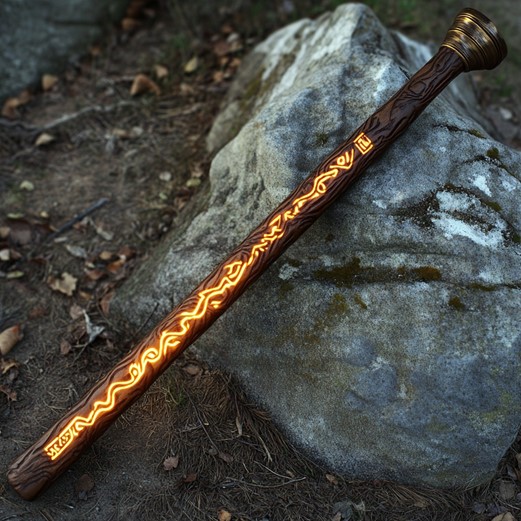
Lore: The Rune-Emblazoned Cane has its origins in the ancient order of the Harmonic Monks, a group of mystics and warriors renowned for their mastery of both physical and spiritual balance. Seeking to amplify their acrobatic prowess, the Harmonic Monks discovered the Rune of Nimble Evasion, which they believed held the key to unlocking exceptional stability and mobility. They carved the rune along the length of a sleek wooden cane, infusing it with magical properties that allowed the user to maintain balance even in the most precarious situations. The cane became a symbol of the Harmonic Monks’ discipline and agility, granting them the ability to perform graceful and agile maneuvers despite any obstacles they faced.
Use: The Rune-Emblazoned Cane is a versatile tool that enhances the user’s balance, stability, and mobility. When wielded, it bestows the character with increased agility and the ability to perform agile maneuvers, even in challenging terrain or when injured. The cane becomes an extension of the user’s body, providing support and enhancing their physical capabilities. It allows the character to maintain their balance while executing acrobatic feats, making it easier to navigate uneven surfaces, traverse narrow paths, or recover from stumbles with remarkable grace.
Tier One Stats:
- Bonus to Balance: +2 (providing a +2 bonus to balance-related skill rolls)
- Bonus to Mobility: +1 (providing a +1 bonus to mobility-related skill rolls)
Skills gained: The Rune-Emblazoned Cane enhances the following skills for the wielder:
- Balance: The cane’s magical properties improve the character’s ability to maintain equilibrium, making them more stable and less prone to falls or being knocked off balance.
- Mobility: The cane enhances the character’s mobility, enabling them to move more swiftly and fluidly, even in challenging terrain or when hindered by injuries.
Preparation: Crafting a Rune-Emblazoned Cane requires a skilled woodcarver with knowledge of enchantment techniques. The process begins with selecting a sleek and sturdy wooden cane, typically made from materials such as oak or hickory. The artisan then carefully carves the intricate Rune of Nimble Evasion along the length of the cane, infusing it with magical properties that enhance balance and stability. The enchantment process involves channeling arcane energy into the rune, binding it to the wood, and imbuing it with the desired magical effects.
Cost: The Rune-Emblazoned Cane is a sought-after item due to its magical properties and the craftsmanship required to create it. At level one, the cane may be priced at around 200 gold pieces or more, depending on the availability of materials and the demand for such enchanted items. The cost reflects both the skill of the woodcarver and the value placed on its ability to enhance the user’s agility and stability.
Process Tags: Woodcarving, Balance enhancement, Mobility improvement, Harmonic Monks, Mystical tool, Magical stability, Agile maneuvers, Rune Carving, Sturdy Wood, Arcane Energy, Enchantment Techniques, Challenging Terrain, Precise Footwork, Extension of the Body, Tactical Advantage, Status Symbol, Weapon
The Rune-Emblazoned Cane finds its greatest utility in environments that demand exceptional balance and mobility. It allows the wielder to navigate treacherous terrains, such as narrow ledges, rickety platforms, or uneven surfaces, with relative ease. Adventurers who possess the cane gain a significant advantage in situations that require precise footwork, agility, and stability. It becomes an invaluable tool for traversing challenging landscapes, recovering from falls, and maintaining poise in combat. The Rune-Emblazoned Cane is a testament to the wielder’s connection with the Harmonic Monks and their mastery of balance and agile maneuvers.
The recipe for the Rune-Emblazoned Cane is typically sold or obtained in locations that cater to practitioners of magical arts, as well as those who appreciate elegant and functional items. Here are some details on where and how this recipe is sold, as well as the environment and usage of the end results:
- Enchanting Emporiums: Specialized enchanting shops or emporiums are likely to offer the recipe for the Rune-Emblazoned Cane. These establishments cater to adventurers, scholars, and magic enthusiasts who seek unique and enchanted items. Enchanters or artisans with expertise in woodcraft and rune carving may sell the recipe directly or create the canes for sale. These shops are often located in bustling cities or towns, attracting customers with their impressive displays of magical wares.
- Harmonic Monastery: Deep in secluded and serene environments, such as mist-covered mountains or tranquil forests, lies the Harmonic Monastery. This sacred place is the ancient home of the Harmonic Monks, who originally created the Rune-Emblazoned Cane. The monastery’s teachings and knowledge are passed down through generations, and those deemed worthy may gain access to the recipe. Adventurers must earn the trust and respect of the monks, perhaps through acts of valor or service, to be granted this sacred knowledge.
- Collector’s Auctions: Rare and valuable items, including enchanted artifacts, often make their way into high-end auctions. Wealthy collectors, nobles, and influential individuals frequent these events in search of unique treasures. The recipe for the Rune-Emblazoned Cane may find its way into such auctions, where it fetches a high price due to its rarity and magical properties. Adventurers with the means to attend these auctions or connections to influential buyers may have the opportunity to acquire the recipe.
The end results and usage of the Rune-Emblazoned Cane are as follows:
- Balancing Act: The Rune-Emblazoned Cane becomes a cherished tool for those who value balance and stability. Adventurers and individuals who explore treacherous terrains, such as ancient ruins, dense forests, or rocky cliffs, find great utility in the cane. It aids in maintaining equilibrium, preventing falls, and granting them the confidence to navigate challenging environments.
- Agile Maneuvers: The cane enhances the user’s agility and allows them to perform acrobatic maneuvers with greater ease. It becomes an extension of their body, providing support and stability during complex movements. Adventurers can use the cane to execute impressive jumps, landings, spins, and other agile actions, making it particularly useful for characters with a focus on acrobatics, such as rogues or monks.
- Combat Advantage: In combat, the Rune-Emblazoned Cane grants a tactical advantage. It enables the wielder to maintain balance and stability even while engaged in fast-paced combat encounters. This allows for more accurate strikes, agile dodges, and quick recoveries from enemy attacks. The cane’s magical properties make it an effective tool for characters who prefer a nimble and evasive fighting style.
- Symbol of Prestige: Owning and utilizing the Rune-Emblazoned Cane carries a certain prestige and reverence. It is a symbol of mastery over balance and agile movements. In social situations, the cane can serve as a conversation starter or a status symbol, displaying the owner’s refined tastes and appreciation for the arcane arts.
The environment in which the Rune-Emblazoned Cane is used depends on the adventurer’s pursuits. It proves most beneficial in settings that demand exceptional balance and agility, such as ancient ruins, dense forests, mountainous terrains, or labyrinthine structures. The cane’s end results are utilized by adventurers who value grace, agility, and stability in their exploration, combat, and social endeavors, cementing their reputation as individuals who possess both physical and mental harmony.
Tale of the Still Walker’s Staff
The fragments of text, pieced together from crumbling clay tablets and the tattered remnants of bark scrolls, tell of a time when the mountains clawed higher at the sky and the forests whispered secrets unknown to modern ears. They speak of the Order of the Still Point, known to us, through the muddled lens of translation, as the Harmonic Monks.
These were not monks in the sense of cloistered scholars or pious recluses. They were wanderers, pilgrims of the precarious path, seekers of balance in a world of chaos. Their monasteries were not built of stone and mortar, but of the shifting landscape itself – a windswept cliff face, a precarious ledge overlooking a bottomless chasm, the swaying canopy of a primeval forest. They believed that true understanding could only be found in the heart of instability, that enlightenment lay at the razor’s edge of a fall.
Their leader, known only as Still Walker, was a figure of legend even amongst his own order. It was said he could walk a tightrope strung between two storm-wracked peaks, meditate on the tip of a swaying reed, and dance upon the surface of a raging torrent. But even Still Walker, the master of balance, recognized the limitations of the mortal form. Age, the relentless sculptor of flesh and bone, began to whisper its insidious song in his joints, to paint its chilling brushstrokes upon his once-steady limbs.
He sought a way, not to defy age, but to harmonize with it, to find balance not in the denial of change, but in its acceptance. He retreated to the highest peak in their domain, a place where the wind howled like a tormented spirit and the ground trembled with the pulse of the earth. There, for forty days and forty nights, he fasted and meditated, seeking guidance from the spirits of the mountain.
The answer, when it came, was not a thunderous revelation, but a gentle whisper, like the rustling of leaves in a summer breeze. It spoke of a tree, an ancient oak that grew at the base of the mountain, its roots delving deep into the heart of the earth, its branches reaching towards the heavens. This tree, the whisper said, held the secret of unwavering stability, of perfect equilibrium.
Still Walker descended the mountain, his steps slow but sure. He found the oak, its trunk gnarled and twisted by the passage of countless seasons, its leaves a tapestry of emerald and gold. He spent days studying the tree, observing the way it swayed in the wind, yet remained rooted, the way it yielded to the storm, yet did not break.
Finally, with reverence and respect, he selected a single, perfectly straight branch, fallen from the tree during a recent storm. He carried it back to his simple dwelling, where he began to work, guided by the intuition that flowed from his deep connection to the natural world.
He stripped the branch of its bark, revealing the smooth, pale wood beneath. He polished it with river stones and the softest of cloths, until it gleamed like polished ivory. Then, using a sharpened shard of obsidian, he began to carve the rune.
This was not a rune of power, in the conventional sense. It was not a symbol of fire or ice, of lightning or thunder. It was a rune of being, a representation of the perfect balance that Still Walker sought. It was a spiral, endlessly turning in on itself, yet always finding its center. As he carved, he chanted, not words of magic, but the simple sounds of the wind, the rustling of leaves, the murmur of the stream.
When the rune was complete, it glowed with a soft, inner light, a reflection of the harmony that Still Walker had poured into it. He capped the ends of the cane with polished brass, not for adornment, but for grounding, to connect the cane to the earth.
The moment he grasped the cane, he felt a shift within himself. It was not a sudden surge of power, but a quiet settling, a deep sense of centeredness. The aches in his joints eased, his steps became surer, his balance unwavering. He could walk the narrowest ledge, traverse the most treacherous terrain, with the same effortless grace he had possessed in his youth.
But the cane was more than just a physical aid. It was a reminder, a constant prompt to seek balance in all things – in his thoughts, in his emotions, in his actions. It was a tool for meditation, a focus for his mind, a conduit to the deeper energies of the world.
Still Walker used the cane for the rest of his long life, teaching his disciples the principles of balance, not just in physical movement, but in all aspects of their existence. The cane became a symbol of the Order, passed down from master to student, each adding their own understanding, their own essence, to its already potent magic.
The Order of the Still Point, like all things, eventually faded into the mists of time. Their teachings were scattered, their monasteries crumbled, their very name became a subject of scholarly debate. But the legend of Still Walker’s Staff, the Rune-Emblazoned Cane, persists, a whisper in the wind, a promise of balance in a world that often seems to be teetering on the brink of chaos. Fragments of texts and broken images remain, they are hard to read but hold the story.
Moral of the Story: True mastery lies not in conquering the external world, but in achieving inner harmony. Balance is not a static state, but a dynamic process, a constant seeking of equilibrium in the face of change. Even in the face of aging and adversity, it is possible to find grace and stability, not by resisting the inevitable, but by embracing it with wisdom and understanding. The tools we use are not just extensions of our physical selves, but reflections of our inner state, and can serve as reminders of the principles we strive to embody.
Suggested conversions to other systems:
Call of Cthulhu (7th Edition)
Rune-Emblazoned Cane
- (Artifact)
- Lore: A relic from a forgotten order that sought harmony with nature, rather than dominance over it. The runes, while not directly Mythos-related, resonate with a subtle, unsettling energy that hints at the vastness of the cosmos.
- SAN Cost: 0/1 Sanity points upon first wielding the cane. This represents a brief moment of clarity, a glimpse of the universe’s underlying order, which can be both awe-inspiring and unsettling.
- Mechanics:
- Grants a +10% bonus to the wielder’s DEX roll when attempting to maintain balance or avoid falling.
- Grants a +5% bonus to any skill roll involving graceful movement or physical poise (e.g., Dance, Stealth if used for quiet, balanced movement).
- Can be used as a weapon, dealing 1D6 damage. It has a sturdy build, granting it an advantage on any attempt to break or damage it.
- Optional Rule: Meditative Focus: If the wielder spends at least 10 minutes meditating while holding the cane, they regain 1D3 Sanity points. This reflects the cane’s ability to promote inner peace and stability, but should be used sparingly (perhaps once per session) to avoid trivializing Sanity loss.
- Build Points: 5 build points to create a custom magic item.
Blades in the Dark
Rune-Emblazoned Cane
- (Fine Balance Item)
- Description: A perfectly balanced cane of dark wood, inscribed with glowing runes that seem to shift and flow. It feels surprisingly light in the hand.
- Effect: When you roll Skirmish or Wreck, you may choose to push yourself to activate the cane:
- Take 1 stress.
- Gain +1d to your roll.
- Gain +1 effect level if in melee.
- On a 1-3 result on any of the dice, suffer a complication related to the cane’s subtle pull on your balance, or a momentary distraction caused by the runes’ shifting patterns.
- Quality: Fine (+1d to engagement rolls when used for relevant actions like fighting, climbing, or moving stealthily)
- When used gain one tick on your downtime.
- Requires 1 load.
Dungeons & Dragons (5th Edition)
Rune-Emblazoned Cane
- (Wondrous Item, Uncommon, Requires Attunement)
- Description: This elegant cane is made of dark wood, carved with luminous, silver runes. It feels perfectly balanced in the hand.
- Properties:
- While attuned to this cane, you gain a +2 bonus to Dexterity (Acrobatics) checks made to maintain your balance.
- While attuned to this cane, you gain a +1 bonus to Dexterity (mobility) checks.
- The cane can be used as a quarterstaff (1d6 bludgeoning damage, or 1d8 versatile).
- As a bonus action, you can speak a command word to activate the cane’s Steady Stance ability. For 1 minute, you have advantage on saving throws against being knocked prone. This property can’t be used again until the next dawn.
Knave
Rune-Emblazoned Cane
- Description: A sleek cane of dark, polished wood, inlaid with glowing, silver runes. It feels almost weightless, yet incredibly strong.
- Effect:
- Advantage on any Dexterity-based saves or tests related to balance, avoiding falls, or traversing difficult terrain.
- Can be used as a weapon, dealing 1d6 damage.
- Occupies one item slot.
- Harmonic Resonance (Optional Rule): If the wearer rolls a natural 20 on a Dexterity-based save or test while using the cane, they may immediately regain 1d4 hit points, representing a momentary surge of perfect equilibrium.
- When worn by anyone over tier 1, for each tier above 1 the avatar suffers 1d4 of damage. (See general rules.)
- The Avatar may use this item up to their tear level. If they use this ability above that level, then damage from overload (above) may be applied.
Fate (Core)
Rune-Emblazoned Cane
- Aspect: Still Walker’s Legacy
- Permissions: Allows the use of the Athletics skill in place of Physique for defense, as long as the defense involves maintaining balance or regaining footing.
- Skills Affected: +2 to Athletics when used to Overcome obstacles related to balance, difficult terrain, or staying upright.
- Stunt: Unwavering Stance: Once per scene, when you succeed on an Athletics roll to defend against being knocked prone or moved against your will, you may immediately create a Boost aspect representing your regained balance and control.
- Stunt: Once per game session, the user can choose to use a Fate point (without spending it) on a successful test of Athletics.
- Cost: 1 Refresh (to represent the cane’s inherent magical properties)
Numenera & Cypher System
Rune-Emblazoned Cane (Artifact, Level 4)
- Form: Polished wooden cane with intricate, glowing runes.
- Level: 4 (Affects the difficulty of tasks related to understanding or modifying the artifact)
- Effect:
- Eases the difficulty of any Speed-based tasks involving balance, stability, or traversing difficult terrain by one step.
- Can be used as a light weapon, dealing 4 points of damage.
- Depletion: 1 in 1d10 each time the difficulty easing effect is used. On depletion, the runes dim, and the artifact ceases to function until repaired (a task with a difficulty of 4).
- Cypher Option (If used as a Cypher): One-time use. For the next hour, the user is immune to being knocked prone and automatically succeeds on any Speed-based tasks related to balance or stability. After the hour, the cane crumbles to dust.
Pathfinder (Second Edition)
Rune-Emblazoned Cane
- (Item 4)
- Usage held in 1 hand; Bulk 1
- Traits: Invested, Magical, Evocation
- Description: A dark wood cane, perfectly balanced and inscribed with glowing runes.
- Activate envision (free action); Frequency once per round; Effect The runes flare, granting you a +1 circumstance bonus to Reflex saves and Acrobatics checks to Balance until the start of your next turn.
- Activate Command (one action) The staff can cast feather fall once per day.
- You can use this cane as a magical weapon granting a +1 item bonus to attack rolls, dealing 1d6 bludgeoning damage.
- Craft Requirements Supply a casting of cat’s grace or a similar spell enhancing balance.
Savage Worlds (Adventure Edition)
Rune-Emblazoned Cane
- (Minor Relic)
- Description: A beautifully crafted cane of dark wood, etched with shimmering, silver runes.
- Powers:
- +2 to Athletics rolls made to maintain balance, resist being pushed or tripped, or traverse difficult terrain.
- Can be used as a staff (Str+d4 damage).
- Steady Stance: As a free action, the wearer can brace the cane, gaining +4 to resist any attempts to push, trip, or knock them prone until the start of their next turn. This requires the user to remain relatively stationary (they can still use their Parry, but cannot move more than 1″ without losing the bonus).
- The user gains +1 pace when using the cane.
- Drawback (Optional): The wearer becomes slightly over-reliant on the cane for balance. If the cane is ever lost, broken, or taken away, they suffer a -2 penalty to Athletics rolls related to balance until they spend a full round re-adjusting to their natural balance. This drawback is only in effect if the Game master chooses to have consequences.
- Requires the arcane background edge.
Shadowrun (6th Edition World)
Rune-Emblazoned Cane
- (Focus, Force 4)
- Description: A seemingly ordinary cane made of dark, polished wood. Closer inspection reveals intricate, silver runes carved along its length, which glow faintly when magic is channeled through it.
- Type: Centering Focus (Balance)
- Availability: 12F (Forbidden – requires a license to own legally)
- Cost: 16,000¥ (4 x 4,000¥)
- Effect:
- Provides a +2 dice pool modifier to all tests involving the Gymnastics skill, including maintaining balance, traversing narrow surfaces, and resisting being knocked prone.
- Provides a +1 dice pool modifier to melee combat tests when using the cane as a weapon (treat as a club, Reach 1, Accuracy 5, Damage (STR+2)P, AP 0).
- Centering: The cane aids in magical centering. The wearer gains a +2 dice pool modifier to resist Drain when casting spells, so long as they are holding the cane and can maintain physical contact with it.
- Requires Karma to activate (bond) the item.
- The character may not bond with another item that has the same effect.
Starfinder (Core Rulebook)
Rune-Emblazoned Cane
- (Hybrid Item, Level 4)
- Level: 4
- Price: 2,400 credits
- Bulk: 1
- Description: This cane appears to be made of polished wood, but is actually a high-tech composite material, with micro-circuitry forming glowing, runic patterns along its length.
- Effects:
- +1 equipment bonus to Acrobatics checks to maintain balance or move across narrow or uneven surfaces.
- Can be used as a basic melee weapon (as a club), dealing 1d6 bludgeoning damage. It is considered to have the “operative” weapon special property, allowing you to use your Dexterity modifier instead of Strength for attack rolls.
- Once per day, as a move action, the user can activate the cane’s stabilizing field. For 1 minute, they gain a +4 circumstance bonus to their KAC against trip and bull rush combat maneuvers, and they are immune to the flat-footed condition caused by being off-balance.
Traveller (Mongoose 2nd Edition)
Rune-Emblazoned Cane
- (TL-7 Artifact)
- Description: A cane made from a material that resembles wood but is far stronger and lighter. Intricate designs, reminiscent of ancient runes, are etched into its surface and glow faintly in low light.
- Cost: Cr12,000 (extremely rare and likely only available on the black market or from specialized collectors)
- Weight: 0.5 kg
- Effects:
- +2 DM to all DEX-based skill checks involving balance, agility, or traversing difficult terrain (e.g., Acrobatics, Athletics).
- Can be used as a club (1D6 damage).
- Psionic Resonance (Optional): If the wielder has any psionic talent, the cane grants a +1 DM to any psionic skill check that involves maintaining control or focus (e.g., resisting psionic attacks, sustaining a telekinetic effect). This reflects the cane’s origin as a tool for mental and physical discipline.
- Requires one week and special training to attune.
Warhammer (Fantasy Roleplay 4th Edition)
Rune-Emblazoned Cane
- (Minor Magic Item)
- Description: A sturdy cane of dark oak, perfectly balanced and inlaid with silver runes that shimmer with a faint, ethereal light.
- Availability: Very Rare
- Cost: 350 gc
- Encumbrance: 1
- Effects:
- +10 bonus to all Tests involving the Athletics skill, specifically when used for maintaining balance, traversing difficult terrain, or resisting being knocked prone.
- Can be used as a quarterstaff (Weapon Skill (WS) +4, Damage SB+3, Qualities: Defensive).
- +10 to the Dodge skill.
- Inner Harmony (Optional): If the wearer spends at least one hour meditating while holding the cane, they gain 1 Advantage on all Willpower Tests for the next 24 hours. This reflects the cane’s ability to promote mental and spiritual balance.
- Requires Identify to learn about, after learning about this item it may be attuned.