
Lore
Among the furnace-cities where sand becomes memory and breath becomes shape, there existed a tradition that glass did not merely melt — it listened. Early glassworkers believed that molten glass held echoes of the earth’s sorrow and joy, trapped since its formation beneath ancient seas. The Zar of the Breathing Crucible was first created by ritual-smiths who combined Zar trance-dance with controlled breathing over a kiln’s mouth. Through rhythm, heat, and exhalation, they learned to coax glass into harmony rather than force it into form. The item was never meant for combat glory, but for steady hands, patient minds, and the quiet shaping of something fragile into something lasting.
Item Description
A narrow collar of heat-darkened bronze worn around the throat or upper chest, inset with a thumb-sized lens of imperfect blown glass. The glass swirls with faint internal striations, as if frozen breath were trapped within. When warm air passes over it, the lens glows faintly and vibrates almost imperceptibly.
Slot
Neck or upper chest slot (counts as one openly worn item)
Skills Gained While Openly Worn
• Glassworking and shaping tasks gain improved control and reduced failure chance
• Fine motor control involving heat, breath, or steady handwork is enhanced
• Improved intuition when judging material stress, thickness, and cooling rates
• Enhanced ability to sense flaws or tension in worked materials
Passive Magical Effects
• Breath Harmony: The wearer’s breathing naturally synchronizes with nearby heat sources, granting increased stability when working with molten or heated materials
• Thermal Awareness: Subtle awareness of temperature gradients within arm’s reach
• Stress Dampening: Reduces tremor and anxiety when performing delicate or dangerous crafting actions
• Material Listening: The wearer gains intuitive feedback when glass or crystal is about to fracture, warp, or fail
Activatable Magical Effects
Breath of the Crucible
• Activation: Slow controlled breathing for several seconds
• Effect: For a short duration, molten or softened glass becomes easier to shape, allowing finer detail and reducing the chance of flaws or collapse
• Additional Effect: Minor imperfections may self-correct as long as the user maintains steady breath
• Limitation: Ends immediately if the wearer panics or speaks forcefully
Echo of the Furnace
• Activation: Rhythmic breathing combined with gentle hand motion
• Effect: The wearer may briefly reinforce a glass object, making it more resistant to cracking, shattering, or thermal shock
• Duration: Short-lived, intended for shaping or cooling phases
• Limitation: Cannot be used to reinforce weapons or armor beyond mundane limits
Tags
ritual-crafted, breath-linked, heat-attuned, artisan-focus, glassbound, calming, crafting-aid, resonance-based, subtle-magic, nonviolent, tradition-bound, kiln-born, breath-guided, thermal-sense, artisan-ritual, molten-flow, fragile-harmony, precision-craft, heat-discipline, trance-crafted, material-whisper, steady-hand
Obtaining the Zar 742 of the Breathing Crucible
This item is rarely mass-produced. It is created through a combination of ritual practice, skilled glasswork, and controlled trance breathing. Most examples come into existence in one of the following ways:
• Apprenticeship Gift
A glassblower who completes a formal apprenticeship under a Zar-trained artisan may be allowed to participate in the ritual shaping of the item. The final step is performed by the apprentice themselves, making the item resonate specifically with their breath and movement. These versions are considered the most stable.
• Commissioned Craft
A master glassworker or ritual-smith may create one on request, but only after observing the buyer’s breathing, temperament, and manual control. If the buyer lacks patience or emotional stability, the request is refused.
• Inheritance or Workshop Relic
Some older furnaces and glass halls keep one or two of these items hanging near the kiln as teaching tools. When a master dies or retires, the item may be passed to a successor or quietly sold to fund the workshop’s survival.
• Pilgrimage Trade
In regions where Zar traditions remain strong, travelers may earn one through participation in communal breathing rites or kiln-rites lasting several days. Coin alone is rarely sufficient in these cases.
• Salvaged or Recovered
Rarely, one may be found among the effects of a deceased artisan or in the ruins of an old glass district. These are often unstable until reawakened through proper use.
• Shops and Places Where It May Be Found
Kiln-Houses and Glasswright Halls
These are the most common legitimate sources. Such locations smell of ash and heat, filled with furnaces and half-finished works. The item is usually displayed hanging near a kiln or wrapped in cloth near tools rather than in a storefront window.
Typical Cost: 6 to 12 Silver
Pricing varies based on craftsmanship, clarity of the glass lens, and how well the item resonates with the buyer.
Artisan Guild Exchanges
Larger cities often have artisan exchanges where masterworks are traded between guilds. The item may be acquired through barter, favors, or proof of craft rather than raw coin.
Typical Cost: 1 Gold or equivalent in trade goods or services.
Ritual Markets and Festival Grounds
During seasonal festivals tied to fire, industry, or transformation, temporary markets form. A few ritual-smiths sell these openly, often performing demonstrations.
Typical Cost: 8 to 15 Silver depending on demand and local superstition.
Traveling Glass-Sages
Rare wandering artisans carry one or two such items wrapped in padded cloth. These sellers often test the buyer’s breath control before agreeing to sell.
Typical Cost: 10 Silver plus a demonstration of calm breathing or steady hand control.
Recovered or Secondhand Sales
In poorer districts or scavenger markets, damaged or dormant versions may appear. These often require reattunement through proper ritual use.
Typical Cost: 3 to 6 Silver, with risk of flaws or reduced effectiveness.
• How It Is Bought and Sold
• Rarely sold through negotiation alone; demeanor and patience influence price
• Buyers who rush, bargain aggressively, or display agitation often see prices rise or the sale refused
• Calm behavior, steady breathing, and respectful handling frequently reduce cost
• The item is usually demonstrated before sale by heating a small glass shard to show its resonance
• Transactions often include a short breathing rite to ensure compatibility
In many regions, the item is considered unsuitable for warriors or those seeking power. It is viewed as a tool of craft, patience, and discipline, and those who misuse it often find its effects muted or unreliable.
Roleplay Use in Different Environments
Zar 742 of the Breathing Crucible
This item does not behave like a weapon or conventional tool of power. Its influence is subtle, tied to breath, heat, and control. How it manifests depends heavily on the environment and the mindset of the wearer.
• In Workshops, Kilns, and Industrial Areas
Defense
• The wearer unconsciously regulates their breathing when surrounded by heat, smoke, or sparks.
• Sudden flares, kiln surges, or steam bursts feel slower and more predictable, allowing the avatar to step aside or shield themselves in time.
• The calming influence reduces panic during accidents, preventing reckless reactions that would worsen injuries.
• If threatened, the wearer’s calm presence can slow escalation, causing aggressors to hesitate or misjudge timing.
Offense
• Offensive use is indirect.
• By controlling breath and posture, the wearer can manipulate the rhythm of movement in a confined space, subtly throwing off an opponent’s timing.
• In close quarters, the wearer’s steady motions can cause enemies to overcommit or misstep near heat sources, molten glass, or machinery.
• When shaping heated material, the user can rapidly form obstructions, barriers, or hazards with precise motion rather than brute force.
• In Urban or Civilized Environments
Defense
• The item’s calming aura helps defuse confrontations before they become violent.
• Guards, merchants, or crowds respond more slowly and cautiously, often mistaking the wearer’s confidence for authority.
• During chaos or fire, the wearer’s steady breathing prevents panic and allows controlled movement through crowds.
Offense
• The item enables controlled intimidation through silence and motion rather than threats.
• Subtle gestures can redirect attention, draw focus away from allies, or disrupt coordination.
• In tense negotiations, the wearer can unnerve opponents by remaining unnaturally calm, causing mistakes or hesitation.
• In Wilderness or Harsh Terrain
Defense
• The breathing rhythm helps regulate temperature and fatigue, especially in hot or arid regions.
• The wearer becomes more aware of environmental stress, such as cracking stone, shifting ground, or thermal changes.
• This allows early reaction to hazards like cave-ins, volcanic vents, or unstable footing.
Offense
• The wearer may use heat and terrain subtly rather than forcefully, guiding enemies into unstable ground or exhausting them through drawn-out movement.
• Fire-based threats become easier to anticipate due to heightened thermal awareness.
• In Combat Situations
Defense
• The item excels at preventing panic, fear spirals, and rushed actions.
• The wearer’s movements become measured, reducing openings caused by haste.
• The calming effect can blunt fear-based attacks or intimidation tactics.
• When injured, controlled breathing delays shock and keeps the avatar functional longer.
Offense
• Direct damage is not the item’s purpose.
• Its strength lies in timing disruption, misdirection, and endurance.
• The wearer can outlast opponents, forcing them into mistakes through overextension.
• Subtle motions can break rhythm, especially against aggressive or emotional foes.
• In Ritual or Social Environments
Defense
• The item shields against emotional manipulation and ritual panic.
• It stabilizes trance states, preventing possession or loss of control.
• The wearer remains grounded even in overwhelming ceremonial settings.
Offense
• In ritual contests or social dominance displays, the item allows the wearer to maintain composure while others falter.
• Calm presence alone can disrupt opponents relying on heightened emotion or frenzy.
• Roleplay Tone and Usage
• This item rewards patience, control, and restraint.
• It does not empower violence directly but reshapes the flow of conflict.
• Characters who rush, panic, or act emotionally gain little benefit.
• Characters who breathe, observe, and move deliberately gain an edge without drawing attention.
The Zar 742 of the Breathing Crucible is not a weapon of force.
It is a tool of endurance, clarity, and quiet dominance through control rather than aggression.
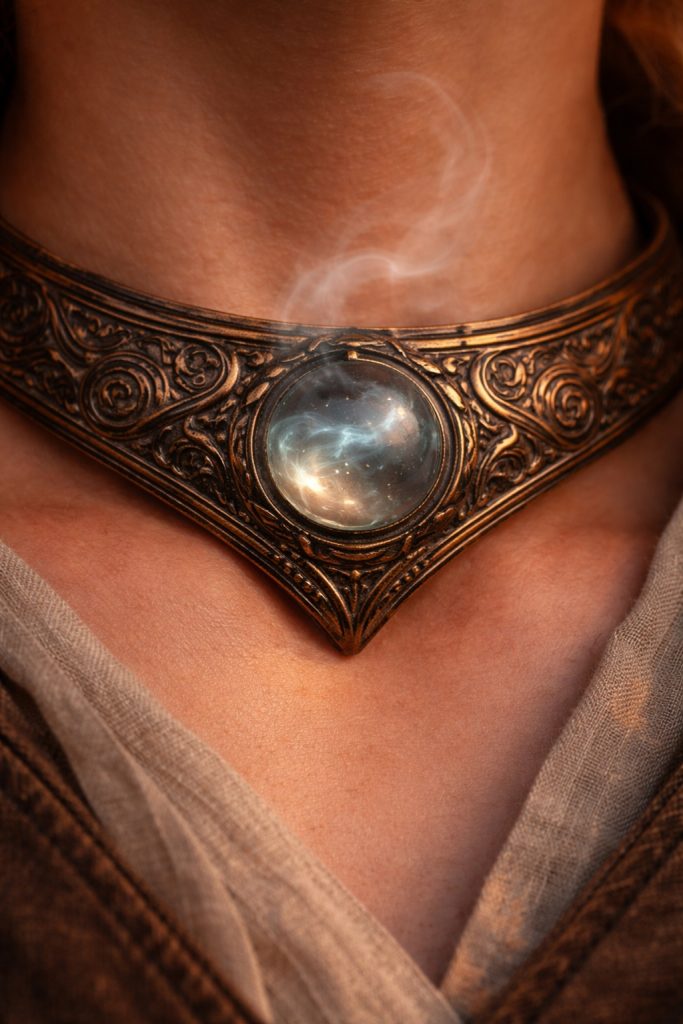
Perception of Activation:
User’s Perspective
When the Zar 742 activates, the first sensation is internal rather than external. The wearer feels their breath deepen on its own, slowing into a steady rhythm as if guided by an unseen hand. The air entering the lungs feels warmer and denser, carrying a faint mineral tang reminiscent of heated sand or stone. With each exhale, there is a subtle vibration in the chest and throat, as though the body itself has become part of a larger bellows.
The glass lens against the skin grows gently warm, not hot, and pulses in time with breathing. The wearer becomes acutely aware of airflow—how breath moves through the mouth, chest, and hands. Muscles relax without going slack. Fine tremors vanish. The mind quiets, narrowing its focus to the present action.
Extra-sensory perception manifests as an intuitive sense of stress within nearby materials. Glass, crystal, or heated objects feel “tense” or “relaxed,” almost like emotional states. The wearer can sense where something might crack, warp, or yield, even without touching it. Heat gradients become visible in the mind’s eye as soft gradients rather than numbers or colors.
There is also a subtle emotional effect: urgency fades. Impulses slow. The wearer feels grounded, anchored by breath and rhythm, as if standing at the still center of a turning wheel.
Observer’s Perspective
To others, the activation is quiet but unmistakable. The glass lens begins to glow faintly, its internal striations shifting as though stirred by a slow current. A soft hum can be felt rather than heard, resonating in the air close to the wearer.
Breath becomes visible in the slightest way—condensing faintly even in warm air. The wearer’s movements grow precise and unhurried, each motion deliberate. Nearby heat sources flicker subtly in response, flames bending inward as if drawn to the rhythm of breathing.
Observers often feel an unconscious urge to slow down. Conversations quiet. Movements become more careful. Even those unaware of the magic sense a change in atmosphere, as though the space itself has become calmer and more controlled.
Positive Effects
• Heightened awareness of breath, balance, and fine motor control
• Increased resistance to panic, stress, and rushed decision-making
• Improved sensitivity to heat, pressure, and material strain
• Enhanced precision when shaping or handling fragile objects
• Subtle calming influence on nearby individuals
• Reduced risk of mistakes caused by haste or agitation
Negative Effects
• Prolonged activation can lead to lightheadedness or emotional detachment
• The wearer may become overly focused, losing awareness of threats outside their immediate task
• Strong emotions or sudden shocks can disrupt the rhythm, causing momentary disorientation
• Extended use may leave the user fatigued, especially in high-heat environments
• If the wearer attempts violent or reckless action while active, the effect weakens or collapses entirely
Overall, the activation of the Zar 742 does not feel like power being unleashed. It feels like alignment—breath, heat, and intention falling into quiet harmony, allowing the wearer to act with precision rather than force.
Rite of the Breathing Crucible
(Crafting the Zar 742 of the Breathing Crucible)
Materials Needed
• A narrow band of bronze or copper alloy capable of withstanding repeated heating
• One thumb-sized piece of blown glass, imperfect and uneven in thickness
• Fine kiln ash or powdered volcanic stone
• Clean water drawn at dawn or dusk
• Natural binding oil (plant resin or rendered wax)
• A length of untreated fiber cord
• Access to steady heat (kiln, forge mouth, or ritual fire)
Tools Required
• Glassworking torch or controlled flame source
• Small shaping hammer and mandrel
• Heat-resistant tongs
• Polishing cloth
• Fine engraving stylus
• Shallow bowl for ash and water
• Quiet workspace with sufficient ventilation
Skill Requirements
• Basic glassworking or metalworking proficiency
• Ability to regulate breathing and remain calm under heat
• Familiarity with ritual timing or meditative practice
• Steady hands and patience
• Emotional control during prolonged focus
Crafting Steps
- Preparing the Glass
Heat the glass fragment slowly until it becomes pliable but not molten. Rotate it gently while breathing in a slow, steady rhythm. The glass must be shaped only during exhalation. If rushed, it will cloud or fracture. Once shaped into a shallow lens, allow it to cool naturally without quenching. - Forming the Collar
Heat the bronze band until it is just malleable. Shape it into a narrow collar sized to rest comfortably at the base of the neck or upper chest. Do not close the ring completely. Leave a slight gap to allow the metal to flex with breath. - Binding the Lens
Set the glass into the collar while both are warm. Use the natural binding oil to seat the glass, pressing gently but evenly. As the materials cool, the glass should settle into place without stress cracks. - Ash and Breath Infusion
Mix the ash with a small amount of water to form a thin paste. Lightly coat the inner rim of the collar. Hold the piece close to your chest and breathe steadily for several minutes, focusing on long exhales. The ash absorbs residual heat and symbolic breath. - Engraving the Flow
Using the stylus, etch shallow, flowing lines around the collar. These should resemble slow currents or spirals. Do not carve symbols or words. The lines must feel continuous and unbroken. - Activation Through Heat
Warm the completed piece over low heat while performing controlled breathing. As the metal warms, the glass should begin to faintly glow or hum. This indicates successful resonance. Remove from heat before it becomes hot to the touch. - Cooling and Rest
Wrap the item in cloth and allow it to rest undisturbed for one full night cycle. It must cool naturally. Do not test or wear it during this time.
Completion Signs
• The glass warms slightly when held
• A faint vibration is felt during slow breathing
• The collar rests comfortably without constriction
• Heat sources nearby feel subtly “present” to the wearer
Failure Conditions
• Rapid heating or cooling
• Speaking during the infusion stage
• Using force instead of breath to shape materials
• Attempting to imbue intent through emotion rather than calm
A properly crafted Zar 742 does not feel powerful.
It feels steady.
It responds to breath, patience, and restraint—
and remains silent to those who rush.
Furnace That Learned to Breathe
Long before the counting of years, before fire was trusted and before glass was known to remember shape, there was a place where the earth exhaled. The ground there was thin, and heat rose from beneath it in slow, patient sighs. The people who lived nearby did not call it a mountain, nor a forge, nor a wound. They called it the Listening Place.
It was said that the Listening Place had once been sealed by the world itself, for the breath beneath it was too strong and too restless. But time wears all seals thin, and one age it began to breathe again.
The people feared it.
Fire came and went without warning. Sand melted where it lay. Stones sang when struck. And those who shouted near the place claimed their voices came back changed, as if the earth itself had answered.
Among these people lived one whose name is lost to the breaking of language. In the oldest fragments, the name is written as a mark shaped like a lung, or a bell, or a flame held between two hands. The translators argue still.
This one did not fear the heat.
They were a worker of glass, though the word “glass” did not yet exist. They shaped sand into vessels by breathing into it through hollow reeds, and they noticed something others did not: the molten earth responded not to force, but to rhythm.
When their breath was ragged, the glass cracked.
When their breath was rushed, it warped.
But when they breathed slowly—deeply—the molten shape obeyed as if listening.
So they went to the Listening Place.
They did not speak. They did not chant. They sat at the edge of the heat and breathed until their chest burned and their thoughts went quiet. The ground answered with a low trembling hum, not angry, not kind, but aware.
They returned each day. They breathed. They listened.
Over many seasons, the heat began to change. It did not flare. It did not lash out. It waited.
One night, when the sky was dark and the stars hid themselves, the ground opened—not in violence, but in invitation. From within rose a slow wind, warm and steady, carrying the smell of stone and memory.
The glassworker did not flee.
They placed their hands into the heat and breathed.
The story says their breath did not burn because it was not fighting the fire. It moved with it. The molten earth folded inward, and from it emerged a band of darkened metal, still glowing, still humming.
At its center was a lens of glass, imperfect and alive, filled with the motion of breath trapped forever.
The earth did not speak, but the glassworker understood.
This was not a tool for command.
It was not a weapon.
It was not a gift for the strong.
It was for those who could listen without demanding.
The glassworker wore the collar and returned to their people. Where they walked, fires steadied. Kilns stopped cracking. Hands stopped shaking. Even arguments softened when the wearer breathed slowly.
But the collar did not obey everyone.
When a ruler tried to take it, the glass dulled.
When a warrior wore it, it grew cold.
When someone tried to force its power, it cracked and fell silent.
Only when worn by one who breathed with patience did it glow again.
When the glassworker grew old, they returned to the Listening Place. They removed the collar and laid it upon the warm stone. The ground closed, and the place went quiet.
But the collar did not remain buried.
It passed from hand to hand across centuries—through furnaces, workshops, and forgotten halls. Sometimes it was cherished. Sometimes it was misunderstood. Sometimes it lay dormant for generations.
Yet always, when placed upon the chest of one who worked with care and breathed with intention, it would warm again.
And the glass would remember how to listen.
Moral of the Story:
Power does not answer force.
It answers rhythm.
And those who learn to breathe with the world
shape it without breaking it.
Suggested conversions to other systems:
—
Call of Cthulhu (7th Edition)
Breathing Crucible Zar-Collar 742
Item Type: Enchanted Talisman (Thermal Resonance / Craft Focus)
Slot: Worn at throat or upper chest (openly)
Rarity/Availability: Uncommon in trade, subtle in effect (Keeper treats as a minor talisman)
Core Effects (while openly worn)
• Heatwise Hands: Gain +10% to Craft (any relevant specialty), First Aid, or Science rolls when the task involves heat, fragile materials, or precision under stress (Keeper chooses the best-fit skill for the character).
• Calm Under Heat: Gain +10% to CON rolls to resist panic, shock, or shaky hands when near fire, furnaces, or stressful heat.
• Fracture Sense: Gain +10% to Spot Hidden when noticing hairline cracks, stress lines, or imminent failure in glass, crystal, or brittle objects.
Passive Magical Perceptions
• Thermal Gradient Awareness: Within a few meters, the wearer senses hotter/colder zones as a “pressure” on the skin and throat.
• Material Tension Echo: The wearer sometimes feels a faint vibration when a nearby fragile object is about to fail (Keeper may allow a bonus die once per day to avert a mishap).
Activated Abilities
• Breath of the Crucible
– Cost: 1 Magic Point
– Time: 1 round of controlled breathing
– Effect: For 1d10 minutes, gain a bonus die on one relevant precision/crafting roll involving heat or fragile material (glass, crystal, ceramic, thin metal). In addition, one minor flaw may be “worked out” if discovered immediately (Keeper adjudication; no miracles).
– Use: Once per day.
• Echo of the Furnace
– Cost: 1 Magic Point
– Time: 1 round
– Effect: One glass or crystal object you can touch becomes briefly resistant to cracking or thermal shock for 1d10 minutes (treat as a small protective edge; Keeper may reduce damage from shatter events or negate one minor break). Not intended to harden weapons beyond normal limits.
– Use: Once per day.
Drawbacks / Risks
• Overfocus: If both activations are used on the same day, make an INT roll. Failure causes tunnel-focus: penalty die on Listen and Spot Hidden (non-heat threats) for 1d10 minutes.
• Emotional Detachment: Repeated use can leave the wearer calm to a fault; roleplay as slowed urgency.
—
Blades in the Dark
Breathing Crucible Collar 742
Item: Arcane Implements (Load 1, worn)
Keywords: Heat Discipline, Precision Craft, Calm Presence, Material Sense
Always-On (when worn openly)
• You have potency on Tinker or Study actions involving heat, fragile materials, and precision shaping (glasswork, crystalwork, kilnwork, delicate repairs).
• You have potency on Resolve when resisting panic, intimidation, or fear in hazardous heat or high-pressure craft scenes.
Special Uses (activate in the fiction)
• Breath of the Crucible
– Spend 0 stress to gain improved position on one action to shape, repair, or stabilize a fragile heated object.
– Spend 1 stress to create an advantage “Aligned Breath,” “Hands Like Still Fire,” or “Molten Obedience,” with one free invocation, usable for the scene.
• Echo of the Furnace
– Spend 1 stress to temporarily “harden” a fragile object against breakage for the scene (door-window, vial, crystal lens, delicate component). Treat it as having one extra “buffer” against harm or mishap.
Limits and Consequences
• If you push yourself with this item twice in one score, start or tick a 4-segment clock: Heat-Drained. When filled, you take level 1 harm “Lightheaded” until you rest.
• It won’t reinforce weapons into supernatural blades; it protects fragility, it doesn’t create brutality.
—
Dungeons & Dragons (5e compatible)
Zar 742, Collar of the Breathing Crucible
Wondrous Item (common), requires attunement
Slot/Use: Worn at throat or upper chest; must be worn openly to function
Passive Benefits (while attuned and openly worn)
• Thermal Intuition: You have advantage on Intelligence checks related to assessing heat, cooling, material stress, or glass/crystal crafting.
• Steady Breath: You have advantage on Constitution saving throws against being frightened if the source is panic, shock, or environmental stress (fire, furnaces, hazardous heat).
• Fracture Sense: You have advantage on Wisdom (Perception) checks to notice hairline cracks, stress fractures, or imminent break points in glass, crystal, or brittle ceramics.
Activated Features
• Breath of the Crucible (1/day)
– As an action, you perform controlled breathing. For 10 minutes, you gain a +1d4 bonus to Dexterity (tool) checks and Intelligence (tool) checks involving glass, crystal, delicate shaping, or heat-work. If a check would fail by 2 or less, you may choose to succeed instead, but the item becomes inert until you finish a long rest.
• Echo of the Furnace (1/day)
– As an action, you touch one glass or crystal object. For 1 hour, it gains resistance to bludgeoning damage from impacts and advantage on saving throws against shattering from thermal shock. This does not affect weapons used to attack.
Drawbacks
• If you use both features before finishing a long rest, you must succeed on a DC 10 Wisdom saving throw or suffer tunnel-focus for 1 minute (disadvantage on Perception checks not related to heat/materials).
—
Knave (latest edition compatible)
Breathing Crucible Zar 742
Type: Worn collar (throat/upper chest)
Slots: 1 slot
While Worn (openly)
• Heatwise Hands: You have advantage on checks involving heat-work, fragile crafting, glass/crystal shaping, careful repair, or kiln/forge procedures.
• Steady Breath: You have advantage on saves/checks to resist panic, fear, or shaky hands caused by dangerous environments.
• Fracture Sense: You have advantage on checks to notice cracks, stress lines, or imminent failure in brittle materials.
Activations
• Breath of the Crucible (1/day)
– For one exploration turn, gain advantage on all checks involving delicate heat-work and fragile shaping. You may also negate one minor crafting mishap if you notice it immediately.
• Echo of the Furnace (1/day)
– One touched glass/crystal object resists breaking for one exploration turn; the first time it would crack or shatter, it instead holds together with a visible stress line.
Costs / Risks
• If you use both activations in the same day, you suffer “Tunnel-Focused” until a long rest: disadvantage on awareness checks unrelated to heat, flame, or fragile material.
—
Fate Core / Fate Condensed
Zar 742 – Breathing Crucible Collar
Item Type: Ritual Focus / Worn Relic
Scale: Personal
Slot: Worn (neck or upper chest)
Aspects
• “The Furnace Answers to Breath”
• “Still Hands Shape Strong Glass”
Permissions
• You may use calm breathing, posture, and heat awareness as justification for actions involving precision, shaping, or emotional control.
• You may treat glass, crystal, or heated materials as responsive rather than inert when narratively appropriate.
Passive Benefits
• +2 to Crafts or Physique when working with heat, molten material, or fragile substances.
• +2 to Will when resisting panic, fear, or stress caused by dangerous environments.
• You may defend against emotional or situational pressure using Crafts if you describe controlled breathing or steady handwork.
Activated Stunts
Breath of the Crucible
Once per scene, spend 1 Fate point.
• Create an aspect such as “Breath-Aligned,” “Glass in Harmony,” or “Steady as the Kiln.”
• Gain one free invocation on that aspect for crafting, shaping, or resisting failure caused by heat or stress.
Echo of the Furnace
Once per session, spend 1 Fate point.
• Reduce the severity of a consequence involving broken equipment, cracked glass, or heat damage by one step (Severe to Moderate, Moderate to Mild).
• Alternatively, prevent a fragile object from breaking once during the scene.
Compels
• You hesitate to rush or act recklessly around fragile things.
• Prolonged calm may dull urgency when immediate action is required.
• You feel compelled to intervene when craft or creation is being mistreated.
—
Numenera / Cypher System
Zar 742, Breathing Crucible Collar
Level: 3
Type: Subtle Artifact (Craft Resonator)
Form: Worn (neck)
Passive Effects
• Asset on Intellect tasks involving crafting, shaping, or analyzing materials.
• Asset on Might defense rolls against heat, fire, or exhaustion caused by labor.
• You can sense structural weakness in glass or crystal within immediate range.
Activated Abilities
Breath of the Crucible
Cost: 1 Intellect
Action
Effect: For 10 minutes, gain an asset on all tasks involving delicate construction, glasswork, or fine shaping. During this time, minor crafting failures may be rerolled once.
Echo of the Furnace
Cost: 2 Intellect
Action
Effect: One object made of glass or crystal within immediate range gains temporary structural integrity, ignoring the next instance of breakage or thermal damage.
Depletion
• 1 in 1d20 if both abilities are used in the same day.
GM Intrusions
• Overfocus causes tunnel vision and situational blindness.
• The wearer becomes emotionally detached while active.
—
Pathfinder Second Edition
Zar 742, Collar of the Breathing Crucible
Item Level: 1
Item Type: Wondrous Item (Invested)
Usage: Worn (neck)
Bulk: L
Passive Effects
• +1 item bonus to Crafting checks involving glass, crystal, or heat-based work.
• +1 item bonus to Fortitude saves against heat, fatigue, or environmental stress.
• You can sense flaws or stress lines in glass or crystal within 10 feet with a successful Perception check.
Activated Abilities
Breath of the Crucible
Frequency: Once per day
Activation: 1 action
Effect: For 10 minutes, you gain a +2 circumstance bonus to Crafting checks involving delicate or heated materials. If you would critically fail such a check, treat it as a failure instead.
Echo of the Furnace
Frequency: Once per day
Activation: 2 actions
Effect: Touch a glass or crystal object. For 1 hour, it gains resistance 5 to physical damage and does not suffer damage from temperature change.
Drawback
• If both abilities are used before daily preparations, you become Fatigued for 10 minutes.
—
Savage Worlds Adventure Edition
Zar 742, Breathing Crucible Collar
Item Type: Minor Relic
Slot: Worn
Rarity: Common
Passive Effects
• +1 to Craft and Notice rolls involving fragile materials or heat.
• +1 to Spirit rolls to resist fear, panic, or stress in hazardous environments.
Activated Powers
Breath of the Crucible
Power Points: 1
Activation: Action
Effect: For 3 rounds, gain +2 to Trait rolls involving crafting, shaping, or stabilizing fragile objects.
Echo of the Furnace
Power Points: 2
Activation: Action
Effect: One glass or crystal object gains temporary resilience, negating one instance of breakage or environmental damage.
Limitations
• Using both powers in a single encounter requires a Vigor roll or the user becomes Fatigued.
• The item offers no benefit in combat focused on brute force or raw damage.
—
Shadowrun (Sixth Edition)
Zar 742 – Breathing Crucible Collar
Item Type: Magical Focus (Somatic / Craft Resonance)
Focus Rating: 1
Bonding Cost: Standard for Rating 1
Slot: Worn (neck or upper chest)
Availability: Restricted, Artisan Circles
Passive Effects
• +1 die to Craft, Engineering, or Artisan-related tests involving heat, glass, crystal, or precision shaping.
• +1 die to Willpower tests to resist fear, stress, or distraction caused by environmental hazards (fire, heat, pressure).
• The wearer gains an intuitive sense when fragile material is about to fail (GM may provide early warning).
Activated Abilities
Breath of the Crucible
Activation: Minor Action
Drain: 1
Effect: For one scene, the wearer gains +2 dice on all tests involving delicate fabrication, heat control, or stabilizing fragile materials.
Additional Effect: One failed crafting-related test during this time may be rerolled once.
Echo of the Furnace
Activation: Major Action
Drain: 2
Effect: A single glass or crystal object within reach gains temporary structural stability. It ignores the first instance of breakage or heat damage it would normally suffer.
Limitations
• Requires calm, steady breathing; effects fail if the user is panicked or under heavy emotional stress.
• Using both abilities in the same scene imposes –1 die to all physical tests for the remainder of the scene due to fatigue.
• No effect on weapons intended to cause damage.
—
Starfinder
Zar 742, Breathing Crucible Collar
Item Level: 1
Item Type: Hybrid (Magic)
Usage: Worn
Bulk: L
Passive Effects
• +1 circumstance bonus to Engineering and Mysticism checks involving heat, crafting, or fragile materials.
• +1 circumstance bonus to saving throws against fire, environmental heat, or fatigue.
Activated Abilities
Breath of the Crucible
Activation: Standard Action
Frequency: 1/day
Effect: For 10 minutes, the wearer gains a +2 bonus to checks involving crafting, shaping, or stabilizing glass, crystal, or heated materials. During this time, one failed such check may be rerolled.
Echo of the Furnace
Activation: Standard Action
Frequency: 1/day
Effect: One unattended glass or crystal object within reach becomes resistant to damage, ignoring the next instance of breakage or thermal shock.
Drawbacks
• If both abilities are used before resting, the wearer suffers a –2 penalty to Initiative and Reflex saves for 10 minutes.
• Ineffective against purely mechanical or synthetic materials.
—
Traveller (Mongoose 2e)
Zar 742, Breathing Crucible Collar
Tech Level: Treated as TL–2 Ritual Artifact
Type: Psychosomatic Craft Aid
Weight: Negligible
Passive Effects
• DM+1 to Engineer, Art, or Mechanic checks involving fine work, glass, or heat.
• DM+1 to END checks made to resist heat exhaustion or stress.
Activated Functions
Breath of the Crucible
Time: 1D6 seconds
Effect: For 10 minutes, the wearer gains DM+2 to all checks involving careful fabrication or heat-sensitive materials.
Echo of the Furnace
Time: 1 action
Effect: One glass or crystal object gains temporary resilience, ignoring the next instance of damage or structural failure.
Limitations
• Cannot be used while running, fighting, or under panic conditions.
• Overuse causes mental fatigue, imposing DM–1 to INT-based checks for 1D6 minutes.
—
Warhammer Fantasy Roleplay (4th Edition)
Zar 742, Collar of the Breathing Crucible
Item Type: Enchanted Trinket
Encumbrance: 0
Rarity: Rare
Availability: Restricted
Passive Effects
• +10 to Trade (Glassblower), Trade (Artisan), or Evaluate Tests involving fragile materials.
• +10 to Cool Tests when resisting fear, panic, or environmental stress.
Activated Powers
Breath of the Crucible
Activation: Action
Effect: For 10 rounds, gain +10 to Tests involving crafting, shaping, or stabilizing delicate materials. Additionally, ignore the effects of one Minor Mishap related to heat or fragility.
Echo of the Furnace
Activation: Full Action
Effect: One glass or crystal object becomes temporarily reinforced, ignoring the next instance of damage or breakage.
Drawbacks
• Using both abilities without rest causes the Fatigued Condition for 1d10 minutes.
• Has no effect on Daemonic, Undead, or purely destructive materials.