
Lore
Crafted within the subterranean chapterhouses and earthen sanctums of early Golden Dawn lodges across Saṃsāra, this heavy hand-spade was forged by initiate-excavators aligned with the sphere of Malkuth (the Kingdom) and the alchemical element of Earth. Believing that all physical matter is the crystallized vessel of the divine, esoteric delvers and sappers designed the tool to align the practitioner’s bodily labor with telluric currents, softening hard stone, parting stubborn clays, and feeling the deep subterranean strata as if reading an open occult text.
Description
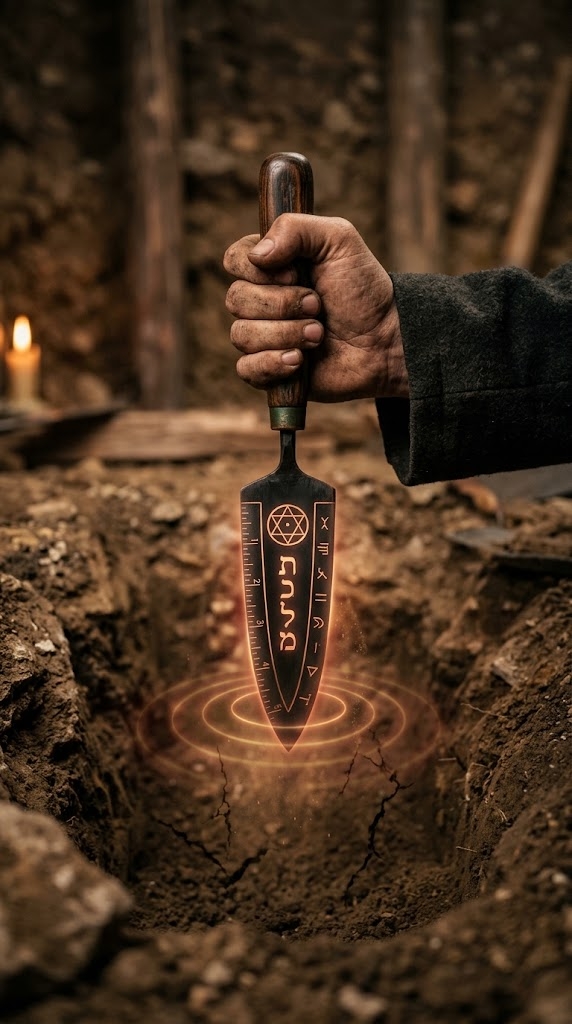
A compact, heavy hand-trowel forged from blackened cold iron, fitted with a contoured handle carved from fossilized bog-oak. The blade’s triangular spine is inlaid with a fine vein of red copper outlining the Hebrew characters for Malkuth and the geometric seal of the Element of Earth. The cutting edges are etched with graduated inch-notches and Hermetic geomantic figures representing Carcer and Fortuna Minor. When struck against soil or bedrock, the blade produces a deep, sustained bell-like resonance rather than a dull clatter.
Slot
Held in 1 hand
Detailed Stats
- Item Tier / Rarity: Tier 1 / Common
- Weight: 2.5 lbs
- Durability: 35/35
- Attunement: Requires 10 minutes of earth-grounding meditation, tracing the Banishing Pentagram of Earth with the trowel’s tip upon raw dirt.
- Proficiency Required: Excavation / Geoturgy / Earthcraft (Tier 1)
Passive Magic
- Telluric Strata Resonance: While holding the trowel or wearing it sheathed at the waist, the bearer intuitively perceives the composition, density, and stability of natural earth, stone, or clay within a 10-foot radius, detecting hollow voids, shifting sands, or structural collapse risks before striking the soil.
- Tireless Trencher: The practitioner’s physical stamina harmonizes with the telluric weight of Malkuth; physical fatigue accumulated from continuous digging, trenching, or shifting loose soil and rock is reduced by half.
Activable Magic
- Assay Bedrock Density (Action): The user drives the point of the trowel firmly into natural stone, dirt, or masonry while reciting the divine name Adonai ha-Aretz.
- Effect: A low harmonic hum travels through the substrate, revealing the location of buried metallic ores, subterranean water pockets, hollow chambers, or buried structural foundations within 30 feet.
- Cost: At will (requires 1 uninterrupted round of concentration).
- Part the Heavy Clay (Action): The user traces the inverted triangle of Earth along the cutting edge of the blade and strikes an expanse of packed earth, clay, loose gravel, or soft shale.
- Effect: For the next 10 minutes, the blade cuts through packed dirt, hardened mud, and crumbly stone with the resistance of soft butter, allowing the user to excavate a 5-foot cube of earth in a fraction of the normal time without dulling the edge or breaking the shaft.
- Cooldown: 3 uses per Long Rest.
Tags
- Tool, Weapon, Earth, Malkuth, Hermeticism, Excavation, Sapping, Mining, Detection, Telluric, Level 1, Burrowing, Masonry, Tunneling, Geology, Geomancy, Fortification, Mineralogy, Strata, Subterranean, Soil, Entrenchment
Commerce and Acquisition of the Terrene Trowel of Malkuth
- Miners’ Guildhalls and Sapping Depots: Situated near quarry pits, deep-shaft headframes, and military sally ports, these cavernous supply houses are filled with iron pickaxes, timber braces, and grease barrels. Foremen and master sappers inspect the trowel by rapping the blade with a tuning fork to hear the telluric pitch of the cold iron. An avatar selling a salvaged trowel receives 10 silver pieces logged directly to their World Bank ledger. Miners, delvers, and trench-engineers seeking to purchase one pay the standard trade price of 12 silver pieces, while sworn guild apprentices in good standing can obtain one at an institutional discount of 10 silver and 5 copper pieces.
- Hermetic Sanctuaries and Earth Temples: Found in vaulted crypts, subterranean chapterhouses, and stone-cut monasteries dedicated to the sphere of Malkuth, these solemn chapels display ritual implements atop slabs of rough-hewn granite. Proctors verify the tool’s copper inlay and trace the geomantic figures to ensure the blade has not suffered spiritual grounding fractures. Initiates wishing to liquidate an extra implement are credited 11 silver pieces through the temple scriptorium’s ledger. Unaffiliated seekers and ritualists purchasing the trowel as an esoteric grounding tool pay a consecrated curio price of 14 silver pieces, whereas initiated fraternity members can purchase it for 11 silver and 8 copper pieces.
- Frontier Outfitters and Excavation Caravans: Located at wilderness trail outposts, dry river-wash settlements, and ruined-city perimeter stations, these dusty log-and-canvas depots supply explorers who must dig through ancient strata or fortify forward camps against hostile beasts. The outfitter tests the edge on dry river stone and inspects the bog-oak handle for dry rot. An explorer selling an extra trowel receives a straightforward salvage payout of 9 silver pieces credited to their bank slip. Outbound prospecting companies buying the tool to excavate ruins or dig emergency trenches in shale and scree are charged 13 silver pieces due to high frontier demand.
- Pawnshops and Salvage Yards: Clustered along harbor canals, tenement alleys, and scrap districts, these crowded stalls are piled with secondhand shovels, pry-bars, and rusted anchors. The pawnbroker rarely appreciates the Hermetic geometry, judging the item merely as high-density blackened iron with an ornamental copper stripe. An avatar in need of quick coin can offload the trowel for a rapid cash payout of 8 silver pieces credited to their ledger. Savvy treasure hunters digging through the junk bins can buy the unauthenticated trowel for a flat price of 12 silver pieces, with stubborn brokers unwilling to haggle unless shown proof of its alchemical balance.
- Undercity Fences and Grave-Robber Dens: Tucked away in sewer vaults, flooded catacomb passages, and illicit burial-turf markets where illegal crypt-crackers and unlicensed tomb-delvers operate, silent and rapid excavation tools command premium value. In an environment where clattering pick strikes can draw city watch patrols or subterranean horrors, an iron trowel that parts packed clay like soft butter without noise is a prized asset. A thief selling a stolen or salvaged trowel to an undercity fence bypasses the banking network completely, receiving 18 silver pieces in cold, untraceable physical silver coin. A nocturnal tunneler or tomb-raider looking to buy the blade without leaving a record must pay a steep black-market rate of 23 silver pieces in hard coin.
Tactical and Environmental Applications of the Terrene Trowel of Malkuth
- Subterranean Crypts and Ancient Ruins: In the damp, cramped silence of forgotten catacombs, environment control is paramount. Defensively, when a corridor begins to groan under shifting weight, the user activates Telluric Strata Resonance to identify the precise keystone holding back tonnes of loose rubble. Using Part the Heavy Clay, they rapidly excavate a shallow drainage trench and a structural anchor pocket, reinforcing the collapsing ceiling with improvised timber struts just before the passage is choked off, saving the party from entombment. Offensively, when ambushed by stone-shaping skeletal guardians, the sapper drives the trowel into the loose sedimentary floor. Activating Assay Bedrock Density, they locate the hollow cistern beneath the defenders; a final, rapid application of Part the Heavy Clay melts the stone floor beneath the enemies, collapsing them into the black void below without exchanging a direct blow.
- Open Steppe and Marshland Battlefields: On broad plains or muddy wetlands where cavalry charges and archer volleys dominate, the ground itself becomes the primary barrier. Defensively, when observing an incoming cavalry unit, the user employs Tireless Trencher to sweatlessly excavate a 10-foot long, 4-foot deep sloped defensive ditch and earthen berm across the party’s front in minutes. By tracing geomantic sigils into the berm’s clay, they fortify it against missile fire. Offensively, when facing a shielded mercenary phalanx on stable ground, the user activates Assay Bedrock Density to feel for a pre-existing soft earth pocket or subterranean spring beneath the enemy formation. Once located, they use Part the Heavy Clay to strike the line. The release of the telluric resonance turns the stable ground beneath the front rank into a grasping, deep mud-trap, shattering the enemies’ tight shield-wall and routing the heavy infantry.
- Besieged Fortifications and Mud-Walled Settlements: In siege warfare, the war is won beneath the walls rather than over them. Defensively, during an enemy assault, the sapper activates Telluric Strata Resonance along the base of the city’s mud-brick rampart. They detect the subtle, rhythmic vibrations of enemy miners digging a collapse tunnel toward the main gate. By activating Part the Heavy Clay, they rapidly dig a narrow intercept counter-mine, collapsing the enemy’s tunnel on top of the sappers before they can detonate their powder kegs. Offensively, when tasked with breeching a reinforced wooden palisade on the approach, the user strikes the ground and activates Assay Bedrock Density to find a fault-line in the bedrock below. Using the Tireless Trencher passive to maintain speed, they rapidly sap beneath the palisade’s primary anchor post and apply Part the Heavy Clay to dissolve the clay support, causing a 10-foot section of the wall to collapse under its own weight.
- Wilderness Foraging and Camp Security: Survival often demands rapid entrenchment far from civilization. Defensively, while establishing a wilderness camp in territory haunted by burrowing monsters, the user activates Telluric Strata Resonance to sweep the 10-foot perimeter. They identify the loose, sandy soil tethers of a nesting pair of ankhegs directly beneath their intended sleep site, warning the camp to relocate to stable ground. Offensively, when hunting a skittish, armored earth-elemental sprite for its magical mineral core, the user uses Assay Bedrock Density to track the creature’s vibration through solid granite. Tracing geomantic patterns onto the trowel’s edge, they wait at an interception point and use Part the Heavy Clay to strike through the bedrock itself, severing the sprite’s earth-tether and instantly capturing the entity before it can phase away through the stone.
- Undercity Sewers and Flooded Canal Tunnels: Below city streets, stability is fractured by centuries of decay and water erosion. Defensively, when trapped by rising sewer water and a pursuing urban monster in a decaying brick vault, the user activates Telluric Strata Resonance. They realize the brick wall behind them is held back only by weak, wet loam. Activating Part the Heavy Clay, they punch through the decayed wall in seconds, creating an emergency escape route into an abandoned cellar before the sewer collapses and the water sweeps them away. Offensively, during a skirmish against a rival gang across a flooded canal, the user utilizes Assay Bedrock Density to locate the structural weak point in the masonry buttress holding back the enemy group’s platform. Driving the trowel into the joint and activating Part the Heavy Clay, they cause the entire platform to disintegrate into the black water, sending the rivals plummeting into the effluent.
Perception of Activation:
- Sight:
- User’s Perspective: As the divine invocation Adonai ha-Aretz is spoken and the tip strikes the ground, the copper-inlaid Hebrew letters for Malkuth flare with a deep, smoldering ember-red luminescence. Concentric rings of terracotta-colored light ripple outward through the soil from the impact point, illuminating subterranean fractures, roots, and stone seams up to thirty feet away as glowing, translucent veins in the darkness of the earth.
- Observer’s Perspective: Observers see the blackened iron blade pulse with a low, cherry-red heat along its copper spine. Where the blade enters the dirt, a faint, glowing orange crest forms on the ground, sending miniature dust clouds and sand particles skittering outward along radiating geomantic lines.
- Positives: Outlines structural flaws, hidden cavities, and buried foundations clearly against the surrounding ground, allowing the user to map out safe excavation paths visually.
- Negatives: The crimson glow from the blade and soil illuminates the excavator’s hands and face, making covert sapping operations difficult to conceal in dark tunnels or nocturnal sieges.
- Hearing:
- User’s Perspective: Rather than a sharp, clattering crunch of metal on stone, the strike triggers a deep, sonorous bass chime that echoes up through the arm bones, resembling the low hum of a massive bronze temple bell struck deep underground. As the blade draws near hollow spaces or water pockets, the note shifts into an airy, resonant drone.
- Observer’s Perspective: Companions hear a low, rhythmic vibration like a muffled bass drum rolling beneath the floorboards, causing loose pebbles and tin canteens nearby to rattle gently.
- Positives: The tonal shifts provide immediate acoustic feedback on the density of the strata, signaling whether stone behind a wall is solid bedrock or unstable scree.
- Negatives: The deep subterranean resonance travels through rock and foundation stones, easily picked up by seismic tremors or alerted burrowing beasts resting in nearby chambers.
- Smell:
- User’s Perspective: An intense, crisp odor of ozone, newly cleaved slate, wet river clay, and rich, upturned loam fills the user’s nasal passages, completely drowning out the stale air of underground tunnels.
- Observer’s Perspective: Nearby allies catch a sharp draft reminiscent of heavy summer rain hitting baked garden dirt, coupled with the hot, metallic scent of struck flint.
- Positives: Clears out noxious sewer damp and stagnant crypt gasses from the digger’s lungs, invigorating their breathing during heavy physical labor.
- Negatives: The strong scent of freshly disturbed earth can betray an ongoing excavation to predators or trackers with keen olfactory senses.
- Taste:
- User’s Perspective: A dry, mineral astringency coats the tongue, tasting of copper coins, crushed granite dust, and petrichor, accompanied by an involuntary settling sensation in the stomach that grounds the senses.
- Observer’s Perspective: Observers experience no direct taste sensation, though they may observe the user swallowing repeatedly or parting their dry lips to clear the mineral taste.
- Positives: Confirms the telluric circuit has closed and acts as an alchemical anchor against disorientation, vertigo, or balance disruption caused by shifting cavern floors.
- Negatives: Leaves the mouth dry and chalky for nearly an hour, requiring frequent sips of water to wash away the gritty metallic tang.
- Touch:
- User’s Perspective: The fossilized bog-oak handle turns heavy and solid in the grip, vibrating with a warm, steady hydraulic force. When thrust into packed clay or granite, the resistance vanishes; the soil yields under the blade like warm tallow or dense foam, absorbing the shock of the impact so no jarring recoil reaches the user’s wrists or elbows.
- Observer’s Perspective: An observer touching the user’s shoulder feels a heavy, rhythmic pulse akin to an underground engine, and watching the trowel enter dense bedrock looks as effortless as sinking a knife into soft butter.
- Positives: Eliminates repetitive-strain injury, blister formation, and kinetic shock, allowing the user to dig through hardened rock and dense clays without joint fatigue.
- Negatives: The lack of physical resistance can cause an overzealous digger to misgauge manual cutting depth, occasionally carving too deeply into fragile load-bearing strata.
- Extra-Sensory Perceptions:
- Telluric Skeletal Grounding:
- User’s Perspective: The user feels their physical bones mentally link to the underlying tectonic plates of Saṃsāra. Gravitational weight becomes a comforting, immovable support; they perceive the immense mass of the ceiling, hills, and surrounding cavern walls pressing down not as a suffocating hazard, but as a stable, predictable network of interconnected stone arches and pressure lines.
- Observer’s Perspective: Mystics viewing through their Mind’s Eye see the user’s silhouette rooted to the bedrock by thick, glowing amber pillars that resemble tree taproots made of dark earth.
- Positives: Completely suppresses claustrophobia, cave panic, and spatial disorientation, ensuring calm focus even when buried or trapped in narrow crawlspaces.
- Negatives: Creates a temporary psychological reluctance to leave the subterranean realm, leaving the user feeling exposed, lightheaded, and vulnerable under the open sky.
- Geomantic Strata Clairaudience:
- User’s Perspective: The user’s consciousness briefly expands through the substrate, hearing the “groan” and “strain” of the earth as a readable language. They feel the impending shear-points where a cave-in is brewing, hear the pressurized hiss of trapped underground aquifers, and detect the metallic presence of buried veins of silver, iron, or lead singing at their respective alchemical frequencies.
- Observer’s Perspective: Earth-attuned spellcasters nearby perceive the ancient symbol of Malkuth glowing faintly upon the bedrock floor, marking the boundary of the trowel’s geological survey.
- Positives: Detects impending structural cave-ins, concealed pit-traps, and hidden burial crypts well before tools breach the masonry.
- Negatives: Siphoning the immense tectonic strain of moving earth can cause a sudden, throbbing tension headache across the temples when the resonance ends.
- Telluric Skeletal Grounding:
Terrene Trowel of Malkuth Fabrication Recipe
- Materials Needed:
- One Tier 1 Magic Crystal (earth-aligned or harvested from a burrowing or subterranean creature).
- Two pounds of high-carbon cold iron ore or refined iron billets.
- One small ingot of refined red copper (for runic inlay).
- One block of fossilized bog-oak (dense, dark, and seasoned against splitting).
- One dram of telluric grounding salt mixed with iron shavings.
- Three drops of pure quicksilver solvent.
- One pint of linseed oil infused with pulverized stone dust.
- Tools Required:
- One charcoal forge with hand bellows.
- One blacksmith’s anvil and cross-peen forging hammers.
- One set of hardened steel cold chisels and diamond-tipped gravers.
- One quench tank filled with mineral-heavy brine and clay slurry.
- One wood-turning drawknife, rasps, and cabinet scrapers.
- One set of brass calipers and an indexing square.
- Skill Requirements:
- Blacksmithing / Metalworking: Rank 3 or higher.
- Woodworking / Toolmaking: Rank 2 or higher.
- Esoteric Runecraft / Geomancy: Rank 2 or higher.
- Crafting Steps:
- Heat the cold iron billet in the forge to a dull cherry-red, carefully avoiding excessive scale formation, and hammer it into a flat, pointed spade blank with a thick central reinforcing spine.
- Draw out an integral tang from the base of the blade, sizing it to seat firmly into a heavy wooden hilt.
- While the iron is cooling, use a narrow grooving chisel to cut a channel along the center spine of the blade corresponding to the geomantic lines of the Earth Element and the Hebrew lettering for Malkuth.
- Hammer thin red copper wire into the incised channel, burnishing and planishing the copper flush with the iron surface to create a solid metallic inlay.
- With diamond gravers, etch inch-graduations along the blade’s bevel edge, alongside the Hermetic geomantic figures of Carcer and Fortuna Minor.
- Pulverize the Tier 1 Magic Crystal within an iron mortar until it reaches a fine powder; combine this powder with three drops of quicksilver solvent and the telluric grounding salts to form an alchemical suspension paste.
- Rub the glowing paste deep into the engraved geomantic marks and along the copper seam, burning off the quicksilver vapor over the forge fire while reciting the Lesser Invoking Pentagram of Earth.
- Bring the finished blade to non-magnetic heat and quench it point-first into the cold brine and clay slurry, hardening the working edge while leaving the central spine resilient.
- Shape the block of fossilized bog-oak into an ergonomic grip using the drawknife and rasps, boring a central channel to accept the forged tang.
- Heat the tang to dull red and burn it into the wooden grip for a permanent, rattle-free friction fit; secure the base with a peened iron butt-washer.
- Treat the shaped bog-oak handle with stone-infused linseed oil, and temper the finished trowel by driving it three times into dry loam while vibrating the divine name Adonai ha-Aretz.
Black Iron Hand-Shovel and Great Wall-Lord Whose House Did Sit Upon Sand-Grease
In the ancient cycle-turn of the unbaked bricks, when the high water of the ditch-lands was yet thick like curdled sheep-milk and the yellow heaven-orb VaporSphere did show its fat face like an unwashed copper platter hung above the mountain-pavements, there dwelt over the stone-terraces of ancient Ur-Gis a stubborn wall-builder whose name on the split river-flags is King-Surveyor Danok-Baal. He was a master of six hundred heavy sledges and three thousand clay-kneaders. In his brick-yards were ninety ovens that smoked from the new moon to the dead moon, and it was his boast that no ditch, wall, or cellar-vault made under his mallet-blows would fall, even though the Great Earth-Bull should shake his horns beneath the world for forty nights.
Now it came to pass in the twelfth year of his measuring-reeds that Danok-Baal did desire to build a tomb-tower so high that the eagles of the cliff would lay their spotted eggs upon his stone-lintels, and beneath the tower a deep burial-pit lined with three layers of squared basalt, wherein his seventy golden pots and his twelve bronze war-chariots should sit until the breaking of the sky-casks.
He did bring together his master-diggers and his wedge-drivers to the dry plateau of the Grey Shale, which is called the Ridge of Horns. The earth there was not sweet garden-dirt; it was hard like iron slag, full of stubborn blue flint and yellow clay that dried in the sun until it did break the bronze pick-heads like dry barley-twigs.
For forty days did the two thousand diggers strike the plateau with their wedges of grey bronze and their oak-shafted adzes. But the stone did turn their tools into flat lead-bits! For every finger-length of dirt they did loosen, four men did spit blood from their lungs, and seven pick-axes were shattered against the bedrock. The chief ditch-master did fall down before the King-Surveyor, crying: “O master of the plumb-line, this mountain is made of dragon-ribs! The teeth of bronze cannot bite it, and if thou forceth the diggers to hammer for forty more days, there will be no living hands left in the three valley-towns to cut the grain!”
King Danok-Baal grew purple in his cheeks, like an over-ripe fig dropped in the mud. He struck the ditch-master with his iron measuring-rod and cried: “Let the whip-men take the skins from their backs! If the bronze breaketh, let them scrape the flint with their hand-fingers! For my tomb-tower shall go down seven cubits into the earth before the rising of the dog-star, or every tenth sapper shall be buried alive in the ditch he hath failed to hollow!”
Now while the whip-men did shout and the poor earth-kneaders did weep upon their broken stones, there arrived at the edge of the pit a solitary sapper of the Hermetic lodges of the Kingdom-House, which is the sphere of the lowest footstool called Malkuth. He had upon his limbs only an unbleached tunic of coarse nettle-cloth, and in his broad girdle of bull-hide he carried a short, heavy hand-shovel of blackened cold iron. The hilt was shaped from dark bog-wood that was black like buried peat, and down the middle spine of the iron spade ran a bright wire of red copper, bent into the marks of the Four-Fold Earth-Sign and the five ancient letters that the scribes of old read as the name of the Lord of the Ground.
The wanderer sat upon a heap of dry scree and spoke to the weeping ditch-men: “Why beat ye the bones of the earth with noisy bronze? The mountain is not an enemy to be broken with an axe; it is a floor that openeth when the proper key is turned in the stone-door.”
The overseers did seize the man and dragged him before Danok-Baal, saying: “Behold, O King, a foolish ditch-beggar who hath brought a gardener’s iron spoon to show unto the master of three thousand sledges!”
The King looked down his crooked nose and laughed with a sound like dry potsherds sliding into a trench. “Canst thou bore through the dragon-ribs with thy little coal-shovel, old ditch-scratcher? If thou canst clear a pit for my chariot before the sun hath turned to grease, I shall fill thy iron bowl with silver grain. But if thy toy breaketh upon the blue flint, my sledge-men shall break thy two knees upon the anvil!”
The wanderer did not bow his back. He walked to the middle of the hard plateau where the blue rock was most fierce and stubborn. He took the black trowel in his right fist, drove the point two fingers deep into the flint-seam, and whispered into the stone the holy name that maketh the mountains lie down like quiet sheep: “Adonai ha-Aretz… let the Kingdom receive the hand of the builder.”
At that word, the red copper wire along the spade’s spine did burst into a smoldering cherry-fire!
Out from the blade flew three round rings of terracotta-colored light that ran across the bedrock like red serpents! A noise arose from the flint, not like the crunch of iron, but a deep, sweet bell-note—a great bronze gong struck inside a cellar three leagues below—and the whole ridge did tremble with a gentle, humming joy. A smell blew across the ditch that was clean like wet clay in the morning rain and struck flints after a shower, driving out the dust-rot and sweat of the whipping-gangs.
The wanderer drew the blade through the blue rock.
Behold, the stone that had broken two hundred bronze adzes did part like soft sheep-grease! The hard slate became like warm honey under a butter-knife! The wanderer did not sweat, nor did his back-cords bend with strain; he tossed aside great cubes of dark flint as though they were cakes of fresh river-mud. Within two hours, a square trench twelve cubits long and seven cubits deep was carved into the heart of the mountain, its wall-faces smooth like polished cedar-planks, while along the floor not a single pebble remained out of place.
The diggers fell upon their faces, crying that the earth-god had walked into the camp. But King-Surveyor Danok-Baal had a belly made of dry gravel and an eye that looked only upon his own glory.
He thought within his dark mind: “This little iron trowel is worth forty thousand slave-hands! If I hold this tool, I can hollow out the mountain-citadels of the hill-tribes in a single night! I shall dig under the walls of the river-kings, drown their palaces in ditch-mud, and make myself the Lord of the Whole Dirt!”
He shouted to his chariot-guards: “Seize the ditch-sorcerer! Take from him the black iron spade, for he hath carved a ditch upon royal land without paying the earth-tribute of two copper rings!”
The guards ran with their iron spears, but the wanderer did not raise his hand to smite them. He set the trowel deep into the center of the basalt floor, turned his back to the King, and said with a voice that was heavy like falling rock: “Thou seest the softness of the earth when the hand is humble, but thou knowest not the weight of the mountain when it closeth its jaws. The trowel is the shovel of the Kingdom, not the spoon of a thief. Keep the trench, O builder of towers, but remember that what is hollowed without balance must be filled by the stone above.”
And when the guards did thrust their spears through the place where he stood, they found only a pile of dry river-sand, and the wanderer was seen no more upon the plateau of Ur-Gis.
King Danok-Baal cared nothing for the warning. He leaped down into the deep trench and plucked the black trowel from the stone with a fat shout of triumph. The bog-oak handle felt heavy and warm in his paw, and the red copper wire hummed against his palm like an angry bee.
“Bring the stones!” he roared. “Bring the granite slabs and the gold wagons! We shall build the high tower upon this very spot, and I shall use the magic shovel to dig the foundation-holes for sixty great columns of diorite!”
He set to work with his own hands, drunken with the power of the blade. Wherever he struck the spade, the mountain gave way. He carved tunnels beneath the ridge; he dug deep cellars under the trench; he hollowed out the rock beneath the very roots of the mountain until the plateau of the Grey Shale was as hollow as an old wasp-nest.
Now the master-masons, who knew the speech of the stones, came to him with shaking hands, saying: “O King, stop the cutting! The rock beneath us is hollowed until it is thin like a dried melon-rind! If thou placeth the great granite columns upon this cavern, the roof of the earth will shatter and swallow the town!”
“Fools and hare-hearts!” roared Danok-Baal, striking a master-mason with the flat of the spade. “The black shovel hath made the rock into soft wax, and I am the master of the wax! Bring the thirty thousand tons of diorite! Set the golden roof-beams upon the columns! I shall sit upon the top of the sky, and the earth shall hold my weight because I have conquered it!”
They set the great stone columns upon the hollowed plateau. They raised the six hundred slabs of polished granite, and on the eighth day they did drag up the twelve bronze war-chariots and the seventy pots of gold, placing the throne-couch of Danok-Baal upon the highest terrace.
The King sat upon his chair of spotted ox-hide, wearing his crown of yellow bronze and holding the black trowel upon his knees like a royal scepter. He looked down upon the three river-valleys and shouted: “Let the gods of the dirt look upon my work! The earth is my footstool, and my house shall stand forever upon the mountain!”
At that very breath, the black trowel upon his knees did cease its gentle hum.
The red copper wire along the spine did turn cold and blue like dead flesh! A sound went out from the spade—not the sweet bell-chime of the temple, but a sharp, splitting scream like an iron tooth breaking upon a diamond!
The trowel did slip from his fingers and struck the basalt terrace floor point-first.
It did not make the stone soft. It did not melt the flint.
Instead, the trowel sent through the stone a great, black shudder—the terrible telluric reckoning of Malkuth! The copper figures of Carcer and Fortuna Minor etched upon the bevel did flash with a pale, cold green lightning, and through the sixty hollow tunnels that Danok-Baal had foolishly carved without timber-braces or grounding-pillars, the weight of the mountain did suddenly speak!
A roar went up from the belly of the ridge like forty thousand war-bulls bellowing in a cave!
The master-columns of diorite did snap like dry grass-reeds! The polished granite terrace did split into seventy thousand jagged knives! The entire roof of the plateau, hollowed by the greedy King into a fragile egg-shell, did collapse straight downward into the black void below!
Down went the seventy pots of gold! Down went the twelve bronze war-chariots! Down went the two thousand sledge-drivers, the whip-men, the singing-girls, and the fat sheep-skins!
King-Surveyor Danok-Baal fell into the black pit with his throne-chair upon his back. As he tumbled through the roaring dark, the mountain closed its stone jaws above him with a sound like a portcullis of thunder! Tonne upon tonne of blue flint, grey shale, and crushed diorite came down upon his head, packing itself tight around his limbs until he was encased in the living rock like a dead worm inside a lump of hardened clay.
His breath was caught in his throat; his eyes were filled with granite dust; and his fingers, which had struck down the poor diggers, were crushed flat between two slabs of basalt. Yet by the terrible power of the telluric grounding, his life did not leave him at once; he was forced to lie in the crushing black weight of the earth for seven moon-turns, unable to move a single hair, hearing the deep, patient breathing of the great mountain that he had mocked with his pride.
When the winter rains came, the diggers from the valley returned to the Ridge of Horns. The great plateau was gone; there was only a wide, flat basin of smooth red clay, where green grass had begun to sprout in the cracks.
Lying in the center of the green meadow was the black iron hand-trowel. The red copper wire was bright once more, gleaming like the morning sun, and the bog-oak handle was clean and dry, resting peacefully upon a bed of wild mountain-thyme.
A humble field-digger picked up the spade, washed the red dust from the Hebrew marks in the stream, and used it to plant twelve rows of sweet leeks for his hungry household.
Moral of the Story: He who useth the sacred implement of the Earth to hollow out the foundation of the world for his own vain glory, forgetting that the stone must be honored with balance and patient humility, shall find that the very mountain he carved like soft wax will become the heavy tomb-stone that sealeth his pride forever.
Suggested conversions to other systems:
Call of Cthulhu (7th Edition)
The Malkuth Resonant Trowel Occult Relic and Earth-Working Implement
- Description: A hefty spade forged from blackened cold iron with an ergonomic handle of petrified bog-oak. Down the center of the spade runs an inlay of red copper tracing archaic Hebrew letters associated with the material realm of Malkuth, bordered by geomantic figures of Carcer and Fortuna Minor. When struck against rock or hard-packed clay, it rings with an unnatural, sustained bell-like resonance.
- Characteristics & Usage:
- Skill: Fighting (Brawl)
- Damage: 1D4 + Damage Bonus (Impaling)
- Base Range: Touch
- Malfunction: 00 (Cold iron resists structural breakage, but spiritual fracturing causes it to lose resonance until cleansed).
- Mechanics:
- Telluric Strata Resonance (Passive): An investigator carrying or wielding the trowel receives a Bonus Die on Geology, Archaeology, or Spot Hidden checks made to evaluate rock stability, detect underground voids or concealed chambers, and assess the risk of cave-ins or mudslides within 10 yards.
- Assay Bedrock Density: By spending 1 combat round and expending 1 Magic Point, the user strikes the point into the ground and whispers the archaic divine vibration Adonai ha-Aretz. The investigator instinctively learns the layout of hollow subterranean spaces, concealed stone vaults, buried metallic caches, or subterranean water tables within 30 yards.
- Part the Heavy Clay: By expending 2 Magic Points, the investigator invokes the geomantic sign of Earth along the cutting edge. For the next 10 minutes, the blade slices through packed earth, stubborn clay, dry shale, and hardened mortar with the resistance of warm tallow. The investigator can dig a 5-foot cube of earth in a single minute without physical strain, granting a Bonus Die on all physical rolls to avoid exhaustion from excavation or sapping.
Blades in the Dark
The Earth-Breaker of Malkuth Arcane Implement / Demolition Gear (1 Load)
- Description: A short, dense hand-spade of blackened cold iron bound to a petrified bog-oak grip, inlaid with grounding copper channels and occult masonry seals. Favored by Whisper sappers, trench-raiders, and tomb-delving scoundrels navigating the subterranean undercity of Doskvol.
- Mechanics:
- Subterranean Breaker: When you make an action roll to excavate, breach masonry, undermine foundations, or bypass earthen fortifications (typically using Wreck or Finesse), you gain potency.
- Telluric Survey (Passive): When surveying tunnels, sewers, cellar vaults, or buried ruins using Survey, you automatically sense structural weak points, hollow cavities behind walls, and impending ceiling collapses before taking action.
- Part the Heavy Clay (Active): You may spend 1 Stress to activate the copper geomantic circuits for the duration of an obstacle. The blade effortlessly cuts through packed earth, ancient lime mortar, hard clay, or crumbly shale as if it were soft wax, producing almost no sound beyond a low, resonant hum and allowing you to dig or breach barriers in moments without standard heavy digging gear.
Dungeons & Dragons (2024 Edition)
Terrene Trowel of Malkuth Weapon (Dagger / Tool), Common (Requires Attunement)
- Description: This blackened cold iron hand-trowel is bound to a contoured handle of fossilized bog-oak. Red copper inlay along the blade’s spine depicts the seals of Malkuth, alongside graduated measurements and geomantic symbols. The tool functions in combat as a magic dagger dealing 1d4 Piercing or Slashing damage and possesses the Nick weapon mastery property (if the wielder has weapon mastery).
- Telluric Strata Resonance (Passive): While carrying or wielding the trowel, you have Advantage on Wisdom (Perception) and Intelligence (Nature or Investigation) checks made to evaluate the stability of natural stone and earth, locate underground cavities within 10 feet, or detect structural hazards such as impending cave-ins and sinkholes.
- Tireless Trencher (Passive): Your physical constitution synchronizes with the telluric weight of the earth. You can excavate, quarry, or clear rubble for up to 8 hours without accumulating levels of Exhaustion from heavy labor.
- Assay Bedrock Density: As an Action, you drive the point of the trowel into natural earth, masonry, or stone while speaking the word Adonai ha-Aretz. You send a harmless seismic vibration through the ground, sensing the direction and approximate depth of any hollow spaces, buried structures, metallic veins, or underground water pockets within 30 feet.
- Part the Heavy Clay: As a Bonus Action, you channel telluric energy through the cutting edge. For the next 10 minutes, the trowel cuts through unworked dirt, packed mud, clay, loose gravel, or soft shale as easily as soft butter. During this time, you can excavate a 5-foot cube of such material in 1 minute using only the trowel. Once you use this property 3 times, you cannot use it again until you finish a Long Rest.
Knave (Second Edition)
Malkuth Earth-Spade Item / Weapon, 1 Slot, 3/3 Quality
- Description: A heavy hand-trowel of blackened iron set into ancient bog-wood, etched with copper runes of the Kingdom. Functions in melee as a hand weapon dealing d6 damage.
- Item Properties: Occupies 1 inventory slot. Stowed at the belt or held in one hand. Can be used as both an excavation tool and a trenching weapon.
- Telluric Sense (Passive): While carried in your active inventory, you automatically detect unstable subterranean ceilings, shifting sand traps, and hollow crawlspaces within 10 feet when underground or inside dungeons.
- Tireless Excavation (Passive): Heavy physical labor spent digging, clearing rockfalls, or sapping trenches does not consume additional rations or force immediate Constitution checks for exhaustion.
- Assay Bedrock: By spending 1 exploration turn (10 minutes) with the trowel buried in bedrock or stone masonry, make a Wisdom check. On a success, you learn the presence and relative direction of any hidden cavities, underground streams, or metallic deposits within 30 feet.
- Part the Heavy Clay: Up to 3 times per day, you may strike the trowel against earth, clay, or soft stone to soften its matrix. For the next 10 minutes, you can excavate a human-sized hole or trench (a 5-foot cube) through dirt, clay, or crumbling shale in just 1 exploration turn without dulling the blade or damaging the tool’s Quality.
Fate (Fate Condensed / Core)
The Terrene Trowel of Malkuth Unique Extra / Geomantic Utility Focus
- Aspects:
- Function Aspect: Hermetic Hand-Spade of Telluric Resonance
- Flaw Aspect: Dependent on Direct Earth Contact
- Skills:
- Grants an effective rating of Fair (+2) to Notice or Crafts exclusively when diagnosing geological stability, locating subterranean voids, or sapping earthen and stone masonry.
- Stunts:
- Telluric Strata Resonance (Passive): While holding the trowel or wearing it at your belt, you automatically perceive structural instability, hidden hollow cavities, or seismic collapse hazards in earth and stone within your zone, bypassing the need to roll Notice against mundane geological ambushes or pit traps.
- Tireless Trencher (Passive): You never gain physical fatigue-based situational aspects (such as Exhausted or Overworked) from continuous manual excavation, clearing cave-in rubble, or digging trench-lines.
- Part the Heavy Clay: Once per scene, by spending a Fate Point and striking the earth, you soften unworked stone, clay, or hard-packed dirt for the rest of the scene. This eliminates environmental barriers related to earth or stone and creates a situational advantage such as Rapidly Dug Fighting Pit or Collapsed Masonry Foundation with one free invoke.
Numenera & Cypher System
Malkuth Telluric Trowel Level 2 Artifact (Depletion: 1 in 1d20)
- Form: A dense, blackened cold-iron spade blade fitted into a fossilized bog-oak hilt, inlaid with grounding copper circuitry along the spine and marked with geometric telluric seals.
- Effect:
- Telluric Resonance (Passive): While carried or held, the artifact eases all tasks related to detecting geological instability, locating hollow subterranean cavities, or identifying hidden masonry joints by one step.
- Tireless Excavation (Passive): Physical exertion tasks associated with continuous manual digging, clearing scree, or tunneling through earth and rubble are eased by one step.
- Assay Bedrock Density (Action): The user drives the point into rock, masonry, or soil. A low harmonic pulse emanates outward, easing the user’s next Intellect task by two steps to map subterranean voids, concealed stone chambers, or buried ore deposits within immediate range.
- Part the Heavy Clay (Action): The user initiates telluric softening on an expanse of packed earth, clay, loose gravel, or soft shale. For the next ten minutes, the user treats stubborn soil and crumbling stone as soft matter, allowing them to excavate a 5-foot cube of earth in a single round without tool wear.
Pathfinder (Second Edition / Remaster)
Terrene Trowel of Malkuth Item 1 | Uncommon, Earth, Geomancy, Magical, Transmutation
- Price: 15 gp
- Usage: Held in 1 hand (or worn on belt); Bulk: L
- Description: A hefty hand-trowel forged of blackened cold iron, set into a handle of fossilized bog-oak with an inlay of red copper detailing the sacred glyphs of Malkuth. In combat, it can be wielded as a light mace or dagger dealing 1d4 bludgeoning or piercing damage.
- Telluric Strata Resonance (Passive): While carrying or wielding the trowel, you gain a +1 item bonus to Survival checks to navigate subterranean spaces, as well as to Perception and Crafting checks to assess geological stability, spot sinkholes, or detect hollow spaces behind earth and stone.
- Tireless Trencher (Passive): You reduce any fatigue penalties or stamina drain from continuous forced digging or sapping operations, gaining a +1 item bonus to Fortitude saves against forced marches or environmental exhaustion caused by heavy manual labor.
- Assay Bedrock Density [two-actions] (Concentrate, Divination, Earth, Magical):
- Requirements: You drive the trowel’s tip into natural earth, masonry, or stone.
- Effect: You whisper the divine name Adonai ha-Aretz. You send a telluric pulse through the ground, learning the relative direction and depth of any hollow cavities, buried vaults, metallic veins, or underground water pockets within 30 feet.
- Part the Heavy Clay [two-actions] (Earth, Manipulate, Magical, Transmutation):
- Frequency: Three times per day
- Effect: You trace the triangle of Earth along the blade’s edge and strike packed dirt, clay, gravel, or soft shale. For the next 10 minutes, the trowel cuts through these materials without resistance, allowing you to excavate a 5-foot cube of earth in 1 minute.
Savage Worlds (Adventure Edition)
Trowel of Malkuth Minor Arcane Device (Novice)
- Description: A hand-trowel of blackened cold iron banded with red copper inscriptions and set with a bog-oak hilt. Used by geomancers and military sappers, it turns tough earth into pliable clay and identifies subterranean faults. Can be used in melee as a dagger (Str+d4).
- Arcane Mechanics:
- Arcane Skill / Power Points: Contains 5 Power Points that recharge at a rate of 1 per hour. Anyone with the Survival or Repair skill can operate its active features.
- Strata Resonance (Passive): While worn openly or held, the user gains a +1 bonus to Notice and Survival checks made to detect pit traps, unstable cavern ceilings, subterranean chambers, or structural weaknesses in stone and earth fortifications.
- Tireless Trencher (Passive): The wielder adds +2 to Vigor rolls made to resist Fatigue from prolonged physical labor such as trenching, digging, or clearing cave-ins.
- Assay Bedrock: Costs 1 Power Point. With an action, the user drives the blade into the ground to release a harmonic vibration. For the next minute, the user automatically detects the direction and distance of any hollow spaces, buried metallic masses, or subterranean waterways within 6 paces (12 yards).
- Part the Heavy Clay: Costs 1 Power Point. As an action, the user channels telluric energy through the edge. For the next 10 minutes, the blade treats hard-packed dirt, dried clay, gravel, and crumbling shale as soft soil, quadrupling the user’s manual digging speed and allowing rapid entrenchment without blunting the tool.
Shadowrun (Sixth World)
Malkuth Telluric Trenching Spade Hermetic Fetish & Manipulation Focus (Rating 1)
- Item Statistics:
- Damage: (STR+1)P
- Attack Rating: 8
- Availability: 3 (Legal)
- Cost: 2,500 nuyen
- Concealability: +1 (Slotted on combat webbing or strapped to an armor harness)
- Type: Sustaining Focus (Manipulation) or Hermetic Weapon/Tool
- Description: Forged from blackened cold-rolled iron with a carved handle of petrified bog-oak, this hand-spade features a spine channeled with red conductive copper displaying Hermetic geomantic figures and the Hebrew characters of Malkuth. Built without micro-actuators or wireless uplinks, the spade interacts directly with the astral plane’s telluric harmonics, bypassing modern sensor grids while easing excavation through dense concrete, packed urban fill, and underground substrate.
- Mechanics:
- Telluric Strata Resonance (Passive): While carried or held, the focus grants a +1 dice pool bonus to Engineering + Logic (Demolitions/Structural) and Survival + Intuition tests to detect subterranean voids, shifting utility lines, weak architectural foundations, or imminent trench collapses within 5 meters.
- Tireless Excavation (Passive): An Awakened bearer carrying the focus gains 1 Edge point whenever making a physical test to resist physical fatigue or Stun damage from prolonged manual labor or subterranean sapping.
- Focus Function: As a Rating 1 Manipulation Focus, an attuned Awakened character can bond the item (Karma cost: 2) to sustain one Manipulation spell (such as Shape Earth or Fling) at an effective Force equal to the focus rating without suffering sustaining penalties.
- Part the Heavy Clay (Action): By spending a Major Action and driving the point into packed earth, gravel, asphalt fill, or crumbling masonry, the user triggers a micro-telluric resonant field. For the next 10 minutes, the substrate’s structural integrity drops, allowing the bearer to cut through non-reinforced material with the ease of soft loam to dig emergency trench-cover in combat or carve quiet bypass routes through basement masonry.
Starfinder (Second Edition)
Malkuth Telluric Resonator Trowel Item 1 | Earth, Magical, Tech, Transmutation
- Price: 50 credits
- Usage: Held in 1 hand (or worn on utility belt); Bulk: L
- Description: An excavation tool manufactured from dense blackened iron alloy, fitted into a reinforced fossilized bog-oak grip with copper tracer channels outlining geomantic earth runes. Designed for field xenobiologists, miners, and frontier planetary sappers, it vibrates at telluric frequencies to breach dense crusts, evaluate alien bedrock, and double as a light melee weapon (dealing 1d4 bludgeoning or piercing damage with the agile and finesse traits).
- Telluric Strata Resonance (Passive): While carried or wielded, the tool grants a +1 item bonus to Perception and Survival checks to detect sinkholes, hollow subterranean cavities, alien burrowing hives, or structural cave-in risks within 10 feet.
- Tireless Trencher (Passive): The bearer gains a +1 item bonus to Fortitude saving throws against environmental exhaustion and fatigue caused by planetary excavation or manual digging in high-gravity or dense-soil terrain.
- Assay Bedrock Density [two-actions] (Concentrate, Earth, Manipulate, Tech):
- Requirements: You drive the trowel’s point into rock, planetary regolith, or stone composite.
- Effect: You trigger an acoustic telluric pulse through the ground. Attempt an immediate Nature or Life Science check against the DC of the terrain to detect the location, depth, and layout of any hollow chambers, subterranean aquifers, or dense mineral deposits within 30 feet.
- Part the Heavy Clay [two-actions] (Earth, Manipulate, Magical):
- Frequency: Three times per day
- Effect: You channel harmonic transmutation through the blade’s edge. For the next 10 minutes, the trowel cuts through packed dirt, hardened clay, gravel, and unreinforced shale as if it were soft foam, allowing the user to excavate a 5-foot cube of material in 1 minute.
Traveller (Mongoose Second Edition)
Telluric Geological Excavator TL 4 / Psionic-Resonant Geological Blade
- Item Specifications:
- Tech Level: 4 (Archaic telluric alloy tool with anomalous acoustic-harmonic resonance)
- Damage: 1D6 (Melee, Piercing/Bludgeoning)
- Mass: 1.0 kg
- Cost: Cr 600 (Exploration supply catalog or field-survey depot)
- Description: A heavy hand-trowel forged from blackened cold iron with a dense, petrified-wood grip, etched with micro-inlaid copper grounding lines along the center ridge. Originally developed by archaic planetary survey brotherhoods, the tool emits a resonant sub-harmonic hum when driven into natural mineral matrices, serving as a non-electronic diagnostic spade and rapid entrenchment implement.
- Mechanics:
- Strata Analysis (Passive): A surveyor carrying or using the spade gains a +1 DM to Survival, Physical Science (Geology), and Engineer checks made to evaluate the structural stability of cavern roofs, detect hollow pockets behind subterranean walls, or avoid terrain sinkholes.
- Tireless Labor: Characters using the tool to dig survival shelters or trench positions double the time they can continuously work before requiring an END check to avoid fatigue or physical characteristic loss.
- Psionic Resonance Link: A psion with the Telekinesis or Awareness talent can attune to the blade by expending 1 Psi point. While attuned, driving the blade into rock allows the user to psionically “ping” surrounding strata, instantly mapping hollow spaces, hidden vaults, or structural stress lines within 10 meters without diagnostic sensors.
- Sub-Harmonic Excavation: Up to 3 times per standard day, the user can strike the trowel against natural earth, packed clay, or soft shale while depressing the grounding plate. The kinetic vibrations loosen the substrate’s molecular cohesion for 10 minutes, allowing a single traveler to excavate an individual defensive foxhole (1-person cover) in under 5 minutes without powered machinery.
Warhammer 40,000 Roleplay (Wrath & Glory)
Malkuth Trench-Spade of the Holy Kingdom Melee Weapon and Imperial Wargear (Common / Archaic Relic)
- Item Profile:
- Keywords: Imperium, Astra Militarum, Adeptus Ministorum, Archaic
- Damage: 4 + 1 ED
- AP: 0
- Value: 2
- Rarity: Common
- Description: A sanctified, heavy hand-trowel cast from blackened shrine-iron, hafted in petrified bog-wood and lined with copper tracery forming liturgical runes of the Holy Foundation. Carried by siege-engineers of the Imperial Guard and trench-hospitallers alike, this sacred blade is hammered into trench walls to commune with the stubborn bones of the battlefield, breaking hostile clay and guiding the faithful through artillery-shattered ground.
- Game Mechanics:
- Litany of the Firm Earth (Passive): While worn at the belt or held in hand, the bearer adds +1 bonus die to all Survival (Willpower) and Tech (Intellect) tests made to evaluate structural collapse hazards in underground ruins, identify weak tunnel bulkheads, or reinforce entrenchments against bombardment.
- Enduring Sapper (Passive): When making Toughness tests to resist physical exhaustion, fatigue, or shock from continuous manual trenching, digging saps, or clearing shattered ferrocrete rubble, the user gains +1 bonus die.
- Communing with the Bedrock (Action): The user drives the point into the ground and invokes the sacred liturgical names of the Emperor’s unyielding foundation. The user makes an Awareness (Intellect) test (DN 2). On a success, they learn the direction and approximate depth of any hollow cavities, underground supply vaults, or subterranean enemy tunnels within 20 meters.
- Cleave the Stubborn Loam (Action): Up to three times per operational session, the user strikes the spade into packed earth, clay, or stone shale. For the next 10 minutes, the implement parts the earth effortlessly, allowing the user to dig out a shallow trench (providing Heavy Cover for one character) in a single narrative round.