
Tier 1 • Common Rarity • Roleplay Emphasis: Architect
Lore: In the deep foundational halls of the sunken city Turalem, where no stone has shifted in over nine centuries, a lone jinn named Isfirān the Ground-Hum lingered beneath the last column raised. Said to be born from the last breath of fire pressed between two quarried stones, Isfirān did not grant wishes nor curses. Instead, she listened to weight, pressure, and form. She knew the strength of earth and the mood of mortared joints. She whispered her truths to masons who worked in perfect silence.
One architect, Yurrat of Silent Binding, earned her favor by constructing an entire subterranean dome with no spoken word, letting only chalk, touch, and patience guide his crew. At its completion, Isfirān bound herself into a ring of pressure-tempered brass and slivered granite, gifting Yurrat a way to feel structure, not merely measure it. This ring—Jinn 041 of the Vault-Rooted Design—now surfaces in cities recovering from disaster or emerging from the bones of the old world.
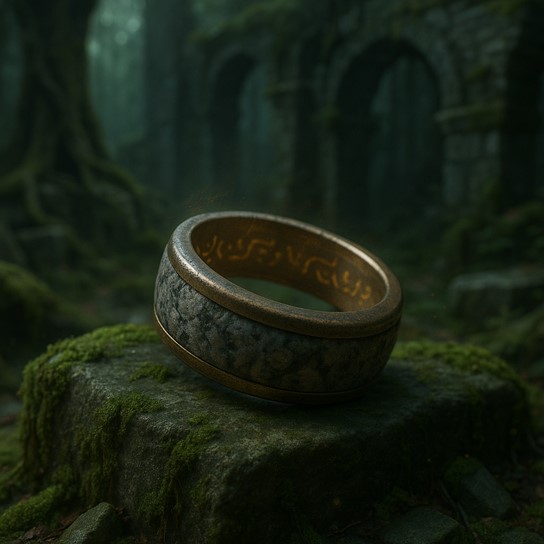
Description: A heavy ring shaped from veined granite fused with a band of dulled brass. The interior rim is studded with barely-perceptible glyph impressions, which shift gently in response to nearby load-bearing surfaces. When worn in silence, the ring emits no heat—but will throb gently when a structure is under strain.
Tier & Rarity
- Tier: 1
- Rarity: Common
- Roleplay Emphasis: Architect
- Slot: Finger (counts as 1 magical worn item)
Passive Magic
- Load-Whisper Sense
While in or near a constructed space (ruins, buildings, tunnels), the wearer feels subtle tactile pulses in the ring corresponding to nearby stress points, hollow spaces, or cracking supports.
Effect: Grants advantage on Insight and Investigation checks related to architectural safety, load distribution, or hidden voids. - Foundation Memory
When touching masonry, timber, or stonework over 50 years old, the wearer receives intuitive impressions of the structure’s original intended use and subsequent alterations (additions, breaches, modifications).
These impressions come in emotional echoes and textures (e.g., warmth from family use, cold sharpness from dungeon retrofits).
Activable Magic
- Isfirān’s Span (1/short rest):
Activation: Tap a structural surface three times with the ring-bearing hand.
Effect: For 10 minutes, the wearer can mentally visualize a ghost-image outline of the structure’s nearest full support system (pillars, joints, beams, and stress vectors) within 60 feet. This includes safe paths, danger zones, and recent shifts.
Great for trap avoidance, sabotage, or safe reinforcement planning. - Seal the Weakness (1/day):
Activation: Press the ring to a cracked, splintered, or sagging section of wall, floor, or column.
Effect: Instantly strengthens the structure as if expertly repaired (within 10 cubic feet), stabilizing it for 1 hour. This magical reinforcement can withstand up to 1000 lbs of shifting pressure before fading.
If used during a collapse, grants advantage on saves to those within the area.
Tags: Architecture‑Linked, Earth‑Bound, Structure‑Sense, Common‑Rarity, Roleplay‑Tool, Stone‑Whisper, Jinn‑Magic, Utility‑Item, Finger‑Slot, Stress‑Detection, Trap‑Support, Reinforcement‑Aid, Tier‑1, Underground‑Friendly, Silent‑Crafting
In the world of Saṃsāra, Jinn 041 of the Vault-Rooted Design is a respected relic among architects, masons, ruin-stabilizers, and subterranean engineers. Though common in rarity, it is rarely sold casually. Instead, it changes hands through specialized outlets where silence, reverence, and structure-mindset dominate. Below are the main types of shops where the item is acquired, how it is offered, and the associated costs.
1. Stone-Chant Registry Halls (City Foundation Offices, e.g., Vakraust or Kharavan)
Setting:
Massive, echo-reduced buildings lined with blueprints, petrified soil samples, and seated record-keepers in whisper-speech masks. These halls handle sacred structure artifacts and the recording of major structural blessings. The ring is classified as an “integrated whisper-bound instrument.”
Acquisition:
Must provide a signed guild certification of structural profession (architect, builder, vault-stabilizer) and complete a 5-question silence-assessment. The ring is presented within a pressure-box beside a slab of cracked sandstone as demonstration.
Cost:
• 480 gp
• Includes vault-journal copy of ring’s known previous owners
• 10% discount for registered reconstruction planners or civic engineers
2. Echo-Mortar Archivist Booths (Hidden Ruin Markets or Sand-Cliff Caravans)
Setting:
Vendors operating from within abandoned construction sites, quarry camps, or crumbled fortress scaffolds. These booths specialize in tools recovered from ruin collapses or lost civil infrastructure. The ring is kept wrapped in twine atop stone surveyor’s pads.
Acquisition:
Buyers are required to tap a broken beam or stone arch in silence. If the ring vibrates in acknowledgment, the seller accepts the trade. Negotiation is done with chalk or drawn diagrams—speech near the ring is frowned upon.
Cost:
• 320–350 gp, depending on the ring’s sensed attunement response
• Occasionally bartered for rare silencing chalks, stress crystals, or ghosted vault-maps
3. Jinn-Resonance Clerestories (Temples to the Silent Flame or Craft-Deity Orders)
Setting:
Vaulted stone sanctums or fireless shrines where jinn are venerated as observers of integrity—not fire spirits, but elemental overseers of design. These locations treat the ring as a minor sacred implement for prayer-aligned design meditation.
Acquisition:
Must undertake a one-hour silent walk along the edge of a ceremonial scaffold. If the wearer reaches the midpoint without disturbing the wind-flags, they are permitted to approach the reliquary. The ring is housed in petrified wood with filigree-script blessings.
Cost:
• 300 gp donation (or completion of a stabilizing service such as reinforcing a cracked dome or sanctum vault)
• Includes a written scroll of jinn-respected architectural symbols and thresholds
4. Surveyor’s Memory Binders (University Excavation Guilds – e.g., Savaxir, Olmë Thell)
Setting:
Quiet, dust-swept academic alcoves attached to structural engineering departments. These offices sell jinn-sensitive relics only to students, explorers, or professionals engaged in ruin-charting or deep-mapping. The ring is kept in a resin-locked examination cube.
Acquisition:
Applicants must provide a construction intent journal or excavation thesis excerpt, along with proof of field hours. Item is offered as a research enhancement, not a weapon.
Cost:
• 550 gp
• Includes access to faculty-guided attunement tutorials and 2 blueprint-extrapolation scrolls
• Discounted by 20% for excavation students or ruin-anchoring projects
5. Collapsed Guildhall Reclaimers (Underground Salvage Markets)
Setting:
Located in the half-flooded or rubble-choked depths of abandoned guildhalls. Salvagers recover jinn-bound equipment from broken vaults. The ring is often embedded in soil samples or relic chests.
Acquisition:
Usually bought under risk or exchanged for personal salvage rights. Must agree to a Binding Clause of Collapse-Blame Denial, waiving liability if the item triggers structural collapse elsewhere.
Cost:
• 240–280 gp, but ring is not guaranteed to be stable without recalibration
• High risk: may still carry fractured spirit resonance or disrupted glyph flow
This item does not offer direct physical combat effects. Instead, it channels the jinn’s silent expertise into structural awareness, defensive planning, and positional advantage, rewarding those who read their surroundings like blueprints. Below is a structured analysis of how the ring functions for defensive and offensive roleplay, across multiple Saṃsāran environments, by a tier‑1 avatar aligned with architectural intuition.
1. Urban Construction Zones and Ruined Cities
Offensive Roleplay:
- The avatar uses Isfirān’s Span to identify load-bearing walls or pillars supporting upper floors. They may target weak points with tools or weapons to cause calculated partial collapse—trapping enemies or splitting enemy lines.
- Knowing where recent architectural modifications exist (from Foundation Memory) allows the avatar to predict escape routes, hideouts, or smugglers’ access tunnels.
Defensive Roleplay:
- The avatar can guide allies to safe upper floors or arches during conflict by feeling micro-vibrations that suggest integrity.
- When chased, they may deliberately lead pursuers into precarious walkways or unstable bridges, then use the environment to escape without confrontation.
- Seal the Weakness can reinforce barricades, protect civilians, or create temporary safety zones during combat.
2. Underground Ruins, Tombs, and Tunnels
Offensive Roleplay:
- Structural overlays from Isfirān’s Span allow the avatar to set traps or subtly loosen overhead stones where combat will occur. This enables ambush tactics or collapsing a narrow tunnel behind them to isolate threats.
- The ring’s sensitivity to shifting tension may warn of enemy movement or pressure-based traps ahead of the party.
Defensive Roleplay:
- In collapsing tombs or while under attack, Seal the Weakness becomes vital for stopping cave-ins, preventing floor collapse, or holding a tunnel open long enough to flee or regroup.
- The avatar can “read” where tunnel airflows shift, allowing them to deduce where safe, stable escape passages might lie, avoiding dead ends or structural dead zones.
3. Siege Situations or Defensive Structures
Offensive Roleplay:
- If aiding a besieged outpost, the avatar can survey the weakest wall sections and coordinate sabotage from within. The ring can guide the planting of explosives or stress tools to create a breach exactly where the enemy expects stability.
- Alternatively, when assaulting a fortification, the avatar might identify ancient drain shafts, forgotten foundation flaws, or post-construction weaknesses to chart entry points or weak siege angles.
Defensive Roleplay:
- The avatar serves as a combat engineer, fortifying breach points in real time with Seal the Weakness.
- They can stand silently and use Load-Whisper Sense to predict whether a wall will hold or fail under artillery impact, guiding troop placement or evacuation.
4. Natural Caves, Cliffside Dwellings, or Mountain Holds
Offensive Roleplay:
- Knowing where stone has been subtly carved or weakened by time, the avatar can use gravity, water flow, or sound resonance to cause distractions, flush enemies from hiding, or re-route natural hazards (e.g., sending a minor landslide across a path).
- In stealth-focused teams, the avatar may identify sound-conducting sections of rock to plan acoustic misdirection.
Defensive Roleplay:
- When trapped or in danger of rockslide, the avatar can reinforce ledges, plug fissures, or even stabilize a hanging platform mid-combat.
- Their predictive awareness of crack patterns lets them keep allies from stepping into structurally compromised terrain, reducing falling hazards or ambush vulnerability.
5. Sacred Grounds, Temples, or Ancient Architectural Sites
Offensive Roleplay:
- If facing enemies within an old temple, the avatar may interpret sacred geometry or stress echoes in marble or clay to divine where key ritual chambers or secret defense mechanisms exist.
- They might use minor structural imbalances to knock over sacred braziers or drop ornamental slabs on intruders.
Defensive Roleplay:
- Recognizing sanctified threshold lines through Foundation Memory allows the avatar to warn allies about crossing spiritual boundaries or activating protective curses.
- Seal the Weakness may restore a crumbled floor section or broken dais to re-enable a protective ritual or shield the group from spiritual backlash.
6. Floating Platforms, Bridges, or Airborne Structures
Offensive Roleplay:
- The avatar, through Isfirān’s Span, visualizes the anchoring geometry and can apply pressure or explosive force to sever key levitation runes or stress anchors, collapsing part of a platform mid-encounter.
- By knowing where structural drift occurs, they can guide arrows or spells to strike counterweight conduits or unstable sky-anchors.
Defensive Roleplay:
- In mid-air platforms prone to windshift or imbalance, the ring enables fast reading of torque patterns and weight drift.
- The avatar may brace platforms mid-crisis with Seal the Weakness, buying precious seconds before total failure. They can also redirect teammates to the center of weight equilibrium, avoiding fatal slides or drops.
Perception of Activation: Jinn 041 of the Vault-Rooted Design
User’s Perspective
Sight:
The glyphs embedded inside the ring’s granite-brass surface begin to shift and glow faintly, like the slow rearrangement of dust motes beneath stone. When the ring nears structural strain, subtle geometric lines—spanning floors, arches, or walls—form in the user’s peripheral vision as soft overlay tracings. These diagrams shimmer as tension points brighten.
Sound:
No overt sound is emitted, but a deep, distant pressure hum develops at the base of the skull, similar to hearing a mountain breathe or a column groan beneath unseen weight. The longer one remains still, the more defined this subterranean resonance becomes—shifting in tone when danger nears.
Touch:
The ring tightens slightly around the finger, like a warning squeeze, then begins to pulse—slow, steady, firm—as if mimicking the heartbeat of the structure itself. Texture on nearby surfaces becomes more distinct to the touch—edges feel sharper, flaws more evident.
Smell:
The faint scent of stone dust, wet clay, and old timber resin rises as the ring synchronizes with its surroundings. This scent intensifies near strain, collapse points, or concealed foundations.
Taste:
A dry mineral tang briefly coats the tongue, like breathing in crumbled sandstone or chalk. The flavor sharpens near fault lines, as though the building itself is “pressing” against the user’s senses.
Extra-Sensory Perceptions:
- Structural Synesthesia: User gains an abstract awareness of stress flow in a building—seeing weight paths, thermal retention, and air pressure as intuitive impressions.
- Echoed Design Memory: Ghostly impressions of past builders, tools, or intended use may flicker through the user’s senses when touching ancient materials. This is more emotional than visual—satisfaction, pride, urgency.
- Stone-Speech Drift: The user may hear non-verbal murmurs in silence—stone complaining, mortar recalling pressure, wood creaking with old intentions.
Positives:
- Empowers the user to intuitively detect unsafe zones, decay, or sabotage.
- Encourages roleplay through architecture-based interaction—feeling when walls lie, or when age and design collide.
- Can create immersive non-verbal dialogue with ruins, sacred sites, or engineered marvels.
Negatives:
- Overexposure may lead to sensory disorientation, especially in areas under severe tension—too many shifting impressions at once.
- If used in an area haunted by collapse or war, echoes may be disturbing: sudden flashes of fear, falling, or screams embedded in foundation.
- The hum may linger too long after deactivation, making it difficult to sleep or think clearly in modern buildings.
Observer’s Perspective
Sight:
From the outside, the ring emits a soft interior amber glow, barely visible unless in darkness. Dust or fine debris nearby may seem to shiver or shift, responding to unseen vibrations. When touching walls, the user’s hand might leave brief patterns or glyph-laced afterimages before fading.
Sound:
To nearby observers, there is only silence. But those attuned to spiritual or elemental senses may notice the absence of ambient sound—like a heavy breath being held by the very structure.
Touch (if close):
If another person touches the user’s hand or the same surface, they may feel a low-frequency thrum, like standing on a vibrating steel beam or near a train buried far underground.
Smell:
Close observers may smell faint traces of lime mortar, granite powder, or old wax as the ring harmonizes with ancient surfaces.
Extra-Sensory Perceptions (Observers):
- Spirit-sensitive observers might glimpse brief silhouette overlays—diagrams floating in the air, or architectural shadows reaching through space.
- Emotionally attuned witnesses may sense a shift in gravity near the user, as if the room becomes more serious or “aware.”
Positives:
- Observers may trust the user instinctively in structural crises—this is someone the stone listens to.
- Can serve as a calming presence in volatile environments, especially in ruins, temples, or civic projects.
Negatives:
- Users may seem distracted or eerily quiet, as though listening to voices others cannot hear.
- In areas of disaster, the user might go still suddenly—overwhelmed by too many impressions, startling onlookers.
Jinn 041 of the Vault-Rooted Design does not shout its power. It breathes through the foundation, letting the avatar perceive buildings not as walls—but as quiet creatures under pressure.
Crafting Recipe: Binding of the Vault-Rooted Design
“Stone listens longer than fire speaks.” — Fragmentary inscription on the inner gate of Turalem’s Deep Forge
Materials Needed
- Veined Foundation Granite (1 palm-sized block)
• Sourced from a structure at least 300 years old
• Must be naturally cracked and retrieved without tools (split only by time or weight) - Dulled Brass Loop (1)
• Forged from melted civic medallions, cracked plumb weights, or construction-grade ritual bells
• Must be poured in silence and quenched in dust-silt from an active construction site - Load-Symbol Ash Ink (small vial)
• Made from mortar scrapings, charcoal dust from a collapsed roof, and trace gold
• Used to imprint shifting glyphs within the ring’s interior edge - Memory Dust of a Forgotten Foundation (pinch)
• Gathered from a site whose architect is unknown and whose name is lost to time
• Must be carried in a sealed clay bead until released during infusion - Voice-Crushed Ceramic (1 shard)
• From a broken architect’s speaking bowl or draft-pot used during design rituals
• Crushed and ground to mix into bonding paste
Tools Required
- Stone-Wheel Cutter
• Slow-turning wheel blessed to never overheat; used to shave granite to perfect ring shape - Silent Furnace Crucible
• A clay crucible lidded with wax-sealant, ensuring no hiss or crackle escapes during brass melting - Glyph-Circulator Stylus
• A tipless etching wand filled with Load-Symbol Ink; must be guided by fingertip pressure alone - Dust-Trowel of Breath
• Small flat bone or copper tool used to smooth runic edges; cannot be lifted more than once per rune - Binding Scaffold Ring-Frame
• Holds the unfinished ring steady beneath vertical pressure; carved with triangle-weight markings
Skill Requirements
- Stoneworking (Rank 1)
To properly shave and shape ancient granite without fracturing its memory imprint - Silent Ritualism (Rank 2)
To execute the no-speech binding stages without breaking spirit concentration - Runic Engineering (Rank 1)
To place the glyph impressions that resonate with pressure-bearing surfaces - Jinn Sympathy (Rank 1)
To ensure the spiritual echo of Isfirān or a like-minded jinn will inhabit the completed ring
Crafting Steps
- Shape the Granite Band
Using the Stone-Wheel Cutter, slowly trim the veined granite block into a smooth inner ring core. Each pass of the wheel must be preceded by a moment of still breath. Imperfections must be left uncorrected—each ring bears the flaws of the structure it honors. - Forge and Fit the Brass Shell
Melt dulled brass in the Silent Furnace Crucible. Once cooled to the silent glow (orange without crackling), pour around the granite ring, sealing both into a unified bond. Press into the Binding Scaffold Ring-Frame for alignment and curing. - Apply Load-Symbol Glyphs
Use the Glyph-Circulator Stylus to paint three glyphs inside the ring—Hold, Crack, and Flow—in Load-Symbol Ink. These must be done without pause and never lifted mid-stroke. Mistakes are final and require a new band. - Inscribe with Memory Dust
Crack open the clay bead containing the Memory Dust. Sprinkle over the semi-warm ring while speaking the phrase “Let the unknown be remembered in weight.” The phrase must be mouthed only, not spoken aloud. - Integrate the Voice-Crushed Ceramic
Mix powdered Voice-Crushed Ceramic into a fine paste and line the inside of the glyph markings. Press and smooth using the Dust-Trowel of Breath. This sets the spirit-locus of the jinn—allowing it to recognize structural intent. - Awakening and Stillness Test
Place the completed ring on a carved stone or beam fragment. If the ring throbs once and ceases, it is awakened. If it remains cold, leave it for one night beside a dormant structure. If no resonance is felt by morning, the jinn has declined the vessel and the process must be repeated.
Crafting Time Estimate
• Material Preparation: 4–6 hours
• Forging and Assembly: 5 hours
• Runic Inscription and Binding: 3–4 hours
• Total Craft Time: ~12–15 hours (not including material gathering or spiritual cooldown periods)
Failure Risks
- Speaking aloud during forging or inscription immediately voids jinn interest—ring becomes inert.
- Incorrect glyph spacing results in chaotic stress feedback; user may misread structure and cause collapse.
- Using modern granite or synthetic brass creates a lifeless replica with no magical function.
The final product becomes a listener to structure, bound by architectural reverence, silent patience, and the jinn’s deep understanding of weight, memory, and intent.
Silence Beneath All Stones
The Ledger of Yurrat — As scratched into a sandstone reliquary, transcribed by the Stonethroat of Thran-Kel, translated poorly from the Deep-Cant of Pre-Turalem, whose origins are unknown.
And so it was, in the fourth quiet of the third moon-crack, in the age when cities stood upon the bones of the cities that stood upon bones of cities before, there lived the silent-shaper, whose name was not stone but whose mouth had never known wind. They called him Yurrat, though that was not the sound he made, for he made none.
Yurrat built with no plans, for the earth told him. He walked between broken teeth of pillars and crooked spines of beams and understood the speech of tension. No one asked how. They knew to leave him be.
In the time of the Split Vault, when the sky-crust above the subterranean dome broke from weight-thought, the city of Turalem-that-still-breathed summoned its builders. But none would touch the cracked rootstone, for they said, “It groans, and where it groans, men die.” So Yurrat was sent alone, and the gates closed behind, as custom told.
There in the deep-deep dark of the breathless dome, where no light could hold and no lantern dared flicker, Yurrat sat. And he did not build.
He waited.
And as the dust settled into silence, the ancient not-voice of Isfirān—the jinn of pressure and pause—entered the ring he carried, a ring forged not by forge but by weight. It had no heat. It had no echo. But when it touched stone, it knew.
The jinn asked, not in sound but in load, “Do you understand me?”
And Yurrat, still and hollow as a buttress, responded without motion. The jinn shivered the ring, and the dome’s bones answered.
Yurrat walked the arch-spines, traced old fracture-lines like calligraphy, and placed pebbles where collapse wept loudest. He tapped three times, and the dust lifted.
On the thirteenth stilling, he laid the ring upon the central keystone—cracked with memory, dry with expectation—and pressed his palm flat.
And the dome held.
It held through the Falling Ashes War.
It held through the Quaking Nine.
It held when silence became forbidden.
It held even when the city above forgot the city below.
But Yurrat did not leave. When the gate was reopened one hundred breath-years later, they found no bones. Only a perfectly silent ring, gently throbbing beside a bowl of untouched mortar and the words etched into basalt in no tongue:
“I listened until the listening was enough.”
They sealed the chamber. Later, the ring was passed. Each time the bearer failed to listen, it grew colder. Each time one listened rightly, it pulsed and showed where to build next.
Many sought to speak to it. It answered no voice, no spell, no shout. But one child, a mute orphan of the Brickstrewn Archipelago, pressed it to her cheek in a broken shrine and felt it thrum a lullaby in cracked rhythm.
Moral of the Story: The earth speaks not in words, but in waiting. Only those who listen to what bears weight shall hold what does not fall.
Suggested conversions to other systems:
Game System: Call of Cthulhu (7th Edition)
Item Name: Ring of Structural Sympathy (Jinn 041 of the Vault-Rooted Design)
Type: Mythos Artifact
Appearance: A heavy, veined granite and brass ring, its glyphs subtly shifting in silence.
Effect:
- When worn, the bearer gains a +20% bonus to Architecture, Engineering, or Archaeology rolls when examining built environments.
- The ring allows the bearer to make an INT or POW check to detect structural instability within 20 feet, with difficulty varying based on age and damage (Hard for ancient ruins, Regular for recent construction).
- If worn in silence for 1 full round (≈5 seconds), the ring thuds gently if the structure within 30 feet is under immediate strain or in danger of collapse.
Mythos Connection:
- The ring is inhabited by an entity believed to be a minor Earth-associated jinn. Each successful use to prevent structural collapse reduces the bearer’s Sanity by 1D2 as the whispering resonance of forgotten structures echoes within the mind.
Uses per Day: Unlimited passive use; active vibration sensing usable 3 times per day.
Sanity Loss (when used near cursed/bound places): 0/1D3
Game System: Blades in the Dark
Item Name: Whisper-Ring of the Vaultroot (Jinn 041)
Item Type: Fine Arcane Implement
Load Cost: 1
Effect:
- When investigating ruins, vaults, or architectural anomalies, gain +1d to any action roll involving Survey, Tinker, or Attune, specifically related to structure or foundational analysis.
- Once per score, you may invoke the ring to detect load-bearing weaknesses and cause a controlled collapse (position = Controlled, effect = Standard, area = small room or corridor).
- When standing still in total silence, you may “speak” to the structure via the jinn’s presence—ask one question of the GM regarding stability, history, or collapse risks.
Drawback:
- If misused to destroy without cause, mark 1 stress and become haunted by the echo of the structure (narrative consequence).
Notes:
- May be included in Whisper, Leech, or Slide loadouts. Best suited for players who mix exploration with subtle supernatural influence.
Game System: Dungeons & Dragons (5th Edition)
Item Name: Jinn 041 of the Vault-Rooted Design
Wondrous Item (ring), common, requires attunement
Passive Properties:
- While wearing this ring, you have advantage on Intelligence (History) and Wisdom (Perception) checks to assess or interpret structures, ruins, or buildings.
- You can determine the approximate age and stress state of any wall, floor, or ceiling within 10 feet with a minute of observation.
Active Abilities:
- Seal Weakness (1/day): As a reaction, when part of a structure within 10 feet takes damage or is about to collapse (as ruled by the DM), you may magically reinforce it. The structure holds together for 1 minute, preventing collapse or damage.
- Pulse of Load (2/day): As an action, you may feel the presence of strain within 30 feet. You know the direction and severity of structural failure (minor, moderate, catastrophic).
Flavor Additions:
- The ring is warm near hidden foundations and trembles slightly near lies in architecture (secret doors or unstable areas).
Game System: Knave (Ben Milton’s edition)
Item Name: Ring of the Still Vault (Jinn 041)
Slot: 1 (counts toward item limit)
Effect:
- When worn, grants advantage on rolls related to exploring, interpreting, or surviving in built structures (e.g., ancient ruins, towers, temples).
- If the wearer stands completely still for 10 seconds, they sense nearby instability, collapse risks, or trap mechanisms hidden within walls or floors (GM describes in abstract terms like “tense,” “hollow,” or “resonant”).
- Once per rest, wearer may reinforce one piece of failing architecture (prevents one trap, collapse, or environmental hazard for 1 scene).
Limitation:
- Only functions in manmade or worked stone environments. Has no effect in wilderness or against natural cave systems unless previously altered.
Notes:
- Treasured by delvers and ruin-scavengers. Some believe the ring hums old blueprints in dreams, which may be used as map clues.
Game System: Fate Core
Item Name: Jinn 041 of the Vault-Rooted Design
Aspect: Whispers of the Deep Foundation
Type: Arcane Relic (Ring)
Permissions: Must be an architect, engineer, ruin-explorer, or spiritually sensitive individual
Cost: 1 Refresh (if permanently kept), or carried as a temporary Relic Asset
Passive Effects:
- Gain +2 on Overcome rolls involving structures, architecture, or interpreting ruins when using skills like Crafts, Lore, or Notice.
- In scenes where silence is maintained for a full exchange, you may Create an Advantage using “Load Echoes” to detect hidden flaws or collapse points in buildings.
Active Effects (Stunts):
- Seal the Cracking Bones: Once per session, spend a Fate Point to prevent a structural collapse or environmental hazard, narratively restoring the affected section long enough for escape or reinforcement.
- Still Resonance Insight: Spend a Fate Point to ask the GM one architectural question about a scene or building’s intent, weakness, or original design purpose—answered as if whispered by the structure’s memory.
Drawback:
- If used to deceive a structure (e.g., cause collapse maliciously), you take a situational Compel reflecting spiritual backlash, paranoia, or physical tremor.
Game System: Numenera / Cypher System
Item Name: Vaultroot Ring of Jinn 041
Type: Artifact (Level 1d6+2)
Form: A granite-and-brass ring with mutable glyphs
Depletion: 1 in 20 (checked on each active use)
Passive Abilities:
- Grants an asset on all Intellect-based tasks related to architecture, ruins, structural engineering, or ancient building logic.
- The ring subtly vibrates or warms when the wearer is within 10 feet of stressed material, decaying supports, or hidden architectural seams.
Active Abilities:
- Structure Whisper (2 Intellect points): The user receives a vision-like sensory pulse of nearby architectural instability or hidden chambers (range 30 feet).
- Reinforce Moment (3 Intellect points): Temporarily reinforces one crumbling structure, granting a +2 bonus to avoid collapse, falling, or a similar hazard for the party for 10 minutes.
- Jinn Insight: Once per day, the user may ask one question about the history or intended purpose of a structure they’re within. The GM must provide an insightful answer, even if cryptic.
Effect: Subtle resonance with buildings, silently accessed by focused stillness.
Quirk: The wearer dreams in shifting stone maps or hears occasional phantom thuds in silence.
Game System: Pathfinder (2nd Edition)
Item Name: Jinn 041 of the Vault-Rooted Design
Item Type: Worn Item (Ring), Magical, Common
Level: 3
Price: 50 gp
Bulk: —
Usage: Worn, 1 hand
Activation: [Free Action] (once per round), [1-2 Interact or Focus Actions] (specific powers)
Passive Effects:
- While worn, gain a +1 item bonus to Crafting (Architecture), Engineering Lore, and Perception checks related to detecting hidden passages or evaluating structure integrity.
- When standing still for 3 consecutive rounds, the ring begins subtly pulsing, and the user gains tremorsense (10 ft) for structural anomalies only, lasting until they move.
Activate — Pulse of Load (1 Focus Point):
Gain insight into the most structurally unstable feature in a 60-foot radius. The user becomes immune to the first hazard or trap triggered by collapsing architecture during that encounter.
Activate — Seal Weakness (2 Focus Points):
Reinforce a crumbling wall, archway, or floor, treating it as if it had an additional 10 Hardness for 1 minute. May also be used to suppress environmental damage caused by architectural hazards.
Traits: Arcane, Jinn-Bound, Architect’s Tool, Utility, Sensory
Game System: Savage Worlds (Adventure Edition)
Item Name: Vault-Bound Ring of Jinn 041
Item Type: Magical Ring (Arcane Item)
Rarity: Common
Requirements: Spirit d6+, Knowledge (Engineering) d4+
Passive Effects:
- +1 to Notice or Knowledge (Engineering) rolls made to detect stress points, hidden vaults, or structural flaws.
- The wearer may reroll one failed Notice or Survival check per session when navigating dangerous ruins or crumbling environments.
Powers (requires ring to be worn and concentration for 1 full round):
- Architect’s Whisper (1 Power Point): Detects all unstable or trapped architecture in a Medium Burst Template. User sees faint outlines or hears whispered warnings.
- Earthbone Stabilize (2 Power Points): Cast Barrier as a structural reinforcement (stone only) instead of a wall. Duration is doubled but the barrier is immobile and attached to an existing wall/floor/ceiling.
Power Points: 5 (Regenerates 1 per hour if the wearer spends that hour in silence near masonry or worked stone)
Quirk: The ring vibrates faintly during arguments or raised voices indoors; if exposed to song or music in ruins, it may hum in harmony.
Game System: Shadowrun (6th Edition)
Item Name: Structural Whisper Band (Jinn 041)
Type: Magical Item (Rating 2 Focus – Utility, Anchored)
Availability: 4R
Cost: 3,000¥
Description:
A ring forged of veined granite fused with dull brass. Its interior runes shift with micro-aerodynamic sensing and magical harmonics tied to building integrity.
Effects:
- While worn, grants a +2 dice pool bonus on Engineering, Perception, or Arcana tests when assessing manmade structures.
- May be used once per scene to detect hidden supports, unstable surfaces, or compromised integrity within 20 meters (simple action; opposed by building’s Object Resistance [OR 6+]).
- Can absorb 1 point of damage from collapsing structures or falling debris per Rating.
Special Rules:
- Acts as a Rating 2 Utility Focus, bonded to its owner. Can be used to anchor Detection spells or Mana-based Engineering rituals.
- Astral Signature faintly resembles a foundation-lattice of ancient buildings and must be cleansed after use in cursed or corrupted locations.
Drawbacks:
- If the user casts destructive spells targeting architecture, the ring becomes inert for 24 hours.
- In areas with high background count (Rating 3+), the ring thrums erratically, imposing a −1 dice pool penalty on related checks.
Game System: Starfinder
Item Name: Jinn-Linked Load-Binder Ring
Level: 2
Price: 1,100 credits
Item Slot: Ring
Usage: Passive (limited use abilities as noted)
Description:
An ancient-looking ring that responds to structural pressure and latent energy in constructed environments. Favored by ruin-delvers and exo-architects.
Passive Abilities:
- +2 insight bonus on Engineering and Physical Science checks involving artificial structures, habitats, or ruins.
- Grants a limited vibration sense (10 feet) usable only to detect structural weaknesses or active shifts (such as pressure plates, failing ceilings, etc.).
Active Abilities:
- Reinforce Integrity (1/day): As a move action, the user can cause a 5-foot cube of adjacent structure to gain +10 Hardness for 1 minute.
- Detect Strain (3/day): As a standard action, the wearer can scan a 30-foot radius area and pinpoint architectural failure, load-bearing tension, or artificial cavities. This functions like detect affliction, but applies to structures.
Aura: Weak transmutation and divination
Bulk: L
Game System: Traveller (Mongoose 2nd Edition)
Item Name: Structural Resonance Ring – Jinn 041
Type: Artifact Tool
Tech Level: TL 11
Cost: Cr8,500
Description:
This ring appears to be ancient, though diagnostic scans reveal microscopic resonance coils. Its veined stone and fused brass construction defy modern engineering, and its true origin is often attributed to lost precursor civilizations.
Effects:
- Grants DM+1 on Engineering, Recon, or Sensors checks when used to analyze or navigate buildings, ruins, and spaceborne structures.
- If worn while immobile for one combat round, the user may make an INT check (Average 8+) to detect structural instabilities or buried voids up to 10 meters away.
Special:
- Once per day, allows the user to stabilize a deteriorating or damaged structure (negating collapse or collapse-triggered events, as decided by Referee).
- Can be used to gain advantage on Life Science or Physical Science rolls related to constructed environments.
Restrictions:
- Not programmable or modifiable. If examined, displays a non-standard waveform energy echo. Attempts to reverse-engineer have failed.
Game System: Warhammer 40,000 Roleplay – Wrath & Glory (Revised Edition)
Item Name: Ring of Earthbound Silence (Jinn 041)
Tier: 1
Rarity: Rare
Keywords: Imperialis, Archaeotech, Occult, Relic
Description:
This thick band of stone and metal bears silent script across its inner rim, seemingly responsive to load-bearing psychic pressure. Banned in most Forge Worlds for its non-Mechanicus provenance.
Passive Abilities:
- Gain +1 die to Scholar (Architecture, Ancient Cultures) and Awareness tests when evaluating artificial structures or ruins.
- When worn, the user cannot be surprised by environmental collapse or shifting terrain, gaining +2 Defense against such hazards.
Wrath Ability – Jinn’s Resonance (1 Wrath Point):
- Reveal an unseen structural flaw or secret mechanism in the environment (GM’s discretion), even if hidden by mundane or heretical means. Can be used to create openings, detect instability, or prevent collapse.
Glory Use (1 Glory):
- Temporarily reinforce a collapsing or degraded structure for one scene, allowing allies to pass or take cover safely.
Corruption Risk:
- Repeated use in daemon-tainted or warp-saturated ruins may draw unwanted warp resonance (roll Corruption Test, DN 3).
Comments
One response to “Jinn 041 of the Vault Rooted Design”
[…] Jinn 041 of the Vault-Rooted Design: The ring must be willingly offered by its attuned owner, as its spirit will resist a forced merger. […]