
Lore: In the old red clay hollows of Saṃsāra’s southern mistlands, where graveyards overlook herb beds and water drips slow from moss-rock ledges, the healers of the folk carved out their craft beneath silence and stars. Among these, a rootworker named Auntie Sil, known for never raising her voice or letting a wound fester, carried on her wrist a simple twist of bark, leaf, and bone—called the Balsam Heartroot. It was said to murmur to her when illness crept in before symptoms showed, and to throb warm when harm had not yet turned fatal.
Passed between healers, caregivers, and watchers of the weak, the charm became known not for miraculous cures, but for steady recovery and that rarest medicine—tenderness bound with truth.
Description: A small bundle worn over the chest, fastened by a thin strap of woven bark-fiber and seed-thread. At its center is a heartroot fragment—reddish-brown, knot-shaped, and lightly resinous—bound with a twist of dried honeyleaf and two tiny bones (bird and mouse). When worn, the charm rests gently over the sternum, growing subtly warm in the presence of suffering, imbalance, or chronic strain. In firelight, the heartroot gleams as if moist. A faint, bittersweet scent clings to the wearer: crushed mint, bark salve, and dried rose petal.
Tier: 1
Rarity: Common
Slot: Chest (counts as one worn magical item)
Weight: Negligible
Durability: Resistant to sweat, minor water, and smoke
Stat Block (Saṃsāra Mechanics)
Passive Magic:
• Pulse-Watcher:
While worn, the avatar can sense when a nearby creature (within 5 ft) is wounded or suffering from internal harm, even if hidden. This includes internal bleeding, disease onset, or emotional despair. Grants advantage on first attempts at diagnosis or basic treatment.
• Healing Presence:
The wearer provides a steady +1 bonus to natural healing checks or recovery rituals, provided they maintain calm, quiet presence for at least 10 minutes with the patient. Can be used even while resting or in camp.
• Scent of Balm:
Creatures within 10 feet feel mildly soothed while the charm is worn. Provides a +1 morale bonus to allies’ saving throws vs. fatigue, nausea, or despair (does not stack with other morale bonuses).
Activable Magic (each usable once per long rest):
• Draw the Strain (1 Action):
Touch a willing creature and transfer 1d4 damage or 1 ailment condition (fatigue, minor infection, poison onset) to yourself. You take it in full, but reduce the intensity by half (rounded down). If used more than once in 24 hours, the user suffers disadvantage on Strength and Constitution checks until next long rest.
• Root-Still Pulse (1 Minute Focus):
Activate to halt the progression of a physical ailment or chronic effect in one creature for up to 1 hour. During this time, disease or poison does not worsen, and healing is more effective (grants +1 to all healing rolls during duration). Once the effect ends, ailment resumes at natural pace.
Tags: Hoodoo, Folk Magic, Health-Focus, Healing‑Charm, Chest‑Slot, Rootworker‑Craft, Soothing‑Presence, Condition‑Aid, Tier 1, Common Rarity, Triage‑Tool, Disease‑Delay, Sympathy‑Ritual, Aura‑Calm, Bird‑Bone‑Bound, Plant‑Wisdom
Shops and Market Context for Hoodoo [119] of Balsam Heartroot (Saṃsāra):
1. Red Clay Apothecaries (Hill-Town Herbal Shops – 80 gp)
Built into mudbrick terraces and overgrown step-paths, these hearth-lit dens are run by elder midwives and folk doctors. The Balsam Heartroot is typically sold in wax-lined leaf wraps, blessed with breath and root-oil. Buyers are often asked to name a patient they’ve healed, or a wound they regret. Payment accepted in coin, tincture stock, or blood-oath vials.
2. Restwell Hospice Bazaars (Sanctified Aid Stations – 95 gp)
Situated near pilgrim paths, battlefields, and plague walls, these mobile structures act as both clinic and marketplace. Here, the charm is offered as part of triage bundles for healers, wrapped in clean linen and marked with a sigil of shared burden. Purchasers must promise to tend the wounded without cruelty. Payment accepted in coin, service tokens, or treated gauze.
3. Lowwind Veil Stalls (Wandering Folk Markets – 60 gp)
Run by traveling Hoodoo caretakers and soft-voiced sellers, these hidden booths emerge at dusk near village fountains, crossroads, or grave-spires. Charms like Balsam Heartroot are laid beside bottles of elderberry tonic, mourning-thread kits, and tearcatcher flasks. Prices are slightly lower, but may involve barter of memories, true names of ancestors, or rare dried leaves.
4. Bonebloom Shrines (Shrine-Menders’ Communes – 70 gp)
Found in cavern sanctuaries or moss-ridden graveyards where sickfolk and spirit-tenders rest together, these shrines sell such charms only to those who light incense at the foot of a shared grave. Each charm is hung on a line between two trees, and buyers are guided to select the one that “pulls warmest.” Often sold in exchange for labor, confession, or whispered song.
5. Emberfast Guildside Clinics (Artisan Healing Houses – 100 gp)
Operated in crowded craft-city quarters where workers suffer burns, strain, and machine wounds. These clinics attach a small mark to each charm: a sigil of steady hands. Sold to caretakers of laborers, often with bulk salves or painleaf bundles. Coin-only transactions, regulated by city folk-law; higher due to demand.
General Trade Notes:
• Typical Price Range: 60–100 gp depending on seller’s method, environment, and ritual involvement
• Cultural Protocols:
– Buyers are sometimes required to light a candle for a sick soul or name a plant they’ve harvested with care.
– Sellers may deny purchase to those with a violent aura or unhealed grief left unspoken.
– Some traditions require the buyer to receive the charm from the hands of someone who knows sorrow.
• Distribution Pattern: Most commonly found in Hoodoo-respecting lowland regions, edge-settlements, and healthway pilgrim paths—not typically sold in high-magic academic districts or military quartermasters.
• Availability: Common among midwife enclaves, grief-walkers, gentle handsmen, and community-rooted healers; rare in commercial arcane shops or formal healing guilds.
The Balsam Heartroot is not just a product—it’s a gesture of care offered through ritual, and it resists those who treat healing as transaction alone.
Roleplay Usage of Hoodoo [119] of Balsam Heartroot in Different Environments (Defense and Offense)
The charm does not strike nor guard—it endures, sustains, and gently alters the course of harm. It is a weapon against decline, and a shield made of patience.
Urban Setting
Defense:
In plague-ridden alleys, slums, or overcrowded infirmaries, the charm allows an avatar to identify illness before symptoms worsen—avoiding danger through foresight. When tending to addicts, fevered streetfolk, or collapsed laborers, Pulse-Watcher helps the avatar stabilize without drawing weapons or magic.
In tense social settings, the aura of the Scent of Balm may calm hostile negotiations or deescalate conflicts by subtly reducing aggression and despair among those present.
Offense:
By using Draw the Strain, the avatar may deliberately absorb the weakening effects of a target to rob them of combat clarity—especially when touching a spellcaster, diseased noble, or agent concealing affliction. Roleplay-wise, this is seen not as attack, but as a compassionate sabotage of violent potential—removing their inner strength with empathy rather than blades.
Wilderness Setting
Defense:
In environments where wounds fester fast and natural poisons linger, the charm serves as early warning. When crossing swamps, deserts, or blighted zones, the user senses infections, internal bleeds, or creeping corruption early—granting crucial time for action or retreat.
The Root-Still Pulse prevents venom from killing immediately or holds a spirit-plague at bay while the party regroups.
Offense:
In confrontations with corrupted beasts, cursed pilgrims, or spiritual decay, the charm can stall supernatural progression. When facing enemies whose power stems from a disease, inherited rot, or slow affliction, the wearer may use Draw the Strain as a self-sacrifice to weaken them emotionally or magically. Narratively, this marks the avatar as one willing to carry pain to stop pain.
Ritual or Temple Setting
Defense:
The charm acts as a ward against unnoticed spiritual sickness—corruption in acolytes, grief in masked spirits, or imbalance in relic-bearers. Its presence may be required in ancestral rites or soul-forging ceremonies to stabilize participants.
Healing Presence allows rituals to be conducted longer, with fewer breakdowns or interruptions by pain or exhaustion.
Offense:
In exorcism-like settings or during rituals of spiritual confrontation, Draw the Strain can be used to absorb wrathful energy that might otherwise lash out. In these scenes, offense becomes a narrative form of defense—intercepting harm through self-sacrifice to preserve the sanctity of the rite.
Battlefield or Siege
Defense:
Among medics, battlefield attendants, and last-line defenders, the charm becomes a triage anchor. It helps the avatar prioritize who is near death, prevent poison from claiming more soldiers, or simply hold someone’s body together long enough to drag them behind the line.
Even when wounded, Scent of Balm bolsters morale and tempers pain-related panic among nearby allies.
Offense:
In narrative warfare, the charm may be used to stall the advance of disease-weapons or magical plagues unleashed by enemy necromancers. When used creatively, Root-Still Pulse may delay the enemy’s use of a disease-augmented berserker or suppress a spreading wound in a commander to render them briefly ineffective.
Social Encounters
Defense:
When interacting with ill or grief-stricken NPCs, the charm provides quiet strength. The wearer becomes a symbol of trust, especially among rural or folk-aligned cultures. Guards lower weapons, mourners speak freely, and wounded nobility allow ungloved hands.
Emotionally, the wearer may soothe arguments before they peak or be permitted into restricted places (quarantines, deathbeds, etc.) that others may not.
Offense:
Used with subtle touch, Draw the Strain becomes a psychological weapon—guiltlessly revealing another’s pain to the group or court by bearing it physically. This roleplay can discredit liars feigning health or manipulate nobles hiding hereditary disease. It may also be used to shame an abuser by bearing the pain they caused aloud and visibly.
Summary Roleplay Themes:
• Defense through early detection, gentle influence, and self-sacrifice
• Offense through redirection of affliction, delaying escalation, or absorbing harm to expose or disable foes
• Ideal for avatars who heal not just wounds, but relationships, courage, and time itself
• Favored by calm medics, quiet mourners, grief-walkers, and pain-bound champions
The Balsam Heartroot offers no protection to the unfeeling—but to those who handle others’ suffering with care, it becomes a soft-spoken bulwark.
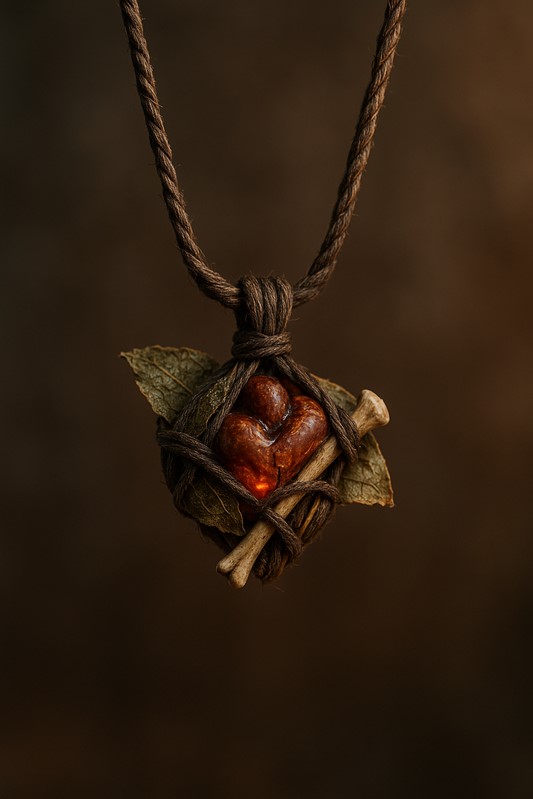
Perception of Activation:
Hoodoo [119] of Balsam Heartroot — Draw the Strain or Root-Still Pulse in use
User’s Perspective:
• Sight:
The reddish-brown heartroot knot at the center of the charm grows faintly luminous, casting a deep, firelit amber glow across the chest. The light pulses softly with each heartbeat and briefly silhouettes the two tiny bones crossed beneath the root. In darkness, the light trails like an afterimage beneath the skin.
• Sound:
The user hears a low thrum, like a heartbeat filtered through wood and earth. Beneath it, a faint whisper rises—not words, but tones of comfort, like a lullaby sung through hollow bark.
• Touch:
Warmth spreads outward from the charm—first across the sternum, then along the arms and into the fingertips. In Draw the Strain, the moment of contact delivers a sudden pressure or chill as the affliction is pulled inward. With Root-Still Pulse, the chest feels weighted but calm, as if hugged by invisible arms.
• Smell:
A wave of bittersweet aroma rises: crushed mint, bark salve, wilted rose petals, and faintly sweet honeyleaf. The scent intensifies in proximity to illness or emotional pain.
• Taste:
A mild taste of herbal bitterness rises in the back of the throat—akin to sipping willowbark tea or biting an unripe root. The sensation is grounding, though it may dull the palate briefly.
• Extra-Sensory Perceptions:
- Pain Echo: During activation, the user perceives flashes of the target’s suffering—momentary glimpses of memories tied to their ailment, often symbolic or emotionally raw.
- Strain Map: A faint awareness of where distress resides within the touched body (e.g., tightness in lungs, sorrow in the heart, poison in the gut) overlays briefly like a translucent outline in the mind’s eye.
- Pulse of Resilience: The user senses how strong the target’s will to recover is—rendered as a “pulse feeling”: strong and steady, or weak and wavering.
Observer’s Perspective:
• Sight:
To onlookers, the heartroot charm glows as though moistened from within, gleaming even without a light source. The glow pulses with visible intensity during activation. In Draw the Strain, a thread of reddish glow may flicker from the target to the charm upon contact.
• Sound:
Most bystanders hear nothing, though those with magical awareness might sense a moment of inward silence—a hush, as if the air briefly holds its breath.
• Smell:
Observers near the wearer may notice a wave of herbal scent—warm and medicinal, evoking salves and graveflowers. It is not overwhelming, but unmistakable.
• Extra-Sensory Perceptions:
- Weight of Mercy: In magically sensitive areas, the activation generates an aura of gentle sorrow and deep compassion. Spirit-bound entities may pause, and cursed or grieving figures may lower their resistance or fall into silence.
- Visual Trace of Burden: Those who can see auras or magical threads might witness the user briefly “carrying” the affliction, the charm glowing brighter while the target dims slightly in aura color.
Positives:
• Provides early diagnosis and emotional anchoring in any healing role.
• Can delay or reduce damage in critical moments without needing formal magic or spell slots.
• Roleplay-deepened empathy; builds character trust, especially with those who resist traditional care.
• Strengthens narrative weight through tactile, symbolic healing rather than clinical treatment.
Negatives:
• Drawn afflictions (via Draw the Strain) can linger and affect the user long-term if untreated.
• Use on beings of deeply entrenched trauma or dark corruption may create backlash—emotional or spiritual.
• Cannot cure—only stabilize or share. May lead to a sense of helplessness if relied on too much.
• In some regions, wearing or activating Hoodoo openly may draw suspicion, mistrust, or magical hostility.
The Balsam Heartroot does not roar or strike—but in activation, its presence soothes the storm and speaks the truth of pain, giving avatars the power to hold, carry, and soften without erasing.
Crafting Recipe: Bundle of the Balsam Heartroot
A chest-worn Hoodoo charm for health and balance, crafted to sense pain, ease burden, and delay affliction by drawing it into the self.
Materials Needed:
• Heartroot Fragment ×1
– Must be harvested from a wild healing tree that grew over a forgotten grave. Wood should be reddish-brown, knot-formed, and weeping faint resin when cut. Dried for seven days in shade.
• Dried Honeyleaf ×1
– Collected at dawn during a waxing moon; should be whole and unsplit. Soaked in warm vinegar and bark oil, then sun-dried until flexible. Used as a softening aura carrier.
• Bird Bone (wingtip) ×1
– From a naturally dead songbird; washed in spring water and dusted with clove ash. Symbolizes lightness and guidance.
• Mouse Bone (rib or paw) ×1
– Taken respectfully from a caught or gifted creature; buried in mint for three days before use. Represents humility and ground-bound care.
• Woven Bark-Fiber Thread (18 inches)
– Made from bark of willow, ash, or medicine-tree. Twisted with seed-thread or hair from the maker’s own family line (or willing stand-in).
• Binding Resin (Healing Blend) ×1
– Beeswax, pine sap, powdered myrrh, and rosewater. Used to seal the heartroot’s crack and anoint the bones.
Tools Required:
• Ritual knife (bone or wood only)
• Threading needle made from thorn or fishbone
• Mortar and pestle (stone or clay)
• Fire bowl or smoldering coal bed
• Calm-silence space (must craft in a place where no grief has recently been spoken)
Skill Requirements:
• Herbalism or Healing (Tier 1 or higher) – To prepare and cure organic materials without spoilage
• Folk Craft (Hoodoo Tradition or Equivalent) – Must know at least one rite of balance or illness-binding
• Empathy or Handling (Roleplay Skill) – Crafter must spend at least one hour in contact with the ill or wounded before crafting
• Optional: Song of Mercy – If sung during binding, the charm gains deeper resonance with emotional trauma
Crafting Steps:
- Cleanse the Components:
Begin by smoking the heartroot, bones, and honeyleaf over a slow-burning balm of mint, rosemary, and resin. Whisper a memory of an illness witnessed and healed—or one that left a mark. - Weave the Strap:
Twist the bark-fiber thread and seed-thread together while humming or gently tapping a rhythm. The thread must be warm from the hands and woven without sharp tools. Tie a single knot for every illness you’ve witnessed in silence. - Assemble the Core:
Lay the honeyleaf behind the heartroot fragment. Press the bones across it in an X-shape, bird bone atop. Sew them together at three contact points using the thorn needle. Each stitch must be spoken to, naming either: (1) one you wish to heal, (2) one you have forgiven, or (3) one whose pain you carry. - Anoint and Seal:
Warm the binding resin until soft and coat the heartroot fragment at its base and any points of visible grain. Rub lightly over the sewn thread and into the bones. Let cool on a folded cloth of clean linen or grave cotton. - Final Binding Ritual:
Hold the charm to your own chest while kneeling or sitting on earth or stone. Speak aloud a single phrase: either a healing vow, a personal name, or a burden you are willing to carry. Hold your breath while the charm warms—if it does not, you must repeat the stitching or correct the imbalance. - Resting Phase (24 hours):
The charm must be left alone in the presence of a recovering creature, plant, or person. This “adoption phase” attunes the charm to mercy rather than pride. If attuned in solitude, the maker must remain in calm meditation for the full day.
A properly crafted Balsam Heartroot does not glow until first exposed to genuine harm—but when it does, it warms not from magic, but from a spirit willing to hold suffering without flinching.
One Who Took the Ache With Quiet Hands
(As transcribed from cracked vellum slates in the Shard-Ash Tongue, itself believed a garbled echo of a forgotten pre-Hollow language, reconstructed through miscopied chant-fragments and hearthside recitations scraped from windbone tablets.)
In the time-before-clay, when the air was thick with wrong and the bones of the sick grew up from the ground like weeds, there walked a figure of no fame, no name, no blood—only breath and a cough. This figure was neither woman nor man, nor child nor elder, but one made of hushes and threadbare steps. All knew them not by face, but by the way the air stilled where they passed, and the way beasts did not growl when they touched the dying.
This one, who we call Quiet Hands, lived not in home, nor hut, nor under shrine-branch, but always beside those who moaned. Where there was ache, they appeared. Where fever bloomed, they waited. Where sorrow cracked ribs, they placed a palm.
They wore nothing fine—only a looped strap of bark-thread across the chest. Upon it hung a heartroot curled like a clenched fist, two tiny bones (bird and mouse), and a leaf dry enough to crumble but never did. This was not a charm made in temple nor blessed by priest—it was woven in silence, over the grave of someone no one remembered but Quiet Hands did.
It is said the charm did not heal. It shared. When a child burned with storm-fever, Quiet Hands pressed their chest to hers, and the fever faded from the child into the curve of the charm. When a stonecutter wept with rot in his gut, Quiet Hands took it without complaint—and vomited roots that night under a mercy tree.
The bones, they say, whispered when close to pain. The honeyleaf curled tight when near cruelty. The heartroot glistened like spit in the mouth of the mourning.
The people feared Quiet Hands. For what kind of creature welcomes hurt? What being holds grief and does not break?
One day, a king came to the village of low ash and hard breath. He brought iron-chant healers and death-price physicians, and ordered Quiet Hands taken, for none could ease his daughter’s soul-burn. She screamed in her sleep and bruised her own skin from within.
They brought Quiet Hands, bound in rope, though the rope fell loose. They placed the charm against the girl’s chest—and the girl sighed.
Then Quiet Hands stiffened, knelt, and wept bark. The bird bone cracked. The mouse bone sank into the heartroot. And the charm dimmed.
The girl rose. The figure collapsed. The charm faded to clay, and the king said, “Bury them.” But the villagers took the charm before the grave was dug. And so it is said:
If you wear a knot of heartroot over your sternum, and you feel it warm, someone else’s ache is near. And if you are brave, you may take it. And if you are true, the charm will not crack.
But if you wear it for pride or profit, the bones will slip from the thread and the root will bloom sharp and bite your heart.
Moral of the Story: True healing is not in curing but in carrying what others cannot bear alone. The softest hand may lift the heaviest sorrow.
Suggested conversions to other systems:
Call of Cthulhu (7th Edition)
Item Name: Heartroot Healing Charm
Type: Folk Magic Talisman
Rarity: Rare (Esoteric and Regionally Known)
Slot: Worn (Chest, under clothing)
Encumbrance: Negligible
Effects:
• Passive – Affliction Sense: Within 10 feet, the investigator senses the presence of unseen suffering (injuries, mental trauma, chronic illness) with an INT ×5 roll. Success gives a symbolic feeling (tightness in chest, bitter taste).
• Passive – Soothing Aura: Allies within 5 feet of the wearer gain a +1 bonus to SAN loss resistance during moments of emotional or supernatural stress.
• Active – Draw the Strain (1/day): Spend 5 Magic Points and touch a willing target. You absorb one temporary injury or minor illness effect (e.g., fatigue, panic, coughing blood), taking a milder form yourself for 1D6 hours.
• Active – Root-Still Pulse (1/week): Spend 7 Magic Points and perform a 10-minute calming ritual. Target’s disease or mental condition is halted for 1 hour, during which healing attempts gain +10%.
Notes:
Absorbed effects from Draw the Strain may linger. Magic-induced maladies may affect the wearer unpredictably (Keeper’s discretion).
Blades in the Dark
Item Name: Charm of the Quiet Pulse
Item Type: Arcane Implement
Load Cost: 1
Rarity: Uncommon; illegal in Charterhall, respected in Dunslough
Mechanical Benefits:
• Empathic Presence: When you aid someone’s healing or stress recovery during downtime, your assistance grants an additional +1d.
• Draw the Strain (Flashback Use): You may flashback to a moment of compassion where you drew pain from another. Spend 1 stress to reduce 1 level of Harm from an ally by taking a lesser version as 1 stress or Level 1 Harm (e.g., “bone-burn ache”).
• Still the Wound (Score Use): As a downtime activity or during a quiet Score, stabilize a supernatural illness, poison, or curse for the rest of the scene. No roll if the target is calm or willing.
Flavor Use:
Highly sought among physickers, grief-menders, and Whisper crews who bind ghosts by mercy.
Dungeons & Dragons (5e)
Item Name: Hoodoo [119] of Balsam Heartroot
Wondrous Item (Common), Requires Attunement
Slot: Chest (counts as one worn magical item)
Passive Effects:
• Pulse-Watcher: You can detect when a creature within 5 feet is suffering from an internal wound, disease, or emotional condition. You gain advantage on Wisdom (Medicine) checks made to diagnose.
• Healing Presence: While you are within 10 feet of a resting or wounded ally, they gain +1 HP when recovering during a short rest. This stacks with other healing effects.
Activable Effects:
• Draw the Strain (1/day): As an action, touch a willing creature to absorb one condition (e.g., poisoned, frightened, blinded) or 1d6 damage. You take the effect instead, but it lasts only half as long.
• Root-Still Pulse (1/day): As an action, you suppress the effects of one disease, poison, or recurring magical affliction on a creature for up to 1 hour. They are treated as stable and gain advantage on healing rolls during this time.
Flavor Note:
Favored by field medics, rural druids, and folk clerics; reacts poorly if attuned by avatars with necrotic intent.
Knave (Ben Milton’s System)
Item Name: Balsam Heartroot Talisman
Type: Worn Charm
Slot: Takes 1 Inventory Slot
Usage: 2 activations per day; resets at full rest or if worn by someone truly grieving
Effects:
• Soothe Aura: Allies resting within 10 feet regain +1 HP above their normal rate.
• Draw the Strain: Once per day, you may absorb 1 condition or effect from an ally (chosen by GM). You suffer its impact for 1 hour, but they are immediately cleared.
• Halt Affliction: Once per day, pause a curse, magical disease, or poison effect in another creature. Lasts 1 hour, or until you fall unconscious.
Flavor Notes:
Cannot be activated without naming aloud someone you’ve helped or failed. If misused, charm binds pain to the user until purified.
Fate Core / Fate Condensed
Item Name: Balsam Heartroot Charm
Item Type: Magical Folk Talisman (Chest Slot)
Rarity: Common Folk Magic
Refresh Cost: 1 (if taken as a Stunt or Item Aspect)
Aspect: “I Take the Hurt That Would Break You”
This Aspect can be invoked to resist, reduce, or redirect pain, illness, or emotional trauma affecting others nearby. You may also compel this Aspect when others suffer visibly, creating narrative obligation.
Stunt:
• Draw the Strain: Once per session, when a nearby ally would suffer a Consequence or severe Condition, you may spend a Fate Point to take it instead as a less severe version. The GM determines the new severity.
• Still the Pulse: Once per session, you may pause the progression of an affliction (poison, curse, fear, or disease) for a scene. During this time, the target cannot worsen, and support rolls against the effect gain +2.
Optional Use:
If used in social or spiritual roleplay, this charm provides narrative authority in spaces of mourning, healing, or communal care.
Numenera / Cypher System
Item Name: Heartroot Mercy Charm
Level: 1
Form: Chest-worn talisman of organic and ritual components
Rarity: Common (Folk Artifact / Minor Healing Cypher)
Type: Wearable (2 uses before depletion)
Passive Effect:
• Aura of Soothing: Allies within immediate range (up to 10 feet) recover 1 additional point of damage during recovery rolls. This includes both Might and Intellect Pools.
Activated Effects (choose one per activation):
• Draw the Strain: Touch a creature. You absorb one condition or harmful status (e.g., poisoned, stunned, fatigued) for 10 minutes. During this time, the effect does not worsen, and the target is considered stable. You suffer -1 to Might tasks while absorbing.
• Root-Still Pulse: For 1 hour, the charm suppresses a disease or poison’s effects in a creature. It does not cure, but allows uninterrupted healing. Affected healing rolls gain +1 asset.
Depletion: Roll a d20. Depletes on 1–2 after each use.
Flavor Tags: Folk-Tech, Compassionate Design, Relic of Burden
Pathfinder (Second Edition)
Item Name: Hoodoo [119] of Balsam Heartroot
Item Type: Talisman (Worn Item)
Level: 1
Price: 6 gp
Bulk: L (Light)
Usage: Affixed to clothing at the chest
Activation: Interact (1 Action); once per day
Passive Effect:
• Soothe Aura: Allies within a 10-foot emanation gain a +1 item bonus to saving throws against the sickened, frightened, or fatigued conditions, but only while the wearer is uninjured and calm.
Activated Effects:
• Draw the Strain: You may transfer one non-permanent condition (sickened, fatigued, frightened, or slowed) from a willing target to yourself. You take it at full effect, but it lasts only half the usual duration.
• Root-Still Pulse: Once per day, as a 10-minute ritual, you delay the effects of a poison or disease in a touched creature for 1 hour. The condition is paused and does not advance during that time.
Traits: Healing, Magical, Divination, Folk Magic, Empathic
Craft Requirements: Must include natural rootwood, crushed honeyleaf, and two cleaned bones from animals given respectfully.
Savage Worlds (Adventure Edition – SWADE)
Item Name: Heartroot of Quiet Burden
Item Type: Magical Worn Item
Rarity: Common (Folk Magic)
Slot: Worn (Chest)
Passive Abilities:
• Soothe Field: Allies within a Small Burst Template gain +1 to Spirit rolls made to recover from Shaken, Fatigue, or Fear effects while the wearer remains stationary.
• Empathic Anchor: The wearer gains +1 to Healing rolls when assisting with poison, disease, or grief-related trauma. This includes spirit-induced conditions.
Active Abilities:
• Draw the Strain (1/session): Transfer one level of Fatigue or a temporary debuff from a nearby ally (touch range) to yourself. The effect’s duration is halved when held this way.
• Still the Pulse (1/session): As a free action, suppress one persistent condition (bleeding, cursed, infected) for 1 hour. All Healing rolls on that subject during the suppression gain +1 die.
Notes:
This item functions only if the wearer acts with intent to heal or protect. Using it selfishly or violently disables its effects until the wearer rests or repents at a place of mercy.
Shadowrun (6th Edition)
Item Name: Balsam Heartroot Talisman
Type: Magical Gear (Worn Item)
Availability: 5R
Cost: 1,250¥
Slot: Chest
Mechanics:
• Passive Effect – Harm Detection: As a Simple Action, the wearer can make a Magic + Intuition Test (Threshold 2) to detect whether a person within 5 meters is suffering from physical trauma, stress-related imbalance, or a magical affliction. Success provides emotional or physical direction (not diagnosis).
• Passive Effect – Calming Aura: All allies within 2 meters gain +1 to Composure Tests if under the effects of fear, pain, or trauma.
Active Effects:
• Draw the Strain (1/Scene): As a Complex Action, transfer a non-magical Condition (Stun, Fatigue, Nausea, or Mild Drug Effect) from a touched ally to yourself. The transferred condition’s severity is halved (round down).
• Root-Still Pulse (1/Day): Touch a target suffering from a poison, illness, or mental trauma. Suppress all penalties from the affliction for (Magic Rating) Combat Rounds. Healing during this time receives +2 dice to the Healing Test.
Notes:
Item loses all effects for 1 day if wearer commits deliberate harm without remorse. Does not function for cyberzombies or technomancers unless they possess a Magic Rating of 1+.
Starfinder
Item Name: Charm of Heartroot Sympathy
Item Level: 2
Price: 850 credits
Type: Magic Item
Slot: Chest
Usage: Passive + Activated (1/day)
Passive Effects:
• Compassionate Resonance: Grants a +2 insight bonus to Medicine checks when diagnosing disease, poison, or psychic trauma within 10 feet.
• Soothing Presence: While adjacent to allies during rest or treatment, they regain 1 additional HP or SP during short rests. Stacks with class features.
Activated Ability – Root-Still Pulse (1/day):
As a standard action, touch a willing or helpless creature to suppress one condition (sickened, fatigued, confused, or poisoned) for 1 hour. During this time, the effect is inactive and target gains a +1 morale bonus to saving throws vs. the same affliction.
Special:
The item radiates faint necromantic and enchantment auras. Illegal in sectors where psychic suppression tech is enforced.
Traveller (Mongoose 2nd Edition)
Item Name: Balsam Heartroot Charm
Tech Level: TL 4 (Primitive)
Mass: Negligible
Cost: 1,100 Cr (rare, culturally restricted)
Type: Sympathetic Healing Relic (Cultural Tool)
Effects:
• Aura of Relief: Grants DM+1 to Medic skill checks when tending to a patient with a known condition (disease, poison, physical trauma).
• Pain Mapping: Wearer may use a Recon or Medic check (DM+1) to detect non-visible injuries or emotional strain in someone they touch or observe for at least 30 seconds.
Special Activation (once per day):
• Draw the Strain: Transfer one level of Fatigue, Poison, or similar Condition from another to yourself. You take a reduced version (DM-1 to all tasks for 1D3 hours) but the target is fully relieved.
Cultural Note:
In spiritual systems on frontier worlds, using this charm may grant a positive Reputation DM when dealing with medics, mourners, or grief-walkers.
Warhammer 40,000 Roleplay: Wrath & Glory
Item Name: Charm of the Quiet Pulse
Tier: 1
Rarity: Rare (Folk Relic)
Keywords: Worn, Empathic, Healing, Relic
Slot: Chest
Passive Abilities:
• Soothing Field: All allies within 5 meters gain +1 to Resolve when resisting effects from trauma, fear, or disease.
• Empathic Healer: When performing a Medicae test to treat Shock or Wounds, gain +1 dice if physically touching the subject.
Active Abilities:
• Draw the Strain (1/Session): When an ally fails a test to resist poison, fatigue, or corruption, you may take their place in the roll and suffer any consequences at reduced potency (e.g., Fatigue Level 1 becomes Fatigue 0 with a narrative drawback).
• Root-Still Pulse (1/Session): Declare during your turn to freeze the progression of a Warp or bio-corruption affliction in a nearby target. Lasts one scene. During this time, all healing effects gain +1 dice when applied to that target.
Narrative Role:
Seen by Ministorum clergy as a blasphemous relic in some sectors; revered in others as a Saint’s forgotten mercy token. May attract heretical devotion or purity inquiries.
Comments
One response to “Hoodoo 119 of Balsam Heartroot”
[…] Hoodoo 119 of Balsam Heartroot (Tier 1 Chest-Slot Charm) […]