
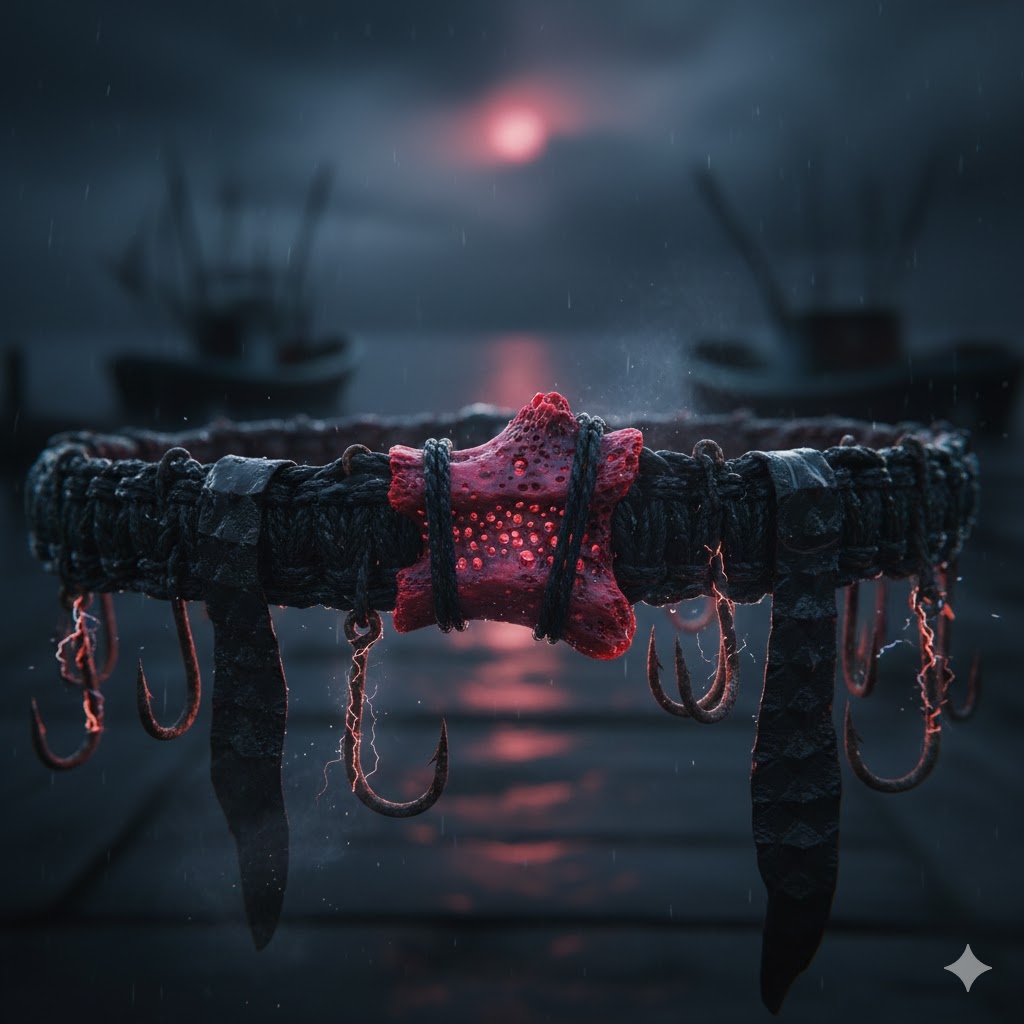
Lore: The Dream 661 of Bad Omens is a heavy, soot-stained charm carved from the porous bone of a whale that perished in a “red tide.” In the spiritual traditions of Saṃsāra, “Bad” is not merely an opinion; it is a tangible weight, a precursor to rot that manifests before a storm or a betrayal. This item was traditionally worn by the “Sorrow-Seers,” those tasked with absorbing the minor misfortunes of a village so that the greater community might thrive. The bone is perpetually damp to the touch, smelling of stagnant salt water and burnt oil. To wear it is to accept a role as a magnet for poor luck and “bad” vibes, interpreting the ripples of failure before they become tidal waves of disaster.
Detailed Stats
- Slot: Waist (A thick, braided cord of black hemp that hangs low, adorned with the carved bone and rusted fishing hooks).
- Tier: 1.
- Rarity: Common.
- Weight: 2.0 lbs.
- Material: Red-tide whale bone, rusted iron hooks, charred hemp cord, and dried stingray skin.
Skills Gained
- Scent of Decay: The avatar gains a proficiency bonus to checks made to identify spoiled food, tainted water, poisoned blades, or corrupted spirits.
- Grim Resilience: The avatar gains a bonus to saving throws against being sickened or nauseated, as they are constantly acclimated to “bad” sensations.
Passive Magic
- Misfortune Magnet: Minor “bad” events in the immediate vicinity (tripping, spilling a drink, a jammed lock) are drawn toward the avatar instead of their allies. This provides a +1 bonus to AC to nearby allies as enemies suffer minor, “bad” coordination when striking near the avatar.
- Low-Tide Vision: The avatar can see through murky water, heavy rain, or thick smog as if it were clear air. The “bad” weather does not hinder their sight.
- Cursed Intuition: The avatar is alerted to “bad” intentions. If a creature within 10 feet intends to steal from or harm the avatar, the rusted hooks on the belt tug sharply at the avatar’s waist.
Activable Magic
- Proclaim the Rot (Normal Activation): The avatar touches a hook on the belt and speaks a “bad” truth about a target’s gear. The target must succeed on a physical resistance check or have one non-magical item (a strap, a buckle, a latch) instantly break or become stuck.
- Transference of Ill-Will (Reaction Activation): When the avatar is hit by an attack, they can activate the belt to force the attacker to make a mental save. On a failure, the attacker feels “bad” about the strike, suffering a penalty to their next roll due to a sudden, overwhelming sense of guilt or impending doom.
- Dream of the Sour Harvest (Ritual Activation): Over 10 minutes, the avatar can interpret the “bad” future of a specific location. They learn one thing that will go wrong in that area within the next 24 hours (e.g., a fire will start, a guard will fall asleep, a bridge will creak).
Tags: Waist-Slot, Dream-Magic, Spiritual, Bad, Whale-Bone, Decay, Misfortune, Tier-1, Salt-Gothic, Ominous, Saṃsāra-Tides, Soot-Stained, Porous, Malign, Brackish, Unlucky, Tethered, Blighted, Red-Tide, Corrosive, Forbidding, Sullen
In the world of Saṃsāra, items flavored by “Bad” omens are considered necessary evils. They are rarely sold in high-end markets where people seek “Good” fortune; instead, they are found in places where the residents have already made peace with their own misfortune.
Where to Buy and Sell
- The Sullen Chandler’s Wharf: Located in the “Drowned Districts” where the tide stays high too long, these shops sell equipment to sailors and divers who work in dangerous, shark-infested waters. The Dream 661 is often hung behind the counter next to waterproof lanterns and rusted anchors. These merchants are pragmatic; they buy and sell the item as a “warning system” rather than a curse.
- The Sin-Eater’s Stall: Found on the outskirts of religious settlements, these stalls are run by outcasts who specialize in “spiritual waste management.” To them, the 661 is a tool for the trade. Buying from them involves a somber transaction where the merchant may insist on “washing” your coin in salt water before accepting it. They buy these items eagerly, as they believe collecting “Bad” energy prevents local disasters.
- The Wreck-Site Fence: These are mobile “shops” operated from the decks of salvage rafts. They sell items literally pulled from the mud and the “Red-Tides.” The 661 is common here because it often survives the destruction of the ships it was meant to protect. The transaction is quick, cold, and usually involves a heavy amount of haggling over the “purity” of the rot within the bone.
Buying and Selling Costs
The economy of “Bad” items is unique; their cost is often lower in gold but requires a “social tax” of being seen with such a grim object:
- Sullen Chandler (Pragmatic/Used): To buy, the cost is 8 to 12 Gold. It is seen as a standard, albeit depressing, piece of survival gear. They will buy it from an avatar for 4 to 5 Gold, provided the bone isn’t cracked.
- Sin-Eater’s Stall (Purified/Blessed): To buy, the price is 60 to 80 Silver. The price is lower because the Sin-Eater views the sale as an act of charity or duty. They will buy it back for 30 to 40 Silver, often including a “blessing of salt” for free to ensure the avatar doesn’t carry the “Bad” home with them.
- Wreck-Site Fence (Raw/Tainted): To buy, the price is highly variable, usually 50 to 100 Copper. It is cheap because it is often covered in barnacles or grime. They will buy it for 25 to 30 Copper, or trade it directly for a bottle of strong spirits or a fresh meal.
The Bad Transaction
In Saṃsāra, buying a Dream 661 feels like buying a funeral shroud. The merchant will rarely wrap it in fine paper; instead, it is handed over in a greasy, salted rag or a piece of old sailcloth. To sell it, the avatar must often prove they are “stronger” than the item—if they look sick or unlucky, the merchant will claim the item is “spent” or “too heavy” and refuse the sale. A successful seller treats the Bad as a professional burden, showing the merchant that the hooks are still sharp and the bone still damp with the spirit’s “Bad” sweat.
In the world of Saṃsāra, roleplaying with the Dream 661 of Bad Omens requires the avatar to act as a “Sponge for Misery.” You aren’t a traditional hero; you are the one who smells the gas leak before the explosion or the rot in the floorboards before they give way. The “Bad” isn’t a weapon of malice, but a weapon of inevitability.
Defensive Roleplay
- Safe Areas (Markets/Inns): Defense in civilized areas is about The Misfortune Magnet. If an ally is about to stumble or get their pocket picked, the avatar roleplays “catching” the bad luck. You might describe how you “accidentally” bump into the thief while trying to adjust your heavy belt, or how you spill your own drink to distract from an ally’s social faux pas. You are the “Bad” buffer that keeps the peace by absorbing the friction.
- Normal Areas (Forests/Coastal Roads): In the wilderness, you use Low-Tide Vision and Cursed Intuition. Roleplay involves constantly pointing out the “Bad” path. “Do not step there; the mud is sour,” or “The wind smells of a bruised sky.” You defend the party by vetoing bad decisions. If an ambush occurs, you describe the rusted hooks on your belt tugging painfully at your skin, allowing you to react a split second before the first arrow flies.
- Unsafe/Deathly Areas: During combat, your defense is Transference of Ill-Will. When an enemy strikes you, you don’t just block; you make them feel the “Bad” weight of their violence. Roleplay the attacker’s hesitation as they realize they’ve struck a “Sorrow-Seer.” You describe the attacker becoming nauseated by the scent of the red-tide whale bone, their follow-up strikes becoming clumsy as they succumb to a “Bad” feeling about the fight.
Offensive Roleplay
- Proclaim the Rot: This is targeted sabotage. You don’t break the enemy; you break their tools. Roleplay involves staring intensely at an opponent’s equipment—a leather strap on their shield, the hinge of their crossbow, or the laces of their boots—and whispering, “That is ready to fail.” When you activate the magic, you describe the “Bad” energy of the whale bone causing the material to instantly decay or snap, leaving the enemy fumbling with malfunctioning gear.
- Dream of the Sour Harvest: This is “Tactical Pessimism.” Before entering a fortress or dungeon, you spend time interpreting the “Bad” future. Roleplay the ritual by rubbing the soot from your belt onto your eyelids. You tell your party, “The left door has a bad hinge that will scream,” or “The guard in the tower has a bad tooth and will be distracted by the pain.” You weaponize the environment’s flaws against your enemies.
- Scent of Decay (Aggressive Application): Use this to ruin an enemy’s resources. You can identify the “Bad” barrel of water or the “Bad” horse in the stable. Offensive roleplay involves poisoning the enemy’s morale by pointing out the rot already present in their ranks. Telling a group of mercenaries that their rations are “Bad” (and being right because of your magic) causes infighting and desertion faster than a sword strike.
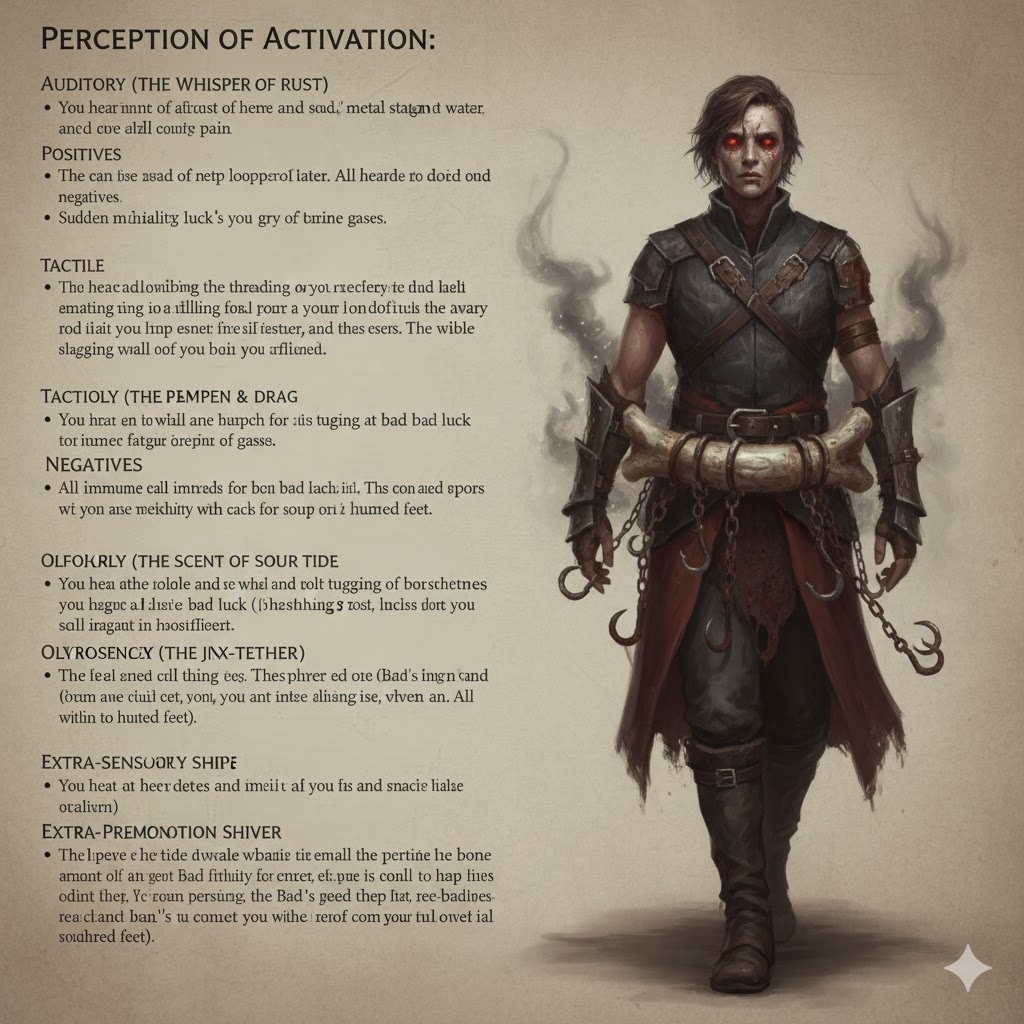
Perception of Activation:
- Auditory (The Low-Tide Groan):
- User’s Perspective: You hear the deep, rhythmic creaking of a ship’s hull under immense pressure, mingled with the wet, slapping sound of waves hitting a muddy shore.
- Observer’s Perspective: A faint, dissonant hum emanates from the belt, like a swarm of flies trapped in a jar.
- Positives: Hidden structural weaknesses in the environment (cracked stone, rotting wood) emit a distinct “pop” that only you can hear.
- Negatives: Sudden loud noises cause a painful physical jolt to your spine, as your ears are tuned to the frequency of disaster.
- Visual (The Rot-Glow):
- User’s Perspective: The world dims as if seen through a dirty lens, but objects that are broken, poisoned, or “bad” pulse with a sickly, bioluminescent crimson light.
- Observer’s Perspective: The carved whale bone on your waist begins to weep a dark, oily moisture that catches the light like an oil slick on water.
- Positives: You can track the “trail” of a wounded or sickened creature through the darkest environments.
- Negatives: Fine details of beautiful or healthy objects are blurred, making it hard to read fine script or appreciate art.
- Tactile (The Heavy Burden):
- User’s Perspective: The hemp cord feels like it weighs fifty pounds; the rusted hooks tug at your skin with a persistent, cold itch that travels up your nerves.
- Observer’s Perspective: Your movements become deliberate and heavy, and your shadow seems to stretch and pool like spilled ink around your feet.
- Positives: You feel “grounded” to the earth, granting you a preternatural resistance to being pushed or knocked over.
- Negatives: Your movement speed feels sluggish, and you find it difficult to perform tasks requiring high agility or sprinting.
- Olfactory (The Scent of the Red Tide):
- User’s Perspective: The air tastes of salt and metallic copper; a thick smell of decomposing seaweed and burnt fat fills your lungs.
- Observer’s Perspective: A sudden chill draft carrying the scent of a stagnant marsh follows in your wake.
- Positives: You can “smell” a trap or an ambush before it happens, as the intent of the attacker smells like scorched ozone.
- Negatives: Fresh food and clean water taste bitter and ashy while the item is active.
- Extra-Sensory (The Prophetic Nausea):
- User’s Perspective: You experience a “sinking feeling” in your gut that intensifies as you move toward a “Bad” outcome; your stomach churns in direct proportion to the danger ahead.
- Observer’s Perspective: You look pale and clammy, as if suffering from a sudden bout of seasickness.
- Positives: You are never surprised by a failure; you know exactly when a plan is doomed to fall apart.
- Negatives: The constant sensation of impending doom makes it nearly impossible to feel joy or relaxation.
- Extra-Sensory (The Echo of Loss):
- User’s Perspective: When you touch an object, you feel the “Bad” moments of its history—the hand that dropped it, the fire that scorched it, or the person who died holding it.
- Observer’s Perspective: You appear to be “daydreaming” or lost in a trance whenever you handle old items.
- Positives: You gain an intuitive understanding of how to finish a job that someone else failed to complete.
- Negatives: You occasionally experience “phantom pains” belonging to the previous owners of the items you touch.
Recipe: Braiding the Anchor of Sorrow
To recreate a vessel for the Dream 661, the artisan must perform the craft during a period of environmental or personal stagnation—ideally while the tide is out and the air is heavy with the scent of salt and rain. The item must be built to endure, functioning as a physical sink for the “Bad” energies it is meant to interpret.
Materials Needed
- 1 Chunk of Porous Bone: Ideally harvested from a large sea creature that died of natural or environmental causes (like a Red Tide). It must be sun-bleached but still retain a “damp” weight.
- 5 Yards of Black Hemp Cord: The hemp must be soaked in a mixture of seawater and soot from a hearth that was extinguished by rain.
- 7 Rusted Iron Fishing Hooks: These must be scavenged from a shipwreck or a lost pier; they cannot be newly forged.
- 1 Square of Cured Stingray Skin: Used to wrap the friction points where the bone meets the cord.
- 1 Vial of Red-Tide Residue: The concentrated silt found in the lungs of a drowned animal or at the bottom of a stagnant tidal pool.
- 1 Echo of a Failed Endeavor: A small token from a project that was abandoned or a ship that never launched.
Tools Required
- A Flint Graver: For carving the bone; metal tools are too “clean” for this work.
- A Bone Needle: For stitching the stingray skin and hemp.
- A Stone Basin: To hold the soot-water for soaking the materials.
- An Iron Weight: To keep the cord taut during the braiding process.
Skill Requirements
- Bone-Carving (Tier 1): To hollow the pores of the bone without shattering the structure.
- Trawling Lore (Sorrow-Seers): Understanding how to bind “Bad” omens into a physical object without the rot spreading to the crafter.
- Survival (Coastal): Knowledge of how to properly cure marine materials so they resist mold while remaining “spiritually moist.”
Crafting Steps
- The Soaking of the Hemp: Submerge the black hemp cord in the soot-water basin for one full lunar cycle. The fiber must absorb the “extinguished” essence of the fire and the “heaviness” of the salt.
- The Carving of the Bone: Using the flint graver, etch the surface of the whale bone with patterns resembling receding tides and broken waves. Hollow out small chambers within the bone to hold the Red-Tide Residue.
- The Sealing: Place the Echo of a Failed Endeavor into the largest hollow of the bone and seal it with a patch of Stingray Skin. This creates the “magnetic” core that attracts misfortune.
- The Braiding: Braid the soot-soaked hemp into a thick, heavy cord using a “Dead-Man’s Knot” pattern. Every few inches, weave in one of the Rusted Fishing Hooks, ensuring the points face outward to “catch” the passing omens.
- The Infusion: Pour the Red-Tide Residue over the finished bone and cord. As it seeps into the pores, the artisan must recount a series of “Bad” omens they have witnessed. When the bone begins to feel cold and oily, and the hooks begin to vibrate with a faint, dissonant hum, the Dream 661 is successfully bound.
Bone-Girdle which Eats Sickness of Sky
In the First-Before-Days, when the Sun was a New-Hot-Eye and the Sea was Restless-and-Bitter, there was the Village-of-Broken-Oars. The Great Spirit of the Storm-with-Many-Teeth was angry because the people forgot to give him the Salt-of-Memory.
He sent the Red-Death-Water (the tide) to kill the whales and make the air smell of Old-Sorrow. The whales fell and became Stone-of-the-Deep. The people grew the Small-Fear-in-Belly.
Then came the Man-of-Wet-Eyes, who was a Healer-of-Rot. He took the bone of the Whale-Who-Saw-the-Beginning and tied it to his middle with the Cord-of-Burnt-Hopes. He put the Hooks-of-Seeking upon it, so that he could catch the Bad-Wind before it touched the children.
The Storm-with-Many-Teeth threw a Mountain-of-Water at the village. But the Man-of-Wet-Eyes stood on the shore. The Bone-Girdle became heavy. It drank the Bad-Strength of the wave. The Man became as heavy as the Deep-Earth. The wave hit him and became Soft-Mist. The hooks caught the Lies-of-the-Lightning, pulling them into the soot-cord where they became Quiet-Darkness.
But the Man was Filled-with-the-Ache. His skin became like the Oily-Skin-of-Whales. He could not taste the Sweet-Fruit, only the Ash-of-Warning. He walked into the sea so the village would stay Dry-and-Happy. The story-bones say he still sits at the bottom, eating the Bad-Dreams of the world so the surface stays Bright-and-False.
The Moral of the Story
To see the rot before it consumes the tree is a heavy burden for the eyes, but he who carries the darkness of the omen on his hip is the only one who can walk through the storm without being swept into the abyss.
Suggested conversions to other systems:
Dungeons & Dragons (5th Edition)
Unique Name: Girdle of the Sour Tide Item Type: Wondrous Item, Common (Requires Attunement)
- Slot: Waist
- Misfortune Magnet: While you are wearing this belt, if an ally within 10 feet of you is hit by an attack, you can use your reaction to grant them a +2 bonus to AC against that attack as the “bad luck” of the strike is diverted toward you. If the attack still hits, you take an additional 1d4 psychic damage.
- Cursed Intuition: You gain a +2 bonus to Passive Perception specifically to detect traps, poisons, or hidden enemies with harmful intent.
- Proclaim the Rot: As an action, you can target a non-magical object within 30 feet. The object’s structural integrity is compromised. If a creature is using the object (like a weapon or a rope), they have disadvantage on the next check or attack roll made with it. Once used, this property can’t be used again until you finish a long rest.
Call of Cthulhu (7th Edition)
Unique Name: Red-Tide Whalebone Charm Item Type: Artifact of Prophetic Misery
- Slot: Waist
- Scent of Decay: By spending 1D3 Sanity, the wearer can “smell” the immediate history of a location. This grants a Bonus Die on Track or Spot Hidden rolls to find bodies, toxic substances, or signs of an unnatural struggle.
- Grim Resilience: The wearer gains a +10% bonus to CON rolls made to resist poisons, gases, or nausea-inducing horrors.
- Transference of Ill-Will: When the wearer suffers a wound, the attacker must succeed on a POW check. On a failure, the attacker is overwhelmed by a “bad feeling,” suffering a Penalty Die on all actions for their next turn.
Blades in the Dark
Unique Name: The Sorrow-Seer’s Hempen Belt Item Type: Supernatural Fine Item (1 Load)
- Slot: Waist
- Quality: Fine (+1 Tier for effectiveness when resisting or sensing environmental hazards and rot).
- Low-Tide Vision: You ignore penalties to Survey or Hunt caused by mist, heavy rain, or murky water.
- Misfortune Magnet: When an ally within reach suffers a Consequence from a physical attack or environmental hazard, you may take 1 Stress to “absorb” the bad omen. The ally ignores the consequence, and you take a Lesser Harm (such as “Nauseated” or “Chilled”).
- Dream of the Sour Harvest: When you Gather Information about a location’s weaknesses or upcoming disasters, you gain Potency.
Knave (2nd Edition)
Unique Name: The Salt-Gothic Girdle Item Type: Magic Item (1 Slot)
- Slot: Waist
- Misfortune Magnet: Once per day, when an ally fails a Saves check, you can choose to fail the check in their place, regardless of your distance, as long as you can see them.
- Cursed Intuition: You cannot be surprised by enemies who have “bad” or murderous intentions.
- Proclaim the Rot: You may spend a turn to target a piece of enemy equipment. The enemy must make a STR Save. On a failure, the item breaks (if fragile) or becomes useless for 1d4 rounds (if sturdy).
- Negative: You suffer a -2 penalty to all social rolls with “high-status” NPCs (Nobles, Priests), as they find your scent and aura repulsive.
Pathfinder (2nd Edition)
Unique Name: Girdle of the Sour Tide Item Type: Item 1, Invested, Magical, Necromancy, Occult
- Slot: Waist
- Usage: Worn; Bulk: 1
- Misfortune Magnet [Reaction]: Trigger: An ally within 15 feet fails a saving throw against a physical effect. Effect: You draw the “bad” energy toward yourself. The ally rerolls the saving throw with a +1 circumstance bonus and must use the new result. You become Sickened 1 as you absorb the spiritual residue of their failure.
- Cursed Intuition: You gain a +1 item bonus to Perception checks to Sense Motive and to detect hazards.
- Low-Tide Vision: You gain a +2 item bonus to Acrobatics checks to balance on uneven or slippery surfaces and ignore difficult terrain caused by shallow water or mud.
Savage Worlds (Adventure Edition)
Unique Name: The 661 Red-Tide Cord Item Type: Enchanted Item
- Misfortune Magnet: Once per session, you may allow an ally within 5″ (10 yards) to reroll a failed Trait roll as if they spent a Bennie. If you do this, your next Trait roll is made at a -2 penalty as the misfortune settles on you.
- Grim Resilience: The wearer gains a +2 bonus to Vigor rolls to resist poisons, environmental diseases, and the effects of a “Cold” or “Stagnant” environment.
- Proclaim the Rot (Power): You can use the Lower Trait power (limiting the choice to Strength, Agility, or Vigor) by touching one of the rusted hooks. You use your Spirit as your arcane skill.
- Minor Hindrance: The item is Outcertainly Ominous. The wearer suffers a -1 penalty to Persuasion rolls against anyone who isn’t an outcast or occultist.
Numenera & Cypher System
Unique Name: Sorrow-Seer’s Anchor Item Type: Artifact (Level 1d6)
- Form: A heavy hemp belt adorned with a porous, oily bone.
- Depletion: 1 in 1d20
- Effect (Cursed Intuition): You gain an Asset to all tasks related to identifying poisons, rot, or structural instabilities in ruins.
- Effect (Low-Tide Vision): Perception tasks are eased by one step when performed in heavy rain, fog, or underwater.
- Effect (Transference of Ill-Will): When you take damage from a creature, you can spend 2 Might points to force the attacker to make an Intellect defense roll. On a failure, the attacker is dazed, increasing the difficulty of all their tasks by one step for one minute.
- Hindrance: The weight of the “Bad” energy increases the difficulty of all Social Interaction tasks (other than intimidation) by one step.
Fate (Core/Condensed)
Unique Name: The Hempen Weight of Omens Item Type: Extra/Stunt
- Aspect: Magnet for the Sour and Sullen
- Stunt (Misfortune Magnet): Once per scene, when an ally in the same zone as you fails a defense roll, you may take the Stress or Consequences for them. If you do, you gain a +1 on your next roll as the “Bad” luck fuels your resolve.
- Stunt (Proclaim the Rot): You can use Provoke or Lore to create a “Structural Weakness” or “Equipment Failure” advantage on an opponent with +2, provided you can physically point out a flaw in their gear.
- Stunt (Cursed Intuition): You gain a +2 to Investigate or Notice when trying to find traps or identify the presence of something corrupt, diseased, or harmful.
- Cost: This item takes up 1 Refresh. The GM may compel your aspect to ensure that minor things—like your shoelaces breaking or your food being cold—always happen to you first.
Shadowrun (6th World Edition)
Unique Name: Dream 661 “Silt-Static” Belt Item Type: Manipulation/Detection Focus (Rating 2)
- Slot: Waist
- Scent of Decay: The wearer adds the Focus Rating (+2) to all Perception and Biotech tests used to detect toxins, pollution (biowaste), or the “Health” status of an infected creature.
- Misfortune Magnet: When an ally within 5 meters is targeted by an attack, the wearer can spend 1 Edge to force the attacker to re-roll one die of the wearer’s choice. The “Bad” luck of the shot is pulled into the Focus, causing the wearer to suffer a -1 penalty to their next Action from the spiritual feedback.
- Low-Tide Vision: The wearer ignores all environmental penalties caused by smoke, fog, or water (up to Level 3).
- Wireless Bonus: The belt syncs with local grid weather data; you gain a +1 dice pool bonus to Survival tests in urban or coastal wastelands.
Starfinder (2nd Edition / Playtest)
Unique Name: 661 Red-Tide Waistwrap Item Type: Level 1, Magic Item
- Slot: Waist
- Bulk: 1
- Cursed Intuition [Reaction]: Trigger: A hazard or trap within 15 feet triggers. Effect: You gain a +2 status bonus to your AC or Saving Throw against that hazard as the belt jerks you out of the path of “Bad” luck.
- Misfortune Magnet [Reaction]: Trigger: An ally within 15 feet takes damage from a weapon attack. Effect: You take a -1 status penalty to your next attack roll, but the ally gains Resistance 2 to all damage from that attack as you absorb the spiritual “rot” of the strike.
- Proclaim the Rot [1-Action]: You target a technological item of Level 1 or lower within 30 feet. The item gains the Broken condition for 1 round unless the wielder succeeds at a DC 15 Fortitude save.
Traveller (Mongoose 2nd Edition)
Unique Name: Dream 661 Entropy-Braid Item Type: TL 13 Psionic Artifact
- Weight: 1kg
- Cost: Cr 4,500
- Description: A braid of soot-darkened fibers and bone that seems to dampen the “luck” of everyone nearby.
- Low-Tide Vision: The wearer ignores any negative DM for visibility caused by weather, mist, or underwater environments.
- Cursed Intuition: The wearer gains a +1 DM to Initiative checks. Furthermore, they receive a +2 DM to Recon and Investigate rolls when searching for hidden dangers or structural damage.
- Misfortune Magnet: Once per combat, the wearer may force an enemy attacking a nearby ally to take a Bane on their attack roll. However, the wearer must take a Bane on their own next check.
- Negative: The item is unsettling to sensors. Any high-tech medical scan (Medical-3+) on the wearer suffers a -2 DM as the “Bad” energy interferes with the machinery.
Warhammer (40,000 Roleplay: Wrath & Glory)
Unique Name: The Penitent’s Red-Tide Girdle Item Type: Worn Relic
- Value: 3 (Rare)
- Keywords: [IMPEDIMENTA], [SPIRITUAL], [SORROW]
- Grim Resilience: You gain +1 Resilience. Additionally, you add +2d6 to any test made to resist the Poisoned or Blinded conditions.
- Transference of Ill-Will: When you suffer a Wound, the enemy that caused it must make a DN 3 Willpower Test. If they fail, they are Hindered (1) for their next turn as the “Bad” omens of the whale bone cloud their spirit.
- Scent of Decay: You gain +2d6 to Awareness (Int) tests to detect hidden traps, tainted water, or the presence of Chaos-tainted flora and fauna.
- Social Penalty: You suffer a -1d6 penalty to all Persuasion (Fel) tests against Imperial Nobility or those of High Standing, who find your “Bad” aura an affront to their dignity.