
Lore: In the world of Saṃsāra, the Valuators’ Consortium was founded by a group of expert appraisers, historians, and artifact connoisseurs. This faction emerged from the need to determine the true worth and significance of items, relics, and treasures in a world rich with history and mystique.
Ideology: The Valuators’ Consortium believes that every artifact, regardless of its outward appearance, holds a unique story and value. They emphasize the importance of understanding the historical, cultural, and magical context of items to accurately appraise them.
Major Concerns: The Consortium is deeply concerned about the spread of counterfeit or misrepresented artifacts, as well as the potential misuse of valuable items for nefarious purposes. They worry that inaccurate appraisals could lead to the loss of irreplaceable treasures and the distortion of history.
Imperatives:
- Accurate Appraisal: The Consortium is dedicated to providing accurate, unbiased, and well-researched appraisals for artifacts.
- Educational Outreach: They strive to educate the public about the importance of understanding an item’s history, provenance, and magical properties before determining its worth.
- Preventing Misuse: The faction aims to prevent valuable artifacts from falling into the wrong hands by identifying potential threats and guiding the responsible management of powerful items.
Grand Strategy and Goals: The grand strategy of the Valuators’ Consortium involves establishing a network of reputable appraisers, artifact historians, and magical experts. They aim to develop a standardized approach to appraisal that considers historical, cultural, and magical factors to provide a holistic understanding of an artifact’s value.
Public Motivations and Agenda: Publicly, the Consortium presents itself as a neutral and authoritative organization that assists individuals, collectors, and institutions in accurately appraising their treasures. They organize seminars, workshops, and exhibitions to promote responsible artifact evaluation and historical understanding.
Means and Methods: The Valuators’ Consortium employs various methods to fulfill their mission:
- Artifact Cataloging: They maintain an extensive database of historical and magical information about artifacts to aid in appraisals.
- Expert Panels: Consortium members collaborate to evaluate complex artifacts, pooling their knowledge and insights.
- Educational Initiatives: They offer courses on artifact history, magical analysis, and responsible collection management.
- Collaboration: The Consortium partners with museums, governments, and academia to ensure accurate and unbiased appraisal of cultural and historical items.
Players can join the Valuators’ Consortium as appraisers, historians, magical analysts, or artifact protectors. Their quests might involve uncovering the history and significance of mysterious items, detecting counterfeit artifacts, preventing the misuse of valuable relics, or even delving into the hidden magical properties of seemingly ordinary objects. However, they must navigate the ethical complexities of valuing artifacts, uncovering hidden truths, and protecting history from distortion.
Tags: Artifact Appraisal, Historical Research, Magical Analysis, Counterfeit Detection, Educational Outreach, Ethical Practices, Relic Preservation, Collaboration, Resource Database, Appraiser Network
Joining the Valuators’ Consortium: Joining the Valuators’ Consortium requires a keen eye for detail, a passion for history and artifacts, and a commitment to ethical appraisal practices. Prospective members typically demonstrate expertise in fields such as artifact history, magical analysis, or provenance research. They undergo a rigorous evaluation process that includes tests of their knowledge, ethical judgment, and ability to assess artifacts accurately.
Benefits of Membership:
- Access to Resources: Members gain access to the Consortium’s vast database of historical records, magical analysis, and artifact research.
- Networking: Membership connects them to a network of fellow appraisers, historians, and magical experts, facilitating collaboration.
- Skill Enhancement: Members receive advanced training in artifact appraisal, historical analysis, magical identification, and ethical considerations.
- Reputation: Being part of the Consortium lends credibility and authority to their appraisals, making them respected figures in the world of artifacts and relics.
Controlled Resources: The Valuators’ Consortium controls a repository of historical texts, magical compendiums, artifact records, and cataloged appraisals. They also possess tools for magical analysis and authentication, such as scrying stones and arcane detectors.
Limitations:
- Subjectivity: Despite their expertise, appraisers must contend with the subjective nature of value, considering factors beyond historical or magical significance.
- Resource Allocation: Balancing the demand for appraisals with available experts and time can be a challenge.
- Ethical Quandaries: The Consortium must navigate ethical dilemmas, such as whether to disclose hidden magical properties or controversial historical origins.
Leadership Concerns: The leadership of the Valuators’ Consortium worries about:
- Counterfeit Artifacts: They fear the proliferation of fake artifacts or relics with fabricated histories that could deceive collectors and institutions.
- Misguided Appraisals: Inaccurate appraisals could lead to the mismanagement of valuable items or the loss of cultural heritage.
Secret Motivations and Hidden Agendas: While the public face of the Consortium emphasizes accurate appraisal and historical preservation, a faction within known as the “Artifact Guardians” believes in the necessity of retaining certain powerful artifacts for safeguarding the world’s magical balance.
Pass Phrases and Identifying Gestures: Members of the Valuators’ Consortium might use phrases related to the study of history and artifacts as passphrases. For instance, a common passphrase could be “Unveil the Tapestry,” while an identifying gesture might involve tracing the outline of an invisible artifact in the air.
Friendly Groups:
- The Historian’s Guild: A group of scholars and historians who collaborate with the Consortium to provide historical context for artifacts.
- The Magical Archives: This organization focuses on magical research and aligns with the Consortium to combine historical and magical expertise.
- The Archaeologist’s Society: An association of adventurers and relic seekers who benefit from the Consortium’s expertise in identifying and understanding the relics they discover.
Ranks and Jobs within the Valuators’ Consortium:
- Apprentice Appraiser:
- Job: Apprentice Appraisers assist in basic artifact evaluations, research, and record-keeping under the guidance of experienced members.
- Advancement: Apprentices must demonstrate their ability to identify key historical and magical details, accurately catalog artifacts, and pass a series of appraisal exams.
- Artifact Historian:
- Job: Artifact Historians specialize in researching the historical context of artifacts, tracing their origins, and understanding their cultural significance.
- Advancement: Advancement involves presenting original research, uncovering hidden histories, and mentoring Apprentice Appraisers.
- Magical Analyst:
- Job: Magical Analysts focus on identifying and understanding the magical properties of artifacts, as well as detecting hidden enchantments.
- Advancement: To rise to the next rank, Analysts must successfully identify complex magical properties, develop new detection techniques, and mentor Apprentice Appraisers.
- Curator of Relics:
- Job: Curators of Relics oversee collections of artifacts, manage archives, and ensure the responsible storage and display of valuable items.
- Advancement: Advancement involves successfully curating major exhibitions, implementing innovative storage solutions, and mentoring Artifact Historians and Magical Analysts.
- Grand Valuator:
- Job: Grand Valuators lead the Consortium’s major initiatives, guide policy decisions, and set the standard for accurate and ethical appraisal practices.
- Advancement: To ascend, Grand Valuators must demonstrate exceptional expertise, initiate impactful projects, and provide visionary leadership.
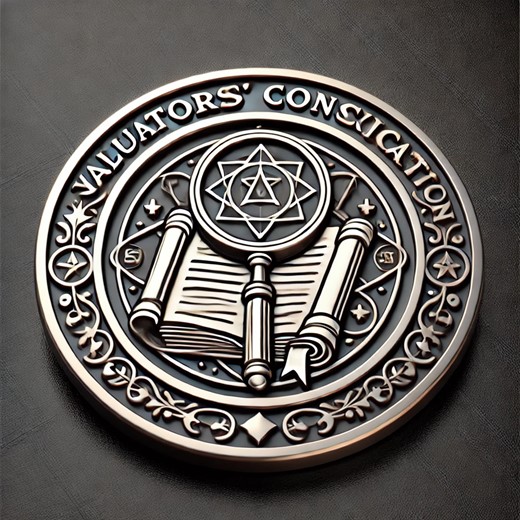
Badge Design: The Valuators’ Consortium badge is a circular pin worn on the members’ attire. It features a stylized depiction of an ancient scroll or tome intersecting with a mystical magnifying glass, symbolizing the combination of historical research and meticulous examination.
Badge Symbol and Rank Insignia:
- Apprentice Appraiser: A bronze badge with a simple magnifying glass icon.
- Artifact Historian: A bronze badge with a magnifying glass icon and a small parchment scroll accent.
- Magical Analyst: A silver badge with a magnifying glass icon and a delicate pattern of arcane symbols.
- Curator of Relics: A silver badge with a magnifying glass icon and a stylized museum display case accent.
- Grand Valuator: A gold badge with a magnifying glass icon, an ornate scroll design, and an outer ring of intricate symbols representing historical and magical expertise.
Each badge is accompanied by specific color variations, which members can wear on their attire to indicate their rank within the faction.
Enemies and Rivals of the Valuators’ Consortium:
- The Forgers’ Syndicate:
- Conflict: The Forgers’ Syndicate is a group of skilled counterfeiters and deception experts who create fake artifacts and manipulate histories to profit from unsuspecting collectors.
- Interactions: The Syndicate engages in subterfuge, attempting to pass off counterfeit artifacts as genuine and deceive the Consortium’s members during appraisals.
- Consequences: The conflict could lead to the spread of fake artifacts, loss of trust in appraisers, and the devaluation of genuine relics. It might also result in legal battles and reputational damage for the Consortium.
- The Obscurantist Order:
- Conflict: The Obscurantist Order believes in withholding knowledge and information, including historical and magical details of artifacts. They view the Consortium’s transparency as a threat to their ideology.
- Interactions: The Order engages in propaganda campaigns to discourage people from seeking appraisals or sharing information about their artifacts with the Consortium.
- Consequences: The conflict might lead to a lack of understanding about historical artifacts, the spread of misinformation, and a potential loss of valuable items to ignorance or secrecy.
- The Ambitious Collectors’ Guild:
- Conflict: The Ambitious Collectors’ Guild is a faction of wealthy collectors who seek to monopolize valuable artifacts for personal gain and influence.
- Interactions: The Guild competes for valuable artifacts at auctions, manipulates prices, and attempts to discredit the Consortium’s appraisals to drive down costs.
- Consequences: The conflict could lead to inflated prices for artifacts, loss of public access to cultural heritage, and the distortion of history for personal interests.
These conflicts pose significant challenges for the Valuators’ Consortium. They must not only uphold their standards of accurate appraisal but also defend themselves against those who seek to undermine or oppose their efforts. The consequences of these conflicts could range from the devaluation of genuine artifacts to the spread of misinformation, loss of public trust in appraisers, and potential legal battles or confrontations.
Tale of the Lost Chronicle
In the annals of Saṃsāra, one story about the Valuators’ Consortium stands out above the rest. It is a tale that showcases their dedication to preserving history and protecting the true value of artifacts. This story is known as “The Tale of the Lost Chronicle.”
Many generations ago, during a time of great upheaval, a legendary artifact known as the Lost Chronicle was said to contain the earliest history of Saṃsāra. This ancient tome was reputed to hold secrets of immense power, detailing the origins of magic, the rise and fall of civilizations, and the hidden truths of the cosmos. The Lost Chronicle had been missing for centuries, and its whereabouts became the subject of myths and legends.
The Valuators’ Consortium, renowned for their expertise in appraising and preserving artifacts, took a keen interest in the Lost Chronicle. They believed that finding and preserving the tome was crucial for understanding Saṃsāra’s history and maintaining the integrity of its cultural heritage. The Consortium launched a quest to locate the Lost Chronicle, led by their most esteemed Grand Valuator, Eamon.
Eamon and his team of appraisers, historians, and magical analysts embarked on a perilous journey across Saṃsāra. They scoured ancient ruins, deciphered cryptic clues, and faced numerous challenges. Their search took them to the remote corners of the world, from the scorching deserts to the icy tundras, and into the depths of forgotten catacombs.
After years of relentless pursuit, they finally discovered the Lost Chronicle hidden within a concealed chamber of an abandoned fortress. However, their joy was short-lived as they found the tome guarded by a powerful and malevolent spirit, bound to protect its secrets from those who would misuse its knowledge.
Undeterred, Eamon used his extensive knowledge of artifacts and magic to communicate with the spirit. He explained the Consortium’s mission to preserve history and prevent the misuse of powerful relics. Through his wisdom and sincerity, Eamon convinced the spirit that the Consortium’s intentions were noble.
In a moment of profound understanding, the spirit relented, allowing Eamon and his team to take the Lost Chronicle. They carefully transported the tome back to the Valuators’ Consortium, where it was meticulously studied and preserved. The knowledge within the Lost Chronicle proved invaluable, shedding light on Saṃsāra’s ancient past and providing insights that shaped the future.
The tale of the Lost Chronicle became legendary, symbolizing the Consortium’s unwavering dedication to truth, history, and the ethical appraisal of artifacts. It highlighted their role as guardians of knowledge and preservers of cultural heritage.
Moral of the Story: The Tale of the Lost Chronicle teaches that the true value of artifacts lies not only in their material worth but in the knowledge and history they preserve. By approaching artifacts with respect, wisdom, and a commitment to ethical practices, we can uncover hidden truths and safeguard the cultural heritage of future generations.