
Lore: In the world of Saṃsāra, the Reliquary Conservators emerged from the ruins of an ancient civilization. This civilization revered history and artifacts, collecting and preserving objects from different eras. As time passed, the Reliquary Conservators formalized into a faction dedicated to the collection, restoration, and protection of antiques, relics, and forgotten knowledge.
Ideology: The Reliquary Conservators believe that the past holds valuable lessons and wisdom that can guide the present and future. They see antiques not just as artifacts, but as vessels of stories, culture, and power. By safeguarding these treasures, the Conservators aim to honor history and ensure that the mistakes and achievements of the past are not forgotten.
Major Concerns: The Conservators are deeply concerned about the loss of historical artifacts due to conflict, theft, or neglect. They worry that the world’s rapidly changing landscape could lead to the erasure of valuable heritage. They also fear that ancient relics, if misused, could bring about calamities or unleash hidden forces.
Imperatives:
- Preservation: The Conservators prioritize the preservation of artifacts through careful restoration, storage, and documentation.
- Knowledge Dissemination: They aim to share historical knowledge with the world, educating societies about the lessons that can be learned from the past.
- Prevention of Misuse: The faction strives to prevent powerful artifacts from falling into the wrong hands, avoiding their potential for destruction or corruption.
Grand Strategy and Goals: The grand strategy of the Reliquary Conservators involves creating a network of hidden repositories and museums to safeguard antiques. They seek to amass knowledge about ancient civilizations, decipher forgotten languages, and uncover lost magic. Their ultimate goal is to prevent history from repeating its mistakes and to empower the world with the wisdom of the past.
Public Motivations and Agenda: Publicly, the Conservators present themselves as scholars and historians, dedicated to uncovering and sharing forgotten histories. They organize exhibitions, offer educational programs, and collaborate with governments and institutions to ensure the preservation of historical sites and artifacts.
Means and Methods: The Reliquary Conservators employ a variety of methods to fulfill their mission:
- Archival Expeditions: They send teams of experts to explore ancient ruins, tombs, and hidden sites to recover artifacts.
- Restoration Workshops: Skilled artisans within the faction restore damaged artifacts to their former glory.
- Knowledge Collection: Conservators study ancient texts, languages, and arcane lore to understand the significance and potential of the artifacts they safeguard.
- Diplomacy: They forge alliances with governments, academia, and other factions to facilitate artifact protection and knowledge sharing.
Players can join the Reliquary Conservators as archaeologists, restoration experts, historians, or artifact protectors. Their quests might involve uncovering lost civilizations, deciphering ancient scripts, stopping artifact theft, or preventing the misuse of powerful relics. However, they must navigate the ethical challenges of preservation, the dangers of coveting ancient power, and the delicate balance between sharing knowledge and protecting it.
Tags: Ancient Civilization, Artifact Preservation, Historical Knowledge, Restoration, Ethical Concerns, Archival Expeditions, Diplomacy, Secret Repositories, Hierarchical Structure, Conflict and Rivalry
Joining the Reliquary Conservators: Joining the Reliquary Conservators requires a deep passion for history, artifacts, and a commitment to their preservation. Prospective members typically demonstrate expertise in fields like archaeology, linguistics, restoration, or magical lore. They are invited to undertake a trial period where they contribute to a preservation project or artifact recovery. After successfully proving their dedication and skills, they are inducted as full members.
Benefits of Membership:
- Access to Artifacts: Members gain access to the Conservators’ extensive collection of artifacts, allowing them to study and learn from these historical treasures.
- Knowledge Pool: Membership grants access to a vast repository of historical texts, languages, and magical lore.
- Specialized Training: Members receive training in artifact restoration, archaeology, artifact identification, and ethical preservation practices.
- Networking: The Conservators form a global network of scholars, historians, and researchers, facilitating collaboration and resource-sharing.
- Protection: Members are protected by the faction’s reputation, making them respected figures in academic and historical circles.
Controlled Resources: The Reliquary Conservators control a network of hidden repositories, museums, and libraries scattered across Saṃsāra. These contain a wide variety of artifacts, from ancient scrolls and manuscripts to magical relics and art pieces.
Limitations:
- Ethical Dilemmas: The faction faces challenges when deciding whether to share or withhold certain information from the world to prevent misuse.
- Resource Allocation: Balancing artifact preservation and restoration with the limited resources available can be a constant struggle.
- Secrecy: Not all artifacts can be openly displayed or discussed, either due to their potential danger or the sensitive nature of their origins.
Leadership Concerns: The leadership of the Reliquary Conservators worries about:
- Artifact Theft: They fear that powerful individuals or factions might seek to steal valuable artifacts for personal gain.
- Historical Vandalism: The risk of artifacts being intentionally destroyed or altered by groups seeking to erase history.
- Misuse of Knowledge: The unintended consequences of sharing knowledge about powerful relics, potentially leading to conflict or catastrophe.
Secret Motivations and Hidden Agendas: While the public face of the Conservators is focused on preservation and education, a faction within the organization known as the “Legacy Seekers” believe that certain artifacts possess hidden powers that could reshape the world. They quietly collect these artifacts with the intention of harnessing their latent potential.
Pass Phrases and Identifying Gestures: Members of the Reliquary Conservators use phrases and gestures related to history, art, or mythology. For instance, a common passphrase might be “Unveil the Past,” while an identifying gesture could involve tracing the outline of an ancient artifact in the air.
Friendly Groups:
- The Lorekeepers Guild: A group of historians and scribes who collaborate with the Conservators to document and safeguard historical records.
- The Magus Consortium: This magical research organization often seeks the Conservators’ assistance in understanding ancient magical texts and artifacts.
- The Artisan Guild: A group of skilled craftsmen and craftswomen who collaborate with the Conservators to restore damaged artifacts to their original beauty.
Ranks and Jobs within the Reliquary Conservators:
- Curator Apprentice:
- Job: Curator Apprentices assist in cataloging and organizing artifacts, as well as basic restoration work.
- Advancement: Apprentices must successfully complete artifact identification tests, demonstrate proficiency in basic restoration techniques, and contribute to the organization’s projects.
- Artisan Archaeologist:
- Job: Artisan Archaeologists specialize in artifact recovery, excavation, and more advanced restoration work.
- Advancement: Advancement involves leading successful artifact recovery missions, presenting research on newly discovered artifacts, and mentoring Curator Apprentices.
- Historian Scholar:
- Job: Historian Scholars research the historical and cultural context of artifacts, decode ancient languages, and contribute to the faction’s knowledge pool.
- Advancement: To advance, scholars must publish significant research papers, decipher complex languages or magical scripts, and contribute to major exhibitions.
- Reliquary Guardian:
- Job: Reliquary Guardians are responsible for the security and preservation of major artifact repositories.
- Advancement: Advancement requires impeccable security record, devising innovative preservation techniques, and demonstrating leadership during crisis situations.
- Curator General:
- Job: Curator Generals oversee entire relic collections, manage restoration projects, and make critical decisions about artifact allocation and exhibition.
- Advancement: To ascend, they must exhibit comprehensive knowledge of the faction’s history, implement successful preservation strategies, and demonstrate exceptional leadership.
Badge Design: The Reliquary Conservators badge is a circular pin worn on the members’ attire. It features a stylized design of an ancient book or scroll, representing the knowledge preserved within artifacts. The center of the badge holds an intricate image of an artifact, showing a symbolic representation of the faction’s mission to protect and understand history.
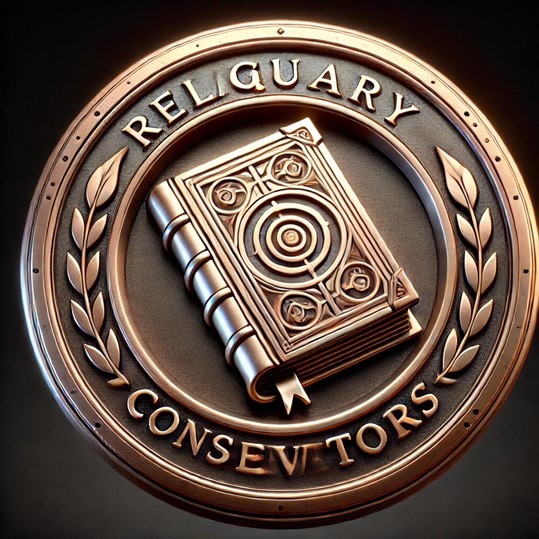
Badge Symbol and Rank Insignia:
- Curator Apprentice: A bronze badge with a simple book icon.
- Artisan Archaeologist: A bronze badge with a book icon and a small, stylized shovel or pickaxe accent.
- Historian Scholar: A silver badge with a book icon and an elegant quill pen accent.
- Reliquary Guardian: A silver badge with a book icon and a shield emblem, signifying protection.
- Curator General: A gold badge with a book icon, a shield emblem, and a radiant sun-like symbol at the center, symbolizing leadership and enlightenment.
Each badge is accompanied by specific color variations, which members can wear on their attire to indicate their rank within the faction.
Enemies and Rivals of the Reliquary Conservators:
- The Arcane Hoarders:
- Conflict: The Arcane Hoarders are a secretive group that seeks to amass magical artifacts for their own power and control. They view the Conservators as obstacles in their quest to obtain rare and potent relics.
- Interactions: The Arcane Hoarders engage in covert operations to steal artifacts from the Conservators’ collections. They also spread misinformation and propaganda to undermine the faction’s reputation.
- Consequences: The conflict could lead to a loss of invaluable artifacts, weakening the Conservators’ ability to preserve history and culture. It might also result in a rise of dark magic or misuse of potent relics by the Arcane Hoarders.
- The Order of Erasure:
- Conflict: The Order of Erasure seeks to erase certain historical truths and artifacts that they believe could destabilize current society. They see the Conservators’ preservation of these artifacts as a threat.
- Interactions: The Order of Erasure engages in propaganda campaigns, attempting to discredit the Conservators and convince the public that certain artifacts should be destroyed or hidden.
- Consequences: The conflict threatens to erase parts of history and cultural heritage, leading to ignorance and a skewed understanding of the past. It could also undermine the Conservators’ efforts to educate and preserve.
- The Relic Redeemers:
- Conflict: The Relic Redeemers are a faction of religious zealots who believe that the artifacts the Conservators protect hold heretical or dangerous powers. They see themselves as agents of cleansing, aiming to destroy these artifacts to “purify” the world.
- Interactions: The Relic Redeemers engage in acts of vandalism, attempting to destroy artifacts and disrupt Conservator operations. They may also attempt to manipulate public sentiment against the faction.
- Consequences: The conflict could lead to the loss of significant historical and cultural artifacts, robbing the world of its heritage and understanding of the past. It could also result in violent confrontations and destabilization.
These conflicts create a dynamic and potentially dangerous environment for the Reliquary Conservators. They must not only strive to fulfill their mission of preservation but also defend themselves against those who seek to destroy or misuse the artifacts they hold dear. The consequences of these conflicts could range from the loss of historical knowledge to potential societal upheaval and the rise of dark powers if powerful artifacts fall into the wrong hands.
Legend of the Lost Archive
Long ago, in the world of Saṃsāra, there existed a hidden repository known as the Lost Archive. This place, buried deep within the heart of a forgotten mountain range, was said to contain the most valuable and ancient artifacts from civilizations long past. The Reliquary Conservators, a faction dedicated to the preservation and protection of history, sought tirelessly to uncover this fabled collection.
The story begins with Eamon Varis, a renowned archaeologist and one of the most esteemed members of the Reliquary Conservators. Eamon had spent his life studying ancient texts and maps, convinced that the Lost Archive was not merely a legend but a real place waiting to be discovered. His dedication was unwavering, and his reputation for deciphering the most cryptic of clues was unparalleled.
One fateful day, Eamon stumbled upon an old manuscript in a dilapidated library within the ruins of an ancient city. The manuscript, written in a forgotten language, hinted at the location of the Lost Archive. Eamon, with his expertise, managed to translate the document, revealing a map that led to the treacherous mountains of the Whispering Peaks.
Eamon assembled a team of skilled Conservators, each with unique abilities in excavation, restoration, and ancient lore. Together, they embarked on a perilous journey, navigating through harsh landscapes, battling the elements, and overcoming numerous obstacles. Their determination was fueled by the knowledge that the Lost Archive could hold keys to understanding Saṃsāra’s history and preventing future calamities.
After months of relentless exploration, the team finally discovered a hidden entrance within a cavern concealed by thick vines and magical wards. Inside, they found the Lost Archive, a vast chamber filled with relics, scrolls, and artifacts of immense historical significance. The walls were adorned with murals depicting the rise and fall of ancient civilizations, their triumphs, and their mistakes.
As they cataloged the treasures, Eamon and his team realized the true value of their discovery. The Lost Archive not only held physical artifacts but also profound lessons from the past, capable of guiding the future. They worked tirelessly to document and preserve everything, ensuring that this newfound knowledge would be accessible to all who sought to learn from history.
News of the discovery spread across Saṃsāra, and the Reliquary Conservators were hailed as heroes. Their efforts had not only enriched the understanding of the world but also emphasized the importance of preserving history. The Lost Archive became a beacon of knowledge, attracting scholars, historians, and adventurers from far and wide.
Moral of the Story: The past holds invaluable lessons that can illuminate the path to a better future. By preserving and learning from history, we can prevent the repetition of mistakes and foster a deeper understanding of our world.