
Lore: In the realm of Saṃsāra, where law and order are essential for stability, the Juris Enforcers stand as a formidable faction dedicated to upholding justice through the role of the bailiff. Originating from a diverse collection of legal scholars, warriors, and experts in mediation, this faction seeks to maintain a balance between maintaining the rule of law and ensuring fairness in a complex world.
Ideology: The Juris Enforcers believe in the primacy of justice and accountability. They see themselves as guardians of a harmonious society, charged with the responsibility of ensuring that laws are upheld, disputes are resolved, and the rights of individuals are protected.
Major Concerns: The Juris Enforcers are concerned with maintaining the delicate equilibrium between order and chaos. They aim to prevent powerful factions from exploiting their might and to safeguard the rights of the weak from undue oppression.
Imperatives:
- Impartiality: Members of the Juris Enforcers are bound by an oath of impartiality, ensuring that their decisions are based solely on the merits of the case, regardless of social status or affiliations.
- Conflict Resolution: The faction places great importance on resolving disputes through negotiation, mediation, and fair trials, seeking to prevent violence and promote understanding.
- Maintaining the Balance: The Juris Enforcers strive to ensure that laws are consistently applied across Saṃsāra, fostering a sense of equity and preventing the rise of oppressive regimes.
Grand Strategy and Goals: The grand strategy of the Juris Enforcers is to establish a system of justice that transcends faction boundaries. They aim to create a network of law enforcement and dispute resolution that is recognized and respected by all factions. Their ultimate goal is to build a realm where justice is accessible, powerful factions are held accountable, and individuals can live without fear of abuse.
Public Motivations and Agenda: Publicly, the Juris Enforcers present themselves as neutral arbitrators, dedicated to ensuring fair trials, protecting the innocent, and upholding the rule of law. They are often called upon to mediate disputes between factions and individuals, positioning themselves as advocates for peace and harmony.
Means and Methods:
- Mediation and Arbitration: The faction uses skilled negotiators and mediators to facilitate peaceful resolutions between parties in conflict, avoiding violence whenever possible.
- Trial by Jury: The Juris Enforcers conduct trials with impartial juries composed of members from different factions, ensuring that verdicts are not influenced by bias.
- Emissaries of Peace: The faction sends envoys to negotiate treaties, ceasefires, and truces between warring factions, leveraging their reputation for impartiality.
Joining the Juris Enforcers offers an opportunity to play a crucial role in upholding justice, resolving disputes, and fostering stability within Saṃsāra. Members must demonstrate a strong sense of ethics, diplomacy, and a commitment to maintaining the balance between factions. As advocates for peace and equity, they navigate a complex landscape where allegiances and enmities can shift in an instant, shaping the destiny of the realm through their actions.
Tags: Justice, Impartiality, Conflict Resolution, Mediation, Arbitration, Legal Expertise, Peacekeeping, Authority, Balance, Negotiation
Joining the Juris Enforcers: Joining the Juris Enforcers is a process that involves both legal expertise and a strong commitment to justice. Prospective members are identified through their reputation for fairness, legal knowledge, and conflict resolution skills. They are then approached by existing members who recognize their potential.
To become a member, candidates must undergo rigorous training in negotiation, mediation, legal studies, and combat. They are tested on their ability to remain impartial and make just decisions under pressure. Once they demonstrate their qualifications and dedication, they are officially inducted into the faction.
Benefits:
- Authority: Members wield significant authority as arbiters and mediators in conflicts, which can grant them access to influential figures and key events across Saṃsāra.
- Networking: The faction provides opportunities to establish connections with leaders of various factions and diplomatic envoys, potentially leading to alliances and partnerships.
- Knowledge Base: Members gain access to an extensive legal library and archives, filled with historical cases, legal precedents, and diplomatic treaties.
Controlled Resources: The Juris Enforcers control a repository of legal knowledge, negotiation techniques, and case histories. They also possess a network of safehouses and diplomatic venues where they conduct mediations and negotiations.
Limitations:
- Lack of Coercive Power: The faction’s influence is limited to their ability to mediate and negotiate; they lack the force of arms that other factions might possess.
- Balancing Factions: The Juris Enforcers must carefully navigate their relationships with powerful factions to avoid becoming pawns in political struggles.
- Vulnerability to Manipulation: Their reputation for impartiality can be exploited by factions seeking to manipulate their decisions or using them as pawns in their own agendas.
Leadership Concerns: The leadership worries about maintaining the faction’s reputation for impartiality and preventing internal corruption. They also face challenges in dealing with factions that might attempt to coerce or manipulate their decisions.
Secret Motivations and Hidden Agendas: While the faction’s public motivations are centered on justice and mediation, some members may secretly harbor ambitions to influence the realm’s power dynamics by using their position to tip the scales in favor of specific factions. These hidden agendas can create tension within the faction’s ranks and challenge their commitment to impartiality.
Pass Phrases, Codes, and Identifying Gestures: Members of the Juris Enforcers use subtle legal terminology and references as pass phrases and codes to identify each other discreetly. They may also use a particular hand gesture – a firm but open palm – to signal their allegiance, symbolizing their commitment to upholding fairness and openness in their dealings.
Friendly Groups:
- The Diplomatic Accord: The Diplomatic Accord values the Juris Enforcers’ dedication to peaceful resolution and often seeks their expertise in negotiating treaties and resolving conflicts.
- The Guardians of Equilibrium: This faction appreciates the Juris Enforcers’ efforts to maintain balance and prevent factions from becoming overly dominant, aligning with their principles of harmony and order.
Ranks and Jobs within the Juris Enforcers:
- Associate Arbiter:
- Associate Arbiters are newly inducted members who undergo training in negotiation, mediation techniques, and legal studies. They assist higher-ranking members in resolving conflicts and learning the ropes of the faction.
- Mediator:
- Mediators are skilled negotiators responsible for facilitating discussions and mediations between factions and individuals. They work to find common ground and resolve disputes through diplomacy.
- Court Justice:
- Court Justices preside over legal proceedings and trials, ensuring that justice is served and decisions are made fairly. They analyze evidence, listen to arguments, and deliver verdicts based on impartial evaluation.
- Diplomatic Envoy:
- Diplomatic Envoys are members entrusted with representing the faction in negotiations with other factions. They work to forge alliances, establish treaties, and navigate the complex web of Saṃsāra’s diplomatic landscape.
- Grand Arbiter:
- Grand Arbiters are experienced leaders within the faction, overseeing major mediations and trials. They set faction strategy, mentor junior members, and have a hand in shaping the direction of the Juris Enforcers.
Advancement: Advancement within the Juris Enforcers is based on a combination of skill, experience, and demonstrated commitment to the faction’s principles. Members who consistently excel in their assigned roles, demonstrate strong ethics, and contribute meaningfully to the faction’s goals are considered for promotion.
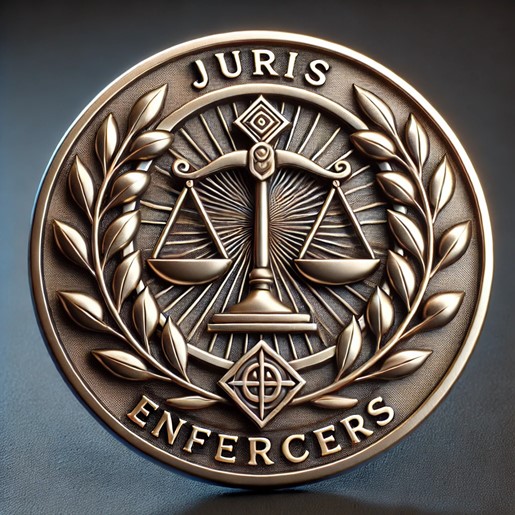
Badge and Rank Symbol:
- Members of the Juris Enforcers wear a distinctive badge denoting their rank within the faction. The badge is a circular pin with a central scale icon flanked by branches of an olive tree, representing justice and peace. Each rank is represented by a different configuration of the scale and branches:
- Associate Arbiter: The badge for Associate Arbiters displays a simple set of scales with a single branch on each side, symbolizing their entry-level role in the faction.
- Mediator: The badge for Mediators features a pair of scales balanced by two branches, reflecting their role in finding equilibrium and harmony in conflicts.
- Court Justice: The badge for Court Justices shows a pair of scales with a third branch added underneath, representing their responsibility in upholding justice through trials.
- Diplomatic Envoy: The badge for Diplomatic Envoys depicts a pair of scales surrounded by two intertwined branches, symbolizing their role in fostering unity and cooperation through diplomacy.
- Grand Arbiter: The badge for Grand Arbiters displays a pair of scales framed by three branches in a triangular pattern, representing their leadership and influence in the faction.
Each badge also includes a subtle emblem that signifies the bearer’s specific rank within the faction. This design allows Juris Enforcer members to quickly identify each other’s roles and expertise during negotiations and mediations.
Enemies and Rivals: The Juris Enforcers’ commitment to justice and balance often puts them at odds with factions and groups that prioritize power and dominance over equity and order. Some of their notable enemies and rivals include:
- The Dominance Coalition: A coalition of power-hungry factions seeking to establish dominance, the Dominance Coalition views the Juris Enforcers’ impartiality as an obstacle to their control and aims to undermine their authority.
- The Faction of Vengeance: Composed of those who seek retribution, the Faction of Vengeance opposes the Juris Enforcers’ emphasis on mediation and negotiation, often preferring violent means to settle disputes.
- The Arbiters of Chaos: This faction thrives on the destabilization of Saṃsāra, and they view the Juris Enforcers’ pursuit of justice as a threat to their agenda of sowing discord.
Conflicts and Interactions: Conflicts between the Juris Enforcers and their enemies arise from differing values, methods, and goals:
- Legal Battles: The Dominance Coalition seeks to challenge the Juris Enforcers’ authority through legal means, using their own legal experts to manipulate the system and gain an upper hand.
- Direct Confrontations: The Faction of Vengeance often clashes with the Juris Enforcers when disputes escalate into violence, creating a tension between the use of force and the pursuit of justice.
- Mediation Attempts: The Juris Enforcers engage in attempts to mediate with the Arbiters of Chaos, aiming to bring stability to areas they disrupt. However, these attempts are met with resistance due to differing ideologies.
Consequences of Conflicts:
- Erosion of Trust: The conflicts erode trust and cooperation between the factions, making diplomatic resolutions more challenging and contributing to an atmosphere of suspicion.
- Destabilization: The Faction of Vengeance and the Arbiters of Chaos contribute to the overall instability of Saṃsāra, further complicating the Juris Enforcers’ efforts to maintain order.
- Shifts in Influence: The conflicts can lead to shifts in influence, with factions gaining or losing ground based on the outcomes of their interactions with the Juris Enforcers.
- Moral Dilemmas: The Juris Enforcers are faced with moral dilemmas when attempting to mediate conflicts involving violence-driven factions. They must navigate the balance between justice and the immediate need for stability.
The consequences of these conflicts ripple throughout Saṃsāra, impacting the realm’s overall stability and the relationships between factions. The Juris Enforcers find themselves in a constant struggle to maintain their principles of justice and impartiality while navigating the complex web of allegiances and rivalries that define the world they operate within.
Legend of the Juris Enforcers
In the days of old, when the lands of Saṃsāra were fraught with chaos and discord, there emerged a band of wise and noble souls who called themselves the Juris Enforcers. Born from the union of learned scholars, fierce warriors, and skilled mediators, their mission was to bring justice and harmony to a world teetering on the brink of turmoil.
The story begins with the Great Council of Tranquillitas, where the leaders of various tribes and factions gathered to seek peace. The council, fraught with disputes and endless debates, seemed destined for failure. It was then that Valeria, a learned scholar of the ancient laws, stepped forth. Her voice, though soft, carried the weight of wisdom. She proposed the formation of an order dedicated to upholding the law and mediating disputes. Thus, the Juris Enforcers were born, with Valeria as their first Grand Arbiter.
The Enforcers established themselves in the Hall of Equilibrium, a grand structure built at the heart of Saṃsāra. From here, they dispensed justice and resolved conflicts, their decisions guided by the ancient principles of fairness and impartiality. One of their earliest and most celebrated cases involved the dispute between the Mountain Clans and the River Tribes, who clashed over water rights.
Valeria, accompanied by her trusted Mediators, journeyed to the contested lands. There, she listened to the grievances of both sides, her demeanor calm and her judgments wise. She proposed a solution that involved sharing the water resources and constructing a system of channels that would benefit both clans. Her decision, accepted by both parties, averted a potential war and cemented the Juris Enforcers’ reputation as impartial arbiters.
As the years passed, the Juris Enforcers grew in number and influence. They became the guardians of justice, their presence a beacon of hope for the oppressed and a check against the ambitions of the mighty. Their emblem, a pair of scales flanked by olive branches, came to symbolize peace and fairness throughout the land.
However, not all was serene. The Dominance Coalition, a faction driven by a lust for power, saw the Juris Enforcers as an obstacle to their ambitions. They sought to undermine the Enforcers, spreading lies and attempting to bribe key members. Yet, the Enforcers remained steadfast, their commitment to justice unshaken. They exposed the Coalition’s deceit, preserving their integrity and the trust of the people.
The most perilous trial came when the Arbiters of Chaos, a group reveling in anarchy, unleashed a wave of disruptions across Saṃsāra. The Juris Enforcers, led by Valeria’s successor, Grand Arbiter Dorian, faced a series of challenges that tested their resolve. Through strategic negotiation and unwavering dedication, Dorian and his team managed to restore order, proving that justice, though often challenged, could prevail against even the most chaotic forces.
Moral of the Story: Justice and fairness are the bedrock of a harmonious society. In the face of discord and deceit, unwavering commitment to these principles can guide a realm towards lasting peace and stability.