
Original Life Forms Referenced
Class Mammalia: Pangolin
Class Reptilia: Gila Monster
Class Insecta: Antlion (adult & larval traits)
Class Cephalopoda: Blue-ringed Octopus
Appearance
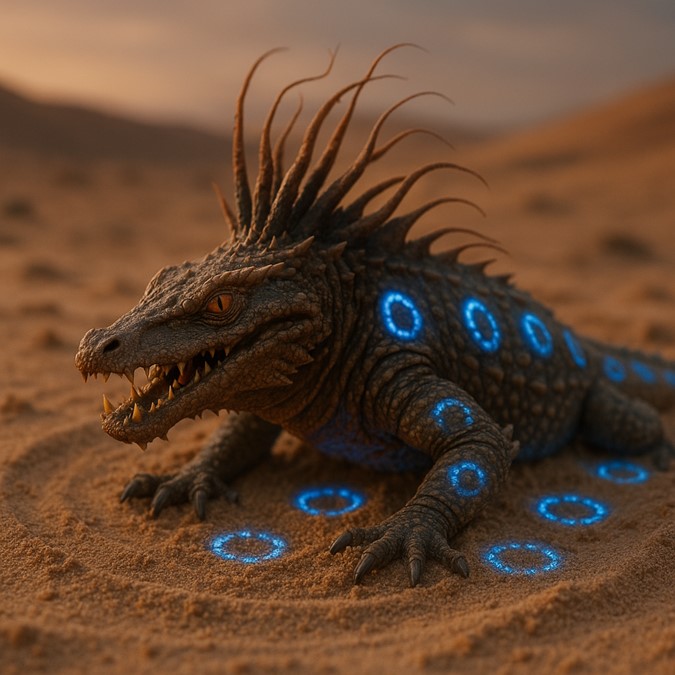
Vulcryntheris 918 carries a low, broad body covered in overlapping, keratinous pangolin scales patterned with mottled desert-brown and iridescent blue-ringed highlights. Along its spine, these scales are edged in rough, granular texture reminiscent of Gila monster skin, secreting faint venomous oils. Its head blends the squat, wide mouth of an antlion with the sharp, forward-set eyes of a predator, framed by short, writhing octopus-derived sensory tendrils tipped with bioluminescent blue rings that pulse when agitated. Four muscular, clawed legs are adapted for both rapid digging and sudden lunges. A long prehensile tail, scaled on top and soft-skinned below, ends in a flexible, squid-like siphon capable of blasting short-range jets of venom-infused sand.
Size
Length: 1.8 m (6 ft)
Height: 0.9 m (3 ft) at shoulder
Weight: ~85 kg (187 lbs)
Speed
Land: 25 ft per round (burrow 15 ft)
Short burst: 35 ft per round for up to 3 rounds
Climb: 10 ft per round
Stat Modifiers
+2 Dexterity
+2 Constitution
−1 Charisma
Skills
- Stealth (burrow concealment, camouflaging in debris)
- Perception (vibration and heat sensing through tendrils)
- Athletics (short lunges, rapid digging)
- Survival (ambush positioning, hunting in arid zones)
Behavior
The Vulcryntheris 918 is an ambush predator, burying itself beneath sand or loose soil with only its bioluminescent tendril rings showing as false water-glints to lure prey. It strikes with explosive speed, gripping with claws while blasting sand in the face of attackers. It is solitary outside of short mating windows and highly territorial, often marking the edges of its range with chemical scent-trails from its venom oils.
Diet
Primarily carnivorous—small mammals, lizards, large insects—but will scavenge carrion. Its venom-infused saliva begins breaking down prey tissue within minutes, aiding digestion.
Emotions
Displays patience during hunts, sudden aggression when threatened, and surprising caution around larger predators. Territorial pride manifests in repeated patrolling of its burrow networks.
Environment Where Found
Dry coastal dunes, arid scrublands, and inland deserts where loose soil allows for easy burrowing. Occasionally spotted along salt flats where prey is drawn to scarce water sources.
Tags
Feral, Predator, Venomous, Ambush-Hunter, Desert-Dwelling, Burrower, Bioluminescent, Solitary, Lure-Tactic, Territorial, Digging-Claws, Scaled-Armor, Sand-Jet, Cephalopod-Adaptation, Heat-Sensing, Defensive-Oils, Medium-Beast
Life Cycle
- Hatchling Stage (0–6 months): Born from leathery, sand-colored eggs laid in deep, warm burrows. Hatchlings are only 15 cm long, with soft scales and muted ring markings. They remain hidden in the parental burrow for several weeks, feeding on regurgitated partially digested prey from the mother.
- Juvenile Stage (6 months–3 years): Scales harden and distinctive blue-ring bioluminescence develops. Juveniles leave the parental burrow after their first year to establish shallow hunting pits within the parent’s territory fringe.
- Adult Stage (3–12 years): Fully mature scales and venom potency. Adults claim and defend a large hunting and burrowing range, creating a network of hidden ambush chambers.
- Elder Stage (12+ years): Reduced hunting activity but increased territorial defensiveness. Elders often seal themselves in deeper burrows during harsher seasons, living off stored kills or carrion.
Mating
- Occurs once per year during the warmest part of the dry season when bioluminescent rings glow in vivid, rhythmic pulses visible from up to 50 meters away.
- Males perform a slow circling display, ejecting fine arcs of sand from their siphon to create patterned rings around the female’s burrow entrance.
- Females choose mates based on the vibrancy and coordination of the light-and-sand display, which signals health and venom potency.
- After mating, the female drives the male away and constructs a deep nesting burrow lined with shed scales and hardened sand walls to regulate humidity and temperature for the clutch of 4–6 eggs.
Tactics
- Ambush Luring: Lies buried with only glowing rings showing, mimicking the shimmer of water or the movement of small prey.
- Sand-Jet Disorientation: Fires a short, pressurized blast of sand mixed with venomous oils to blind and confuse attackers or prey.
- Rapid Strike: Explosive lunge with claws and crushing bite to immobilize prey before envenomation.
- Burrow Collapse Trap: Undermines terrain beneath a prey path, causing collapse and trapping the victim.
- Venom Drain: Keeps prey alive but paralyzed to ensure fresh feeding over several hours or days.
Actions
- Burrow Shift: Relocates dens seasonally to follow prey migrations.
- Ring Flash Communication: Uses pulsing light patterns to warn rival Vulcryntheris of territory boundaries.
- Heat and Vibration Scan: Sweeps tendrils through sand to detect faint thermal signatures and ground vibrations.
- Predator Avoidance: When outmatched, will eject a concentrated venom-oil plume, creating a noxious haze that masks scent and irritates mucous membranes, buying time to escape.
Other Interesting Information
- The venom of Vulcryntheris 918 is prized by Stillbay desert apothecaries for creating both paralytic hunting serums and potent anti-coagulants.
- Their hardened scales are sometimes collected after natural shedding and used to craft decorative yet functional laminar armor for Tier-1 avatars.
- In Saṃsāra folklore, their glowing rings are said to be “the eyes of the buried moon,” guiding lost travelers to hidden oases—but this is a dangerous superstition, as most who approach are never seen again.
- Extremely sensitive to magic surges in the environment, Vulcryntheris 918 often retreats deep underground before large-scale mana storms. This behavior sometimes alerts desert nomads to incoming magical weather.
- Lifespan averages 15 years in the wild, though some domesticated for venom harvesting in fortified pit enclosures have reached 20 years.
Adventurers on Saṃsāra might encounter or deliberately seek out the Quoravex 671 for several interconnected reasons tied to its ecology, magical properties, and the societal needs of surrounding settlements.
1. Harvesting Rare Magical Resources
The Quoravex 671’s composite biology produces several unique materials highly valued in Stillbay and other island nations. Its silicate-infused scutes, flexible yet magically conductive chitin, and glandular secretions can be crafted into specialized armor, alchemical catalysts, and enchantment foci. The market demand for such goods draws not only hunters but also licensed harvesting parties operating under royal charter.
2. Territory Incursions into Trade Routes
When magical weather patterns shift, Quoravex populations sometimes expand beyond their normal habitats into vital coastal or overland trade corridors. These incursions disrupt caravans and shipping convoys, as the creatures’ predatory instincts and resource hoarding behaviors lead them to ambush supply trains and defend captured goods with tenacity. Adventurers are contracted to locate, displace, or eliminate such threats.
3. Guardian Beasts of Forgotten Ruins
Quoravex 671 is often found nesting in or around ancient, ice-etched ruin complexes and submerged vaults—remnants of long-fallen civilizations. Whether drawn by the ambient magical resonance or the availability of fortified shelter, their presence makes these sites hazardous to explorers. Adventurers seeking relics, lost gear, or arcane knowledge must contend with these territorial sentinels.
4. Ritual Trials for Local Prestige
Some Stillbay coastal clans, influenced by the Tidebound Covenant, view the hunting of a Quoravex as a rite of passage for Tier-2 warriors seeking societal recognition. Such hunts are ritualized, with strict rules about engagement methods, and are often sponsored by the monarchy to strengthen loyalty among elite fighters. Adventurers may be invited—or coerced—into participating to prove worthiness or gain political favor.
5. Bounty for Overpopulation Control
In high-magic years, the Quoravex reproductive cycle accelerates, and juvenile packs threaten to destabilize local ecosystems by outcompeting other apex predators. The crown issues bounty notices, sometimes with bonuses for capturing live specimens for controlled relocation. Adventurers skilled in nonlethal takedown are especially valued for such contracts.
6. Quests for Exotic Companions or War Beasts
Wealthy Stillbay nobles and military officers occasionally seek juvenile Quoravex for training as battle companions or ceremonial beasts. Their combination of brute strength, adaptive camouflage, and semi-trainable intelligence makes them formidable assets—if captured young and conditioned early. Such missions require subtlety, endurance, and significant risk to the capture team.
From the corpse of a Quoravex 671, skilled harvesters can obtain numerous valuable components, each with distinct uses in Saṃsāra’s economy, magic, and crafting traditions. The extraction process is usually done in stages, with specialist teams handling particularly volatile or perishable materials.
1. Silicate-Infused Scutes
Description: Layered, glass-hard dermal plates reinforced with crystalline silica strands and faint magical conduits.
Uses:
- Forged into composite armor plates that are both lightweight and highly resistant to slashing damage.
- Ground into powder for alchemical heat-resistant sealants.
- Shaped into conduit-inlays for magical gear to improve mana channeling efficiency.
2. Chitin-Silk Tendons
Description: Dense, elastic connective fibers interwoven with natural chitin for both tensile strength and flexibility.
Uses:
- Bowstrings and siege weapon torsion cables with near-unbreakable draw resistance.
- Flexible joints for articulated magical constructs.
- Binding threads for ritual wards, as they can hold enchantments far longer than mundane fibers.
3. Bio-Luminal Gland
Description: A volatile organ that produces a steady, cold magical glow in a shifting spectrum of colors.
Uses:
- Primary reagent in potions that enhance low-light vision or reveal hidden magical glyphs.
- Core component for lighthouse beacons along treacherous Stillbay coasts.
- Altar lighting for Tidebound Covenant temples where flame is forbidden.
4. Frost-Slick Secretion
Description: A viscous, alchemically reactive slime excreted from subdermal reservoirs to regulate temperature and prevent ice adhesion.
Uses:
- Applied to weapons for a temporary frostbite effect in combat.
- Used in metallurgy to chill rapidly forged components without shattering.
- Ingredient in brews that cool the body in fever-reducing poultices.
5. Resonance Spine
Description: A long, ridged vertebral column that hums faintly when exposed to certain sound frequencies or magical vibrations.
Uses:
- Carved into instruments capable of producing harmonics that disrupt stealth magic.
- Structural reinforcement for ships, resisting both mundane and magical impact.
- Embedded in ceremonial staffs for Tidebound Covenant high priests to amplify chant-based spells.
6. Quoravex Heart-Core
Description: Dense muscular heart lined with metallic micro-nodes that store residual mana.
Uses:
- Extracted mana nodes can power Tier-1 and Tier-2 magical devices for short durations.
- Used whole in rare resurrection or vitality-restoring rituals, often as a proof of the hunter’s strength.
7. Triple-Claw Phalanges
Description: Hardened, serrated claws with mineralized edges.
Uses:
- Forged into daggers and arrowheads with natural armor-piercing qualities.
- Ground into a gritty abrasive for polishing enchanted glass or crystal lenses.
8. Deep-Scent Gland
Description: A submandibular pouch that emits a pheromonal musk detectable by predators and prey at great distances.
Uses:
- Used by trackers as a lure for other Quoravex during population control hunts.
- Processed into extremely potent bait for fishing in deepwater regions.
Cold-Blooded King and Ice That Would Not Break
In the time before the nets were mended and the bells of Stillbay were hung above the tide, the Quoravex walked between the wind and the frost, wearing the shape that was not yet set. It came from the hollow between sky and water, where no wave remembers its own name. There it learned to crawl like the serpent, to strike like the hawk, and to stand as if the ground itself feared to move beneath it.
The elders say there was a village called High-Shell, though none remember where it stood, for its stones have long been fed to the sea. This village’s people lived by the quiet hunt, taking fish in winter when the ice sang and the nets could speak to the moon. One year, the frost stayed too long, and the fish hid in holes too deep for rope or spear. The bellies of the people grew silent.
It was then that an old woman with eyes the color of deepwater told of the Quoravex, a beast whose blood was a river of cold fire, whose plates shone like glass in the moonlight, and whose bones could make a spear sing until it broke the skin of any prey. She said: “One heart of the Cold-Blooded King will warm the village for fifty nights, but only if taken by those who walk without fear.”
Three hunters set out: the Tall One, whose shadow fell like a mast’s; the Bent One, who carried the scars of other hunts; and the Quiet One, whose feet did not trouble the frost. They followed the trail of broken ice and frost-slick slime, where even the sun would not touch. For seven days and nights, the wind carried no birdsong, and the ice groaned like an old man’s back.
On the eighth night, they found the Quoravex, standing in the white silence. Its eyes burned pale as the northern moon, and its tail swept the snow as if writing the names of the dead. The hunters remembered the old woman’s words: “Strike not the first time, nor the second, for the King will test you with wind and shadow.”
They circled it once; the beast gave chase, and its claws tore lines in the ice that steamed like hot breath. They circled it twice; the frost in the air turned to needles that bit their skin. Only on the third turn did the Tall One leap with his spear, the Bent One bind its foreleg with rope of seal-hide, and the Quiet One slip beneath its belly to cut free the Heart-Core.
When the Quoravex fell, it made no sound—only the wind sighed, and the ice did not groan again that winter. They carried the heart back, wrapped in kelp and prayer, and the old woman boiled it in a cauldron of snowmelt and salt. The people drank, and their breath no longer clouded in the cold; their nets caught fish even in the deepest dark; and the bells of High-Shell rang for the first time in many years.
But the old woman whispered to the hunters in the night: “You have taken from the King. One day, the frost will come to take from you.” And so it did—when the hunters’ hair was silver, and the frost stayed too long once more, a shape moved beyond the ice, wearing eyes like the moon and claws that carved the snow into names.
Moral: The gifts of the cold are never free, and what is taken in hunger will one day return in hunger.