
(Derived from: Velvet Worm + Crustacean + Urial + Thrush)
- Original Life Forms Referenced (Animalia Kingdom):
- Onychophora (Velvet Worm) – soft-bodied ambush predator known for slime-spraying
- Crustacea (Fiddler Crab) – asymmetric claws, burrowing, territorial signaling
- Mammalia (Urial) – wild sheep known for cliff-running, headbutting, and sharp vision
- Aves (Blue Whistling Thrush) – mountain-dwelling songbird with piercing whistles and insect diet
Appearance: Velcruith 422 is a chimeric mountain-stalker, with the stocky frame of a quadruped built for sheer inclines. Its body is covered in plush, iridescent setae like a velvet worm, which constantly ripple with low-pitched vibration. A massive asymmetrical claw juts from its right forelimb—chitinous and jointed like a crab’s, pulsing with blue bioluminescence. Its head resembles a horned ungulate with avian eyes and narrow jaws capable of emitting high-frequency sound bursts. Sprouting from its spine are tough, segmented antennae used for scanning vibrations and temperature.
When still, it looks like a bushy patch of rockmoss. When moving, it glides in loping arcs, suddenly halting to spray mucus or whistle explosively.
Size:
Shoulder Height: ~3.5 feet
Length (head to tail): ~6 feet
Weight: 120–140 lbs
Speed:
- Land Speed: 30 ft (can sprint in bursts of 50 ft on vertical terrain)
- Climb Speed: 20 ft (can ascend rock, wood, and dense bark with ease)
- Burrow Speed: 10 ft (can briefly dig shallow furrows in soft mountain clay or wet lichen)
Stat Modifiers (Tier 1):
- Strength: +2 (powerful claw, ramming horns)
- Dexterity: −1 (bulk and claw weight reduce subtle motion)
- Constitution: +1 (resilient tissues and heat tolerance)
- Intelligence: −2 (instinctual; limited short-term learning)
- Wisdom: +2 (high perception and environmental awareness)
- Charisma: −1 (unsettling appearance and sound bursts)
Skills:
- Athletics: +3 (mountain running, climbing, charging)
- Stealth: +2 (inert camouflage; immobile deception)
- Perception: +3 (sensitive to vibrations, sound shifts, and temperature)
- Survival: +2 (identifies prey, shelter, and terrain hazards)
- Intimidation: +1 (claw snapping, mucus hiss, sonic whistle)
Behavior: Velcruiths are territorial ambush creatures that perch motionless for hours, scanning for vibrations or air pressure changes. They defend nesting zones with wide-claw displays, sudden mucus sprays, and high-pitched whistles that disorient foes. Outside of breeding, they are solitary, fiercely defending cliffside dens made of sun-warmed rock and moss.
They show limited curiosity—often approaching novel sound sources—but flee from intense light or persistent echo-based magic. During rainstorms or misty dawns, they become hyperactive and may roam for new burrow-sites or fresh prey.
Diet:
- Carnivorous: small birds, rodents, insects, and other cliff-dwelling creatures
- Occasionally scavenges decaying organic matter
- Licks mineral deposits from cliff walls to metabolize silicates for claw maintenance
Emotions:
- Neutral: Cautious, still, mildly alert
- Aggressive: Claw held high, frill extended, whistling bursts at 120+ decibels
- Mating: Repetitive clicking with claw and extended antennae tapping
- Distressed: Emits pulsing “gurgle chirps,” sprays slime in arcs
- Content: Emits low, subsonic thrumming—feels like pressure underfoot to nearby observers
Environment Where Found:
- Steep, humid cliff-faces near geothermal ridges
- Fog-drenched mesas, sun-shaded crags, or mossy escarpments
- Especially active in the mineral-rich slopes of the Tuunek Spiral Range and the whispering walls of Dreadnotch Gorge
Tags: Feral, Mountain-Dwelling, Ambush-Predator, Sonic-Based, Slime-Spitter, Camouflaged, Climber, Cliff-Warden, Bioluminescent, Asymmetric-Limbed, Ungulate-Hybrid, Invertebrate-Tissue, Temperature-Sensitive, Solo-Territorial, Tier 1, Rare
Stat Modifiers (Tier 1):
- Strength: +2 (due to its oversized claw and headbutting horns)
- Dexterity: −1 (asymmetrical limbs and weight imbalance affect agility)
- Constitution: +1 (rugged tissue, slime-sealing wounds, heat/cold tolerance)
- Intelligence: −2 (limited reasoning, instinct-driven behavior)
- Wisdom: +2 (high sensory acuity and environmental awareness)
- Charisma: −1 (unnerving appearance, shrieking vocalizations)
Skills (Tier 1):
- Athletics: +3 (rock scrambling, uphill charges, combat leaps)
- Perception: +3 (keen sound, vibration, and air-pressure detection)
- Stealth: +2 (inert camouflage when stationary)
- Survival: +2 (foraging, scenting water, navigating fog-shrouded cliffs)
- Intimidation: +1 (sound bursts, claw-rattling, and body display posture)
Age:
- Lifespan: 16–21 years
- Maturity: Reaches full adulthood by age 2
- Tier 1 Typical Age Range: 1–4 years (juvenile to young adult; territorial and erratic)
Height:
- ~3.5 feet at shoulder
- ~5.5 to 6 feet long from horned head to tailbase
- ~5 feet upright when threatening display is triggered
Weight:
- 120–140 lbs
- Muscle-dense and moisture-rich body; asymmetrical weight from oversized claw
Speed:
- Land Speed: 30 ft
- Climbing Speed: 20 ft (adheres to rocky, barked, or mossy surfaces)
- Burrow Speed: 10 ft (shallow clay/silt layers only; used to nest or ambush)
- Sonic Dash (special): Can burst up to 50 ft once per short rest using sound-enhanced startle leap
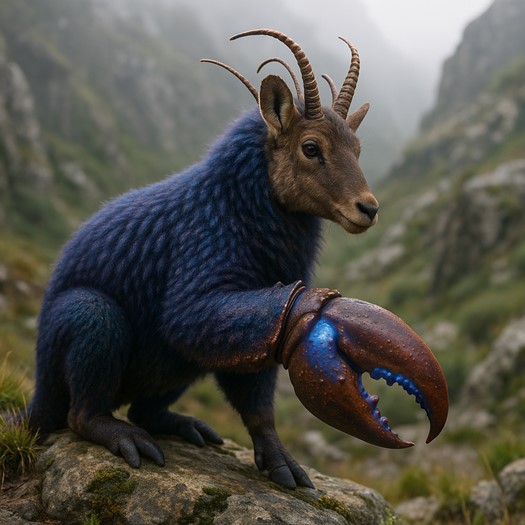
Adventurers may encounter or pursue the Velcruith 422 for numerous compelling reasons—ranging from alchemical opportunity to strategic necessity, lore-driven prophecy, or ecological disruption. Its hybrid form, defensive mechanisms, and cliffside habitat position it as both a predator and a key to ancient secrets within the mountains of Saṃsāra.
1. Harvestable Materials for Rare Crafting
The Velcruith 422 possesses several components highly sought by alchemists, armorers, and sonic engineers:
- Vibrating velvet setae are used in cloaks that dull movement noise or disrupt tracking spells.
- Chitinous asymmetrical claw can be shaped into resonant gauntlets or siege-harpoons.
- Mucus glands yield a viscous adhesive perfect for trap glyphs, restraint tools, or potion-binding stabilizers.
Adventurers might be sent to locate and harvest these items—either for profit or in response to a commission from a guild, whisper-chemist, or artisan enclave.
2. Aggressive Expansion into Trade Routes
The creature’s growing population has begun inhabiting cliff passes and cave roads, particularly those near the Verdhold Ridge and Tuunek Spiral Range, threatening:
- Trade caravans
- Messenger lines
- Pilgrim routes between sky-shrines
Herders, clergy, or mountain-dwelling city-states may hire the party to cull, redirect, or lure away a nest of territorial Velcruiths before the creatures collapse vital transit.
3. Ritual Beast in Cliff-Warden Trials
In certain highland cultures—particularly among the Karrak-horn Brotherhoods or Mistwatcher Clans—the Velcruith 422 is revered as a sacred adversary in rites of adulthood or vision-seeking.
Adventurers might be:
- Escorts to an initiate
- Forced to take the trial themselves to earn a title or favor
- Hunting one to recover a songbone used in “cliff-chant” ceremonies that mimic its whistle
4. Echo-Fraud Incident
An unusually large Velcruith may have mimicked the whistle-signals of aerial messengers or avalanche warnings, triggering:
- Misdirected troops
- Collapsed mining tunnels
- Lost expeditions following false calls
The party is hired to track and neutralize the sound-thief, or recover missing explorers led astray by the creature’s disorienting shriek mimicry.
5. Mysterious Guardian of an Ancient Vault
Legend tells of an echo-keyed vault carved into the mountain’s spine where ancient mind-glyphs sleep behind a pressure-locked gate. Only a creature capable of producing a three-toned whistle and limb pressure pattern can open it.
The Velcruith 422 is either:
- The last living cipher to the vault’s unlocking
- Or the involuntary warden, drawn to the area and now defending it from any approach
The party must choose whether to study it, tame it, or risk provoking it into battle to reach what lies beyond the gate.
6. Beacon for Subterranean Predators
Some theorize that the subsonic pulse emitted by mature Velcruiths resonates with ancient deep-dwelling monsters, acting like a slow heart-signal across stone.
A party may discover that Velcruith 422 sightings correlate with seismic readings and fear-laden prophecies. Stopping it—or following it—could lead to the emergence (or suppression) of a greater threat.
7. Lost Familiar or Evolved Companion
In certain deep records, mention is made of a named Velcruith, trained in the age of glass temples to serve a sound-mage known as Elymox of the Fifth Spiral.
Some arcane circles believe one such creature may still live—an ancient mutant whose echo-mimicry includes languages now extinct.
The party may be commissioned to find this relic, decode its echoes, or determine if it holds the last living voice of an extinct civilization.
The corpse of a Velcruith 422 is a rich—if volatile—source of unique biological and arcano-organic materials. Its hybrid composition, toxic defense adaptations, and harmonic structures make it a highly valued target for harvesters, alchemists, ritualists, and sonic engineers. However, many of its components are time-sensitive, resonance-reactive, or environmentally unstable if not handled correctly.
Harvestable Components from a Velcruith 422
1. Chitonclaw Core (Asymmetrical Fiddler-Claw Carapace)
- Use:
• Forged into Resonant Gauntlets or Ritual Blades—tools that vibrate at specific frequencies, granting sonic bonuses or disrupting crystal/golem defenses.
• Ground and infused into siege-horn harpoons, which ignore certain magical silence effects. - Harvest Notes: Must be carved within 30 minutes to retain internal calcium harmonics. Cracks if chilled or struck with steel.
2. Velvet Setae Hide (Rippling iridescent worm-fur)
- Use:
• Used in crafting Silenceweave Cloaks—garments that absorb ambient footfalls and soften spell gestures.
• When dissolved and filtered, produces Whisper-Dust, applied to weapons or scrolls to mute activation sounds. - Harvest Notes: Must be plucked while moist. Exposes natural mucus channeling structures underneath.
3. Mucosal Pressure Glands (Internal sac system tied to slime defense)
- Use:
• Distilled into Slimehold Resin, a viscous binding agent used in climbing gear, binding runes, or trap glyphs.
• Mixed with specific lichens, forms Echoseal Paste, used to coat walls against scrying or audio projection. - Harvest Notes: Highly reactive. Will burst if agitated or exposed to sharp sound (e.g., shouting, clanging).
4. Subsonic Throat Whorl (Internal cartilage ring chamber for whistling)
- Use:
• Can be used to craft Whistle Wands—wands that mimic spells like Thunderwave, Minor Illusion, or disorienting shout effects.
• Rare enchanters bind them into Harmonic Locks—devices that require precise tone to unlock. - Harvest Notes: Only found in adults. Freezes under 5 °C, loses tone stability if left in dry air.
5. Antennae Fractures (Segmented spine-like sensors)
- Use:
• Used in Vibration Rods—tools for sensing pressure shifts, footsteps, or tunneling creatures.
• Wound into signal charms—when enchanted, resonate when specific words or sounds occur nearby. - Harvest Notes: Shatter if overbent. Must be harvested with bone pliers or clay-carved tools.
6. Horn Echo-Spires (Ram-horn-like protrusions)
- Use:
• Serve as focuses in sonic divination or used to make Echo-Fang Instruments, which can replicate languages or battle cries.
• Burnt horn-ash is infused into memory-recall incense used by monks and psychomancers. - Harvest Notes: Hollow, must be emptied of marrow residue without fracturing resonance lines.
Optional Rare Drops (1d6 on high-tier or elder specimen):
- Vibraglass Pearl – Organic resonance gem, stores one sound perfectly until triggered
- Cragspit Stone – Hardened mucus gland capable of disrupting footing like a grease spell
- Throat-Ember – Warm node used to start fires with breath or empower sonic damage
- Silent Heart – Pulsating gland that nullifies nearby magic for 3 seconds once/day
- Cliffbone Totem – Etched bone fragment that grants surefooting on vertical terrain
- Mistpulse Gland – Emits faint sonic aura, causes sleep in vermin or low-tier beasts
These ingredients are sold in:
• Steep-market alchemist rings
• Sky-monk monasteries
• Beast-dismemberer guilds
• Glass-singer merchant ships crossing cliffside cities like Rell’thun or Skarhold-on-the-Mist
From the Scroll of Split-Wind Echoes, Fragment XI-b
“The Horn That Whispered to the Mountain and Was Answered by Stone”
—poorly translated by the Cloudvault Chroniclers from pre-Vellune cliff glyphs, themselves a fading memory of a language spoken only in echo
In the mist-before-now, when rock still listened and sky had not yet learned how to fly,
there was a creature, or a not-creature, or a question-with-a-shell.
It was not named in the way names are now made, but it was known by its weight upon the stone,
its shimmer in the un-light,
and the way its horn curved like a promise half-kept.
It was called Velcruith in the crooked tongue,
which means, maybe, “He-Who-Sings-Without-Song,”
or else “That-Which-Runs-Sideways-Through-Time.”
This Velcruith was not born,
but shaken loose
when a mountain groaned too loudly in its sleep
and a fissure opened that hummed like a flute carved from regret.
Velcruith did not speak.
But the world heard it anyway.
It walked on four legs but leaned to five,
its claw large enough to carry a shadow
and its frill pulsing with the breath of pressure.
It lived on mist.
It dined on sound.
And it sang—not like birds, nor beasts, nor bards—but like rock remembering rain.
Each night it would climb to the cliff’s lip and release a whistle so sharp
that time would wince
and loose stones would remember their old shapes and try to roll home.
And the mountain listened.
And the wind forgot itself.
And the echoes bent backward.
One day, a child—possibly a wanderer, possibly a storm disguised as a child—
came to the cliff.
They wore no shoes, for they had been swallowed by a word long ago.
They carried no blade, for the air had dulled all sharpness.
But in their chest they held a hollow space shaped like a question:
“Who calls to the mountain?”
The Velcruith answered—not in words, but with a spray of vibration
that twisted the air into a shape the child could not hold.
And so the child became like the mountain—still, patient, and slowly breaking.
The Velcruith placed its claw to the stone,
and in that moment, the cliff remembered the child’s name.
The mountain whispered back:
“The answer to the song is silence.”
And the cliff cracked.
From that rift came a wind so old it could not be measured,
and the child was never seen again,
though sometimes their laughter is heard in the echo of falling rocks.
The Velcruith descended, molting its horn,
leaving it wedged in the fault-line like a bookmark in the spine of the world.
That horn—still thrumming, still whispering—
is said to grant one sound that the mountain will obey:
a cry for shelter, a call for guidance,
or, once, a command to bury a war beneath ten thousand stones.
It has not been seen since.
But the valley beneath that cliff is still silent.
No birds sing there.
No name holds.
And the wind, when it passes through, hums with something almost like a question.
Moral of the Story: Even the mountain will answer if you ask in the language of stillness, but beware—the answer may bury you.