
ORIGINAL LIFE FORMS:
- Class Insecta: Giraffe Weevil (Trachelophorus giraffa)
- Class Mammalia: Platypus (Ornithorhynchus anatinus)
- Class Osteichthyes: Archerfish (family Toxotidae)
- Class Arachnida: Trapdoor Spider (family Ctenizidae)
APPEARANCE: The Toxophorus is a bizarre, low-profile creature that seems to defy all logical classification. Its main body is about two feet long, squat, and covered in a hard, glossy, and often colorful chitinous carapace, much like that of a weevil. From its rear emerges the wide, flat, leathery tail of a platypus, which it uses as a rudder in the water. It has six legs: the front four are insectoid, stout, and used for walking on land, while the two rear legs are thicker, mammalian, and have webbed feet for swimming. Hidden on the inside of each rear ankle is a sharp, venomous spur.
The creature’s most striking feature is its neck. Like the Giraffe Weevil, it possesses an impossibly long, thin, and heavily articulated neck that can be three to four feet in length. This allows it to raise its head high above its body like a periscope. At the end of this neck is not a small insect head, but the rubbery, sensitive, duck-like bill of a platypus. The creature’s nostrils and a specialized groove for firing water jets are located on the top of this bill. Its eyes are small and beady, set on either side of the neck’s base on the main body.
SIZE: The core body of a Toxophorus is small and dense, weighing around 30 to 40 pounds. However, its extremely long neck gives it an effective height or reach of over four feet, making its perceived size much larger.
SPEED: On land, the Toxophorus is slow, awkward, and vulnerable. In the water, it is a graceful and efficient swimmer, using its webbed hind feet and beaver-like tail for propulsion. It is also an exceptional burrower, able to excavate extensive, waterproof tunnels in riverbanks.
STAT MODIFIERS: Strength: Low Stamina/Constitution: Moderate Dexterity: High Perception: Very High (electro-reception) Intelligence: Moderate (instinctual engineering) Willpower: Moderate Charisma/Social: Very Low
SKILLS: Ranged Attack (Water Jet): Capable of spitting a high-pressure jet of water with extreme accuracy. Trap Construction: Weaves silk from abdominal spinnerets to construct intricate, camouflaged trapdoors for its burrows. Burrowing: Can create complex, multi-chambered dens in soft earth. Swimming: A fast and agile swimmer. Electro-reception: Its platypus-like bill can detect the faint electrical fields generated by the muscles of other creatures underwater or in mud. Venomous Strike: Its ankle spurs can deliver a potent, pain-inducing venom.
BEHAVIOR: The Toxophorus is a semi-aquatic, territorial trap-maker. Its entire life revolves around its burrow, which is an engineering marvel. It excavates a complex, multi-chambered den into a riverbank, with at least one entrance underwater and one on land. The land entrance is covered by a perfectly camouflaged, silk-hinged trapdoor made of woven silk, mud, and local foliage.
Its hunting style is patient and tactical. It will often hide just below the water’s surface, raising its head on its long neck like a periscope to survey the area. Using its bill’s electro-sense, it can detect fish or crustaceans moving in the murky water. Alternatively, it will hide in its burrow and wait for a creature to step on or near its trapdoor. Its primary offensive tactic is its water jet. It can shoot a powerful, focused stream of water at targets up to 15 feet away, accurately knocking large insects, birds, or rodents off branches or banks and into the water. Once the prey is in the water and disoriented, the Toxophorus will swim out to retrieve it. For larger or more dangerous prey, it will attempt to lure them over its trapdoor, which gives way under their weight, dropping them into a chamber below where the creature can attack them with its venomous spurs.
DIET: The Toxophorus is a carnivore, subsisting on a diet of fish, frogs, crustaceans, large insects, and any small land animals it can successfully knock into the water or trap in its burrow. It uses its bill to sift through mud and silt for smaller prey, and its venomous spurs to dispatch larger victims that have fallen into its trap.
EMOTIONS: The creature displays a methodical and industrious nature. It seems perpetually busy, either hunting, maintaining its burrow, or reinforcing its trapdoor. It is not overtly aggressive and will typically retract its long neck and hide if it senses a large threat. However, it is fiercely defensive of its burrow. If its den is directly threatened, it will attack relentlessly with its venomous spurs and water jets until the threat is neutralized or driven away.
ENVIRONMENT WHERE FOUND: The Toxophorus is found exclusively along the banks of freshwater rivers, streams, lakes, and in large, marshy wetlands. It requires a specific type of environment: calm or slow-moving water adjacent to soft, stable earth or clay banks suitable for the construction of its elaborate burrows.
TAGS: Feral, Magical Beast, Carnivore, Piscivore, Semi-Aquatic, Trap-Maker, Venomous, Ranged Attack, Burrower, Riverbanks, Wetlands, Chimera, Abomination, Water-Jet, Electro-reception, Silk-Spinner, Periscope-Neck, Ambush-Predator, Territorial
AGE
The Toxophorus 404 is an industrious creature with a relatively short but busy lifespan, typically living for 10 to 15 years. Its life is one of constant construction, hunting, and territorial maintenance.
The life cycle begins in a clutch of 20 to 30 small, translucent eggs wrapped in a waterproof silk cocoon. This egg sac is hidden in a special, air-filled chamber deep within the parent’s burrow. Upon hatching, the larval young, known as “Spitters,” are almost entirely aquatic. They are tiny, lack the species’ signature long neck, and live in the underwater passages of the burrow, feeding on algae and tiny crustaceans.
After about a year, the juvenile “Weaver” stage begins. The creature’s neck undergoes a period of rapid, incredible growth. It is at this stage that the parent drives the young out of the burrow to fend for themselves. A Weaver will spend the next two years practicing its skills, digging its first rudimentary burrow, learning to spin silk for its trapdoors, and hunting small insects with weak pulses of water.
An adult Toxophorus, from age three onward, has reached its full size and potential. Its neck is fully grown, its venom spurs are potent, and its trap-making abilities are masterful. An adult’s entire life is dedicated to the endless expansion and perfection of its single, massive burrow complex, which becomes its castle, its hunting ground, and its tomb.
Elder Weavers, creatures over the age of twelve, become master artisans. Their movements on land slow to a crawl, but their trap-making skills are unparalleled. The trapdoors of an Elder are so perfectly camouflaged they can be considered artifacts of natural engineering, almost impossible to detect. Elders hunt less actively, relying almost entirely on their traps and water-jet sniping to acquire food.
MATING
The mating ritual of the Toxophorus is a unique test of engineering prowess and architectural skill. As these creatures are solitary and territorial, mating is a rare and risky event for the male. When ready to reproduce, a male will abandon his own territory and travel in search of a female’s burrow.
Upon finding one, he will not engage in any vocal or physical display. Instead, he will begin to work on her primary trapdoor entrance. For several days, the male will labor to improve her creation. He might weave a more intricate silk hinge, add a more deceptive layer of camouflage, dig a steeper pit beneath the door, or even create a secondary, smaller trap nearby. This is his courtship offering: a dowry of skilled labor.
The female observes his work from a hidden peephole within her burrow, using her periscope neck to judge the quality of his craftsmanship. If his work is skillful, strengthening her defenses and improving her trap’s efficiency, she will accept him. If his work is clumsy or weakens her lair in any way, she will burst from a secondary exit and violently drive him away with her venomous spurs. If his offering is accepted, she grants him brief access to the burrow for mating, after which he is immediately expelled and must find a new territory of his own to claim.
TACTICS
The Toxophorus is a master of territorial control and ranged harassment. Its tactics revolve around shaping the battlefield to its advantage and engaging prey from a position of absolute safety.
Its primary tactic is the “Periscope Snipe.” The creature will hide its body completely underwater or behind a log or riverbank, extending only its long, flexible neck to survey the area. With its bill resting on the surface, it uses its electro-reception to sense any living thing moving in the water or mud. When it detects prey on the riverbank, it uses its Hydro-Jet attack, firing a precise, high-pressure stream of water to knock the target off balance and into the water. Once the prey is floundering, the more mobile and dangerous Toxophorus moves in to attack.
For land-based hunting, it relies entirely on its “Trapdoor Ambush.” Having lured a creature near its camouflaged, silk-hinged pit trap, it will wait for the target to step on the lid. The trap gives way, dropping the victim into a dark chamber below. The Toxophorus will then enter this chamber from a connecting underwater tunnel to dispatch the trapped and disoriented prey with its venomous spurs.
Defensively, its first and best tactic is to retreat into the labyrinthine, multi-entrance burrow it calls home. If cornered on land, it is awkward and vulnerable. It will use its Hydro-Jet defensively, aiming for the eyes of attackers to blind and confuse them while it scrambles for the nearest water source or burrow entrance.
ACTIONS
Hydro-Jet: A ranged attack using a high-pressure stream of water. It deals minor bludgeoning damage but can be used to push a target, knock them prone, or extinguish small non-magical fires.
Venomous Spur: A melee attack made with its sharp, venomous ankle spurs. This attack is typically only used underwater or against a trapped victim. It deals moderate piercing damage and injects a potent venom that causes intense pain and disorientation.
Trapdoor Release: Not an attack, but an action the creature can take to remotely trigger its trapdoor mechanism when a creature of sufficient weight is standing on it.
Periscopic Scan: The creature takes a full round to carefully survey its surroundings with its long neck while keeping its body hidden in cover or underwater. This grants it a significant bonus to any perception checks for the following round.
Expert Swimmer: A passive ability. The Toxophorus is incredibly fast and agile in the water, able to move, turn, and attack with great speed. It can hold its breath for up to an hour.
OTHER INTERESTING INFORMATION
The silk produced by the Toxophorus is a highly valued trade good. It is stronger than conventional silk and completely waterproof. Ropes woven from this silk are a favorite among sailors, as they never rot. Alchemists also use it to create the filtration bags for water-breathing potions, as it is the only substance that allows the magical transfer to occur without degrading.
A strange behavioral quirk of the species is its attraction to shiny objects. They will often collect pebbles of quartz, discarded pieces of metal, or even coins, and weave them into the camouflage of their trapdoors. Older lairs have been found with a scattering of treasure from past victims embedded in the entrance, acting as a potential secondary lure for greedy adventurers.
The creature’s platypus-like bill is not hard, but soft and rubbery. It is covered in tens of thousands of receptors that grant it a form of 3D “sight” underwater and underground, allowing it to “see” the muscle contractions of a fish hiding in the mud. This makes it impossible to ambush a Toxophorus in its native aquatic environment.
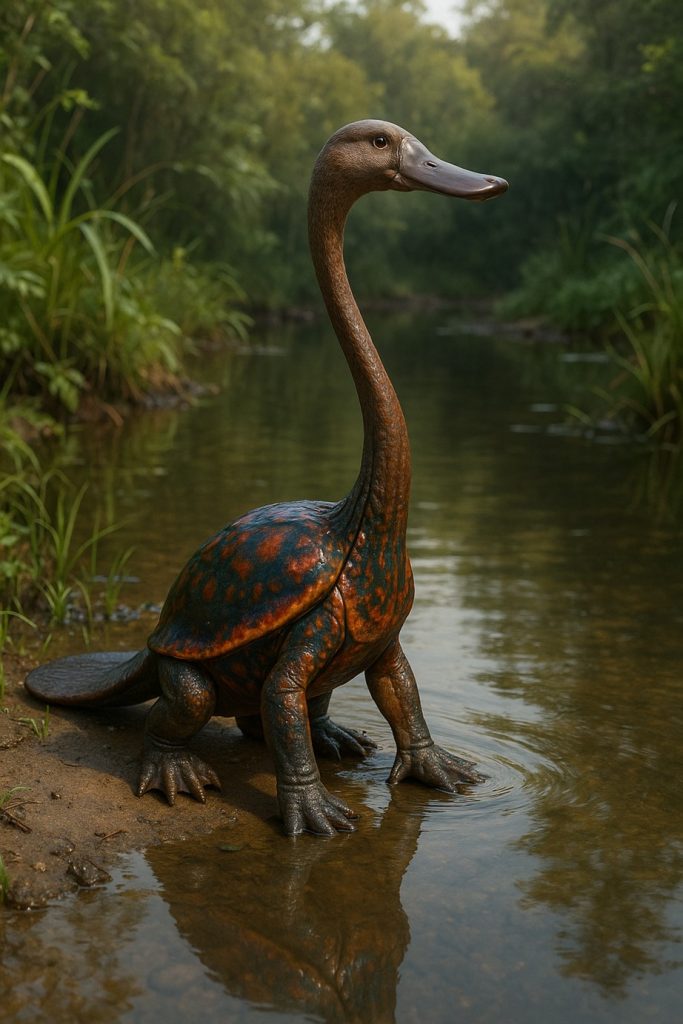
An adventurer’s path crosses that of a Toxophorus 404 not through a clash of aggression, but through a convergence of purpose and territory. These creatures are not roving monsters; they are sedentary engineers, and an encounter is almost always on their terms, in the environment they have meticulously crafted for their own survival. One might be found by being cleverly tricked, or hunted for a resource that is a marvel of natural design.
WHY A PARTY WOULD ENCOUNTER A TOXOPHORUS
Incidental encounters with a Toxophorus are often preceded by a sense of strangeness and misplaced danger. The creature’s influence on its environment is subtle but absolute, turning a simple river crossing or exploration into a tactical puzzle.
The Sabotaged Ferry Route: The party arrives at a river they must cross, only to find the local ferryman has suspended service. He claims a “river demon” is attacking his vessel. He reports that as he crosses, powerful, precise blasts of water strike his boat’s rudder, rendering it impossible to steer. He is not being attacked directly, but his boat is being methodically disabled each time he attempts the crossing. The “demon” is a Toxophorus whose territory the ferry route bisects. It perceives the large, moving boat as a threat or a territorial rival and is using its Hydro-Jet to disable it and drive it away. The party must now either risk the crossing under fire from the creature’s aquatic artillery or find a way to eliminate or distract the unseen sapper.
The Collector of the River: An important shipment of sealed, buoyant cargo was lost upstream and the party is hired to retrieve the floating containers. They track the cargo downriver to a quiet bend, only to find it snagged and tethered to the riverbank. A Toxophorus, attracted to the strange, new objects in its domain, has been “collecting” the containers, using its remarkably strong silk to anchor them near its burrow. The party’s objective is now part of a monster’s territorial decorations. They must devise a plan to retrieve their cargo from the water, all while being watched by the creature from its hidden, underwater burrow entrance, knowing that any attempt to take the “decorations” will be seen as an act of theft.
The Cursed Bridge: Travelers have begun to avoid a major stone bridge, claiming it is cursed. They report being pelted by small, sharp river stones seemingly thrown by an unseen force, and hearing strange, disembodied voices whispering from below. The party is hired to investigate the “curse.” They would find that an Elder Toxophorus has made its den in the soft earth around the bridge’s central pylon. It views the bridge as the roof of its home. It uses its powerful Hydro-Jet to shoot pebbles up at travelers to scare them away, and its vocal mimicry accounts for the “whispers.” The adventurers must now deal with a creature that has integrated a major piece of civic infrastructure into its lair.
WHY A PARTY WOULD SEARCH FOR A TOXOPHORUS
To deliberately seek out a Toxophorus is to hunt for a living marvel of biological engineering. The quests that demand this are rarely simple kill-missions; they require the acquisition of a specific, unique component that makes the creature so extraordinary.
The Spymaster’s Weapon: A spymaster or guild leader requires a specialized tool for a delicate operation: a non-lethal weapon that can create a painful, debilitating distraction without raising a general alarm. They have learned of the venomous spur on the hind leg of the Toxophorus. The venom is not lethal but causes excruciating, temporary paralysis, which would be the perfect tool for incapacitating a specific guard or target during an infiltration. The party is hired to acquire a single, venom-filled spur. The difficulty is immense, as the spurs are on the creature’s powerful, webbed hind legs, used for swimming and for defense in close quarters. The party must likely engage the creature in the water, where it is fastest and most dangerous.
The Airship’s Secret: A wealthy industrialist is constructing a revolutionary new airship, one designed to be lighter and more durable than any before. The key to their design is the gas bladder, for which they require a material that is impossibly lightweight, stronger than steel cable, and absolutely impermeable. Their research leads them to one conclusion: the silk produced by the Toxophorus to create its trapdoors and egg sacs is the only material in the world that meets these specifications. The party is hired not to hunt the creatures, but to “farm” them. They are tasked with locating a dense population of burrows and harvesting the silk from the trapdoors, a mission that requires them to repeatedly raid the homes of dozens of these territorial and dangerous creatures.
The Architect’s Obsession: A brilliant but eccentric architect has been commissioned to build an unbreachable vault for a paranoid client. She dismisses traditional locks and gears, instead becoming obsessed with the principles of natural engineering. Her studies lead her to the Toxophorus and its silk-hinged, perfectly counter-weighted, and flawlessly camouflaged trapdoor. She believes it holds the secret to a new type of seamless, undetectable vault door. She hires the party for a research expedition. Their task is not to harm the creature, but to protect the architect while she studies its lair. They must defend her from the creature’s water-jet attacks and prevent her from falling into the very trap she is so determined to understand.
The corpse of a Toxophorus 404 is a biological treasure chest for those with the skill and knowledge to properly harvest its unique anatomy. Beyond the well-known value of its waterproof silk and venomous spurs, its body offers a range of rare components prized by engineers, alchemists, and artisans across Saṃsāra.
THE ELECTRO-SENSITIVE BILL
Harvest: This is the most delicate and valuable harvest. The creature’s bill is not hard, but a soft, rubbery organ filled with thousands of hyper-sensitive nerve endings. It must be removed whole and immediately placed in a magically prepared, nutrient-rich brine to prevent the nerves from decaying. Any damage to the soft surface renders it useless. Use: The bill is the key to the creature’s ability to “see” without sight. A master magi-tech artisan can carefully dissect the preserved nerve web and suspend it in a conductive gel. This gel can then be integrated into complex sensory devices. A common application is the “Life-Finder’s Probe,” a handheld device that allows the user to detect living creatures through several feet of mud, murky water, or even thin stone walls, making it invaluable for rescue operations or for hunting hidden foes. It is also used in advanced security systems to create detection fields that cannot be fooled by invisibility.
ARTICULATED NECK CARTILAGE
Harvest: The creature’s long neck is not supported by bone, but by a series of interlocking, incredibly durable cartilaginous rings. The entire neck structure must be severed at the base and the flesh carefully stripped away to reveal the chain-like cartilage. Use: This cartilage is a marvel of natural engineering, combining strength with extreme flexibility. Engineers use cleaned sections of this cartilage as master templates for creating flexible, high-pressure conduits. This allows steam pipes and hydraulic lines to be routed around tight corners in complex machinery and automatons without kinking or losing pressure. A single, long section can also be used as the internal structure for a highly flexible mechanical arm or a “snake-cam” for exploring tight spaces.
IRIDESCENT CARAPACE
Harvest: The glossy, often colorful carapace on the creature’s back is relatively easy to harvest. It can be pried off the main body in large sections with a sturdy blade. The value is determined by the vibrancy of its natural color and the size of the intact pieces. Use: The carapace’s primary value is aesthetic. Its surface has a unique crystalline structure that refracts light in dazzling ways. When the carapace is ground into a fine powder, it creates the base for “Iridescent Pigments.” These paints are highly sought after by wealthy patrons for customizing armor, vehicles, and personal effects. An object painted with this pigment seems to shift colors as it moves, creating a beautiful and mesmerizing effect. It is a status symbol among the elite.
HYDRO-JET SACCULE
Harvest: Located deep within the creature’s body near its mouth is the muscular sac that pressurizes water for its ranged attack. It must be carefully removed without puncturing it, as the muscle loses all contractile ability if it is not kept whole during the preservation process. Use: This organ is a natural high-pressure pump. Alchemists are its primary buyers. By integrating a preserved saccule into their equipment, they can create an “Alchemical Sprayer.” This device allows a user to project a potion, acid, or other liquid concoction in a concentrated, high-velocity stream over a much greater distance than simply throwing a vial. This has revolutionized the use of alchemical mixtures in both construction and combat, allowing for the precise application of dangerous or beneficial liquids from a safe distance.
TRAPDOOR HINGE RESIN
Harvest: This is not harvested from the corpse itself, but from its lair. The Toxophorus secretes a thick, amber-colored resin to create the flexible, waterproof hinge for its silk trapdoor. A harvester can carefully scrape this resin from the edges of an abandoned (or cleared) burrow entrance. Use: The resin never fully hardens, instead curing into a substance that is as tough as leather but as flexible and sticky as tar. It is completely waterproof and an incredible sealant. Sailors pay a high price for it to perform emergency repairs on ship hulls, as it can patch a hole even underwater. Artisans use it to create perfectly waterproof bags and containers. Its most common use, however, is as a flexible, vibration-dampening sealant for the joints of steam-powered automatons and vehicles.
FAILED APPRENTICE AND RIVER-NECK TEACHER
This telling is of a time when the sun was a cruel, yellow eye, and the Great River had grown thin and weak like an old man’s arm. The people of the Clay Bank Village saw their fields turn to dust and their pots crack with thirst. The elders and the wise ones declared that a great machine must be built, a thing of steam and gears to pull water from the deep earth. But their hands, though skilled in pottery and weaving, did not know the ways of such a machine. Their pipes of clay cracked under the steam’s anger, and their leather seals leaked.
There was a young woman in the village named Ilyana. Her hands were not good for the old ways. Her pots were lopsided, her weaving was crooked. She was a dreamer of gears and levers, a tinkerer with strange bits of metal, and the elders looked upon her with sad eyes, for her skills were not the skills of their people. When she brought them her own strange drawings for the great machine, with twisting pipes and odd hinges, they turned her away, for her ideas were not like the straight, true lines they understood.
Her heart heavy, Ilyana walked away from her village. She went to the wide, wet marshes down by the river, a place of soft mud and buzzing flies where others did not go. She sat by the water’s edge, her mind as murky as the pool before her. And then she saw it. A thing of impossible shape. A creature with a shell like a beetle, a tail like a beaver, and a great, long neck like a serpent made of joints. The creature hid in the water, only its head showing, its flat, duck-like bill resting on the surface.
Ilyana was not a hunter, so she felt no fear. She was an artisan, and she felt a great wonder. She did not see a monster; she saw a machine made of flesh. For many weeks, she returned to that same spot. She watched the creature, which the old tales named Toxophorus. She saw how it built a hidden door for its burrow, weaving a thick, sticky silk into a hinge that was both stronger than leather and more flexible. She saw how it could bend and twist its long, segmented neck in any direction, a perfect conduit that never kinked or failed. And she watched as it hunted, spitting a hard jet of water from its bill, a perfect nozzle that focused the stream with great power.
Day after day, Ilyana watched the River-Neck Teacher. She did not have paper, so she drew sketches of its joints and its hinge in the wet mud with a stick. She saw that the secret to the neck’s movement was not one long piece, but many small, interlocking rings of cartilage. She saw that the secret to the hinge was not just the silk, but a sticky resin that kept it waterproof and strong. She understood that the power of the water jet came not from great strength, but from a small opening and a great, sudden pressure. She saw a living answer to all the problems of the village’s great machine.
Ilyana ran back to the village. The elders were in despair, their machine lying in pieces. She stood before them, her hands covered in mud, her eyes bright with discovery. She did not show them her old, strange drawings. Instead, she spoke of the creature. “The water-pipes must not be straight and rigid,” she said, “They must be made of many small, linked rings, like the neck of the River-Serpent! The seals must not be of hard leather, but of woven fiber sealed with heated resin, like the creature’s hidden door!” She explained how to make a nozzle of bronze, narrow and fine, to turn the steam’s hiss into a powerful piston’s push.
The elders were doubtful, for her wisdom came from a strange and feral beast. But their own wisdom had failed, and their people were thirsty. They agreed to try her new way. For a month, the entire village worked, following Ilyana’s designs, which were the designs of the Toxophorus. They forged rings of iron and linked them into flexible pipes. They wove great seals of fiber and coated them in resin.
The day came to fire the great machine. A great hiss of steam entered the new, flexible conduits. The resin seals held firm. The new nozzle focused the power, and with a great groan, the piston moved. And then water, cool and dark, began to pour from the spout and onto the thirsty earth. A great cheer rose from the people. They lifted Ilyana upon their shoulders, no longer the failed apprentice, but the Master of the River-Neck Way. She had learned a truth the elders had forgotten.
Moral of the story: The wisest teacher is the world itself. Do not scorn the lessons learned from the crooked, the strange, or the humble, for their way of surviving may be the key to your own.
Suggested conversions to other systems:
CALL OF CTHULHU
THE SILT-WEAVER
This creature is a biological enigma, a chimerical being that defies sane classification. It haunts the muddy banks of remote rivers and wetlands, where it constructs elaborate, trapped burrows. Its most unsettling feature is its long, periscope-like neck, which it uses to observe its surroundings from hiding before disabling prey with a powerful jet of water.
STR 50, CON 75, SIZ 45, DEX 80, INT 40, POW 55, HP 12 Move: 4 / 8 (swimming) ATTACKS:
- Attacks per round: 1
- Fighting (Venom Spur) 35% (17/7), damage 1d4 + potent venom
- Water Jet 60% (30/12), special, see below
Dodge 40% (20/8) (in water only) Armor: 3-point chitinous carapace. Skills: Stealth 75% (when hidden in its lair), Spot Hidden 50%.
SPECIAL RULES:
- Trapdoor Lair: The Silt-Weaver creates a burrow with a perfectly camouflaged trapdoor entrance. Spotting the trapdoor requires an Extreme Spot Hidden roll. A character stepping on it falls 10 feet into a muddy pit.
- Hydro-Jet: The creature can fire a focused jet of water at a target up to 15 yards away. This is a ranged attack that deals no damage. Instead, a successful hit forces the target to make a Hard STR roll. Failure means they are knocked off their feet and drop any single item they are holding.
- Painful Venom: Anyone hit by the Venom Spur must make a Hard CON roll. Failure results in excruciating pain, imposing a penalty die on all physical skill rolls (Fighting, Dodge, Athletics, etc.) for 1d10 hours.
- Electro-sense: The creature’s bill allows it to automatically detect any living creature in murky water or mud within 10 yards.
- Sanity Loss: 0/1d4 SAN points for witnessing this impossible creature for the first time.
BLADES IN THE DARK
THE SUMP-WEAVER (A territorial, skulking, engineer; Tier II Threat)
This bizarre creature has adapted to the polluted canals and forgotten sump-drains beneath Doskvol. It is a master of ambush and territorial control, not through overt violence, but through ingenious natural engineering. It builds hidden, trapped lairs and uses jets of pressurized sewer water to harass and disable intruders.
DRIVES:
- To construct the perfect, unassailable burrow.
- To disable and drive off any creature that approaches its lair.
- To collect shiny objects from the canals to adorn its traps.
MOVES (GM ACTIONS):
- Reveal its periscope-like head from the murky water.
- Fire a powerful jet of filthy water, knocking someone over or into the canal.
- Spring a camouflaged trapdoor, dropping someone into a lower passage.
- Disappear into a hidden, underwater tunnel.
- Jab with a hidden, venomous spur if cornered.
- Drag an interesting piece of equipment (or a person) back to its lair.
NOTES FOR THE GM: A Sump-Weaver is an environmental obstacle, not a straightforward monster. A score might involve navigating a section of tunnels that a Sump-Weaver has claimed. Use clocks to represent the crew’s progress through the trapped area, or for them to disable one of its trapdoors. A direct fight is unlikely; the creature will always prioritize escape to its burrow. Its water jet is a perfect tool for separating a crew member from their gear or pushing them into a dangerous position.
DUNGEONS & DRAGONS
TOXOPHORUS (Small monstrosity, unaligned)
Armor Class: 16 (natural armor) Hit Points: 52 (8d6 + 24) Speed: 20 ft., burrow 15 ft., swim 40 ft.
STR 10 (+0), DEX 16 (+3), CON 17 (+3), INT 4 (-3), WIS 14 (+2), CHA 7 (-2)
Skills: Perception +4, Stealth +5 Senses: Electrolocation 30 ft., Darkvision 60 ft., Passive Perception 14 Challenge: 3
Electrolocation. The toxophorus can detect the location of living creatures within 30 feet of it while underwater or while the target is in contact with mud or soft earth.
Amphibious. The toxophorus can breathe air and water.
Trap Master. The toxophorus can use a bonus action on its turn to remotely spring a trapdoor it has created within 30 feet of it. Any creature standing on the trapdoor falls into the 10-foot-deep pit beneath it.
ACTIONS:
- Venomous Spur. Melee Weapon Attack: +5 to hit, reach 5 ft., one creature. Hit: 5 (1d4 + 3) piercing damage, and the target must make a DC 13 Constitution saving throw, taking 10 (3d6) poison damage on a failed save, or half as much damage on a successful one.
- Water Jet (Recharge 5-6). The toxophorus spits a jet of water in a 30-foot line that is 5 feet wide. Each creature in that line must make a DC 13 Strength saving throw. On a failed save, a creature takes 7 (2d6) bludgeoning damage and is knocked prone. On a successful save, the creature takes half as much damage and is not knocked prone.
- Create Trapdoor. The toxophorus spends 1 minute digging and weaving a 5-foot-square trapdoor on a surface of soft earth or mud. The trapdoor is difficult to spot, requiring a successful DC 16 Wisdom (Perception) check to discern.
KNAVE
THE WEEVIL-JETTER
HD 4, Armor as Plate (16), Morale 8, Venom Spur d6 + poison, Move 20ft
- Aquatic: Moves at double speed in water (40ft).
- Trapdoor: Creates 10ft deep pit traps covered by a camouflaged lid made of silk and mud. A character must make a successful Wisdom save to spot the trap before stepping on it.
- Water Jet: As its action, can fire a jet of water at a single target within 40ft. The target must save versus paralysis or be knocked prone and drop one item they are holding.
- Venom Spur: A character hit by the spur must save versus poison or suffer intense pain, giving them Disadvantage on all attacks for 1d6 hours.
- Periscope Neck: The creature can keep its body in total cover (in water or behind an obstacle) and only expose its head, making it very difficult to hit. Attacks against it in this state have Disadvantage.
- Burrower: Can move through soft earth at a speed of 20ft.
FATE
THE RIVERBANK ENGINEER
This creature is an NPC whose primary role is to shape the environment and create complex obstacles for the players. It is a builder and a trapper first, and a combatant only as a last resort.
HIGH CONCEPT: Instinctive Trap-Making Predator TROUBLE: Awkward and Vulnerable on Dry Land OTHER ASPECTS: Periscope Neck, Unseen Eyes; A Jet of Water to Topple the Unwary; My Burrow is My Fortress
SKILLS:
- Great (+4): Crafts
- Good (+3): Shoot, Stealth
- Fair (+2): Athletics (Swimming), Physique
- Mediocre (+1): Notice
- Poor (-1): Fight
STUNTS:
- Masterful Trapdoor: The Riverbank Engineer can use its Crafts skill to Create an Advantage on a specific zone, creating the aspect Perfectly Hidden Pit Trap with two free invokes that it can use to knock targets prone.
- High-Pressure Jet: When it succeeds with style on a Shoot attack with its water jet, instead of taking a boost, it can attach the situational aspect Soaked and Off-Balance to the target.
- Defensive Spur: The creature gets a +2 bonus to its Fight skill when specifically using the Defend action against a character trying to grapple it.
NUMENERA & CYPHER SYSTEM
THE HYDRO-SAPPER
LEVEL: 3 MOTIVE: To construct and defend its burrow. ENVIRONMENT: Riverbanks, swamps, and other wetlands. HEALTH: 12 DAMAGE: 3 ARMOR: 2 MOVEMENT: Slow; immediate swimming; immediate burrowing in soft earth. MODIFICATIONS: Stealth as level 5 when in its burrow or in murky water.
COMBAT: The Hydro-Sapper is a territorial creature that prefers to disable threats from a distance. Its primary attack is its Water Jet, which can target anyone at short range. This is a Speed defense task for the target. On a failure, the target is knocked prone and the difficulty of their next physical action is increased by one step. If a creature enters its burrow or gets within immediate range, it will attack with its Venom Spur. This is a standard melee attack that inflicts 3 points of damage. Any target damaged by the spur must also make a Might defense task. On a failure, the difficulty of all their actions is increased by one step for one hour due to extreme, distracting pain. The Hydro-Sapper’s lair is always protected by a level 4 trapdoor—a camouflaged pit trap that leads into a water-filled chamber.
PATHFINDER
TOXOPHORUS SAPPER (CREATURE 3) UNCOMMON, N, SMALL, ANIMAL, AMPHIBIOUS
Perception +9; darkvision, electrosense (imprecise) 30 feet Skills: Acrobatics +9, Athletics +7 (+11 to Swim), Crafting +9 (for traps), Stealth +9 Str +1, Dex +4, Con +3, Int -4, Wis +2, Cha +0 Electrosense: The toxophorus can sense the bioelectric fields of living creatures as an imprecise sense. This sense only functions in water.
AC 19; Fort +10, Ref +11, Will +7 HP 45 Periscope Sight [reaction] Trigger: The toxophorus is targeted by an attack or effect while its body is in cover. Effect: The toxophorus gains the benefit of standard cover against the triggering effect.
Speed 20 feet, burrow 15 feet, swim 40 feet Melee [one-action] Spur +11 (agile, finesse), Damage 1d6+4 piercing plus toxophorus venom Ranged [one-action] Water Jet +11 (range 30 feet), Damage 1d4+4 bludgeoning and Push 5 feet.
Toxophorus Venom (poison) Saving Throw DC 19 Fortitude; Maximum Duration 4 rounds; Stage 1 Enfeebled 1 (1 round); Stage 2 Enfeebled 1 and Clumsy 1 (1 round). Trapdoor Snare (Crafting, Trap) The toxophorus can spend 10 minutes to create a pit trap with a camouflaged lid in a patch of soft earth. The pit is 10 feet deep. A creature that steps on the lid must succeed at a DC 19 Reflex save or fall in. Detecting the trapdoor requires a successful DC 21 Perception check.
SAVAGE WORLDS
THE WEEVIL-SNIPER (WILD CARD)
This strange, semi-aquatic creature is a master of battlefield control, using its natural abilities to harass and disable foes from the safety of cover.
Attributes: Agility d8, Smarts d6(A), Spirit d6, Strength d6, Vigor d8 Skills: Athletics d8, Fighting d6, Notice d8, Shooting d8, Stealth d8 Pace: 4; Parry: 5; Toughness: 8 (2) Edges: Aquatic
SPECIAL ABILITIES:
- Armor +2: Chitinous carapace.
- Burrow: Pace 3
- Camouflage: +2 bonus to Stealth rolls when in wetlands or murky water.
- Periscope: The creature can ignore the Cover penalty for shooting from behind cover.
- Venomous Spur: Str+d4. A character who suffers a wound from this attack must make a Vigor roll or be Distracted by the intense pain.
- Water Jet: Uses the Shooting skill, Range 6/12/24. This attack does no damage. Instead, a character who is hit is Distracted. On a Raise, they are also knocked Prone.
- Trap-Maker: The creature’s lair is always protected by a pit trap. Noticing the trap requires a Notice roll at -2.
SHADOWRUN
THE WEIR-WEEVIL (PARACRITTER)
A bizarre, semi-aquatic paracritter that has become a significant nuisance in the corporate-owned waterways and industrial canals of the Seattle metroplex. The weir-weevil is an instinctual engineer, creating complex, trapped burrows in riverbanks and using powerful jets of water to disable drones and harass wage-mages.
Attributes: Body 4, Agility 4, Reaction 3(5), Strength 3 Essence: 6.0, Magic: 6.0 Initiative: 8 + 3d6 Matrix AR: N/A Condition Monitor: 10P / 10S
Skills: Athletics 3, Exotic Ranged Weapon (Water Jet) 5, Perception 3, Stealth (Aquatic) 5, Unarmed Combat 3 Powers: Armor 4, Amphibious, Enhanced Senses (Electrosense), Natural Weapon (Spur, DV 2P, AP -), Toxin (Mild Neurotoxin), Trap-Building
SPECIAL ABILITIES:
- Electrosense: The weir-weevil’s bill allows it to perceive the electrical signatures of living things and active electronics underwater or through soft ground up to 20 meters away.
- Water Jet: As a Major Action, the weir-weevil can fire a concentrated jet of water at a single target within 20 meters. This is an Exotic Ranged Weapon attack. It does no damage, but a successful hit forces the target to make a Strength + Body (3) test or be knocked prone.
- Venomous Spur: The toxin delivered by its spur is a mild neurotoxin that causes intense pain. A character hit must make a Body + Willpower (2) test or suffer a -2 dice pool penalty to all physical actions for one hour.
- Trap-Building: A weir-weevil’s lair is always protected by a camouflaged pit trap. Detecting the trap requires a Perception + Intuition (4) test.
STARFINDER
THE FEN-RAPTOR (CR 2) XP 600 N Small animal Init +3; Senses blindsense (electricity) 30 ft., low-light vision; Perception +7
DEFENSE EAC 13; KAC 15 HP 22 Fort +6; Ref +6; Will +1
OFFENSE Speed 20 ft., burrow 15 ft., swim 40 ft. Melee spur +7 (1d4+3 P plus fen-raptor venom) Ranged hydro-jet +10 (trip)
STATISTICS Str +1; Dex +3; Con +1; Int -4; Wis +1; Cha +0 Skills Athletics +12, Stealth +7, Survival +7
SPECIAL ABILITIES Amphibious: The fen-raptor can breathe both air and water. Periscope Neck: The fen-raptor can attack from behind cover and is treated as having partial cover (+2 to AC, +1 to Reflex saves). Trap-Maker: The fen-raptor can spend 10 minutes creating a hidden pit trap in any patch of soft earth. The pit is 10 feet deep, and the lid requires a DC 18 Perception check to notice. Hydro-Jet (Ex): As a standard action, the fen-raptor can fire a jet of water at a single target up to 60 feet away. This attack performs a trip combat maneuver against the target with a +10 bonus.
Fen-Raptor Venom: Type poison (injury); Save Fortitude DC 11; Frequency 1/round for 4 rounds; Effect fatigued; Cure 1 save.
TRAVELLER
THE HYDRO-GEOMETER (RIVERBANK PREDATOR)
This semi-aquatic lifeform is notable for its complex, instinctual engineering and its unique method of hunting. It constructs elaborate, trapped burrows along waterways and uses a biologically generated high-pressure water jet to disable prey from a distance.
UPP: 35A430-0 Skills: Stealth-2, Engineer (traps)-1, Gunner (spitter)-1 Pace: 6m (swimming 12m, burrowing 6m) Armor: 2 (Hard Carapace) Weapons:
- Spur (venomous): 6, 1d6, plus venom
- Water Jet: 8, knockdown
Traits: Aquatic, Burrower, Camouflage (Wetlands), Trap-builder (Pit) Behavior: A territorial trapper. It uses its Water Jet to knock prey into the water or into one of its pits. It will then attack with its venomous spurs. Water Jet: An attack with a range of 20m. A target hit must make an Average (8+) DEX or Athletics check to avoid being knocked prone. Venom: A character hit by the spur must make an Average (8+) Endurance check or suffer DM-1 on all physical actions (STR, DEX, END) for 1d6 hours due to debilitating pain.
WARHAMMER FANTASY ROLEPLAY
THE REIKLAND SILT-SPINNER
A strange and reclusive beast that haunts the muddy banks of the River Reik and its tributaries. Riverfolk tell tales of these creatures, whose long necks can be mistaken for strange birds, and whose water-spit can knock a man clean off a barge deck. They are considered a bad omen, as their burrows can weaken levees and cause flooding.
M 4, WS 35, BS 45, S 25, T 30, I 30, Agi 45, Dex 30, Int 10, Wp 35, Fel 5 Wounds: 11
Traits: Amphibious, Armour (1), Fear (1), Size (Small), Skittish, Stealthy, Swamp-strider, Venom (Painful), Weapon+4 Skills: Athletics 55, Endurance 40, Perception 40, Stealth (Wetlands) 65
SPECIAL ABILITIES:
- Periscope Neck: The Silt-Spinner can attack while its body is behind cover. When doing so, it still benefits from the cover, imposing a -10 to -20 penalty on enemies trying to hit it.
- Water Jet: As its main action, the Silt-Spinner can make a Ranged (Sling) Test to fire a jet of water at a target up to 16 yards away. This attack does no damage, but a successful hit forces the target to make a Challenging (+0) Athletics Test or gain the Prone condition.
- Venomous Spur: The creature’s spur is a Weapon with the Poisoned (2) and Tiring qualities. The venom forces an Endurance Test to avoid gaining a Fatigued Condition from the distracting pain.
- Trapdoor Lair: The Silt-Spinner’s lair is hidden by a trapdoor. Detecting it requires a Hard (-20) Perception Test. A character who fails this test while moving over the lair falls 10 feet into a muddy, water-filled pit.