
Original Life Forms Used
• Mammalia – Pangolin
• Reptilia – Thorny Devil (Moloch)
• Insecta – Atlas Moth
• Cephalopoda – Blue-Ringed Octopus
Appearance
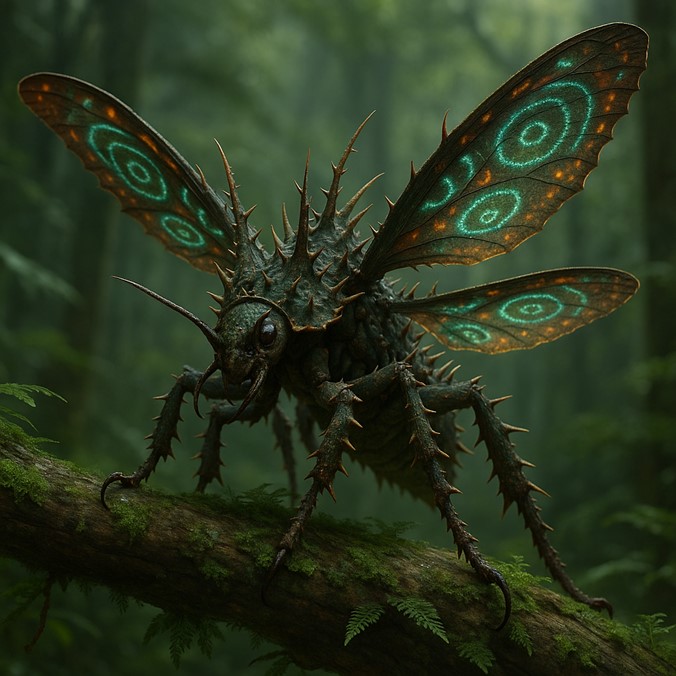
The Thyraquillophid 682 has a heavily scaled body reminiscent of a pangolin, each overlapping plate edged with tiny, thorn-like spines patterned in the fractal geometry of the thorny devil. Its forelimbs are thick and clawed for digging, while its hind limbs are longer and more muscular, built for sudden bursts of speed. Four large, iridescent wings sprout from its mid-back, patterned like an Atlas moth’s but with hypnotic, concentric blue rings that flash when threatened. The head is streamlined, with short antenna-like feelers, large faceted eyes, and a beak-like mouth concealing a retractable, venom-tipped proboscis derived from its octopus heritage. Its underside is soft and mottled, covered in shifting chromatophores that can mimic its surroundings in muted tones.
Size
Length: 1.8 m from head to tail tip
Wingspan: 2.4 m fully extended
Weight: ~46 kg
Speed
Ground: 25 ft per round
Flight: 40 ft per round (short bursts, max 2 minutes continuous)
Climb: 20 ft per round
Swim: 15 ft per round
Stat Modifiers
+2 Dexterity
+2 Constitution
+1 Wisdom
−1 Strength
−2 Charisma
Skills
• Stealth (+3 racial bonus in environments with natural patterns)
• Perception (+2 from compound eye structure)
• Climb (+2 from limb morphology)
• Poison Use (natural venom handling without self-harm)
Behavior
The Thyraquillophid 682 is a mostly solitary ambush predator, relying on camouflage until it flashes its wing patterns to startle or distract prey. It is territorial, marking feeding zones with claw scrapes and chemical pheromones. During the night, it may bask under moonlight to recharge minor bio-luminescent patterns, which seem to influence mating displays.
Diet
Carnivorous–omnivorous; primarily feeds on small mammals, reptiles, and large insects, but supplements with nectar and fruit when animal prey is scarce.
Emotions
Shows heightened caution and suspicion toward larger creatures. Displays aggressive posturing when cornered, including wing flashing, spine-flaring, and venom-proboscis strikes. Displays curiosity toward glittering or patterned objects, sometimes stealing them for unknown purposes.
Environment Where Found
Dense subtropical forests with scattered rocky outcrops; prefers transitional zones where thick foliage meets open clearings, giving both cover for ambush and space for short flight bursts.
Tags
Feral, Magical, Terrestrial, Flight-Capable, Venomous, Armored, Ambush-Predator, Nocturnal, Pattern-Shifter, Solitary, Hypnotic-Wings, Climbing, Burrowing, Camouflaging, Bio-luminescent, Pheromone-Marking, Glider, Thorn-Scaled, Territorial, Nectar-Feeding
Life Cycle
The Hexathorn Glidebeetle 911 begins life as a soft-shelled larva, hatched from clusters of translucent, thorn-guarded eggs hidden in high canopy hollows or inside abandoned burrows. The larval stage lasts approximately three months, during which the young feed on nectar, sap, and soft-bodied insects. They then enter a pupal stage within a hardened cocoon made from woven plant fibers and secreted resin. After four to six weeks, they emerge as fully formed adults. Adults have a lifespan of 8–10 years, during which they molt twice to replace damaged wing membranes and restore vibrancy to their thorn scales. Elders of the species often develop darker, more muted camouflage tones and reduced gliding capability.
Mating
Breeding occurs once yearly during a seasonal mana swell, when the species’ bioluminescent wing patterns intensify into complex, hypnotic spirals visible from long distances. Males and females engage in an aerial display, circling and locking wings mid-glide before descending to the ground to exchange pheromone signals. Courtship can last several hours, with physical contact including thorn-scale brushing, which releases subtle scent markers. Females lay between 15–30 eggs, hidden in protected areas guarded by both parents for the first month.
Tactics
The Hexathorn Glidebeetle relies heavily on ambush and disorientation. It uses its vibrant, shifting wing patterns to distract or hypnotize prey before striking from above. Its thorned scales double as both armor and weaponry, raking opponents during gliding passes. When threatened, the creature emits a pheromone cloud that causes confusion and temporary disorientation in predators. It is adept at climbing trees and rock faces to establish advantageous positions, then gliding silently to attack or retreat.
Actions
In combat or hunting, it alternates between bursts of fast climbing and long, controlled glides, striking prey with its forward thoracic claws before anchoring with hind limbs. It can deliver a venomous bite that induces weakness and sluggishness in smaller creatures. Outside of hunting, it engages in nectar harvesting, using its elongated mouthparts to feed on flowers and mana-rich fungal blooms. Thorn scales are periodically shed during grooming, leaving a trail that can be used to mark territory or warn off intruders.
Other Interesting Information
- Their thorn scales retain mana residue for several weeks after shedding, making them valuable to alchemists for use in stealth elixirs and light-diffusing armor.
- They are capable of near-silent gliding by folding their wings at precise angles, making them difficult to detect until they are very close.
- Young are trained by both parents to glide within their first month of leaving the cocoon.
- They are fiercely territorial during mating season but form loose colonies of up to 50 individuals during other times of the year.
- Legends in certain forest cultures claim that their bioluminescent spirals can show visions of past lives to those who stare too long.
Adventurers on the world of Saṃsāra might deliberately seek out or cross paths with the Tuskserra 496 for several reasons, often tied to both practical needs and the risks of its domain.
The creature’s tusks—dense, naturally spiraled composites of keratin and mineral—are prized by certain Solutrean craftsmen for shaping durable hafts, arcane conduits, or inlays for ceremonial weapons. These tusks hold residual mana from the beast’s lifetime and can be re-awakened in skilled hands, making them sought-after components for magical gear.
Its dense dermal plates, layered with fibrous hide beneath, yield exceptional armor stock capable of withstanding both blunt and cutting strikes, especially valued by those who travel through high-magic weather fronts. Specialized alchemists covet the thick, oily secretions from glands along its shoulders; these oils can be refined into slow-burning lamp fuel or mixed with resins for waterproofing high-value items.
The Tuskserra’s territories also overlap with rare mineral outcrops and magically infused root clusters—resources that draw miners, herbalists, and prospectors. Because the creature is territorial, such ventures often require either stealthy avoidance or direct confrontation.
Certain remote sects believe the Tuskserra is a living warden placed by divine will to guard ancient waypoints or buried vaults, so explorers or treasure-seekers may need to bypass or placate one to reach their goal. For some mercenary companies, capturing a live specimen for a menagerie, military breeding program, or research hall represents a fortune in contracted pay.
Even unplanned encounters can occur—especially for expeditions pushing into fog-swathed canyon basins, where its low calls and ground-vibrating footfalls give away its presence only moments before it charges. Those who hunt it without proper preparation often become part of local cautionary tales told around Solutrean tavern hearths.
Beyond the tusks, hide, and oil already valued from the Tuskserra 496, skilled harvesters can obtain several rarer materials from a slain specimen, each with distinct uses in Saṃsāra’s economies and crafts.
1. Crest-Horn Core – The internal marrow of the forward ridged crest contains concentrated mineralized collagen saturated with mana-trace elements. When dried and powdered, it becomes a potent stabilizer for binding volatile magical reactions in weapon-smithing or large-scale ward construction.
2. Tendon-Cords – The beast’s leg and neck tendons are exceptionally strong, with a natural flex-memory that resists fraying under tension. Bowyers weave them into composite bowstrings for high-draw Solutrean hunting bows, while engineers employ them as tension lines for compact siege devices.
3. Blood Resin – When its blood is exposed to open air, it coagulates into amber-like nuggets within minutes. Alchemists grind these nuggets to form the base for certain medicinal salves that quicken wound closure and reduce magical backlash from failed spellwork.
4. Scent-Pouch Musk – Hidden within paired glands at the base of the neck, this musk is used by perfumers to craft long-lasting animalic notes for luxury scent-charms, or by hunters to mask their own odor in predator-rich zones. In diluted form, it can be applied to traps to attract large carrion-eaters.
5. Eye-Lens Discs – The creature’s eyes contain thick, crystal-like corneal lenses that retain clarity after removal. Artificers cut and polish them into precision optical components for telescopic scopes, navigational astrolabes, or magical sight-stones attuned to tracking movement.
6. Stomach-Stone Cluster – Many mature individuals carry polished gastroliths infused with trace minerals from grinding magically-charged roots and ores. These stones, once cleaned, are ground to powder and added to geomantic inks, enhancing the durability of runes against weathering and magical erosion.
7. Spine-Plates – The dorsal ridges are made of layered bone and chitin that, when steamed and pressed, yield curved plates ideal for laminar armor or reinforced shield edges without adding excessive weight.
8. Heart-Mantle Tissue – A ring of fatty, mana-dense muscle surrounding the heart can be cured into jerky-like rations that briefly boost stamina when consumed, though overdosing risks intense muscle cramps.
These resources make the Tuskserra not just a formidable hazard but a highly valuable quarry—explaining why hunters, artisans, and alchemists alike may risk the trek into its contested ranges.
Beast Who Carried the Road
It is told, in the winding words of the stone-tongued elders, that in the long-before-time, when the sun still fell sideways and rivers ran to the mountains, there lived the great tusked walker, whose name in those days was not spoken but hummed through the teeth. The people of the High White Plains say this creature was not made of flesh alone, but of the memory of the earth, and each step it took was heavy enough to remember a thousand steps before.
The elders sing that the beast roamed alone, crossing hills and reed-water valleys, carrying with it the scent of storms. Its hide was like the dark slope of mountains after rain, and its eyes held the gold-fire of setting sun. In those ancient seasons, the land between villages was broken and wandering, for the ground would not hold still. Paths made by morning would twist by night, and travelers were lost, their voices swallowed in the turning air.
One day, a young herder whose name was lost to time followed a trail of hollowed hoofprints filled with sky-water. These were not of any herd, for each print was large enough to cradle the child’s sleeping mat. The herder walked, and as they walked, they found the prints formed a road, long and straight, pressing deep into the restless ground.
On the fourth night of walking, the herder saw the creature. Its tusks were not white but the pale blue of glacier-light, curving in great arcs. Upon its back, the wind dragged long grasses from distant fields, tangled in its spine-plates. The beast was not grazing, nor did it fear the herder—it looked down with one round, still eye and breathed a slow cloud that smelled of cold iron and wet stone.
The herder, finding courage from hunger, spoke in the trade tongue of the valleys: “Great Walker, the land loses itself each night. The villages starve for want of the road. Will you help us?”
The beast did not speak in words, but the ground beneath them trembled, and the prints it left behind filled not with water but with stone. The road it made shone pale under the moon, a path that would not move.
For many days the herder followed, guiding it toward the far-off settlements. The creature would only walk when the sun dipped, resting at dawn by curling into a shape like a hill, so still that moss would grow on its flanks. In the day’s heat, the herder would sit beneath its tusks, feeling the shade cool as winter riverbeds.
When they reached the farthest village, the people saw the road behind them, unbroken from horizon to horizon. They offered the creature barrels of grain and skins of sweet water, but it did not eat. It merely turned away, walking again toward the edge of the known lands. The herder tried to follow, but the beast stopped and rumbled in a voice that shook the knees, a voice that needed no translation:
“The road is carried. Your feet must now remember it.”
Then it was gone, fading into a dust storm that did not touch the road. The path remains, though cracked and worn, leading out into the barren flats where no one has seen the beast since. Yet the old ones say that on nights when the air smells of iron and rain, you may hear slow steps beyond the horizon, and in the morning find a new line of prints pressed deep into the wild ground.
Moral: A path made for you can guide you, but only the memory of the path will keep you from becoming lost.
Suggested conversions to other systems:
CALL OF CTHULHU
Name: Roadbearer Colossus
Type: Unique Monster
STR 135 (27) CON 110 (22) SIZ 320 (64) DEX 40 (8) INT 70 (14) POW 90 (18)
HP: 43 Move: 6 (Land)
Build: +5 Damage Bonus: +6d6 Armor: 10 (Stone-plated hide)
Attacks:
• Gore with tusks 65%, damage 4d6+db
• Trample 60%, damage 3d6+db, knocks prone (CON roll to resist)
• Stone-road creation (ritual) — takes 1d4 rounds, creates permanent, unmoving path through shifting terrain.
Skills: Listen 60%, Spot Hidden 50%, Track 70%, Intimidate 60%
Powers:
• Earth Memory: Once per day, can sense all creatures within 50 yards through ground vibrations (no stealth possible).
• Pathbind: Any road it creates cannot be altered by natural or supernatural terrain shift.
• Trample the Lost: Advantage (roll twice) on attacks vs. prone or trapped targets.
Sanity Loss: 0/1D6 to witness, 1/1D8 if attacked by it.
BLADES IN THE DARK
Name: Stoneback Path-Maker
Type: Threat — Colossal Beast (Tier V, Scale 4)
Edges:
• Armored: ignores weapon effects below heavy ordnance unless special means bypass armor.
• Mythic: immune to fear, supernatural presence deters most predators.
Harm: Tusks (severe harm), Trample (severe harm, area), Crushing Step (destructive terrain damage).
Special:
• Path Carver: When moving through unstable or supernatural terrain, creates a permanent safe path. This counts as a 6-effect long-term project clock for each major route.
• Ground Sense: Always aware of approaching gangs or crews within long range (2–3 blocks in city scale).
Suggested Clocks:
• Drive Off the Colossus — 8-tick
• Follow to the Edge of the Map — 6-tick
Faction Status: +2 for offering tribute before passage, −3 if attacking or blocking its way.
DUNGEONS & DRAGONS 5e
Name: Colossus of the Carried Way
Gargantuan monstrosity, unaligned
Armor Class: 21 (stone-plated hide) Hit Points: 510 (28d20+224) Speed: 40 ft.
STR 28 (+9) DEX 9 (−1) CON 26 (+8) INT 12 (+1) WIS 18 (+4) CHA 15 (+2)
Saving Throws: Con +15, Wis +11 Skills: Perception +11, Survival +11
Damage Resistances: bludgeoning, piercing, and slashing from nonmagical attacks
Damage Immunities: poison; psychic
Condition Immunities: charmed, frightened, paralyzed, poisoned
Senses: tremorsense 120 ft., passive Perception 21
Languages: understands Primordial but cannot speak
Challenge: 22 (41,000 XP)
Traits:
• Immutable Path. The Colossus can create a permanent stone road along its path. This road cannot be altered by natural events or magic of 7th level or lower.
• Legendary Resistance (3/day). If it fails a saving throw, it can choose to succeed instead.
• Seismic Awareness. The Colossus automatically detects any creature in contact with the same ground within 120 feet.
Actions:
• Multiattack. The Colossus makes two Tusks attacks and one Stomp.
• Tusks. Melee Weapon Attack: +16 to hit, reach 15 ft., one target. Hit: 31 (4d10+9) piercing damage.
• Stomp. Melee Weapon Attack: +16 to hit, reach 5 ft., one target. Hit: 26 (3d10+9) bludgeoning damage, target must succeed on DC 23 Strength save or be knocked prone.
Legendary Actions:
• Groundquake (Costs 2 Actions). All creatures within 30 ft. must succeed on DC 23 Dexterity saving throw or take 21 (6d6) bludgeoning damage and be knocked prone.
• Step Further (Costs 1 Action). Moves up to half speed without provoking opportunity attacks.
KNAVE (latest edition)
Name: The Road-Carrier Beast
HD: 20 HP: 160 AC: 18 Move: 40 ft.
Attacks: Tusks (2d10 damage), Stomp (3d8 damage, knock prone)
Special:
• Roadbinder: Once per journey, creates a permanent, straight path through unstable or hostile terrain. Counts as a 1-slot treasure for those who map or claim it.
• Stonehide: Ignores first 5 damage from any nonmagical attack.
• Tremor Sense: Knows location of all creatures in contact with the ground within 100 ft.
Morale: 10 Size: Gargantuan
Description: A towering, tusked creature whose heavy footfalls press stone roads into existence. Hunters, pilgrims, and rulers alike seek it to secure trade routes or to gain the prestige of guiding it through their land.
FATE (Core / Condensed)
Name: Roadwright Colossus
High Concept: Gargantuan, tusked beast that shapes the land into permanent roads with each step.
Trouble: Bound to the Path — cannot deviate far from its chosen route.
Aspects:
• “Every Step is a Monument”
• “The Ground Whispers All”
• “Ancient and Patient as Stone”
Approaches:
• Forceful +5 • Careful +4 • Quick +2 • Clever +2 • Flashy +1 • Sneaky +0
Stress: □□□□ Consequences: Mild (2), Moderate (4), Severe (6)
Stunts:
• Stonehide: Reduce all physical damage by 2 shifts (once per exchange).
• Immutable Road: Once per scene, create a lasting Aspect on the scene (“Permanent Road”) with two free invokes.
• Tremor Sense: Spend a Fate Point to detect all hidden or invisible creatures on the same ground zone.
Scale: Legendary against human-sized opponents; gains +4 shifts to overcome or create advantage when its size matters.
NUMENERA & CYPHER SYSTEM
Name: Roadforge Titan
Level: 9 (27)
Health: 54 Damage: 12 points Armor: 5 (stone plates)
Movement: Short when careful, Long when charging
Modifications: Perception as Level 10; Strength-based tasks as Level 10; Speed defense as Level 7 due to size
Combat: Tusks (12 damage) or Stomp (knock prone, targets in Immediate range must succeed on Level 8 Speed defense or fall).
Special Abilities:
• Permanent Road (2 Intellect points): Creates a safe, permanent route through unstable or hostile terrain. This path resists alteration by any effect less than Level 9.
• Tremor Sense: Detects all creatures in Immediate and Short range that are in contact with the ground.
• Groundquake: Once per day, can shake the earth in Immediate and Short range; all creatures must make a Level 8 Speed defense roll or take 8 damage and fall prone.
Interaction: Generally ignores smaller creatures unless provoked or obstructed; can be bargained with using rare minerals or crafted stonework.
Use: The PCs must guide the Roadforge Titan to create a route to a newly discovered settlement, while rival factions attempt to stop them.
Loot: Fragments of roadstone hide (armor crafting, Level 6 artifact materials).
PATHFINDER 2E
Name: Waymaker Behemoth
Gargantuan Beast
Perception +21; tremorsense 120 ft.
Languages understands Terran
Skills Athletics +30, Survival +23, Intimidation +18
Str +9, Dex −1, Con +8, Int +1, Wis +5, Cha +2
AC 40; Fort +27, Ref +17, Will +21
HP 500; Immunities poison, mental; Resistances physical 10 (except adamantine), magic 5
Speed 40 ft.
Melee [1 action] Tusks +28 (reach 15 ft.), Damage 4d10+9 piercing
Melee [1 action] Stomp +28 (reach 10 ft.), Damage 3d10+9 bludgeoning plus Knockdown
Roadbinder [3 actions] (earth, primal): The Waymaker Behemoth presses a permanent road into the ground along a 30-foot path. This road cannot be altered by magical effects of 8th level or lower.
Groundquake [2 actions] (earth, primal): All creatures within a 30-foot emanation must attempt a DC 38 Reflex save; on a failure, they take 6d6 bludgeoning and fall prone (critical failure = double damage).
Tremor Awareness: Automatically notices all creatures within tremorsense range that are in contact with the ground.
Legendary Actions (3 per round): Can take 1 action after each other creature’s turn to Move, Tusks attack, or use Tremor Awareness to Seek.
SAVAGE WORLDS (Adventure Edition)
Name: Stonepath Colossus
Attributes: Agility d6, Smarts d6 (A), Spirit d8, Strength d12+6, Vigor d12+2
Skills: Athletics d10, Notice d8, Intimidation d8, Survival d8
Pace: 8; Parry: 8; Toughness: 20 (5)
Special Abilities:
• Size +8: Gargantuan, grants +8 Toughness.
• Armor +5: Stone-plated hide.
• Tusks: Str+d10 damage, Reach 2.
• Stomp: Str+d8, Large Burst Template; those hit are knocked prone.
• Permanent Road: As an action, creates a permanent road 1d6×2” long. Counts as difficult terrain removal in any future encounters.
• Tremor Sense: Can detect any creature in contact with the same ground within 24”.
• Groundquake: Once per encounter, all within a Large Burst Template must make an Agility roll at −4 or suffer 3d6 damage and be knocked prone.
Edges: Fearless, Nerves of Steel
Hindrances: Stubborn (Major), Code of Honor (keeps to chosen path unless forced off).
Wild Card: No (treat as an Extra for damage rules, but with special immunity to being Shaken except by magic).
SHADOWRUN (6th Edition)
Name: Pathbreaker Leviathan
Metatype: Unique Critter (Paranormal Macrofauna)
Movement: 15/35
Attributes: BOD 15, AGI 3, REA 4, STR 16, WIL 8, LOG 2, INT 6, CHA 4, ESS 6
Initiative: 10 + 2D6
Condition Monitor: 20 (Physical), 11 (Stun)
Armor: 12 (natural)
Attack: Tusks (Reach 2, DV 12P, AP –4), Stomp (DV 10P, AP –2, Knockdown)
Powers:
• Tremor Sense (Critter) — Detects all creatures in contact with same ground within 100m.
• Earthquake (Magical) — Complex Action; creates a 15m radius quake, Body + Magic [Physical] vs. Threshold 3 to avoid falling prone; structures take DV 10P.
• Roadbinder Path — Free Action; leaves a magically reinforced path that ignores difficult terrain modifiers for vehicles and metahumans.
• Immunity to Normal Weapons — Hardened Armor 12 (only magic or AP reduces it).
Weaknesses: Territorial (always follows a chosen migration path).
Typical Encounter: Hunted for rare “roadstone plates” used in magical barrier foci.
STARFINDER (Latest)
Name: Earthshaper Behemoth CR 17
XP 102,400
Gargantuan magical beast
Init +3; Senses darkvision 60 ft., tremorsense 120 ft.; Perception +29
DEFENSE HP 480; RP 0
EAC 34; KAC 36
Fort +23, Ref +15, Will +20
Defensive Abilities stonehide (DR 15/adamantine), immunity to poison; Resistances cold 10, fire 10
OFFENSE Speed 60 ft.
Melee tusks +33 (6d12+22 P; critical knockdown), stomp +33 (4d12+22 B; area burst)
Space 30 ft.; Reach 20 ft.
Special Attacks groundquake (30-ft. burst, Reflex DC 31 half, prone on fail), roadbinder (permanent terrain alteration in 60-ft. path, unaffected by non-epic effects)
STATISTICS Str +10, Dex +3, Con +9, Int +1, Wis +6, Cha +2
Skills Athletics +34, Survival +29
Languages understands Terran
ECOLOGY Environment any terrestrial; Organization solitary or migration chain (2–4)
SPECIAL ABILITIES
• Tremor Sense: As listed.
• Roadbinder: Creates permanent level terrain that reduces travel time by half.
TRAVELLER (Mongoose 2nd Edition)
Name: Roadwright Titan
Type: Fauna (Major Herbivore – Grazer, Territorial)
STR 25 (+5), DEX 4 (–2), END 20 (+4), INT 5 (–1), EDU 3 (–3), SOC 2 (–4)
Hits: 49 Armor: 15 (stone plates)
Attacks: Tusks (2D6+8), Stomp (2D6+6, Knockdown)
Traits: Tremor Sense (500m), Territorial, Massive Bulk (can block vehicular movement), Roadbinder Path (permanent safe travel route, cannot be erased without TL 14 engineering)
Speed: 20 kph walking; can sustain 35 kph for 1 hour in charge
Behavior: Defends path from all threats; ignores non-threatening creatures.
Notable Uses:
• Plates can be harvested for high-durability TL 12 ship hull composites.
• Path networks become strategic trade arteries.
Encounter: Often found during planetary survey or frontier roadbuilding.
WARHAMMER (Age of Sigmar / Soulbound Bestiary Format)
Name: Stonepath Colossus
Creature Type: Monstrous Beast
Melee: Tusks (Great Weapon, DMG 6 + 2ED, Rend -2, Knockback), Stomp (DMG 5 + 1ED, Knockdown)
Attributes: M 6, WS 3+, S 12, T 10, W 45, A 5, Bravery 8, Save 3+
Skills: Awareness (Tremor Sense) +2, Intimidate +3
Talents:
• Roadbinder — Wherever it walks, leaves an unbreakable stone path. Treat all terrain in this path as Open Ground for allies.
• Earthquake Stomp — Once per battle, all within 12″ must pass a Body (4) Test or be Knocked Prone and take D6 Mortal Wounds.
• Immovable Bulk — Cannot be moved by abilities unless the source rolls a natural critical.
Defences: Stonehide (ignore first Rend -1 or lower from each attack), Immune to Bravery tests.
Threat Level: Godbeast-tier (recommended for parties of high-rank Soulbound or full Dawnbringer battalion).
Use in Play: Often the center of a pilgrimage or war effort to control the routes it creates; some cities owe their entire prosperity to the ancient migration paths of a Stonepath Colossus.