
Original Life Forms
- Class Reptilia: Jackson’s Chameleon (Triocerosjacksonii)
- Class Aves: Shoebill Stork (Balaenicepsrex)
- Class Insecta: Bombardier Beetle (Tribe Brachinini)
- Class Malacostraca: Peacock Mantis Shrimp (Odontodactylusscyllarus)
Appearance The Stomatoleo-Bombardeus is a bipedal monstrosity that embodies a terrifying fusion of its progenitors. It stands in a hunched, predatory posture reminiscent of a shoebill stork, supported by two powerful, digitigrade legs that end in sharp talons. Its body is not covered in scales or feathers, but in a thick, iridescent carapace of chitin, segmented like an insect’s exoskeleton. This carapace possesses the chromophoric properties of a chameleon’s skin, allowing the creature to shift its color and pattern with startling speed to perfectly match its surroundings, from the dappled light of a jungle floor to the slick grey of wet stone.
Its head is the most striking feature: a massive, shoebill-like cranium and beak, wide and heavy, capable of crushing bone and shell. Set into the sides of this large head are two independently rotating, cone-shaped eyes, identical to a chameleon’s, that constantly scan the environment in different directions. From beneath its chest, tucked close to the body, are a second pair of limbs. These are not for walking, but are the devastating raptorial appendages of a mantis shrimp, ending in dense, hammer-like clubs. A long, prehensile tail, coiled like a chameleon’s, provides exceptional balance. The creature’s abdomen is visibly segmented and terminates in a pair of small, directable nozzles.
Size An adult Stomatoleo-Bombardeus stands approximately 6 to 7 feet tall, even with its characteristic hunched posture. Its dense, chitinous plating and powerful musculature give it a significant weight, averaging between 350 and 450 pounds. When its prehensile tail is fully extended, it can measure over 10 feet from its beak to the tip of its tail.
Speed This creature is not built for sustained pursuit. Its primary mode of movement is a slow, deliberate, stalking walk. It can remain perfectly motionless for hours on end. When it strikes, its movements are deceptively explosive. Its club-like appendages can lash out at speeds that are nearly impossible for the eye to track. It can also produce a short, powerful burst of speed with its legs to lunge at prey or evade a sudden threat, but it cannot maintain this pace for more than a few seconds.
Stat Modifiers
- Strength: High
- Dexterity: High
- Constitution: Very High
- Intelligence: Low (Animalistic)
- Wisdom: Moderate
- Charisma: Very Low
Skills
- Stealth: Its ability to remain motionless combined with its active camouflage makes it exceptionally difficult to spot.
- Perception: Its independently moving turret-eyes grant it a nearly 360-degree field of vision, making it almost impossible to surprise. Its complex eyes can also perceive a wider spectrum of light and magical auras than most avatars.
- Athletics: It possesses excellent balance due to its prehensile tail and powerful core, allowing it to navigate difficult and uneven terrain with ease.
- Intimidation: Its alien appearance, unnerving stillness, and the audible, high-pressure clicks it makes before striking are deeply unsettling to other life forms.
- Natural Weapons: Its beak can crush, its talons can tear, and its raptorial clubs can deliver devastatingly fast and powerful bludgeoning strikes.
Behavior The Stomatoleo-Bombardeus is a solitary ambush predator defined by its extreme patience. It will find a strategic location and enter a state of near-torpor, using its camouflage to become one with the environment. It can wait in this state for days, its eyes being the only part of it that moves, ceaselessly scanning for any sign of prey. Once a target enters its strike zone, it attacks without warning, using its mantis shrimp-like clubs to shatter limbs and armor. It is fiercely territorial and will attack anything that enters its hunting grounds, regardless of size. When threatened, cornered, or facing a particularly resilient foe, it will aim its abdomen and fire a boiling, caustic chemical spray from its rear nozzles, a trait inherited from the bombardier beetle. This spray creates a loud popping sound and a cloud of noxious vapor.
Diet Strictly carnivorous. Its diet consists of any creature it can subdue. This includes large fish, amphibious creatures, unwary jungle mammals, and even lone or small groups of avatars. It uses its powerful beak to crack open armored prey like giant crabs or shelled monstrosities, and to tear flesh from bone. It consumes its meals slowly, often dragging the carcass back to a secluded, well-hidden lair.
Emotions As a feral creature, its emotional range is limited to primal instincts. It operates on a foundation of predatory hunger, territorial aggression, and defensive fear. It does not display joy, companionship, or sadness. Its most common perceivable state is one of unnerving, placid patience while hunting, which quickly shifts to explosive, focused violence during an attack.
Environment Where Found This creature thrives in humid, warm, and densely vegetated environments within the world of Saṃsaˉra. It is most commonly found in muggy mangrove swamps, foggy river basins, ancient jungles with thick undergrowth, and the twilight zones of large, subterranean cave systems that are perpetually damp. It requires access to water but spends most of its time on land, using foliage, rock formations, and even the crumbling walls of ancient ruins as cover for its ambushes.
Tags Feral, Creature, Carnivore, Ambush Predator, Solitary, Territorial, Amphibious, Camouflage, Chemical Defense, Bludgeoning, Chitinous, Bipedal, Magical Beast, High Perception, Jungle, Swamp, Stalker, Caustic Spray, Crushing Beak
Age The Stomatoleo-Bombardeus has a considerable lifespan, often living for 80 to 100 years if it survives to maturity. Its life is marked by distinct stages of development.
- Egg: The life cycle begins in a clutch of 10 to 20 hard, leathery eggs, each resembling a mottled river stone. These are buried in damp soil or mud and left to incubate from ambient heat and moisture.
- Nymph: Upon hatching, the creature is a foot-long nymph. In this stage, it is highly vulnerable, lacking the hardened carapace, powerful clubbing arms, and crushing beak of an adult. It is primarily insectivorous and survives by relying entirely on its innate camouflage, spending its first several years hidden in dense undergrowth and rock crevices. The mortality rate for nymphs is exceedingly high.
- Juvenile: After approximately five years, if it has survived, the nymph molts into a juvenile form standing three to four feet tall. Its carapace begins to harden and its raptorial clubs start to develop, though they lack their full devastating power. During this stage, which lasts for about a decade, it becomes solitary and begins to hunt larger prey, graduating to fish, lizards, and other similarly sized creatures.
- Adult: At around 15 years of age, the creature reaches its full adult size and capabilities. It establishes a wide territory and begins the cycle of patient, solitary hunting that defines its existence.
- Elder: A specimen that lives beyond 70 years is considered an elder. Its movements become slower, and its camouflage ability may become less responsive. Elders compensate for their waning physical prowess with heightened cunning, selecting ambush spots of unparalleled perfection. Their chemical spray often becomes more potent and volatile, though it takes them longer to regenerate between uses.
Mating Reproduction is a rare, dangerous, and impersonal event. An adult female becomes receptive to mating only once every five to ten years. She will find a high point in her territory and secrete a complex pheromone that is carried on the humid air and through waterways. Males whose territories border hers will be drawn to the scent. The ensuing ritual is not a courtship but a tense display of fitness. The males will confront each other, not with immediate physical violence, but with an intimidating exhibition. They flash complex, strobing patterns across their carapaces and emit deep, guttural, booming sounds from their chests. The female observes these displays from a distance and will consent to mate with the male she perceives as the most dominant. The act itself is brief and aggressive, after which the female violently drives the male away. There is no pair bonding or parental care; the female buries her clutch of eggs and abandons them to their fate.
Tactics The creature’s combat and hunting tactics are centered on efficiency and overwhelming force from a position of surprise.
- The Patient Ambush: Its primary tactic is to find a choke point, such as a well-used game trail, a narrow passage in a cavern, or the bank of a river, and wait. Using its Perfect Camouflage, it becomes functionally invisible and can remain motionless for days. Its independent eyes give it a panoramic view, ensuring it spots approaching targets long before it is spotted.
- Isolating Strike: It prefers to attack lone targets. When facing a group, it will strike the very first or very last individual, attempting to secure a kill and drag the prey away before the others can mount an effective response.
- Overwhelming Alpha Strike: The initial assault is a lightning-fast blow from its club-like raptorial appendages. It does not test defenses; it aims to end the fight before it begins by shattering a limb, crushing a skull, or collapsing a ribcage in a single, devastating impact.
- Calculated Defense: The Caustic Spray is reserved for when an ambush fails or when the creature is unexpectedly threatened by multiple hostiles. It uses the spray to create chaos, block sight, and force enemies to scatter, allowing it to either escape or focus its physical attacks on a single remaining foe. It will use its prehensile tail in a low sweep to knock opponents off their feet if they manage to engage it in close quarters.
Actions
- Raptorial Club: A bludgeoning melee attack of incredible speed. While it may appear to be a single strike, it is often a flurry of two or three blows that land in the same instant.
- Crushing Bite: A powerful melee attack using its massive, shoebill-like beak. This action is slower than the club strike but is used to puncture heavy armor, splinter shields, or deliver a finishing blow to a disabled opponent.
- Tail Sweep: The creature braces itself and swings its long, muscular tail in a low arc. This can strike multiple opponents around it, often knocking them prone.
- Caustic Volley (Limited Use): The creature aims its abdomen and expels a 15-foot cone of boiling, noxious chemicals. This action inflicts immediate chemical damage and creates a lingering cloud of vapor that heavily obscures vision.
- Perfect Camouflage: As an action, the creature can alter its carapace to perfectly match the color, texture, and light of its immediate surroundings, making it unseen. It can maintain this state as long as it remains still.
- Intimidating Display: The creature can lock its eyes onto a target, flare its carapace with threatening colors, and emit a series of loud, sharp clicks. This is a psychological attack meant to cause hesitation or fear.
Other Interesting Information
- Magical Nature: The Stomatoleo-Bombardeus is intrinsically magical. Its camouflage is not purely biological pigment but a minor manipulation of light and shadow around its body, making it resistant to magical detection. The chemical reaction for its Caustic Spray is catalyzed by absorbing ambient magic from the environment of Saṃsaˉra into specialized internal glands.
- Ecological Value: As an apex predator, it plays a crucial role in maintaining the balance of its biome by controlling populations of other large creatures. Its solitary and territorial nature ensures its own numbers never grow excessive.
- Harvested Materials: Avatars and crafters hunt the Stomatoleo-Bombardeus for its valuable components. The iridescent carapace can be fashioned into masterwork armor that retains a fraction of its camouflage abilities. The incredibly dense chitin of the raptorial clubs is used to create peerless shields and the heads of bludgeoning weapons. Its unique eyes are priceless to artificers and enchanters for creating optical tools and scrying devices, while the caustic glands are highly sought after by alchemists.
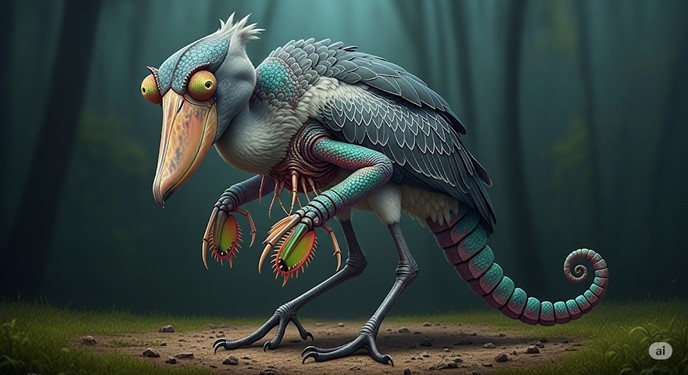
Adventurers in the world of Saṃsaˉra might find themselves in conflict with a Stomatoleo-Bombardeus 817 through two primary avenues: deliberate searching motivated by a specific goal, or accidental encounters while pursuing other objectives.
Reasons for Searching
Parties of adventurers would actively seek out one of these formidable creatures when the potential reward outweighs the extreme risk involved. Such quests are not undertaken lightly and are typically commissioned by wealthy or powerful patrons who require the unique biological components that only the creature possesses.
- Alchemical and Artificer Commissions: A high-ranking alchemist in a metropolis like a floating city or a megacity in a dark cave system might post a bounty for the fresh caustic glands of a Stomatoleo-Bombardeus. The volatile, magically-catalyzed chemicals within these glands are irreplaceable reagents for creating legendary-tier corrosive acids, potent chemical explosives, or catalysts for complex magical transmutations. Similarly, an artificer specializing in optics or scrying might pay a near-priceless sum for the creature’s eyes. The unique, multi-faceted lenses, capable of perceiving a wide spectrum of light and ambient magic, are essential for constructing scrying devices of unparalleled clarity or helmets that grant the wearer panoramic, magically-enhanced vision. In these scenarios, the party is hired as specialized exterminators, often provided with detailed information on a rumored lair and a contract that stipulates the components must be harvested with care.
- Masterwork Armor and Weapon Crafting: A master armorer, seeking to create a signature piece for a noble, guild master, or even for one of the adventurers, would require the creature’s chromophoric carapace. When properly treated, this chitin retains its light-warping properties, allowing for the creation of stealth armor that actively blends with its environment. Likewise, the dense, impact-resistant chitin from the creature’s raptorial clubs is a legendary material for forging the heads of warhammers and maces, or for creating shields that can absorb devastating amounts of kinetic energy. The quest would involve hunting the beast specifically to harvest these parts, a task requiring immense martial prowess to defeat the creature without shattering the very materials they seek.
- Tests of Worth and Rites of Passage: A party might search for a Stomatoleo-Bombardeus not for monetary gain, but to earn favor or knowledge. A reclusive sage or skills master might demand that the adventurers prove their skill, teamwork, and courage by hunting one of these apex predators and returning with a trophy, such as its intact beak or a raptorial club. Defeating such a foe would demonstrate the party’s worthiness to receive secret training or vital information. In other cases, the party might be aiding an ally who belongs to a remote jungle or swamp-dwelling culture where slaying a Stomatoleo-Bombardeus is a rite of passage for leadership. Success in this hunt would secure a powerful political alliance or the unwavering loyalty of that community.
Reasons for Encountering
Accidental encounters with a Stomatoleo-Bombardeus are often more dangerous than planned hunts, as the adventurers are typically unprepared for the specific threat it poses.
- Trespassing on Hunting Grounds: The most common accidental encounter occurs when a party is simply traveling through the creature’s domain. Jungles and swamps are major arteries for trade and travel between the island nations of Saṃsaˉra. A party escorting a steam-driven caravan, charting a forgotten path to ancient ruins, or pursuing an unrelated bounty might unknowingly wander into the vast territory claimed by one of the creatures. The encounter would not begin with a roar, but with silence. A member at the rear of the formation might vanish without a sound, or a pack animal might suddenly collapse with its armored flank caved in. The party would realize they are being stalked by an invisible hunter, turning their journey into a tense battle for survival against a foe that has every advantage in its home environment.
- Lured into a Trap: Cunning enemies could use the creature’s known territoriality as a weapon. A rival adventuring party or a savvy bandit leader, when pursued, might intentionally flee into a swamp they know is the lair of a Stomatoleo-Bombardeus. They would use their knowledge of the terrain to navigate the edges of its hunting grounds while the pursuing party, unfamiliar with the danger, plunges straight into it. This creates a deadly three-way conflict where the adventurers must simultaneously fight, evade, or outsmart their original quarry while also dealing with the sudden, violent appearance of the territorial apex predator.
- Disturbing a Lair: Many of the ancient ruins and deep, unexplored cave systems that dot the world of Saṃsaˉra offer perfect habitats for a Stomatoleo-Bombardeus. A party delving into such a location in search of forgotten lore or treasure might inadvertently choose an active lair for their base camp. The light from their magical torches, the noise of their exploration, and their very presence could be enough to disturb the creature. In this scenario, the adventurers would face the beast not while it is hunting, but while it is aggressively defending its home. The confined spaces of a ruin or cave system would prevent easy escape and could be used by the creature to its advantage, turning the environment itself into a weapon.
Beyond the primary components like the carapace and raptorial clubs, nearly every part of a Stomatoleo-Bombardeus 817 corpse can be harvested and repurposed by skilled individuals, making the successful hunt of one a highly lucrative endeavor.
Crushing Beak Powder The massive, bone-heavy beak is more than just a trophy. While the intact beak can be fashioned into a wicked, armor-piercing pick or the core of a shield boss, its true value to alchemists is when it is painstakingly ground into a fine, dense powder. This Crushing Beak Powder is a key ingredient in potent elixirs of strength. When consumed, these elixirs grant a temporary but significant boost to physical might, allowing the user to bypass the natural armor of other creatures or shatter stone with their blows. It is also used in the forging process of certain weapons, infused into the metal to give the final product an innate quality that weakens the durability of armor it strikes.
Prehensile Tongue Sinew Inherited from its chameleon ancestry, the creature’s tongue is an incredibly long and muscular organ. The sinew, once harvested and properly cured, is a material of unparalleled tensile strength and elasticity. This Prehensile Tongue Sinew is highly prized by bowyers for creating bowstrings that allow for a faster, more powerful release than any wooden or gut-string equivalent. Artificers and engineers also seek it out for use in the mechanisms of complex traps, the pulley systems of steam-powered cranes, and as shock-absorbing cords within the chassis of racing airships.
Volatile Hemolymph The creature does not have blood in the common sense, but a copper-based hemolymph that circulates through its body, carrying oxygen and magical energy. This shimmering, teal-colored fluid is highly unstable. When exposed to air, it effervesces violently for a few moments before degrading into a useless, inert sludge. If an alchemist can draw and stabilize the Volatile Hemolymph within seconds of its exposure, it serves as a powerful, short-lived magical catalyst. A few drops can drastically speed up alchemical reactions or temporarily overcharge a magic circuit. In its stabilized form, it is sometimes used as a fuel for specialized lanterns that burn with a silent, hypnotic, multi-colored light.
Coordinating Ganglion To manage its independent eyes, its rapid camouflage, and its lightning-fast raptorial strikes, the creature possesses a uniquely complex neural cluster at the base of its brain. This Coordinating Ganglion is a marvel of biological engineering. Enchanters can carefully extract and preserve this organ to embed it within helmets or circlets. Such items grant the wearer enhanced processing speed and a sort of mental multitasking ability, allowing them to track multiple opponents on a battlefield or simultaneously read text while remaining aware of their surroundings. Less scrupulous artificers integrate these ganglia into the control modules of steam-automatons, granting them a degree of autonomy and reaction speed that mimics a living creature.
Gripping Tail Hide The hide from the creature’s long, prehensile tail is distinct from its main carapace. It is covered in fine, unidirectional ridges that give it an exceptional grip, much like the pads of a gecko’s feet. This Gripping Tail Hide is tanned and used to create non-slip grips for weapons and complex tools, ensuring perfect handling even when wet or slick with blood. It is also fashioned into superior climbing gear, gloves, and boot soles for adventurers who specialize in vertical movement. In a more brutish application, the entire hide can be turned into a formidable, flaying whip.
Resonant Internal Chitin Lining the creature’s chest cavity are thin, overlapping plates of internal chitin that protect its organs. These plates have a unique crystalline structure that causes them to vibrate in response to magical or sonic frequencies. This Resonant Internal Chitin is harvested by bards and instrument makers to create one-of-a-kind instruments, whose tones are said to be both beautiful and deeply unsettling, capable of producing magical effects. More practically, engineers use these plates as sensitive diaphragms in long-range listening devices or as focusing components in sonic-based weaponry used to disorient foes.
Petrified Yolk Dust The unfertilized eggs of the creature, if they can be found in a nest, are a rare prize. The yolk within is a dense concentration of proteins, lipids, and raw magical energy. If the egg is carefully drilled and the yolk is drained and desiccated, it forms a hard, amber-like substance. This is then ground into Petrified Yolk Dust. As a primary ingredient in the most powerful healing salves, this dust promotes incredible regenerative properties, allowing wounds to close in minutes rather than days and even encouraging the slow regrowth of nerve tissue.
Dominance Pheromone Glands The glands used by females to attract mates can be harvested from their corpses. The potent Dominance Pheromones within can be distilled and bottled. In their raw form, they act as an irresistible lure for other Stomatoleo-Bombardeus and can attract other, lesser predators as well, making them useful for trappers or for creating diversions. When artfully diluted by a master perfumer, these pheromones can be blended into elixirs or perfumes that grant the wearer an aura of authority and unsettling presence, giving them a distinct edge in negotiations, interrogations, and other matters of political intrigue.
Chronicle of Stillness That Shatters
In the before-times, when the land of Saṃsaˉra was younger in its memory, there was a village whose feet were always wet. It stood at the edge of the Whispering Marsh, a place of tall reeds and dark water. And to this village came a great badness. It was a sorrow that had a shape.
At first, a hunter was gone. He went to check his snares and did not make a return. Then, a woman washing clothes at the water’s edge was taken; only her basket remained, floating. The people felt a fear. It was a cold fear, like the mud of the deep marsh. They spoke of a demon, a spirit of the swamp. But the elder, whose eyes had seen many seasons pass, said it was no spirit. It was a beast. A creature whose name was like the cracking of stone, but the people came to call it the Stillness That Shatters. For it would be unseen, a perfect stillness in the reeds and shadows, and then there would be a sound like rock breaking bone, and a life would be ended.
The village heads gathered. Their faces were grim. They said, this beast is a doom upon us. We must send our warriors. But the warriors went into the marsh, and they found nothing. They saw only trees and water and mist. Yet when they returned, one was always missing from their number. The Stillness That Shatters took them from the back of the line, from the edge of the firelight, and no one saw its coming.
There lived in the village a man called Fen-Walker. His heart was strong like woven roots, and his eyes knew how to read the water and the wind. He was not a warrior of great renown, but a hunter of great patience. Fen-Walker saw the sorrow of his people, and he went before the village heads. He spoke words. “The warriors look for a beast to fight. Their eyes are loud. This thing is not fought with loud eyes. It is a quiet thing, until it is not quiet. I will go. This badness I will face.”
The elders gave him their blessing, for they had no other choice. But Fen-Walker did not take up a great axe or a heavy spear. He went to the smith and asked for a shield. Not a large shield for stopping arrows, but a round shield, and its face was to be polished until it held the sun. For three days the smith worked, and the shield was made bright like a captured piece of daylight. Fen-Walker also took a small spear, its point sharpened from the tooth of a great river fish.
He walked the wet paths into the Whispering Marsh. The paths knew him. He did not look for the beast. No. He looked for the place where the world was wrong. He held the bright shield low, watching its shining face. In it, the world was a bent copy. He saw the reeds, the dark water, the hanging moss. For a day he walked, and then another. He ate little. He slept less. He became a quiet thing, like the marsh itself.
On the third day, he saw it. In the bright shield, he saw a patch of reeds that moved when the wind did not move them. He saw the air bend, like heat over a fire. He saw a piece of the world that was not real. He stopped. His heart was a drum, but his hands were steady. He knew. The Stillness That Shatters was there, but it was not there. It wore the skin of the world.
Slowly, so slowly, he turned. The beast was before him, twenty paces away. It was a horror. Its head was a great crushing maw, like the river birds that swallow fish whole. Its body was of segmented shell, and it shifted with colors, showing him the trees behind it. Its eyes, like two horns, looked at him and also past him. Two heavy arms, like stone-fists, were held tight to its chest.
It knew he saw it. The colors on its back stopped shifting and became the dark green of pure anger. And the stone-fists came. The sound was the end of things. Fen-Walker was not there. He had already thrown himself to the side, into the deep mud. One of the fists hit the great cypress tree where he had stood, and the old wood exploded into splinters.
Fen-Walker scrambled up, his spear held ready. The beast turned, its strange tail like a coiled serpent giving it balance. It let out a hot breath from its hind-parts, a steaming cloud that hissed and stank of poison. Fen-Walker raised his bright shield, and the hot mist struck it, turning the polished metal black and dull. But the shield held.
The beast charged, its two legs tearing through the mud. It was a thing of impossible speed. It swung its great head, the crushing maw open to snap Fen-Walker in two. He was too close to flee. He did the only thing he could. He held up the shield, not to block, but to show.
He showed the beast its own face in the bright shield.
For the first time in its long life, the Stillness That Shatters saw itself. It saw a monster. It saw the great beak, the mad eyes, the killing arms. It did not understand. Its feral mind, made for hunting and killing, was for one moment, two minds. It saw the hunter before it, and it saw the beast in the shield. It paused. A heartbeat of not-knowing.
In that moment of not-knowing, Fen-Walker made his strike. He did not aim for the hard shell or the stone-fists. He lunged beneath the great crushing maw and thrust his small spear, with all his strength, into one of the strange, searching eyes.
A screech tore through the marsh, a sound that was not stillness and not shattering, but only pain. The beast thrashed, its stone-fists striking blindly. Fen-Walker was already gone, scrambling back into the reeds he knew so well. The great creature stumbled, its balance lost, and fell with a final crash into the dark water, its one good eye staring at a world it no longer understood. The great badness was ended. The village gave Fen-Walker much honor, and his name was known for all the now-times that followed.
The Moral: To see a monster, you must not look for the monster. You must look for the space in the world where the world is not right.
Suggested conversions to other systems:
Call of Cthulhu (7th Edition)
The Prismatic Stalker A territorial predator from the sodden, forgotten parts of the world, its biology is an affront to terrestrial evolution. Its very presence warps the observer’s sense of reality, and its speed is preternatural.
STR 90 CON 100 SIZ 90 DEX 85 INT 45 POW 75 HP: 19 Dmg. Bonus: +2d6 Build: 3 Move: 8
Attacks
- Attacks per round: 2 (may use any combination of Bludgeoning Pseudopod or Crushing Beak)
- Bludgeoning Pseudopod: 75%, damage 1d10+DB. These strikes are impossibly fast, often appearing as a blur of motion followed by the sound of impact.
- Crushing Beak: 50%, damage 1d10+4+DB. This attack can punch through cover and armor. When damaging an Investigator, it may also destroy one piece of their gear on a successful hit (Investigator’s choice).
- Caustic Geyser: Can be used once per combat encounter. The Stalker expels a 20-yard cone of boiling chemicals from its abdomen. Anyone in the area must make a Dodge roll. Failure results in 2d8 points of damage and the ruin of one item carried (e.g., a firearm jams permanently, a book dissolves). Success halves the damage and saves the item.
Skills
- Stealth: 90%
- Dodge: 45%
- Spot Hidden: 75%
Armor: 6-point chitinous carapace. Sanity Loss: 1/1d8 SAN to see the Prismatic Stalker for the first time. Witnessing its Bludgeoning Pseudopod strike shatter a person or large object costs 0/1d4 SAN.
Blades in the Dark
The Still-Water Horror A whisper from the deathlands that has somehow made its lair in the forgotten waterways and cisterns beneath the city. It is not just a beast, but a living embodiment of silent, sudden violence. It doesn’t hunt for food, it hunts to eradicate anything that isn’t itself.
Threat Level: Tier IV Instinct: To eliminate all trespassers with absolute efficiency. Description: A large, chitinous horror that becomes the scenery it stands against. Its hammer-like fists shatter brick and bone with equal ease. It is a solitary creature of terrifying patience and explosive violence.
Mechanics of the Horror:
- It cannot be reliably targeted until its camouflage is broken. An Attune roll might sense the wrongness of its presence, or a Survey roll might spot a distortion in the environment. Both are Desperate actions.
- When the Horror reveals itself, all who witness it must make a Resolve roll or suffer 2 Stress.
- Its attacks are a severe consequence, not just damage. A hit from its Shattering Blows ignores 2 levels of armor and inflicts Level 3 Harm (e.g., “Shattered Arm,” “Caved-in Ribs”).
- Its Caustic Mist creates a hazardous zone. Entering or starting your turn within it requires a Prowess roll to resist taking Level 2 Harm (“Chemical Burns”) and having an item destroyed.
Clocks:
- Sense Intrusion (8-Clock): This clock fills as the crew makes noise or disturbs the Horror’s lair. When full, it ambushes with Great Effect.
- Eradicate Target (6-Clock): When it strikes, it focuses on one person. Mark 2 ticks on this clock for a successful hit. When full, that person is cornered and about to be finished off unless the crew intervenes.
- Driven From its Lair (10-Clock): The crew cannot kill the Horror through simple violence. To survive, they must fill this clock by inflicting harm (2 ticks), destroying a key feature of its lair (3 ticks), or exploiting its nature with weird powers (tick progression determined by the GM).
Dungeons & Dragons (5th Edition)
Chameleonic Stomapode Large monstrosity, unaligned
Armor Class 18 (natural armor) Hit Points 152 (16d10 + 64) Speed 30 ft., swim 30 ft.
STR 20 (+5) DEX 16 (+3) CON 18 (+4) INT 5 (-3) WIS 14 (+2) CHA 7 (-2)
Saving Throws CON +8, WIS +6 Skills Perception +6, Stealth +11 Damage Resistances bludgeoning Senses blindsight 30 ft., darkvision 60 ft., passive Perception 16 Languages — Challenge 11 (7,200 XP) Proficiency Bonus +4
Chameleonic Carapace. The stomapode has advantage on Dexterity (Stealth) checks made to hide. As a bonus action, it can attempt to hide. It is considered invisible while hidden.
Siege Monster. The stomapode deals double damage to objects and structures.
Actions Multiattack. The stomapode makes three attacks: two with its Stomping Clubs and one with its Crushing Beak.
Stomping Club. Melee Weapon Attack: +9 to hit, reach 10 ft., one target. Hit: 18 (2d12 + 5) bludgeoning damage.
Crushing Beak. Melee Weapon Attack: +9 to hit, reach 5 ft., one target. Hit: 16 (2d10 + 5) piercing damage. If the target is a creature, it must succeed on a DC 17 Strength saving throw or be knocked prone.
Caustic Spray (Recharge 5–6). The stomapode exhales acid in a 30-foot cone. Each creature in that area must make a DC 16 Dexterity saving throw, taking 35 (10d6) acid damage on a failed save, or half as much damage on a successful one. A creature that fails its save also has its nonmagical armor damaged, suffering a permanent and cumulative -1 penalty to the AC it offers. The armor is destroyed if the penalty reduces its AC to 10.
Knave (2nd Edition)
The Fen Strider An apex predator of the swamps and ancient ruins. It appears as a man-sized, bipedal fusion of insect, bird, and reptile. It is a patient hunter that blends perfectly into its surroundings before attacking with explosive force.
HD 10 Armor 16 Morale 10
Qualities:
- Perfect Camouflage: The Strider is invisible until it attacks or takes damage. Spotting it beforehand requires a successful Wisdom save at a disadvantage, and only if the player describes a clever method of detection (e.g., watching for distortions, using a polished mirror to scan the area).
- Territorial Imperative: If adventurers attempt to flee after combat has begun, its Morale increases to 12.
- Valuable Corpse: Its parts are worth 3d6 x 1000s to interested buyers.
Actions (d6 roll on its turn):
- Vanish: The Strider uses its camouflage to become invisible and moves to a new strategic location. It cannot be targeted directly until its next action.
- Crushing Beak: Makes a single attack against one PC for 3d6 damage. If this attack hits, the target’s shield (if any) is shattered. If they have no shield, their torso armor is ruined.
- Caustic Geyser: Sprays a 30ft cone. All PCs in the area must save vs. Hazard or take 2d10 damage. Any PC who fails this save has one random item in their inventory destroyed by corrosion.
- Shattering Flurry: Makes two Club attacks against one or two different PCs. Each attack deals 2d8 damage.
- Shattering Flurry: Makes two Club attacks against one or two different PCs. Each attack deals 2d8 damage.
- Stalker’s Focus: The Strider focuses on the PC with the lowest HP. Its next attack against that PC is made with advantage and deals maximum damage.
Fate Core System
The Stillness That Shatters This creature is a living paradox, an entity of absolute patience that explodes into absolute violence. It is less a creature and more a force of nature within its own territory, a blind spot in the world that suddenly and brutally makes itself known.
High Concept: Apex Ambush Predator Trouble Aspect: Territorially Blinded by Rage
Other Aspects:
- Wears the World as a Cloak
- Fists Faster Than Sight
- Armor of Living Chitin
Skills
- Peak (+5): Stealth
- Great (+4): Fight, Physique
- Good (+3): Athletics, Notice
- Fair (+2): Provoke
- Average (+1): Will
Stunts
- Perfect Camouflage: Because it Wears the World as a Cloak, it gains a +2 bonus when it uses Stealth to create the advantage Perfectly Hidden. It can do this even without cover, blending into the environment itself.
- Shattering Blows: Because its Fists are Faster Than Sight, once per scene when it succeeds with style on a Fight attack, it can choose to inflict a second consequence of the same severity on its target instead of taking a boost.
- Caustic Mist: Once per conflict, it can use Physique to attack every target in its zone. This is a special attack that creates a zone aspect called Corrosive Haze with one free invocation, in addition to any damage dealt.
Stress: Physical [1][1][1] Mental [1][1] Consequences: One Mild, one Moderate, one Severe.
Numenera & Cypher System
The Chromatic Render A biomechanical predator, possibly a relic of a prior world’s failed terraforming efforts or an invasive species from another dimension. It hunts with an unnatural intelligence, its body a fusion of hyper-advanced materials and savage biology.
Level: 7 Motive: To hunt, kill, and secure its territory. Environment: Swamps, humid jungles, and flooded, overgrown ruins. Health: 21 Damage: 7 points. Armor: 3 Movement: Short
Modifications:
- Stealth as level 9 due to its active light-bending camouflage.
- Perception as level 8 due to its panoramic, multi-spectrum eyes.
Combat:
- The Chromatic Render is invisible until it makes an attack. Afterwards, it can use its action to become invisible again. A GM Intrusion might dictate that an adventurer completely loses track of the creature, which then makes its next attack against that character with a two-step bonus (as level 9).
- Shattering Strike: The Render can make a focused attack with its clubs. This is a level 8 attack that inflicts 9 points of damage. A character who takes damage from this attack also has one of their assets (a weapon, a piece of armor, or a cypher) rendered useless until it can be repaired (a level 5 task).
- Caustic Jet: As its action, the Render can douse a short-range area in acid. Any character in that area takes 5 points of ambient damage that ignores Armor.
- GM Intrusion: The creature’s prehensile tail lashes out, grabbing a character and pulling them off balance. They are hindered, and all their actions are at a one-step penalty until they can use their action to free themselves with a successful Might-based task.
Loot: The creature’s corpse is a treasure trove of biotech components. It yields 1d6 oddities, a random cypher, and its carapace plates can be used as the primary material for crafting an artifact shield that grants the user +2 Armor and the ability to become invisible for one minute once per day.
Pathfinder (2nd Edition)
Stomatopode Lurker – Creature 11 RARE – N – LARGE – BEAST
Perception +23; all-around vision, scent (imprecise) 60 feet Skills Acrobatics +21, Athletics +24, Stealth +25 Str +7, Dex +6, Con +5, Int -4, Wis +6, Cha -2
All-Around Vision The stomatopode lurker’s independently moving eyes allow it to see in all directions at once, preventing it from being flanked.
AC 31; Fort +22, Ref +23, Will +19 HP 215 Resistances bludgeoning 10
Reactive Camouflage [reaction] Trigger The lurker is targeted by an attack or becomes the subject of a hostile spell. Effect The lurker’s skin shifts to perfectly match its surroundings. It uses the Hide action, then can Stride up to half its speed. It is concealed until the start of its next turn.
Speed 35 feet, swim 35 feet
Melee [one-action] Club +24 (forceful, reach 10 feet), Damage 2d12+13 bludgeoning Melee [one-action] Beak +24, Damage 2d10+13 piercing
Sudden Flurry [two-actions] The lurker makes two Club Strikes against a single target. Its multiple attack penalty does not increase until after both attacks are made.
Caustic Spray [two-actions] (acid, evocation, primal) The lurker exhales a 30-foot cone of acid. Each creature in the cone takes 12d6 acid damage (DC 30 basic Reflex save).
Perfect Camouflage The stomatopode lurker can use the Hide action even when it is only in natural terrain, without needing any cover or concealment.
Savage Worlds Adventure Edition
Swamp-Stalker A legendary monster that is spoken of in hushed tones by those who live near the great swamps. It is described as a walking nightmare that appears from nowhere, shatters its victims with blindingly fast strikes, and vanishes back into the scenery.
Attributes: Agility d10, Smarts d6(A), Spirit d8, Strength d12+1, Vigor d12 Skills: Athletics d10, Fighting d12, Notice d10, Stealth d12, Swimming d8 Pace: 6; Parry: 8; Toughness: 17 (5)
Edges: Ambidextrous, First Strike, Frenzy (Improved)
Special Abilities:
- Armor +5: Heavy, biological chitin plating.
- All-Around Vision: The stalker has 360-degree vision. It ignores Gang Up bonuses.
- Bludgeoning Clubs: Str+d8, AP 2, Reach 1″.
- Caustic Spray: Once per encounter as an action, can use the Cone Template. Anyone touched must make an Agility roll or become Vulnerable and take 2d10 damage.
- Perfect Camouflage: In natural terrain, the stalker is effectively invisible. Attackers must make a Notice roll at -4 to target it with a ranged attack or spell. This penalty is removed for one round after the stalker attacks. Melee attackers do not suffer this penalty but cannot Gang Up on it unless its camouflage is somehow negated.
- Size 4 (Large): Attackers gain +2 to attack rolls against the stalker due to its size. Its Toughness is increased by 4.
- Wild Card: The Swamp-Stalker is a Wild Card and uses a Wild Die. It may also be given Bennies by the Game Master.
Shadowrun (6th Edition)
Chimeric Basin Stalker This highly territorial paracritter is a terrifying example of an awakened predator that has carved out a niche in magically active swamps and overgrown urban ruins. Corporate xenobiologists theorize it’s a bizarrely stabilized mutation or a creature that has crossed over from a metaplane of savage predation. It is known for its ability to become completely invisible in its native environment before striking with enough force to pulp reinforced concrete.
Attributes
- Body: 8
- Agility: 6
- Reaction: 6
- Strength: 9
- Willpower: 5
- Logic: 2(A)
- Intuition: 5
- Charisma: 3
- Edge: 6
- Essence: 6.0
- Magic: 6
Derived Stats
- Initiative: 11 + 2D6
- Physical Condition Monitor: 12
- Stun Condition Monitor: 11
- Hardened Armor: 12
Skills: Athletics 5, Close Combat (Clubs) 7, Exotic Ranged Weapon (Corrosive Spit) 5, Perception 5, Stealth 8, Unarmed Combat (Beak) 7.
Powers & Qualities
- Critter Power (Corrosive Spit): Ranged attack, DV 8P, AP -3. If this attack deals damage, the target’s armor is permanently reduced by 1.
- Critter Power (Guard): When defending its designated lair, the stalker gains 1 point of Edge at the start of each Combat Round.
- Critter Power (Hardened Armor): Provides 12 points of Hardened Armor.
- Natural Weapon (Clubs): DV (STR/2)+2P = 7P, AP -2.
- Natural Weapon (Beak): DV (STR/2)+3P = 8P, AP -4.
- Awakened Power (Camouflage): The stalker can change its skin color and texture at will. This provides a +4 dice pool bonus to all Stealth tests.
- Quality (Enhanced Senses: 360-Degree Vision): The stalker has panoramic vision and cannot be surprised.
Starfinder
Stomatoid Ambusher – CR 11 XP 12,800 N Large magical beast Init +5; Senses all-around vision, darkvision 60 ft., low-light vision; Perception +20 Aura frightful presence (60 ft., DC 20)
Defense
- EAC 24; KAC 26
- HP 195; RP 5
- Fort +15; Ref +15; Will +12
- Defensive Abilities reactive camouflage
Offense
- Speed 40 ft., swim 30 ft.
- Melee club +24 (3d10+18 B; critical knockdown) or beak +24 (3d8+18 P)
- Multiattack club +18 (3d10+18 B), club +18 (3d10+18 B), beak +18 (3d8+18 P)
- Ranged caustic spray +21 (30-ft. cone, 12d6 A, Reflex DC 20 half)
Statistics
- STR +7; DEX +5; CON +4; INT -3; WIS +2; CHA -1
- Skills Athletics +25, Stealth +20
Special Abilities
- All-Around Vision (Ex) The stomatoid’s independently rotating eyes grant it panoramic vision. It cannot be flanked.
- Perfect Camouflage (Ex) A stomatoid can use the Stealth skill to hide, even if it has no cover or concealment. While hidden in this way, it is treated as if it had total concealment (50% miss chance).
- Reactive Camouflage (Ex) As a reaction when targeted by an attack, the stomatoid can activate a light-warping field around its body. It gains the effects of the displacement spell for 1 round. It can use this ability three times per day.
Traveller (Mongoose 2nd Edition)
Swamp Predator (Chameleoline-Alpha) This creature is an ambush predator found in the dense, wet environments of worlds with a robust and competitive ecosystem. It is a solitary hunter, establishing a territory several square kilometers in size and ruthlessly eliminating any creature large enough to be considered a competitor. Its most dangerous trait is its near-perfect active camouflage, making electronic detection difficult and visual confirmation nearly impossible before it strikes.
STATS: 12A9A9-C A-12 2 Age(10), Armour(6), Camo(4), Fear(2), Natural Weapon(Clubs/Beak), Recon(4), Size(12), Walker
- STR 12 (+3), DEX 10 (+2), END 9 (+2)
- Skills: Athletics (DEX) 2, Fighting (Unarmed) 3, Recon (INT) 4, Stealth (DEX) 4, Survival (INT) 3
- Attacks: 2 per round
- Damage (Clubs): 4D, AP 2
- Damage (Beak): 5D, AP 4
- Armour: 6 points of natural chitin.
- Health: 31 (Sum of physical stats)
Traits & Behavior:
- Camouflage: Its hide shifts color and texture, granting DM +4 to any Stealth checks.
- Fear: Any character first encountering the creature must make a Willpower check (8+) or suffer DM -2 to all actions for the remainder of the encounter.
- Ambush: If the creature attacks from hiding, its first attack is made at DM +4.
- Caustic Spray: Once per encounter, the creature can spray a 6-meter cone with corrosive enzymes. Anyone caught in the cone must make an Average (8+) Dexterity check to dive for cover. Failure results in 3D damage and the target’s armor is permanently degraded by 1D3 points.
- Solitary: These creatures are always encountered alone. Evidence of one indicates that no others will be in the immediate area.
Warhammer Fantasy Roleplay (4th Edition)
Fenland Mire-Stalker A monstrous beast of the deep fens and misty riverlands, the Mire-Stalker is a thing of nightmare made flesh. The few who have seen one and lived speak of a creature that wears the swamp as a cloak, its shape only a shimmering distortion in the air before it erupts into a flurry of bone-shattering blows. The Cult of Sigmar denounces it as a beast of Chaos, while Imperial naturalists claim it is simply a cunning and oversized predator from a bygone age.
Profile | WS | BS | S | T | I | Ag | Dex | Int | WP | Fel | | :–: | :–: | :–: | :–: | :–: | :–: | :–: | :–: | :–: | :–: | | 65 | 45 | 55 | 65 | 50 | 45 | 30 | 25 | 50 | 10 |
Skills: Athletics 55, Climb 65, Endurance 80, Melee (Basic) 75, Perception 70, Ranged (Corrosive Spit) 55, Stealth (Rural) 75 Talents: Ambidextrous 2, Armour Piercing 2 (Beak), Combat Reflexes, Fear 2, Hardy, Relentless, Strike Mighty Blow 2 Traits: Armour (Body, Head) 4, Bite (Beak) +10, Corrosive Spit, Fear 2, Size (Large), Stomp (Clubs) +9 (x2), Swamp-Strider, 360-Vision, Ward (Camouflage) 3+, Weapon +9 Wounds: 64
Attacks
- Hammering Clubs (x2): WS 65, Damage S(5)+4=9.
- Crushing Beak: WS 65, Damage S(5)+4=9. Has Armour Piercing Trait.
- Corrosive Spit: BS 45, Range 10 yards, Cone Template. Creatures hit suffer a Damage 10 Hit with the Damaging and Unreliable Qualities. The Mire-Stalker can only use this attack once every 1d3 rounds.
Special Rules
- 360-Vision: Cannot be Surprised by enemies in stealth and gains no penalties for being outnumbered.
- Swamp-Strider: Suffers no movement penalties for moving through mud, marsh, or other difficult swamp terrain.
- Ward (Camouflage) 3+: While in natural terrain (swamps, forests, etc.), the Mire-Stalker has a 3+ Ward Save against all incoming damage. This Ward is lost for one round if it takes damage from a source with the Fiery or Magical quality.